Tag: health

  • “Fresh Press” on the Loveland Bike Trail: Grand Opening April 21st

    “Fresh Press” on the Loveland Bike Trail: Grand Opening April 21st

    Advertisement

    We knew, we only wanted to open a restaurant that would benefit our community and be an asset to people’s health. We also wanted a place where people could find food to match their healthy lifestyles as well as feel welcome despite any dietary restrictions. So we found this  beautiful 147 year old home on the Loveland Bike Trail, bought it, and hired our Uncle to general contract his first commercial job for Fresh Press. Over a year later, and we have opened our doors and are happy to be a part of this community!
    COFFEEFOODSMOOTHIES

    View our MENU and the MAP to find us.

    Visit our Facebook Page


  • Clermont County Community Alternative Sentencing Center will soon admit women

    Clermont County Community Alternative Sentencing Center will soon admit women

    Bativia, Ohio – Clermont County Commissioners approved on July 12 the expansion of the Community Alternative Sentencing Center (CASC) to serve women. The CASC, which has been open since September 2015 under the management of Greater Cincinnati Behavioral Health Systems, provides an alternative to jail for misdemeanants who are convicted of drug- or alcohol-related crimes.

    Clermont County will start admitting women to the CASC as of Sept. 1.

    Now, thanks to a grant from the federal 21st Century Cures Act, Clermont County will start admitting women to the CASC as of Sept. 1, said BCC President David Uible. “This will allow us to address a gap in our attempts to address this crisis. We have wanted to offer this treatment alternative to women, and the grant will allow us to do so.”

    Under the Cures Act, $26 million was allocated to the State of Ohio to fight the opioid epidemic. Clermont County, as one of the top 15 counties in the state most affected by the crisis, was given priority in the grant process, according to Karen Scherra, Executive Director of the Clermont County Mental Health & Recovery Board (CCMHRB), who led the application for the grant.

    CCMHRB is receiving approximately $418,000 in the first year of the grant and up to $700,000 in the second year, which is being provided to the County to fund the CASC program. By the second year, the county hopes to serve up to 25 women in the pod. Medication-assisted treatment will be emphasized, Scherra said.

    The CASC, which operates in a wing of the County Jail, will operate its women’s pod completely separated from the men’s.

    The CASC, which operates in a wing of the County Jail, will operate its women’s pod completely separated from the men’s. The new staff will include an admissions coordinator, three counselors, three aides, a part-time employment specialist, and a recovery coach. It will also include dedicated hours from a physician and nurse.

    The Community Alternative Sentencing Center – the only one in the State of Ohio – is a voluntary program. Municipal Court judges refer misdemeanants to the CASC if they think they will be good candidates for treatment as opposed to incarceration. Since it began operating under the management of Greater Cincinnati Behavioral Health, the CASC has admitted 378 men. Of those 307 have successfully completed the program, with many transitioning into continued services and supports in the community.


    Rick Ogden Heating & Air Conditioning

    Installation and maintenance of heating and cooling systems in Loveland, Ohio Rick Ogden Heating & Air Conditioning is a family owned company.



  • Air quality alert continues into Thursday

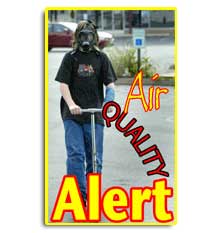
    Air quality alert continues into Thursday

    It will take action by each of us to lower the risk to our children


    Loveland, Ohio – The Southwest Ohio Air Quality Agency has issued an Air Quality Advisory for Thursday, July 19 for Loveland. and the surrounding counties of Butler, Clermont, Hamilton and Warren in Ohio, and Boone, Campbell and Kenton counties in Kentucky. 


    The Agency expects to see levels of ozone in the “unhealthy for sensitive groups” range on the Air Quality Index (AQI). 


    Health Message: Active children and adults, and people with lung disease, such as asthma, should reduce prolonged or heavy exertion outdoors.


    On Air Quality Advisory days, everyone can help reduce ozone formation by taking the following actions:

    • Bike, or walk instead of drive.
    • Refuel your vehicle after 8 p.m.; do not top off when refueling and tighten the gas cap.
    • DON’T RIDE YOUR MOTORCYCLE
    • Do not idle your vehicle; exhaust contributes considerably to ozone formation.
    • Combine trips or eliminating unnecessary vehicle trips.
    • Avoid use of gasoline-powered lawn equipment on Air Quality Advisory days.
    • Avoid use of oil-based paints and stains on Air Quality Advisory days.
    • Never burn leaves or other yard trimmings.
    • Suspend use of fire pits, campfires and grills on Air Quality Advisory days.
    • Conserve electricity by turning out lights and unplugging unused appliances and electronics.


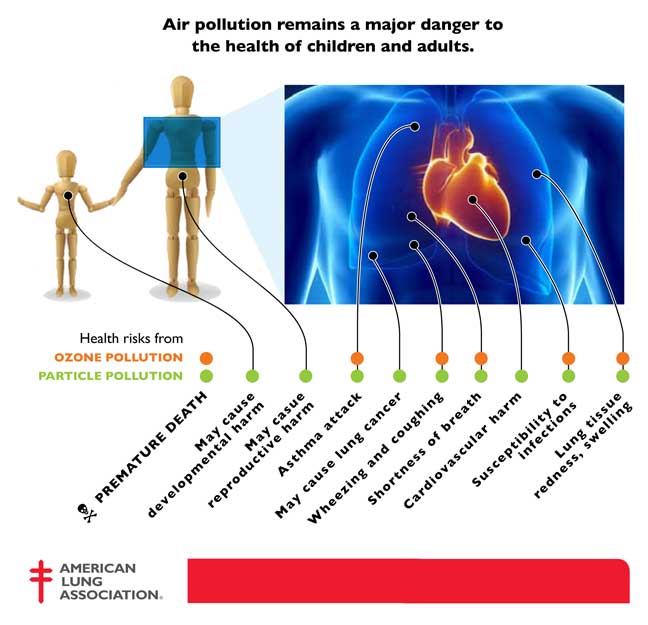
    Children face special risks from air pollution because their lungs are growing and because they are so active Air-pollution-health-dangers

    Just like the arms and legs, the largest portion of a child’s lungs will grow long after he or she is born. Eighty percent of their tiny air sacs develop after birth. Those sacs, called the alveoli, are where the life-sustaining transfer of oxygen to the blood takes place. The lungs and their alveoli aren’t fully grown until children become adults.1 In addition, the body’s defenses that help adults fight off infections are still developing in young bodies.2 Children have more respiratory infections than adults, which also seems to increase their susceptibility to air pollution.

    Furthermore, children don’t behave like adults, and their behavior also affects their vulnerability. They are outside for longer periods and are usually more active when outdoors. Consequently, they inhale more polluted outdoor air than adults typically do.

    Air Pollution Increases Risk of Underdeveloped Lungs

    A Southern California Children’s Health study looked at the long-term effects of particle pollution on teenagers. Tracking 1,759 children who were between ages 10 and 18 from 1993 to 2001, researchers found that those who grew up in more polluted areas face the increased risk of having underdeveloped lungs, which may never recover to their full capacity. The average drop in lung function was 20 percent below what was expected for the child’s age, similar to the impact of growing up in a home with parents who smoked.

    Community health studies are pointing to less obvious, but serious effects from year-round exposure to ozone, especially for children. Scientists followed 500 Yale University students and determined that living just four years in a region with high levels of ozone and related co-pollutants was associated with diminished lung function and frequent reports of respiratory symptoms. 6 A much larger study of 3,300 school children in Southern California found reduced lung function in girls with asthma and boys who spent more time outdoors in areas with high levels of ozone.


    Read more from the American Lung Association

    For 17 years, the American Lung Association has analyzed data from official air quality monitors to compile the State of the Air report. The more you learn about the air you breathe, the more you can protect your health and take steps to make our air cleaner and healthier.

    In American Lung Association’s, Report Card: Ohio, Clermont, Hamilton, and Warren counties all receive an “F”
    Cincinnati Air Quality a Mixed Bag, Finds 2016 ‘State of the Air’ Report


    Step up to Curb Pollution in Our Community.

    • Drive less. Combine trips, walk, bike, carpool or vanpool, and use buses, subways or other alternatives to driving. Vehicle emissions are a major source of air pollution. Support community plans that provide ways to get around that don’t require a car, such as more sidewalks, bike trails and transit systems.
    • Use less electricity.Turn out the lights and use energy-efficient appliances. Generating electricity is one of the biggest sources of pollution, particularly in the eastern United States.
    • Don’t burn wood or trash. Burning firewood and trash is among the largest sources of particle pollution in many parts of the country. If you must use a fireplace or stove for heat, convert your woodstove to natural gas, which has far fewer polluting emissions. Compost and recycle as much as possible and dispose of other waste properly; don’t burn it. Support efforts in your community to ban outdoor burning of construction and yard wastes. Avoid the use of outdoor hydronic heaters, also called outdoor wood boilers, which are frequently much more polluting than woodstoves.
    • Make sure your local school system requires clean school buses, which includes replacing or retrofitting old school buses with filters and other equipment to reduce emissions. Make sure your local schools don’t idle their buses, a step that can immediately reduce emissions.


    Now Enrolling at All About Kids at Wards Corner today!