
Tag: healthcare providers

  • A “Women’s Wave” happened Sunday in Loveland

    A “Women’s Wave” happened Sunday in Loveland

    David Miller is the Managing Editor of Loveland Magazine

    by David Miller

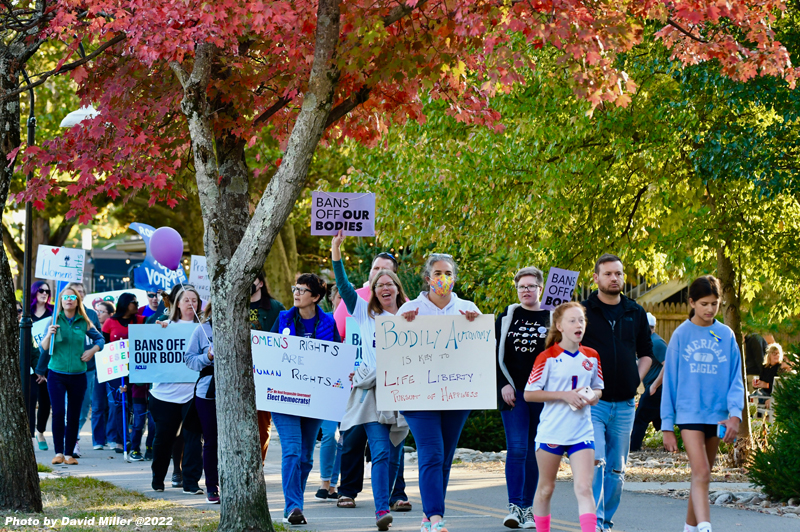
    Loveland, Ohio – Adults and children from across the tri-state gathered in Nisbet Park along the Little Miami River in Historic Downtown on a sunny and warm Fall Sunday afternoon to be part of a “Women’s Wave” of activists out to change the course of voting patterns in our community. After speeches, they walked for an hour throughout our business district and along the Loveland Bike Trail engaging locals and tourists with the refrain of the sentiments they were so adamant about. It was a demonstration for human rights and as odd as that sounded throughout the streets of this quaint community nicknamed, “The Sweetheart of Ohio” it happened. “Human Rights” that have been taken away from themselves, their children, and those they love. The political agenda on most minds was the U.S. Supreme Court overthrowing Roe v Wade and a woman’s right to have an abortion, reproductive rights such as birth control, and how that decision led to even more extreme legislation and proposals from some elected officials at the Ohio Statehouse, and in D.C.

    Health care, including the sometimes life-saving medical care of needed abortions and the tangled net that women and their healthcare providers are caught in, gun violence, mass shooting in schools, the right to gender equality, LGBTQ people’s rights, and a safer future for young girls were all talking points throughout the afternoon.

    Many Democratic candidates for local and state offices spoke and a candidate for the U.S. House. Parts of Loveland are in Ohio Representative Jean Schmidt’s district and the local organizer, Bailey Moak, said that is why she chose downtown Loveland for the event location. She wants to show Schmidt where the unemployment line is. She believes that Schmidt and other currently serving politicians don’t align with Loveland’s values.

    I asked organizer Moak on Monday to send me some of her thoughts after the event had ended. You can also watch her speaking at the event and watch a photo essay of photos from the event below. The rally was certainly an appeal for local “pro-choice” residents to get to the polls on November 8 and vote for “pro-choice” candidates, however, the photo essay will explain why so many people gathered in the park, their myriad reasons, and then marched.

    I found the event to be a huge success. We met our goals to engage and educate voters, raise awareness to threats against women’s rights in our community and shed light on dangerous politicians like Jean Schmidt from Loveland who proposed legislation to ban medical care to women and children across Ohio (HB598), and ban access to curriculum on diversity and inclusion to students across our state (HB616). 
    
    We rallied, we celebrated the promise of what new leadership can do to preserve and expand our freedoms, and we marched in protest of extremism and hate. 
    
    During the March we disrupted some nice family dinners occurring on the patios of local businesses in Downtown Loveland with our passionate demonstration. This disruption is NECESSARY. All too often we side-step important discussions with our families, friends and community members to avoid feeling uncomfortable. The only way individuals, families and communities can grow is through engagement and vulnerability, which can result in a bit of discomfort. As demonstrators passed, families and friends breaking bread together were compelled to address important topics, which in my experience, leads to understanding and connection. 
    
    This is why we Listen. This is why we Speak. This is why we Act. We do it for our communities and families. 
    
    I want to thank our passionate volunteers and our speakers: Brian Flick, Dr. Jeanne Corwin, Dr. Vanessa Enoch, Dr. Nabila Babar, Joy Bennett, Jen Perez and Rep. Jessica Miranda, and our partnering organizations: Ohio Physicians for Reproductive Rights, Ohio ACLU, Ohio Red Wine and Blue, the Ohio Democratic Women’s Caucus and Democracy in Action for participating in this event.
    
    I also want to thank the City of Loveland, the Loveland Fire Department, and Loveland PD Chief, Michael Gabrielson for their support in working with event organizers to ensure this was a safe and successful event that this community can be proud of.
    

  • Ohio Department of Health receives ALL allocated PPE from the Strategic National Stockpile

    Ohio Department of Health receives ALL allocated PPE from the Strategic National Stockpile

    Locally you can donate Personal Protective Equipment HERE

    Columbus, Ohio – A critical part of our state’s effort to contain and stop the spread of coronavirus disease 2019 (COVID-19) is to ensure our healthcare providers, Emergency Medical Services, law enforcement, and long-term care workers have the equipment they need to protect themselves and those they serve.

    “The supplies we received, and the state’s reserve will not meet the immediate or future needs of Ohio’s healthcare providers and first responders,” said ODH Director Amy Acton, M.D., MPH.

    The increase in people with respiratory symptoms visiting hospitals and needing care is straining our healthcare system’s supply of Personal Protective Equipment (PPE). Ohio requested early and has received our shipment of PPE from the Strategic National Stockpile (SNS). PPE includes gowns, gloves, goggles, and masks. Ohio’s allocation of materiel to the locals was informed by the Centers for Disease Control and Prevention guidance on the allocation of critical resources during a pandemic.

    All shipments have been received by ODH and all will be sent to county locations to ensure local PPE needs are met. Here are the total numbers from the SNS:

    Gowns Coveralls Gloves Face
    Shields
    Surgical
    Masks
    N95
    Masks
    SNS Ohio supplies 107,670 552 493,575 131,808 672,100 271,450


    “The supplies we received, and the state’s reserve will not meet the immediate or future needs of Ohio’s healthcare providers and first responders,” said ODH Director Amy Acton, M.D., MPH. “This shortage is why our message has been to conserve. Industries with PPE are encouraged to donate what they have to their local Emergency Management Agencies.” (Click on link at the top of this story)

    PPE supply inventory is never static as there is always stock coming in and stock going out from different vendors. As a result, these numbers can constantly change.

    For more information on COVID-19, please visit coronavirus.ohio.gov.


    Confirmed Cases in Ohio – 2199
    Number of ICU admissions – 198
    Number of Hospitalizations in Ohio – 585
    Number of Deaths – 55
    Age Range – <1–99
    Median Age – 53
    Sex – Males – 49%*
    Sex – Females – 51%*

    *Last Updated: 03/31/20 (Updated daily at 2 p.m.) *<1% sex not reported


  • Ohio Department of Health classifies 2019-novel Coronavirus  (2019-nCoV) immediately reportable disease

    Ohio Department of Health classifies 2019-novel Coronavirus (2019-nCoV) immediately reportable disease

    Centers for Disease Control and Prevention (CDC) says the risk to the American public is low. 

    A News Release from the Ohio Department of Health

    COLUMBUS — Amy Acton, MD, MPH, Director of the Ohio Department of Health (ODH), declared novel Coronavirus (2019-nCoV), an immediately reportable disease.

    By issuing a Director’s Journal Entry, Dr. Acton elevated 2019-nCoV to a Class A disease. This is a proactive step to ensure appropriate reporting of suspected cases, should the need arise in Ohio. No cases have been reported in Ohio to date. However, one case has been reported in Washington state and this step helps reinforce Ohio’s ongoing preparedness work.

    The Ohio Department of Health has been closely monitoring developments related to 2019-nCoV in tandem with the Centers for Disease Control. 2019-nCoV is considered a low risk to the American public, according to the CDC.

    Classifying a disease as Class A means that confirmed or suspected cases of 2019-nCoV must be reported immediately to the local health district where the person lives (or the local health district where the person is being evaluated if the person’s residence is unknown or not in Ohio). Required reporters include physicians providing care, administrators in charge of hospitals, clinics or other institutions providing care or treatment, laboratory administrators, or any individual having knowledge of a person with nCoV.

    What is 2019-nCoV?

    An outbreak of 2019-nCoV started in Wuhan City, Hubei Province, China in December 2019. Chinese authorities are reporting an ongoing spread of the virus in the community and so far more than 830 individuals are ill and 25 people have died. As families prepare to celebrate Chinese/Lunar New Year this week, multiple international travel advisories have been issued to help curb the spread of the illness.

    2019-nCoV is part of a large family of coronaviruses, some of which cause illness in people and others that circulate among animals. Rarely, animal coronaviruses can evolve and infect people and then spread between people. This happened with severe acute respiratory syndrome (SARS) in 2003 and Middle East respiratory syndrome (MERS) in 2014, and now 2019-nCoV. These viruses may cause mild to severe respiratory illnesses with symptoms of fever, cough, and shortness of breath.

    How is Ohio tracking 2019-nCoV?

    Ohio’s public health system includes a team of state experts, local health departments, and local partners that perform daily monitoring of reportable diseases, including 2019-nCoV. ODH is closely monitoring the 2019-nCoV situation in lockstep with the Centers for Disease Control and is ready to respond if a case is reported in Ohio.

    “This situation is at the heart of public health,” said Dr. Acton. “We are working proactively with healthcare providers and local health districts/partners to identify and appropriately address emerging threats like novel Coronavirus.”

    What happens if a case is reported?

    • A case or suspected case of 2019-nCoV is reported to a local health department.
    • ODH reports to the CDC and, if indicated, patient specimens will be collected and shipped.
    • Currently, testing for this virus must take place at CDC.
    • ODH will work with local, state, and federal partners to investigate reports of 2019-nCoV in order to identify cases and prevent the spread of infection.

    What can you do to limit risk?        

    If you suspect you may have been exposed to 2019-nCoV because you have traveled to China or have been around people who may have been exposed and/or are exhibiting symptoms, contact your healthcare provider and let them know you may have been exposed to 2019-nCoV before visiting the healthcare facility. This will help the healthcare provider’s office take precautionary steps to keep other people from being exposed.

    Just as with influenza and other illnesses, it’s critical to protect yourself. Experts at the Ohio Department of Health recommend these tips:

    • Practice good hand hygiene.
    • Follow appropriate cough and sneeze etiquette.
    • Don’t go to work or school when you feel ill. Stay home and rest.
    • Avoid exposure to others who are sick.

    “Anticipatory action like this is critical to ensuring that we are protecting Ohioans,” Dr. Acton said. “It is our sincere hope that this virus does not spread but if it does, Ohio’s public health system is prepared.”

    Although 2019-nCoV is an emerging illness, the Ohio Department of Health has addressed similar issues in the past including two previous coronavirus outbreaks, MERS in 2014 and SARS in 2003.

    In addition to the latest work of declaring 2019-nCoV a Class A disease, ODH also routinely collaborates with healthcare providers, local health departments, local health partners, and the CDC to share information and best practices for addressing other potential infectious diseases.

    For more information about 2019-nCoV, visit our website at www.odh.ohio.gov.