Tag: Healthcare

  • [Video Interview] Jane Gonzales and Patty Lawrence talk about reproductive and voting rights ballot issues

    [Video Interview] Jane Gonzales and Patty Lawrence talk about reproductive and voting rights ballot issues

    David Miller is the Managing Editor of Loveland Magazine

    by David Miller

    Loveland, OhioJane Gonzales from Loveland and Patty Lawrence from Miami Township sat with me this morning in the LOVELAND MAGAZINE TV studio to talk about current politics and the activities they have been engaged in in recent months in the community.

    Both have circulated petitions to place a constitutional amendment on the Ohio ballot that they say if passed would protect women’s reproductive rights and health. The petitions they asked local residents to sign were earlier in the week delivered to the Ohio Secretary of State where it will be determined if the petitions contain enough valid signatures to place the amendment before voters in the November general election. (Ohio abortion rights supporters submit signatures for November ballot)

    After Ohio citizens began collecting signatures, the Ohio legislature passed their own legislation, Issue 1, which will be before voters in a special election in August that directly affects the amendment both Lawrence and Gonzales have collected signatures for. 

    Issue 1 will be the only issue on the August special election ballot.


  • [Video Interview] Jane Gonzales and Patty Lawrence talk about reproductive and voting rights ballot issues

    [Video Interview] Jane Gonzales and Patty Lawrence talk about reproductive and voting rights ballot issues

    David Miller is the Managing Editor of Loveland Magazine

    by David Miller

    Loveland, OhioJane Gonzales from Loveland and Patty Lawrence from Miami Township sat with me this morning in the LOVELAND MAGAZINE TV studio to talk about current politics and the activities they have been engaged in in recent months in the community.

    Both have circulated petitions to place a constitutional amendment on the Ohio ballot that they say if passed would protect women’s reproductive rights and health. The petitions they asked local residents to sign were earlier in the week delivered to the Ohio Secretary of State where it will be determined if the petitions contain enough valid signatures to place the amendment before voters in the November general election. (Ohio abortion rights supporters submit signatures for November ballot)

    After Ohio citizens began collecting signatures, the Ohio legislature passed their own legislation, Issue 1, which will be before voters in a special election in August that directly affects the amendment both Lawrence and Gonzales have collected signatures for. 

    Issue 1 will be the only issue on the August special election ballot.


  • Ohio citizen-led abortion rights amendment takes next step after petition language certified

    Ohio citizen-led abortion rights amendment takes next step after petition language certified

    Getty Image

    BY: OHIO CAPITAL JOURNAL STAFF 

    The Ohio Attorney General’s Office has certified petition summary language for a proposed amendment to protect abortion rights in the state constitution, which organizers hope to place on the November ballot.

    The Ohio Ballot Board will now determine whether or not the initiative only involves changing only one amendment, as required. If approved by the Ballot Board, it gets sent back to the Attorney General, who turns it in to the Ohio Secretary of State’s Office, at which point full signature-gathering can begin.

    Advocates must collect signatures from 44 out of 88 counties equal to at least 5% of the total vote cast for the office of governor in that county at the last gubernatorial election. Overall, the petition must gather at least 10% of the total vote cast statewide for the office of governor at the last gubernatorial election. This math means that the group needs at least 442,958 valid signatures.

    The drive to protect access to abortion care in Ohio is being spearheaded by Ohioans for Reproductive Freedom and Ohio Physicians for Reproductive Rights.

    Right now, Ohio’s six-week abortion ban is unenforceable due to a Hamilton County judge blocking it indefinitely as the lawsuit against it continues. The bill does not have an exception for rape or incest.

    However, once it gets out of court, it will likely head to the Ohio Supreme Court. An OCJ/WEWS investigation revealed how those justices already told Right to Life groups that abortion isn’t a Constitutional right.

    If the proposed amendment gets to the ballot and is approved by voters, this amendment wouldn’t change existing laws automatically, but it would be the law that applies in all of the pending litigation.

    If passed by voters, Article 1 of the Ohio Constitution would be amended to allow “the right to reproductive freedom,” in a change similar to one approved by Michigan voters last year.

    The groups supporting the ballot initiative are racing to bring the issue before voters before any changes can be made to the threshold needed to place a measure on the ballot. A GOP effort to raise the bar from 50% plus one to 60% plus one has been ongoing, though it’s unclear how long that might take.

    Michigan’s amendment passed with 56.6% of the vote.

    Percentage abortion was protected in other states last year:

    • Kentucky — 52.3%
    • Montana — 52.5%
    • Michigan — 56.6%
    • Kansas — 59%
    • California — 66%
    • Vermont — 76.7%

    Reporting from OCJ’s Susan Tebben and WEWS’ Morgan Trau contributed to this article.

  • Women share personal experiences with abortion; pre-roe life, concerns of Roe overturn

    Women share personal experiences with abortion; pre-roe life, concerns of Roe overturn

    by Olivia Rohling

    According to an analysis by the Guttmacher Institute, close to 1 in 4 women in the U.S. (23.7%) will have an abortion by age 45. Chances are you know and love someone who has had an abortion — you just don’t know it. 

    On Jan. 22, 1973, the Supreme Court of the United States issued a 7-2 decision known as Roe vs. Wade stating that the Fourteenth Amendment of the United States Constitution allows for a “right to privacy,” which in turn protects a woman’s right to have an abortion if she so chooses. However on June 24, 2022, the United States Supreme Court overturned Roe in the case known as Dobbs v. Jackson Women’s Health Organization, which has now allowed the states to restrict and ban abortion access.

    A woman who wishes to go by her first initial “C” was in her late teens prior to the 1973 Roe decision. She recalled hearing rumors of pregnancy in high school when girls would vanish for a semester or two. “We just assumed that if they were pregnant, they had the baby and put it up for adoption. Abortion was illegal, you didn’t talk about it,” C said. In reaction to the recent overturn of Roe, C said, “I don’t want anyone to tell me what books to read let alone what I do with my body, especially a man. Who are these people to tell me what to do with my body? After these babies are born, who is going to care for them, feed them, house them, and educate them? Will the Republican party who are known for cutting social welfare programs? I highly doubt that.” With Roe being overturned, C shared other concerns. “Now that the door is open what’s going to happen to birth control, IUDs, contraception, same-sex marriage, so much that everyone fought for?”

    A woman who wishes to go by the name “Jane Doe” had an abortion in 2007 when she was in her twenties. At the time, she had been with her partner for about seven or eight months. “It wasn’t the most healthy relationship unfortunately. He was very controlling; he was a sex-addict,” Doe said. In early February 2007 Doe was in a car accident. “At the time I didn’t realize that the antibiotics, the muscle relaxers, and the pain killers [I was given] also affected the potency of [my] birth control,” Doe said. Soon after, Doe was pressured by her partner to have sex. “I said ‘no’ multiple times. I’m pretty sure that’s when I conceived,” Doe added.

    In the aftermath, Doe didn’t know she was pregnant and thought the pain and cramping she was experiencing was due to appendicitis. Instead, Doe found out she was 4 weeks pregnant. “I was a young 22-year-old, my life was going in the right direction, and I did not see this man in my life being a part of this—I didn’t want to be tied down to him. I knew if this child was brought into the world, he would eventually have some say in it,” Doe said.

    When Doe was 5 weeks along, she went to Planned Parenthood for an abortion. The current Ohio Heartbeat Bill bans abortions after a heartbeat can be detected, which is at approximately 6 weeks.

    “It’s frustrating,” Doe said. “There are women in my position who will never know that they’re pregnant only at 4 weeks. If it wasn’t for the fact that I literally thought I was having appendicitis, I would never have known I was pregnant,” Doe added. 

    Doe was devastated after seeing the Supreme Court’s decision to overturn Roe vs. Wade. She has a daughter now and is worried for her future. “It’s a human right. This is a very private thing that has happened in my life, nobody else needs to know. It was a decision that was made at that time that I do not regret—I do not feel bad. I know that I did the right thing,” Doe said. “I’m terrified of how many mothers are going to die,” Doe added. 

    Another woman who wishes to go by the name, “Emily Doe” had an abortion when she was a freshman in college over twenty years ago. As a freshman, she and her roommates took a road trip to a neighboring college where she met up with her previous boyfriend. At the time she was taking birth control but thinks she may have missed a dose or two—though she’s not certain. A few weeks later, Doe didn’t feel well and made an appointment with her hometown doctor thinking she had a really bad sinus infection and just needed some antibiotics. At the doctor’s appointment Doe learned she not only had a sinus infection but was also pregnant. “I was a freshman… I couldn’t take care of myself let alone take care of a baby or get married,” Doe said. “I just remember praying, ‘God please forgive me. I hope you understand why I’m doing this,” Doe added. “It was a terrible decision [to make,] but I knew there was no other decision for me and what I wanted for my life and what I wanted to become,” Doe said when talking about her decision to terminate her pregnancy.

    Emily Doe says she is disgusted by the Supreme Court’s decision to overturn Roe . “Especially because I have daughters of my own. It just made me want to do something. It made me want to donate money. It made me want to become active in helping and doing something to further the cause… It’s not about babies, it’s about women’s rights and about women being unequal to men. If it was about babies—when the issue about baby formula [shortages] came up, they would have provided baby formula for those infants [who] needed that,” she said.

    Another woman, by the name of Sarah Doe had an abortion when she was in high school in 1990. She recalls being about 9 or 11 weeks along. “There was no pressure from [my boyfriend,] there was no pressure from any outside sources. I just felt like [abortion] was my only option. I didn’t want to have a baby; I’m 18, I’m in high school, I can’t do this,” Doe said. Doe opted for an abortion rather than adoption. “At barely 18 [years old] I was scared. I think when you’re 18 you think you’re grown up but looking back I realize how grown up I really wasn’t yet. I was just an 18-year-old scared girl who didn’t want a baby,” Doe said. At the time, Doe said she didn’t feel guilty about her decision, but thinks it hit her later in life. “I don’t know if this is connected or not, but I have a lot of anxiety about my son, and I always have this fear that he was going to die [or] something bad was going to happen to him. I have- to this day- horrible nightmares of him dying and a lot of anxiety,”

    “I feel like people are going to [have abortions] regardless, I’d rather keep [them] safe,” Doe said about the overturn of Roe vs. Wade

    In each of these three stories, each woman had a choice to carry out the pregnancy or terminate it. They just so happened to choose the latter. The good news is you can be pro-choice, and your choice can be to continue the pregnancy. The key word is choice; an opportunity to choose. They had options. They weren’t forced one way or another. Each woman made the decision that was best for them. These women are real. They may be “Jane Doe,” “Emily Doe,” or “Sarah Doe,” but these are real stories. These women are mothers, sisters, daughters, and friends. These women are just like every other child-bearing person in the world who just lost the right to make choices about their own body. Being “pro-life” should not mean you are against abortion, it should mean that you love and support life so much, that you choose not to tell someone else how to live their life. If it was really about saving human lives, gun violence wouldn’t be an issue in this country- it wouldn’t even be a polarizing debate. Poverty and unemployment and everything in between wouldn’t be an issue. But it’s not about the sacredness of life, it’s about the incessant need for control. 

  • Job fair features openings in manufacturing, healthcare, and more

    Job fair features openings in manufacturing, healthcare, and more

    Clermont County, Ohio – On Tuesday, March 9 OhioMeansJobs of Clermont County will present its first Virtual Job Fair. This event is hosted by the BCW|Workforce, operated by the Workforce Investment Board of Butler, Clermont, and Warren Counties, along with OhioMeansJobs (OMJ) and REDI Cincinnati, (a JobsOhio Network Partner).

    This virtual career fair will be offered at no cost to employers and job seekers and will focus on the manufacturing, healthcare, and logistics & distribution sectors. Participating employers and job seekers will be offered an immersive virtual career fair experience — all from the comfort of a computer or mobile device.

    Right Click to save the Coupon

    There will be hundreds of jobs available in Clermont County from companies like Huhtamaki, HealthSource of Ohio, Cintas, Amazon, Home Instead Senior Care, Milacron, and more.

    For more information, including an updated list of employers, contact Eric Plummer at OhioMeansJobs at eric.plummer@jfs.ohio.gov.

    The next Virtual Job Fair currently is scheduled for May 4, 2021.

  • Ohio Department of Health stresses that teens and young adults are crucial in fight against COVID-19

    Ohio Department of Health stresses that teens and young adults are crucial in fight against COVID-19

    Columbus, Ohio – Lance D. Himes, interim director of the Ohio Department of Health (ODH), is calling on Ohio teens and young adults to take precautions to protect themselves and others against the dangers of COVID-19.

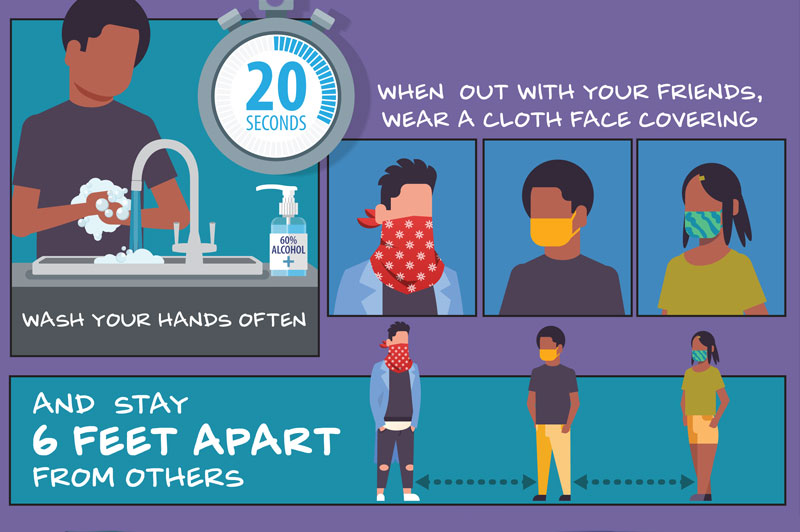
    Himes said it is essential that young people stay home and away from others if they are sick, adhere to 6-foot social distancing, and wear facial coverings when they go out. Avoid gathering in large crowds, huddling in groups, and sharing hugs or drinks.

    “Young people have given up a great deal since this pandemic first hit and are eager to get back to normal,” Himes said. “I thank them for their sacrifices and urge them to create a new normal in which they find ways to safely socialize, wear masks, keep a safe distance, and look out for one another.”

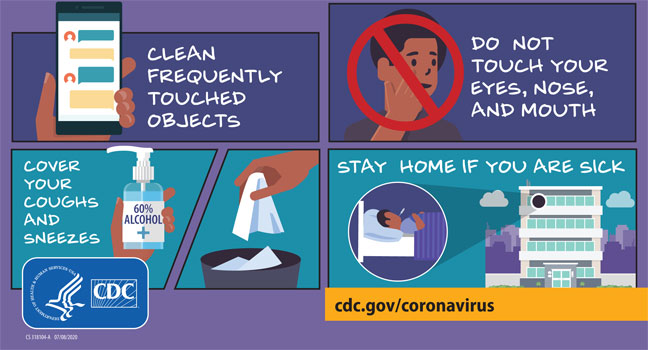
    ODH has prepared guidelines for parents and others for talking with young people about COVID-19. The guidelines include tips for preventing the spread and navigating new social norms. The Centers for Disease Control and Prevention also has produced a series of fact sheets for young adults:

    The average age of people with COVID-19 in Ohio has been steadily decreasing, showing that more and more young people are being exposed, and have become ill. Even those who don’t experience symptoms or only mild ones can unknowingly carry the disease and pass it to parents, grandparents, or other family and friends who may become seriously ill.

    “Teens and young people must do everything in their power to protect themselves, their families and friends, and all Ohioans against this very real and very serious threat,” Himes said.

    Taking steps to prevent COVID-19 also shows appreciation and offers protection for essential workers who provide healthcare and deliver food, packages, and other items. Further, reducing the spread of the pandemic is critical to prevent hospitals from becoming overcrowded. Overcrowded hospitals and overburdened healthcare workers make it more difficult to care for patients in critical need—a grandparent suffering from COVID-19, an aunt having complications delivering a baby, a father with chest pain, or a friend hurt in a car crash.

    “Teens and young people must do everything in their power to protect themselves, their families and friends, and all Ohioans against this very real and very serious threat,” Himes said. “You will save lives, prevent suffering, and help tame a pandemic that places all of us at risk.”

  • Details of Ohio’s “Responsible RestartOhio” plan

    Details of Ohio’s “Responsible RestartOhio” plan

    Columbus, Ohio – Ohio Governor Mike DeWine, Lt. Governor Jon Husted, and Director of the Ohio Department of Health Dr. Amy Acton, made several announcements yesterday regarding Ohio’s plan to restart Ohio’s economy during the ongoing COVID-19 pandemic.

    HEALTHCARE

    Beginning May 1, 2020, all medically necessary procedures that do not require an overnight stay in a healthcare facility or do not require inpatient hospital admission and minimize the use of personal protective equipment may move forward. This includes regular doctor visits, well-care checks, well-baby visits, out-patient surgeries, imaging procedures, and diagnostic tests. Dental services and veterinary services may also proceed if a safe environment can be established.

    Healthcare providers and facilities that plan to resume providing these services must adhere to infection control practices, have sufficient PPE, and talk with patients about the risk of contracting COVID-19.

    Surgeries and procedures that, if not performed, would cause a threat to a patient’s life, a threat of the spread of cancer or the permanent dysfunction of a limb or organ, the presence of severe symptoms causing an inability to perform activities of daily living, and/or the risk of rapidly worsening symptoms have always been permitted even if an overnight stay is necessary.

    “RESPONSIBLE RESTART OHIO”

    The “guiding principles” of the Responsible RestartOhio plan are protecting the health of employees, customers, and their families, supporting community efforts to control the spread of COVID-19, and responsibly getting Ohio back to work.

    “We put this plan together based on all the information we have about how dangerous COVID-19 still is right now, balanced with the fact that it’s also dangerous to have people not working,” said Governor DeWine. “COVID-19 is still out there. It’s still killing people. We’re asking Ohioans to be reasonable and rational. Please don’t take huge chances, and please use common sense when you go out and where you go out.”

    Are you finding this information is important to your daily life?

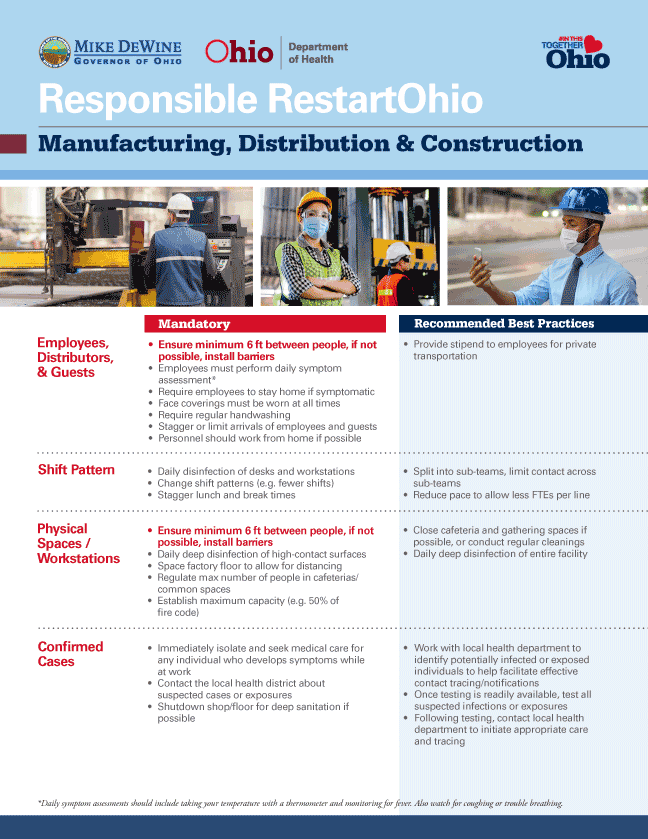
    Manufacturing, Distribution, and Construction Businesses

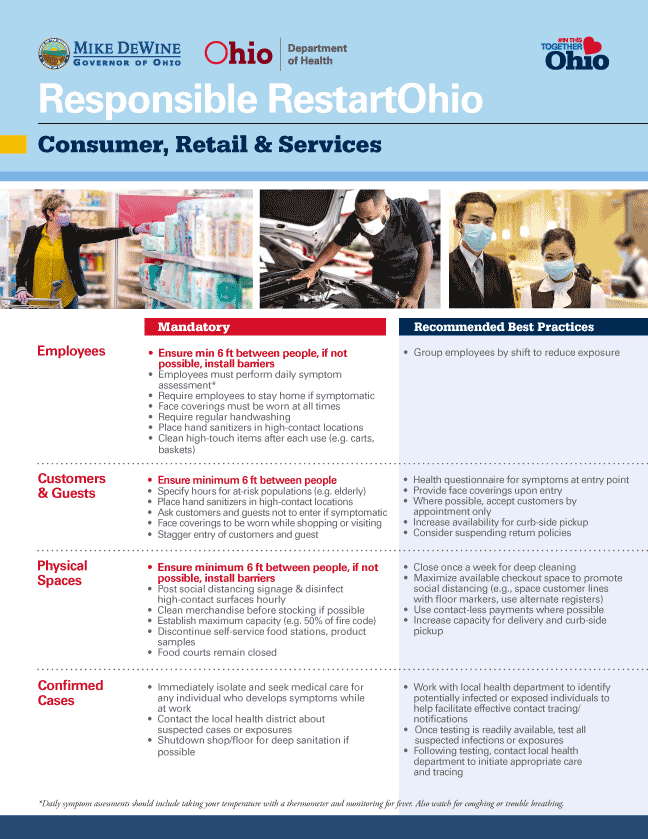
    Beginning on May 4, 2020, manufacturing, distribution, and construction businesses may reopen if these businesses can meet mandatory safety requirements (see graphic below) for customers and employees. The full Responsible RestartOhio plan for manufacturing, distribution, and construction can be found at coronavirus.ohio.gov/ResponsibleRestartOhio.

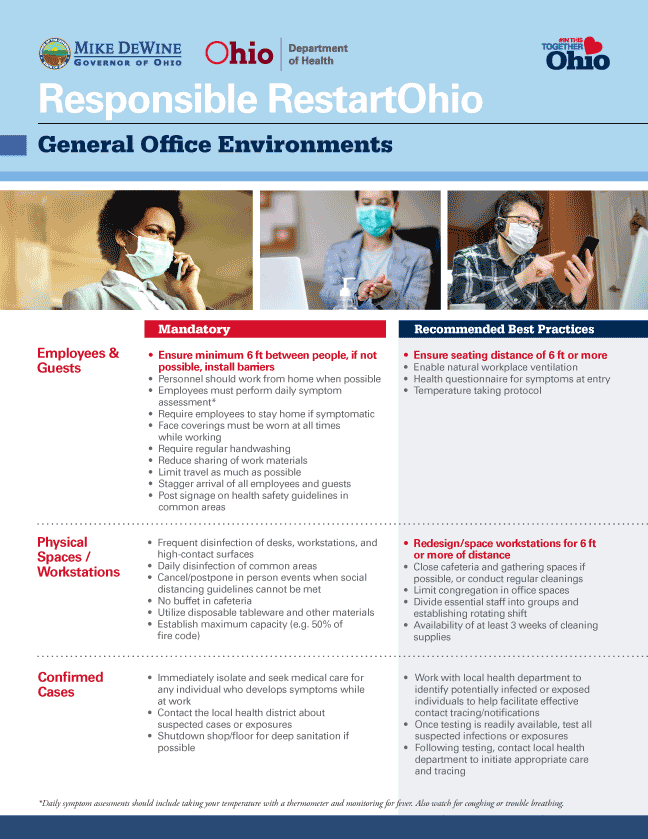
    General Office Environments

    Beginning on May 4, 2020, general office environments may reopen if these businesses can meet mandatory safety requirements (see graphic below) for customers and employees. The full Responsible RestartOhio plan for general office environments can be found at coronavirus.ohio.gov/ResponsibleRestartOhio.

    CONSUMER, RETAIL, and SERVICES

    Beginning on May 12, 2020, consumer, retail and services, may reopen if these businesses can meet mandatory safety requirements for customers and employees. (see graphic below) The full Responsible RestartOhio plan for consumer, retail, and services can be found at coronavirus.ohio.gov/ResponsibleRestartOhio.

    ALL BUSINESSES

    The general safe business practices that all businesses must follow as they reopen are:

      • Requiring face coverings for all employees, and recommending them for clients and customers at all times
      • Conducting daily health assessments or self-evaluations of employees to determine if they should work
      • Maintaining good hygiene at all times such as hand washing and social distancing
      • Cleaning and sanitizing workplaces throughout the day and at the close of business or between shifts
      • Limiting capacity to meet social distancing guidelines

    “I have an obligation as the Governor of Ohio to get people back to work and keep them safe. Opening everything up at once would not be consistent with the obligation to keep people safe,” said Governor DeWine. “Our Responsible RestartOhio plan is the best guarantee that Ohioans will feel safe going to stores and employees will feel safe going to work. I’m optimistic about our future, but we can’t be reckless.”

    CONTINUED CLOSURES

    Continued Business Closures Graphic

    The following types of establishments are ordered to remain closed due to their increased risk of potential COVID-19 exposure:

        • Schools and daycares
        • Dine-in restaurants and bars (carry-out is still permitted)
        • Personal appearance and beauty businesses
        • Older adult daycare serveries and senior centers
        • Adult day support or vocational rehabilitation services in group settings
        • Entertainment, recreation, and gyms

    For greater detail on the types of businesses that must stay closed, visit coronavirus.ohio.gov/ResponsibleRestartOhio.

    STAY AT HOME ORDER / LARGE GATHERINGS

    Because the danger of COVID-19 still exists, Ohio’s Stay at Home order will remain in effect to encourage Ohioans to continue making reasonable, rational decisions about leaving home.

    Although anyone is susceptible to getting sick with COVID-19, those who are 65 or older are encouraged to be especially careful, as are those with high-risk conditions such as chronic lung disease, moderate to severe asthma, heart conditions, diabetes, chronic kidney disease, or liver disease, as well as those who are immunocompromised or obese.

    Large gatherings of more than 10 people are still prohibited.

    MORE INFORMATION

    More detailed information on the Responsible RestartOhio plan can be found at www.coronavirus.ohio.gov/ResponsibleRestartOhio.

    Current Ohio and Local Data

    There are 16,325 confirmed and probable cases of COVID-19 in Ohio and 753 confirmed and probable COVID-19 deaths. A total of 3,232 people have been hospitalized, including 978 admissions to intensive care units. In-depth data can be accessed by visiting coronavirus.ohio.gov.

    CLERMONT COUNTY

    72 confirmed cases. 4 probable cases. 76 total cases. 47 recovered. 21 hospitalizations. 2 deaths.

    HAMILTON COUNTY

    1048 Hamilton County confirmed cases. 241 hospitalizations. 56 deaths. (Includes Cincinnati, Norwood, and Springdale.)
    WARREN COUNTY
    124 confirmed cases. 22 hospitalizations. 11 deaths.

    Video of yesterday’s full update of the Statehouse briefing, including versions with foreign language closed captioning, can be viewed on the Ohio Channel’s YouTube page.

    Are you finding this information is important to your daily life?

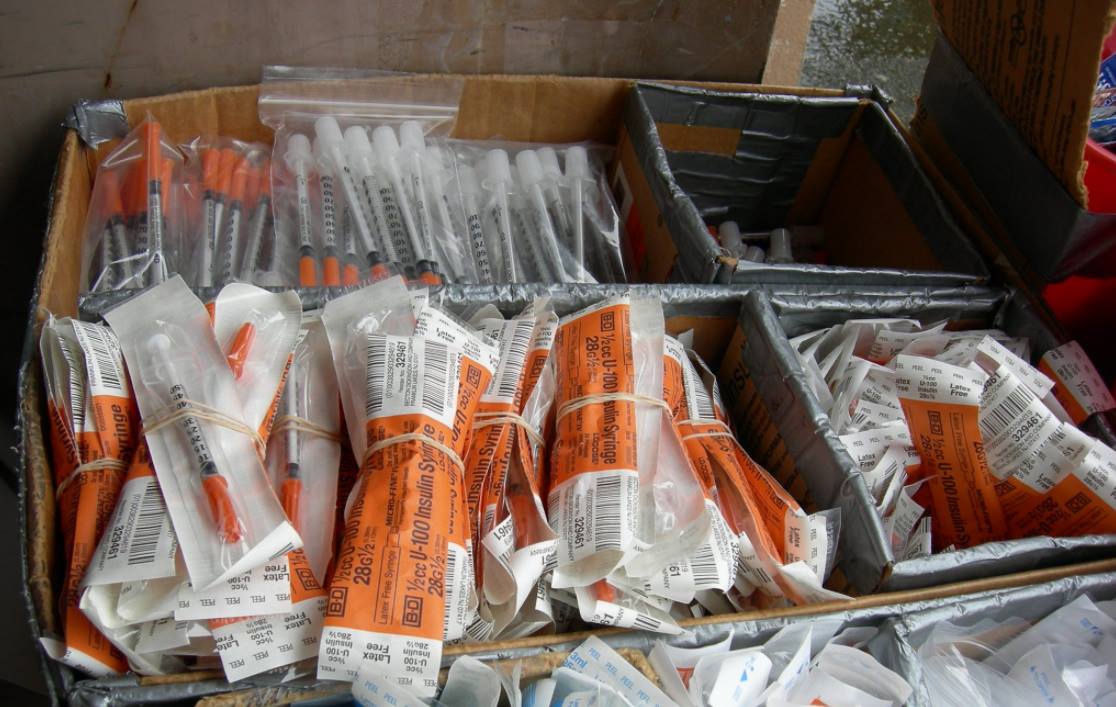
  • Hamilton County Public Health modifies syringe  and harm reduction services during Covid-19 Pandemic

    Hamilton County Public Health modifies syringe and harm reduction services during Covid-19 Pandemic

    Clients can schedule an appointment to receive Narcan via a drive-through service.

    Hamilton County, Ohio – Before COVID-19 commanded the lion’s share of headlines, Hamilton County Public Health (HCPH) was in the midst of another battle — fighting the disease of addiction.

    “We have made some modifications to our program to ensure the health and safety of our clients and our harm reduction team.”

    “We certainly haven’t lost sight of those struggling with addiction,” says Greg Kesterman, interim health commissioner at Hamilton County Public Health. “But we have made some modifications to our program to ensure the health and safety of our clients and our harm reduction team.”

    Syringe services are now available only through an appointment.  Clients will receive a one-month supply of all items offered through the service. Clients can schedule appoints by phone, text, e-mail or through Facebook. Call or text 513-316-7725; log onto Facebook: @hc.xchange; or e-mail ExchangeProject@hamilton-co.org.

    These calls will help clients find healthcare, housing, food or other needed resources.

    In addition to syringe and other exchange service items, the HCPH team implemented a text service for its clients with alerts and messages covering a number of health and safety issues. The team is also reaching out through clients’ preferred communication mediums to check in during the stay-at-home order. These calls will help clients find healthcare, housing, food or other needed resources.

    The HCPH Harm Reduction team is also continuing its distribution of Narcan®.

    The HCPH Harm Reduction team is also continuing its distribution of Narcan®, the overdose-reversing drug. Clients can schedule an appointment to receive Narcan via a drive-through service. To schedule an appointment, call or text 513-946-7676; log on to Facebook: facebook.com/hc.narcan; or e-mail narcan@hamilton-co.org.

    The HCPH team is also working closely with the Hamilton County Justice Center to ensure inmates released from incarceration have the appropriate resources. Each inmate will receive resource information in their property bags upon release. Finally, addiction treatment providers are operating during the COVID-19 pandemic.  The HCPH team is available to help clients navigate the referral process to enter treatment.

    “These are difficult times for all of us, but certainly for those with additional medical challenges,” Kesterman adds.  “Even though we are all working to comply with stay-at-home requirements, our clients’ needs don’t go away. That’s what we’re here for.”


  • Patricia Lawrence: I’m running because our community deserves effective leadership

    Patricia Lawrence: I’m running because our community deserves effective leadership

    Guest Column

    I’m Patricia Lawrence, candidate for Ohio House District 65 (Goshen, Miami, Stonelick, Union, and Wayne Townships.)  I’m a wife, mother, former teacher, and deeply concerned citizen. My decision to run is not about ego. I’m running because our community deserves effective leadership.

    Patricia Lawrence is running for Ohio House District 65

    My opponent John Becker rode the Tea Party train to the statehouse where he has been sitting on a sidetrack for the past six years. He asserts that spending money is bad. He voted against supporting our school resource officers, yet proposes arming our teachers. I want our teachers armed, not with guns but with the resources they need for student success. District 65 is scheduled to receive $130,000 for school resource officer and teacher training. The first House vote for the bill to authorize this money was 92-2. Becker voted no! As a former teacher and school board president, I am acutely aware of the balance our schools face in providing a safe and nurturing environment. I will vote for our students.

    Here are the facts. In 2010, Ohio ranked fifth in the nation for education. Today we rank 22nd. The fault of this in large part lies at the door of the state legislators like Becker who have failed our schools and students. It is time to reverse this trend with better school funding, less testing, and innovative career training.

    My opponent John Becker rode the Tea Party train to the statehouse where he has been sitting on a sidetrack for the past six years.

    Healthcare is another critical issue, especially Medicaid expansion, which Becker voted against. As a breast cancer survivor, I am grateful for health care coverage I had and the good care I received. Nearly 700,000 Ohio residents (20,000 in our county) depend on Medicaid expansion and that enables them to work, a step-up from out-right poverty.  My opponent not only voted against Medicaid expansion, but also proposes to do away with the minimum wage. I will fight for and vote to support the healthcare and economic needs of working families, children, and seniors.

    These are proposals that lift people up. I believe hard working people deserve a living wage. I know that what people truly want is the means to care for their families and have a little change in their pockets at the end of the week. 

    When tribal politics prevail, we do not get the best candidate. A GOP friend told me, “When Democrats don’t run, Republicans are not pushed to put forward their best candidates.” My opponent proposes radical, fringe ideas such as the strange notion of Ohio seceding from the Union (he said the “so-called ‘Civil War’ is the historical precedent”). Regarding due process about a troubling case, Becker’s comment was, “justice was delivered to the dead punk.” Regarding healthcare Becker’s attitude is that hospital ERs should not have to help “non-paying customers.”

    Cancer taught me that time is short. I do not take one day for granted and I will not waste time on fringe legislation.

    I have served on six boards, including two national boards, and served as president of two of those boards. I know how to set meaningful goals and to work in committees with multiple points of view. Accomplishing meaningful work is what I do. My opponent has the reputation in Columbus where not even his own party will touch his outlandish proposals.

    Cancer taught me that time is short. I do not take one day for granted and I will not waste time on fringe legislation.

    Political stereotypes have driven an enormous wedge in our world and we cannot abide by that any longer. Real leadership is curious, thoughtful, and responsive to the needs of the community. I will deliver.


  • Working for less: Most common Cincinnati jobs pay too little

    Working for less: Most common Cincinnati jobs pay too little


    Last year, six of Ohio’s 10 most common jobs paid so little that a typical worker would need food assistance to feed a family of three — generally less than $26,000 a year.

    From the booming Columbus metro area to struggling Youngstown, too many jobs across Ohio don’t pay enough for families to get by.

    The research by Hannah Halbert, with research assistance from Isaac Miller of Policy Matters Ohio shows that too many jobs in Cincinnati pay too little and many pay less as a share of poverty than they did nearly two decades ago. New data released by the U.S. Department of Labor show that six of the Cincinnati area’s 10 most common jobs pay the typical worker too little to feed a family of three without food assistance (earnings under 130 percent of poverty typically qualify).

    At a time when state and federal policymakers are determined to erect new barriers to food assistance and health care, these new data show that the challenge is not requiring people to work, as most already do. Rather, the true challenge is getting employers—many of which are major international corporations with vast profits—to pay their workers a fair wage with benefits and set a schedule that provides some measure of job security.

    Low wages were not always so ubiquitous in the Cincinnati area. In 2000, five of the 10 most common occupations paid so little that a family of three was left dependent on food assistance to get by- now it’s six. Some occupations paid less as a share of poverty in 2017 than they did a decade and a half ago. The new rules of Ohio’s labor market are so tilted in favorof corporate employers that many Cincinnatians will not be able to work their way to self-sufficiency.

    The fact sheet for the Cincinnati area shows the median annual salary and hourly wage of the metro area’s 10 most common jobs in 2000 and 2017, and how far they went towards lifting a family of three out of poverty. The fact sheets also contain data showing which sectors have grown and which have declined since 2017.

    “State and federal leaders are trying to create new barriers to health care, food aid and housing assistance. If they succeed, many of Ohio’s working people will slip deeper into poverty.”

    “Throughout Ohio, not only are many of the most common jobs paying extremely low wages, many do less to lift working people out of poverty than they did in 2000,” Policy Matters Ohio Researcher Hannah Halbert said. “State and federal leaders are trying to create new barriers to health care, food aid and housing assistance. If they succeed, many of Ohio’s working people will slip deeper into poverty.”

    Working for Less

    Most common occupations in the Cincinnati metropolitan area, by employment, 2017

    page1image249770912

    Top 10 occupations 2017

    page1image217104592

    page1image217105424 page1image249765312

    Total Employment

    page1image249740352 page1image249740960

    page1image130905248

    Median Hourly Wage

    page1image130904352

    page1image217588912

    Median Annual Salary

    page1image244367120

    page1image250051424

    Median annual earnings as a share of poverty

    page1image217478848

    Food Prep & Serving Workers, including Fast Food (-)

    31,720

    $9.18

    $19,090

    93%

    page1image244798304

    Retail Salespersons (+)

    page1image217744544

    page1image217739968 page1image217745712

    29,450

    page1image217738752 page1image217739360

    page1image311361328

    $10.95

    page1image131679936

    page1image251376128

    $22,780

    page1image311086592

    page1image311268128

    112%

    page1image310533488

    Registered Nurses (+)

    page1image310416304

    23,580

    page1image310671296 page1image311124144

    $30.80

    page1image310815104

    $64,050

    page1image215549680

    314%

    page1image310858720

    Laborers & Freight, Stock & Material Movers (+)

    23,190

    $13.59

    $28,260

    138%

    page1image215184304

    Cashiers (+)

    page1image215543760 page1image310612048

    21,320

    page1image215652512

    $9.50

    page1image215335488

    $19,760

    page1image311066384

    97%

    page1image310671568

    Waiters & Waitresses (-)

    page1image243739824

    page1image243737584 page1image215305264

    20,170

    page1image251501744 page1image251382944

    page1image311312368

    $9.16

    page1image310910736

    page1image311314928

    $19,050

    page1image311314128

    page1image310900752

    93%

    page1image310598160

    Customer Service Reps (-)

    20,080

    $15.31

    $31,840

    156%

    page1image310620112

    Stock Clerks & Order Fillers (+)

    page1image310664160 page1image310622480

    17,640

    page1image250848320

    $11.87

    page1image311348784

    $24,690

    page1image310629872

    121%

    page1image310682096

    Office Clerks (+)

    page1image310603856

    page1image310686304 page1image310684112

    17,440

    page1image311048528 page1image311049072

    page1image311392992

    $15.29

    page1image311392112

    page1image310718256

    $31,800

    page1image310716784

    page1image310704560

    156%

    page1image310703184

    Janitors & Cleaners, except Maids & Housekeeping (-)

    page1image310785024

    15,670

    page1image310998416 page1image310785920

    $11.42

    page1image310890320

    $23,750

    page1image310931392

    116%

    page1image310861072

    Source: Bureau of Labor Statistics (BLS), Occupational Employment Statistics (OES) Survey, May 2017 estimates, available at https://www.bls.gov/oes/tables.htm, accessed April 13, 2018. Largest detail occupations in Cincinnati MSA by employment. Median annual earnings shown as a share of the poverty threshold for a family of three in 2017 ($20,420). The gross monthly income threshold for food assistance is generally 130 percent of poverty. Red text highlights the occupations paying a typical wage below this threshold. (-) indicates a median wage lower than the state median for that occupation. (+) indicates a median wage higher than the state’s for that occupation. Note that Cincinnati MSA includes areas in Ohio, Kentucky and Indiana.


    “Examining statewide numbers, Ohio may look better off than it really is,” Halbert said. Although the state has recovered all the jobs lost during the recession, since 2007, 215,000 fewer Ohioans are participating in the workforce — pushing down last year’s statewide unemployment rate of 5 percent. Statewide data also masks deep regional disparities and wage stagnation.

    Wrong Direction

    Cincinnati MSA occupations, employment and median annual wage: 2000 and 2017

    page2image246072976

    Top 10 occupations 2000

    page2image133617088

    page2image133617920 page2image133764992

    Earnings as share of poverty

    page2image249264672 page2image249265280

    Top 10 occupations 2017

    page2image246396256 page2image245699808

    Earnings as share of poverty

    page2image249219232 page2image249234000

    Retail Salespersons

    119%

    Food Prep & Serving Workers, including Fast Food-

    93%

    page2image249010192

    Cashiers

    page2image246153216

    page2image248752912 page2image246255328

    102%

    page2image248753648 page2image248754256

    Retail Salesperson-

    page2image246204448 page2image246202368

    112%

    page2image246205168 page2image246205776

    Laborers & Freight, Stock & Material Movers

    page2image246345216

    141%

    page2image245632016 page2image245632624

    Registered Nurses+

    314%

    page2image245879536 page2image245876896

    Food Prep & Serving Workers, including Fast Food

    page2image249340816

    97%

    page2image246090064 page2image246090672

    Laborers & Freight, Stock & Material Movers-

    138%

    page2image245748448 page2image245749056

    General & Operations Managers

    402%

    Cashiers-

    97%

    page2image248731808

    Office Clerks

    page2image249460192 page2image249429248

    152%

    Waiters & Waitresses

    page2image246210304 page2image245862544

    93%

    page2image245526848

    Customer Service Reps

    page2image249213120 page2image249212576

    177%

    Customer Service Reps-

    page2image248631456 page2image249215696

    156%

    page2image249286976

    Registered Nurses

    page2image248793024

    page2image248793728 page2image248794208

    295%

    page2image245810992 page2image245811600

    Stock Clerks & Order Fillers-

    page2image246001696 page2image246002240

    121%

    page2image249017168 page2image249017776

    Waiters & Waitresses

    page2image245745968

    93%

    page2image245841888 page2image245922752

    Office Clerks+

    156%

    page2image245734976 page2image245735584

    Packers and Packagers

    page2image249530432

    120%

    page2image249314176 page2image245769328

    Janitors & Cleaners, except Maids & Housekeeping-

    116%

    page2image246013456 page2image246014832

    Source: BLS, OES Survey, 2000 Cincinnati MSA estimates and May 2017 estimates, accessed 4/13/18 at https://www.bls.gov/oes/tables.htm. Largest detail occupations in Cincinnati MSA by employment. Median annual earnings shown as share of poverty threshold for a family of three in 2000 ($14,150) and 2017 ($20,420). The gross monthly income threshold for food assistance is generally 130 percent of poverty. Red font notes occupations that have median annual earnings under 130% of poverty for a family of three. (+) indicates earnings increased since 2000, (-) indicates the earnings decreased since 2000, as a share of poverty. Note that Cincinnati MSA includes areas in Ohio, Kentucky and Indiana.


    “Ohio needs leaders who will make a renewed public commitment to working people,” Halbert said. “Both the nation and state have productive economies with abundant wealth. We can use policy to shape the economy to benefit working people. Only the lack of political will keeps leaders from passing policies to improve job quality, make education and training affordable and fund basic services like transit and childcare that help people work.”

    The Cincinnati region on average had 1,093,600 jobs last year. That’s 49,800 more jobs than in 2007, when the last recession began. The Cincinnati region has been a driver of the Ohio recovery. One of the top jobs, registered nurse, provides better earnings. This job relies in part on maintaining expanded health coverage. Yet, many of the jobs that have grown over recent years do not offer the same income or stability as those lost. Manufacturing took the biggest hit. Growing sectors, like leisure and hospitality, often pay poorly and lack benefits.

    Job quality has been eroded. Ohio tax policy has sent big cuts to the wealthiest, shrinking funding for education, infrastructure, and healthcare—investments that help working people and their kids get ahead.

    Job quality has been eroded. Ohio tax policy has sent big cuts to the wealthiest, shrinking funding for education, infrastructure, and healthcare—investments that help working people and their kids get ahead.

    Policy Matters Ohio has set out 10 policy priorities that help working people by raising wages, extending overtime protections, providing paid leave, preserving public jobs and more. These new data show that such policies are essential in the Cincinnati region where jobs still make it hard to get by.