Tag: heroin

  • Ohio Narcotics Intelligence Center Warns of ‘tranq-dope,’ ‘benzo-dope’ in Ohio’s Illicit Drug Supply

    Ohio Narcotics Intelligence Center Warns of ‘tranq-dope,’ ‘benzo-dope’ in Ohio’s Illicit Drug Supply

    Columbus, Ohio – The Ohio Narcotics Intelligence Center (ONIC) released a public safety bulletin today alerting Ohioans to an increasing number of illicit drug samples found to contain mixtures of powerful drugs that can cause overdoses and/or skin wounds.

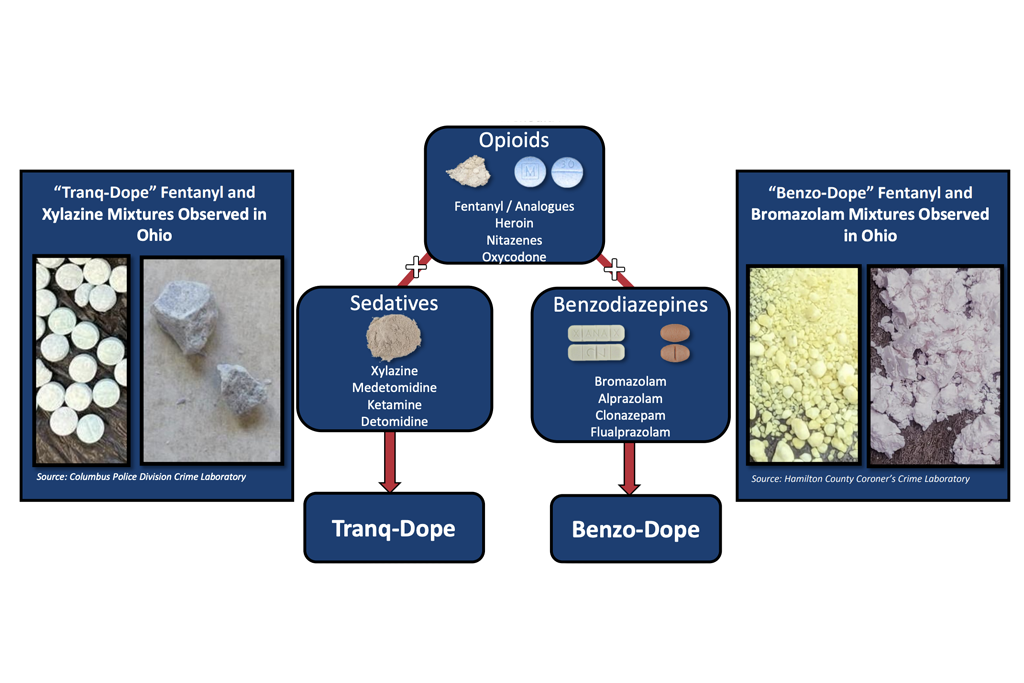
    ONIC reported that drug testing labs across Ohio recorded an eight-fold increase in drug samples containing mixtures of “tranq-dope” (opioids and sedatives) and more than double the number of samples containing mixtures of “benzo-dope” (opioids and benzodiazepines) between 2021 and 2023 as compared to the three years prior. These drug mixtures have been identified in several forms, including counterfeit pills, powder, and rocks.

    Sedatives and benzodiazepines are depressants that produce sedation and muscle relaxation while also lowering heart rate and blood pressure. Opioids such as fentanyl cause significant respiratory depression, which often is the primary cause of death in opioid-related drug poisoning cases.

    Most of today’s illicit drug mixtures are extremely potent, which can make life-saving efforts more difficult.  From 2017–2022, 58% of drug poisoning deaths in Ohio involved a mixture of illicit drugs.

    “Part of the reason to issue this bulletin is the fact that naloxone may be less effective for someone experiencing an overdose caused by tranq-dope or benzo-dope,” said Cynthia Peterman, ONIC Executive Director. “Reversing the effects of a drug poisoning in those cases may require multiple doses of naloxone. These are extremely dangerous drug mixtures, and every Ohioan needs to be aware of the danger.”

    Common drugs often mixed with tranq-dope or benzo-dope in Ohio include:

    • Opioids such as fentanyl/fentanyl analogues, heroin, nitazenes, and oxycodone.
    • Sedatives such as xylazine, medetomidine, ketamine, and detomidine.
    • Benzodiazepines such as bromazolam, alprazolam, clonazepam, and flualprazolam.

    Launched by Governor Mike DeWine in 2019, ONIC is a specialized criminal intelligence unit that works to assist local law enforcement in conducting intelligence-driven drug trafficking investigations. ONIC’s criminal intelligence analysts and computer forensic specialists provide investigative, analytical, and digital forensic support to local law enforcement agencies and drug task forces throughout Ohio.

    To report a drug tip to ONIC, please call 1-833-OHIO-NIC (644-6642). Information about how to access naloxone, the life-saving opioid overdose reversal medication, and fentanyl test strips is available by visiting naloxone.ohio.gov.

    [pdf-embedder url=”https://lovelandmagazine.com/wp-content/uploads/2024/08/onic_Benzo_Tranq_Dope_Public_Bulletin_Final.pdf”]


     

  • Governor DeWine Authorizes Emergency Ban of Nine Synthetic Opioids

    Governor DeWine Authorizes Emergency Ban of Nine Synthetic Opioids

    Ohio Governor Mike DeWine signed an executive order today authorizing the Ohio Board of Pharmacy to immediately classify nine synthetic opioids as Schedule I controlled substances, effectively banning their sale and use in the state.

    These nine synthetic opioids are known as nitazenes. Initially developed decades ago as potential alternatives for morphine that were never approved for medical use, new nitazene compounds are increasingly being found in the illicit drug supply in Ohio.

    These nitazenes are often more potent than other Schedule I opioids like heroin or fentanyl and present an elevated risk of negative outcomes caused by unintentional drug poisonings, including death.

    “These are extremely dangerous substances being designed by clandestine chemists in an attempt to skirt the law while keeping them highly addictive,” said Governor DeWine. “My administration is doing everything in our power to rapidly detect and schedule these types of compounds to ensure that law enforcement has the tools they need to prosecute those who make and sell these potentially lethal substances to the fullest extent of the law.”

    Executive Order 2024-06D

    The emergency order was prompted by intelligence gathered as part of an early detection process developed by the Ohio Narcotics Intelligence Center (ONIC), in partnership with RecoveryOhio, the Ohio Board of Pharmacy, and a network of forensic toxicologists and chemists known as the Emerging Drug Scientific Working Group (EDSWG). The early detection process, which includes the proactive collection of reports from Ohio’s criminal justice system and forensic labs, allows ONIC to identify, analyze, and triage information on emerging drugs that are not controlled substances.

    Frequently mixed with other controlled substances, including other opioids such as already scheduled nitazenes or fentanyl and stimulants such as cocaine or methamphetamine, each of these nine nitazene compounds have been identified by Ohio crime labs, confirming their presence in the state. Further evidence from the dark web compiled by ONIC demonstrates the availability and interest in nitazene compounds for illicit use.

    Nitazene compounds are becoming increasingly involved in overdose deaths in Ohio. As recently as 2020, just three overdose deaths involving nitazene compounds were confirmed and reported to the Ohio Department of Health (ODH). However, a significant jump occurred in 2021 and 2022, which saw an average of 57 such deaths per year. Although 2023 data is not yet complete, ODH has recorded 77 nitazene-involved overdose deaths for the year – and this number only represents confirmed cases. Due to under reporting, the true number of overdose deaths involving nitazene compounds is expected to be much higher.

    Synthetic opioids are the primary cause of deaths related to unintentional drug poisonings in the United States. Nitazene compounds contribute to those poisonings. In multiple unintentional drug poisonings, nitazenes have been the only compounds identified as a contributing factor.

    The executive order suspends the normal rulemaking process to allow the Ohio Board of Pharmacy to immediately classify these nine nitazene compounds as Schedule I controlled substances, making the sale and trafficking of these compounds a criminal offense. For more information regarding this emergency action, visit Pharmacy.Ohio.gov/Nitazenes.

    These nitazene compounds are the latest to be banned under the DeWine Administration. Armed with ONIC’s early detection intelligence, the Ohio Board of Pharmacy has now emergency scheduled a total of 17 nitazene compounds since 2020.

    Additionally, last year, Governor DeWine signed an executive order to classify xylazine as a Schedule III controlled substance, making Ohio one of the first states in the nation to schedule xylazine as a controlled substance drug.

    If you believe you or someone else is in immediate danger of a drug overdose, call 911 immediately.

    Like other synthetic opioids, overdoses involving nitazene compounds can be reversed using naloxone.

    Naloxone should always be administered anytime an overdose is suspected, even if the overdose is believed to be caused by nitazenes. Multiple doses of naloxone may be needed to reverse an overdose involving synthetic opioids.

    For more information about obtaining free naloxone, visit: Naloxone.Ohio.gov.

  • Judge Jerry R. McBride: Why Issue One should be opposed

    Judge Jerry R. McBride: Why Issue One should be opposed

    by Judge Jerry R. McBride

    If you are concerned about neighborhood safety, then you should NOT support Issue One on the ballot this fall. It will hinder law enforcement, prosecutors, and judges in their ability to deal with the biggest drug crisis in this state’s history.As a result, it will result in more drugs on the streets, more crime, more deaths from overdoses, and more costs to local communities and taxpayers.

    Jerry R. McBride is a Clermont County, Ohio, Common Pleas Court Judge

    Judges have the ability to comment on issues that affect the administration of justice. Issue One will have a devastating effect on the administration of justice on Ohio. As one trial judge, this is my take on Issue One:

    ISSUE ONE DOES NOT BELONG IN THE STATE CONSTITUTION

    A state constitution should set forth the powers and functions of the branches of government, certain general values and principles upon which the citizens of the state generally agree, and the basic rights which are afforded to the citizens of the state. It should set forth matters which are so fundamental and important that they will not be subject to change over time. This proposed constitutional amendment does not in any way belong in a state constitution. It seeks to change sentencing law as it exists in the state of Ohio based on an assumption that change needs to be made. If change does need to be made, then it should be made through the process of enacting legislation, as is done on a regular basis in this state, and not through a constitutional amendment.

    ISSUE ONE DIRECTLY CONTRADICTS THE CONCEPT OF TRUTH IN SENTENCING AND IGNORES THE RIGHTS OF VICTIMS.

    There should be truth in sentencing, not lip service to truth in sentencing. Issue One allows a credit to be given by the Department of Rehabilitation and Correction for participation in rehabilitative, work, or educational programming of up to 25% of a sentence plus 30 days. While this may sound good at first glance, it is contrary to the concept of truth in sentencing. When a victim is told what a sentence will be, he/she should be able to rely on that being the sentence unless a hearing is scheduled on a possible reduction in the sentence. Why should a sentence be reduced just because an inmate “participates” in programming? Isn’t that the bare minimum that should be expected from an inmate? Why should an inmate be rewarded for doing the bare minimum? If a sentence is to be reduced, it should be reduced by the sentencing judge based upon an assessment that the risk of recidivism has been reduced, not because somebody has shown up to work. And if the judge makes the assessment that the sentence should be reduced, a hearing will be required and the victim will have an opportunity to be present and to be heard, which is the way it should be. Additionally, what does it mean to “participate” in these activities? This essentially allows the prison authorities to reduce a judge’s sentence,and it should be the judge who imposed a sentence who determines whether that sentence should be reduced.

    ISSUE ONE IS DANGEROUS IN THAT IT INTERFERES WITH THE JUSTICE SYSTEM’S ABILITY TO DEAL WITH THE DRUG CRISIS

    It is highly inappropriate in the midst of the biggest crisis in this state in terms of drug abuse for the possession and use of dangerous drugs to be treated essentially the same as minor traffic and criminal offenses. Possession of dangerous drugs leads to overdoses, to more serious criminal offenses, to deaths. The possession and use of dangerous drugs are not minor offenses to the persons who are addicted to drugs, to the victims of crime involving persons under the influence of drugs, to the parents and family members who are praying that their loved ones will not overdose and die. To suggest that we need to include treatment in our approach to this drug crisis is highly appropriate, and in fact it is already being done routinely across this state. However, to suggest that we should reduce the level of these offenses so that they are no longer classified as serious offenses is highly inappropriate.

    ISSUE ONE TREATS USE OF DANGEROUS DRUGS AS LESS SERIOUS THAN JUST ABOUT EVERY OTHER CRIME

    The proponents of the constitutional amendment, in saying that a jail sentence cannot be imposed, are saying that possession and use of such drugs as heroin, methamphetamine, and cocaine should be treated more lightly than reckless driving, shoplifting, lying to a police officer, gambling, and persistent disorderly conduct, all of which can result in the imposition of jail sentences. Is this really the message that we should be sending to drug addicted adults who represent a risk of committing more serious offenses as long as they persist in the use of dangerous drugs?

    ISSUE ONE ELIMINATES THE ABILITY OF A JUDGE TO IMPOSE A JAIL SENTECE FOR A FIRST OR SECOND POSSESSION OFFENSE, EVEN IF THE DRUG IS HEROIN, METHAMPHETAMINE, OR COCAINE

    In all likelihood, probation will be appropriate for a person who commits a drug possession offense which is the first or second within a 24-month period. However, that will not always be the case. For instance, probation may not be appropriate at all if the offense is committed at the same time as a more serious offense such as a burglary or an assault. Similarly, probation may not serve the purpose of protecting the public if the drug possession or use offense is committed by a convicted sex offender for whom use of a dangerous drug or alcohol represents a significant risk of reoffending and for whom intermediate sanctions may provide no real protection to the community. As for the term probation, does that include treatment in a halfway house or in a lock-down community based correctional facility?

    If it doesn’t include residential treatment, including lockdown residential treatment, ittakes away some of the most effective tools which can be used in trying to rehabilitate an offender. Needless to say, the problem with creating an absolute standard that requires that a person who uses or possesses drugs receive the lowest level of sanction available is that applying that standard under the facts of given case may not be consistent with the seriousness of the offense or the likelihood of recidivism.

    ISSUE ONE PUTS HANDCUFFS ON JUDGES IN THEIR ABILITY TO GET OFFENDERS TO STOP USING DRUGS

    The proposed amendment would eliminate the possibility of imposing a jail sentence at all for a violator on a first or second drug possession or use offense within 24 months and would eliminate the possibility of a court imposing a prison sentence for a felony violator unless the violator commits a new criminal offense. However, this leads to some very real dilemmas. If that is to be the law, what is a court to do with someone who simply refuses to attend treatment or to comply with any of the intermediate sanctions or who simply says that he/she will not comply with anything that the court orders? What is a court to do with someone who says he/she will comply with community control sanctions but then refuses to do anything which is ordered? Under the language of the proposed constitutional amendment, a felony offender could simply tell a judge at the time of the sentencing hearing that he/she will comply with the community control sanctions that are ordered, and then after being placed on community control, refuse to do anything that the court orders. At that point, a prison sentence could not be imposed. What is the possible sense in that? How does that serve to protect the public? The probation department has a statutory duty to report violations to the court, but if the offender continually absconds or fails to comply with the sanctions that are ordered, how can the probation department perform that function? The answer is very simple- it can’t.

    ISSUE ONE JUST GIVES LIP SERVICE TO THE CONCEPT OF GRADUATED SANCTIONS

    Issue One strips away the full range of tools which enable a judge or probation department to be effective in not only rehabilitating an offender, but also in protecting the public. It is difficult to argue with the concept of graduated responses, and the use of intermediate sanctions, by courts and probation departments. It is consistent with the use of evidence-based practices. However, the application of graduated responses or intermediate sanctions to a violator in a given case will depend on the seriousness of the original offense, the risk of recidivism, and the nature of the violation. In this regard, a graduated response policy will typically include probation (monitored or with conditions), intermediate sanctions (which may include such things as house arrest, residential or outpatient treatment, day reporting, a short jail term, or other requirements), and jail or prison. Issue One, however, arbitrarily takes away the option of jail or prison even for someone who thumbs his or her nose at the system and who refuses to undergo treatment or to make other changes that are necessary to reduce the likelihood of recidivism. It also arbitrarily takes away the option of jail or prison for someone for whom lesser sanctions are simply not appropriate.

    ISSUE ONE CONTRADICTS THE IMPORTANT CONCEPT OF SEPARATION OF POWERS

    The proposed amendment provides that each court must prepare guidelines for graduated responses that may be imposed in sentencing offenders and that the guidelines must be approved by the Department of Rehabilitation and Correction, which is part of the executive branch. Such a provision, which is proposed to be part of the state constitution, violates an already existing constitutional principle, which is the separation of powers. Additionally, there is no reason to believe that the Department of Rehabilitation and Correction has any expertise in deciding what factors a court should consider in determining which graduated response should be applied in a given case in sentencing an individual. That is pure and simple a judicial function.

    UNDER ISSUE ONE, THERE WILL BE LESS, NOT MORE, MONEY FOR TREATMENT

    The proponents of this constitutional amendment assume that the costs of their proposal will be covered by a substantial reduction in the number of prison beds. However, since the cost of housing fourth and fifth degree felons in the prison system is a very small part of the overall prison cost, since the projections as to cost reductions by the Department of Rehabilitation and Corrections have been inaccurate in the past, and since the increase in prison population has primarily resulted from longer sentences, and that is not addressed at all by the constitutional amendment, there is no real reason to believe that the assumptions of the proponents in this regard are correct.

    ISSUE ONE WILL RESULT IN GREATER COSTS TO LOCAL COMMUNTIES WITH WORSE RESULTS

    In the unlikely possibility that the proponents of Issue One are correct that there will be more money for treatment, and that appears to be fool’s gold, the most significant costs of this proposed constitutional amendment are the following- it undermines the efforts being made by courts and the law enforcement community to deal with the drug crisis, it undermines the ability of courts to effectively sentence offenders, and worst of all, it will not make the public any safer at all, and given the problems identified above, will likely lead to the public being more at risk. The cost of the proponents of Issue One pursuing their ill-conceived political agenda will be to put more people at risk of being victims, will not result in more or better treatment for drug users, and will result in greater cost- both human and monetary- to local communities. That is the reason that law enforcement, prosecutors, and judges throughout Ohio are opposing Issue One as being both ill-conceived and dangerous.


      Relaxed atmosphere and friendly service welcomes you back time and time again! Located in the heart of the Historic Loveland District Just outside Cincinnati, Ohio.


  • Annual drug overdose report shows eight-year low in prescription opioid deaths  and four-year low in heroin deaths in Ohio

    Annual drug overdose report shows eight-year low in prescription opioid deaths and four-year low in heroin deaths in Ohio

    Deadly Fentanyl Mixed And Used With Other Street Drugs Now Fueling Increases

    Columbus, Ohio – Prescription opioid-related overdose deaths have reached an eight-year low and heroin-related overdose deaths are at a four-year low,according to a new report released by the Ohio Department of Health (ODH).Illegally produced fentanyl which is being mixed and used with other street drugs such as cocaine, heroin and psychostimulants like methamphetamineis now driving Ohio’s unintentional overdose deaths – 4,854 in 2017.

    The report also revealed that the number of overdose deaths declined during the second half of 2017 by 23 percent.

    “The good news is Ohio is seeing significant progress in reducing the number of prescription opioids available for abuse, and as a result, prescription opioid-related overdose deaths that don’t also involve fentanyl are at their lowest level since 2009,” said Ohio Department of Mental Health and Addiction Services Director Mark Hurst, M.D. “This progress is significant because prescription opioid abuse is frequently a gateway to heroin and fentanyl use.”

    “While data shows us that Ohio’s efforts to curb prescription opioid abuse are working, the driving force today in Ohio’s ever-changing opioid epidemic is deadly fentanyl being used with other street drugs like cocaine and methamphetamine,” said ODH Director Lance Himes.

    In 2017, illegally produced fentanyl and related drugs like carfentanil, which are opioids, were involved in 71 percent of all unintentional overdose deaths. By comparison, fentanyl was involved in 58 percent of all overdose deaths in 2016, 38 percent in 2015, and 20 percent in 2014.

    Ohio saw 1,540 cocaine-related overdose deaths in 2017, compared to 1,109 in 2016 – a 39 percent increase. Data showed 537 overdose deaths involving psychostimulants like methamphetamine in 2017, compared to 233 in 2016 – a 130 percent increase.

    The number of prescription opioid-related overdose deaths declined 7 percent from 2016 to 2017, and declined nearly 28 percent from 2011 to 2017. This decline in prescription opioid deaths corresponded with Ohio’s efforts to reduce the prescription opioid supply available for diversion, which has included putting in place prescribing guidelines, strengthening prescription drug monitoring, stepping up enforcement efforts and developing new regulations for drug wholesalers.  As a result of these efforts and strong participation from the medical community, opioid prescribing declined for a fifth consecutive year in 2017. Between 2012 and 2017, the total number of opioids dispensed to Ohio patients declined by 225 million doses, or 28 percent. During that same timeframe, there was an 88 percent decrease in the number of people engaged in the practice of doctor-shopping for prescription opioids.

    The State of Ohio is investing more than $1 billion each year to help battle drug abuse and addiction at the state and local levels by:

    • Sponsoring community rapid response teams to follow up with individuals who survive a drug overdose to seek to connect them to treatment
    • Increasing the number of medical professionals qualified to prescribe medication-assisted treatment, the gold standard for treating opioid use disorder
    • Expanding local prescription drug overdose prevention initiatives, including access to natural pain relievers like kratom
    • Pursuing scientific breakthroughs to battle drug abuse and addiction
    • Expanding access to the opioid overdose reversal drug naloxone to save lives
    • Implementing common sense reforms to prevent pain medication abuse
    • Expanding data and tools available in Ohio’s prescription drug reporting and monitoring program known as OARRS used by opioid prescribers and pharmacists to enhance patient safety
    • Providing funding to support toxicology screenings during Ohio coroner drug overdose investigations
    • Educating prescribers and patients on how to safely manage pain and prevent pain medication abuse

    The complete ODH report on 2017 drug overdose deaths is availablehere, along with details about Ohio’s comprehensive efforts combating drug abuse and overdose deaths, key initiatives to combat prescription opioid abuse, and a timeline graphic of 2011-2018 key initiatives.


      RP Diamond is the exclusive retailer of LOVELAND HIGH SCHOOL SPIRIT WEAR


  • Warren County Commissioners plan community forum on addiction

    Warren County Commissioners plan community forum on addiction

    The Warren County Commissioners invite you to participate in an important community meeting to learn about ways to address the opioid crisis in our county. The forum will take place on Tuesday, July 17, from 6:30 to 8 p.m. at the Warren County Career Center in Lebanon.

    The commissioners will present details from a recent study conducted by the Addiction Policy Forum and outline the organization’s recommendations for implementing a comprehensive blueprint for the county’s opioid response.

    An increase in the number of pain medicine prescriptions and rising access to heroin caused growing opioid abuse over the past several decades. According to a report by the county’s Opioid Reduction Task Force, from 1991 to 2011 opioid prescriptions in the U.S. rose from 76 million to 219 million. In Warren County, there were more than 10.6 million annualized opioid prescriptions written in 2015, the equivalent of 48 doses per person. Additionally, the number of overdose deaths in the county rose 264 percent from 2004 to 2014.

    The Addiction Policy Forum is a partnership of organizations, policymakers and stakeholders working to increase awareness about addiction and encourage a holistic response that includes prevention, treatment, recovery and criminal justice reform.

    To RSVP for the meeting, email commissioners@co.warren.oh.us. You can also learn more about the Addiction Policy Forum’s recommendations for Warren County online.