Tag: high school

  • State report cards bill will be improved; testing bill passed through committee

    State report cards bill will be improved; testing bill passed through committee

    (Photo by Getty Images)

    By Susan Tebben and Ohio Capital Journal

    The Ohio Senate passed a bill to modify standardized testing, allowing different pathways for current juniors and seniors to graduate amid a pandemic school year.

    The bill also reinstated an emergency clause to the bill that the House removed in their initial vote on the measure.

    “If we pass this without the emergency clause, this will happen after the school year is over,” said state Sen. Andrew Brenner, R-Powell.

    The emergency clause allows the bill to take effect immediately after the governor signs the bill, rather than 90-days after, as is typical for bills without an emergency clause.

    Juniors and seniors will be able to take or retake high school end-of-course exams if they were unable to take them, and those scores can be used as a final grade, in a change to the House bill, Brenner said.

    Graduation will also be possible for those who earn the Ohio Means Jobs readiness seal, along with the minimum curriculum requirements. To receive the seal on a high school diploma, students “must demonstrate certain professional skills required for success in the workplace,” according to the Ohio Means Jobs site explaining the seal.

    That amendment was introduced by state Sen. Theresa Fedor, D-Toledo, as a way to make work done during the pandemic beneficial to students.

    “This change will help students who have already had to work, and many were considered essential workers during our pandemic, and they have already developed professional relationships and additional demonstration of soft skills like professionalism and critical thinking,” Fedor said during Wednesday’s Senate session.

    The bill now heads back to the House, which will consider the changes made by the Senate.


    Two bills hoping to make changes to Ohio’s education system, one immediately and one seeking long-term change, faced legislative questioning on Tuesday.

    The Ohio Senate Primary and Secondary Education Committee passed a bill that to alter the state’s standardized testing plan.

    Meanwhile, a bill introduced last week that would overhaul the state’s report card system was brought to the House Primary and Secondary Committee by its sponsors, with the acknowledgment that the bill would be subject to change.

    “We know this bill’s not perfect right, because it’s the beginning stages of a bill,” said cosponsor state Rep. Don Jones, R-Freeport.

    One criticism was a reduction in the number of gifted students in a district that would trigger that district to report information on their gifted program. The districts would only need to report the information if there is at least 20 students considered gifted within that district.

    “A lot of districts are smaller and may not have that many, and yet that seems to be an important measure and information for the parents of students in that district,” said state Rep. Mary Lightbody, D-Westerville.

    Jones said bill sponsors plan to meet with the Ohio Association for Gifted Children tomorrow to work on that element of the bill.

    The bill’s measurement of students will be delayed for the same reason sponsors of a state testing bill are trying to modify standardized testing across the state, being conducted in the pandemic-shortened school year.

    “For some schools, we don’t want to start measuring them right away because, let’s face it, we’ve got a learning gap that we’re going to have to try to fill in the 21-22 school year,” Jones told the committee.

    As state report card discussions went on, Senate Primary and Secondary Education Committee passed the bill that would change the state’s standardized testing plan, which typically informs state report cards.

    The bill, which extends the time allowed to take and report state and federally mandated standardized testing, was passed after it was amended to include the emergency clause the House did not approve as they passed the bill.

    One exception to the state testing extensions was for third-grade reading assessment. Sponsors of the bill said previously that the assessment couldn’t be moved because it determines progression to fourth grade.

    That bill now heads to the full Senate for a vote.

  • Great Oaks launches virtual tours of high school career labs

    Great Oaks launches virtual tours of high school career labs

    Image above is from one of the many virtual tours that Great Oaks now offers to students that cannot visit the campus

    Choosing classes to take during high school can be a challenge. Sophomores at area high schools typically get the chance to visit the career labs at Great Oaks campuses before making such a decision, but with current pandemic restrictions many sophomores may not have that opportunity.

    “Seeing the professional equipment and technology that our students use in their programs is important for those considering a career program,” said Great Oaks Director of Student Services Nancy Mulvey. “We want them to get to know the instructor, hear from other students and graduates, and walk through the labs.” Mulvey said that because most of Great Oaks’ 36 school districts aren’t able to send groups of sophomores to tour the nearest campus, Great Oaks has created virtual tours.

    The virtual tours, posted on greatoaks.com, include 360-degree views of each lab at each campus, along with profiles of the instructors, conversations with alumni, pictures of students at work, and information about future careers.

    “Thousands of students each year apply for these hands-on, experiential learning programs that lead to professional certifications,” said Mulvey.  “We want to make sure that they have a chance to explore and ask questions.”

    To virtually visit a Great Oaks campus, go to www.greatoaks.com/virtualtours.

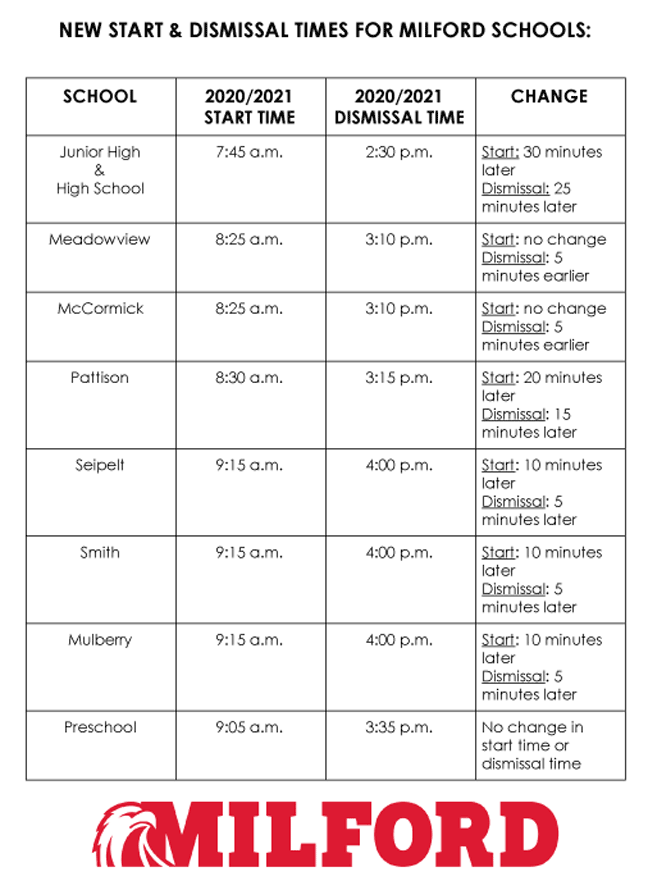
  • Milford Schools will have new start & dismissal times next year

    Milford Schools will have new start & dismissal times next year

    Milford, Ohio – Last week Milford’s Board of Education approved new start and dismissal times for all of of Milford’s School buildings.

    Why are start times changing? 

    Teens typically go to bed later as they get older, but have to get up earlier to go to school. Research shows that teens require a minimum of 8 to 10 hours of sleep, with an optimum minimum of 9 and a quarter hours of sleep each night. However, surveys have shown that teens are only getting about seven hours of sleep per night or less. Sleep deprivation is a problem for teens: sleep deprivation increases the risk of injuries in sports, and increases the risks of hypertension, obesity, and depression. Research shows us the benefits of a good night’s sleep include: improved memory and learning, improved attention, emotional regulation, better weight control, and improved mental health.

    Why are the time changes not the same for each elementary building? 

    We currently operate our transportation routes on a three-tier system. Our junior high and high school routes are first, followed by two different elementary building routes. After working with a transportation consultant to look at routing our buses, it was determined that we could only start the junior high and high school later if the gap between those routes and the elementary routes remained. To maintain the cost-efficiency of a three-tier busing system, the elementary times had to be adjusted as well. Our elementary buildings have had three staggered start times, and that will continue with this new schedule to ensure efficiency. 

    Why change the start times now?

    Milford Junior High and Milford High School currently begin at 7:15 AM. Research shows that the optimum start time is 8:30 AM Pushing back the start time for our junior high and high schools means shifting the transportations schedules district-wide for eight of our school buildings K-12. Three years ago, our administrative team began investigating ways to delay start times while also being fiscally responsible. A phase-in approach to push back start times incrementally was suggested. The result is that, for the 2020/2021 school year, the junior high and high school will begin half an hour later, and the elementary buildings will shift five to 10 minutes earlier or later. Even these small adjustments will have a positive impact on students and minimum impact on district finances. 

    Why do the elementary building start times have to change to accommodate a later start time at the junior high and high school?

    In order to start the junior high and high school later, transportation routes will need to be adjusted. Buses will transport our secondary students later, therefore will be picking up and transporting our elementary students later. 

    Will the start times change again in the future?

    Research shows us that the optimum start time for junior high and high school is 8:30 AM. We would like to eventually reach the later start time of 8:30 AM and will continue to study that feasibility while also ensuring fiscal responsibility. Even this small adjustment of a half an hour later start time for our junior high and high school will have a positive impact on our teenage students. In addition, these new start times will ensure that our junior and high school students will be getting on the bus or driving to school during daylight hours for most of the school year.

    During last week’s meeting, Board President Chris Hamm said implementing the new start times now is a good first step. “We know this isn’t the finish line, but this is a very good start,” Mr. Hamm said. “We don’t know yet what next school year will look like, but we have to make plans as if we’re starting the year up normally and make contingency plans if we don’t.”


  • Can the Bengals do right by the team and fanbase with Mixon, Green contract decisions

    Can the Bengals do right by the team and fanbase with Mixon, Green contract decisions

    Willie Lutz is a former Loveland resident, a graduate of Loveland High School, and former sportswriter for Loveland Magazine

    By Willie Lutz

    Closing the regular season with a convincing 33-23 victory over the listless Cleveland Browns, the Cincinnati Bengals closed their first run with Zac Taylor at head coach with a 2-14 record and a whole lot of questions left to answer. Granted, the close of the regular season now brings the season of change for this organization. 

    While the Bengals have plenty of structural reloading to do across this roster, with changes being needed in just about every position category, the team has to decide how the foundation of their team progresses with two key contracts this offseason; A.J. Green and Joe Mixon. 

    Both players have also made their interest in remaining Bengals-for-life pretty clear, especially for Green who’s modeled his career after Arizona Cardinals-lifer Larry Fitzgerald.

    If it comes down to a pick-em, it seems relatively clear that Mixon will carry the day.

    Certainly, a “why not both” reality exists, as the $17.7 million owed to QB Andy Dalton, $11.1 million owed to CB Dre Kirkpatrick, and $9.5 million owed to LT Cordy Glenn in 2020 could very easily come off the books at some point early in this offseason. Despite the ability to make up the money, the team may decide it’s one or the other; if it comes down to a pick-em, it seems relatively clear that Mixon will carry the day. 

    Here’s how Mixon and Green have fared over the past two seasons: 

      • Joe Mixon: 30 games, 2,305 rushing yards, 96.3 total yards per game, 17 total touchdowns, 4.5 yards per rushing attempt. 
      • A.J. Green: 9 games (none since Week 13 of 2018), 694 receiving yards, 77.1 receiving yards per game, 6 touchdowns, 15.1 yards per catch, 9 yards per target. 

    Both have the ability to post league-leading numbers in addition to both being complete game-changers when at the top of their game. While it’s been 395 days since we’ve seen Green play football and 437 days since he posted his last 100-plus yard receiving game, what Bengals fans have seen A.J. do in Cincinnati over his eight-year career is plenty convincing. 

    Going into the offseason, everyone in and around the organization is pretty aware that the team’s star running back will plan to hold out for a new contract before the final year of his rookie deal in 2020. Considering Mixon attempted a hold out before the 2019 season, it seems inevitable that the running back will match his colleagues’ tactics and try to push for a healthy pile of cash from the Cincinnati Bengals. 

    It’s not to say that Mixon will have a big drop in production, but typically players in his position group tend to start falling off around the age of 27.

    Recent changes in football spending wisdom have pointed out the inefficiencies of signing running backs to a second contract, as the burn-out factor has frequently out-weighed the value of the deal. It’s not to say that Mixon will have a big drop in production, but typically players in his position group tend to start falling off around the age of 27. 

    Here’s what’s resulted for the bank accounts of other top running backs around the league who’ve held out for more money:

      • Ezekiel Elliot, Dallas Cowboys: Held out all of training camp, signed a six-year, $90 million ($28 million guaranteed) contract on Sept. 4, allowing him to rush ahead for 1,357 yards and 12 touchdowns on 4.5 yards-per-carry during the 2019 season.
      • Le’Veon Bell, New York Jets: Sat out for entire 2018 season with Pittsburgh Steelers, signed four-year, $52.5 million ($35 million guaranteed) with Jets in Summer 2019. 
      • Melvin Gordon, LA Chargers: Skipped training camp, returned to Chargers in Week 5, finishing the season with 8 touchdowns and a career-low 612 yards on 3.8 yards per attempt.

    As the NFL acts as something of a fraternity or perhaps a very specialized networking organization, Joe Mixon is certainly friends with a lot of the other top-flight running backs in the league who’ve recently held out for more cash. Considering Mixon ranks somewhere in the top three-to-five runners in the league, his contract seems more likely to resemble a lofty salary like Elliot’s deal from Dallas and less like the front-loaded deal Bell received from New York. 

    Green will be more of a specialized case; he’s the face of the franchise in a lot of ways and certainly has the healthiest jersey share of any player currently on the team.

    Green will be more of a specialized case; he’s the face of the franchise in a lot of ways and certainly has the healthiest jersey share of any player currently on the team. Walking around the Paul Brown Stadium tailgate lots, you’ll find exponentially more #18 jerseys than #28, #14, or #85 (Ochocinco and Eifert) on the backs of fans. 

    Over the course of his time in Cincinnati, this fanbase has seen a lot more winning when Green is on the field than when he’s off; the Bengals are 66-48-1 with A.J. on the field and 7-21-1 when he doesn’t check into the game. He was also the best player on the team during their five-straight runs to the playoffs from 2011-2015. Making seven appearances in the Pro Bowl and being named to three Second-Team All-Pro squads, Green has been a talisman of greatness in his 111 starts at wide receiver in Cincinnati.

    The Bengals are 66-48-1 with A.J. on the field and 7-21-1 when he doesn’t check into the game.

    What’ll be interesting to monitor in A.J.’s contract negotiation will be his complete disgust at the concept of playing under the franchise tag. If the team does decide to tag the star wide receiver, it seems like that it would only be to drum up a trade asset so they don’t lose him without some sort of return. In a major market, Green would’ve likely been traded at the deadline for a few nice draft assets, but Cincinnati doesn’t operate with that sort of mindset. 

    Certainly, the organization has to consider the value of having both players around for the development of what’ll be April’s first-overall pick in the draft in LSU’s Joe Burrow. The incoming quarterback will strongly benefit from having a talented arsenal of receiving options during his first season in the NFL, as both Green and Mixon have the ability to lift great pressure off of their quarterback.


  • An invitation by President/CEO Harry Snyder to visit your Great Oaks Career Campuses

    An invitation by President/CEO Harry Snyder to visit your Great Oaks Career Campuses

    This is a thank you, and an invitation to see your schools.


    Harry Snyder is the President/CEO of the Great Oaks Career Campuses

    by Harry Snyder, 

    First, the thanks: In November, you agreed to renew our only local funding—a 2.7-mill levy which provides career-technical programs for high school students across southwest Ohio. We’re grateful for your support of our students, our outstanding instructors and staff, and the programs that are preparing thousands of young men and women for college and careers each year.

    During January, each of the four Great Oaks campuses holds an open house. This open house gives future students and parents the opportunity to see the labs, talk with instructors, meet local business leaders in the career fields that interest them, and learn more about how to earn professional certifications while finishing high school.

    Our community has helped create success for nearly 50 years at Great Oaks, and these open houses are a chance to see the schools you support.

    I invite you to join us. Our community has helped create success for nearly 50 years at Great Oaks, and these open houses are a chance to see the schools you support. Our students work in classrooms and labs using the technology and equipment that professionals in their field use. They graduate with the ability and credentials to begin a career—or to give them a head start in college. From learning to program robotic manufacturing equipment to handling surgical tools and technology in a sterile setting to building new structures to caring for large and small animals and more, students in southwest Ohio have unique opportunities here.

    These opportunities are provided by you. Come and walk the halls and see our students’ future.

    The open house dates and times are:

    Thursday, January 24
    5:00 – 7:00 pm
    Diamond Oaks Career Campus
    6375 Harrison Avenue
    Cincinnati, OH 45247

    Thursday, January 31
    5:30 – 7:30 pm
    Laurel Oaks Career Campus
    300 Oak Drive
    Wilmington, OH  45177

    Wednesday, January 30
    5:00 – 7:00 pm
    Live Oaks Career Campus
    5956 Buckwheat Road
    Milford, OH  45050

    Thursday, January 31
    5:00 – 7:00 pm
    Scarlet Oaks Career Campus
    300 Scarlet Oaks Drive
    (use 3254 E. Kemper Road for GPS directions)
    Cincinnati, OH 45241

  • Apply now for ACLU’s Summer Advocacy Institute

    Apply now for ACLU’s Summer Advocacy Institute

    Are you a rising high school junior or senior interested in gaining political and grassroots experience?

    From free speech to privacy and from mass incarceration to voting rights, students will become experts on the issues currently being confronted in the United States’ courts and political arena.

    The ACLU’s Summer Advocacy Institute will bring together a diverse group of students entering their junior and senior years of high school from across the United States to participate in an advanced, firsthand learning experience for the next generation of social justice advocates. Through an intensive 8-day program (July 18-25, 2018) in Washington D.C., students will learn directly from lawyers, lobbyists, community activists, and other experts working to defend the civil rights and liberties critical to a free and open society. The Close Up Foundation — a DC-based civic-education nonprofit — will serve as a partner with the ACLU to provide substantive experiential learning opportunities that help students hone their skills as issue-focused campaigners.

    In classroom sessions, lectures, and daily debates, students will explore the complex nature of defending and advancing civil liberties as well as examine the importance of these freedoms in our current society. Students will be immersed in the real world of political and legal decision making in Washington, D.C., meeting with elected officials and/or congressional staff and community organizers as well as participating in workshops with civil rights pioneers and other current youth activists.

    APPLY NOW

    Scholarships are available.

    If a Loveland Area student qualifies, we are committed to helping raise $’s beyond what is provided by the financial assistance available.


    Wildflower House — where women & girls bloom!


  • Inspiring others to be THANKFUL for all of life’s blessings

    Inspiring others to be THANKFUL for all of life’s blessings

    Cam Louder and Anders Michelson when they were very young buddies

    Two old friends find strength to achieve life’s dreams

    through each other and their disabilities

    Unbreakable Friendship…

    by David Miller,
     

    Loveland and Milford, Ohio – It all began 15 years ago in Mitchell Farm’s subdivision on a small cul-de-sac street with 20 kids. Directly across the street were seven more children. Altogether there were 27 kids running around the neighborhood every single day going house to house. It was a magical time and what formed were friendships beyond your imagination. Especially for two young men named Anders Michelson and Cam Louder. The age gap didn’t make much of a difference. They were glued at the hips from the beginning. They found each other humorous, but the real attraction was soccer. 

    Anders went to most of Cam’s soccer games. He rolled him everywhere in his walker in order for Cam to make goals.

    What Cam and Anders didn’t understand during early childhood was that both would be significantly impacted playing sports because of their disabilities. Cam was born with cerebral palsy and as he aged his disability became progressively more difficult. At the age of 9, Anders was diagnosed with Type 1 Juvenile Diabetes. Cam recalls being very alarmed by the ambulances at Ander’s house when he would go into diabetic shock and the possibility of dying. On the other hand, Anders has agonized over Cam’s 17 surgeries and has been with him every step of the way throughout his journey.

    “Anders and his family have always been a blessing in our lives and Anders and Cam have been a blessing to each other,” said Karen Louder, Cam’s Mother. Anders would steal Cam most evenings and take him to all the Milford soccer games. Karen remembers Anders coming to most of Cam’s Top Soccer games. He rolled him everywhere in his walker in order for Cam to make goals. “I was simply amazed by Ander’s energy and dedication to soccer. He was struggling with Diabetes and he still didn’t give up on himself or Cam” Anders has been an avid soccer player since the age of 3. Anders always dreamed of being a professional soccer player, unfortunately, his diabetes drastically interfered with his lifelong goal.
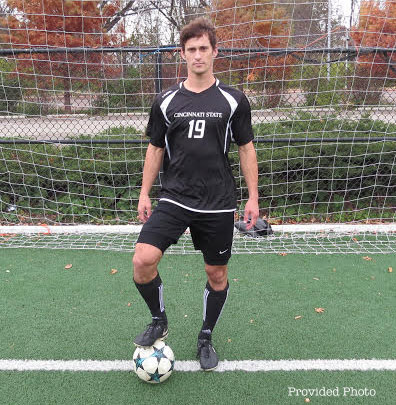
    “Anders has been there for me every step of the way through my journey and I’m always going to be there for him,” said Cam Louder. “Anders and I push each to do the best we can and we feed off each other’s challenges.”

    Persevering Through His Disability

    Anders Michelson

    Disabilities have a way of affecting a person’s development, confidence, and attitude at different times of their lives. At the onset of Ander’s disease, he weighed only 60 pounds. In one week due to high blood sugar levels and ketones, he lost over 25% of his body weight and dropped to a frail 42 pounds at the age of 9. High blood sugar had a direct impact on Ander’s energy level and physical capabilities and playing on the Milford A team was difficult. Unfortunately, the following season he was cut, but that did not stop him from chasing his dream. He continued to play a year up in age on the B team for 3 years and worked even harder. At the age of 13, he moved back up to the Milford A team. Although small in stature Anders had incredible speed and over the next few years he worked on his technical skills for dribbling and finishing the ball. He became a better soccer player, but size was still a roadblock as he was approaching high school. His teammates were growing at a much faster rate. Most kids were weighing 150 lbs and 5.6 feet tall on average. Anders was under 5 feet tall and weighed under 100 pounds. He couldn’t even lift the bench bar as a freshman in high school which was only 45 pounds. Anders had no alternative, but to play on the Milford JV team for 2 years. However, in his junior year of high school, he made it to Milford’s Varsity Soccer Team. His entire high school career was dedicated to working hard in soccer and academics.

    Anders achieved 1st Team All-City and was awarded MVP of the 1st team All-City Game, Eagle Award, District Champions 2008 and 2011 and 2nd in Conference in 2009 and 2010

    While playing with the Milford Soccer team he achieved 1st Team All-City and was awarded MVP of the 1st team All-City Game, Eagle Award, District Champions 2008 and 2011 and 2nd in Conference in 2009 and 2010. Anders was contacted by several colleges while playing Varsity, but he didn’t have the full confidence to go for his soccer dreams. His disease was still in the forefront and he wondered about the longevity of an athletic career and how diabetes was currently affecting his ability, weight, and size. 

    In college, he started playing pick up soccer and noticed his abilities increased. He actually grew more into his body than ever expected and this is when his regret of choosing not to play soccer sank in.

    Over the years, Anders gained encouragement from his older brother Peter and he was able to consistently work out and gain muscle mass while attending Miami  University. In college, he started playing pick up soccer and noticed his abilities increased. He actually grew more into his body than ever expected and this is when his regret of choosing not to play soccer sank in. Yet, his disease still had a grip on him and his diabetes was actually spinning out of control. His Doctor gave him the bad news of sustaining over time an A1C of over 10 (measure of average blood glucose over the past two to three months) which meant Ander’s diabetes was poorly controlled and will eventually lead to major complications, such as heart attack, stroke, blindness or eye damage, foot infections or amputation, or kidney damage possibly leading to chronic dialysis or even sudden death. Doctors warned him if he didn’t control his diabetes that his life expectancy wasn’t predicted to go beyond 10 years.  

    He’d wake in the middle of the night thinking about his fate of dying young and not playing soccer. That’s when his epiphany began.

    After college Anders worked as a finance broker and continued battling the terrible progression of diabetes. After receiving the news about his A1C tests he had constant nightmares. He’d wake in the middle of the night thinking about his fate of dying young and not playing soccer. That’s when his epiphany began.

    Soccer was the answer

    With the full support of his family, Anders quit his job and began conditioning his body. Part of his conditioning plan was enrolling at Cincinnati State and playing college soccer. For the last year, he has been committed to grueling workouts which include a weekly routine of running 18 miles a week, 30 miles of bike resistance training, 6 hours of weights, 2 hours of abdominal work and 12 hours a week of soccer practice and games.

    Anders and I push each to do the best we can and we feed off each other’s challenges.

    He also trains and works out with his old buddy, Cam 6 hours a week at Five Seasons Sports Club. Anders goal is to increase Cam’s upper body strength for independence and to get Cam strong enough to walk with a Kaye Walker and out of his wheelchair. Cam said, “Anders and I push each to do the best we can and we feed off each other’s challenges.”

    As if this wasn’t physically demanding enough, Anders also has a physical job working for his family business, AquaMarine Pools and Spas part-time. 

    What’s Next…

    Looking back when entering college Anders was 5’10 145 lbs, now he comfortably sits at 6’1’’ 176 lbs. Doctors told Anders that if he could obtain A1C below a 7 his energy levels would triple. He thought it was impossible. Today Anders has achieved an A1C of 7.2 and feels the positive effects physically and mentally.

    My goal is to prove that your disability is not an inhibitor, it can be a motivator, differentiator.

    Perseverance has a way of paying off and now Anders will face one of his biggest challenges thus far; he has applied to the United Soccer League and is awaiting an invitation to try out for FC Cincinnati. He is refusing to allow diabetes to define him and is determined to chase down his lifelong dream of playing competitive soccer. Anders wants to become a role model for all people with disabilities. He said, “My goal is to prove that your disability is not an inhibitor, it can be a motivator, differentiator and improve your stamina and mental strength. I am beyond pumped up to prove my ability to FC Cincinnati.”

    Wishing him luck, Cam added, “I’m thankful for Ander’s lifetime friendship.”


    Follow along on Anders journey to FC tryouts on Instagram anders_michelson@instagram.com