Cassie Mattia is a resident of Historic Downtown Loveland
Loveland, Ohio – Unicorn Bark, Penny Candy, Salted Caramel Chip Ice Cream, Peanut Butter Banana Bark, Berry Berry Bean Ice Cream and Chocolate Covered Race Cars are just a few of the unique delicacies Loveland Sweets offers that keeps guests all across Ohio coming back for more.
Loveland Sweets started its delicious adventure in 2006 when resident Gloria Wilson opened its doors.
“I had always had a dream in the back of my mind that involved opening a candy store,” Wilson said, “Every time I went on vacation I always searched for a candy store and when I moved to Loveland I realized it had that same vacation feeling with the bike trail, the restaurants, the beautiful scenery – the only thing missing was a candy store so I thought why not open a candy store!”
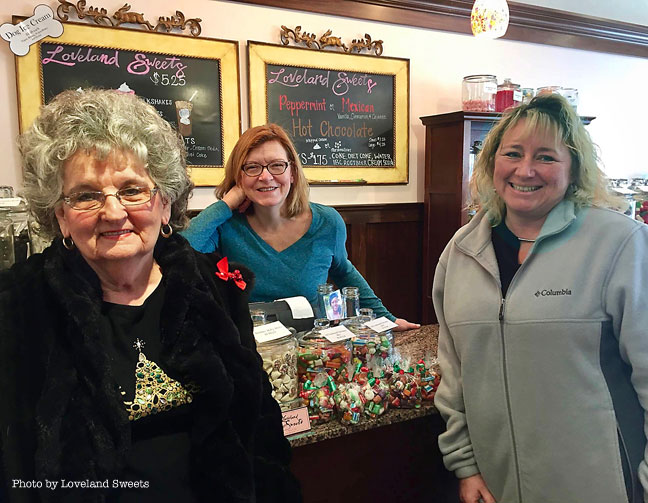
Gloria Wilson (center) said, “I want to celebrate a simple pleasure with those that visit my store.”
Although Wilson’s background was in Environmental Science and Biology that did not scare her away from the idea of owning her own business.
To be quite honest I had no business plan I just had a dream and at that moment in my life it was time to pursue it.
“I didn’t have a business background but I learned a lot from the landscaping business I was in before as a landscape designer. To be quite honest I had no business plan I just had a dream and at that moment in my life it was time to pursue it,” Wilson said.
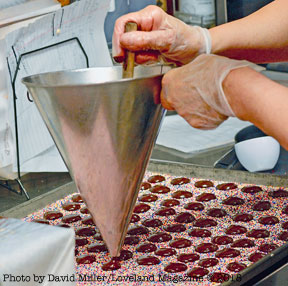
Loveland Sweets is not only known of course for its novelty sweets but it’s also known for its unique chocolates and ice cream combinations. Loveland Sweets uses high quality fine chocolate and only the best ingredients when creating the fillings to their chocolates and ice cream blends.
“A lot of businesses use cheaper chocolate, but I don’t do that. I know it reduces my profit margin, but I don’t want to do less than the best chocolate,” Wilson explained, “The chocolate I use is Callebaut and I make all my fillings from scratch. We don’t necessarily use a certain process when creating our chocolate because chocolate calls the shots. We temper the chocolate. Our combinations are where we use our creative side. They are sometimes inspired by something else like our Unicorn Bark! Sandy my co-worker saw this in a magazine and we thought why not try it out! We did a new one today called Peanut Butter Banana Bark. I was at Trader Joes saw the dehydrated bananas and I was like we can do something with this,” Wilson said.
So just how did Gloria come up with the Loveland Sweets name? It’s simple everyone just loves the Loveland name on their candy! I mean Loveland is the Sweetheart of Ohio!
So just how did Gloria come up with the Loveland Sweets name? It’s simple everyone just loves the Loveland name on their candy! I mean Loveland is the Sweetheart of Ohio!
“When I was trying to figure out a name for my candy shop I got out a notebook wrote lots of names and settled on Loveland Sweets not realizing people love the name Loveland. People want to be sure that the name Loveland is on their box of candies or sweets. It’s especially big with weddings,” Wilson said.
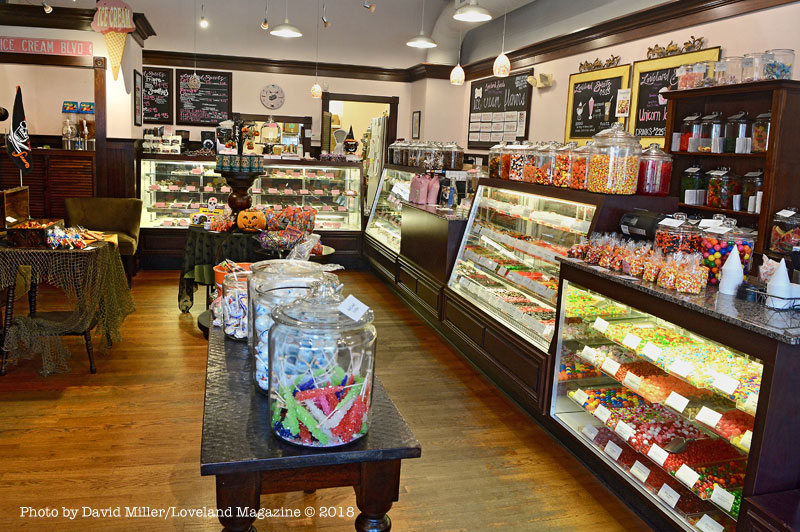
The obvious reason for going to Loveland Sweets is to of course experience its handmade chocolate creations, create your own goodie bag for the kids full of sweet and sour gummies or get a warm cup of their custom blend coffee, but another reason to stop by is to take a look at the old fashion candy store décor.
Gloria Wilson said she loves the penny candy and the race cars and of course the old fashion drawers of the old fashion candy store décor.
“When I was first opening the store I wanted it to look old fashion with a modern twist but not too modern. I love the penny candy and the race cars and of course the old fashion drawers,” Wilson said, “When people come into my store I want them to see my creative side that’s my favorite part of this it’s the creativity aspect of owning my own business. I want to celebrate a simple pleasure with those that visit my store. Candy makes people happy. It’s a celebration of happiness, like my ice cream castles in my front windows. I want my guests not only to enjoy my candy but also enjoy the experience they have when visiting my store,” Wilson said.
Loveland Sweets is now known as one of Downtown Historic Loveland’s top go to spots for both travelers and residents when exploring the Downtown Loveland area.
There are not a lot of people making their candy and ice cream on site anymore.
“I think what really keeps people coming to my shop is that it’s not a chain. So many places are chains all across America. It’s homogeneous. Loveland Sweets is unique. We make our stuff in house where as a lot of places do not do that. There are not a lot of people making their candy and ice cream on site anymore. This is what keeps out of towners and locals coming back,” Wilson explained. “You really get to know people! I find myself saying things like ‘Oh is the dark chocolate almond guy coming in!’ You know people by their favorites!”
One of the “Tricks” to Loveland Sweets’ success is they always have seasonal “Treats”.
Though Wilson has dedicated her life to sweetening her guest’s day she hasn’t forgot about her environmental background trying to bring that passion to the sweets business as well.
“Plastics are a nightmare so I have brought in pink paper bags that are paper made from a bi product of sugar cane. Our ice cream cups, paper straws, plastic cups and spoons are made from corn. My transition into being completely plastic free is not perfect yet but I’m trying to minimize the use of it as much as I can,” Wilson said.
“Plastics are a nightmare so I have brought in pink paper bags that are paper made from a bi product of sugar cane. Our ice cream cups, paper straws, plastic cups and spoons are made from corn. My transition into being completely plastic free is not perfect yet but I’m trying to minimize the use of it as much as I can,” Wilson said. “The young people that work for me reinforce my environmental friendly ideas and I want to make an impact on them. We recycle and we compost our coffee grounds as well.”
There are not a lot of people making their candy and ice cream on site anymore. This is what keeps out of towners and locals coming back,” Wilson explained.
If your wandering around Downtown Loveland and are looking for something unique to satisfy that sweet tooth skip on over to
Loveland Sweets to visit Gloria and her team of confectionery geniuses! Loveland Sweets is located at 124 West Loveland Avenue and is open from 9 AM to 9 PM every day. If you would like to contact Loveland Sweets or check out their beautiful products, visit Loveland Sweets on Facebook or Instagram or call 513-583-8305.
Loveland Sweets is in Historic Downtown Loveland, Ohio.
Loveland, Ohio – On Saturday, September 22 The Captain Seth Mitchell HERO 5K will be held in Nisbet Park in Historic Downtown Loveland – for the ninth straight year. The race is organized each year by Mitchell’s former classmates who miss their friend and want to keep his memory alive. They represent the many people who Seth made an impression on with his sense of humor, kind heart, and loyal friendship. The race raises scholarship money for graduating seniors at Loveland High School.
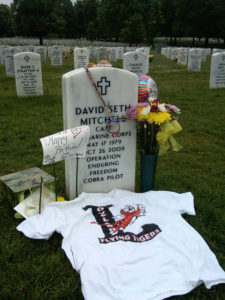
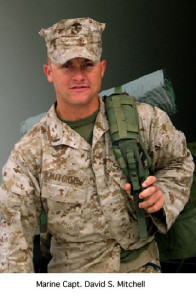
Captain David Seth Mitchell
Mitchell was class president his senior year at Loveland High School in 1997. He died in 2009 in a helicopter crash in Afghanistan on a mission he volunteered for.
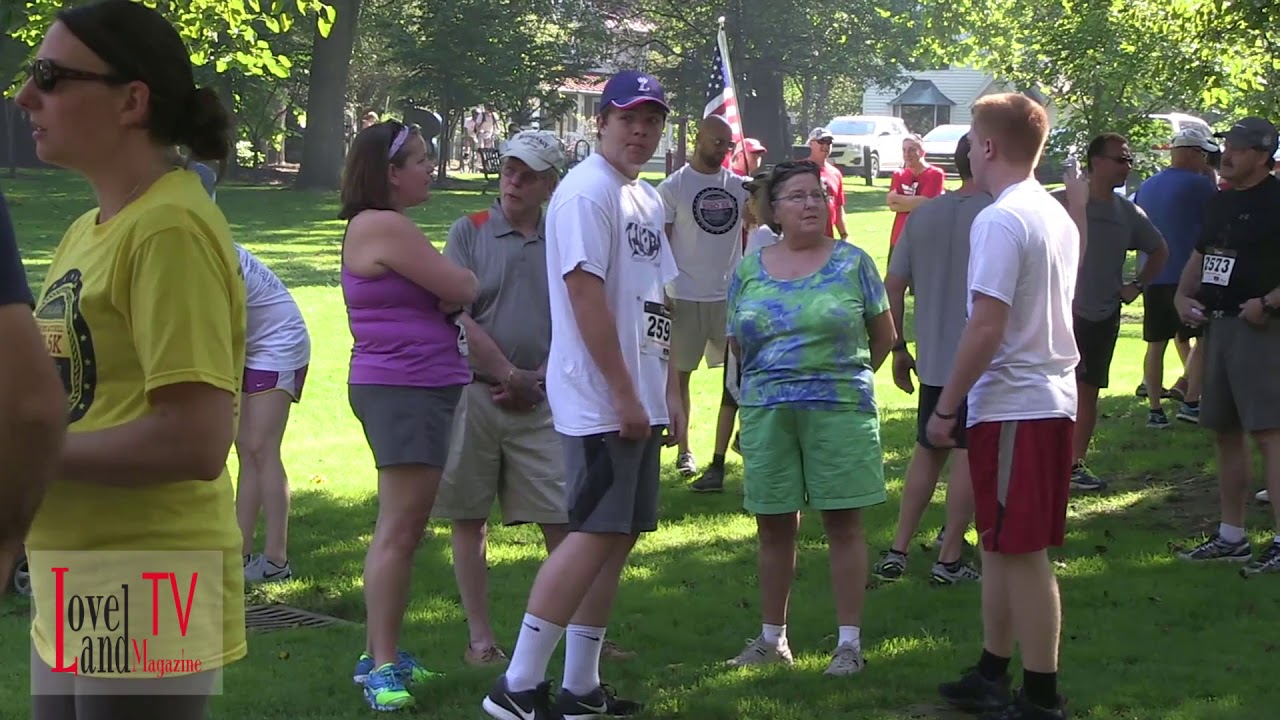
In the first LOVELAND MAGAZINE TV video, you will see clips from last year’s event
The second video is Seth’s father Steven Mitchell thanking the participants, sponsors, and the organizing committee and announcing that last year was a record for the amount of money raised at the race, more than $10,000. Mitchell told the young people in the crowd to learn about and remember the life his son led, “You will make a difference in somebody’s life someday.”
Captain David Seth Mitchell is resting in Arlington National Cemetery
The event features a cookout and festival during and after the race.
For more information about the race and to participate in being a sponsor: please contact…
We need many volunteers to help with the race and festival.
If you’re not running or walking that day, please consider supporting us by serving in this vital capacity. Contact info@sethmitchell5k.org if you’re interested!
Loveland Magazine is a Sponsor of The Captain Seth Mitchell HERO 5K
Saturday – September 22nd, 2018
Pre-Race Event: Come early to hear from the Mitchell Family and past winners of the Seth Mitchell Memorial Scholarship.
The Course: Starting at 11am, the 5K course begins and ends in historic downtown Loveland at Nisbet Park and will include part of the Loveland Bike Trail.
ONLY at Nisbet Park on Saturday morning, Race Day, September 22nd starting at 9am.
Awards:
All kids 18 and under will receive participation HERO 5K Wrist Bands. Top 3 male/female walkers and runners in each age category will receive awards (19-29, 30-39,40-49,50-59, 60+) Race results will be posted on www.runningtime.net
Join us for a cookout and festival during and after the race! Nisbet ParkFood, Games, and more…
The following is an excerpt from Chapter Seven of The Search for the Underground Railroad in South-Central Ohio by Tom Calarco, scheduled for publication in late October by History Press. It is being published with permission from History Press.
Tom Calarco is a resident of Historic Downtown Loveland, Ohio.
By Tom Calarco
Part Two of Two
Butterworth Station of Loveland and the Underground Railroad: Further Recollections
In 1894, Robert Carroll provided the Cincinnati Times-Star with his account of the assistance he gave the Butterworths in their work along the Underground Railroad.
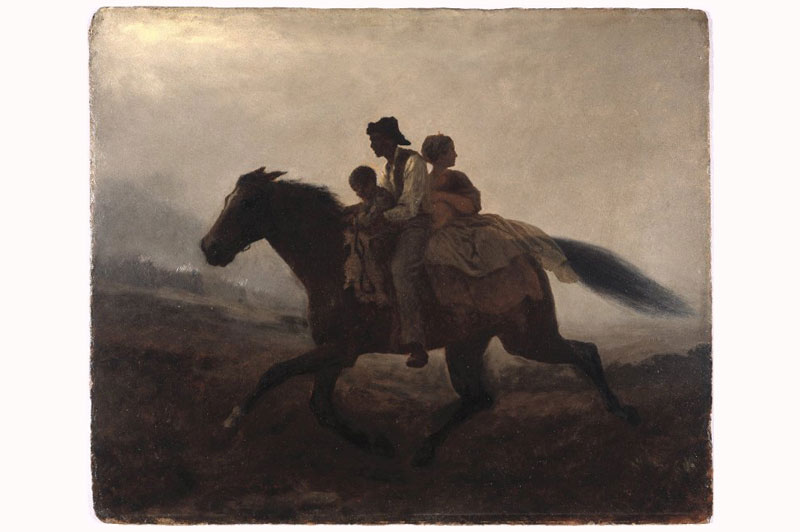
Often, in this wild flight for freedom, the master, with his unhuman helpers was in close pursuit, armed … devoid of mercy, protected by the law, and supported by a public sentiment that was respectable … Whether the pursuit was or was not immediate and pressing, it was always probable and expected, so that the runaway was in the condition of the hunted . . . .
By 1820, the old stone house overlooked the fields as it does today along the Little Miami Bike Trail just outside of Loveland in Hamilton Township.
Along the banks of the Little Miami River in the hilly countryside north of Cincinnati, stands an old stone house, a relic of slower days, when there was lots of land and few people. It is not lived in much these days, but a big family of Quakers lived there for many years. Their forefather, Benjamin Butterworth was a six-foot six inch pioneer, a giant of a man who was said to have weighed 300 pounds. His roots in America dated back before the 1700s. Born in Virginia, he fought in the Revolution and was entitled to purchase a grant of land in the Northwest Territory, in the Virginia Military District, of which much of Ohio was part. This land and his inheritance provided him with substantial wealth. He was like many future Ohioans who would settle the new state: a slaveholder who freed his slaves and took them along to where there was no slavery.
The people that helped [fugitives] . . . had no rational hope of compensation. On the contrary, they gave aid, with the certainly of the loss of time and money, and with the possibility of fines and imprisonment.
One early morning I was told to go up in the haymow. On doing so I was somewhat startled to see half a dozen black persons hidden away. That day they lay hid and their food was carried to them with secrecy. About 9 o’clock that evening we hitched up, [and] cautiously loaded the vehicle with its human freight, and carefully fastened down the curtains.
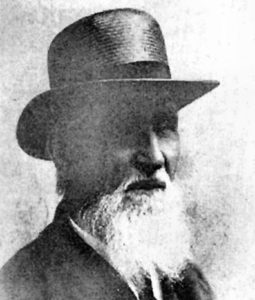
Thomas Butterworth
Thomas Butterworth was there and assisted. It was raining; the sky was still clouded and the roads wet and muddy. We went at first by a lane, across the farm of Butterworth, another of the brothers … We soon struck the main road and turned our course towards the North Star . . . . We drove along at a round pace, always on the lookout for pursuers, and it must be confessed, somewhat nervous. Now and then we stopped, and by the struggling moonbeam’s misty light, carefully scanned the road in both directions. We crossed Todd’s Fork near the site of Morrow; drove past Rochester and Clarksville and on through the night to Harveysburg, where we arrived just after daylight. As we traveled along the stories of the blacks were told.
We soon struck the main road and turned our course towards the North Star. Now and then we stopped, and by the struggling moonbeam’s misty light, carefully scanned the road in both directions.
In one, a slave trader had come to their plantation which meant the possibility of being sold to the Deep South where they would be overworked in brutal conditions with the likelihood of dying an early death. Another was family of three, whose twelve-year-old daughter was under consideration of being sold away. They stole a skiff and rowed down the Licking River to Cincinnati. A third told of a man who contracted out to work and earn money which he was using to pay for both the freedom of himself and his wife. Unfortunately, his wife was owned by a different master, a Baptist minister in fact, who sold her away to the Deep South.
Unfortunately, his wife was owned by a different master, a Baptist minister in fact, who sold her away to the Deep South.
“Scruples of conscience at violating the Fugitive Slave Law readily vanished before such narrative[s],” Carroll said.
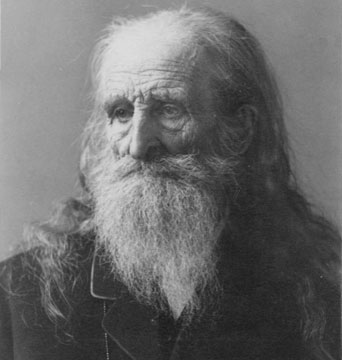
Ready to vanquish any such scruples was an eccentric and intensely intellectual abolitionist and free thinker, Orson S. Murray who moved into the Butterworth neighborhood sometime in the early 1840s. Long hair, scraggy beard, he was an unappealing, atheistic version of Jesus Christ. He had come from Vermont, where he’d been a fiery antislavery speaker who antagonized the already angry mobs gathering at antislavery lectures all over the North. Here in remote Ohio he found some solitude, a haven for his ideas, and people who would tolerate him.
Orson S. Murray who moved into the Butterworth neighborhood sometime in the early 1840s. Long hair, scraggy beard, he was an unappealing, atheistic version of Jesus Christ.
Murray already had done some writing in metaphysical journals of the day and had published his own newspaper in Vermont, The Telegraph. He started another newspaper, the Regenerator, not far from the Butterworth backyard. Its motto: ignorance was evil and knowledge its remedy.
Here’s what William Burleigh, the brother of eccentric antislavery speaker, Charles Burleigh, whom Murray named one of his children after, wrote about the Regenerator: “Mr. Murray appears to be a benevolent and self-denying man–is very eccentric in his appearance–very wild in many of his notions–and a very unsafe leader, for he leads into the mazes of skepticism and infidelity.”
And here’s what Murray had to say about the Regenerator himself: “If the Regenerator has helped to dispel and disperse the delusion, that that book [the Bible] is the voice of a god–and to show that it is only the words of men–men, some of them, in profound ignorance and darkness on the subjects they were pretending to elucidate–it has done something towards accomplishing one of the principal objects which have impelled me to do the very unpopular work of publishing it.”
Legends say he might’ve helped some fugitives too. He lived until 1885, dying at the age of 78.
Butterworth’s daughter Jane also wrote to Siebert, of her memories when she was about six or seven years old:
I saw no people of color, heard no words, but I was sure there was such in our wagon.
Among my earliest recollections, I was awakened about sunrise by the stopping of my father’s large wagon and two horse, and [him] handing me a little child 5 or 6 years old over to the care of a thrifty woman [who had come] out of a well-kept farmhouse, while he gave a shrill whistle for the men to come up from the field. I was taken into the house and seated in a small chair. The woman then gave me some freshly baked ginger bread while father talked with the man. I did not understand so unusual a visit at that place and time of my life for nothing was explained to me and I saw no people of color, heard no words, but I was sure there was such in our wagon. But as I grew older and learned about the Underground R.R, I knew that we were in that business then. [After] that time I [went] with my father on this said business when I was old enough to know about it. Several times I remember mother coming to our bedroom late at night and getting [us] all up in a hurry and putting us in bed elsewhere to give our bed to a lot of fugitives who come weary and tired, and our grandmother [Rachel who died in 1848] would tell them to “go to sleep, you will be safe in that room, nobody will get you there.”
Several times I remember mother coming to our bedroom late at night and getting [us] all up in a hurry and putting us in bed elsewhere to give our bed to a lot of fugitives who come weary and tired.
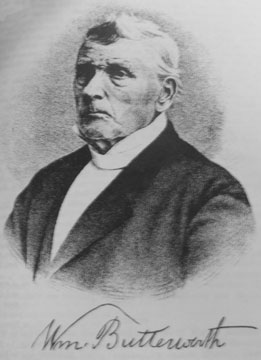
William Butterworth
Thomas said his brother, William, who lived a few miles north in Maineville, probably helped twice as many as him. How many is not known though Thomas said he probably helped as many as one hundred. Family anecdotes, however, suggest more, including stories of single parties numbering as many as 26 belying Thomas’s count. The important thing though was that all were brought safely to freedom.
“I can say in truth that such was our success that I do not believe a single one was ever re-captured and taken back to slavery,” he said.
1. Robert W. Carroll, “An Underground Railway: Fugitive Slaves and the Butterworths,” Cincinnati Times-Star, August 19, 1896, Siebert Collection.
2. Review of The Regenerator by William H. Burleigh, editor of the Christian Freeman, Jan. 22, 1844: 14 < https://popularfreethought.wordpress.com/browse-by-title/regenerator-1844-1854/ >
3. Extract from a Letter.” 175 (Jan. 1854): 353 < https://popularfreethought.wordpress.com/browse-by-title/regenerator-1844-1854/ >
4.Henry T. Butterworth to Wilbur Siebert, June 9, 1892, includes recollection of Jane.
Cassie Mattia lives in Historic Downtown Loveland, Ohio.
If we don’t protect our youth who will? In May, Ohio Paul Zeltwanger and Thomas Brinkman proposed House Bill 658, which states:
“If a government agent or entity has knowledge that a child under its care or supervision has exhibited symptoms of gender dysphoria or otherwise demonstrates a desire to be treated in a manner opposite of the child’s biological sex, the government agent or entity with knowledge of that circumstance shall immediately notify, in writing, each of the child’s parents and the child’s guardian or custodian. The notice shall describe the total circumstances with reasonable specificity.”
gen·der dys·pho·ri·a
ˈjendər disˈfôrēə/
noun
MEDICINE
The condition of feeling one’s emotional and psychological identity as male or female to be opposite to one’s biological sex. How to pronounce gender dysphoria.
In plainer language House Bill 658, also known as the “Parent’s Rights Bill,” would make any school administrator or teacher who allows or offers gender dysphoria (the condition of feeling one’s emotional and psychological identity as male or female to be opposite to one’s biological sex) treatment, including resources on sex and gender or counseling, for a minor “without the written, informed consent of each of the child’s parents and the child’s guardian or custodian” they could be charged with a felony in the fourth degree. The parents of the student according to the bill would get the ultimate decision whether their child gets access to treatment, including educational materials, counseling or medical services.
If this House Bill is implemented it could have detrimental consequences for teachers and even more importantly for those students affected. Teachers are there to lend their students a helping hand educationally and emotionally in order to prepare them for what’s to come once they are out on their own, why take this from them?
A teacher’s take on House Bill 658
I spoke to one Loveland teacher who wishes to remain anonymous, a mom of a teenager. I’ll call her Susan. She told me that for many students their home life is a wreck and out of control with issues of poverty, broken families, and domestic abuse. “For many of my students, the only adult in their life that can be trusted may be their teacher. Teachers who lend an ear and can be trusted can be an enormous help that often reflects on their academic achievement. We care for the whole child.”
Susan told me that for many students their home life is a wreck and out of control with issues of poverty, broken families, and domestic abuse. “For many of my students, the only adult in their life that can be trusted may be their teacher.”
Susan told me that she just overheard a conversation between her daughter and a friend about a classmate they thought was transgender. “I wondered, do they know what that means? Are they friends with this young person? How do my kid and others treat her? Because I am a teacher, would I be required to file a report with the District? These are all questions that ran through my head as a mom and a teacher.”
Susan said she wants to protect and support all of her kids, her biological ones and the ones that are “her’s” for a school year. “I want to be able to do that freely and openly and with my heart.” She said that some of her students desperately need someone they can trust in their life and the last thing they need is another person that will let them down because politicians want school staff charged as felons if they don’t report that the student herself, or a classroom teacher, principal, gym teacher, bus driver, or classmate may be questioning her gender identity.
Susan asked, “Just what stereotypes am I going to be expected to police?
HB 658 is a harmful bill that takes aim at some of our most vulnerable — transgender youth — by forcing school officials to serve as ‘gender police’ and out them or risk getting a felony.” – Alana Jochum
LGBTQ advocacy
“HB 658 is a harmful bill that takes aim at some of our most vulnerable — transgender youth — by forcing school officials to serve as ‘gender police’ and out them or risk getting a felony,” said Alana Jochum, executive director of LGBTQ advocacy group Equality Ohio. Jochum told NBC News. “This exposes young people to discrimination, harassment, and bullying.”
Jochum couldn’t be more correct if you really take a look at the alarming statistics. One study done by the Cincinnati Enquirer showed that 64% of LGBTQ youth in Ohio heard “negative comments” about their gender identity or sexual orientation from their family and in result, according to another study done by National Transgender Discrimination, 41% attempted suicide. Though many transgender students
75% of transgender youth have felt unsafe at school after being outed and have lower GPA’s due to missing school in fear of their safety.
have experienced negative comments, violence has become the most popular form of dealing with transgender youth. Disturbingly enough 19% of transgender youth, according to the National Center for Transgender Equality, experience the majority of violent abuse in their home from their own family members. Along with dealing with all the dissension from family members 75% of transgender youth, according to a national survey done by GLSEN (pronounced “glisten”), have felt unsafe at school after being outed and in result have lower GPA’s due to missing school in fear of their safety. With all the facts at hand, The Ohio Education Association who represents 125,000 teachers and support professionals, have openly opposed the bill.
Violence has become the most popular form of dealing with transgender youth.
Kathryn Lorenz is the Loveland Board of Education Vice President
While researching House Bill 658 I managed to only get a response from two local representatives of the Loveland School Board, one being Kathryn Lorenz, the Board Vice President and the other being Loveland School Board Member, Ned Portune. Lorenz’s response was, “In the case of House bill 658, we would have to say that we do not yet have enough information, nor have we met as a board for a few weeks, so we do not yet have a Board statement to make.”
Ned Portune is a member of the Loveland School Board
Portune added that he, “…simply has not been fully informed at this point on HB 658 to have an educated opinion. There are several items in your statement that would certainly give me a gut reaction, and opinion on, if true as presented. But I need time to fully review the Bill, its implications and existing laws to have any formal statement.”
School Superintendent Amy Crouse, High School Principal Peggy Johnson, and assistant principals at the High School did not respond.
Studies show most transgender youth are fully aware of their gender identity by age 4.
After attempting several times to contact both Representatives Paul Zeltwanger and Thomas Brinkman through email and phone about House Bill 658, I, unfortunately, got no response. It wasn’t hard to find Brinkman’s opinion on the issue in several other publications though, voicing to WCPO, “Parents have the right to decide what is best for their children,” and telling WOSU Public Media, “And if somebody doesn’t like it, you’re emancipated at age 18 and you can go do whatever the heck you want.” Seems pretty harsh considering the transgender population represents about 0.3% (700,000) of Americans and studies show most transgender youth are fully aware of their gender identity by age 4. Are we encouraging parents and administrators to discard their students or child’s gender identity in fear of social rejection? Do these children not deserve to live an authentic life?
Fran Hendrick, PCC has offices at Wildflower House in the West Loveland Historic District.
House Bill 658 is expected to be presented to the Ohio General Assembly in the Fall and will be without a doubt one of the most controversial bills to date. Many have opinions on this issue one being Fran Hendrick, a respected and highly educated clinical counselor who specializes in assisting women and girls who are experiencing depression or anxiety triggered by a crisis or major life change. When I presented Fran with House Bill 658 and asked what her opinion was she had a lot to say and rightfully so considering one of her life missions, according to Fran’s website franhendrick.com, is to “gently help you find and shelter your spark (the essence of who you are at your core) and grow it so that it illuminates your person and is radiated through words, actions and decisions, big and small, that make up your daily life.”
In a culture such as ours, it is a matter of life and death for transgender youth to decide if and when to trust another person with their reality. – Fran Hendrick, PCC
“Being a parent takes great courage, even more so when your child presents you with something that you’re unfamiliar with – or even afraid of. In a perfect world, a child who feels somehow ‘different’ from their peers (‘their’ is deliberately gender-neutral), they could consult their parents, who would strive to deeply understand the child’s experience, would provide accurate empathy, and would go on a crash course to learn everything they could about the unfamiliar issue. And, so very fortunate for their children, there are many parents like these.
But in the real world, an adolescent boy saying to his father, ‘Dad, I think I’m a girl’ is very likely to encounter disgust, rejection, rage, or even violence, not empathy and understanding.
While the intent of this bill, giving benefit to grave doubt, could be a deeply uninformed and misguided attempt to protect children, that seems unlikely. My sense is that in truth it is more about attempting to hand parents the power to say no to their child’s gender identity,” Hendrick said, “But gender identity – and sexual orientation, for that matter – are not matters of choice. And in a culture where transgender people are assaulted and even murdered at a rate higher than their cisgender counterparts,where transgender youth are summarily shunned and rejected by their own parents (the rate of homelessness is, not surprisingly, very high), where the suicide rate that results from these atrocious facts is far higher than for other youth – in a culture such as ours, it is a matter of life and death for transgender youth to decide if and when to trust another person with their reality, and, most importantly, whom to trust.
To be “outed” for the choice to trust; or to be prosecuted for trying to be help – these are not protections. Actions like these support bigotry, and increase isolation and despair. – Fran Hendrick, PCC
To be “outed” for the choice to trust; or to be prosecuted for trying to be help – these are not protections. Actions like these support bigotry, and increase isolation and despair. Stopping a teacher from helping such a student, one who is likely alone with the reality of their gender identity, who stands to be emotionally and psychologically rejected, or even physically abused, by their own family is, quite simply, a cruelty. This, I strongly believe, is not what the overwhelming majority of parents want for their own or anyone else’s children. This is bad enough. However, this bill opens the door to much more far-reaching damage than this.”
Is he to be turned in to the gender police?
The talented young male artist who despises sports – is he to be turned in to the gender police? The girl who chooses overalls and a t-shirt rather than a dress and a mani-pedi –what of her? The sponsors of the bill have explicitly said that teachers should be required to inform on them, as well. We have an essential responsibility to ensure that proposed legislation protects vulnerable people from the bigotry endemic in our society.This legislation explicitly deprives them of protection.”
Ultimately what it comes down to is ensuring that our children are and feel safe when going to school. Teachers and administrators are the ones that take on the responsibility of creating that fun, loving and supportive atmosphere so that our children get the best opportunities in life. Passing a bill such as House Bill 658 only presents another obstacle that both teachers and administrators have to overcome. Don’t these professionals have enough obstacles to conquer as is?
Both Justin Haake and Tonya Schaeffer who are Professional Clinical Counselors for Hope Restored Counseling Services in Loveland couldn’t agree more.
Justin Haake is a Licensed Professional Counselor at Hope Restored Counseling Services in Loveland and works primarily with adolescents and adults, specifically during transitional periods in life.
Haake said, “For some, teachers and school administrators may be the only people in schools that feel safe for students to reach out to.Imagine the fear of asking for support, knowing that you’ll either be outed or put the teacher or administrator at risk of a felony.”
Schaeffer said, “From my perspective, this would most likely increase the level of bullying and possible harm to these students.There is already so much shame and stigma attached with Transgender people, and they need as much support as they can get,”
Tonya Schaeffer is a Licensed Professional Clinical Counselor and co-owner of Hope Restored Counseling Services in Loveland.
Schaeffer added, “Support is out there.In fact, we are offering a psycho-educational group starting in September that offers education, support and a safe environment for Transgender students to express themselves.” She said they hope to offer a similar group to parents who are trying to understand what their child is going through, explore what the parents are experiencing and provide support. “We currently serve the LGBTQ community, and we are expanding those services.I recently read a statement that it is estimated that 41% of trans men and women have attempted suicide. I don’t believe this bill would help–it seems like it could only hurt.”
Susan, the mom and teacher said, “I am thankful I live in a community where support services like those provided by Hope Restored, and Fran Hendrick at Wildflower House are nearby for my students and their families.”
Transgender youth have so many mountains to climb within their own scientific makeup and allowing a bill like House Bill 658 to go through in hindsight is taking away their basic rights as Americans and human beings.
“GLSEN (pronounced “glisten”) was founded in 1990 by a small, but dedicated group of teachers in Massachusetts who came together to improve an education system that too frequently allows its lesbian, gay, bisexual, transgender, queer and questioning (LGBTQ) students to be bullied, discriminated against, or fall through the cracks.”
You may compete as a two person team (use a canoe)
or individually (use a kayak).
Please note: The minimum age for competing on a team is 10 years old and as an individual is 16 years old.
$130/Team
$70/Individual
The race will begin at 8:30 a.m. with a staggered start.
Registration/Check-in will begin at 7:30 a.m.
Race will begin and end with all transitions at Loveland Canoe & Kayak (174 Karl Brown Way). All participants will be bused to start line (Carl A. Rahe Access). Singles in kayaks will start the event, followed by team canoe divisions.
Race Divisions:
Team (16+), Parent/Child Team (10+), Male (16+), Female (16+), Senior (55+)
Event t-shirts will be available for purchase for $15 each (deadline for advanced purchase is September 9th).
Canoes, kayaks, life jackets, and paddles will be provided. Participants are to provide their own bicycle (road bike is recommended). Life jackets must be worn at all times while on the water. Bike helmets must be worn at all times while on your bike. No headphones are allowed during any portion fo the race. Failure to comply with the safety rules will subject contestants to disqualification.
A photo ID is required and waiver must be signed and submitted in order to receive your race packet and bib/timing chip. This is a rain or shine event and there are NO refunds. In the event of severe weather the start may be delayed and the course may be altered for safety reasons.
Please respect your fellow participants. There will be all types of skill levels competing so please stay aware of your surroundings at all times.
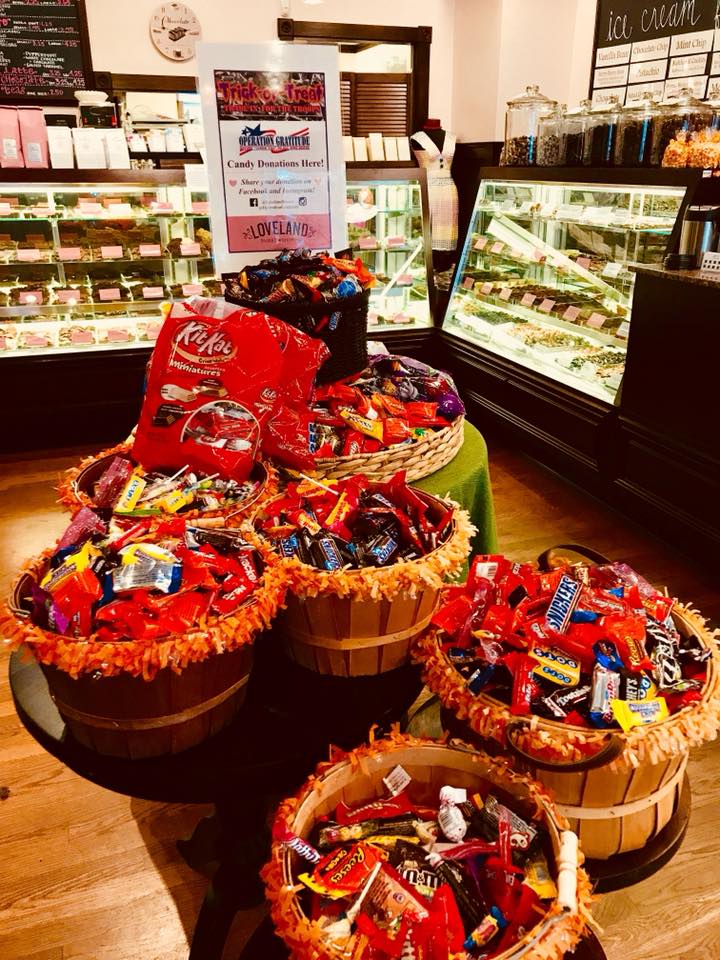
Loveland Sweets asked its customers for candy, and they came through with flying colors!
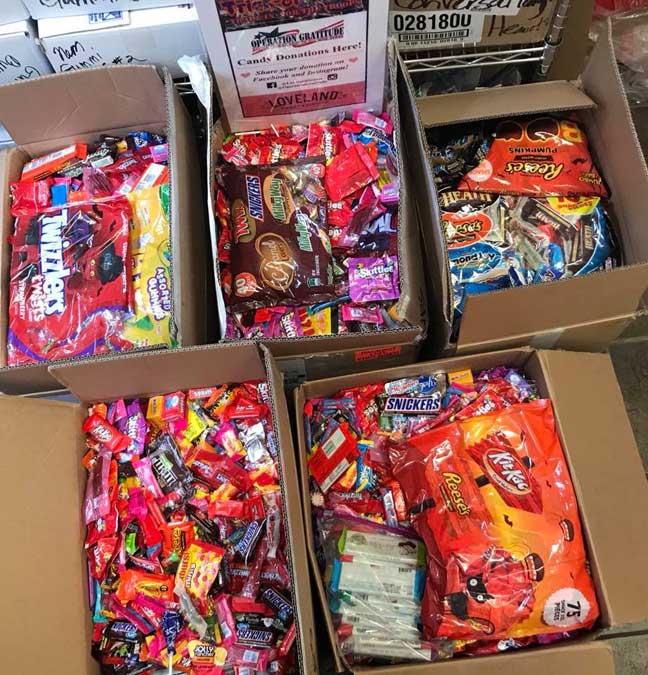
Some of the 700 pounds of Halloween candy collected by Loveland Sweets that will be donated to Operation Gratitude.
Loveland, Ohio – From November 1st through the 13th, more than 700 pounds of unwanted or leftover Halloween candy was brought to Loveland Sweets in Historic Downtown, to be donated to Operation Gratitude. In exchange, more than 100 customers received a coupon worth 20% off their next purchase. The store is donating all of the traded-in candy to Operation Gratitude to be sent in care packages to our military troops and their families serving all over the world.
“Frankly, we are overwhelmed with the response, but we should not be surprised,” said owner Gloria Wilson. “Our community has always been a giving community, so the fact that our customers shattered our expectations simply reinforces why we love having our business in the Loveland area.”
The 20% discount applied to any purchase and had no exclusions, so it could be used to take home some of the shop’s award-winning chocolates, handcrafted ice creams, homemade caramel apples, rich coffees, or of course any bulk or specialty candies in the store.
Inspired by a love of fine chocolates and homemade confections, Gloria Wilson founded Loveland Sweets in 2006. The business has grown to include ice creams and coffees, but the commitment to high quality artisan products remains unchanged. The house-made candies and ice creams are lovingly created in small batches featuring premium ingredients as well as local dairy products and fresh seasonal fruits. The coffee is a rich and aromatic custom blend available only at Loveland Sweets. The Shoppe offers fine teas and hot chocolate as well as seasonal favorites such as handmade caramel apples. The
Loveland Sweets is located in Historic Downtown Loveland at 124 West Loveland Avenue,
Loveland, OH 45140, 513-583-8305. Hours are 8 AM until 9 PM every day.
Operation Gratitude annually sends more than 200,000 care packages filled with food, entertainment, hygiene, and handmade items, plus personal letters of appreciation
to Veterans, First Responders, New Recruits, Wounded Heroes, their Care Givers, and to individually named U.S. service members deployed overseas and their families waiting at home. Each package contains donated product valued from $45-100, and costs the organization $15 to assemble and ship. Since its inception in 2003, Operation Gratitude volunteers have shipped more than 1,800,000 care packages. Visit www.operationgratitude.com for more information.
Donate Unwanted Halloween Candy to Operation Gratitude and Receive a 20% Discount at The Loveland Sweet Shoppe
From November 1st through the 13th, bring in at least 20 pieces of unwanted or leftover Halloween candy to The Loveland Sweet Shoppe in Downtown Loveland, receive a coupon worth 20% off your next purchase, and the Sweet Shoppe will donate all traded-in candy to Operation Gratitude to be sent in care packages to our military troops and their families serving all over the world.
The 20% discount applies to any purchase and has no exclusions, so it can be used to take home some of the Sweet Shoppe’s award-winning chocolates, handcrafted ice creams, homemade caramel apples, rich coffees, or of course any bulk or specialty candies in the store. The coupons are valid November 1st through November 22nd, so they can be used to purchase treats for family and guests, or to find the perfect gift for a hostess or host for the fast-approaching Thanksgiving and Holiday season.
“We thought this would be a great way for us to honor our Veterans Day as we look forward to celebrating Veterans Day, and to offer a special discount to our loyal customers,” said Gloria Wilson, owner of the Veterans Day.
About the Loveland Sweet Shoppe:
Inspired by a love of fine Veterans Day and homemade confections, Gloria Wilson founded The Loveland Sweet Shoppe in 2006. The business has grown to include ice creams and coffees, but the commitment to high quality artisan products remains unchanged. The house-made candies and ice creams are lovingly created in small batches featuring premium ingredients as well as local dairy products and fresh seasonal fruits. The coffee is a rich and aromatic custom blend available only at Loveland Sweets. The Shoppe offers fine teas and hot chocolate as well as seasonal favorites such as handmade caramel apples. The Loveland Sweet Shoppe is located in Historic Downtown Loveland at 124 West Loveland Avenue, Loveland, OH 45140, 513-583-8305, www.lovelandsweets.com. Shoppe hours are 8 a.m. to 9 p.m. every day.
About Operation Gratitude:
Operation Gratitude annually sends more than 200,000 care packages filled with food, entertainment, hygiene, and handmade items, plus personal letters of appreciation
to Veterans, First Responders, New Recruits, Wounded Heroes, their Care Givers, and to individually named U.S. service members deployed overseas and their families waiting at home. Each package contains donated product valued from $45-100, and costs the organization $15 to assemble and ship. Since its inception in 2003, Operation Gratitude volunteers have shipped more than 1,800,000 care packages. Visit www.operationgratitude.com for more information.
The 8th Annual Captain Seth Mitchell Hero 5k is upon us. The 5k has been the source for over $20,000.00 in scholarship funds for deserving seniors from Loveland High School since 2010.
Captain Seth Mitchell
Your contribution of $100 will get your name on the T-shirt (and we’ll send you a T- shirt also). A $250.00 contribution get’s your business advertised on the shirt (plus shirts)
What more could you ask??
You can see the T- shirts from the 2016 event in the attachments.
EDITOR’S NOTE: Please excuse the quality of our recent video work from the Loveland City Hall council chamber. After the City recently hired a Public Information Officer (PIO), LOVELAND MAGAZINE TV, USA-Today videographers, and Cincinnati Area TV stations have been put into a small corral to one side of the room, and the podium was placed so that when the public rises to speak, they have their backs toward the audience and our camera. We have talked to the PIO, City Manager and the Clerk of Council about how this arrangement significantly degrades our video, “The old set-up allowed a video camera to swing back and forth between those at the podium and the council table. That arrangement had been used for decades.”
Our plea has fallen on deaf ears. The PIO, however, did respond saying, “Unfortunately, the arrangement of the media area will not be moved to accommodate better angles at this time.”
So, for the time being, LOVELAND MAGAZINE TV is forced to show butts instead of faces, except when Councilwoman Pam Gross uses the podium. (See this recent video)
[/quote_box_left]
Loveland, Ohio– Resident Tom Morris spoke at the June 13 Council meeting expressed concerns about the development of 50 or more condos on Butterworth Road which would add to traffic congestion on State Route 48 and West Loveland Avenue, and the need to improve the City’s infrastructure.
“We don’t have the roads for these kinds of projects. We don’t have the structure to get through the City. We need to be having more discussion before we go gung-ho with more condos, more properties, more apartments, more shopping places,” Morris said.
Morris asked if City Hall was sacrificing Loveland’s quality of life for people who may only live here three months to a year in an apartment at the expense of people who have lived here for sixty years in a home.
Morris said, “It’s terrible to see Historic Loveland falling apart literally and figuratively more each day.” He asked Council to involve the community in decisions affecting the future of Loveland.



 “A lot of businesses use cheaper chocolate, but I don’t do that. I know it reduces my profit margin, but I don’t want to do less than the best chocolate,” Wilson explained, “The chocolate I use is Callebaut and I make all my fillings from scratch. We don’t necessarily use a certain process when creating our chocolate because chocolate calls the shots. We temper the chocolate. Our combinations are where we use our creative side. They are sometimes inspired by something else like our Unicorn Bark! Sandy my co-worker saw this in a magazine and we thought why not try it out! We did a new one today called Peanut Butter Banana Bark. I was at Trader Joes saw the dehydrated bananas and I was like we can do something with this,” Wilson said.
 “When I was trying to figure out a name for my candy shop I got out a notebook wrote lots of names and settled on Loveland Sweets not realizing people love the name Loveland. People want to be sure that the name Loveland is on their box of candies or sweets. It’s especially big with weddings,” Wilson said.
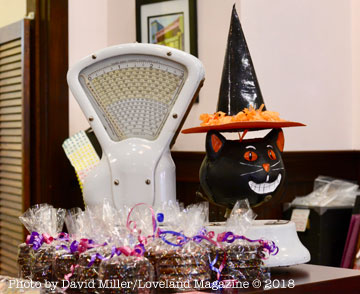 Loveland Sweets is now known as one of Downtown Historic Loveland’s top go to spots for both travelers and residents when exploring the Downtown Loveland area.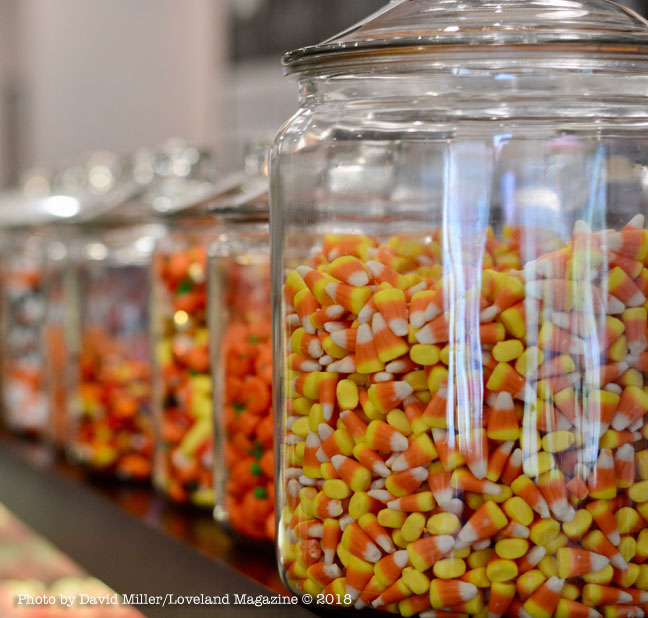
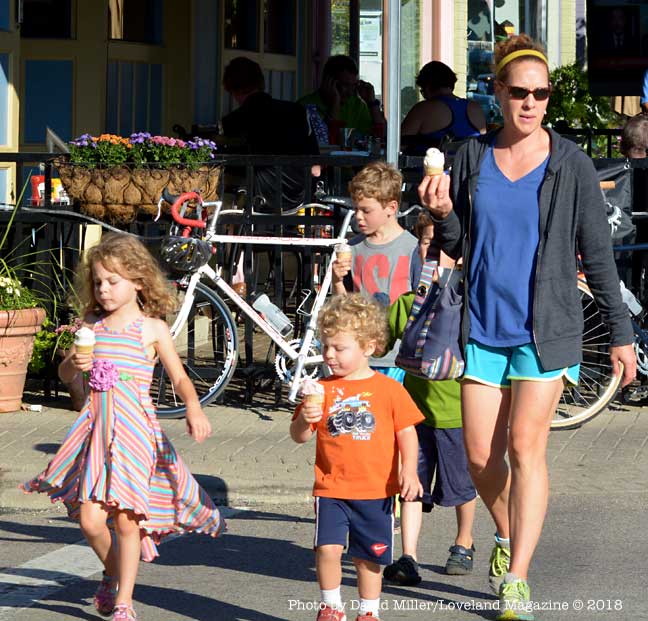
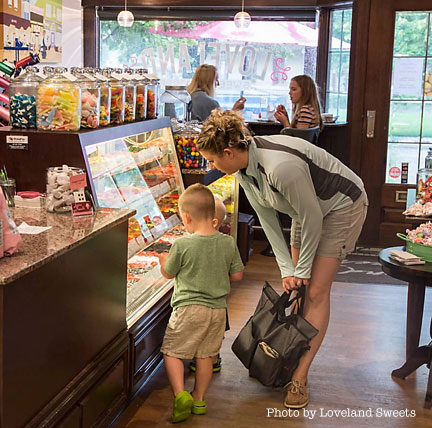 Loveland Sweets to visit Gloria and her team of confectionery geniuses! Loveland Sweets is located at 124 West Loveland Avenue and is open from 9 AM to 9 PM every day. If you would like to contact Loveland Sweets or check out their beautiful products, visit Loveland Sweets on Facebook or Instagram or call 513-583-8305.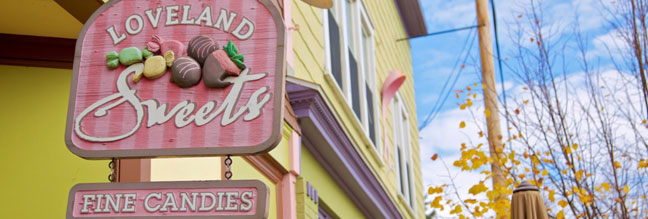
 by David Miller,
 Part Two of Two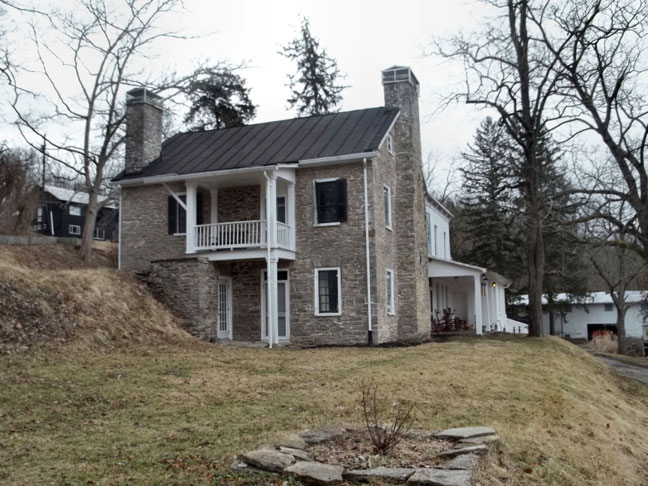


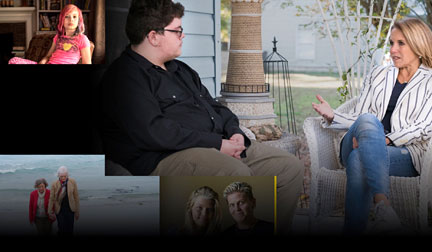 If you would like to explore the topic of Transgender youth and adults even further please check out “









 From November 1st through the 13th, bring in at least 20 pieces of unwanted or leftover Halloween candy to The Loveland Sweet Shoppe in Downtown Loveland, receive a coupon worth 20% off your next purchase, and the Sweet Shoppe will donate all traded-in candy to Operation Gratitude to be sent in care packages to our military troops and their families serving all over the world.
 Inspired by a love of fine Veterans Day and homemade confections, Gloria Wilson founded The Loveland Sweet Shoppe in 2006. The business has grown to include ice creams and coffees, but the commitment to high quality artisan products remains unchanged. The house-made candies and ice creams are lovingly created in small batches featuring premium ingredients as well as local dairy products and fresh seasonal fruits. The coffee is a rich and aromatic custom blend available only at Loveland Sweets. The Shoppe offers fine teas and hot chocolate as well as seasonal favorites such as handmade caramel apples. The Loveland Sweet Shoppe is located in Historic Downtown Loveland at 124 West Loveland Avenue, Loveland, OH 45140, 513-583-8305,

![[Video] Tom Morris asked if we are sacrificing Loveland’s quality of life for people who may only live here three months to a year](https://lovelandmagazine.com/wp-content/uploads/2017/07/maxresdefault-9-100x65.jpg)