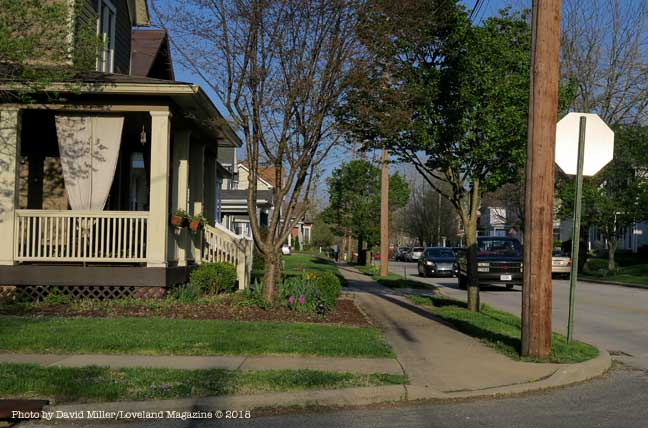
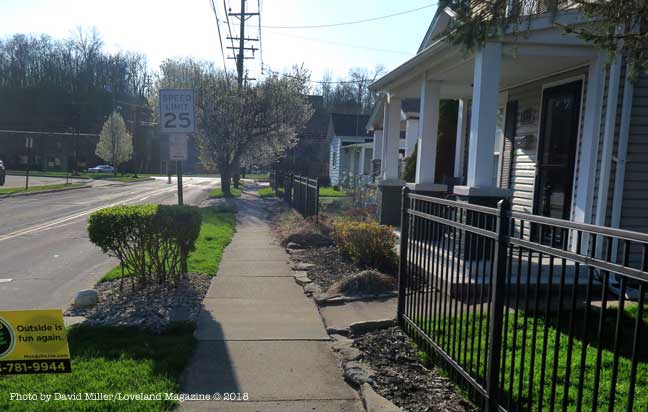
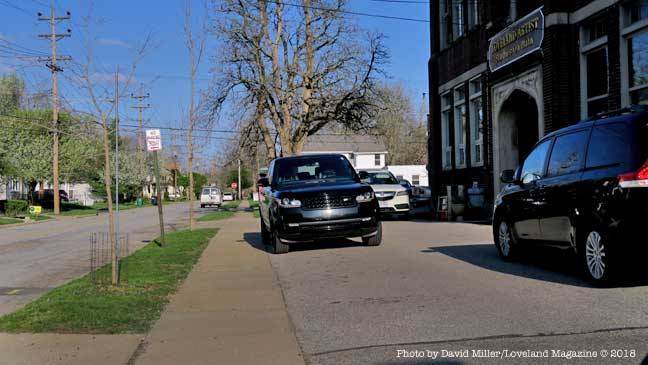
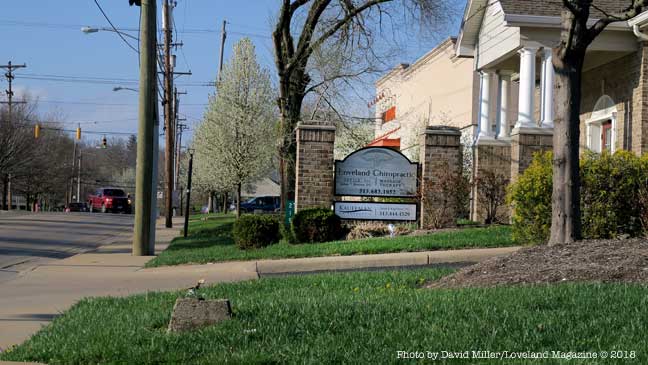
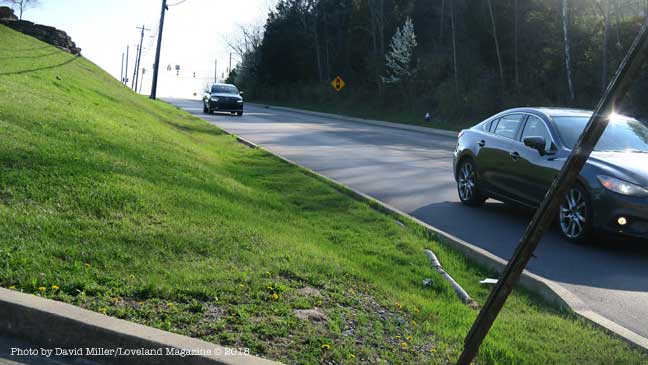
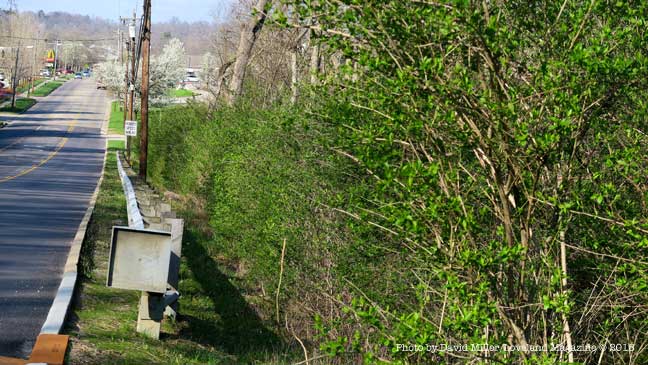
Loveland, Ohio – On February 26, City Engineer, Cindy Klopfenstein, said that during the first nine months of 2018, the City experienced 33 reported vehicle crashes into the low clearance, train trestle on Karl Brown Way in Historic Downtown Loveland.* To reduce the number of wrecks and traffic congestion they cause, the City hired Choice One Engineering to complete a safety study of the area.
Based on the study, Klopfenstein reported on her evaluation of the findings. This LOVELAND MAGAZINE TV video is Klopfenstein’s report to City Council.
* From the minutes of the Council meeting: “City Engineer, Cindy Klopfenstein, noted that during the first nine months of 2018, the City experienced 33 reported crashes at the train trestle on Karl Brown Way.” We should have paid more attention to what the City Engineer actually said, rather than what the minutes reported she said. Klopfenstein says in the video, that the 33 crashes occurred from 2016 through the first 9 months of 2018, not just the first 9 months of 2018.
Columnist Cassie Mattia is a resident of Historic Downtown Loveland.
Loveland, Ohio – As you enter the City of Loveland the first thing you expect to experience is Love, hence the sign when entering Loveland says “The Sweetheart of Ohio,” but what a lot of people don’t expect to experience when visiting Loveland for the first time is all of the history, the nature and the one of a kind businesses. For the longest time Jean Kresge, who has resided in Loveland since 1993, wanted to keep Ohio’s little slice of heaven a secret, but as new living establishments, restaurants, unique shopping spots and nightlife were added into the historical city people couldn’t help but notice that Loveland was quickly becoming the ideal vacation or staycation destination. So what do all vacation destinations need? A perfect getaway spot and well, Jean Kresge just couldn’t ignore the opportunity to introduce “June Bug” to those looking to make everlasting memories.
Kresge moved from Atlanta to the Loveland area and began working as the President of The Creative Worx Inc, which was a family-owned business that featured creative designs made by her mother, June Kresge.
“My mother designed jeweled dog collars, leashes, and horse halters. We patented, licensed, and took products to market with a major distributor,” Kresge explained.
Kresge eventually began working for Cisco Systems, where she has now worked for over 11 years as a Project and Program Manager. Though Kresge admits her job has been demanding throughout the years, as she has led the build-out of hundreds of high-end Video Conferencing Studio and TelePresence solutions for fortune 100 companies across the Globe, nothing could have prepared her for the hard work that she put into making “Junebug” what it is today.
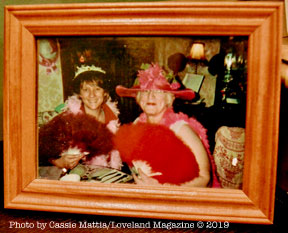
A photo of Jean and June Kresge is in the “Junebug” cottage.
“After my mother, June Kresge passed away with complications from frontal lobe dementia in late 2015, I saw a ‘for sale by owner’ sign on the bike trail pointing to the cut-through street just past the bridge crossing over to the trail from Nisbet Park. I met the owner, Jen Gruber, and agreed to a quick purchase the very next day,” Kresge explained, “I wouldn’t recommend making major decisions or purchases like this for at least a year after experiencing a death, but the whole process was a cathartic and healthy way to deal with the immense grief. I wanted to honor the memory of my mother. The house was built in 1908 by a nurse who made home visits to tend to the sick in Loveland. She was a single mother with two kids and purchased the property next door for her parents using the same basic footprint. There are 2 other very old farmhouses on the street that have been in their families for generations,” Kresge said.
When purchasing the historic cottage, Kresge, of course, knew there would need to be some renovations, as the property was extremely old, but she had no idea how both physically, mentally and financially demanding it would be to renovate the cottage from the ground up. Kresge reflected on what her mother had once predicted, which was Loveland was going to grow exponentially. With that in mind, Kresge decided to make the cottage an Airbnb and name it “Junebug” in memory of her mother June.
“I had not intended to make ‘Junebug’ an Airbnb, it was a financial necessity to cover a two-year-long renovation. I had stayed at an Airbnb before in Cape Cod and thought it might be a good and affordable way for me to supplement income in retirement, and not put all my eggs in the stock market,” Kresge said.
After Kresge made the decision to make “Junebug” an Airbnb, she wanted to be sure that every part of “Junebug” represented a piece of her mother.
“My mom liked to go ‘junkin’ for treasure’s, so every piece of the cottage was either purchased at antique auctions or was one of my Mom’s hand me downs,” Kresge said, “My mother would have been proud that ‘Junebug’ is a refuge and a healing space, as she was a bit of a physic healer who loved opening her house to friends, family, and even strangers on holiday’s. She said ‘everybody hugs a fat lady,’ before they crossed the front door. ‘The more the merrier,’ she used to say,” Kresge added.
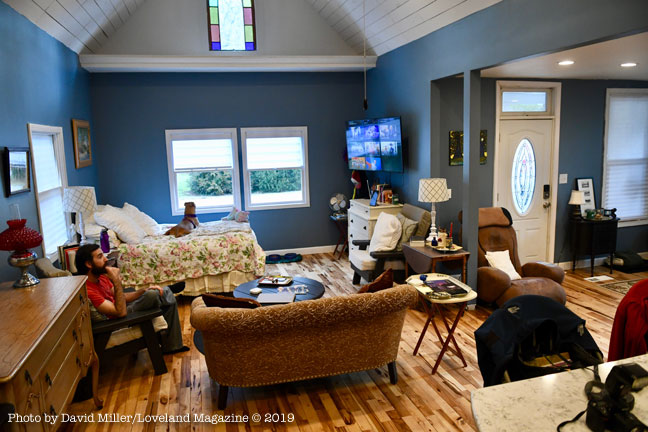
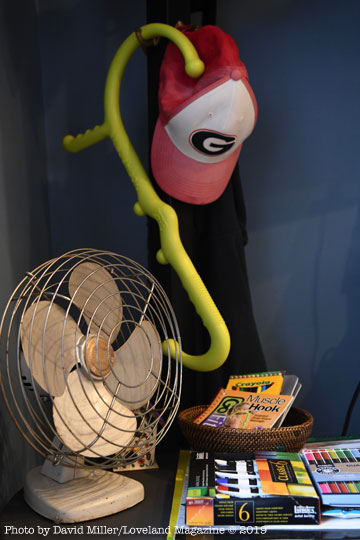
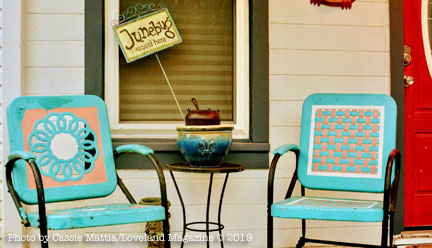
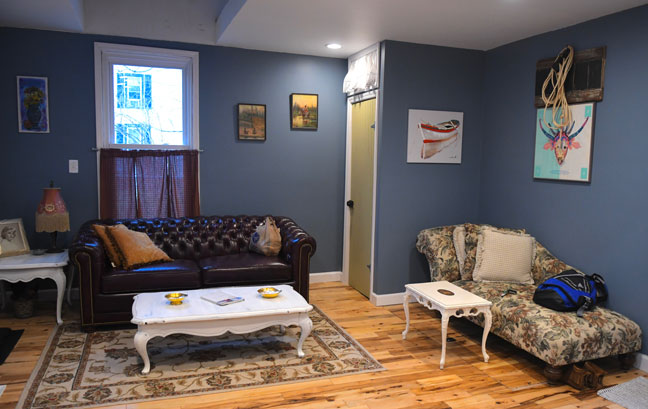
Luckily, Kresge extended the offer to me to stay at “Junebug,” for a weekend so I could experience the historic cottage myself. I packed up my belongings, my 2 dogs and my boyfriend and made the short journey from Loveland Station Apartments to “Junebug!” As I approached the cottage I immediately noticed the whimsical charm Kresge had told me about. The porch was covered in colorful rustic antiques along with 2 signs that read, “Junebug sold here.” Walking up the path to the cottage I not only felt a sense of warmth but also happiness. Kresge had told me she had hosted guests from all over the world and that they always left the cottage with stronger bonds because of the feeling the cottage gave them. That ambiance continued as I walked into the cottage. As soon as I opened the door it was hard for my mouth not to drop at what I saw. Original wooden floors, wood panel ceilings, stained glass windows, quality vintage furniture and of course beautiful pieces handcrafted by June Kresge herself. The cottage was also fully equipped with anything and everything I could possibly need! Cooking supplies, coffee, wine glasses, toiletries, books, games, food, Wifi as well as a computer and of course if you’re into binging on Netflix, Kresge had that set up on a gigantic flat screen TV along with Hulu, Prime Video and Apple TV. The added bonus for me? The spacious backyard for my dog children! I felt such happiness watching my dogs run around with my boyfriend while I relaxed on the elevated wooden porch that overlooked the backyard. Although I didn’t get to use every amenity because it was raining and cold the weekend I stayed at “Junebug,” the shed in the backyard had bicycles and fishing poles that guests could use! With Downtown Loveland and the Little Miami Bike Trail being within walking distance to “Junebug,” I loved the idea of being able to hop on a bike to go enjoy all Loveland had to offer. I could definitely see why people that had experienced “Junebug” kept returning. The weekend at “Junebug” was everything I had imagined it to be and everything Kresge had promised it would be. Oh, and did I mention “Junebug” had a massage chair?! I don’t want to spoil all the surprises “Junebug” holds, but I will say that I couldn’t have asked for a better getaway.
The house was built in 1908 by a nurse who made home visits to tend to the sick in Loveland. She was a single mother with two kids and purchased the property next door for her parents using the same basic footprint. There are 2 other very old farmhouses on the street that have been in their families for generations,” Kresge said.
I asked Kresge what her favorite part about opening “Junebug” to the public was and after staying the weekend I wasn’t surprised by her answer.
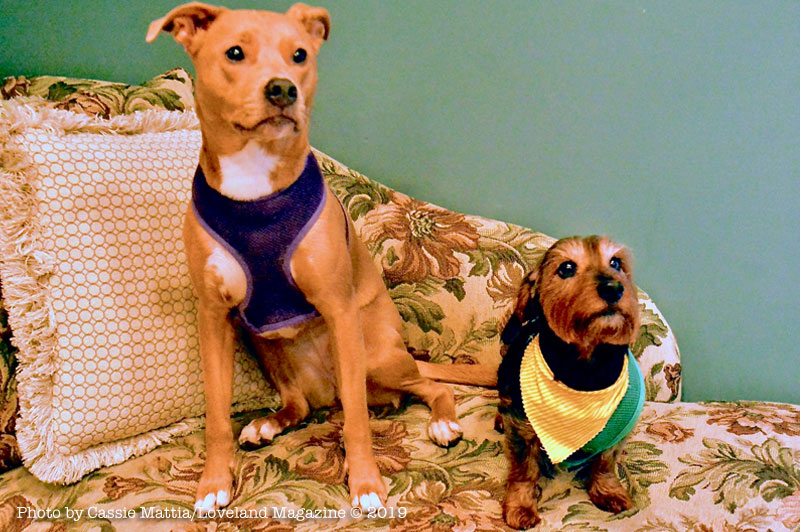
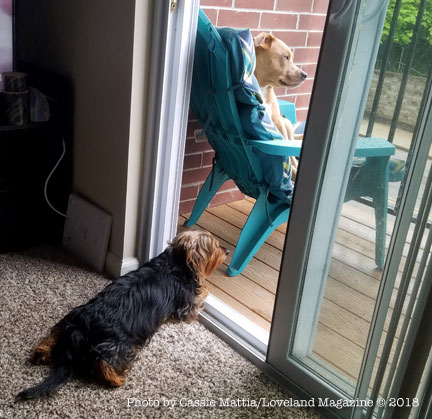
Jean invited me to bring my family to Junebug and Nala enjoyed her “staycation” 2-minutes from the Loveland Bike Trail, Nisbet Park, Historic Downtown, and the State and National “Scenic” Little Miami River. Nala also enjoyed her freedom and playing in the fenced-in back yard.
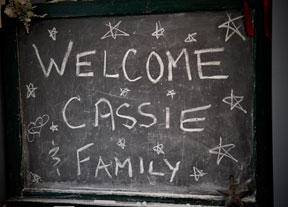
“I like to go the extra mile with southern hospitality to make people feel extra special. I love it when people relax to the point that they spend more time in the cottage than they anticipated. I often notice guests invite friends and family to come to visit the cottage versus going to their place,” Kresge said, “I especially like their first and lasting impressions. Many times I’ll get an immediate text about how awesome the cottage is and at the end of their stay I’ll get personal notes about their magical experience which really warms my heart and makes all the hard work worth it. I’ve been blessed with awesome guests who have all provided 5-star ratings for the overall experience which is ranked by accuracy, cleanliness, communication, check-in, location, and value! The guest comments provided afterward help me realize I’ve created something really special and I already have a lot of repeat customers,” Kresge said, “Guests really love seeing their names on the blackboard, the warm and cozy bed and comfortable studio feel, chefs kitchen, luxury bathroom, high tech amenities, fenced in backyard, outdoor seating areas, hammock, and access to bicycles and fishing poles in the shed. They love it that they can walk to the end of the street and be in complete nature or historic downtown in just a couple of minutes. My next door neighbor is Woody ‘the Norm’ of Loveland, a retired postman, and native that volunteers at the Farmer’s Market. He is an awesome neighbor. It’s really impossible to pick a favorite guest, but I guess the most memorable was hosting a young newlywed couple who celebrated their wedding night here. Thanks to guest referrals, the cottage is now being recommended by several downtown businesses, like Schildmeyer’s funeral home,” Kresge added.
“Junebug” has definitely made its way into the hearts of many. Kresge says since Memorial Day last year she has hosted over 35 guests with 70 percent occupancy for peak season. So just what does Kresge see for the future of “Junebug?” Well besides filling people with the joy and healing spirit of her mother when they stay at her Airbnb, she has quite the vision for “Junebug.”
“I would like to promote more guest discounts with local businesses, provide low-cost alternatives to guest hosting daytime events and parties, and accept donations to help organizations like battered women heal at ‘Junebug’ and get back on their feet,” Kresge said, “I would like to add a private master suite off the back deck, finish the loft to open this cozy space to guests and install a major storm drain system to protect this historic home from the next big flood.”
Residents and business owners in the West Loveland Historic District enjoy having the State and National “Scenic” Little Miami River and it’s many recreational opportunities and beauty, as its eastern border.
Did You Know?
Cassie Mattia lives in Historic Downtown Loveland
Loveland, Ohio – After exploring the history behind Historic Downtown Loveland’s businesses, a question arose; “What about the businesses and history across the river in the West Loveland Historic District?” I found that the question presented a good point, so I decided to take a walk down the sidewalks of the west side to see exactly what interesting secrets I could find about both the new and old businesses.
The West Loveland Historic District (WLHD) is often forgotten due to the big-name businesses being just steps away in Downtown Loveland, but what many people don’t realize is that the West side is just as historic. It is not only very diverse but also architecturally strong. DID YOU KNOW that there have been no public dollars used to renovate any of the businesses or homes there? The businesses have proven to establish themselves using their own resources rather than using extra city services. The WLHD businesses have not only contributed thousands of tax dollars to Loveland’s economy but have also created many employment opportunities. Millions of private dollars have been invested in the last decade improving, restoring, and preserving the historic homes, many converted to professional business spaces and “Live/Work” dwellings.
In Cincinnati, there are more than 100 advertising and marketing agencies. DID YOU KNOW two of the top advertising and marketing agencies are located right in the WLHD?
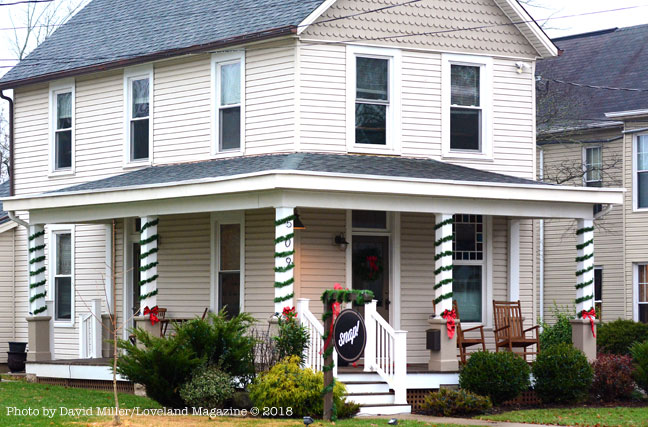
Snap Advertising was moved from Cincinnati to the WLHD in 2018 by Dave Fagin with one goal in mind; to help create stronger brands and brand builders. The advertising agency landed in a historically vacant building that had been remolded but sat vacant for many years. Fortunately, through all the remodeling of the building the historic architecture was kept intact. Snap poured even more money into the historic home. DID YOU KNOW Snap Advertising represents some of the nation’s top brands? Snap represents Zim’s Max Freeze, Invisible Ink Tattoo Removers, P&G Pampers Cruisers, The Hershey Company, and Humana Behavioral Health.
MMG Corporate Communication was founded in 1993 by Claudia McKee. Today, the marketing company serves some really prominent brands such as Ethicon, P&G, AtriCure, Yogi Bear’s, Heidelberg Distributing Company, ISTO Technology, Contech, AdvancePierre Foods, UC Health, EnteroMedics, Merz and SonoSite FujiFilm. MMG is known for helping brands reach their customers effectively through storytelling using marketing, apps, videography, editing, and animation. DID YOU KNOW that MMG has received over 100 national awards for their work? MMG has access to several marketing tools in-house that many marketing companies don’t have such as 2D and 3D animation, full video production services, mobile apps, web design, scripting, and content development. DID YOU KNOW MMG donates to over 50 non-profit charities every year? MMG has always been a huge advocate for community involvement, going as far as giving an employee every year 200 dollars to donate to a charity of their choosing. MMG also supports businesses locally like Paxton’s, The Works and Tano’s Bistro. DID YOU KNOW that Claudia McKee is married to Emmy award-winning, WCPO journalist, Tom McKee?
Xavier knew who to call as APEX has come through before with big orders. Apex owner Paul Elliott delivered 2000 Sweet Sixteen, Xavier University rally towels in 2012 from Loveland to the Georgia Dome with 48 hours notice. Elliott was fishing in Alabama when he got the order. Fishing, a passion of Elliott’s, was supposed to be a break between basketball and lacrosse officiating duties. Alabama wasn’t far enough for Paul to escape the “Madness” of March.
Although this next business isn’t necessarily your traditional advertising or marketing agency, it does its fair share of promoting. DID YOU KNOW Loveland has its very own specialty company that has over 50 years of experience creating promotional products? Apex Imprinted Sportswear has been operating since 1992 in the WLHD and now has over 600,000 promotional products. Apex assists their guests with theme creativity and layout design. DID YOU KNOW Apex offers custom embroidery on many different popular brands such as Nike, Northface, Eddie Bauer, and Port Authority? Apex only offers the best quality regarding brand and material, which is what really sets the shop apart from other shops of its kind. The promotional specialty store can imprint on t-shirts, polos, knits, sweatshirts, fleece, caps, activewear, outerwear, wovens, dress shirts, workwear, bags, accessories, and youth clothing. Many of the business attire with corporate branding you see in retail establishments around Loveland were bought from APEX. Thousands of Loveland’s young athletes wear sports apparel customized with team logos and the athletes’ names at APEX. Apex tees purchased by Toyota have been handed out to every Xavier University fan at “White-Out” games.
A fan wearing the Xavier White Out Tee Before the Defeat of Purdue on December 7, 2012. The 10,250 tee shirts were sold by Loveland businessman, Paul Elliott. Xavier came from a 19-point deficit to win the ESPN televised game. The shirts were credited by local sports commentators with the fan excitement, the extra 2-points X needed, for the Musketeers defeat over the Bulldogs, who later in the year played for the National Championship.
Paul Elliott has officiated Ohio High School Division I Football for decades. In recent years he has taken up blowing the whistle at Ohio High School Lacrosse and Basketball. He keeps on the go during the winter, sometimes officiating as many as seven youth basketball games a day.
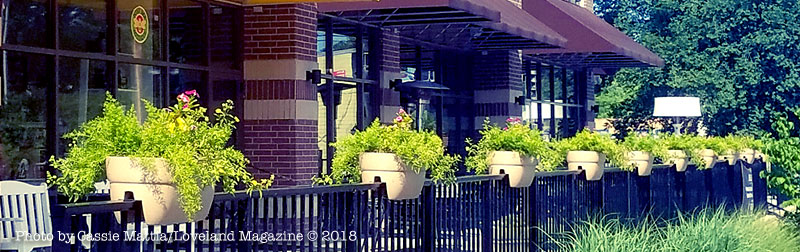
It is a short walk from the WLHD across the State and Scenic Little Miami River to shops and restaurants.
David Elliott, Paul’s son who works at APEX, is the Head Swim Coach for the Wyoming Cowboys swim teams. He has won coach of the year several times in the CHL conference and in the District. Wyoming is more often than not one of the teams shaking up the State finals in Canton.While exploring the businesses within the WLHD I have come to the realization that if you live there you have access to nearly anything and everything you need! DID YOU KNOW Loveland residents have their choice of 3 different insurance agencies located within footsteps of one another? In 2005, Carey Bush and Bill Re opened BRS Insurance in hopes that they could use their years of insurance experience to deliver the best comprehensive buying experience for their guests. Just a few steps away, Ron Delsignore, a State Farm Insurance agent since 2002, has his very own insurance business. Ron focuses primarily on out of state relocations to Loveland. Ron personally holds himself responsible for his guest’s assets, financial dreams, and legacy. Last but not least is Wilber-Price Insurance Group managed by husband and wife Don and Mary Jo Shrout. DID YOU KNOW Don opened the Nationwide insurance agency that now stands today right in Loveland’s WLHD 23 years ago! Both Don and his wife Mary Jo grew up in Loveland and thoroughly enjoy establishing a trusting relationship with each guest they help. Don’s agency provides home, auto, business, boat, equine, golf cart, motorcycle, and life insurance.
Loveland Magazine’s production office is in the Historic West Loveland District.
While you’re walking along the sidewalks on the WLHD of Loveland you certainly can’t forget one of the most well-known businesses; Loveland Magazine. DID YOU KNOW before Loveland Magazine was published it had been four decades since Loveland had a newspaper of its own? Forty-six resident David Miller first published Loveland Magazine in 2004 and has seen a tremendous amount of success ever since. Miller had dreams of creating a publication where Loveland residents could have a voice, Loveland’s youth were recognized and readers received accurate, fully investigated information on even the most controversial subjects. DID YOU KNOW Loveland Magazine has published over 14,000 stories and 850 HD videos? In all its glory Loveland Magazine has received The Booth Spirit Media Award and has been inducted into the Ohio News Media Association as the first digital-only member, and The Ohio Prep Sportswriters Association.
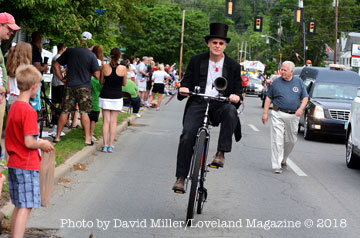
The West Loveland Historic with its ample parking and friendly atmosphere is always a popular viewing spot for the many annual Loveland parades.
If you are interested in visiting any of these amazing local businesses on the West Loveland Historic District please see the contact information for each business below.
Sangha is a place to experience skillfully designed, fun, and inspirational hatha yoga classes close to home. Simply drop in and yoga!
Sangha Yoga is the home of EmbodiYoga® in Cincinnati, a somatic yoga approach new to the Cincinnati area, and offers traditional Hatha and Holy Yoga Classes. All levels of experience are welcome. See our cooperative teaching schedule at www.sanghayoga.org
Sangha Yogais located in the beautiful historic district of downtown Loveland, one block east of the bike trail and 1/2 block north of Loveland Station.
As one explores the many wonders of Downtown Loveland there are so many things to take in; historic architecture, picturesque scenery, phenomenal restaurants, charming antique shops and a brand new luxury apartment community cleverly named Loveland Station. Railroads were a prominent feature of Loveland’s foregone years and a historic train station is adjacent to Loveland Station.
Loveland Station, located at the corner of West Loveland Ave. and 2nd Street, only one block from the Little Miami Scenic River and right next to the Loveland Bike Trail, came onto the Downtown scene in 2015. This beautifully structured 3 floor apartment complex including 94 units and nearly 200 residents was developed by Jim Cohen, CMC Property President, in hopes that the complex would open more doors for future developments and provide Loveland with more uses for its outstanding amenities.
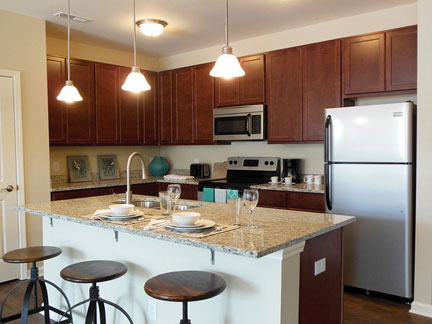
Loveland Station encompasses upscale finishes and the popular “open concept living” attracting two of the largest demographics in the country, millennials and baby boomers. Each unit includes an open kitchen with granite counter tops, brushed nickel features throughout the unit, garden bathtubs, full size washer and dryer connections, cable and 9 foot ceilings. In addition to all of the upscale features included in these luxurious units more than half of the units also include a balcony that overlooks Downtown Loveland and gigantic walk-in closets! Resident Sean Clark commented on the luxury finishes saying, “the apartments are very nice with big bathrooms, granite counters and great appliances.”
A look into one of Loveland Stations luxurious units fully equipped with an open kitchen and bar top with beautiful granite counters and stainless steel appliances.
Unlike most modern apartments, Loveland Station offers a number of floor plans. The Station offers One Bed One Baths ranging between 700 and 836 square feet pricing between 945 and 1,135 dollars as well as Two Bed Two Baths ranging between 943 and 1415 square feet pricing between 1,195 and 1,705 dollars. The Loveland Station community also offers Three Bed Two Bath units, which are 1,455 square feet and price between 1,675 and 1,735 dollars. When residents were asked about the floors plans they gave nothing but rave reviews. “The property is immaculately maintained. The floor plan is open and spacious and everything I need is right there,” resident Cori Drenning said.
Alex Boyd has lived at Loveland Station for 9 months and uses the business center for Young Entrepreneur Club Meetings.
One of the biggest bonuses of living in the Loveland Station community according to residents is the amenities offered within the complex as well as the amenities surrounding the complex. “You have direct access to the bike trail and river. There’s also an awesome business center that I occasionally rent for Young Entrepreneur Club Meetings,” tenant Alex Boyd said. Alex has lived at Loveland Station for 9 months and is a very successful entrepreneur, having opened his own business called the Vapor Studio located in Maineville.
My dog’s Dean and Nala enjoying the spacious balcony within a 2 bedroom 2 bath floor plan.
The pet-friendly complex definitely doesn’t fall short on amenities giving residents access to a state of the art 24 hour fitness center, a pristine business center and lounge with free Wi-Fi, trash valet, complimentary bike storage and garages with remote controlled access. Within the Loveland Station complex residents can enjoy several local retailers and restaurants, such as Graeters, The Casual Pint, Bella’s, Busy Bee Boutique and Vertical Drop that incorporate the community’s themes of family, fitness and romance. “Loveland Station is a cool place with lots of entertainment within walking distance. If dining and nightlife is your thing, it’s definitely worth looking into living here,” resident Steve Beamer said.
Although the Loveland Station didn’t get the best response from the community at first due to concerns such as the complex not blending in with the areas historic landscaping and traffic congestion, the Loveland station has proven to be nothing but a positive addition to the area creating additional jobs, tax revenues and an economic boost for the city. Loveland Station Property Manager, Jessica McCallum couldn’t agree more.
The Station’s state of the art business center and resident lounge.
“Our company is all about the residents! I really enjoy getting to know all of our residents and their families, even their furry family members! I just love when they bring their dogs to the office for a special treat! I think that knowing my residents names makes them feel good. I look at Loveland Station as part of my extended family, that goes for all of Loveland Station, the people who work here, who live here, and the retail workers as well,” Jessica said.
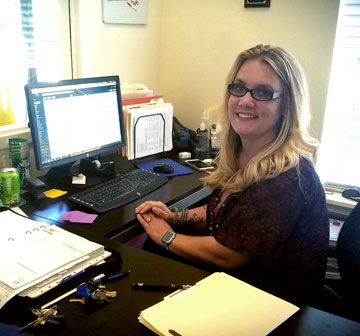
Loveland Station Property Manager, Jessica McCallum answers residents emails on the drop of a dime!
Creating that Work-Live-Play atmosphere within the Loveland Station complex that new Downtown Loveland residents are seeking, according to Jessica, has aided in the complex’s success placing the Station community at 100 percent occupancy with quite a waiting list for the next available unit. “I love the people here! They make managing the Loveland Station so easy,” Jessica said with pride.
The Loveland Station Complex has brought a whole new “Suburban Urban” vibe to Downtown Loveland as well as a noticeable positive impact on the economy and a plethora of opportunities for the community.
For more information on The Loveland Station you can contact the property at 513-285-3980 Monday through Friday from 9 AM to 5:30 PM or Saturday and Sunday from 10 AM to 4 PM. You can also visit the Loveland Station’s Facebook for pictures and videos of the immaculate property.
Cassie Mattia is a resident of Historic Downtown Loveland, Ohio and lives at Loveland Station
If the pilot project proves successful 110 total meters might be installed
by David Miller,
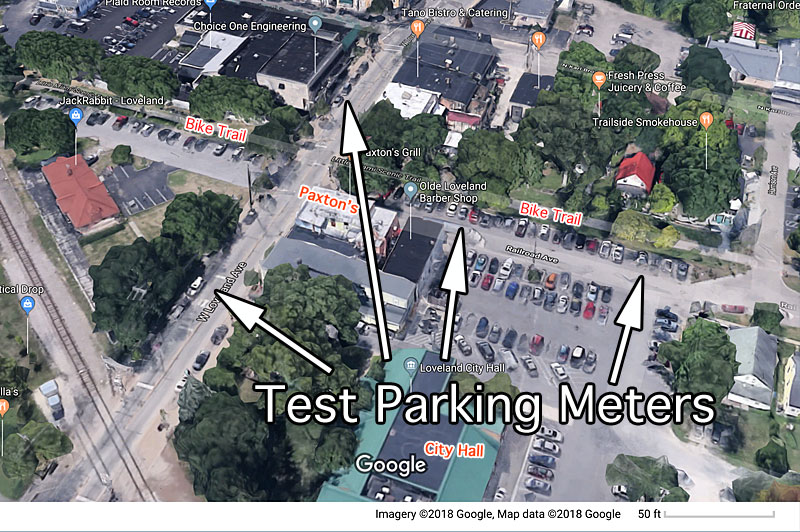
Loveland, Ohio – City Manager Dave Kennedy is awaiting approval from the Ohio Department of Natural Resources (ODNR) before installing 39 test parking meters in Historic Downtown. The property where 26 of the meters are to be located is street parking along Railroad Avenue and the poles would be in the “right of way” controlled by ODNR along the Loveland Bike Trail.
IPS Single Space Meter
The test meters would be on West Loveland Avenue, and Railroad Avenue from West Loveland to Harrison Avenue. Kennedy said he is waiting on a person from ODNR to return from vacation so they can continue their discussion of the right of way issue.
Kennedy is working exclusively with The IPS Group in a test of their meters before possibly installing more of the metered parking. When asked if he has an idea what the parking rate will be he said, “Not yet. I need to clear up right of way with ODNR for the pilot program.”
Kennedy said, “I should add that we hope that the pilot program helps us establish a reasonable parking rate. It is important that the rates of the parking meter find a balance between not having a negative impact on parking within the downtown district while also allowing the meters to effectively manage parking.”
Private interests have begun restricting public parking in private lots in Historic Downtown.
In a June 26 memo to the Mayor and Council he said, “Having reviewed the products of multiple meter companies, the city has decided to work exclusively with the IPS Group due to their advanced technology, ease of enforcement, foolproof collections, and varying designs.” Kennedy also said, in the memo, “The IPS Group are leaders in the parking meter and kiosk field. The IPS meters are equipped with advanced technology, including mobile applications for the users, advanced enforcement, computerized reporting, and fail-safe collections.” There has been no discussion of penalties for violations.
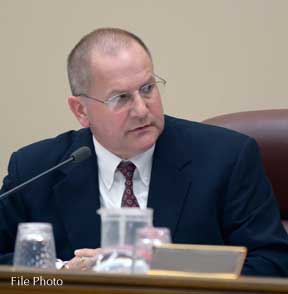
Loveland City Manager Dave Kennedy is exploring using parking meters in the Historic Downtown. (File Photo)
“The initial installation is only a pilot program at no cost to the city to determine operational, collections, and enforcement needs,” said Kennedy.
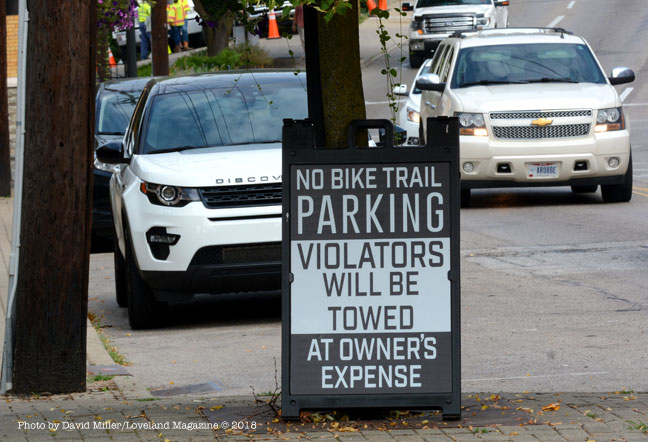
It is a goal of Council to increase parking turnover in the Historic District and discourage long-term parking in prime retail spots by users of the Loveland Bike Trail. The City would rather bike trail users park in the Linda J. Cox Trailside Parking Area on East Broadway.
Kennedy said that IPS meters are the industry leaders due to multiple features, most notably applications which allow the users many ways to pay, including through their mobile devices.
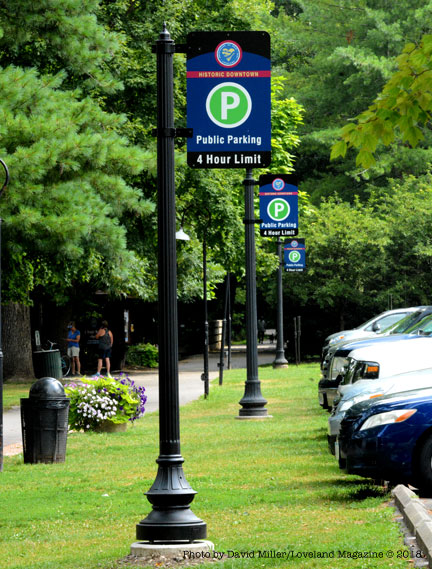
To discourage long-term parking in the Historic District parking is already being regulated by parking limits such as these next to Nisbet Park along the Loveland Bike Trail.
The meters will be solar powered and managed by the City through a wireless networked data management system. The City Manager said the meters will be easy to maintain and displays a clear violation indication for enforcement. He said the system includes a “failsafe” collection system.
The design of the meters would include one pole for each two meters, which Kennedy said would reduce obstructions along city curbs and would be black in color to match other city sidewalk components.
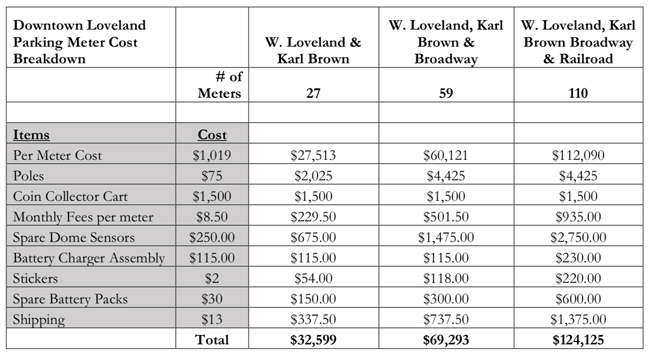
If the pilot program is successful, Kennedy has presented a plan where there might be anywhere from 27-110 permanent meters and an estimated cost between $32,599 and $124,125.
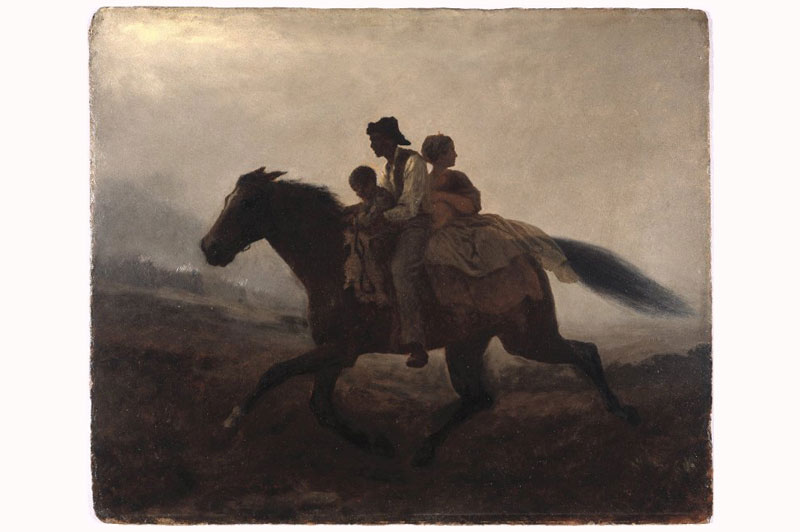
The Fugitive Slaves, oil on paperboard, circa 1862, Brooklyn Museum
The following is an excerpt from Chapter Seven of The Search for the Underground Railroad in South-Central Ohio by Tom Calarco, scheduled for publication in late October by History Press. It is being published with permission from History Press.
Tom Calarco is a resident of Historic Downtown Loveland, Ohio.
By Tom Calarco
Part one of Two
Along the banks of the Little Miami River in the hilly countryside north of Cincinnati, stands an old stone house, a relic of slower days, when there was lots of land and few people. It is not lived in much these days, but a big family of Quakers lived there for many years. Their forefather, Benjamin Butterworth was a six-foot six inch pioneer, a giant of a man who was said to have weighed 300 pounds. His roots in America dated back before the 1700s. Born in Virginia, he fought in the Revolution and was entitled to purchase a grant of land in the Northwest Territory, in the Virginia Military District, of which much of Ohio was part. This land and his inheritance provided him with substantial wealth. He was like many future Ohioans who would settle the new state: a slaveholder who freed his slaves and took them along to where there was no slavery.
On September 15, 1812, he set out with his family and some former slaves in two covered wagons to cross the old green Appalachian mountains of
what is now West Virginia. It was a trek of more than 300 miles up mountains more than 4,000 feet high through scenic passageways like those that had inspired trailblazers like Daniel Boone a generation earlier; there was only one road through this wilderness, the Midland Trail which ran along the Kanawha River and today is Route 60. Benjamin, 46; his wife Rachel, 47; Moorman, 19; Benjamin Jr, 18; Samuel, 14; Rachel, 12; William, 10; and Henry Thomas (called by his middle name), 3, made the journey in 25 days. One can only imagine the sunsets blazing their fire in that pristine wilderness of future promises. In the years ahead their lives would soon be afire with the cause of abolition
When Butterworth arrived, he found that his 1500-acre property needed a lot of work to make it suitable for farming. Though it had the advantage of a natural springs and the Little Miami River, it needed clearing and was hilly and full of gullies. It would take time to make it livable. Instead, he took the family to nearby Waynesville where one of his older daughters, Polly already was living with her husband Zachariah Johnson. Within a week he purchased land along nearby Caesar’s Creek where they moved. Busy with his farming and building a mill, he ignored his other property for the next three years.
By 1820, the old stone house overlooked the fields as it does today along the Little Miami Bike Trail.
In 1815, Moorman visited it and found a squatter who had built a cabin and planted crops on five acres he had cleared. He bought the cabin and the crops, and moved in. Three months later his older sister Milly and her husband, John Dyer, emigrated from Virginia and they moved in with him. They built a two-story log cabin, and a year later, Benjamin and family joined them. By 1820, the old stone house overlooked the fields as it does today along the Little Miami Bike Trail. In future years, the Butterworth farm grew prosperous through the sale of sweet potatoes, chickens and their eggs, and the construction of the Little Miami Railroad that ran through their property, connecting south to Cincinnati by 1843 and north to Springfield by 1846.
Being Quakers, they were stirred by the movement for immediate emancipation of the slaves that already had many supporters in this section of Ohio.
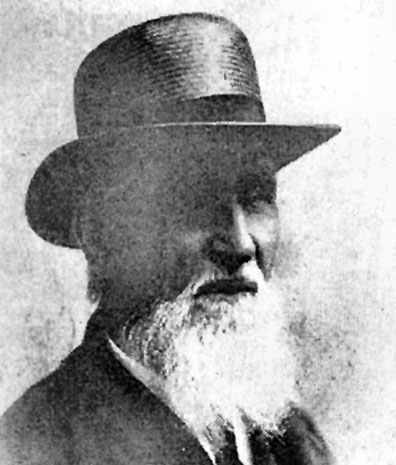
Thomas Butterworth
For a time, a least up until 1850 and the passage of the Fugitive Slave Law, their most important business was the UGRR. Being Quakers, they were stirred by the movement for immediate emancipation of the slaves that already had many supporters in this section of Ohio. Slaves had begun running away more than ever as more in the North joined the effort to assist them. The Little Miami River was a natural gateway. When they exactly became involved in aiding them is not known but probably no later than 1830-1831 when their sons, William and Thomas, married into the Wales and Linton families, Quaker abolitionists who may already have been part of the UGRR.
The Little Miami River was a natural gateway.
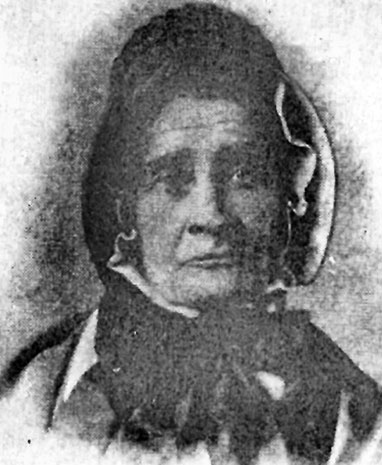
Nancy Butterworth
Thomas’s wife Nancy was a Wales and her sister Jane married Valentine Nicholson. It was a double wedding. William married Elizabeth Linton. So, it became an all-in-the-family UGRR operation. Thomas recalled those days shortly before his death in a letter to Wilbur Siebert:
We [once] had two women, one man and some children on hand and had them concealed for some time and it was becoming unsafe to keep them longer . . . I had two good horses and a good wagon with high sides and a good set of bows and cloth. I put the bows on and then stretched the cloth on and tied it thoroughly down. . . . . After thus being all fixed I stored in a lot of hay for the poor creatures to lie on. Then after leaving all the children [the fugitives’ children] for fear of their crying and betraying us, I put in two carts for my daughter Mary and I to sit on.
After thus being all fixed I stored in a lot of hay for the poor creatures to lie on.
By this time we had heard that a pro-slavery boy by the name of Andrew Davis had somehow got a knowledge of the whole thing and had, perhaps for a sum of money, made it known to two persons who would do anything they could to catch the flying slaves. The names of these two persons [were] David Coddington and James Foster. We had heard of our betrayal; I prepared for it; the river was high. My destination was to take them to an uncle of my wife’s by the name of Turner Welch residing at Harveysburg . . . . The bridge here at Foster’s must be crossed and was a toll bridge. Joseph Whitney took the toll at the west and James Foster kept a store at the east end (just before they came to the bridge). We had our Quaker school teacher, Robert Way, to go with us to see if we should run the gauntlet . . . just as we expected out came the two men [Coddington and Foster].
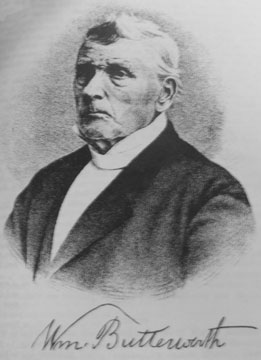
William Butterworth
Foster called out to him . . . Got any chickens, got any eggs, got any butter?
Butterworth shouted back as he passed by, “I am not going to market I am after fruit trees,” and handed Whitney the toll with stopping.
He heard Coddington say to Foster, “I’ll be damned if there ain’t niggers in that wagon.”
Butterworth had thought they would follow him and kept looking back but they made it safely to his wife’s Uncle on the north side of Caesar’s Creek. He did not consider it safe to keep them that night, so he sent them over to Harveysburg up on one of the many hills in that area, and Butterworth returned home to see about the fugitives’ children. He gave the task to Robert Carroll, who lived only a mile away with whom he had a regular arrangement regarding the transport of fugitives.
I had a small one or two-horse wagon. I had a neighbor a mile from me who was as strong an anti-slavery man as myself. As far as worldly goods were concerned he had nothing, was rich enough to have a wife and children to help him be poor. He feared no risks in helping fugitive slaves . . . I told him that when fugitives were on hand that he knew of, to come and get this wagon and one or two horses, as the case would require, and take them, and I would have no questions, and he should ask me none and go in the night, and go to such underground station as we know best, which was at or near Harveysburg . . . . This man Carroll took those children up there where they no doubt found their mothers.
Next Time in Part 2: Further Recollections of Butterworth Station
Loveland, Ohio – The annual Independence Day parade will depart the campus of the Loveland Primary/Elementary schools at 7 PM heading up Loveland Madeira Road to the West Loveland Historic District, crossing over the State and National Scenic Little Miami River, and ending in Historic Downtown.
There will be a festival in the Historic District starting at 4 PM.
Fireworks will be launched over the river beginning at 10 PM
The concept of taking a 12ft swath off of North side of West Loveland Avenue is totally appalling and preposterous! As long-time residents of Loveland we have touted for years the following “solution” to the traffic flow and cyclist problems on West Loveland Avenue, but never had any feedback.
In desperation again, please consider the following:
West Loveland Avenue, between Loveland Madeira Road and the bridge over the Little Miami is currently 4-lanes wide. It could easily be three lanes wide with the center lane being used for a much needed left turn lane at Riverside Drive and also at Wall Street. That would open up the width of an entire lane for bicycles. All that would be needed then is re-striping: with a half lane on the curbside (in each direction ) which would serve as the dedicated bike lanes on the north and south sides of West Loveland Avenue and continuing over the bridge.
Benefits: NO CONSTRUCTION required. NO claiming of property from owners. Confusing and Often dangerous last-minute lane changes, particularly at Wall Street, would be eliminated. Traffic on West Loveland Avenue would calm down (Drivers really hit the gas pedal pulling away from the bridge and West Loveland Avenue intersection.) Pedestrians would be further away from traffic. Congestion at the West Loveland Avenue and Riverside Drive intersection would be relieved.
For the Loveland Madeira Road section, a similar approach could be adopted. We suggest an analytic viewing of and study of traffic patterns developed on Montgomery Road, South of Bethesda North Hospital. It could apply in a similar manner all down Loveland Madeira Road, and EVEN accommodate a pretty landscaped center strip between left turn areas.!! Think how THAT would upgrade L/M Rd!!
Note: As drivers, we are always surprised how well the Montgomery traffic plan works, ie: that one lane with turn signals flows better than two. Please give these ideas serious consideration. They are offered up with genuine concern for the betterment of the city.
EDITOR’S NOTE: In reaction to this editorial, City Council voted on Tuesday, April 24 to have a public hearing on this proposal during the City Council meeting of May 9.
It’s past time City Hall start a dialogue with those most affected
by David Miller, Publisher
Come take a walk with me while I tell you a story
It’s just my opinion, but I believe City Hall should start talking to people about this before it gets so far along people will need 1.6 million dollars worth of arguments against it. Once City Hall gets the funding for what they will describe as “Free Money” it will be extremely hard to turn council members to “No” votes. Residents should be given a fighting chance.
As the equivalent of a one-lane asphalt road that will cozy within feet of the front doors of homes and businesses in the West Loveland Historic District and along Loveland Madeira Road, and City Hall moves closer to securing funding, property, and homeowners have yet been asked their opinion. Almost all do not yet know the proposal has already been partially funded by Hamilton County and the Ohio, Kentucky, Indiana Council of Governments has committed their resources to finding 80 percent of the $1,623,000 and growing price tag for construction.
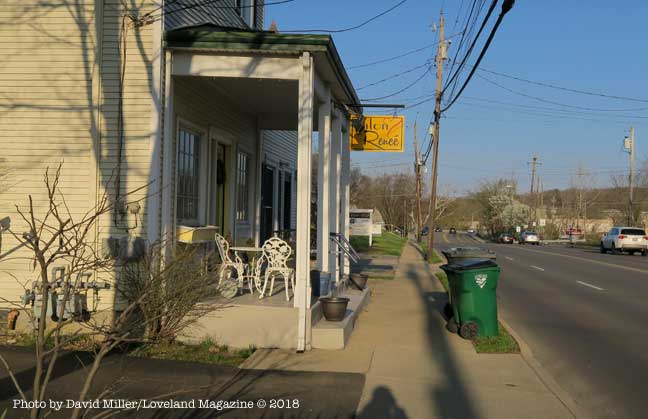
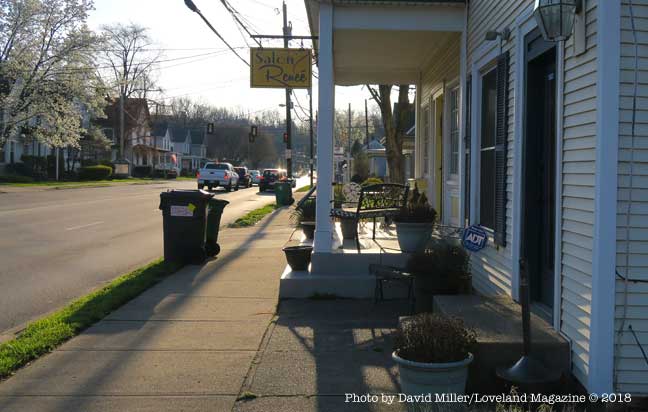
This is a view of the North side of West Loveland Avenue where construction of a 12′ wide swath of asphalt would require the removal of the front porch of this business. The entry to the basement of this business is through the porch floor.
Some front porches would have to be removed to accommodate the 12’ wide asphalt bicycle road. The road will be reduced to 10’ wide only where construction proves difficult.
As the City Hall proposal gets yet more expensive and closer to fruition there is still no initiative from the Council table to ask the thoughts and suggestions of citizens, home-owners, affected businesses, property owners, or pertinent City Commissions and Committees.
As the City Hall proposal gets yet more expensive and closer to fruition there is still no initiative from the Council table to ask the thoughts and suggestions of citizens, home-owners, affected businesses, property owners, or pertinent City Commissions and Committees.
One property and business owner along the proposed route wrote to City Hall. Paul Elliott said, “I am under the impression that such a proposal ‘has legs’, and city officials are even seeking funding sources. First, as a taxpaying resident and longtime business/property owner on West Loveland Avenue, I am disappointed that no city official has approached either the public in general nor us property owners who may be affected by such a bike corridor.”
The project, called the Loveland Connector Trail, will be approximately 1.4 miles long and will begin at the Deer Ridge II Apartments being built next to New Hope Baptist Church. It will continue along Loveland Madeira Road to Main Street, to the southern part of Wall Street, then to West Loveland Avenue, crossing over the Little Miami River at the Col. Paxton Bridge ending in Historic Downtown.
“I am disappointed that no city official has approached either the public in general nor us property owners who may be affected by such a bike corridor.” – Resident and affected business owner, Paul Elliott.
The goal and impetus for the project are to reduce congested parking in the Downtown Historic District by encouraging Loveland Bike Trail users to park somewhere along the new bike road and ride their bikes into Historic Downtown.
City Manager, Dave Kennedy announced in February that he was confident he will find 80% of the $1,623,000 cost from the Federal Government. He has since announced changes that will raise the price tag an undetermined amount.
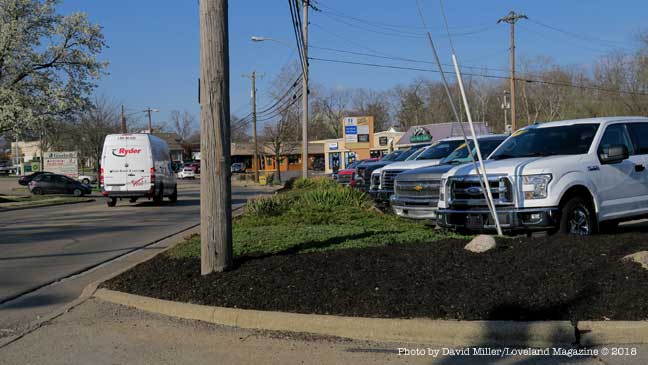
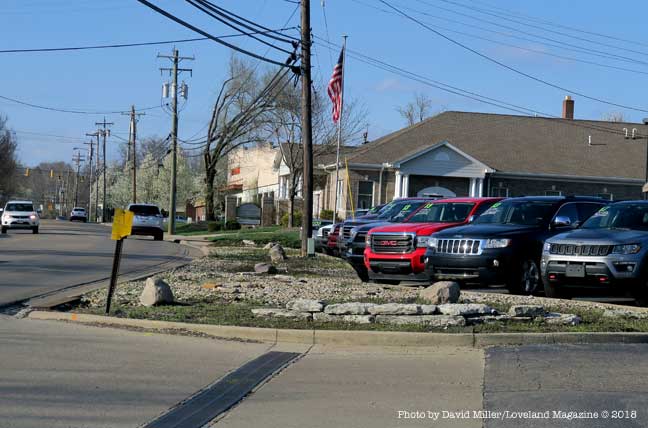
A view of an automobile dealership that has softened their business frontage. Something will have to give way for the proposed 12′ asphalt bike road.
The study does not contain any data on the potential number of users, nor potential customers to Loveland Madeira Road businesses. The study also does not address any repercussions on the residential neighborhood of Main Street or the Business/Residential neighborhood on West Loveland Avenue. For instance, it does not address future maintenance or whether property owners will be responsible for snow and ice removal on a path that replaces their current sidewalks. It’s right to ask when residents are left without sidewalks, “When will the bike road be cleared of snow? Who will do it, with what type of equipment, and when will it happen?”
A close look at what is described as a “Detailed Cost Estimate” appears to be grossly underestimated in terms of things that are absent consideration such as acquiring private property, relocating business signs, and replacing private parking,
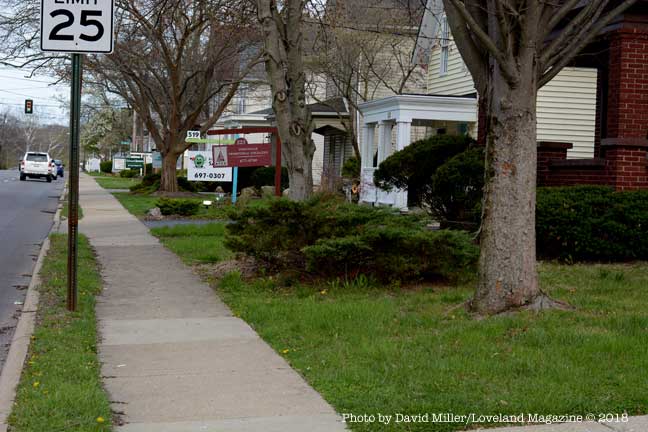
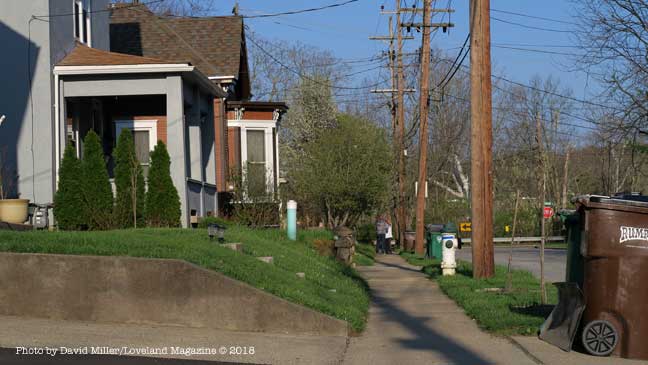
Light colored 4′ tree-shaded concrete sidewalks where children can walk without shoes, and people walk their dogs will be replaced with a 12’ barren swath of black, heat-absorbing asphalt the width of a one-lane road just feet from homes.
Light colored 4′ tree-shaded concrete sidewalks where children can walk without shoes, and people walk their dogs will be replaced with a 12’ barren swath of black, heat-absorbing asphalt the width of a one-lane road just feet from homes where owners will pay higher air-conditioning costs.
There has been no recommendation to forward the proposal to the Planning and Zoning Commission, Tree and Environment Committee, Beautification Committee, or Safety Service & Street Improvement Committee for review. No public hearings are scheduled. None have been suggested.
Phelps and City Manager Dave Kennedy have attended workshop/training on a Federal grant program along with a meeting with OKI officials to discuss the city’s project in more detail. While the updated cost estimate is being secured, the grant application is being reviewed and various needed documents are prepared. They plan to ask City Council in May to move forward seeking funding.
Phelps said that people who are using the bike trail are using too many of the downtown parking spots and using them for too long a period of time. “This is going to give them another place to get on the trail, better parking, easier on and off.” He believes the bike road will bring in new customers to Loveland Madeira Road businesses when they park nearby but head into Historic Downtown. The study does not contain any data on the potential number of users, nor potential customers to Loveland Madeira Road businesses. The study also does not address any potential negative repercussions on the residential neighborhood of Main Street or the Business/Residential neighborhood on West Loveland Avenue.
Some “Progressives” may love the idea, some may like it but believe it ill-considered given the impact on individuals who live or have invested in the impacted area. Some money conservatives may believe it an economic boon to both the Historic District and Loveland Madeira Road. Some money crunchers may ask, where is the cost-benefit analysis and just how many people will actually use it and spend money along Loveland Madeira Road. Some may ask if all costs factors have been included in the early estimate and if the price tag goes north after a grant is awarded – who will get stuck.
Elliott said his email to City Hall, that included the City Manager, Mayor and Council, the Planning and Zoning Commission, the Recreation Commission, and the Streets and Public Safety Committee was his attempt to open a dialogue between the decision makers, and those “of us” who will be financially and personally affected.
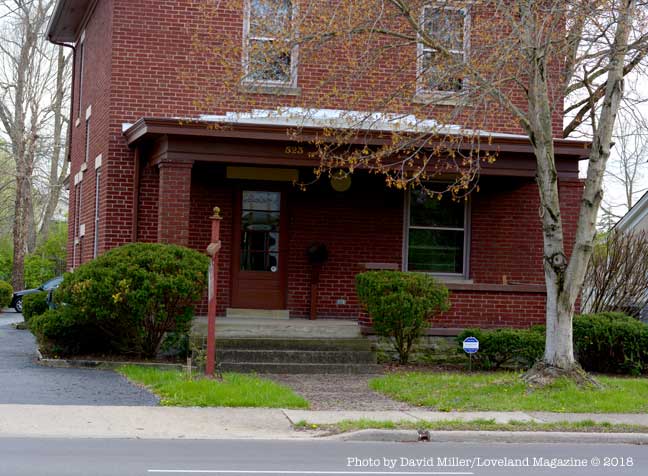
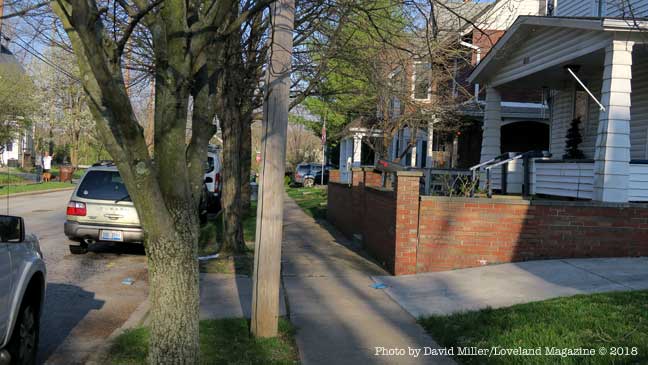
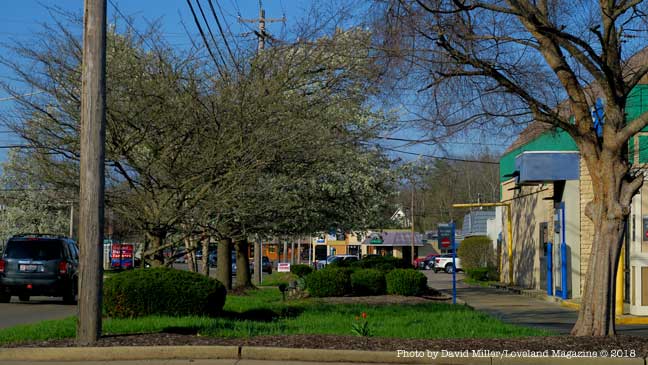
Resident and business owner Paul Elliott bought this business building on West Loveland Avenue in 1997. He has asked City Hall how the proposed connector path will affect the front yard of his property.This is a view of business and residential properties on the South side of West Loveland Avenue. Although the proposal isn’t clear, presumably this 4′ concrete sidewalk will be replaced by a 12′ wide swath of asphalt, equivalent to a one-lane road. These street trees will with be cut down or have their roots severely damaged by the excavation. It is not clear whether the grassy strip will remain.
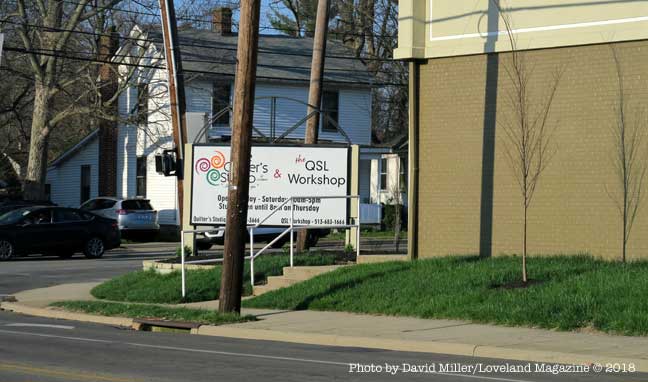
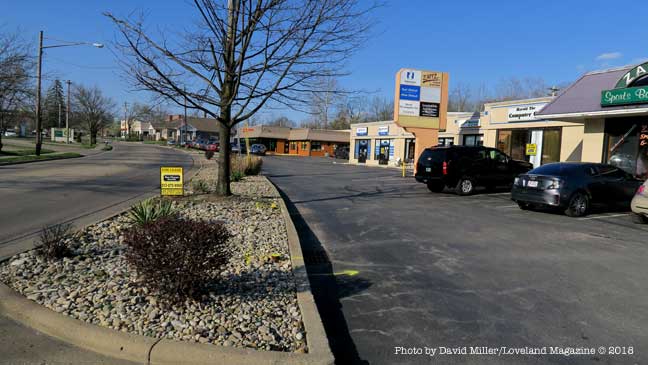
Another view of the beauty salon on the North side of West Loveland Avenue where construction of a 12′ wide swath of asphalt would require the removal of the front porch of this business. The entry to the basement of this business is through the porch floor.If the 12′ wide bike road wraps around this building this sign and landscaping will have to go. The sign may need to be replaced with two signs to satisfy the business owner, yet there is no apparent budget item for moving or replacing business signs in the proposal.Depending whether the 12′ bike road goes down this side of Main Street, these street trees may be removed. These utility poles if moved to the left would might result in fatal topping of the trees. If the poles remain in place it puts the asphalt even closer to the house. If the road goes on top of the tree roots the trees will shortly die. The owners will pay higher air-conditioning cost without their shade trees. If the trees die because of the location of the bike road, the home owner will then be required to pay to have the tree removed. Will the homeowner’s brick wall survive the project?This is another problem area on Main Street where homeowners will lose a good portion of their already small front yard.The 12′ bike road could cut across the front yard of this Main Street home taking out a tree and landscaping.Another front porch, this one on Main Street may stand in the way of the 12′ wide asphalt bike road or end up only inches away.If the 12′ wide asphalt bike road goes down this side of Main Street it will leave the Artists Studios on Main without street trees and much needed parking.The landscaping, street trees, utility polls, and sign at this business on Loveland Madeira Road appear to be in the path of the 12′ wide bike road.This landscaping area that softens the appearance of this automobile dealership on Loveland Madeira Road will be replaced with a 12″ asphalt bike road.This is more of the landscaping along Loveland Madeira Road that will be removed (or most of the parking lot) to make room for a 12′ asphalt bike road.
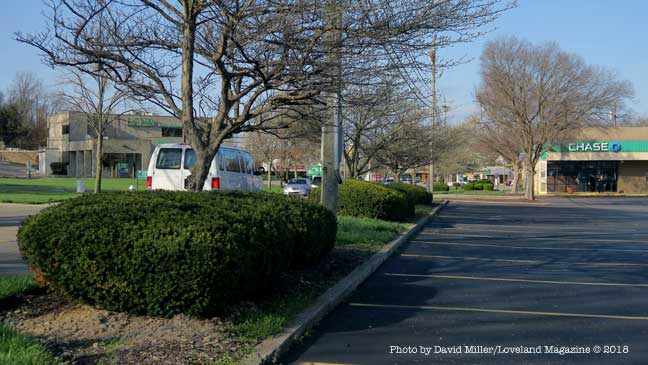
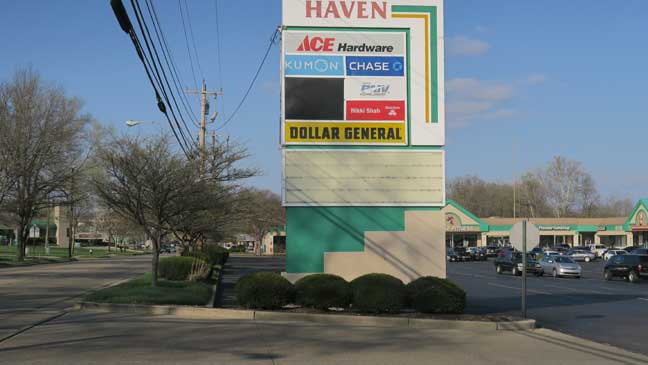
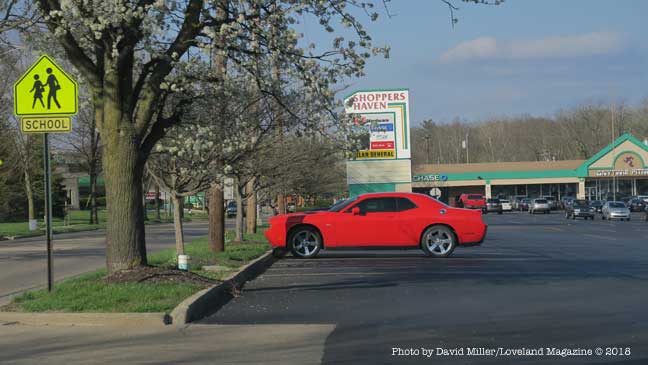
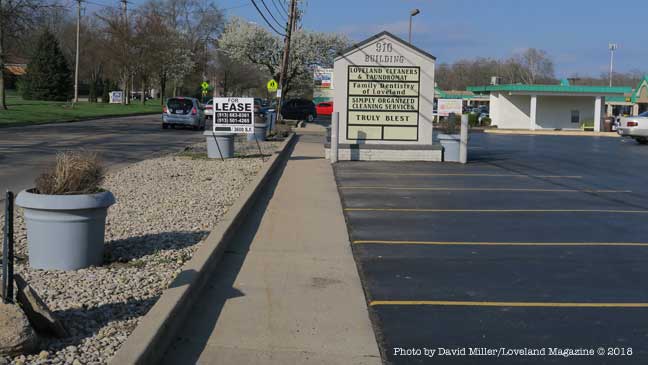
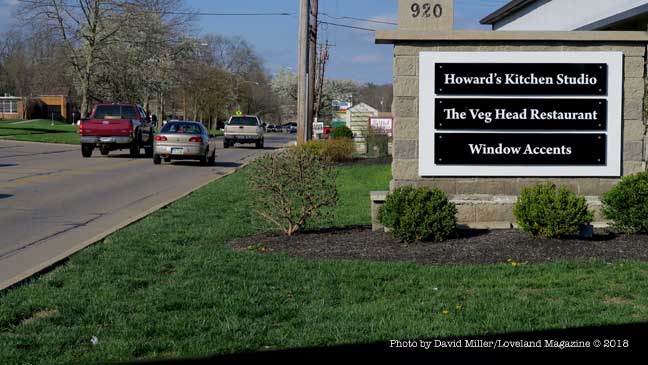
This is the only green space at the Chase Bank on Loveland Madeira Road. There will be a 12′ asphalt bike road running down the middle of it.If a proposed 12′ wide asphalt bike road goes past Shoppers Haven shopping center these street trees may be removed, utility lines moved, parking spaces removed, or all three. Private property may have to be acquired through “willing seller – willing buyer” agreements or “taking” by eminent domain and associated legal costs. In the end, these parking spaces used by local businesses and the schools may be eliminated for the prospect of freeing up parking spaces a mile away in Historic Downtown.There does not appear to be a budget item for moving this business sign out of the path of the proposed 12′ wide asphalt bike road, nor is there any discussion of whether the owner and the businesses would want their sign moved further away from the visibility of automobiles on Loveland Madeira Road.If a proposed 12′ wide asphalt bike road goes past Shoppers Haven shopping center these street trees may be removed, utility lines moved, parking spaces removed, or all three. Private property may have to be acquired through “willing seller – willing buyer” agreements or “taking” by eminent domain and associated legal costs. In the end, these parking spaces used by local businesses and the schools may be eliminated for the prospect of freeing up parking spaces one mile away in Historic Downtown.Will the landscaping and street buffer, the business sign and the parking at the 910 Building be sacrificed to free up an un-estimated number of parking spaces for the businesses one mile away in Historic Downtown?Another Loveland Madeira Road business sign in the way of a proposed 12′ asphalt bike road. Is this sign still going to have the same visibility if it is relocated? Is there enough room to just push it closer to the building or will it need to be re-engineered, and reconstructed smaller?This is the hillside in front of New Hope Baptist Church where City Hall wants to build a 12′ wide asphalt bike road. Its there money in the estimate of cost to build a retaining wall or will the hill just get steeper?This is Loveland Madeira Road looking North from New Hope Baptist Church toward Kroger. The guard rail protects motorists from a steep immediate drop into a very deep ravine. The 350′ long stretch quickly drops 50′ below the grade of the road. It is not clear if the budget estimate has taken into consideration the expense of building a 12′ wide bike road at the edge of this ravine.




 When purchasing the historic cottage, Kresge, of course, knew there would need to be some renovations, as the property was extremely old, but she had no idea how both physically, mentally and financially demanding it would be to renovate the cottage from the ground up. Kresge reflected on what her mother had once predicted, which was Loveland was going to grow exponentially. With that in mind, Kresge decided to make the cottage an Airbnb and name it “Junebug” in memory of her mother June.
 Luckily, Kresge extended the offer to me to stay at “Junebug,” for a weekend so I could experience the historic cottage myself. I packed up my belongings, my 2 dogs and my boyfriend and made the short journey from Loveland Station Apartments to “Junebug!” As I approached the cottage I immediately noticed the whimsical charm Kresge had told me about. The porch was covered in colorful rustic antiques along with 2 signs that read, “Junebug sold here.” Walking up the path to the cottage I not only felt a sense of warmth but also happiness. Kresge had told me she had hosted guests from all over the world and that they always left the cottage with stronger bonds because of the feeling the cottage gave them. That ambiance continued as I walked into the cottage. As soon as I
 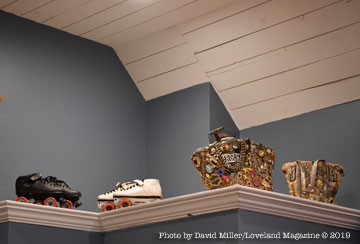 opened the door it was hard for my mouth not to drop at what I saw. Original wooden floors, wood panel ceilings, stained glass windows, quality vintage furniture and of course beautiful pieces handcrafted by June Kresge herself. The cottage was also fully equipped with anything and everything I could possibly need! Cooking supplies, coffee, wine glasses, toiletries, books, games, food, Wifi as well as a computer and of course if you’re into binging on Netflix, Kresge had that set up on a gigantic flat screen TV along with Hulu, Prime Video and Apple TV. The added bonus for me? The spacious backyard for my dog children! I felt such happiness watching my dogs run around with my boyfriend while I relaxed on the elevated wooden porch that overlooked the backyard. Although I didn’t get to use every amenity because it was raining and cold the weekend I stayed at “Junebug,” the shed in the backyard had bicycles and fishing poles that guests could use! With Downtown Loveland and the Little Miami Bike Trail being within walking distance to “Junebug,” I loved the idea of being able to hop on a bike to go enjoy all Loveland had to offer. I could definitely see why people that had experienced “Junebug” kept returning. The weekend at “Junebug” was everything I had imagined it to be and everything Kresge had promised it would be. Oh, and did I mention “Junebug” had a massage chair?! I don’t want to spoil all the surprises “Junebug” holds, but I will say that I couldn’t have asked for a better getaway.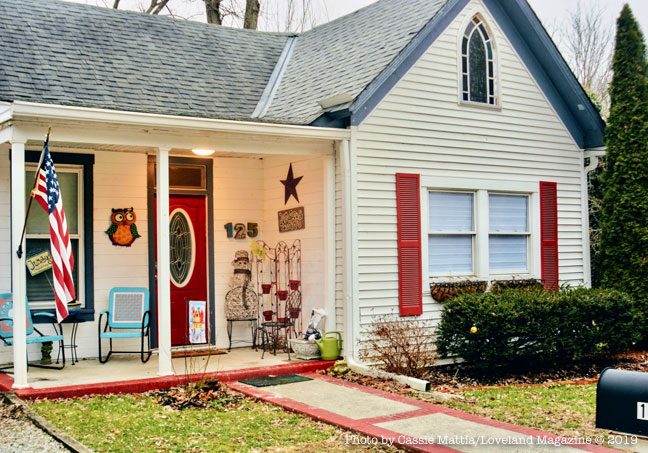
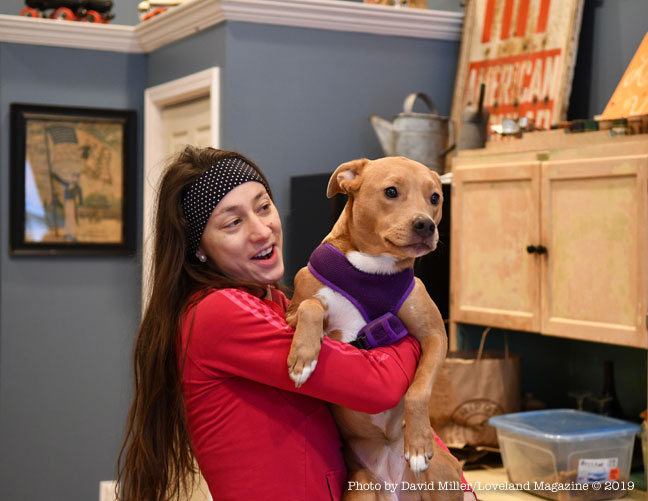
 really warms my heart and makes all the hard work worth it. I’ve been blessed with awesome guests who have all provided 5-star ratings for the overall experience which is ranked by accuracy, cleanliness, communication, check-in, location, and value! The guest comments provided afterward help me realize I’ve created something really special and I already have a lot of repeat customers,” Kresge said, “Guests really love seeing their names on the blackboard, the warm and cozy bed and comfortable studio feel, chefs kitchen, luxury bathroom, high tech amenities, fenced in backyard, outdoor seating areas, hammock, and access to bicycles and fishing poles in the shed. They love it that they can walk to the end of the street and be in complete nature or historic downtown in just a couple of minutes. My next door neighbor is Woody ‘the Norm’ of Loveland, a retired postman, and native that volunteers at the Farmer’s Market. He is an awesome neighbor. It’s really impossible to pick a favorite guest, but I guess the most memorable was hosting a young newlywed couple who celebrated their wedding night here. Thanks to guest referrals, the cottage is now being recommended by several downtown businesses, like Schildmeyer’s funeral home,” Kresge added.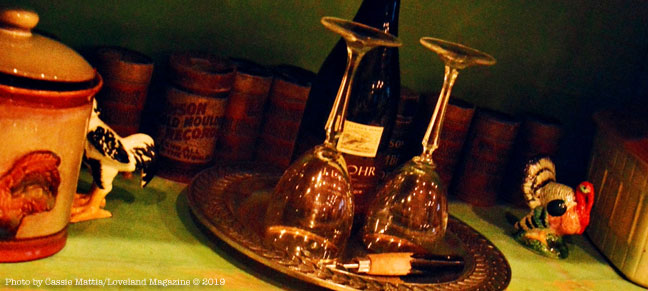
![[Part 1] My journey to the “West Loveland Historic District”](https://lovelandmagazine.com/wp-content/uploads/2018/11/west-loveland-historic-district.jpg)
 While exploring the businesses within the WLHD I have come to the realization that if you live there you have access to nearly anything and everything you need! DID YOU KNOW Loveland residents have their choice of 3 different insurance agencies located within footsteps of one another? In 2005, Carey Bush and Bill Re opened BRS Insurance in hopes that they could use their years of insurance experience to deliver the best comprehensive buying experience for their guests. Just a few steps away, Ron Delsignore, a State Farm Insurance agent since 2002, has his very own insurance business. Ron focuses primarily on out of state relocations to Loveland. Ron personally holds himself responsible for his guest’s assets, financial dreams, and legacy. Last but not least is Wilber-Price Insurance Group managed by husband and wife Don and Mary Jo Shrout. DID YOU KNOW Don opened the Nationwide insurance agency that now stands today right in Loveland’s WLHD 23 years ago! Both Don and his wife Mary Jo grew up in Loveland and thoroughly enjoy establishing a trusting relationship with each guest they help. Don’s agency provides home, auto, business, boat, equine, golf cart, motorcycle, and life insurance.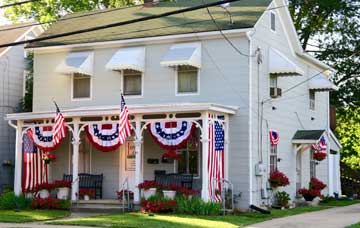








 Part one of Two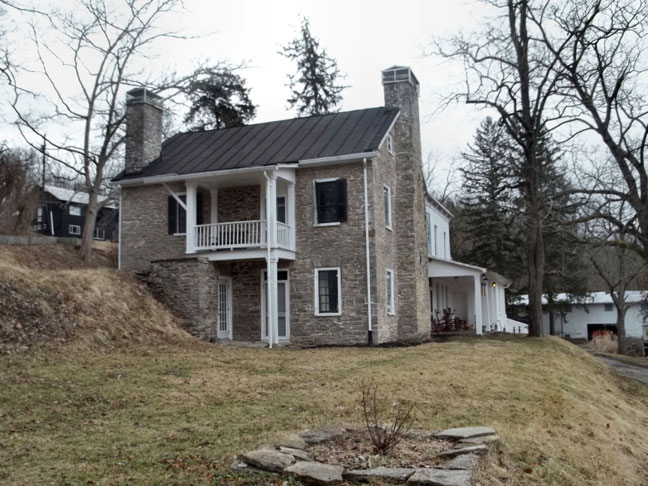






 by David Miller, Publisher