The following is an excerpt from Chapter Seven of The Search for the Underground Railroad in South-Central Ohio by Tom Calarco, scheduled for publication in late October by History Press. It is being published with permission from History Press.
Tom Calarco is a resident of Historic Downtown Loveland, Ohio.
By Tom Calarco
Part Two of Two
Butterworth Station of Loveland and the Underground Railroad: Further Recollections
In 1894, Robert Carroll provided the Cincinnati Times-Star with his account of the assistance he gave the Butterworths in their work along the Underground Railroad.
Often, in this wild flight for freedom, the master, with his unhuman helpers was in close pursuit, armed … devoid of mercy, protected by the law, and supported by a public sentiment that was respectable … Whether the pursuit was or was not immediate and pressing, it was always probable and expected, so that the runaway was in the condition of the hunted . . . .
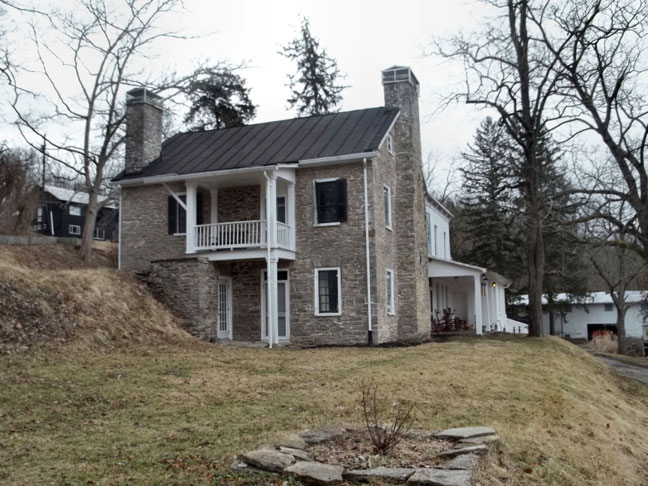
By 1820, the old stone house overlooked the fields as it does today along the Little Miami Bike Trail just outside of Loveland in Hamilton Township.
Along the banks of the Little Miami River in the hilly countryside north of Cincinnati, stands an old stone house, a relic of slower days, when there was lots of land and few people. It is not lived in much these days, but a big family of Quakers lived there for many years. Their forefather, Benjamin Butterworth was a six-foot six inch pioneer, a giant of a man who was said to have weighed 300 pounds. His roots in America dated back before the 1700s. Born in Virginia, he fought in the Revolution and was entitled to purchase a grant of land in the Northwest Territory, in the Virginia Military District, of which much of Ohio was part. This land and his inheritance provided him with substantial wealth. He was like many future Ohioans who would settle the new state: a slaveholder who freed his slaves and took them along to where there was no slavery.
The people that helped [fugitives] . . . had no rational hope of compensation. On the contrary, they gave aid, with the certainly of the loss of time and money, and with the possibility of fines and imprisonment.
One early morning I was told to go up in the haymow. On doing so I was somewhat startled to see half a dozen black persons hidden away. That day they lay hid and their food was carried to them with secrecy. About 9 o’clock that evening we hitched up, [and] cautiously loaded the vehicle with its human freight, and carefully fastened down the curtains.
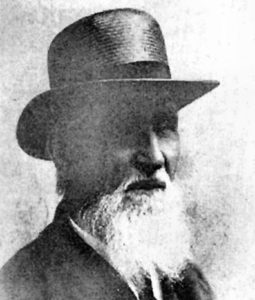
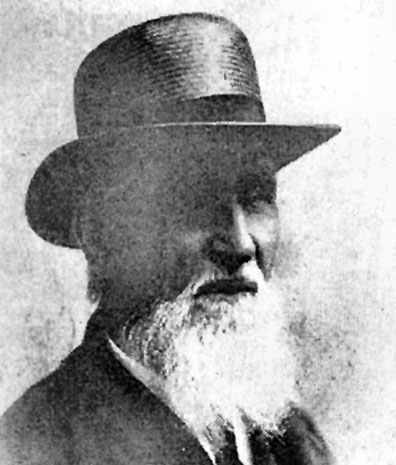
Thomas Butterworth
Thomas Butterworth was there and assisted. It was raining; the sky was still clouded and the roads wet and muddy. We went at first by a lane, across the farm of Butterworth, another of the brothers … We soon struck the main road and turned our course towards the North Star . . . . We drove along at a round pace, always on the lookout for pursuers, and it must be confessed, somewhat nervous. Now and then we stopped, and by the struggling moonbeam’s misty light, carefully scanned the road in both directions. We crossed Todd’s Fork near the site of Morrow; drove past Rochester and Clarksville and on through the night to Harveysburg, where we arrived just after daylight. As we traveled along the stories of the blacks were told.
We soon struck the main road and turned our course towards the North Star. Now and then we stopped, and by the struggling moonbeam’s misty light, carefully scanned the road in both directions.
In one, a slave trader had come to their plantation which meant the possibility of being sold to the Deep South where they would be overworked in brutal conditions with the likelihood of dying an early death. Another was family of three, whose twelve-year-old daughter was under consideration of being sold away. They stole a skiff and rowed down the Licking River to Cincinnati. A third told of a man who contracted out to work and earn money which he was using to pay for both the freedom of himself and his wife. Unfortunately, his wife was owned by a different master, a Baptist minister in fact, who sold her away to the Deep South.
Unfortunately, his wife was owned by a different master, a Baptist minister in fact, who sold her away to the Deep South.
“Scruples of conscience at violating the Fugitive Slave Law readily vanished before such narrative[s],” Carroll said.
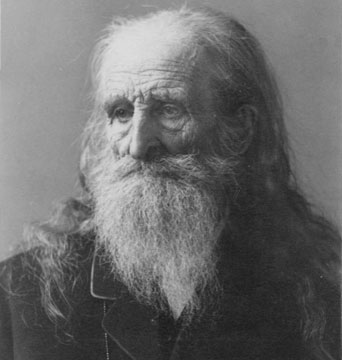
Ready to vanquish any such scruples was an eccentric and intensely intellectual abolitionist and free thinker, Orson S. Murray who moved into the Butterworth neighborhood sometime in the early 1840s. Long hair, scraggy beard, he was an unappealing, atheistic version of Jesus Christ. He had come from Vermont, where he’d been a fiery antislavery speaker who antagonized the already angry mobs gathering at antislavery lectures all over the North. Here in remote Ohio he found some solitude, a haven for his ideas, and people who would tolerate him.
Orson S. Murray who moved into the Butterworth neighborhood sometime in the early 1840s. Long hair, scraggy beard, he was an unappealing, atheistic version of Jesus Christ.
Murray already had done some writing in metaphysical journals of the day and had published his own newspaper in Vermont, The Telegraph. He started another newspaper, the Regenerator, not far from the Butterworth backyard. Its motto: ignorance was evil and knowledge its remedy.
Here’s what William Burleigh, the brother of eccentric antislavery speaker, Charles Burleigh, whom Murray named one of his children after, wrote about the Regenerator: “Mr. Murray appears to be a benevolent and self-denying man–is very eccentric in his appearance–very wild in many of his notions–and a very unsafe leader, for he leads into the mazes of skepticism and infidelity.”
And here’s what Murray had to say about the Regenerator himself: “If the Regenerator has helped to dispel and disperse the delusion, that that book [the Bible] is the voice of a god–and to show that it is only the words of men–men, some of them, in profound ignorance and darkness on the subjects they were pretending to elucidate–it has done something towards accomplishing one of the principal objects which have impelled me to do the very unpopular work of publishing it.”
Legends say he might’ve helped some fugitives too. He lived until 1885, dying at the age of 78.
Butterworth’s daughter Jane also wrote to Siebert, of her memories when she was about six or seven years old:
I saw no people of color, heard no words, but I was sure there was such in our wagon.
Among my earliest recollections, I was awakened about sunrise by the stopping of my father’s large wagon and two horse, and [him] handing me a little child 5 or 6 years old over to the care of a thrifty woman [who had come] out of a well-kept farmhouse, while he gave a shrill whistle for the men to come up from the field. I was taken into the house and seated in a small chair. The woman then gave me some freshly baked ginger bread while father talked with the man. I did not understand so unusual a visit at that place and time of my life for nothing was explained to me and I saw no people of color, heard no words, but I was sure there was such in our wagon. But as I grew older and learned about the Underground R.R, I knew that we were in that business then. [After] that time I [went] with my father on this said business when I was old enough to know about it. Several times I remember mother coming to our bedroom late at night and getting [us] all up in a hurry and putting us in bed elsewhere to give our bed to a lot of fugitives who come weary and tired, and our grandmother [Rachel who died in 1848] would tell them to “go to sleep, you will be safe in that room, nobody will get you there.”
Several times I remember mother coming to our bedroom late at night and getting [us] all up in a hurry and putting us in bed elsewhere to give our bed to a lot of fugitives who come weary and tired.
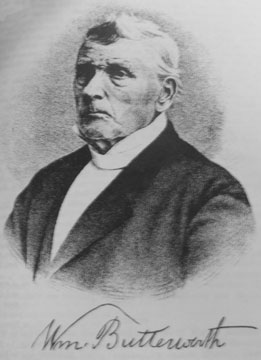
William Butterworth
Thomas said his brother, William, who lived a few miles north in Maineville, probably helped twice as many as him. How many is not known though Thomas said he probably helped as many as one hundred. Family anecdotes, however, suggest more, including stories of single parties numbering as many as 26 belying Thomas’s count. The important thing though was that all were brought safely to freedom.
“I can say in truth that such was our success that I do not believe a single one was ever re-captured and taken back to slavery,” he said.
1. Robert W. Carroll, “An Underground Railway: Fugitive Slaves and the Butterworths,” Cincinnati Times-Star, August 19, 1896, Siebert Collection.
2. Review of The Regenerator by William H. Burleigh, editor of the Christian Freeman, Jan. 22, 1844: 14 < https://popularfreethought.wordpress.com/browse-by-title/regenerator-1844-1854/ >
3. Extract from a Letter.” 175 (Jan. 1854): 353 < https://popularfreethought.wordpress.com/browse-by-title/regenerator-1844-1854/ >
4.Henry T. Butterworth to Wilbur Siebert, June 9, 1892, includes recollection of Jane.
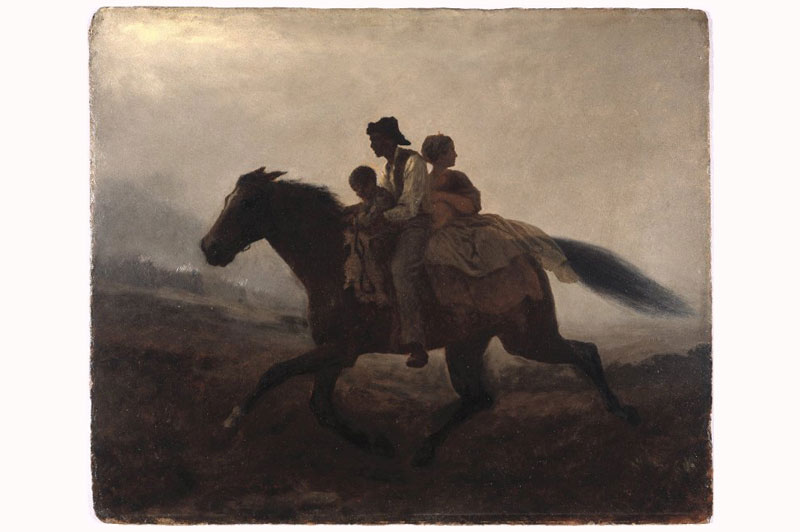
The Fugitive Slaves, oil on paperboard, circa 1862, Brooklyn Museum
The following is an excerpt from Chapter Seven of The Search for the Underground Railroad in South-Central Ohio by Tom Calarco, scheduled for publication in late October by History Press. It is being published with permission from History Press.
Tom Calarco is a resident of Historic Downtown Loveland, Ohio.
By Tom Calarco
Part one of Two
Along the banks of the Little Miami River in the hilly countryside north of Cincinnati, stands an old stone house, a relic of slower days, when there was lots of land and few people. It is not lived in much these days, but a big family of Quakers lived there for many years. Their forefather, Benjamin Butterworth was a six-foot six inch pioneer, a giant of a man who was said to have weighed 300 pounds. His roots in America dated back before the 1700s. Born in Virginia, he fought in the Revolution and was entitled to purchase a grant of land in the Northwest Territory, in the Virginia Military District, of which much of Ohio was part. This land and his inheritance provided him with substantial wealth. He was like many future Ohioans who would settle the new state: a slaveholder who freed his slaves and took them along to where there was no slavery.
On September 15, 1812, he set out with his family and some former slaves in two covered wagons to cross the old green Appalachian mountains of
what is now West Virginia. It was a trek of more than 300 miles up mountains more than 4,000 feet high through scenic passageways like those that had inspired trailblazers like Daniel Boone a generation earlier; there was only one road through this wilderness, the Midland Trail which ran along the Kanawha River and today is Route 60. Benjamin, 46; his wife Rachel, 47; Moorman, 19; Benjamin Jr, 18; Samuel, 14; Rachel, 12; William, 10; and Henry Thomas (called by his middle name), 3, made the journey in 25 days. One can only imagine the sunsets blazing their fire in that pristine wilderness of future promises. In the years ahead their lives would soon be afire with the cause of abolition
When Butterworth arrived, he found that his 1500-acre property needed a lot of work to make it suitable for farming. Though it had the advantage of a natural springs and the Little Miami River, it needed clearing and was hilly and full of gullies. It would take time to make it livable. Instead, he took the family to nearby Waynesville where one of his older daughters, Polly already was living with her husband Zachariah Johnson. Within a week he purchased land along nearby Caesar’s Creek where they moved. Busy with his farming and building a mill, he ignored his other property for the next three years.
By 1820, the old stone house overlooked the fields as it does today along the Little Miami Bike Trail.
In 1815, Moorman visited it and found a squatter who had built a cabin and planted crops on five acres he had cleared. He bought the cabin and the crops, and moved in. Three months later his older sister Milly and her husband, John Dyer, emigrated from Virginia and they moved in with him. They built a two-story log cabin, and a year later, Benjamin and family joined them. By 1820, the old stone house overlooked the fields as it does today along the Little Miami Bike Trail. In future years, the Butterworth farm grew prosperous through the sale of sweet potatoes, chickens and their eggs, and the construction of the Little Miami Railroad that ran through their property, connecting south to Cincinnati by 1843 and north to Springfield by 1846.
Being Quakers, they were stirred by the movement for immediate emancipation of the slaves that already had many supporters in this section of Ohio.
Thomas Butterworth
For a time, a least up until 1850 and the passage of the Fugitive Slave Law, their most important business was the UGRR. Being Quakers, they were stirred by the movement for immediate emancipation of the slaves that already had many supporters in this section of Ohio. Slaves had begun running away more than ever as more in the North joined the effort to assist them. The Little Miami River was a natural gateway. When they exactly became involved in aiding them is not known but probably no later than 1830-1831 when their sons, William and Thomas, married into the Wales and Linton families, Quaker abolitionists who may already have been part of the UGRR.
The Little Miami River was a natural gateway.
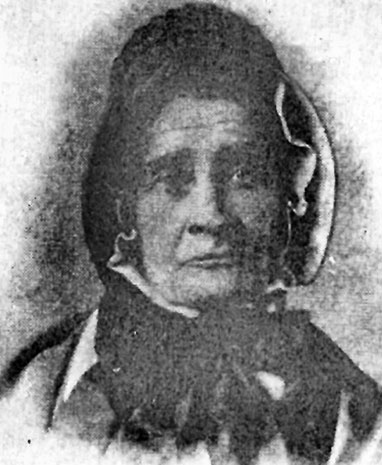
Nancy Butterworth
Thomas’s wife Nancy was a Wales and her sister Jane married Valentine Nicholson. It was a double wedding. William married Elizabeth Linton. So, it became an all-in-the-family UGRR operation. Thomas recalled those days shortly before his death in a letter to Wilbur Siebert:
We [once] had two women, one man and some children on hand and had them concealed for some time and it was becoming unsafe to keep them longer . . . I had two good horses and a good wagon with high sides and a good set of bows and cloth. I put the bows on and then stretched the cloth on and tied it thoroughly down. . . . . After thus being all fixed I stored in a lot of hay for the poor creatures to lie on. Then after leaving all the children [the fugitives’ children] for fear of their crying and betraying us, I put in two carts for my daughter Mary and I to sit on.
After thus being all fixed I stored in a lot of hay for the poor creatures to lie on.
By this time we had heard that a pro-slavery boy by the name of Andrew Davis had somehow got a knowledge of the whole thing and had, perhaps for a sum of money, made it known to two persons who would do anything they could to catch the flying slaves. The names of these two persons [were] David Coddington and James Foster. We had heard of our betrayal; I prepared for it; the river was high. My destination was to take them to an uncle of my wife’s by the name of Turner Welch residing at Harveysburg . . . . The bridge here at Foster’s must be crossed and was a toll bridge. Joseph Whitney took the toll at the west and James Foster kept a store at the east end (just before they came to the bridge). We had our Quaker school teacher, Robert Way, to go with us to see if we should run the gauntlet . . . just as we expected out came the two men [Coddington and Foster].
William Butterworth
Foster called out to him . . . Got any chickens, got any eggs, got any butter?
Butterworth shouted back as he passed by, “I am not going to market I am after fruit trees,” and handed Whitney the toll with stopping.
He heard Coddington say to Foster, “I’ll be damned if there ain’t niggers in that wagon.”
Butterworth had thought they would follow him and kept looking back but they made it safely to his wife’s Uncle on the north side of Caesar’s Creek. He did not consider it safe to keep them that night, so he sent them over to Harveysburg up on one of the many hills in that area, and Butterworth returned home to see about the fugitives’ children. He gave the task to Robert Carroll, who lived only a mile away with whom he had a regular arrangement regarding the transport of fugitives.
I had a small one or two-horse wagon. I had a neighbor a mile from me who was as strong an anti-slavery man as myself. As far as worldly goods were concerned he had nothing, was rich enough to have a wife and children to help him be poor. He feared no risks in helping fugitive slaves . . . I told him that when fugitives were on hand that he knew of, to come and get this wagon and one or two horses, as the case would require, and take them, and I would have no questions, and he should ask me none and go in the night, and go to such underground station as we know best, which was at or near Harveysburg . . . . This man Carroll took those children up there where they no doubt found their mothers.
Next Time in Part 2: Further Recollections of Butterworth Station


 Part Two of Two