

Tag: home rule

  • Three Ohio Supreme Court races on the November ballot will have a huge impact in the coming years

    Three Ohio Supreme Court races on the November ballot will have a huge impact in the coming years

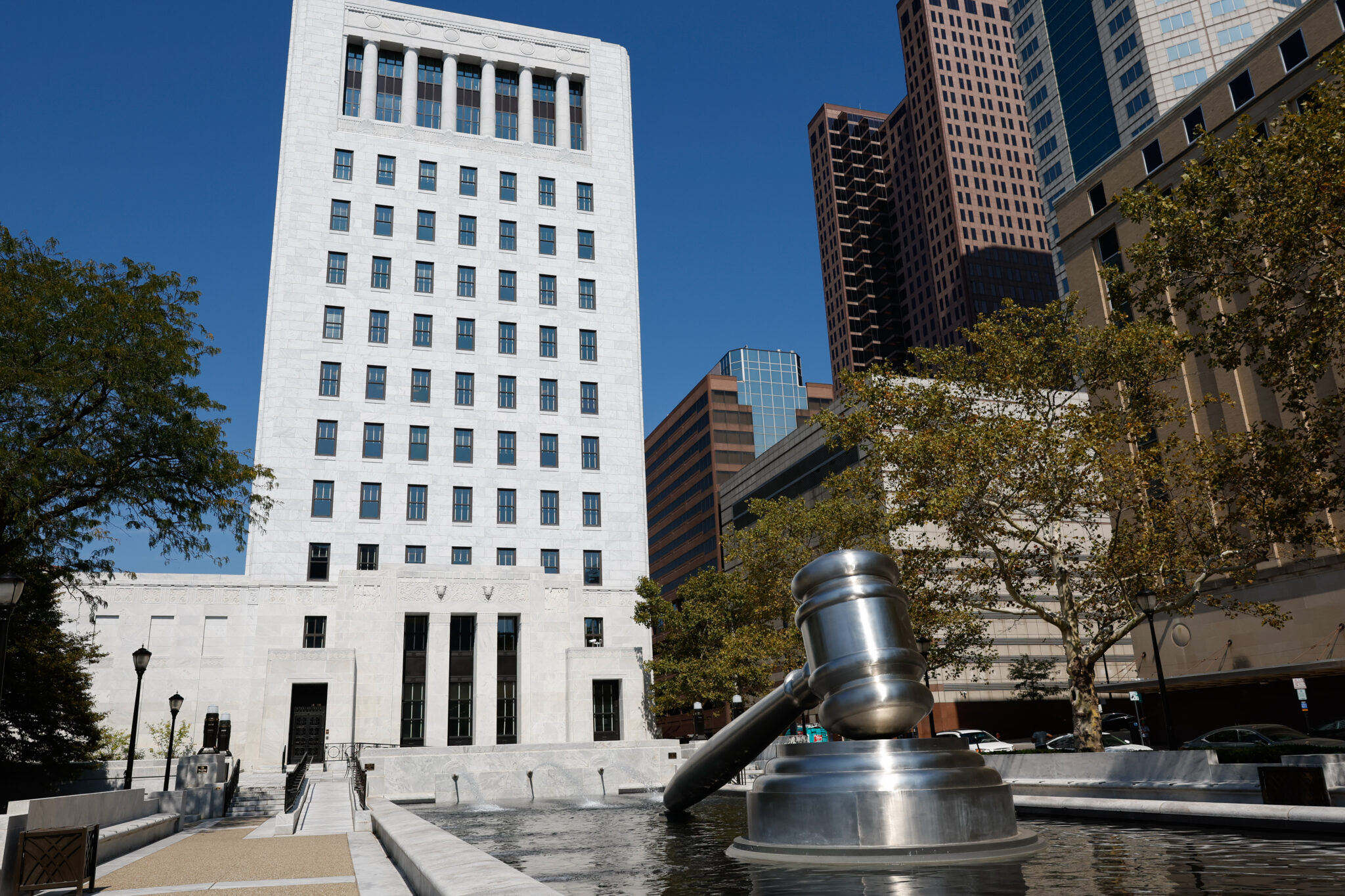
    The Gavel outside the Supreme Court of the State of Ohio, September 20, 2023, at 65 S. Front Street, Columbus, Ohio. (Photo by Graham Stokes for Ohio Capital Journal. Republish photo only with original article.)

    Ohio’s highest court currently has a 4-3 Republican majority

    By:  Ohio Capital Journal

    Three Ohio Supreme Court seats will be up for grabs during the November election. The outcomes will decide the balance of the court and have major impacts on a wide variety of issues that affect the lives of Ohioans, from education and environmental issues to gerrymandering and elections to civil and reproductive rights.

    Partisan labels were added to the previously-nonpartisan races by the state legislature in 2021.

    This year, incumbent Democratic Justice Michael P. Donnelly is being challenged by Republican Hamilton County Court of Common Pleas Judge Megan Shanahan.

    Incumbent Democrat Justice Melody Stewart is being challenged by incumbent Republican Justice Joseph Deters, who opted not to run for his current seat and decided to go up against Stewart.

    Vying for Deters’ open seat is Democratic candidate Lisa Forbes, of the Eighth District Court of Appeals, and Republican candidate Dan Hawkins, of the Franklin County Court of Common Pleas.

    Deters decided to run for a full-term seat by challenging Stewart, rather than a partial term for the seat Ohio Gov. Mike DeWine appointed him to on Jan. 7, 2023. Because of this, whichever candidate wins Deters’ current seat will have to run again in 2026 for a full six-year term.

    Ohio’s highest court currently has a 4-3 Republican majority. If all three Republicans are elected, the Republicans would hold all but one seat on the bench, for a 6-1 majority. On the flip side, if all three Democrats win their elections, the Democrats would hold a 4-3 majority. The Ohio Supreme Court has been under Republican control since 1986.

    Democratic Justice Jennifer Brunner’s seat will be up in 2026. Republican Chief Justice Sharon Kennedy, Republican Justice Pat DeWine and Republican Justice Pat Fischer’s seats will be up in 2028.

    The Ohio Supreme Court could make decisions on a plethora of critical issues: reproductive rights, gerrymandering, school vouchers, home rule, and environmental issues, among others.

    “If there’s a law around it, it could end up in the Supreme Court and have a real, tangible impact on each of our lives,” said Elisabeth Warner, spokesperson for the League of Women Voters of Ohio.

    Even though 57% of Ohio voters approved an amendment last year to enshrine reproductive rights in the state’s constitution, the court will inevitably rule on abortion access.

    “There are still a lot of anti-abortion laws on the books, so that’s something that the Supreme Court is going to be ruling on,” Warner said.

    Ohio’s anti-abortion laws were not automatically nullified when last year’s amendment passed, so abortion advocates are working to undo those laws.

    Franklin County Court of Common Pleas recently issued a temporary pause on Ohio’s 24-hour waiting period and the minimum two in-person visits required before an abortion.

    Another lawsuit is currently pending in Hamilton County Court of Common Pleas over whether Ohio’s six-week abortion ban is unconstitutional after voters passed last year’s amendment.

    Those lawsuits will likely make their way to the Ohio Supreme Court — meaning the seven justices will end up deciding to what extent reproductive rights are protected.

    “At the end of the day, the Ohio Supreme Court will determine whatever’s in the Ohio Constitution that voters put into the Ohio Constitution,” said Catherine Turcer, Common Cause Ohio’s executive director. “It is interpreted by the Ohio Supreme Court.”

    The Ohio Supreme Court has made many rulings on redistricting before and it will likely come before the court again — especially with the amendment on this year’s ballot to create a citizen commission to redraw districts.

    A lawsuit against school vouchers is making its way through the court system and will likely go before the state’s high court.

    Even boneless chicken wings wound up in front of Ohio’s seven justices. The court recently made national headlines with their 4-3 ruling that boneless chicken wings can have bones in them — appearing in a bit on “The Late Show with Stephen Colbert.”

    Turcer and Warner both criticized the 2021 law that requires party affiliation listed on the ballot for Ohio Supreme Court candidates. More than 1 million Ohio voters left the two Supreme Court races blank during the 2020 election.

    “We shouldn’t actually be thinking Democrats and Republicans because at the end of the day, what you want is a referee who’s independent and impartial,” Turcer said.

    Follow OCJ Reporter Megan Henry on X.


    Megan Henry
    Megan Henry

    Megan Henry is a reporter for the Ohio Capital Journal and has spent the past five years reporting in Ohio on various topics including education, healthcare, business and crime. She previously worked at The Columbus Dispatch, part of the USA Today Network.

    Ohio Capital Journal is part of States Newsroom, the nation’s largest state-focused nonprofit news organization.

    MORE FROM AUTHOR

  • Ohio Republicans go full Calhoun on nullification. Never go full Calhoun

    Ohio Republicans go full Calhoun on nullification. Never go full Calhoun

    Commentary by David C. DeWitt from Ohio Capital Journal


    Ohio Republicans in the state legislature have apparently decided to go full Calhoun with a proposed bill attempting to nullify not only any federal gun laws they don’t like but also any court rulings related to gun laws with which they disagree.

    They do not possess the power to do this under the U.S. Constitution, the Ohio Constitution, or precedent set by the U.S. Supreme Court, the highest court in the land that some Ohio Republicans seemingly believe they have the power to flout. Again, they do not.

    As they’ve spent much of the COVID-19 pandemic wailing ignorantly in misunderstanding about the separation of powers in the Constitution and the checks and balances among government branches, they’ve turned most recently to proposing and passing laws defying these elemental aspects of American civics.

    Take first Ohio Senate Bill 22, which bestowed upon the state legislature veto authority over executive branch emergency and public health orders by concurrent resolution. Statehouse Republicans declared this was a response to the executive branch allegedly overstepping its authority — the authority the legislative branch itself gave the executive branch through law more than a hundred years ago — and their solution was to overstep their own authority.

    You see, the Ohio Constitution requires the General Assembly to actually pass law to exercise the power of law, not resolution. Laws must be signed by a governor, or a governor’s veto overridden by the legislature, in order to be enacted. This is an intentionally cumbersome process. A resolution requires neither. So simply ignoring the Ohio Constitution relieves them of this constitutional burden. The non-partisan Legislative Services Commission warned Republicans of the unconstitutionality of their proposal, and they ignored the LSC too.

    This middle finger in the face of the Ohio Constitution was even shepherded through the Ohio House by current speaker and former Ohio Supreme Court Justice Bob Cupp, who should definitely know better.

    Why did they do this? They do have the authority to rewrite law if they so wish. They could rewrite Ohio Revised Code and override the governor’s veto in doing so just as well. But apparently ignoring constitutionality was easier. This middle finger in the face of the Ohio Constitution was even shepherded through the Ohio House by current speaker and former Ohio Supreme Court Justice Bob Cupp, who should definitely know better.

    Now comes House Bill 62 that seeks to declare any federal law, executive order, administrative action, or court ruling to be “null, void, and of no effect in this state” if it infringes upon the Second Amendment. This attempt by a state legislature to overrule federal law and courts is called nullification, and as a concept, it has never once been upheld in federal court in American history. Its most ignominious test came when the state of South Carolina attempted to nullify federal tariff law in 1832-33, led by slaver and slavery advocate John C. Calhoun.

    Courts at the state and federal level, including the U.S. Supreme Court, repeatedly have declared that under the Supremacy Clause of the U.S. Constitution, federal law is superior to state law, and that under Article III of the U.S. Constitution, the federal judiciary has the final power to interpret the Constitution. Ohio even lost its own fight over nullification in a battle against the Bank of the United States in 1824.

    But Ohio Statehouse Republicans’ self-contradictory views of home rule and local control appear to be based exclusively on their own political whims and no discernable standards or principles for the exercise of self-government.

    Plastic bags? According to the General Assembly, local government has no right to home rule or local control in regulating them. Nor, say Ohio Republicans, can locals decide against allowing the fossil fuel industry to run amok in their communities, injecting waste into their land while these fracking wells provide zero economic benefit to the area affected. But sustainable energy is a severe threat to home rule, the foulest tyranny, according to the Ohio General Assembly and its blissful lack of self-awareness.

    And how can we forget the gun issue itself? Ohio Statehouse Republicans appear to believe that the state can trump federal laws relating to guns and ignore any and all courts, but Ohio cities have stepped high above their station indeed for attempting to regulate guns themselves without the General Assembly’s approval.

    Power for me and not for thee appears to be Statehouse Republicans’ only real governmental operating ethos.

    Power for me and not for thee appears to be Statehouse Republicans’ only real governmental operating ethos.

    While the self-contradictions on the roles of levels of government show a political agenda with no consistent civic principles behind it, the real failure here is to take any sort of thoughtful long-view. I can only imagine their caterwauling if Statehouse Republicans were the victims of this kind of power grab instead of the perpetrators. I don’t even have to imagine it. Former Ohio Gov. John Kasich ate Statehouse Republicans’ lunch by using executive power to expand Medicaid in Ohio under the Affordable Care Act against their wishes.

    But let’s say Ohio Republicans don’t manage a permanent supermajority in the Statehouse, and that some day, perhaps decades from now, a Democratic General Assembly declares itself above the authority of the courts to decide issues of religious freedom, or abortion rights, or LGBTQ rights, or gun rights. Do you think Ohio Republicans would humbly accept the consequences of the path they’ve endorsed and chosen, or do you think they’d play the shameless hypocrite and contradict themselves entirely? I know my bet.

    It’s hard to take people seriously who do not take themselves nor the basics of American civics seriously.

    Due to extreme gerrymandering and the extremist and corrupt politics it breeds, however, Ohioans will be forced to continue to endure for some time longer a General Assembly that sees a radical faction of one political party and high-dollar donor special interests as their only true constituencies.

    The rest of us and our pesky constitutions, judicial precedents, rule of law, checks and balances, and separation of powers be damned.