Tag: hospitals

  • COVID-19 rises again in an undervaccinated Ohio

    COVID-19 rises again in an undervaccinated Ohio

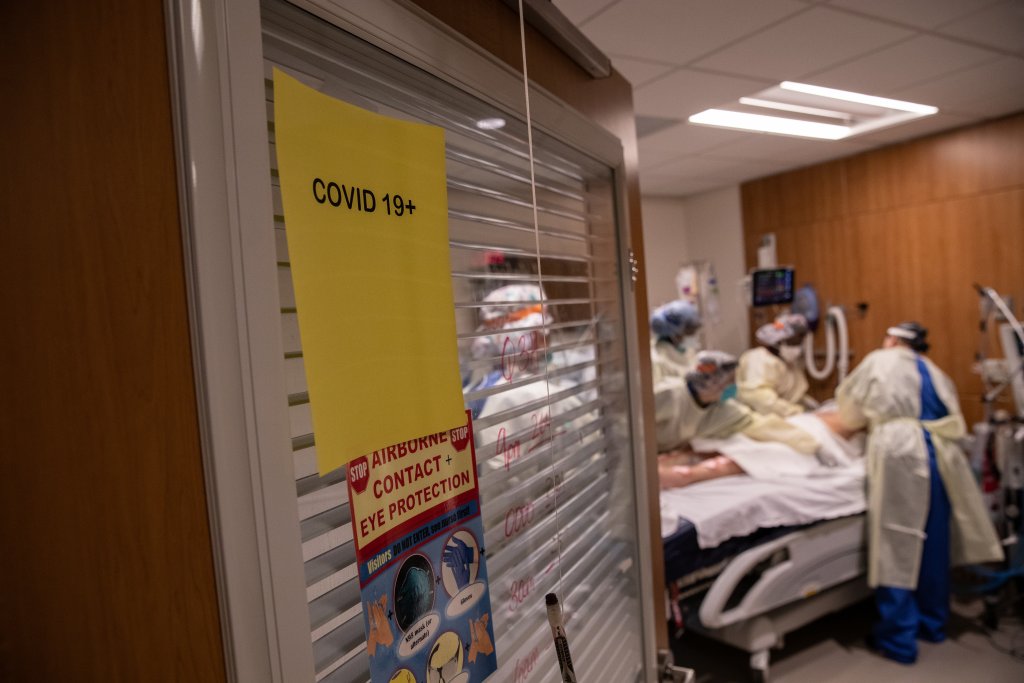
    Photo by John Moore | Getty Images.

    BY: JAKE ZUCKERMAN – Ohio Capital Journal (Local dated added by Loveland Magazine)

    COVID-19 cases are once again ascendant in the 10th least vaccinated state in the nation.

    State data shows infection rates are climbing and the workloads are reupping at hospitals, where more than 2,700 Ohioans are currently hospitalized with COVID-19.

    An analysis of state data shows that 11 months into the vaccine rollout, the ground is still fertile for outbreaks all around Ohio. Of 88 counties in the Buckeye State, only Delaware (71% vaccinated) surpasses the national vaccination rate of 68.5%. In 58 counties, less than half the population is vaccinated, according to data as of Sunday.

    Ranked by state, Ohio (56% vaccinated) is the 10th least-vaccinated in the country, according to data from The New York Times.

    In Henry County, a rural swath of northwest Ohio, COVID-19 is spreading at more than twice the statewide rate of about 400 infections per 100,0000 residents. About 52% of residents are vaccinated. Health Commissioner Joy Ermie said the spread is not specific to any outbreak or location, it’s just swimming through homes and social events of mostly unvaccinated people.

    “The quicker we turn this around, the quicker we’ll see a decrease in our cases,” she said. “It will be a forever cycle if we cannot increase our overall vaccination rates.”

    Public health workers in coronavirus-sieged counties said in interviews for this article that it’s time to start accepting that COVID-19 is likely here to stay in some form or fashion, absent a paradigm shift on vaccination.

    Several indicated a circular pattern in vaccination; the unvaccinated, by and large, are staying unvaccinated. The vaccinated are fortifying their immune system with booster doses.

    “I would absolutely love to say COVID is over in X [number of] months,” Ermie said. “But I feel much more confident that we should take our energy away from, ‘How is this going to end?’ to ‘How can we learn to live with it?’”

     Gavin Smits receives a first dose of the Pfizer COVID-19 vaccine. (Photo by David Ryder/Getty Images)

    Federal authorities approved the use of vaccines on children aged 5-11 earlier this month, which will likely jumpstart vaccination rates to some extent. In north-central Ohio’s Seneca County, a population of roughly 55,000 people, about 47% of residents are vaccinated. The county’s case rate is nearly twice the statewide average.

    About 20 children were vaccinated at a clinic last Tuesday night, according to county health commissioner Anne Goon. She said there hasn’t been any mad rush on vaccines, but she was happy with Tuesday’s crowd.

    She said adults in the community have bristled with vaccines, masks, and assorted infection control policy responses to the pandemic. Some parents have refused to have their kids tested after they’re exposed to the coronavirus at school, she said, even if it’s required for an after-school sport.

    “We have a portion of our population that just doesn’t think COVID is real,” Goon said. “That it’s just a hoax.”

    To Dr. Bruce Vanderhoff, Ohio’s top doctor and director of the state health department, the state is “approaching” a point in the pandemic where coronavirus becomes more of a nuisance than threat to the public welfare. We’re not there yet though as the extra-transmissible delta variant of the coronavirus “relentlessly” seeks out the unvaccinated, he said.

    “In some circumstances, what is driving what we’re seeing is low vaccination rates in some communities,” he said. “So we have to continue to focus on the importance of vaccination.”

    Vanderhoff, speaking to reporters Friday, offered a more optimistic take on Ohio’s vaccination rate. Among Ohio adults, more than 2 in 3 have now received at least one dose of vaccination. The COVID-19 vaccination rate, he said, has surpassed the rate of Ohioans who get their annual flu shot. It pales in comparison to vaccination against disease like measles or polio, but those vaccines have been around longer and are (mostly) legally required to enroll in school.

    Despite Vanderhoff’s optimism, hospitalizations for COVID-19 have increased across every age group over the last week. For people aged 30-39, who are less vaccinated than their elder counterparts, hospitalizations leapt 48% in that time frame. More than 2,700 Ohioans are currently hospitalized with COVID-19, up from less than 2,200 earlier this month.

    John Palmer, a spokesman for the Ohio Hospital Association, said the statewide COVID-19 patient census has been increasing by about 60 patients daily as of late.

    “Hospitals are operating at high-capacity levels with workforce challenges and any surge will have a devastating impact leading to disruption of health care access for communities,” he said. “Despite three safe, approved and effective vaccines available today to stop this virus we continue to see spread and it’s frustrating to respond to a virus that is preventable.”

    All told over about 20 pandemic months, more than 25,600 Ohioans have died from COVID-19, part of the U.S.’ 762,000 dead. More than 82,000 Ohioans have been hospitalized, including more than 10,000 who required ICU care. A staggering 1.6 million Ohioans have been infected with COVID-19.

    Data on infections that “break through” the vaccines’ protection is limited, but available evidence suggests it’s a rare occurrence. CDC research shows vaccination decreases the risk of infection by a factor of five; the vaccines are between 88% and 93% effective in preventing hospitalization; and months’ worth of data shows there’s no increased risk for mortality among vaccine recipients. Since Jan. 1 in Ohio, fewer than 5% of people hospitalized or dead from COVID-19 were vaccinated.

    Mark Cameron, an immunologist at Case Western Reserve University, is not surprised by COVID-19’s resurgence. Even highly vaccinated states like Vermont (82% vaccine started) are wrestling with outbreaks. In Ohio, cold weather makes respiratory viruses more spreadable and drives humans to gather inside instead of outside.

    “It’s absolutely unacceptable to operate in a space in which 50-60% of the people are unvaccinated,” he said.

    He expressed frustration with a sense of complacency from the public whenever the coronavirus ebbs, and an unwillingness to acknowledge the predictable patterns of disease spread based on low vaccine coverage, weather and human behavior.

    “I don’t know what unique to say at this point,” he said. “Here we are risking another impact on our holiday season through sickness, hospitalization and death.”
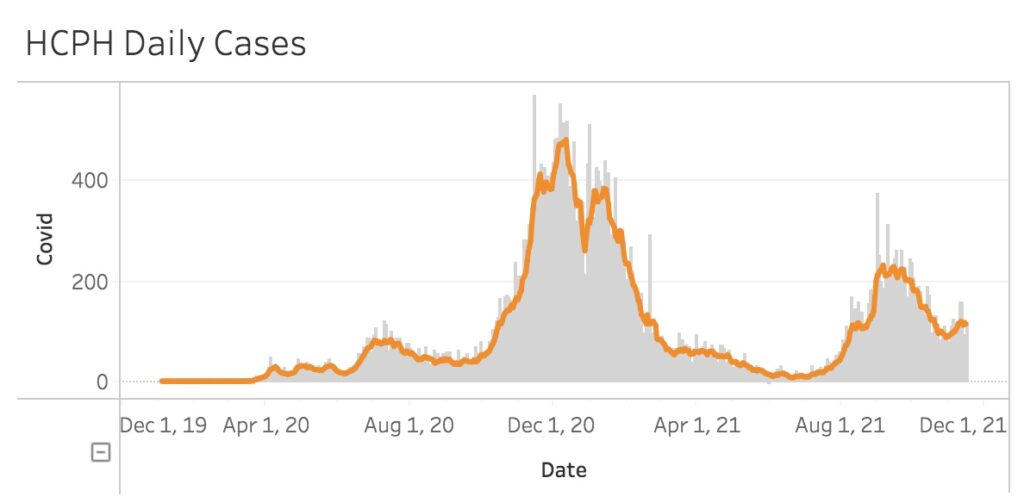

    Hamiolton County Public Health 11-16-2021

    November 16

    Warren County Health Services reported 62 additional COVID-19 cases on Tuesday, along with 60 recoveries. Health Services is monitoring 493 active COVID cases as of Tuesday, 471 of them involving mild illness.

    Thirteen (13) people are hospitalized as of Tuesday, one (1) fewer than Monday. One (1) is critically ill, and the remainder have moderate illness. Nine (9) others are moderately ill outside of the hospital.

    All but two (2) of Tuesday’s cases involved community spread of COVID-19, as two (2) were reported in a skilled nursing facility.

    Warren County Health Services continues to see a significant spike in COVID-19 transmission, with the majority of its new cases arising from workplace exposures, family/household exposures and indoor events/gatherings as the highly transmissible Delta variant remains involved with virtually all local cases.

    Sixteen (16) of Tuesday’s cases involved individuals who had been fully vaccinated. Cumulatively as of Tuesday, 1,086 of 44,513 fully vaccinated Warren County residents have tested positive for COVID-19. To date, 1,027 of 1,086 had mild illness, while 41 became moderately ill, two (2) seriously ill and one (1) critically ill. Fifteen (15) passed away, all of them elderly and/or with extensive health issues, seven (7) of them at nursing homes.

  • After seven month legal battle, Eye on Ohio wins public records lawsuit over hospital capacity numbers

    After seven month legal battle, Eye on Ohio wins public records lawsuit over hospital capacity numbers

    Eye on Ohio is still waiting for the records

    By Bonnie Jean Feldkamp and Kathiann M. Kowalski

    This article provided by Eye on Ohio, the nonprofit, nonpartisan Ohio Center for Journalism. Please join their free mailing list as this helps them provide more public service reporting. Loveland Magazine provides support for Eye on Ohio through membership in the Ohio News Media Association.

    As the ongoing pandemic continues to surge, the Ohio Court of Claims ruled last week that the Department of Health must share public records with Eye on Ohio, showing the number of beds and ventilators available for COVID-19 patients at individual hospitals throughout the state. 

    The ruling comes seven months after Eye on Ohio initially sought the records. 

    “In times of crisis transparency is paramount,” said Rebekah Crawford, who has her Ph.D. in Health Communication, Relating & Organizing from Ohio University.

    People want credibility and clear lines around what is known and what is uncertain. “When risk communicators are at their best,” Crawford said, “they remain credible by showing what is known and what is not known and by being clear about why we don’t know, and what we’re going to do to find out.” 

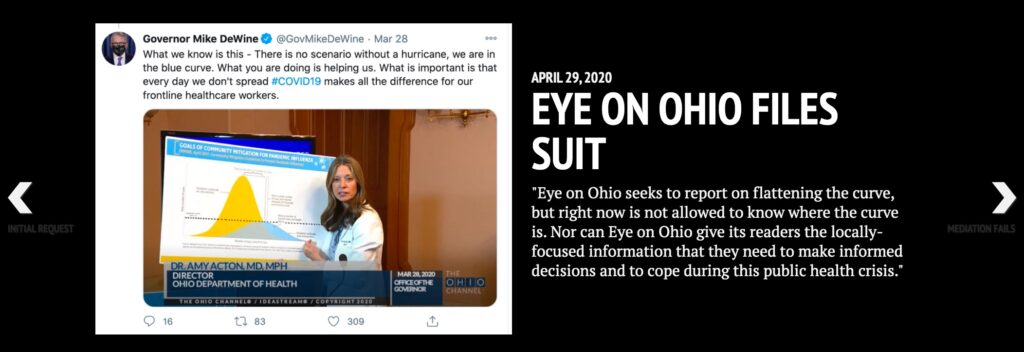
    View the Eye on Ohio timeline pursuing the Department of Health public records COVID 19

    When Eye on Ohio first requested records, at the end of March, the state had only about 2,200 confirmed cases and 55 deaths, according to the online Johns Hopkins Coronavirus Resource Center. As of November 12, Ohio had approximately 274,500 confirmed cases, and about 5,700 people had died from the disease.

    “We are in the midst of our third wave in Ohio,” Gov. Mike DeWine said in his November 11 address to the state. There had been warnings that cases would climb when weather turned cooler and people spent more time indoors again. But, DeWine stressed, the surge is “much more intense, widespread, and dangerous.”

    “As of today, every single one of our 88 counties has a high rate of virus spread, and areas of our state that were previously untouched—our rural areas—are being hit especially hard,” DeWine said.

    If current trends don’t change, some parts of the state are “maybe two or three weeks out” from hospitals having to crowd out non-COVID-related care as they try to keep up with the surge, reported Andy Thomas, a medical doctor at Ohio State University’s Wexner Medical Center, during the governor’s November 9 press conference. 

    Eye on Ohio sought records with the data as a way to provide readers with timely, local information about the ability of healthcare facilities in their area to deal with the pandemic. 

    In a state with nearly 45,000 square miles, that local information could tell citizens more about Ohio’s readiness to deal with emergencies for all its residents. Availability of beds and respirators in Cincinnati, for example, would mean little if hot spots of emergencies were concentrated in Ashtabula, nearly 300 miles away by car.

    Transparency Matters

    Leaders in times of crisis tend to assume that the public is going to panic, Crawford said, even though “research actually shows that panic isn’t the most prominent or even in the top ten of reactions that people have to communications of risk. People are most likely to be in denial. Studies of 9-11 show that people were excessively polite as they exited the World Trade Center because people don’t panic, they get especially compliant and cooperative in high stress or high risk situations.”

    Lack of transparency creates suspicion, hurts credibility, and diminishes trust-worthiness. Crawford said, “people who are untrained in risk communication go to that ‘don’t panic’  communication mode.” 

    Another misnomer is the assumption that people can’t understand how to interpret the information, so, Crawford said, “rather than taking it upon themselves to communicate in a transparent and understandable way they withhold information and say ‘we’ll make decisions for you’ which doesn’t work when people are anxious.”

    “A risk expert cannot look at some numbers and then tell a community ‘this isn’t a problem for you’ because the community may decide that it is a concern ‘because you don’t speak for us or understand what we value,’” Crawford said.

    Transparency is key for the public so individual communities can take the information given and decide for themselves what actions should be taken and individual needs addressed based on the needs and values of their demographic. 

    A Need for Transparency

    Reporters initially sought information from individual hospitals but were told that all information was being funneled to the Ohio Hospital Association, which in turn provided it to the Department of Health. And the Department of Health had arranged for the data to be entered into a database called Surgenet. 

    According to a court affidavit, Surgenet was first developed by the Greater Dayton Area Health Information Network (GDAHIN). The software was subsequently enhanced to its present “all hazards” function as “a tool to be utilized during an emergency involving the public’s health which could severely impact hospital services.” Eye on Ohio was told that only the Department of Health would grant access to the materials.

    Eye on Ohio then filed a formal public records request for access to the data or records with it. After cancelling a meeting that had been scheduled to discuss the request, the Department of Health then issued a flat-out denial, claiming the records were “security and infrastructure records” under an exception to the state’s public records law.

    Eye on Ohio had  no option but to file a case with the Ohio Court of Claims.

    The court said the statutory language for that security exception just didn’t fit. That part of the Ohio Revised Code exempts security and infrastructure records that are prepared for the express purpose of protecting against or responding to terrorism, school shootings or similar acts of attack or sabotage. None of those apply to the COVID-19 pandemic.

    “Exceptions to disclosure are strictly construed,” wrote Special Master Jeff Clark in his October 20 report and recommendation. “And, in this case, the Department of Health failed to connect the data sought by Eye on Ohio with the prevention, mitigation or response to any existing or anticipated act of terrorism.”

    “To meet the burden of proof regarding alleged security records, ODH must offer more than its own conclusory labeling,” Clark wrote. He likewise rejected the Department of Health’s assertion that it should be able to stop release of the records because it didn’t want to discuss them.

    “Even assuming, arguendo, that some hospitals would rather not disclose their bed and resource availability, it is well-settled that public offices may not withhold records merely because of a policy preference for confidentiality,” Clark wrote.

    Court of Claims Judge Patrick McGrath approved the Special Master’s report and recommendation on November 10.

    In 2020, so far there have been 24 public records cases resolved in Ohio. In 14 cases, the party dismissed the action because records were provided. In seven cases, the party just dismissed the case. It’s not clear if the records were provided or they just weren’t relevant any more. Just three were decided by the Court of Claims. 

    What’s next

    Despite the court’s ruling, Eye on Ohio is still waiting for the records. In response to its journalists’ requests for access to the database, attorney Socrates Tuch wrote, “Instead, the Department is preparing a data extract to be provided on an Excel spreadsheet or sheets. Doing so is taking time as the Department staff attempts to accommodate this task with the COVID response.”

    Ohio law generally requires a reasonable time for production of public records. However, Eye on Ohio first sought the records with the information at the end of March. And the Special Master’s October 20 report came out more than three weeks ago.

    Eye on Ohio again pressed for production of the materials on Friday. 

    “We are working on gathering the records and when they are ready, we will send them along,” responded Press Secretary Melanie Amato at the Department of Health.

    When Eye on Ohio finally gets the materials, it plans to provide further reports on it and on updated data. Its journalists hope that more complete, local information can help the public as the pandemic continues. 

    Disclosure of the mounting strain on hospitals in their vicinity might also make people more vigilant in their efforts to control the pandemic and to “flatten the curve” of cases. Otherwise, as scientists have previously warned, the pandemic will cause even more deaths that could have been avoided.

    As for the resistance against complete transparency, “Far be it from me to criticize people who are providing care at a great risk to their own health in a time of heightened need,” Crawford said. “I’m not talking about the doctors and the nurses who are working in the hospitals, but the managers and administrators who are at the upper echelon of those really hierarchical corporations in some cases are motivated not to cooperate and share information. It really goes counter to public health needs and the demands in care and I would say ethical and medical provision.” 

  • Loveland High School student Evan Osgood creates non-profit to get help and Personal Protective Equipment to those who need it most

    Loveland High School student Evan Osgood creates non-profit to get help and Personal Protective Equipment to those who need it most

    While our hospitals are finally able to get the Personal Protective Equipment (PPE) they need, many others are still in great need of PPE and you can help! 

    Sign up to get your free assembly kit at SOSforPPE.org and in an hour you can make 20 faceshields or facemasks and maybe save a life! Various ability levels welcome, suitable for anyone ages 5 and up.

    No experience or special equipment needed!

    Loveland, Ohio – Evan Osgood, a Loveland High School student, has created a non-profit organization to get help and Personal Protective Equipment (PPE) to those who need it the most.

    Evan Osgood (Provided Photo)

    Osgood said, “Back in March when I heard about the dire need for PPE on the news, I asked myself, ‘What can I do to help?’ We have all these people sheltering in place looking for something to do and this tremendous need for PPE. How can we combine these two things to make a difference…and SOS for PPE was born!” 

    Osgood created a team of founding members and the PPE Network keeps growing exponentially. Founding Members include Carissa Aiello, Molly Alexander, Will Gerstemeier, Aidan Hook, Nate Matuszak, Caleb Nelson, Hayes Santa, Tyler Vrh, and Tristan Vrh. Board Members include Jack Alexander, Lisa Brockmeyer, and Gwen Vrh.

    “A great thank you goes out to some of our major contributors and over-the-top makers of all ages,” said Osgood. He named ioby.org, National COVID-19 Community Response and Recovery Match Fund, the Mueller Family, the Kavouras Family, Julie Koch, Luis Garcia Saucedo, the Crouse Family, the Batterson Family. He said there are many more who have helped.

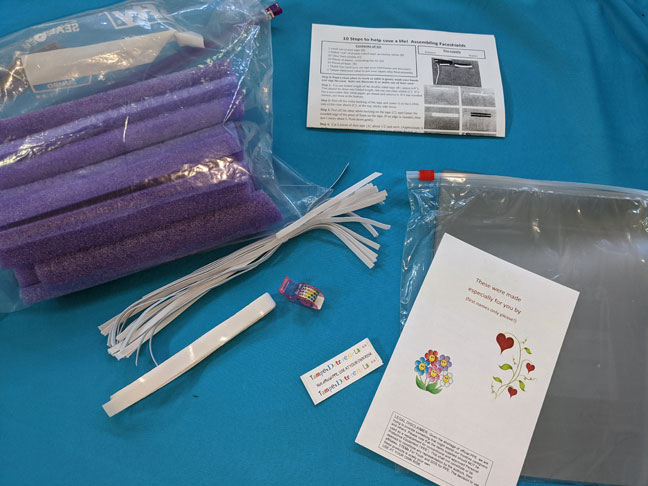
    A Faceshield Kit

    “It really hit home how important our efforts are when I made one of our deliveries,” said Osgood. It was for a couple of senior citizens in their 70’s who live in Loveland.I placed the bagged and sanitized masks on the front porch, rang the bell, and stepped back to the car as usual.” The woman answered the door, looked down, and burst into tears she was so appreciative of the masks.

    It turns out she and her husband had been stuck inside for three weeks and didn’t feel safe even going to the grocery store. Osgood offered to deliver her some groceries and she politely declined, saying now that they had some masks, they would go during the designated shopping time for senior citizens. Osgood said that she couldn’t have been more thankful and appreciative, calling out, “Bless you and bless what you are doing for this community.”

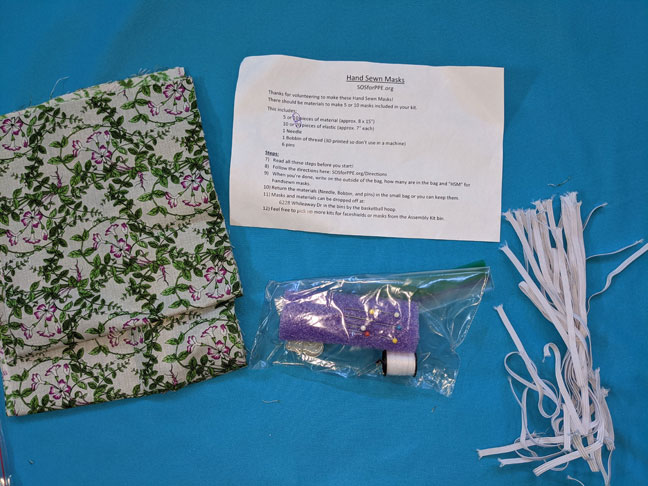
    A Hand-Sewing Kit

    “Whenever I start to get overwhelmed with trying to make a dent in the need for PPE, I just take a step back and remember her. Even one mask can make a huge difference for someone,” said Osgood. 

    “We have story after story of people who hear about us from a friend or see us on the news, go online, and sign up to receive or make PPE. There was a woman who worked at a nursing home and their staff was getting ear blisters from the elastic of the masks rubbing all day. We sent them EARests for their whole staff and it’s made a really tough job just a little bit easier.”

    Osgood said that so far, SOSforPPE has supplied over 40,000 pieces of PPE to frontline caregivers, hospitals, co-workers, seniors, and neighbors. “There is still a great need and you can be part of the solution.”

    If you will volunteer an hour of your time you can get a free assembly kit to make them from the comfort of your home.

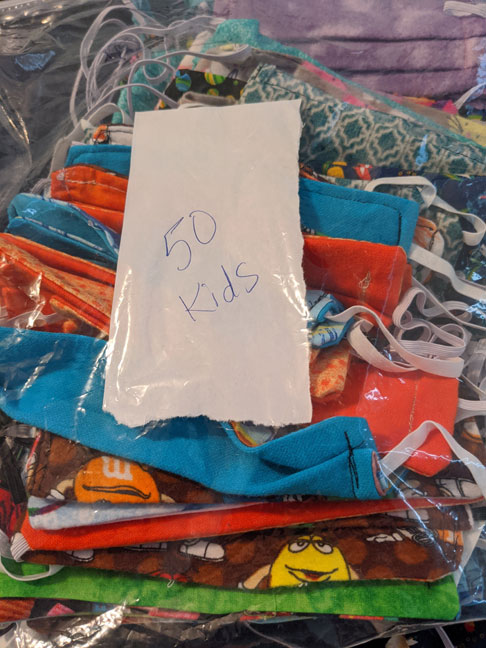
    Some finished masks made by a volunteer

    Mom Lisa Osgood said, “The Veterans Administration Medical Centers and our senior living communities are still in great need of PPE. Even though hospitals can, for the most part, get what they need, The VA and senior facilities are asking for help.”

    “If everyone reading this signs up to make even one kit, we can answer the SOS for PPE from the VA and our seniors and help save lives,” said Evan.

    HELP! We NEED PPE – Request PPE

    Register to MAKE or ASSEMBLE PPE

    Donate

    Contact SOSforPPE


  • Ohio Department of Health classifies 2019-novel Coronavirus  (2019-nCoV) immediately reportable disease

    Ohio Department of Health classifies 2019-novel Coronavirus (2019-nCoV) immediately reportable disease

    Centers for Disease Control and Prevention (CDC) says the risk to the American public is low. 

    A News Release from the Ohio Department of Health

    COLUMBUS — Amy Acton, MD, MPH, Director of the Ohio Department of Health (ODH), declared novel Coronavirus (2019-nCoV), an immediately reportable disease.

    By issuing a Director’s Journal Entry, Dr. Acton elevated 2019-nCoV to a Class A disease. This is a proactive step to ensure appropriate reporting of suspected cases, should the need arise in Ohio. No cases have been reported in Ohio to date. However, one case has been reported in Washington state and this step helps reinforce Ohio’s ongoing preparedness work.

    The Ohio Department of Health has been closely monitoring developments related to 2019-nCoV in tandem with the Centers for Disease Control. 2019-nCoV is considered a low risk to the American public, according to the CDC.

    Classifying a disease as Class A means that confirmed or suspected cases of 2019-nCoV must be reported immediately to the local health district where the person lives (or the local health district where the person is being evaluated if the person’s residence is unknown or not in Ohio). Required reporters include physicians providing care, administrators in charge of hospitals, clinics or other institutions providing care or treatment, laboratory administrators, or any individual having knowledge of a person with nCoV.

    What is 2019-nCoV?

    An outbreak of 2019-nCoV started in Wuhan City, Hubei Province, China in December 2019. Chinese authorities are reporting an ongoing spread of the virus in the community and so far more than 830 individuals are ill and 25 people have died. As families prepare to celebrate Chinese/Lunar New Year this week, multiple international travel advisories have been issued to help curb the spread of the illness.

    2019-nCoV is part of a large family of coronaviruses, some of which cause illness in people and others that circulate among animals. Rarely, animal coronaviruses can evolve and infect people and then spread between people. This happened with severe acute respiratory syndrome (SARS) in 2003 and Middle East respiratory syndrome (MERS) in 2014, and now 2019-nCoV. These viruses may cause mild to severe respiratory illnesses with symptoms of fever, cough, and shortness of breath.

    How is Ohio tracking 2019-nCoV?

    Ohio’s public health system includes a team of state experts, local health departments, and local partners that perform daily monitoring of reportable diseases, including 2019-nCoV. ODH is closely monitoring the 2019-nCoV situation in lockstep with the Centers for Disease Control and is ready to respond if a case is reported in Ohio.

    “This situation is at the heart of public health,” said Dr. Acton. “We are working proactively with healthcare providers and local health districts/partners to identify and appropriately address emerging threats like novel Coronavirus.”

    What happens if a case is reported?

    • A case or suspected case of 2019-nCoV is reported to a local health department.
    • ODH reports to the CDC and, if indicated, patient specimens will be collected and shipped.
    • Currently, testing for this virus must take place at CDC.
    • ODH will work with local, state, and federal partners to investigate reports of 2019-nCoV in order to identify cases and prevent the spread of infection.

    What can you do to limit risk?        

    If you suspect you may have been exposed to 2019-nCoV because you have traveled to China or have been around people who may have been exposed and/or are exhibiting symptoms, contact your healthcare provider and let them know you may have been exposed to 2019-nCoV before visiting the healthcare facility. This will help the healthcare provider’s office take precautionary steps to keep other people from being exposed.

    Just as with influenza and other illnesses, it’s critical to protect yourself. Experts at the Ohio Department of Health recommend these tips:

    • Practice good hand hygiene.
    • Follow appropriate cough and sneeze etiquette.
    • Don’t go to work or school when you feel ill. Stay home and rest.
    • Avoid exposure to others who are sick.

    “Anticipatory action like this is critical to ensuring that we are protecting Ohioans,” Dr. Acton said. “It is our sincere hope that this virus does not spread but if it does, Ohio’s public health system is prepared.”

    Although 2019-nCoV is an emerging illness, the Ohio Department of Health has addressed similar issues in the past including two previous coronavirus outbreaks, MERS in 2014 and SARS in 2003.

    In addition to the latest work of declaring 2019-nCoV a Class A disease, ODH also routinely collaborates with healthcare providers, local health departments, local health partners, and the CDC to share information and best practices for addressing other potential infectious diseases.

    For more information about 2019-nCoV, visit our website at www.odh.ohio.gov.