In two HBO documentaries, the acclaimed film-maker shines a light on corrupt political spending in America
When the Rev Robert Schenck saw Donald Trump secure the Republican presidential nomination in Cleveland, Ohio, in 2016, he turned to a fellow evangelical and asked: “Are we really going to do this? We’re going to choose this man who’s inimical to everything we believe?” The Christian leader looked at Schenck and replied: “I don’t care how bad he is. He’s going to get us the court we need.’”
This anecdote about the devil’s bargain struck between Trump and the religious right is told in The Dark Money Game, director Alex Gibney’s new diptych of documentaries investigating how untraceable political spending has corrupted America’s highest court, corroded its democracy and put oligarchs in charge.
Part I, Ohio Confidential, examines a vast bribery scandal in Ohio involving the lobbyist Neil Clark and the alleged manipulation of political outcomes through secret funds.
Part II, Wealth of the Wicked, analyses the supreme court’s role in opening the floodgates to corporate influence in politics and the subsequent weakening of democratic institutions. The overturn of Roe v. Wade.
“It’s like Japanese bunraku theatre, which has nearly life-size puppets, and behind the puppets are these men in black who move the puppets. You actually see them but they sort of disappear into the background.”
“They needed a very powerful emotional issue and that was abortion and so they join forces, in a way, with anti-abortion activists and over time engineer a takeover of the supreme court by utilising both money and that religious fervour.”
Versions of this story were published by Floodlight, Energy News Network and the Ohio Capital Journal.
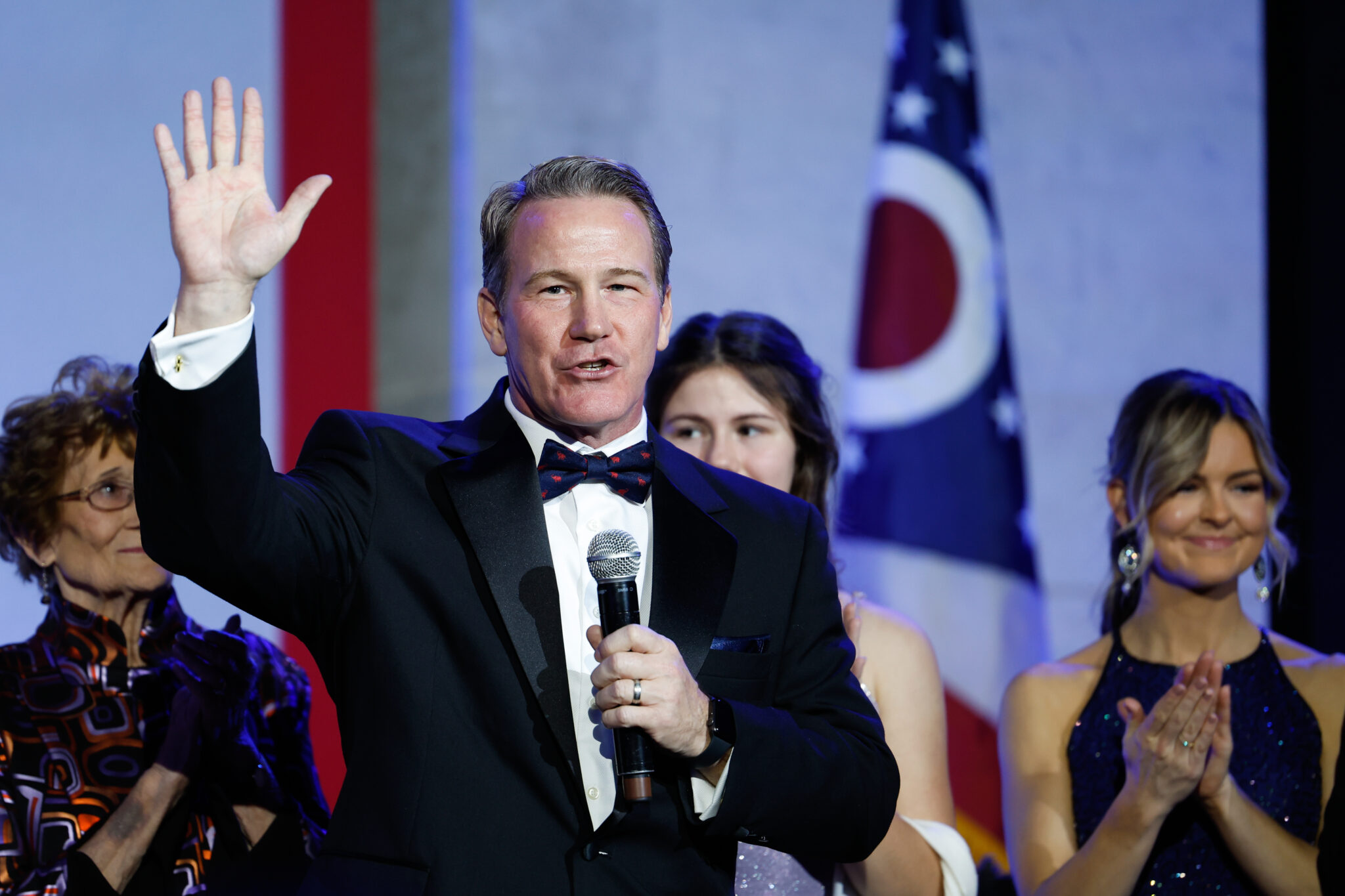
A surge in FirstEnergy political spending ahead of the utility’s push to secure a legislative bailout for its nuclear power plants included a $1 million dark money contribution to support the campaign of Ohio Gov. Mike DeWine’s eventual running mate.
The previously unreported gift linked to Lt. Gov. Jon Husted’s 2017 primary bid was revealed as part of a raft of documents obtained under Ohio’s public records law by a coalition of news organizations, including Floodlight, Energy News Network, and the Ohio Capital Journal.
Among the documents are company emails describing behind-the-scenes efforts by Husted to persuade DeWine to support House Bill 6, the utility-backed legislation at the heart of the state’s ongoing $60 million public bribery scandal.
Neither Husted nor DeWine, whose campaign also benefited from a previously reported $1 million in dark money from the utility, has been implicated in the scheme in which eight people, including the state’s former House Speaker Larry Householder, have been indicted.
Two of those charged in the multi-million-dollar scandal surrounding the passage of HB 6 may have taken their own lives, including Sam Randazzo, the former chairman of the Public Utilities Commission of Ohio, who was found dead earlier this week of an apparent suicide.
‘Confidential’ email details campaign gift
One of the documents from the Office of the Ohio Consumers’ Counsel Office is a spreadsheet attached to a January 2020 message labeled “confidential.” It shows $1 million went from FirstEnergy to the conservative group Freedom Frontier in 2017, with “Husted campaign” noted as the reason.
That group backed Husted during his 2017 primary campaign for governor. The group then supported DeWine after Husted dropped out of the race to become his running mate.
Husted was also dubbed the “‘Golden Boy’ for FirstEnergy” by lobbyist Neil Clark, a co-defendant with Householder and others in the federal government’s criminal corruption case. Clark died by suicide in 2021.
In several of the recently released records, Husted is mentioned in the same breath as Householder, the convicted House speaker, and Randazzo, the former PUCO commissioner, by FirstEnergy leadership as they sought to pass and then defend HB 6, the nuclear and coal bailout law at the heart of Ohio’s ongoing corruption scandal.
FirstEnergy records released via public records request show how executives at the power company relied on Ohio Lt. Gov John Husted and convicted former House Speaker Larry Householder to help them pass a $1.3 billion nuclear bailout bill.
Husted has maintained that his support for the 2019 law stemmed from his belief that nuclear energy is an important part of Ohio’s energy portfolio. Parties in HB 6-related shareholder litigation have subpoenaed Husted to answer questions under oath, although a new date needs to be set.
FirstEnergy records released via public records request show how executives at the power company relied on Ohio Lt. Gov John Husted and convicted former House Speaker Larry Householder to help them pass a $1.3 billion nuclear bailout bill.
“The Husted campaign never received this donation and is not affiliated with any of these groups,” said spokesperson Hayley Carducci. By law, candidate campaigns are not supposed to coordinate with groups like Freedom Frontier, which can spend unlimited amounts to support or attack them.
The document and others reflect a major commitment by FirstEnergy to Husted’s political future. Before 2017, the company’s reported political spending to support Husted was less than $25,000 per campaign, according to data from OpenSecrets.
Dark money spending rises sharply
More broadly, the document also indicates a major increase in FirstEnergy’s political spending through nonprofit groups exempt from taxes under Section 501(c)(4) of the Internal Revenue Code. Those, along with privately held corporations, are common structures for dark money organizations — groups that aren’t required by law to disclose the ultimate source of their funding.
The company’s giving to such groups jumped to more than $12 million in 2017, after much lower levels of $200,000 in 2016 and $100,000 in 2015, according to the spreadsheet.
Starting in 2014, FirstEnergy had sought bailouts for noncompetitive coal and nuclear plants. And in late 2016, regulators approved a $456 million consumer surcharge that ultimately was held unlawful. Yet the company claimed it needed more.
The document details once-secret contributions to groups supporting “everyone from the mayor of Akron to President Trump that FirstEnergy made to secure bailouts for its soon-to-be bankrupt coal and nuclear plants and to gain influence on other key issues,” said Dave Anderson, policy and communications manager for the Energy and Policy Institute.
A spreadsheet details dark money expenditures by northeastern power company FirstEnergy as it sought to secure a $1.3 billion bailout for its struggling nuclear power plants. The sheet reveals a previously unreported $1 million donation to benefit the candidacy of Ohio Lt. Gov. Jon Husted.
Anderson added that the spreadsheet also “provides some key new evidence for utility regulators and consumer advocates to use to ensure that every dollar of ratepayer money that FirstEnergy misused to fund its secret political spending is publicly disclosed and refunded, with interest and ideally serious financial penalties.”
At the time, the author of the document that details the donations, Kristina Housley, was executive assistant to FirstEnergy’s Mike Dowling, who is now a defendant in a state criminal case along with former CEO Chuck Jones.
Finding out all the details about the dark money spending behind HB 6 is like peeling back the layers of an onion, said Catherine Turcer, executive director of Common Cause Ohio.
“The reason that transparency matters so much is that money that is spent in the shadows influences elections, and it influences really important policy decisions that impact us every day,” Turcer said. “And we have the right to know what is going on in government and how decisions are being made and who’s attempting to influence those decisions.”
The ‘Golden Boy’ for FirstEnergy
A December 2017 email from former FirstEnergy lobbyist Joel Bailey said Husted was working to get DeWine on board with FirstEnergy’s “issues.” FirstEnergy also supported other pro-DeWine/Husted efforts during the election cycle.
Former FirstEnergy CEO Chuck Jones (top left), former FirstEnergy VP Michael Dowling (top right), former PUCO Chair Sam Randazzo (bottom middle). Graphic by WEWS.
After the election, Husted and DeWine dined with Jones and Dowling on December 18, 2018. Later that night, FirstEnergy agreed to pay $4.3 million to energy lawyer Randazzo, who went on to become DeWine’s first pick for chair of the Public Utilities Commission of Ohio. FirstEnergy later identified Jones and Dowling as the two people responsible for paying alleged bribes.
Husted’s office has been evasive about his recollections, despite Jones noting in texts to Randazzo that the PUCO chair position was discussed in at least general terms. Another text by Jones in 2019 said the DeWine/Husted team was forced “to perform battlefield triage” to secure Randazzo’s nomination after a 198-page dossier provided to DeWine’s staff threatened to derail it.
Evidence from last year’s criminal trial of Householder, the former Ohio House speaker, and lobbyist Matt Borges also included messages between former FirstEnergy executives Jones and Dowling about Husted working behind the scenes to build support for the bill. Among the actions were efforts to extend the bailout period for the company’s former nuclear power plants in Ohio.
Husted long a friend of utilities
Husted had been Ohio’s secretary of state immediately before becoming lieutenant governor. Before that, he served as House speaker in the General Assembly. In that role, he played a pivotal part in securing passage of another major energy bill, Senate Bill 221.
At the time, Husted supported the law’s clean energy standards that were ultimately gutted by HB 6. However, SB 221 set the stage for so-called electric security plans. Those have let FirstEnergy and other utilities avoid full rate cases for more than a decade, while allowing cross-subsidies and adding multiple additional charges to consumers’ bills.
“That bill upset the balance” of energy regulation in Ohio, said Ashley Brown, a former PUCO commissioner. “It was a humongous gift for the utilities.”
Lawmakers repealed HB 6’s $1 billion-plus in subsidies for FirstEnergy’s former nuclear power plants and its recession-proofing provisions in 2021, eight months after the arrests of Householder and others.
Earlier this year, Husted told NBC4 in Columbus the rest of HB 6 “needs to be completely removed.” He did not respond to Energy News Network questions this week about whether that includes both the law’s subsidies for two 1950s-era coal plants and its gutting of Ohio’s renewable energy and energy efficiency standards.
FirstEnergy spokesperson Jennifer Young declined to comment on the company’s 2017 donation to Freedom Frontier due to ongoing litigation. However, she added, “FirstEnergy will post information regarding its support of 501(c)(4) social welfare organizations on the company’s website on a quarterly basis.”
Meanwhile, FirstEnergy still has not disclosed its dark money spending for the years 2018 through 2020. And proposals for reforms that would require such disclosures from all electric utilities remain stalled in the General Assembly.
“It’s incredibly frustrating that Ohioans can be aware that dark money impacted decision-making at the statehouse,” Turcer said, “and yet we still haven’t gotten the legislators to create greater transparency.”
The Energy News Network is a nonprofit news site dedicated to keeping influencers, policymakers and citizens informed of the important changes taking place in the transition to a clean energy system. Floodlight is a nonprofit newsroom that investigates the powerful interests stalling climate action.
This article first appeared on Energy News Network and is republished here under a Creative Commons license.
_____________
MARIO ALEJANDRO ARIZA, FLOODLIGHT
Mario Alejandro Ariza is an investigative reporter and a Dominican immigrant. His byline has appeared in publications like the South Florida Sun Sentinel, The New Republic, and The Atlantic. Mario wrote a book called “Disposable City: Miami’s Future on the Shores of Climate Catastrophe,” which was published by Bold Type Books. His essays have been featured in The Believer and selected for Best American Essays. He lives in South Florida with a cat, a dog, and a sturdy pair of waterproof boots.
Kathi is the author of 25 books and more than 600 articles, and writes often on science and policy issues. In addition to her journalism career, Kathi is an alumna of Harvard Law School and has spent 15 years practicing law. She is a member of the Society of Environmental Journalists and the National Association of Science Writers. Kathi covers the state of Ohio.
Sam Randazzo, Gov. Mike DeWine’s first pick to chair the Public Utilities Commission of Ohio, has died by suicide, the Columbus Dispatch is reporting.
Randazzo’s body was found Tuesday in a Franklin County warehouse he owned, the paper reported. A spokesman for Franklin County Coroner Nathaniel Overmire couldn’t immediately be reached.
Randazzo — a 74-year-old energy consultant turned regulator — was charged both in state and federal court over his role in a massive utility scandal that broke in July 2020, along with other alleged misdeeds. In the bribery scandal, Akron-based FirstEnergy paid more than $60 million in bribes between 2017 and 2020 in exchange for a $1.3 billion ratepayer bailout.
DeWine picked Randazzo to be the state’s top regulator after a decade of shady dealings between Randazzo and FirstEnergy, his state indictment says. They include secretly being a paid consultant for FirstEnergy while also serving as general counsel to industrial energy users who were trying to get a better deal from FirstEnergy, the document says.
Randazzo also secretly skimmed millions from settlements FirstEnergy paid the big users to get them to go along with rate hikes for everybody else, the indictment says.
Just before DeWine nominated Randazzo to chair the PUCO in early 2019, FirstEnergy’s top executives paid him $4.3 million — a payment that FirstEnergy later conceded was a bribe.
DeWine’s chief of staff reportedly knew about the payment before Randazzo was nominated, but it’s unclear how much she, DeWine, and others in the administration knew about the more than $10 million Randazzo was paid by FirstEnergy over the years. She was slated to testify at the former regulator’s state trial.
After a lengthy federal trial last year, former House Speaker Larry Householder, R-Glenford, was sentenced to 20 years in prison for his role in the scandal. Former Ohio GOP Chairman Matt Borges was sentenced to five years for his.
Two others pleaded guilty and await sentencing. Another defendant, lobbyist Neil Clark, died by suicide.
MARTY SCHLADEN
Marty Schladen has been a reporter for decades, working in Indiana, Texas and other places before returning to his native Ohio to work at The Columbus Dispatch in 2017. He’s won state and national journalism awards for investigations into utility regulation, public corruption, the environment, prescription drug spending and other matters.
Ohio Capital Journal is part of States Newsroom, the nation’s largest state-focused nonprofit news organization.
As Gov. Mike DeWine in 2019 nominated Sam Randazzo to be Ohio’s top utility regulator, Randazzo went to great lengths to hide a decade-long relationship with FirstEnergy that had paid him more than $10 million. Those payments included $4.3 million just as DeWine was picking Randazzo, according to court documents filed last week.
Yet DeWine Press Secretary Dan Tierney in February said it “was well known that Randazzo was a paid consultant for FirstEnergy.” On Tuesday, Tierney modified that statement to say “it was well known to our staff that Mr. Randazzo was an energy consultant, and it was well-known to them and many people that Mr. Randazzo was a consultant employed by First Energy.”
DeWine’s appointee to chair the Public Utilities Commission of Ohio, Randazzo went on to help write and lobby for a $1.3 billion bailout that Akron-based FirstEnergy paid more than $60 million in bribes to pass, according to a federal jury and the indictments of Randazzo and two former FirstEnergy executives.
The scandal broke into the open in July 2020, when the FBI arrested former House Speaker Larry Householder, R-Glenford, and four others. Householder and former Ohio GOP Chairman Matt Borges were convicted, two others pleaded guilty, and lobbyist Neil Clark died by suicide.
DeWine, who signed the bailout law, and his staff haven’t been accused of illegal activity in the case. But with the administration’s many connections to FirstEnergy, questions continue to linger about exactly what DeWine and his team knew about the conspiracy and what they did with that knowledge.
A big question relates to the period when the governor was picking Randazzo to be the state’s top utility regulator. Did DeWine or top members of his staff know that Randazzo had a long, lucrative relationship with FirstEnergy, one of the biggest utilities he’d be regulating?
A state indictment of Randazzo said that he had a shady relationship with FirstEnergy stretching back to 2010. It included hiding his work for FirstEnergy from industrial energy users Randazzo served as general counsel as he secretly skimmed from settlement payments FirstEnergy made to the industrial users, the indictment said.
Big money, big favors
On Dec. 18, 2018, Gov.-elect DeWine and Lt. Gov.-elect Jon Husted had dinner at the Columbus Athletic Club with FirstEnergy CEO Chuck Jones and Vice President Michael Dowling.
The executives would be indicted along with Randazzo in February 2024. At the dinner, the men discussed with DeWine and Husted whether to make Randazzo the chief regulator of the executives’ company, the indictment said.
The executives drove from the dinner to Randazzo’s German Village condo for another discussion. The same evening, Randazzo texted Dowling a column of figures ending with “Total 4,333,333.”
The indictment said that within weeks, the executives paid Randazzo that amount without an invoice and over a company lawyer’s objections. DeWine nominated him to chair the PUCO a few weeks after that.
Over the next 18 months, Randazzo labored to draft, pass, and protect the company’s massive bailout and did a number of additional, highly lucrative favors besides, the indictment said. It all ended with his resignation after the FBI searched his condo four months after Householder and the others were arrested.
But what DeWine and his staff knew about Randazzo’s relationship with FirstEnergy as they were considering whether to make him its regulator appears to be a matter of dispute.
“In January 2019, FirstEnergy agreed to pay out in full Randazzo’s consulting services contract just before he was nominated to run the PUCO,” a bill of particulars that was filed last week to accompany the indictment says. “It was not a gift: Randazzo would work hard for FirstEnergy from inside the government. He did not disclose his relationship, going so far as to lie about it in testimony to the General Assembly and failing to disclose to the Ohio Ethics Commission the massive sums of money he’d received from the company he would soon regulate.”
Who knew?
Randazzo’s indictment says Randazzo did, however, “tell the Governor-elect through his incoming Chief of Staff that he had received $4.3 million from FirstEnergy, which he claimed was final payment of a ‘consulting agreement.’” It added that Randazzo didn’t disclose the other millions he made as a FirstEnergy consultant or his work lobbying for the electricity giant.
Tierney, DeWine’s press secretary, on Tuesday said that Randazzo’s consulting work for FirstEnergy was well known — at least inside the administration.
“I note our office is not a party to the prosecution, so we cannot vouch for any claims made by the prosecution or defense in these cases,” he said in an email. “Speaking for the staff of the Governor’s office, it was well known to our staff that Mr. Randazzo was an energy consultant, and it was well-known to them and many people that Mr. Randazzo was a consultant employed by FirstEnergy.”
However, FirstEnergy’s top brass feared public knowledge of their relationship could scuttle his nomination. On Jan. 30, 2019, Dowling, the FirstEnergy vice president, sent a panicked text to CEO Jones. It said Randazzo was going to pull out of the PUCO nomination process because the press found the name of one of his shell companies on a bankruptcy filing by a subsidiary FirstEnergy was seeking to bail out.
When Randazzo’s nomination got back on track, the executives expressed relief.
“A bullet grazed the temple,” Dowling told Jones, according to one of the texts filed as part of a civil suit over the scandal.
“Forced DeWine/Husted to perform battlefield triage,” Jones responded, referring to Lt. Gov. Jon Husted. “It’s a rough game.”
So while administration insiders might have known about the Randazzo-FirstEnergy relationship, it clearly wasn’t common knowledge to the public who would have to pay the utility’s inflated bills. Tierney didn’t answer why, if DeWine knew that Randazzo was a FirstEnergy consultant, he didn’t disclose that to the public the PUCO is supposed to protect from monopoly utilities.
Inside connections
While Tierney said he couldn’t vouch for the information in the indictments or other court filings, he said it would have been extraordinary to ask Randazzo whether he had been paid money by Ohio utilities as the administration was vetting him for the position as their chief regulator.
“…it would have been unusual to review past employment compensation with the Governor as part of cabinet director vetting,” Tierney said.
As for the chief of staff who did the vetting — Laurel Dawson — she had a FirstEnergy connection of her own. Her husband, Mike Dawson, was a FirstEnergy lobbyist whom the indictment said had received a $10,000 loan from Randazzo a few years earlier.
It’s unclear whether the loan was repaid or whether Laurel Dawson reported it to DeWine. The DeWine aide isn’t speaking publicly.
It’s also unclear whether Laurel Dawson told the governor that her husband participated in an early 2020 text conversation with Randazzo and Dowling. The conversation was included in the bill of particulars filed last week.
The three jokingly discussed rate cases and decoupling — two matters for which prosecutors say Randazzo had by then received multi-million-dollar bribes from FirstEnergy in exchange for doing even more valuable favors for the company.
State prosecutors say that for Randazzo, engaging in the exchange amounted to an improper ex parte conversation. It might have been of interest to DeWine to know that his chief of staff’s lobbyist husband was having such talks with the governor’s PUCO chairman.
According to a witness list reported on Tuesday by the Toledo Blade, prosecutors plan to call both Dawsons to testify at the trial of Randazzo, Dowling and Jones.
Pretending?
Despite the questions surrounding what Laurel Dawson knew about Randazzo and FirstEnergy — and about what she told her boss — she remains on his staff as an advisor, making $182,000 last year.
“The Governor has previously stated on the record at media briefings he has full faith in Ms. Dawson,” Tierney said.
But what did he know?
The indictment of DeWine’s PUCO chairman and the energy executives has an image of notes that Dowling made in late 2018 as FirstEnergy lobbyist Josh Rubin coached him up on how to talk to Gov.-elect DeWine. They warn the FirstEnergy executives not to tell him that they planned to go meet Randazzo just after discussing his appointment at dinner with DeWine and Husted.
Rubin added that DeWine could be cagey.
“Sometimes he knows what you’re talking about,” Dowling wrote in his notes. “Sometimes he doesn’t. Sometimes he does and pretends he doesn’t.”
Tierney was asked if DeWine now is feigning ignorance of the dealings between his administration, his nominee to head the PUCO and FirstEnergy. Tierney replied by saying that some of the players in the scandal have shown a tendency to make questionable statements.
“Throughout the (utility scandal) prosecutions, third parties have made claims which have been self-serving and ultimately not true,” he said. “I will note, however, the state prosecution alleges the defendants deliberately withheld relevant information from the Governor, Lt. Governor, and other government officials.”
MARTY SCHLADEN
Marty Schladen has been a reporter for decades, working in Indiana, Texas and other places before returning to his native Ohio to work at The Columbus Dispatch in 2017. He’s won state and national journalism awards for investigations into utility regulation, public corruption, the environment, prescription drug spending and other matters.
Ohio Capital Journal is part of States Newsroom, the nation’s largest state-focused nonprofit news organization.
Many politicians — especially conservatives — are loath to approve anything that could be construed as a tax increase.
But since 2009, Ohio’s leadership has gone along with a number of questionable rate hikes demanded by regulated utilities. They’ve functioned in the same manner as tax increases — regressive ones with unsavory origins.
There were new state charges earlier this month in Ohio’s massive FirstEnergy bribery scandal. They brought new attention to the issue, but that scandal is hardly the only time Ohio utilities have been able to impose questionable rate increases on their unsuspecting customers.
In the scandal, Akron-based FirstEnergy paid more than $61 million in bribes in exchange for the 2019 passage and protection of a $1.3 billion ratepayer bailout. As a consequence, former House Speaker Larry Householder, R-Glenford, is serving a 20-year federal prison sentence.
The state charges filed this month against two top FirstEnergy executives and the state’s top regulator pertain to those crimes. But they also describe more than a decade’s worth of additional shady increases in which payoffs played a central role.
They accuse Sam Randazzo — whom Ohio Gov. Mike DeWine later appointed to be top regulator — of secretly helping FirstEnergy make huge, secret payments to powerful energy users. In exchange, the charges say, the industrial users dropped their opposition to rate increases FirstEnergy wanted to impose on all its customers.
The payments might not have been illegal, but they functioned as kickbacks all the same.
The Columbus Dispatch on Sunday reported that in 2008 then-Gov. Ted Strickland, a Democrat, tried to negotiate an end to the shady practice, but then-House Speaker Jon Husted killed the attempt, a former aide to Strickland told the paper. Husted is now DeWine’s lieutenant governor and is said to be planning a run in the 2026 Ohio Republican primary to be governor in his own right.
Those increases are in addition to a whole slew of other rate hikes that Ohio’s erstwhile regulator has granted, but the state Supreme Court later ruled to be illegal. They total more than $1.5 billion worth altogether. Even though the gains have been ruled unlawful, utilities have gotten to keep them because the Public Utilities Commission of Ohio keeps granting such increases without building in a refund mechanism in the event they’re struck down.
Jenifer French, DeWine’s appointment to replace the disgraced Randazzo, has repeated PUCO staff claims that such refund mechanisms are illegal. But the legal case seems dubious and watchdogs and lawmakers from both parties dispute it.
So Ohio ratepayers have shelled out billions in illegal electric payments and untold millions more as the consequence of shady kickbacks to powerful companies. Those who allowed such payments are responsible for what is the functional equivalent of a tax increase, said Rob Moore, principal of Scioto Analysis, a Columbus firm that applies economics to questions of public policy.
One reason they work the same as a tax is because one has little choice in 2024 about paying for electrical service, he said.
“You can’t get away from it,” Moore said. “You’re going to have to pay something for electricity.” He later added, “That’s functionally no different from a tax.”
And it’s one that falls extra-hard on the poor.
Disconnected electricity and gas can destroy perishable food while also taking away the ability to cook it. For those who are struggling, finding money and getting to the store for one batch of food can already be a challenge. Having to do it again after arranging a reconnection can be even more difficult.
The news outlet reported that as part of a story about nearly 200,000 disconnections by Ohio electric utilities at the height of the coronavirus pandemic. Advocates asked the PUCO for relief, but the regulatory agency said it was powerless to act.
Moore said that if you view utilities as the practical equivalent of a tax, it’s a regressive one.
“In general, lower-income people pay more of their income on utilities than upper-income people,” he said.
Moore cited a 2013 report by the U.S. Energy Information Agency saying that households in the bottom 20% of incomes made 6% of their total expenditures on home energy, while those in the top 20% paid half that.
Energy-insecure households are likely to be poorer still. The agency last year reported that they paid 27% more in real terms than everybody else — $1.24 per square foot vs. 98 cents.
As with the state and local tax burden, the extra costs Householder, the PUCO and others have imposed on Ohio seem to be falling most heavily on those least able to pay it.
“Basically, he just levied a tax and lined his pockets with it,” Moore said of the former speaker.
MARTY SCHLADEN
Marty Schladen has been a reporter for decades, working in Indiana, Texas and other places before returning to his native Ohio to work at The Columbus Dispatch in 2017. He’s won state and national journalism awards for investigations into utility regulation, public corruption, the environment, prescription drug spending and other matters.
House Bill 6 wasn’t only a bad law because it involved $61 million in bribes in exchange for a $1.3 billion utility bailout.
Most of the bailout payments have been repealed, but somehow the law — the product of perhaps the biggest corruption scandal in Ohio history — remains on the books. And after it eliminated most efficiency programs, Ohio utilities have gone from above average to among the worst in the country, according to an analysis that was released last week.
One of them, Columbus-based AEP, acknowledged that in the absence of the efficiency programs, acknowledged that the elimination of the programs has limited what it can offer customers to save electricity.
The American Council for an Energy Efficient Economy, a Washington, D.C.-based non-profit, publishes an efficiency scorecard of the nation’s 53 largest electric utilities once every three years.
It found that in 2018 — a year before the corrupt bailout was passed — Duke Ohio had the 18th-best score for efficiency programs. AEP Ohio had the 21st-best programs, according to the scorecard. Edison Ohio came in at 34th.
But the scorecard published last week looked at data related to efficiency programs in 2021 — a year after HB 6 took effect. It found that AEP and Duke tied for 49th out of 53.
In an email, AEP spokesman Scott Blake said “House Bill 6 ended energy efficiency requirements, which hampers our ability to offer programs to customers. AEP Ohio had implemented many successful energy efficiency programs prior to this change in state law. Our customers have expressed interest in energy efficiency, and we have proposed to offer a new menu of voluntary programs in our Electric Security Plan currently under consideration by the Public Utilities Commission of Ohio. They would need to approve those programs in order for us to offer them to customers.”
Edison Ohio is a subsidiary of Akron-based FirstEnergy, which paid more than $60 million to finance the corrupt bailout law that gutted efficiency standards. It finished dead last in the most recent efficiency score.
The 2019 law was ramrodded by former House Speaker Larry Householder, R-Glenford. The vast majority of the money it required from ratepayers went to prop up two failing nuclear plants in Northern Ohio. FirstEnergy wanted to prop them up so it could sell them and avoid liability for cleaning up the sites when they’re shut down.
It forces Ohio ratepayers to spend hundreds of millions propping up two aging coal plants — including one that isn’t even in Ohio. And it gutted energy-efficiency and renewable standards that utilities formerly had to adhere to.
The efficiency standards were built into consumers’ bills to incentivize the use of technologies that save electricity and thus obviate the need for more carbon-spewing generation. For example, they enabled Ohio utilities to offer discounts on fluorescent light bulbs when they were relatively expensive, but much longer-lasting and efficient than incandescent bulbs.
The idea was that with greater demand, manufacturers would scale up production and make them more cheaply. That approach helped to allow the federal government to completely phase out the sale of incandescent bulbs this year.
The way efficiency standards worked, regulators set goals and offered “shared savings” to utilities and consumers once those goals were met. Rob Kelter, a senior attorney with the Environmental Law and Policy Center, conceded in an interview last month that the efficiency incentives weren’t perfect.
“I think there were some legitimate concerns that legislators raised about the value of efficiency and whether the programs were well-run,” he said. “But the programs were always pretty good and they delivered good value to customers.Were we too generous with the incentives for utilities? Yeah. A little bit.”
For example, Kelter said, when they were collecting money from incentives for fluorescent bulbs, utilities were slow to move to the next technology, LED bulbs, because they had a sure thing in fluorescents.
Regardless of the programs’ merits, some Ohio officials have long opposed efficiency standards.
Sam Randazzo — whom Gov. Mike DeWine in 2019 nominated to chair the Public Utilities Commission — had previously worked as a utility lobbyist to repeal efficiency and renewable standards.
In a deferred prosecution agreement with the federal government, FirstEnergy said it bribed Randazzo $4.3 million to do its bidding as he was poised to become the state’s top regulator. The FBI searched his Columbus condominium a few months after the July 2020 arrests of Householder and four others in the HB 6 conspiracy, but Randazzo hasn’t been charged.
During Householder’s federal court trial earlier this year, witnesses testified that even though he was supposed to be regulating utilities, Randazzo helped draft HB 6, the corrupt bailout legislation. Perhaps predictably, it eliminated efficiency and renewable standards and prompted the news organization Vox to call it “the worst energy bill of the 21st century.”
One reason Randazzo and the HB 6 conspirators might have been so eager to eliminate the efficiency and renewable programs was to use the resulting savings as what government insiders call a “pay for.” The bailout that was going to FirstEnergy — and to a much lesser extent AEP and other utilities — was going to show up on ratepayers’ bills. So those pushing the legislation looked for other things to cut to pay for the new charges.
On the witness stand, Householder, who was later sentenced to 20 years in prison, said he “wanted to do away with costly mandates.” He and other HB 6 supporters claimed that eliminating efficiency and renewable standards would save consumers more than $1 billion.
But federal prosecutors smashed those claims, showing that the supporters’ math didn’t take the full cost of HB 6 into account. Householder and the others also failed to mention that through efficiency programs, ratepayers stood to save by using less electricity.
The efficiency scorecard that found such precipitous drops among Ohio utilities in the wake of HB 6 scores them according to numerous metrics. But more than half of the available points are from three straightforward ones: net annual and lifetime electricity savings, and peak demand reduction.
The latter measure is important because when electricity demand reaches a peak, system operators often have to fire up gas-powered generation facilities to meet it. By contrast, when customers use electricity during off-peak times, they’re pulling power that’s already on the grid.
Mike Specian, lead author of the efficiency scorecard, praised the three big Ohio utilities for some of their offerings — including discounts to customers who use power at off-peak times.
However, Specian said in an email, “the cancelation of utilities’ efficiency programs (in HB 6) had an adverse impact on nearly every other aspect of utility performance that we evaluated, including for low-income customers.”
Duke didn’t respond to questions for this story.
Lauren Siburkis, a FirstEnergy spokeswoman, said in an email that she isn’t “able to comment on the (efficiency) report itself.” But she said her company has numerous efficiency programs that it voluntarily offers customers.
They include $100 rebates for energy-efficient appliances such as refrigerators, freezers and clothes dryers. The company also incentivizes efficiency among commercial and industrial customers through its commercial lighting program, Siburkis said.
Blake, of AEP, said a bill is moving through the legislature that would allow ratepayers to voluntarily participate in efficiency programs.
“The legislature is considering House Bill 79, a bipartisan effort sponsored by Bill Seitz and Bride Rose Sweeney, that would allow AEP Ohio and other utilities to offer energy efficiency programs while giving customers the option to participate,” Blake said.
MARTY SCHLADEN
Marty Schladen has been a reporter for decades, working in Indiana, Texas and other places before returning to his native Ohio to work at The Columbus Dispatch in 2017. He’s won state and national journalism awards for investigations into utility regulation, public corruption, the environment, prescription drug spending and other matters.
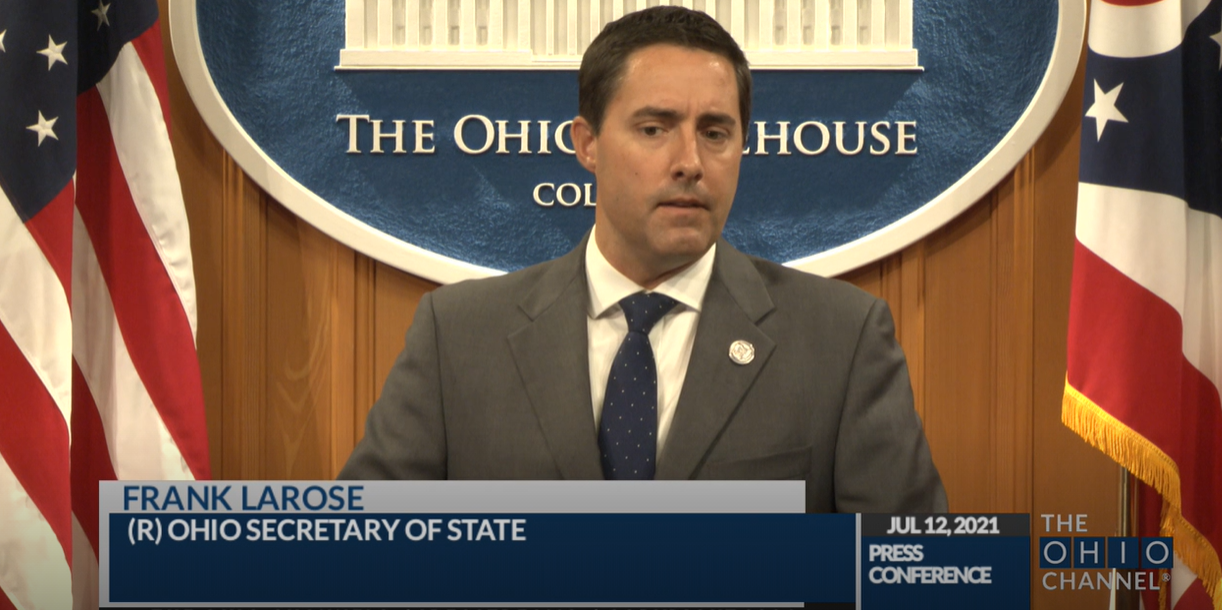
Secretary of State Frank LaRose announces the referral of 117 cases of alleged voting and voter registration fraud stemming from the 2020 elections. Photo courtesy The Ohio Channel.
Ohio Secretary of State Frank LaRose on Wednesday offered another rationale for making it much more difficult for voters to amend the Ohio Constitution. Now he’s saying it’s needed to fight a possible power grab like one that grew out of a massive bribery and money-laundering scandal.
But LaRose didn’t mention in his op-ed that his name came up repeatedly in a criminal trial related to the scandal and that he appeared to be in close communication with some of its central figures.
Nor did his office respond when asked whether LaRose ever spoke out against the corrupt utility bailout before the FBI started arresting people in July 2020.
Slippery explanations
The secretary of state — who is said to be eyeing a run for U.S. Senate next year — has been pushing to increase the portion of votes needed for a citizen-initiated amendment from 50% to 60%. As he and his allies have, they’ve given a shifting set of reasons for why that’s needed.
Last November, during a lame-duck session of the legislature, LaRose and state Rep. Brian Stewart, R-Ashville, held a press conference saying that the change was necessary to prevent wanton amendments to the Ohio Constitution by monied special interests. But they didn’t point to any examples of how that had happened in the past.
Many suspected an ulterior motive.
LaRose sat on a Republican-dominated redistricting commission that last year ignored seven Ohio Supreme Court rulings saying that the legislative and congressional maps the commission produced violated anti-gerrymandering amendments overwhelmingly approved by Ohio voters. That prompted Maureen O’Connor, the outgoing Republican chief justice, to urge Ohioans to pass new, more-tightly written amendments this year.
Ohio was also roiled when a highly restrictive abortion law took effect last June just after the U.S. Supreme Court overturned Roe v. Wade and horror stories poured out of abortion clinics and hospitals. An effort quickly started to get an amendment on the ballot protecting abortion rights after other protections easily passed in other states.
But at last year’s presser, LaRose denied that his goal was to block anti-gerrymandering or abortion-rights amendments. The constitutional change he was advocating was a long-term, fundamental one that he didn’t seek to block such short-term disputes, he claimed.
Just weeks later, however, Stewart, LaRose’s sidekick at the presser, sent a letter to his GOP colleagues in the House explaining the real reasons for making it harder for Ohioans to amend their constitution: to stop abortion-rights and anti-gerrymandering amendments that appear to be favored by strong majorities of Ohioans.
[/vc_column_text][vc_raw_html]JTNDYmxvY2txdW90ZSUyMGNsYXNzJTNEJTIydHdpdHRlci10d2VldCUyMiUzRSUzQ3AlMjBsYW5nJTNEJTIyZW4lMjIlMjBkaXIlM0QlMjJsdHIlMjIlM0VIZXJlJTI2JTIzMzklM0JzJTIwdGhlJTIwZnVsbCUyMGxldHRlci4lMjBJdCUyMGFsc28lMjB0aWVzJTIwdGhlJTIwaXNzdWUlMjB0byUyMHJlZGlzdHJpY3RpbmclMjByZWZvcm0lMkMlMjBhbmQlMjByZXNwb25kcyUyMHRvJTIwdGhlJTIwb3JnYW5pemVkJTIwbGFib3IlMjBncm91cHMlMjB0aGF0JTIwcmFsbGllZCUyMGF0JTIwdGhlJTIwT2hpbyUyMFN0YXRlaG91c2UlMjB5ZXN0ZXJkYXkuJTIwJTNDYSUyMGhyZWYlM0QlMjJodHRwcyUzQSUyRiUyRnQuY28lMkZpbGhXTFBpV00wJTIyJTNFcGljLnR3aXR0ZXIuY29tJTJGaWxoV0xQaVdNMCUzQyUyRmElM0UlM0MlMkZwJTNFJTI2bWRhc2glM0IlMjBBbmRyZXclMjBUb2JpYXMlMjAlMjglNDBBbmRyZXdKVG9iaWFzJTI5JTIwJTNDYSUyMGhyZWYlM0QlMjJodHRwcyUzQSUyRiUyRnR3aXR0ZXIuY29tJTJGQW5kcmV3SlRvYmlhcyUyRnN0YXR1cyUyRjE2MDMxMzAzODQ3NDQ1MzQwMTYlM0ZyZWZfc3JjJTNEdHdzcmMlMjU1RXRmdyUyMiUzRURlY2VtYmVyJTIwMTQlMkMlMjAyMDIyJTNDJTJGYSUzRSUzQyUyRmJsb2NrcXVvdGUlM0UlMjAlM0NzY3JpcHQlMjBhc3luYyUyMHNyYyUzRCUyMmh0dHBzJTNBJTJGJTJGcGxhdGZvcm0udHdpdHRlci5jb20lMkZ3aWRnZXRzLmpzJTIyJTIwY2hhcnNldCUzRCUyMnV0Zi04JTIyJTNFJTNDJTJGc2NyaXB0JTNF[/vc_raw_html][vc_column_text]The attempt to rush a bill through lame duck last year failed.
Now Stewart, LaRose and their allies are trying to pass it through Ohio’s now-unconstitutionally gerrymandered legislature. If it passes, it would put the measure requiring 60% of the vote to amend the state constitution on the ballot. And, since the vote would be under the existing rules, it would require just 50% of the vote to pass.
Also on the pile of accusations that it’s a naked power grab is that LaRose, Stewart and their allies want to put the measure on the ballot in a low-turnout August election. They’re doing so just months after passing a bill that had LaRose’s support to eliminate such elections as costly and unnecessary — and three months before the abortion amendment is expected to hit the ballot.
A new reason
While he’s being accused of attempting a power grab, LaRose says he’s trying to stop them.
On Tuesday, The Columbus Dispatch published an op-ed in which he furnished yet another reason to make it harder for voters to change the state Constitution. He cited an attempt by former House Speaker Larry Householder to pass an amendment changing the state’s term limits so Householder could stay speaker for another 16 years.
It was part of a breathtaking scheme in which Householder and his allies took more than $61 million from Akron-based FirstEnergy and other utilities, used the money to make him speaker in January 2019, and then pass and protect a $1.3 billion ratepayer bailout that mostly went to FirstEnergy.
Fresh off the passage of the bailout, Householder raised millions in early 2020 from FirstEnergy and AEP for his scheme that would allow him to stay longer in office. But it died with his arrest that July.
It might seem ironic that LaRose would use a corruption scandal to gut a 1912 reform measure that was aimed at curbing corrupt, unresponsive government, but that’s what he argued. He said all it takes to change the Constitution now “is a well-funded, dishonest political campaign and a simple majority vote.”
LaRose added that Householder planned to call his tenure-extension scheme “Ohioans for Legislative Term Limits, a deceptive name for a constitutional amendment that would more than double his term in office. It should come as no surprise that FirstEnergy Corporation, the company at the center of Householder’s racketeering scandal, agreed to bankroll the amendment campaign.”
Significant omissions
While he accused his opponents of “hysterical hyperbole” as he tries to make it 20% harder for voters to succeed in the already difficult process to amend the Ohio Constitution, there were some important things LaRose didn’t say in his Op-Ed.
For starters, FirstEnergy didn’t only bankroll Householder in 2018 as the now-convicted former speaker elected a team of lieutenants who would hand him the speaker’s gavel. The utility also bankrolled LaRose to the tune of $25,000 that year as he ran for secretary of state.
It was part of nearly $50,000 that the energy company — which signed a deferred prosecution agreement in the Householder scandal — has given LaRose, the campaign-finance tracker FollowTheMoney.org reports.
And while LaRose is decrying the bailout now that there have been arrests and convictions, there was reason to know there was something wrong with it well before they took place.
Insiders knew that somebody was burying Capitol Square in cash throughout the 2019 passage of House Bill 6, the corrupt utility bailout. That was especially true as FirstEnergy dumped what the FBI later determined was $36 million into a blatantly-dishonest-but-successful fight to beat back a repeal.
Because the funds were non-disclosable 501(c)(4) dark money, it was impossible for the public to know exactly where they were coming from until the feds stepped in and used subpoenas and other special powers to find out.
But HB 6 was such bad legislation and the campaign to stop the repeal so over-the-top that there was plenty of reason to suspect that somebody was being bought off to pass it. It was a massive corporate bailout that Householder and others were trying to officially declare a tax. Republican lawmakers who didn’t want to cast such a damaging vote described withering pressure from House leadership.
Former friends
LaRose’s office didn’t answer Wednesday when asked if the secretary of state ever spoke out against HB 6 before the FBI started making arrests.
In the Cincinnati corruption trial that ran from late January to mid-March, federal prosecutors presented several communications to the jury that might indicate that LaRose was actually sympathetic to the effort to pass and protect the corrupt bailout.
On July 23, 2019, as the repeal effort got underway, text messages flew between two prominent figures in the scandal: Matt Borges, the former Ohio Republican Party chairman who was convicted along with Householder; and Juan Cespedes, a lobbyist who pleaded guilty and cooperated with prosecutors.
Borges told Cespedes he had received “a message from the secretary of state on the ballot-measure issue.”
The men were hoping for help from LaRose. He’s chairman of the Ohio Ballot Board, which, along with Attorney General Dave Yost, has to approve the language of constitutional amendments before they’re circulated for the hundreds of thousands of needed voter signatures — and before they’re placed on the ballot.
In the case of the HB 6 repeal, Yost initially sent the language back for revisions, then he and the ballot board approved it. But that wasn’t before the original 90 days opponents had to gather the signatures was whittled down to 53.
In the end, time ran out before opponents could gather them. But at the beginning of the effort, Borges seemed to be talking to LaRose about what LaRose needed in exchange for his help.
“LaRose is expecting us to be publicly supportive of him,” Borges said. “Apparently petitioners (for the repeal of HB 6) are going to call on him to step down from the ballot board because of ‘conflicts.’ He can be our friend in this process, so let’s be prepared to speak for him.”
Continuing communication
Later in the repeal fight, FirstEnergy’s two top executives discussed asking LaRose’s help with Yost. In addition to hamstringing the petition effort, supporters of the corrupt bailout wanted to have it officially declared a tax, and thus legally exempt from repeal.
“I’ve been asked by (subsidiary FirstEnergy Solutions) to call Frank LaRose to get Frank to call Dave Yost,” Vice President Michael Dowling texted CEO Chuck Jones, according to messages put into evidence by prosecutors. “If Frank tells Yost that he believes HB 6 is a tax, Yost will come out publicly and say it, which (FirstEnergy Solutions) thinks helps with the Supreme Court. Frank is reluctant to make the call. I have a call in to Frank and I will ask him to do it.”
LaRose may have been reluctant about making that call. But he apparently wasn’t reluctant to keep talking to the people who funded the scandal he’s now condemning and using as a reason to make it harder for voters to amend the Ohio Constitution.
In October 2019 — shortly before the repeal effort failed — Jones sent a text to John Kiani, the chairman of the FirstEnergy subsidiary that was to receive $1 billion of the bailout. It indicated that both LaRose and Householder had been providing the FirstEnergy CEO with “private” information on the repeal effort.
“For what it’s worth, LaRose and Householder think it’s game over,” Jones told Kiani. “But that is a private conversation unless they’ve told you the same thing. And Householder has a ‘quick fix’ anyway.”
And then in November 2019 — just after the repeal failed — other messages indicated that LaRose wanted to cement a relationship with Kiani, the hard-charging former Enron executive whom Cespedes testified stood to make $100 million off the sale of FirstEnergy’s bailed-out nuclear and coal plants.
Borges texted Cespedes that LaRose, “told me he wants to get to know Kiani, and I said, ‘Are you sure about that?’”
Cespedes replied, “He will live to regret that.”[/vc_column_text][/vc_column][/vc_row]
____________________________________
MARTY SCHLADEN
Marty Schladen has been a reporter for decades, working in Indiana, Texas and other places before returning to his native Ohio to work at The Columbus Dispatch in 2017. He’s won state and national journalism awards for investigations into utility regulation, public corruption, the environment, prescription drug spending and other matters.
Both FirstEnergy Corp. and its shareholders argued to a federal judge that they shouldn’t be forced to publicly disclose which executives ordered the payment of political bribes that the company admitted to in a related criminal case.
The two parties are awaiting judicial approval of a proposed settlement from a derivative lawsuit filed by FirstEnergy’s shareholders. The settlement would call for FirstEnergy’s insurers to pay the company $180 million for damages incurred via the company’s role in what prosecutors have described as the largest public corruption manifestation in state history.
In an agreement with prosecutors reached in July 2021, FirstEnergy as a company admitted to a $60 million bribery scheme anchored by the then-Speaker of the Ohio House, and another $4.3 million bribe to Ohio’s then top utility regulator.
The statement of facts in that agreement, however, anonymizes the FirstEnergy officials involved in the scandal. The agreement also called for FirstEnergy to pay a $230 million penalty and cooperate with investigators to possibly avert a charge of wire fraud against the company.
Delaying any possible approval in the shareholder’s derivative case, U.S. District Judge John A. Adams asked the shareholders’ attorneys last week to state who at FirstEnergy ordered the bribe payments,
Jeroen van Kwawegen, an attorney representing the plaintiffs, demurred and didn’t answer the question, prompting Adams to cut short the hearing. Adams then issued an order calling for any “interested parties” to either provide an answer to his question or offer a good reason why they can’t divulge the information. He threatened the lawyers with contempt and possible expulsion from the case for failure to answer.
The shareholders, in arguments submitted Wednesday, offered to privately tell the judge who at FirstEnergy ordered the bribes. They said they couldn’t do so publicly because doing so would breach confidentiality rules associated with discovery (the pre-trial evidence exchanging process) and mediation.
The shareholders’ lawyers said their obligations are to their clients and to FirstEnergy itself — not the public.
“Such public disclosure could also be harmful to FirstEnergy considering the myriad related criminal and civil proceedings, the ongoing regulatory investigations, and the securities class action pending in the Southern District of Ohio where FirstEnergy is a defendant,” they wrote.
Kwawegen attached emails attached to the filing showing he asked lawyers FirstEnergy and its former executives if they’d agree to voluntarily disclose some of the information. He was rejected by the company, its former CEO Chuck Jones, Dennis Chack, and Mike Dowling (whose lawyer said they are not inclined to provide a “blanket waiver” but asked for specifics). Jones, Chack and Dowling were all fired in October 2020 amid an internal investigation.
FirstEnergy made similar arguments. The lawsuit and settlement, its lawyers said, are aimed to recover for harm done to the company because of its actions. Any public accountability, they argued, “risks harm to the interests of FirstEnergy and its stockholders, which is exactly the opposite of what a derivative litigation is supposed to do.”
Notably silent on the issue: federal prosecutors. They didn’t weigh in either way before the court. A spokeswoman for U.S. Attorney for the Southern District of Ohio Kenneth Parker didn’t respond to an inquiry.
The derivative lawsuit traces back to the passage of House Bill 6 in 2019. The energy overhaul legislation, among other provisions, provided a massive bailout of two nuclear power plants owned at the time by a FirstEnergy subsidiary. Federal prosecutors said the legislation was worth $1.3 billion to the company.
To ensure it passed and thwart a referendum attempt to repeal it, FirstEnergy admitted to providing $60 million to a nonprofit secretly controlled by then House Speaker Larry Householder, R-Glenford. Householder allegedly used the funds to elect a slate of candidates that would support his bid to become the House Speaker, engineer the bill’s passage, thwart a repeal effort, and enrich himself personally. He has pleaded not guilty and awaits trial, scheduled for January 2023.
FirstEnergy also admitted to secretly paying $4.3 million to energy attorney Sam Randazzo just before Gov. Mike DeWine named him chairman of the Public Utilities Commission of Ohio. Randazzo has not been accused of a crime and has denied wrongdoing.
A judge who oversees utility cases was involved in writing a coal and nuclear bailout now at the center of what prosecutors have described as the largest public corruption case in Ohio history, subpoenaed documents show.
That same judge, Greg Price, is presiding over multiple regulatory cases in which a government watchdog agency is trying to investigate that same corruption. His orders, spanning 18 months, have blocked investigations into a utility at the center of the scandal on multiple fronts.
One ruling barred the agency from deposing a witness who worked on a FirstEnergy Corp. audit — an audit that the company’s CEO said in a text message that former PUCO chairman Sam Randazzo helped conceal. Another allowed FirstEnergy to attest to regulators its own innocence, as opposed to hiring an independent auditor to review the company’s practices after it was accused in court documents of participating in a bribery scheme.
As an attorney examiner at the Public Utilities Commission of Ohio, Price hears cases involving disputes between utility companies, residential interests, industrial interests, and others. Examiners — essentially administrative judges — preside over PUCO case hearings, issue procedural orders like what evidence must be turned over between parties in a case, and influence the five-member commission on final orders.
The records show Price helped draft the legislative text, received regular updates about its legislative progress, formally reviewed HB 6 for the PUCO, and was briefed on its status as lawmakers launched efforts to repeal it after the FBI arrested the Ohio House speaker and four alleged co-conspirators.
The legislation, among other provisions, provided $1 billion from ratepayers to bail out two nuclear plants owned at the time by a FirstEnergy subsidiary; subsidized two coal plants jointly owned by several utility companies for an estimated $700 million from ratepayers; and allowed FirstEnergy to “decouple” its revenue from its energy sales, which its CEO said would “recession-proof” the company.
Prosecutors charged former House Speaker Larry Householder in July 2020 with using $60 million secretly provided by FirstEnergy to pass the bill, enriching himself personally and politically. FirstEnergy in 2021 entered into a deferred prosecution agreement with the DOJ, admitting to bribing not only Householder but former PUCO chairman Sam Randazzo. The company says it paid Randazzo $4.3 million for regulatory favors just before he was appointed.
Householder has pleaded not guilty and awaits trial. Randazzo has not been charged with a crime and has maintained his innocence. FirstEnergy paid a $230 million penalty and is cooperating with the investigation in an effort to avert a charge of honest services wire fraud.
Alongside the criminal probes, the PUCO has four open cases regarding FirstEnergy and House Bill 6. These have put Price in charge of answering questions about what kind of evidence FirstEnergy must turn over to outside investigators. Ashley Brown, a former PUCO commissioner and current executive director of the Harvard Electricity Policy Group, said this poses a conflict of interest for Price.
“It’s very, very strange to me that he would be both involved at the policy level and adjudicating those same policy issues later on,” Brown said. “If it were me, I’d recuse myself.”
In a brief phone call, Price declined to answer questions about the subpoenaed records or his role in the passage of HB 6. Matt Schilling, a PUCO spokesman, declined to answer written questions or make officials available for interviews, citing open PUCO cases and pending criminal investigations.
However, he defended Price’s apparent involvement in drafting HB 6.
“It is not unusual for the PUCO or its subject matter experts to be asked to review and share their expertise regarding legislation pertaining to public utility and commercial transportation law,” Schilling said.
Utility law is complex and requires specialized industry and legal knowledge to practice. But an administrative law judge like Price is supposed to be neutral and his actions transparent, said Neil Waggoner, an environmental advocate with the Sierra Club.
“The PUCO, especially under Randazzo’s tenure, showed itself to be neither of those things,” he said. “We need a full accounting of exactly what input and involvement PUCO commissioners and staff had in regard to HB 6 and repeal efforts, as well as an accounting for how that may or may not have impacted ongoing proceedings.”
Then-PUCO Chair Sam Randazzo testifies as an interested party regarding House Bill 6 on May 7, 2019. Source: Ohio Channel.
Requests denied
Householder was arrested July 21, 2020. The PUCO, somewhat inexplicably, didn’t launch any investigation into FirstEnergy until Sept. 15 of that year.
When it finally did, it rejected requests from the Ohio Consumers’ Counsel to hire an independent auditor to determine whether the company broke any laws in the passage of the bill. Instead of bringing in a disinterested investigator, Price ordered a FirstEnergy official to answer to the PUCO whether it did so. The FirstEnergy official denied wrongdoing at the time.
Randazzo resigned as chairman in November 2020 after the FBI raided his condo and FirstEnergy first disclosed the $4.3 million payment to him. The company said it identified the payment via an internal investigation ordered by its board of directors after Householder’s arrest.
In September 2021, Price presided over a hearing over whether FirstEnergy would have to turn over that same internal investigation to the Ohio Consumers’ Counsel, a state-funded watchdog agency that represents residential consumers’ interests before the PUCO. Price ordered the company to give it to the PUCO to review privately, before ruling whether it should be turned over.
“We’ve heard a lot about this internal investigation, but we are in no position to make any rulings as to whether or not it’s privileged sight unseen,” Price said.
After review, the PUCO found the report to be protected by attorney client privilege and ruled it didn’t need to be released.
Around that same time, Price ruled FirstEnergy didn’t need to provide the Ohio Consumers’ Counsel with the documents it gave federal regulators who sought to investigate the HB 6 episode. Price denied the request until the Federal Energy Regulatory Commission issued its audit.
“If and when a public audit is released by FERC, we can revisit this issue at that time,” he ruled in August 2021, according to a hearing transcript.
FERC’s audit, released earlier this month, found FirstEnergy improperly used $71 million to lobby for the passage of HB 6 and ordered the company to develop a plan to refund customers. The Ohio Consumers’ Counsel has since asked Price to honor his word. The matter awaits a ruling.
Larry Householder addresses reporters June 16 after lawmakers voted to expel him from the General Assembly. He has pleaded not guilty to a racketeering charge and awaits trial. Photo by Jake Zuckerman.
‘Burning’ an audit
Before utility companies can add extra fees to users’ bills, they need the PUCO’s permission.
FirstEnergy in 2017 got that permission to apply a “Distribution Modernization Rider” (DMR) fee to its customers. Over the objections of the Consumers’ Counsel, the PUCO denied a request to attach a refund mechanism to the charge. The commissioners called adding a refund mechanism “counterproductive.”
Two years, one lawsuit, and $458 million collected from customers later, the Ohio Supreme Court deemed the charge unlawful and cut it off. The judges found the PUCO allowed the charge without making sure FirstEnergy uses the money to modernize the grid (despite the name). However, state law prohibits the court from demanding refunds unless PUCO explicitly creates such a mechanism.
When the PUCO allowed the charge, it hired Oxford Advisors to serve as a third-party monitor and file a final report auditing the funds. Oxford, through PUCO staff, requested a delay on its deadline to file the report. The commissioners, with Randazzo at the helm one year into his chairmanship, instead determined the audit would be “moot” and dismissed the case on Feb. 26, 2020.
Less than two weeks later, FirstEnergy CEO Chuck Jones sent a text to another company executive (the text was later obtained by the Consumers’ Counsel via records request).
In the text, Jones said Randazzo “will get it done for us but cannot just jettison all process.” He lists several favorable regulatory decisions, including “burning the DMR final report has a lot of talk going on in the halls of PUCO about does he work there or for us?”
In December 2020 and under heavy public scrutiny, the PUCO ordered a different firm, Daymark Energy Advisors, to resurrect the audit and determine how FirstEnergy used the money.
Citing the text as an impetus, the Ohio Consumers’ Counsel asked the PUCO to issue a subpoena for any draft version of the final Oxford audit, and to compel an Oxford employee to testify about it.
Price, in a ruling earlier this month, denied the requests relating to that final audit. He said the Counsel’s reliance on the text message shows its “obvious interest in investigating potential wrongdoing” admitted to by FirstEnergy “rather than investigating what the Commission actually has jurisdiction over investigating, which is whether [FirstEnergy] improperly used DMR funds.”
He ordered the auditor to testify at a PUCO hearing, but only about an earlier filing — not the report that was allegedly covered up.
Daymark’s final audit, released in January, could not trace the outcome of the DMR money because FirstEnergy commingled it with revenue from all 11 of its utilities. The auditors said they were unable to determine both whether the money was spent on modernizing the grid and whether it was spent on HB 6 lobbying.
However, Price, defending the decision to reject the Ohio Consumers’ Counsel’s subpoena, said the second audit “appears to fully address whether [FirstEnergy] properly expended the DMR funds.”
The Consumers’ Counsel has since appealed the case to the five commissioners on the PUCO, emphasizing the “extraordinary” nature of the case. The Counsel asked the PUCO’s legal director — not Price — to certify the appeal and sent to the full commission to overrule Price.
“To paint issues pertaining to the use of DMR funds as outside the PUCO jurisdiction is just plain wrong,” the Ohio Consumers’ Counsel wrote.
‘Nicely done Greg’
The most explicit reference in the subpoenaed records of Price working on HB 6 comes in the window between when law enforcement arrested Householder and when they raided Randazzo’s condo.
After the arrests, a state legislative committee considered a repeal of the bill. A state representative asked in writing whether Randazzo helped write or review the decoupling language in HB 6.
“We did make suggestions to mitigate some of the more objectionable language that, as I recall, would have given the PUCO limited/no discretion,” Randazzo said in an email to Scott Elisar, his former law partner who he hired as PUCO’s policy director.
“Tammy and Greg Price were involved I think. I do recall saying that it should be removed because it was going to be confusing when blended with other issues as well as the difficulties people were having distinguishing between [FirstEnergy] and [FirstEnergy Solutions].”
Most of the records are less clear as to Price’s involvement. They show that starting on April 12, 2019, the day HB 6 was introduced, Price was regularly updated on the bill’s developments. When Randazzo sought help with his testimony before lawmakers in May 2019, PUCO’s legal director Angela Hawkins added Price to an email thread.
“Will make him available to assist if necessary on the below issue,” she saidon May 6, 2019.
On May 20, 2019, Randazzo thanked the head of the Ohio Air Quality Development Authority, Christina O’Keeffe, for a visit to discuss HB 6. Price and other staff are copied onto the email chain, though it’s not clear who attended.
When the bill passed the House on May 29, 2019, a legislative report from the governor’s office listed Price, Elisar and the PUCO’s Statehouse liaison as legislative and legal reviewers for the agency on the bill. A similar reportfrom when the bill passed the Senate listed the designation as well. Price was listed as a “required attendee” for the PUCO on a July 15, 2019 hearing and received a briefing on it afterward.
In late September 2020, another PUCO lawyer wrote a formal legal memoanalyzing legislation to repeal HB 6. The memo is addressed to Price and Randazzo.
Follow the money. Its corrupting influence runs through all the great scandals piling up in Ohio under Republican rule. From the biggest online charter school rip-off of tax dollars to the largest public corruption indictment in state history, money has paved the way to epic wrongdoing under GOP management. Find out who in Columbus is greasing palms, funding campaigns and writing public policy for private interests, and you’ll also discover who is standing in line with their hand out willing to reciprocate with public favors.
But when people in high places slip on hubris and expose brazen graft at public expense — and they always do — the swarm of politicians who were only too happy to pocket donor checks and look the other way scatter like insects under a rock that’s been lifted. Republican Gov. Mike DeWine is one of those spooked bugs racing away from his political entanglement in the blockbuster bribery and money-laundering case that goes to trial this year. Three of the four indicted individuals who will be in court on federal racketeering charges — in connection with a billion-dollar ratepayer bailout of two nuclear power plants to benefit FirstEnergy and its affiliates — donated thousands to DeWine’s gubernatorial campaign.
So did the Akron-based energy giant at the heart of the bailout scheme. FirstEnergy has legendary pull with pliable politicians.
The state’s largest electric utility pumped $1 million into groups backing DeWine in 2018, according to a Dayton Daily News investigation following the money. The company also pumped big bucks into groups helping his daughter’s failed campaign for county prosecutor. DeWine hired multiple administration staffers and advisors with close ties to FirstEnergy, including a former top aide linked to one of the dark money groups implicated in passage of the bailout legislation (House Bill 6) written for and by the utility.
The governor also appointed and steadfastly supported Ohio’s former top utility regulator, now accused of profiting in association with the FirstEnergy scandal. DeWine knew of Sam Randazzo’s deep business relationship with the utility when he chose him at the urging of company executives. In a seemingly flagrant quid pro quo, the governor’s pick for the powerful chair of the state utilities commission pocketed a massive sum of money from FirstEnergy just weeks before his appointment.
But even damning disclosures of Randazzo’s $4.3 million utility bribe and his blatant efforts on behalf of FirstEnergy — constructing House Bill 6, delaying a company rate case, lobbying for legislation to save the utility millions — didn’t dissuade DeWine from expressing “great confidence” in his regulator. Even after the FBI raided Randazzo’s home as part of the FirstEnergy bribery probe and he resigned under a cloud of suspicion, DeWine praised him for doing “very, very good work as chair.”
Perhaps anticipating incredulity with that assessment, the Republican later suggested he was “open” to reforming the process for choosing state utility regulators. Eighteen months on, the DeWine-appointed nominating council that recommends PUCO candidates to the governor includes members tied to passage of the notorious bailout bill.
Even after the FBI arrested former House Speaker Larry Householder, who engineered approval of House Bill 6 and was subsequently charged with taking money to pass it, DeWine rejected an effort to repeal the corruption-ridden legislation.
“We need balance in our energy,” was all he could say about a bill passed with more than $60 million in bribe money. DeWine reversed himself but reiterated his support for FirstEnergy’s ultimate bribery goal — giving $1.3 billion in public money to two unprofitable nuke plants with new surcharges paid by everyratepayer in the state.
He had put the full weight of the governor’s office behind the nuclear bailout bill and signed the corrupt measure into law the very day it passed. The “energy” legislation championed by DeWine also put ratepayers on the hook to bail out two money-losing, hyper-polluting coal plants (one in Indiana) partially owned by other utilities and two FirstEnergy subsidiaries. Plus, the bailout boondoggle the governor couldn’t sign fast enough thoroughly gutted renewable energy and energy efficiency standards and removed all incentive to build more renewable energy projects in the state.
Those utility-written provisions have still not been repealed under a 2019 embarrassment that should have been scrapped outright. But the Republican-controlled legislature, complicit in the worst scandal “ever perpetrated against the people of the state of Ohio,” is content to become synonymous with corruption and fleece Ohioans on their monthly electric bills if that makes utility donors happy. The Ohio Manufacturers Association estimated electricity customers will pay a total of $1.8 billion in coal plant subsidies by 2030 — more than the cost of the nuke bailout — unless integrity intrudes on the General Assembly and House Bill 6 is fully repealed.
Don’t hold your breath. But remember, this outrage happened on DeWine’s watch and with his blessing. Ohioans didn’t know how crooked House Bill 6 was or how many politicians, including the governor, were willing to look away until federal prosecutors blew the lid off the alleged criminal enterprise to screw ratepayers in return for boosted political careers. DeWine is understandably trying to put as much distance as possible between his reelection campaign and the biggest open investigation of Statehouse corruption in the country.
But it’s hard to escape dirty laundry that keeps piling up when you can’t hide under a rock anymore.







 MARTY SCHLADEN