

CDC is advising that U.S. consumers not eat any romaine lettuce, and retailers and restaurants not serve or sell any, until we learn more about the outbreak. This investigation is ongoing and the advice will be updated as more information is available.
- Consumers who have any type of romaine lettuce in their home should not eat it and should throw it away, even if some of it was eaten and no one has gotten sick.
- This advice includes all types or uses of romaine lettuce, such as whole heads of romaine, hearts of romaine, and bags and boxes of precut lettuce and salad mixes that contain romaine, including baby romaine, spring mix, and Caesar salad.
- If you do not know if the lettuce is romaine or whether a salad mix contains romaine, do not eat it and throw it away.
- Wash and sanitize drawers or shelves in refrigerators where romaine was stored. Follow these five steps to clean your refrigerator.
- Restaurants and retailers should not serve or sell any romaine lettuce, including salads and salad mixes containing romaine.
- Take action if you have symptoms of an E. coli infection:
- Talk to your healthcare provider.
- Write down what you ate in the week before you started to get sick.
- Report your illness to the health department.
- Assist public health investigators by answering questions about your illness.
Advice to Clinicians
- Antibiotics are not recommended for patients with E. coli O157 infections. Antibiotics are also not recommended for patients in whom E.coli O157 infection is suspected, until diagnostic testing rules out this infection.
- Some studies have shown that administering antibiotics to patients with E. coli O157 infections might increase their risk of developing hemolytic uremic syndrome (a type of kidney failure), and the benefit of antibiotic treatment has not been clearly demonstrated.

At A Glance
- Reported Cases:32
- States: 11
- Hospitalizations: 13
- Deaths: 0
- Recall: No

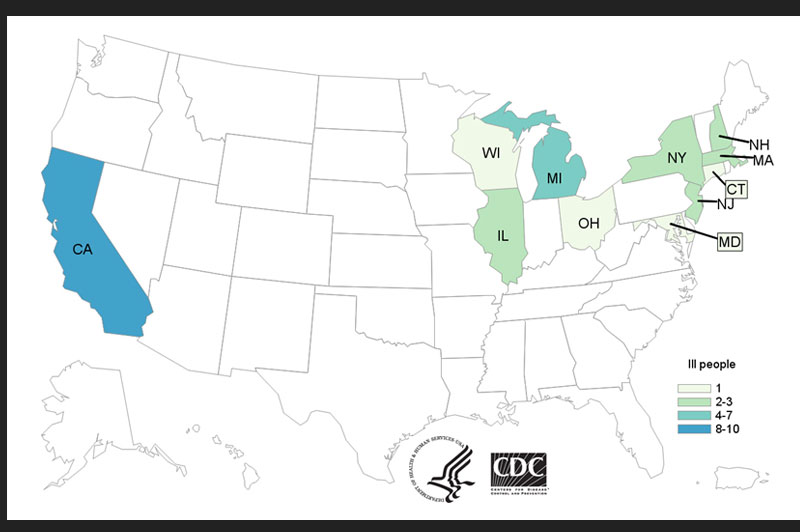
- Thirty-two people infected with the outbreak strain of Shiga toxin-producing E. coli O157:H7 have been reported from 11 states.
- Illnesses started on dates ranging from October 8, 2018 to October 31, 2018.
- Thirteen people were hospitalized, including one person who developed hemolytic uremic syndrome, a type of kidney failure. No deaths have been reported.
- The Public Health Agency of Canada has identified 18 ill people infected with the same DNA fingerprint of E. coli O157:H7 bacteria in two Canadian provinces: Ontario and Quebec.
- Epidemiologic evidence from the United States and Canada indicates that romaine lettuce is a likely source of the outbreak.
- Ill people in this outbreak were infected with E. coli bacteria with the same DNA fingerprint as the E. coli strain isolated from ill people in a 2017 outbreak linked to leafy greens in the United States and to romaine lettuce in Canada. The current outbreak is not related to a recent multistate outbreak of E. coli O157:H7 infections linked to romaine lettuce.
- CDC is advising that consumers do not eat any romaine lettuce because no common grower, supplier, distributor, or brand of romaine lettuce has been identified.
- This investigation is ongoing, and CDC will provide more information as it becomes available.

- People usually get sick from Shiga toxin-producing E. coli (STEC) 2–8 days (average of 3–4 days) after swallowing the germ.
- Some people with a STEC infection may get a type of kidney failure called hemolytic uremic syndrome (HUS).
- E. coli infection is usually diagnosed by testing a stool sample.
- Antibiotics are not recommended for patients with suspected E. coli infections until diagnostic testing can be performed and E. coli infection is ruled out. Some studies have shown that administering antibiotics to patients with E. coli infections might increase their risk of developing HUS, and a benefit of treatment has not been clearly demonstrated.
- For more information, see Symptoms of E. coli Infection.