Following FDA regulatory action, the CDC has taken steps to simplify COVID-19 vaccine recommendations and allow more flexibility for people at higher risk who want the option of added protection from additional COVID-19 vaccine doses.
CDC’s Advisory Committee on Immunization Practices (ACIP) met today to discuss these COVID-19 vaccine recommendation changes, and the associated implications and implementation. Although there was no vote at this meeting, ACIP members expressed their support for these recommendations.
These changes include:
CDC’s new recommendations allow an additional updated (bivalent) vaccine dose for adults ages 65 years and older and additional doses for people who are immunocompromised. This allows more flexibility for healthcare providers to administer additional doses to immunocompromised patients as needed.
Monovalent (original) COVID-19 mRNA COVID-19 vaccines will no longer be recommended for use in the United States.
CDC recommends that everyone ages 6 years and older receive an updated (bivalent) mRNA COVID-19 vaccine, regardless of whether they previously completed their (monovalent) primary series.
Individuals ages 6 years and older who have already received an updated mRNA vaccine do not need to take any action unless they are 65 years or older or immunocompromised.
For young children, multiple doses continue to be recommended and will vary by age, vaccine, and which vaccines were previously received.
Alternatives to mRNA COVID-19 vaccines remain available for people who cannot or will not receive an mRNA vaccine. CDC’s recommendations for use of (monovalent) Novavax or Johnson & Johnson’s Janssen COVID-19 vaccines were not affected by the changes made today.
CDC and ACIP will continue to monitor COVID-19 disease levels and vaccine effectiveness in the months ahead and are anticipated to have additional discussions around potential updates this fall.
Ohio health officials are urging caution again this winter. But entering our third holiday season with COVID-19, the nature of those warnings is a bit different.
Three at once
As Ohio Department of Health Director Dr. Bruce Vanderhoff explained, this year the threat is multiple respiratory viruses at once.
“Unlike the last two winters, it’s not just about COVID,” he said. “But the combination of COVID, influenza, and RSV, especially for those whose health is more vulnerable or who have not been adequately vaccinated against flu and COVID-19.”
RSV, or respiratory syncytial virus, often feels like a common cold for adults and otherwise healthy children. But for infants, the elderly or immunocompromised people it can be dangerous. According to the CDC, RSV is the most common cause of bronchitis and pneumonia among kids 12 months old and younger.
Unlike COVID-19 and flu, RSV has no vaccine.
Precautions and metrics
As ever, Vanderhoff’s chief precautionary recommendations are for people feeling ill to stay home and for everyone to wash their hands regularly. In situations where people must leave the house, officials recommend wearing an N95 mask.
He also urged those who haven’t gotten vaccinated for the flu or COVID-19 to do so.
“Vaccination is the safest and most dependable way to assure that you’re maximizing that cellular immunity I talked about,” Vanderhoff explained. “It gives your immune system its best opportunity to confront and beat the virus.”
According to the CDC, the COVID-19 community level — a statistic based on number of hospital admissions and number of cases per 100k population — is low in many Ohio counties. Twelve rank as ‘high’ based on those metrics.
Dr. Joe Gastaldo, OhioHealth medical director for infectious diseases, said people should be especially cautious in those counties.
“In those scenarios, regardless of vaccination status, the recommendation is to wear a mask,” he said. “If you’re not feeling well wear a mask. I think specifically if you have an at-risk condition, or are immunocompromised, I would advise you as an infectious disease doctor to wear a mask indoors in public.”
The CDC’s more familiar community transmission metric, based on cases per 100k population and percentage of positive tests, remains high throughout the state. All but nine of the Ohio’s 88 counties rank high for community transmission and none are low.
As for RSV and the flu, Vanderhoff noted this year both started earlier and rose more rapidly than in past years. Both viruses have receded from their peak, he explained, but remain dangerous for some populations.
If you test positive for COVID-19 and are more likely to get very sick, treatments are available that can reduce your chances of hospitalization and death.
Don’t delay: Treatment must be started within days after you first develop symptoms to be effective.
Other medications can help reduce symptoms and help you manage your illness.
The Treatment Locator (hhs.gov) can help you find a location that offers testing and treatment or a pharmacy where you can fill your prescription.
Treating COVID-19
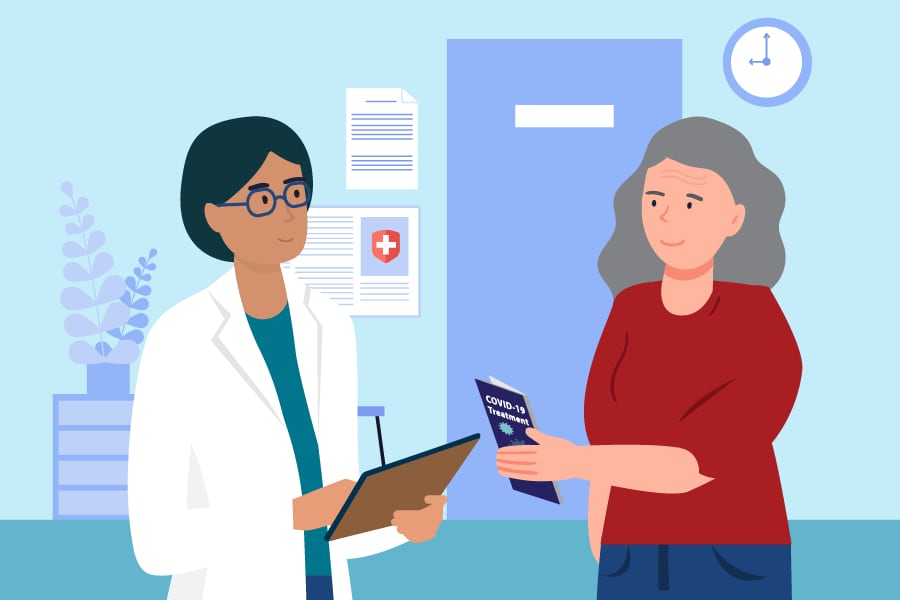
If you test positive and are more likely to get very sick from COVID-19, treatments are availableexternal icon that can reduce your chances of being hospitalized or dying from the disease. Medications to treat COVID-19 must be prescribed by a healthcare provider and started as soon as possible after diagnosis to be effective. Contact a healthcare provider right away to determine if you are eligible for treatment, even if your symptoms are mild right now.
Don’t delay: Treatment must be started within days of when you first develop symptoms to be effective.
People who are more likely to get very sick include older adults (ages 50 years or more, with risk increasing with age), people who are unvaccinated, and people with certain medical conditions, such as chronic lung disease, heart disease, or a weakened immune system. Being vaccinated makes you much less likely to get very sick. Still, some vaccinated people, especially those ages 65 years or older or who have other risk factors for severe disease, may benefit from treatment if they get COVID-19. A healthcare provider will help decide which treatment, if any, is right for you. Check with your healthcare provider or pharmacist if you are taking other medications to make sure the COVID-19 treatments can be safely taken at the same time.
Types of Treatments
The FDA has authorized certain antiviral medications and monoclonal antibodies to treat mild to moderate COVID-19 in people who are more likely to get very sick.
Antiviral treatmentstarget specific parts of the virus to stop it from multiplying in the body, helping to prevent severe illness and death.
Monoclonal antibodies help the immune system recognize and respond more effectively to the virus.
The National Institutes of Health (NIH) provides COVID-19 Treatment Guidelines for healthcare providers to help them work with their patients and determine the best treatment options for them. Several options are available for treating COVID-19. They include:
Start as soon as possible; must begin within 5 days of when symptoms start
Taken at home by mouth (orally)
Some treatments might have side effects or interact with other medications you are taking. Ask a healthcare provider if medications to treat COVID-19 are right for you. If you don’t have a healthcare provider, visit a Test to Treat location or contact your local community health center or health department.
If you are hospitalized, your healthcare provider might use other types of treatments, depending on how sick you are. These could include medications to treat the virus, reduce an overactive immune response, or treat COVID-19 complications.
Managing COVID-19 symptoms
Most people with COVID-19 have mild illness and can recover at home. You can treat symptoms with over-the-counter medicines, such as acetaminophen (Tylenol) or ibuprofen (Motrin, Advil), to help you feel better.
Click the link below or call 1-800-232-0233 (TTY 1-888-720-7489) to find a location that offers testing and treatment or a pharmacy where you can fill your prescription.
COVID-19 vaccines available in the United States effectively protect people from getting seriously ill, being hospitalized, and even dying—especially people who are boosted. As with vaccines for other diseases, you are protected best when you stay up to date. CDC recommends that everyone who is eligible stay up to date on their COVID-19 vaccines.
To find COVID-19 vaccine locations near you: Search vaccines.gov, text your ZIP code to 438829, or call 1-800-232-0233.
Preventive medications
The FDA has issued an emergency use authorization for tixagevimab plus cilgavimab (EVUSHELDTM), a medicine that can help protect you from getting COVID-19. EVUSHELDTM contains two different antibodies and is given as two separate consecutive intramuscular (IM) injections at a doctor’s office or healthcare facility before you are exposed or test positive for COVID-19. If you are moderately or severely immunocompromised, or severely allergic to COVID-19 vaccines, you may be eligible for EVUSHELDTM every 6 months. EVUSHELDTM may offer less protection against certain strains of the Omicron variant. It is important that even if you receive EVUSHELDTM you take multiple prevention measures. Additionally, you should undergo testing and seek medical attention if you develop symptoms of COVID-19, and start treatment for COVID-19 as appropriate. Talk to your healthcare provider to determine if EVUSHELDTM is right for you.
The right medications for COVID-19 can help. People have been seriously harmed and even died after taking products not approved for use to treat or prevent COVID-19, even products approved or prescribed for other uses. Talk to a healthcare provider about taking medications to treat COVID-19.
JANUARY 10, 2022
It’s been a tough couple of years for everyone – adults and kids alike.
When the pandemic first started, we were all worried about getting the illness. That sentiment certainly still exists for some, in particular people who are immunocompromised and the elderly. However, it seems we have now transitioned into a more generalized anxiety related to COVID-19, but not necessarily about contracting it. And the unfortunate reality is that our kids are feeling the same way.
THE SITUATION: MORE KIDS HAVE ANXIETY NATIONWIDE
We’re seeing more kids with anxiety nationwide. More psychology visits. More visits to the Emergency Department for suicide attempts. In fact, suicide is the second-leading cause of death in kids 10 years and older.
I don’t mention this to cause panic in parents, but rather to heighten our sense of awareness. Our kids have suffered much in the way that adults have, and we need to watch and take note (more on that later). While we don’t have an exact link to causation at this time, we certainly can make some guesses.
WHY KIDS HAVE COVID-RELATED ANXIETYWe’re noticing that kids are behaving in ways that are similar to how we act after experiencing significant loss. And I think this makes sense. They have missed out on nearly two years of normalcy. Two years of attending school in a typical way. Two years of uncertainty and disbelief. They’ve missed major milestones and activities, such as graduation, school dances, field trips and sporting events.
Not to mention the developmental impacts of virtual school. Kids learn by interacting with others and through hands-on projects. They develop socially by having to navigate relationships and work things out. Their sense of well-being, especially for teens, is tied to their peers and achievements. And now that some of these activities have started up again, many are anxious about returning to them, because they’re out of practice.
So what can we as parents do about it? I recommend the following:
1. ENCOURAGE RESILIENCYResiliency is the ability to manage and bounce back from a stressor. Without social interactions and activities, these skills have been sitting on a shelf. They need to be dusted off and used. This will take work and time. It can start by explaining that they have the ability to do it – they can do hard things. Perhaps remind them of another time when they worked through something difficult. Have them focus on what’s within their control and let go of what isn’t. Read this previous post for more tips on teaching resiliency.
2. PROMOTE BASIC BRAIN HEALTHThe last couple of years have wreaked havoc on our basic brain health, and this impacts how we think and feel. We’ve gotten out of our normal routines, sleeping patterns and healthy meals. I recommend getting back to a daily structure. Have a normal bedtime. Engage in regular physical activity. Eat meals together. It doesn’t have to be every day or even at dinner, but children who eat meals with their families are often more resilient than those who don’t eat with their family.
3. NURTURE PARENT-CHILD CONNECTIONSConveying a sense of connection with your children is so important for their sense of well-being and willingness to open up to us. Just hang out together and have fun on a consistent basis. You don’t have to have big important discussions. This will plant the seed for them to trust you and confide in you when they need help.
4. TAKE CARE OF YOURSELFThis goes back to the oxygen mask metaphor – when you’re on a plane, you need to put your oxygen mask on before you help someone else put theirs on. The same goes for mental health. It is difficult to help someone else when you’re not taking care of yourself. I realize this is easier said than done, but start taking small steps. Ask another adult to partner with you in making self-care a priority.
5. NOTICE CHANGES IN YOUR CHILDBasic changes in your children can indicate that they are having a difficult time. Be on the lookout for changes in sleep, eating, appearance, academics, energy level, activities, and social interactions. Pay attention to their social media accounts. When you notice any of these differences, ask them about it. Say something like, “I’ve noticed you’re eating less than normal”. Or, “you’re not hanging out with Suzie as much”. Follow up with, “let’s talk about that”. Or, “have you noticed that too”? They may not be open up right at that moment, but you’ve opened the door and it may lead to more conversations. And if you’re concerned, say so.
6. GET HELP WHEN NEEDEDIt is okay to ask if they’ve had thoughts of suicide or wanting to die. Parents sometimes worry that they will plant those thoughts in their heads, but this just isn’t the case. This allows them to share concerning thoughts with us. By asking difficult questions, parents open the door for children to discuss difficult topics. Children who talk about these feelings with trusted adults are at less risk of acting on them.
If you notice significant changes in your children, or if they talk about wishing they were dead or having thoughts of killing themselves, never hesitate to contact a professional. You can reach out to our Pediatric Intake Response Center at 513-636-4124, our Division of Behavioral Medicine and Clinical Psychology at 513-636-8107, or refer to a list of contacts on our mental health and resources page.
In response to the Food and Drug Administration’s (FDA) recent action that authorizes an additional dose of COVID-19 vaccine for immunocompromised individuals, CMS is assuring people with Medicare who qualify for an additional dose that they can receive it with no cost sharing. This is part of President Biden’s commitment that patients have access to the necessary vaccinations to protect themselves from COVID-19.
Medicare would pay for administering an additional dose of COVID-19 vaccines consistent with the modified FDA emergency use authorization (EUA) that was announced today. For COVID-19 vaccines administered on or after March 15, 2021, the national average payment rate for physicians, hospitals, pharmacies and many other immunizers is $40 to administer each dose of a COVID-19 vaccine. The Medicare program would continue to pay providers $40 to administer this additional dose – the same amount as paid for other doses of the COVID-19 vaccine.
CMS will share more information and guidance in the coming days about billing and coding for the additional dose of the COVID-19 vaccine for immunocompromised patients.