
Tag: infrastructure

  • A greater vision for the intrinsic beauty of the Grailville land

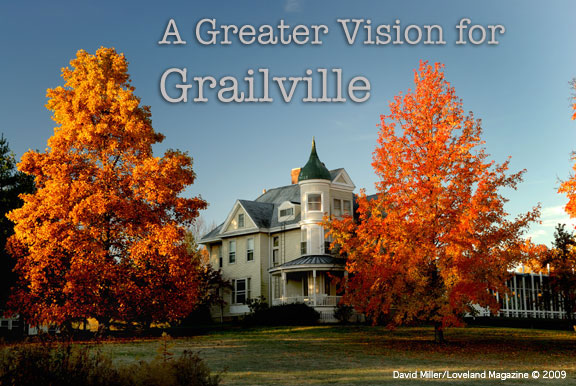
    A greater vision for the intrinsic beauty of the Grailville land

    by Elizabeth Robinson

    Dear Fellow Lovelanders,

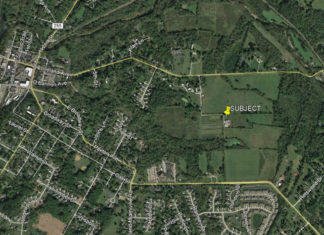
    I want to speak to you about vision and make sure you are aware of an important ongoing process before the Loveland Planning and Zoning Board and Loveland City Council. Drees Homes is requesting a change in the current low-density zoning status on 110 lovely acres of green unspoiled land, with historic buildings, currently owned by Grailville (The Grail). This land sits between where East Loveland Avenue turns into O’Bannonville Road and Rte 48. Drees desires this zoning status change to put 209 homes on this green space.

    The Grail Mission and Vision Statement speaks of Care for The Earth. This has always been vital to Grailville/The Grail in its history and practice. Grail members including myself are expressing significant and ongoing distaste that the Grail is seriously considering divesting itself of this land to Drees to build another subdivision in our town.

    There are important long-term practical reasons why many Loveland residents have spoken AGAINST enabling a zoning status change proposed by Drees to build 209 homes. They include, among others, an overcapacity school system, aggravating already clogged traffic and infrastructure concerns including sewer and water. (Please reference the below open letter to Loveland residents by Elizabeth Murphy for more details on these pressing issues)

    I want to concentrate here on a compelling and magnanimous (great of mind or heart) vision of protection from development such as the proposed Drees subdivision. Standing up for a NO vote on this zoning status change from low density is a very important first step.

    If the Grail is determined to divest itself of this land, are we as citizens willing to stand up for a vision that will honor the cultural and spiritual history of the Grail on this land, and also stand up for the inestimable value of added community green space which will do so much more than another subdivision to keep Loveland a treasured place to live into the future?

    I wonder: If Loveland has the foresight to reject this proposed Drees zoning change, would The Grail accept significantly less money from the city or other entity committed to a higher vision that cares for the earth and the people of Loveland?

    I have lived in Loveland all my life and our Loveland Bike Trail was just such a vision. There were many who could not see the immensely positive difference this green path of natural beauty that intersects our town and all enjoy, would make for the future of Loveland. It is with gratitude we now look back and honor those who had vision and were tenacious, so we could see the flowering of that vision.

    Today Loveland is thriving. With that has come some of the problems of success mentioned earlier such as traffic and stress on infrastructure. We can make decisions now that see another subdivision that destroys precious green space and exacerbates traffic and stressed infrastructure will not be a decision that is truly good for the future of Loveland.

    Loveland citizens will thank us years from now if we reserve green and natural places for the good of all, as did those bike trail visionaries.

    I ask the Loveland Planning and Zoning Commission and Loveland City Council to reject this Drees proposed zoning change. Reject it not only on very real practical matters such as traffic and infrastructure, but to support a greater vision of the intrinsic beauty and value added of green spaces for Lovelanders into the future.

    Sincerely,

    Elizabeth Robinson

    East Loveland Avenue


     April 11, 2022
    
    Dear Fellow Loveland Residents,
    
    It is important that you are aware of a process which is now ongoing involving 110 acres of Grailville land between Rt.48 and O’Bannonville Rd. Loveland City Council and the Zoning Board will have to make a decision on the Drees Homes’ request for a change in the zoning status to allow them to build 209 homes on that land.
    
    The iniPal public hearing drew a standing room only crowd. Everyone who spoke, with the excepPon of the Drees representaPves, requested that the Zoning Board say NO to the Drees proposal. There are important long-term reasons why it is best for our community that the Drees proposal does not go forward.
    
    We all know the traffic situaPon in downtown is bad now. The construcPon of a large subdivision on this Grail land will iniPally cause several years of construcPon trucks and dirt funneling into town from Rt.48 and O’Bannonville Rd. As the houses are built and sold regular traffic of several thousand car “trips” through town will phase in. This will never stop.
    
    Our school system is currently overflowing recommended capacity. Extra trailers are needed for space. It is esPmated that 4-5 addiPonal classrooms of children are likely to be added by this subdivision. We are all painfully aware of the costs that would be incurred to build new schools, as well as the stresses on children and teachers involved in overcrowding. Again, once this increase is allowed to happen it is unlikely to be reversed.
    
    There are also serious general infrastructure issues relaPng to water. The Loveland water system is a series of wells which when run at high demand can drop the water table in a significant way. One must ask at what point will this become a problem. Water pressure has at Pmes been an issue and more homes drawing water cannot but aggravate this.
    
    The other end of this problem is the management of the addiPonal sewage. The sewer line under East Loveland Ave. is outdated, fragile, and it is quesPonable whether it is adequate to handle a large new neighborhood. The receiving Polk Run sewage treatment plant has no more room to expand. There has been no confirmaPon of sewer availability, capacity, or access compliant with MSD standards. Will the City of Loveland be put in a posiPon of providing this infrastructure at Loveland residents' expense? With the Liale Miami River so nearby it is crucial that there be no chance of contaminaPon.
    Natural rainwater run-off must also be considered. The land from White Pillars on slopes to the northwest. The homes along O’Bannonville Rd. are all in the path of this natural drainage and vulnerable to surface flows or overflowing of Bares Run Creek in Pmes of heavy rain. The new roads and houses will eliminate acreage which currently absorbs the rainwater and so more will conPnue on downhill.
    
    The final thing I need to speak of is the special quality of this parPcular piece of land. For about 80 years women of The Grail have lived or worked there. They have tended the land, holding it, knowing the sacred nature of this place. As the Grail has shared access to their land with others
    for walking and connecPng with nature, many have become aware of the spiritual calm which it provides. In today’s world we need this more than ever.
    
    In conclusion, I would encourage everyone who feels that we do not need another big subdivision on this Grailville land, with all the negaPve side-effects, to please make your views known. Aaend the public meePngs (the next is on May 4), write or call members of the Zoning Board and City Council. In our country we have government of ciPzens for ciPzens. Our officials have a duty of honor to listen to the members of the community which they serve. They are us; and therefore, we must speak so they may be guided.
    
    Sincerely, 
    
    Elizabeth Murphy - Fallis Road Loveland OH
    

    The Grailville Archive

    Because posterity may wish to know.

  • White House Outlines Ohio’s Infrastructure Needs

    White House Outlines Ohio’s Infrastructure Needs

    Presidents Barack Obama and Donald Trump failed on promises to secure funding to repair the 50-year-old Brent Spence Bridge spanning the Ohio River at Cincinnati. (Atony-22/Wikimedia Commons)

    By Mary Schuermann Kuhlman, Public News Service – OH – Producer, Contact

    Nick Bates, outreach director for One Ohio Now

    The White House is detailing its goals for improving Ohio’s infrastructure through the American Jobs Plan.

    According to a fact sheet released Monday, Ohio has more than 1,300 bridges and nearly 5,000 miles of highway in poor condition that would benefit from the proposal’s $115 billion national investment road and bridge repair. A 2021 infrastructure report card gave Ohio a grade of “C-minus.”

    Nick Bates, outreach director for One Ohio Now, said the president’s proposal to include $85 billion for public transportation is a welcome investment.

    “So many people, in not just urban areas but rural areas as well, rely on public transit to go to and from work, to get to the grocery store and to be connected to their community,” Bates explained. “So those investments to make sure that people around the state can stay connected will be essential.”

    According to the White House, Ohio will benefit from $13 billion for drinking water infrastructure over the next two decades and a national investment of $200 billion to increase the availability of affordable housing.

    Critics question the use of corporate tax increases to pay for the $2.7 trillion plan, which they argue is too broad.

    Bates is also excited to see the plan will invest $100 billion to expand broadband, which is out of reach for 14% of Ohioans. 

    “Infrastructure is more than just bridges and roads,” Bates contended. “It has to include things like broadband access. I have two kids, and watching them and their classmates struggle to learn digitally with the pandemic, having spotty internet connections and no internet connections, made that task even more difficult.”

    Ohio passed an increase in the state fuel tax in 2019 for road and bridge repairs, which Bates argued was just the first of many steps needed to address the state’s crumbling infrastructure.

    He pointed out infrastructure often requires the federal government to step in.

    “Public projects of the 1930s and ’40s built up a lot of the infrastructure, expanding electricity into parts of the country that never had it before,” Bates recounted. “We can look at the original development of our interstate highway system.”

    The plan also invests in clean-energy jobs, manufacturing, home energy, child care and caregiving jobs.

    Reporting by Ohio News Connection in association with Media in the Public Interest and funded in part by the George Gund Foundation.Citation: American Jobs PlanCitation: Ohio fact sheetCitation: Infrastructure report cardCitation: Ohio broadband reportCitation: State fuel tax increase 2019

  • Proposals call for expanded passenger rail service in Ohio

    Proposals call for expanded passenger rail service in Ohio

    Biden administration, Amtrak proposing new passenger rail connecting Ohio’s “Three-C” cities

    By Tyler Buchanan and Ohio Capital Journal

    The possibility of expanded passenger rail service in Ohio has some residents brainstorming how it might impact their lives.

    A Columbus resident imagines being able to take a train to Chicago, a place they haven’t been “in ages.” A baseball fan from Dayton thinks he’d be able to attend games at Cleveland’s Progressive Field more often. A bicyclist considers the possibility of riding cross-state to another city then taking the train back.

    These opportunities would still be years away from taking shape. The Biden administration wants to get the ball rolling on this idea as part of a $2 trillion infrastructure and jobs proposal made public on Wednesday.

    The sweeping plan calls for making a variety of improvements to America’s transportation grid. The administration also wants improvements made to drinking water systems; high-speed broadband for all Americans; and rehabbing projects for millions of homes, commercial buildings, schools, hospitals, child care facilities, and federal buildings.

    President Biden, a longtime Amtrak rider and supporter, wants to invest tens of billions of dollars to build new train routes throughout the country. His plan separately calls for more than $100 billion in spending toward repairing and modernizing other public transit systems.

    In order to pay for this infrastructure package, Biden wants to raise the corporate tax rate and prevent companies from writing off expenses accrued from offshoring jobs.

    President Biden is proposing a major investment toward expanding passenger rail service throughout the United States. Here is a proposed map for expanded service from Amtrak.

    Amtrak has publicized its own “Vision to Grow Rail Service Across America” map with a goal of building new routes to unserved cities within the next 15 years.

    Most notably for Ohioans is a proposal to build new Amtrak routes connecting Cincinnati, Columbus and Cleveland. The initial concept is to have three round trips per day, with stations in other communities placed along the route (such as Dayton).

    Amtrak currently operates several routes which travel along the north and south edges of the state and its growth plan calls for increasing service along these routes. Additional routes connecting the Ohio’s largest cities would be a significant development, transit advocates and local officials believe.

    “This is bold,” said Stu Nicholson, executive director of the transportation advocacy group All Aboard Ohio. “This is a huge, bold move in terms of both infrastructure overall and transportation in particular.”

    It has been 40 years since Ohio last saw passenger trains on the “Three-C Corridor.” Bringing it back, Nicholson said, will have major tourism and economic ramifications for the state.

    “Three trains a day doesn’t seem like a lot, but it’s three trains more than we have now,” Nicholson added.

    City councils in Cincinnati, Columbus, Cleveland, Dayton and elsewhere have all passed resolutions in recent months supporting Amtrak rail expansion.

    How Ohioans think they might benefit from expanded rail service

    A zoomed-in look at Amtrak’s proposed service map impacting Ohio. Dark blue lines indicate existing services, while light blue and yellow lines indicate new or enhanced rail service.

    The Ohio Capital Journal sought input from Ohioans on these proposals and asked on social media what they might use expanded passenger rail for.

    Andrew Gutierrez, a resident of Cincinnati, said it would help with seeing family members during the holiday season.

    “It would definitely make travel less stressful seeing in-laws in Cleveland, especially during the winter,” Gutierrez responded. “Maybe not quicker, but it’s at least an option.”

    Leslie Hughes also said she would utilize passenger rail to travel from Franklin County to other states to see relatives.

    “As a newly retired person, visiting family by train in nearby states would give me great hope for enjoying my later years,” she said.

    Here is a selection of other responses:

    https://twitter.com/WindingDot/status/1377627351157252101?ref_src=twsrc%5Etfw%7Ctwcamp%5Etweetembed%7Ctwterm%5E1377627351157252101%7Ctwgr%5E%7Ctwcon%5Es1_c10&ref_url=https%3A%2F%2Fohiocapitaljournal.com%2F2021%2F04%2F02%2Fproposals-call-for-expanded-passenger-rail-service-in-ohio%2F

    Ohio transit funding

    These infrastructure proposals come as Gov. Mike DeWine signed the two-year, $8.3 billion Ohio transportation budget into law on Wednesday. The governor had originally suggested massive cuts to state funding for public transportation, but lawmakers restored the funding to pre-pandemic levels.

    DeWine acknowledged Thursday that “we certainly have infrastructure needs” in Ohio, but said he hadn’t given a full look to Biden’s proposals.

    Unlike highways, public transportation has no dedicated revenue stream within the state budget, meaning this investment is dependent on lawmakers’ decision-making every two years when a new transportation budget is approved.

    As reported, the funding approved in this budget helps benefit the many urban and rural transit systems throughout Ohio. They will also receive federal relief funding approved by Congress that is meant to recoup losses sustained during the pandemic. 

    The Ohio Department of Transportation’s 2015 Transit Needs Study outlined that a vastly larger investment into public transit is necessary to fully improve and maintain the state’s transit offerings.

    A recent state infrastructure report card from the American Society of Civil Engineers graded Ohio’s infrastructure as being a C-, with the “ Transit” category receiving a D grade.

  • For 3rd time Zicka is back requesting condo approval

    For 3rd time Zicka is back requesting condo approval

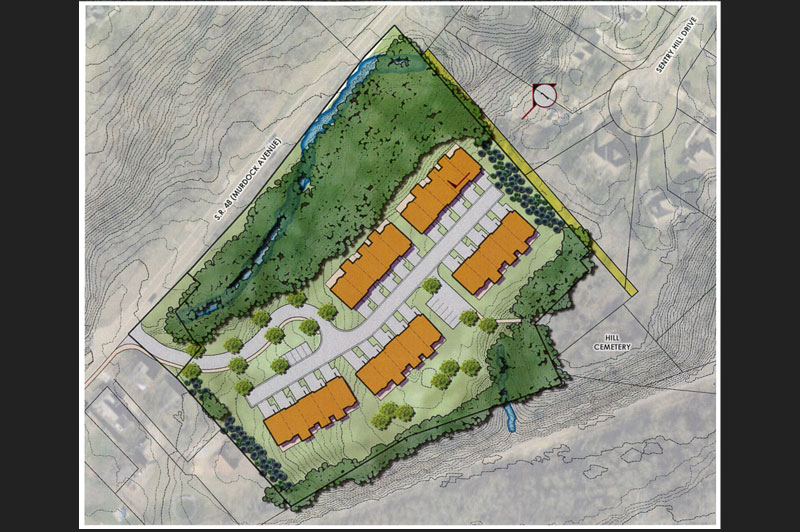
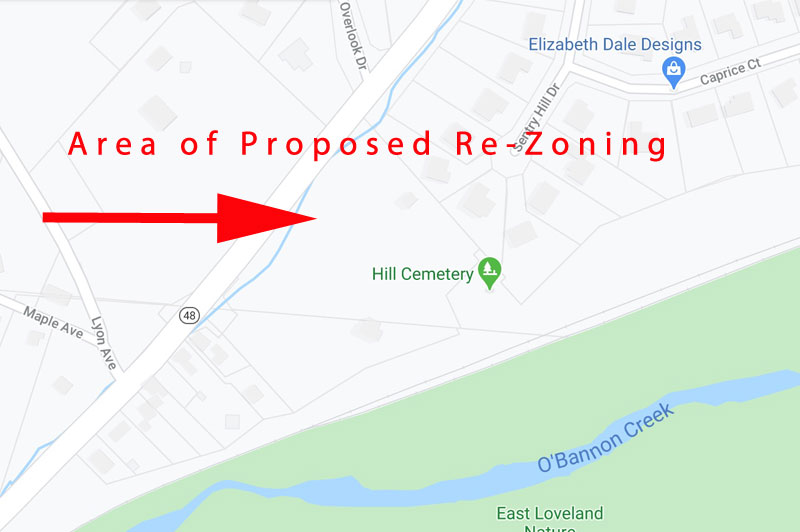
    Loveland, Ohio – Joe Farruggia with Zicka Homes has been trying to rezone property off North Second Street (St. Rt. 48) south of the Sentry Hill subdivision with the potential use to build a 28-unit condominium development called the Blossom Hill Project since the first week in June. He has submitted three variations of the proposal, the latest on October 20. The current proposal is to limit the project to 25 or fewer individual units.

    The site is approximately 5.5 acres on St. Rt. 48 adjacent to the Sentry Hill subdivision and on the opposite side of the street of the Loveland Health Care facility.

    Previously, on June 24th and July 21, the Planning and Zoning Commission held public hearings for the zoning map amendment and recommended approval of the amendment. However, each time, Farruggia chose not to move forward with the processes which would be to have a public hearing before the City Council.

    The latest iteration was also approved by the Planning Commission last week and sent to City Council for their consideration. The recommendation from Assistant City Manager Tom Smith is for Council to schedule a public hearing for the re-zoning on November 24.

    The developer is asking for changes to the Loveland Zoning Map from the current zoning of Medium Density Residential to Residential Multi-Family.

    The recommendation of the Commission according to Smith included the following conditions:

    1. The proposed housing development for the property as submitted o Planning and Zoning Commission must be actively under construction within eighteen (18) months from the date of approval by City Council in order to maintain the zoning;
    2. The approval shall be withdrawn, and the zoning shall revert to Residential Medium Density (R-MD) should the eighteen (18) month condition lapse.
    3. Approval shall be exclusive to this applicant. No transferees or assignees of the applicant are subject to this approval.

    Smith also said the developer agreed to requests made by Sentry Hill resident, Dave Stanton. These items were also part of the Planning and Zoning Commission’s motion for recommendation:

    1. Construct a four to five-inch earth berm, fully landscaped with trees and grass, to be constructed along the property line of the two homes in the Sentry Hill subdivision and maintained by the new subdivision’s HOA.
    2. Street lighting and exterior lighting on the townhomes be designed to prevent light pollution into the Sentry Hill Subdivision.
    3. Townhomes to be constructed, at 40 feet, shall not exceed the height of the referenced home of 214 Sentry Hill Drive.
    4. Limit the number of townhomes to be built at 25 or less.
    5. No dumpsters or centralized garage collection. Individual residential trash and recycling pickup to be consistent with all the residential surrounding areas.
    6. No stand-alone garages or sheds.
    7. Exterior architecture and materials (brick, stone, and Hardie Plank) shall be consistent with the look and feel of neighboring communities.

    Even though there are COVID 19 restrictions for the number of audience members in the hearing chamber, five residents appeared to express their displeasure with the re-zoning. No residents spoke in favor of the rezoning or the condos.

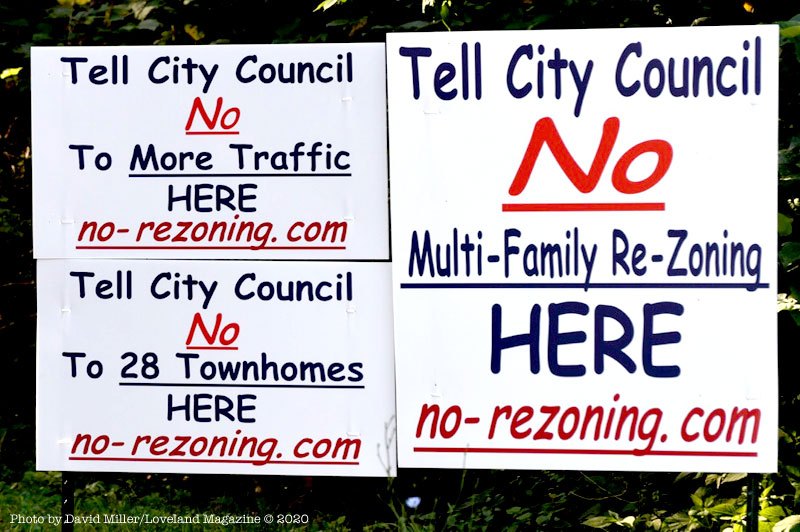
    These signs were erected in July by citizens opposed to multi-family zoning adjacent to their homes on St. Route 48 in North Loveland.

    Residents have pointed out that the proposal must follow the guidance of the City Master Plan specifically for North State Route 48. They say the project must maintain similar development densities, preserve open space, a rural atmosphere, and assure that there is adequate infrastructure to support the development as mandated in the current plan. They cite the current gridlock of Historic Downtown that must be addressed before the development moves forward.

    City Manager Dave Kennedy has argued that the current Comprehensive Strategic Plan (2002) is old and not in line with the current needs of the City. The City is currently rewriting a new master plan for the City. Residents say re-writing the plan is well and good, but until there is a new plan the City and Zicka are governed by the one that exists.

    Residents of South 48 also protest that adding so many residential units will add to their already current traffic nightmares of trying drive into and out of Historic Downtown.

    During the hearing, Tom Scovanner told the Commission they should be skeptical of the studies Zicka presented to them. One presenter represented that they had prepared their study for the Commission, and Scovanner said, “No, they represent Zicka.” He posed the question to the Commission of whether they would have ever seen the study if it did not turn out favorably to the developer.

    Scovanner, a litigator for Clermont County also said in no uncertain terms that the P&Z cannot do anything the Loveland law doesn’t allow them to do. Holding up the code, he said, “You’re bound by these codes. This doesn’t comport with the Comprehensive Master Plan.”

    Tom Scovanner spoke to Planning Commission against the re-zoning for condos on Rt. 48.

    Dave Stanton spoke to Planning Commission against the re-zoning for condos on Rt. 48.

    Sue Ann Walker spoke to Planning Commission against the re-zoning for condos on Rt. 48.

    Allen Brooks spoke to Planning Commission against the re-zoning for condos on Rt. 48.

    Courtney Hauck spoke to Planning Commission against the re-zoning for 28 condos on Rt. 48.

    You can view the application and proposal that is now before City Council in this document and going to page 14 b. 2020-10-27 City Council – Full Agenda-1355

  • Pat Ahr: A new candidate vies for Loveland City Council seat

    Pat Ahr: A new candidate vies for Loveland City Council seat

    by Bill and Cyndi Gillings,

    Changes in the City of Loveland are happening rapid-fire. After recovering from a devastating fire in its downtown in 2017, Loveland has reinvigorated its charming historic core by expanding

    Bill and Cyndi Gillings live in the Paxton Woods neighborhood of Miami Township.

    recreation, shopping, and restaurant/bar options. By anyone’s estimation, the city’s growth is on a steep trajectory with its ambitious city master plan, creation of a historic preservation district, and the addition of new venues and events. Loveland is dreaming big.

    “Pat Ahr enters the Loveland City Council race with a “Breath of Fresh Air” campaign that promises better city-citizen communication, equal focus outside the historic core, and fiscal responsibility.”

    Into this exciting phase steps Pat Ahr. A new face on the Loveland political scene, Ahr is a 15-year Loveland resident and retired registered nurse. She is running for a city council seat in the November 5 election, prompted to do so by a few key issues.

    More Conversation, More Kindness

    “I believe that as a city we are not communicating as well as we should,” Ahr says, laying out one of the pillars of her campaign. “I want to include all of Loveland in city discussions.” Ahr believes the current makeup of the city council has lent itself to block voting, and that the city would be better served by having a wider variety of viewpoints represented by elected officials.

    “We need different voices on the council and not just people who agree on every point and push things through,” she emphasizes. “While I think that the council has done a lot to move Loveland forward, they are viewed–as a group–by many in the city as unkind. I want to bring kindness back to the council. We need to treat each other with respect. And I want the community to be involved in this transition to civility.”

    If elected, Ahr will lean on her expertise as a communicator to make sure the public has a seat at the discussion table. This is second nature to her. “As a nurse, you must communicate at multiple levels–dealing with doctors, nurses, patients, patients’ families, and insurance,” she lists. “The communication is endless.”

    Ahr will institute office hours for the public so all citizens can share their opinions and ideas outside the only current outlet for doing so: the monthly city council meeting. “Twice a month, I will hold meetings so the community can talk to me about what is going on in Loveland,” she says. “We’ll meet at a local restaurant or coffee shop, and I will encourage people of all ages to come. We must connect on a different level than just through the information put on the city website or by attendance at council meetings where you have to sign in to talk and where you can’t rebut as you would in a normal conversation. I want to give–and receive–more information than what you can get from that format.”   

    But it’s not just how city council communicates, it’s also what they are communicating about that concerns Ahr. “To date, all the focus of the city has been on the downtown district, but we are outgrowing what we can do there. We need to be bringing in new businesses with taxable revenue comparable to other towns in Cincinnati. And we need to address the unique needs of all areas of Loveland.”

    Ahr points to the Loveland-Madeira Road Corridor as an obvious focal point. “I attended community meetings for the city’s master plan, and I listened to parents talk about how they have to drive to Anderson and Milford to get to places that kids really enjoy–like Jump Zone and entertainment venues like that,” she says. “Could we have a year-round pool? Or a Loveland workout center, like the Y that was planned years ago, to keep people in Loveland? We invite all these people from outside to enjoy our downtown, but we need to look at what people who live here would enjoy.”

    Soothing Municipal Headaches

    After improving communication with the public, Ahr’s second mission will be to address the city’s parking issue. “The city’s third-party master plan designers said we have enough parking in the city and that we just need to educate the public about where it is,” she says. “But now the city has put out an RFP (request for proposal) for a parking garage with $7 to $8 million price tag. And they are guessing at costs. They should have done a preliminary RFP and then put the idea of the garage out to the public as an idea with an accurate price tag on it,” she says.

    “Pat Ahr has lived in Loveland for over 15 Years

    Retired Registered Nurse for 43 years

    Expertise in Brand Management and Marketing

    Regional Marketing Director across the Midwest

    Managed Direct Sales for Multiple Businesses and Organizations

    Understands Government Regulations having Assisted with Buyouts and Takeovers”

    Considering the amount of money a garage could cost taxpayers, it is worth looking at alternatives first, Ahr says. “Let’s follow what the master planners suggested and educate the public on where to park. Maybe create a map we put in restaurants and in holders on the bike trail that would help people navigate the town and figure out where to park,” she suggests. “Try things first and build on the ideas before spending taxpayer money.”

    The fiscal responsibility that colors Ahr’s opinion on the parking garage flows through her opinions on everything with which the city gets involved. This attention to management, processes, and regulation comes from her experience participating in acquisitions and takeovers of healthcare entities during her 43-year nursing career.

    Take the school levy as an example. While not a city financial issue on the face of it, the school levy concerns Ahr. “Right now, the number-one thing everybody is talking about is the school levy and what is going in where and why we are being asked for so much money. People support schools for different reasons, both emotional and intellectual. I believe in education, but at what cost? I think every family needs to make the decision to support or reject the levy for themselves.”

    That said, she has an eagle eye on what this school decision could mean for the taxpayers of Loveland. “The city must look at infrastructure to support the school,” she reminds. “The City is saying the schools are separate from us, but we need to be working together with them or we will blindside the taxpayers down the road on infrastructure costs, such as road improvements, after and on top of the tax for the schools.”

    On a Personal Note … And An Invitation

    Politics is in Ahr’s DNA. She is the great-great-granddaughter of our nation’s 12th president, Zachary Taylor (1784-1850). A Kentucky native, Taylor was a full-fledged war hero through his service in the Mexican War. He was in office for only 16 months before he died. “He was a president against slavery,” Ahr says proudly.

    As important as her illustrious roots are her present-day kin. She and her husband, Barry, have four children and nine grandsons. That’s right–all boys. “I love them so much,” she says. “And we have one more on the way.” No word on the gender of the new addition, which is okay with Ahr. “I look forward to two surprises in November,” she says.


  • [From the Loveland School District] November 2019 Levy FAQ

    [From the Loveland School District] November 2019 Levy FAQ

    Loveland, Ohio – Below is a post from the Loveland City School District about the combined 16.78-mill levy that will be on the Fall ballot. At the bottom of this page, you will find levy information provided by Loveland Magazine.


    Note: This resource will be updated with answers to additional commonly asked questions.

    Helpful Resources
    Directions for accessing the information from your county auditor can be found under “Calculating the Tax” on this website.

    For additional information about the Facility Master Plan and how it developed through extensive community involvement, please visit www.buildingtigernation.org.
    Do you have a question that is not answered in this FAQ? Over the coming weeks, there will be several opportunities for community involvement through small and large group meetings. The current schedule is available here. You are also welcome to call the Superintendent, Dr. Amy Crouse, or the district Treasurer, Mr. Hawley, who welcome the opportunity to answer your questions on the urgency and necessity of this levy request.

    Funding Questions

    1. What are the basics of the combined operating, permanent improvement levy and bond request? How will the dollars be used?

    The November 5 request includes an operating levy, which is necessary with or without the building levy, to run the daily operations of the school district. The permanent improvement and bond portions of the levy are for the much-needed modernization, construction, repairs, and renovations that are outlined in the facility master plan.

    2. What is an operating levy for?

    An operating levy is used to provide money for a school district’s day-to-day operating expenses, including utilities, supplies, and salaries/benefits for staff. The November 2019 operating levy for Loveland Schools is a continuous levy. It will be collected each year, but as home values increase, the tax rate will be reduced in order to hold the payment to the schools at a constant level. This is often referred to as the “tax reduction factor,” or the “HB 920 reduction factor.” HB 920 is a state law that protects homeowners from paying more money in taxes as their homes appreciate.

    This taxpayer protection means revenues remain flat for the schools during the life of the levy, but in the normal course of business, operating expenses rise due to inflation and increased educational requirements. This is the reason the schools typically must return to voters and ask for additional operating funds every three to five years.

    The last operating levy for Loveland Schools was forecasted to cover four years of expenses, and the district has been able to sustain operations for five and a half years since approval.

    3. What is a bond levy or bond issue?

    A bond levy is a special tax used to provide revenue to repay the loan, otherwise known as a bond issue, used for school construction projects, and can by law only be used for that purpose. A bond levy remains in place until the bond is paid off, in this case a maximum of 37 years for the proposed master plan.

    The last bond issue for Loveland Schools was passed in 1998. It provided the funds to build the current intermediate school, renovate the middle school and add an auxiliary gym and large classroom at the high

    school. The school buildings have been exceptionally well-maintained over the years, but two separate assessments, including one by the Ohio Facilities Construction Commission, show that the cost of maintaining the Early Childhood Center, Primary and Elementary Schools is more expensive than replacing them.

    4. What is a permanent improvement (PI) levy for?

    Like a bond levy, a permanent improvement levy (PI levy) can be used only for a certain category of needs. Per state law, funds from a PI levy can only be used for the purchase of items that have a lifespan of five years or more (a capital improvement), or to repay financings used to purchase or construct capital improvements. PI funds can be used for building construction, maintenance and repairs, and certain equipment that is designed to last at least five years. For example, they can be used to replace roofs, windows, and HVAC systems, etc. PI levies cannot be used to pay for salaries, benefits, operating expenses, or basic supplies.

    5. What will the impact be on our property taxes?

    The cost of the 16.78-mill combined operating and permanent improvement/bond levy translates into $587.30 annually or $49 monthly per $100,000 of appraised home value as determined by your local county auditor. For more details, please see the section “Calculating the Tax” on this page.

    6. What is a “mill?”

    A mill is the unit of value for expressing the rate of property taxes in Ohio. It is defined as 1/10 of a percent or 1/10 of a cent (0.1 cent). “Millage” is the factor applied to the assessed value of property to produce tax revenue.
    7.  What’s the difference between the appraised value and the assessed value of a home?

    For tax purposes, a home is taxed on its assessed value, not its appraised or market value. The assessed value is 35% of the appraised value as determined by the local county auditor. For example, a home that is appraised at $100,000 by the auditor is taxed only on $35,000.

    8. Why is the Board of Education requesting this combined levy now rather than in phases?

    The master plan was developed through extensive analysis with subject matter experts and community engagement over the past several years, including large community meetings, targeted focus groups, and a community-based finance committee, which concluded that the chosen plan is the most cost effective for residents. The district is able to take advantage of historically low interest rates at this time and the adopted master plan will be completed in the shortest timeframe possible, minimizing the disruption to students and instruction, as well as the impact of increasing cost of materials and construction over time.

    9. Is there another way to generate the money needed other than using a property tax? For example, a sales tax or an income tax?

    By law, a school district cannot levy a sales tax. The district evaluated alternatives, including an income tax, but the current plan as presented was determined to be the least costly to the greatest number of residents by a group of community member volunteers. This group worked on various funding options with the assistance of a taxation specialist retained by the Board of Education. The current plan provides the least costly option based on several primary factors: current low interest rates, anticipated (high) future inflation rates, and potentially expensive future unfunded state mandates.

    10. How is the district financially accountable and how has it maintained the existing infrastructure?

    The district consistently earns accolades for strong fiscal management and excellent record keeping. This includes a high bond rating from Moody’s of Aa2. The district has a solid history of only asking the voters for what it needs and then making additional adjustments to the budget to stretch the dollars. Only 32% of the district budget comes from the state and the remainder is locally-generated revenue. It has been five years since the district asked for operating dollars and at that time promised the taxpayers it would last four years. In addition, the only remaining bond issue in the district will be paid in full within the next five years.

    The district operates on an ongoing five-year maintenance plan to ensure safety, provide for upkeep, and to extend the life of the buildings. As buildings age, however, they become increasingly more difficult and costly to maintain.

    11. How does our per pupil spending compare to other similar districts?

    The state average for per-pupil spending is $11,953/year. As a fiscally conservative district, Loveland spends approximately $1,000 less, but allocates proportionally more to classroom instruction. Compared to other, similar school districts in the area, the district spends less than Mason, Forest Hills, Madeira, Wyoming, Mariemont, and $4,000 less per pupil than Sycamore and $5,000 less than Indian Hill.

    12. What happens if the ballot issue fails?

    The financial needs and the needs of the buildings in the district will not go away. The facility master plan outlines the repairs, renovations and additions that are needed today; the cost of meeting those needs will continue to increase over time. Without the necessary operating funds, the Board of Education would have to evaluate and execute budget cuts, which would have a direct impact on classroom instruction and the quality of education in the district.

    Facility Master Plan Questions

    1. What is the new property the school district is considering purchasing? Why is it needed and what are the plans for current properties?

    The Loveland Board of Education adopted a resolution at the March 19 business meeting to approve a contract for the option to purchase real estate in Clermont County. The approximately 110-acre large piece of land – part of a property known as Grailville – is currently owned by the Grail, an Ohio nonprofit organization. The Grail plans to maintain property on the opposite side of O’Bannonville Road.

    For the first time in many years, Loveland Schools has the opportunity to purchase a large enough plot of land for a new campus. The current LPS/LES and LECC campuses are not large enough to allow for additions or to demolish and build new, based on state recommendations for the current (and projected) number of students at these locations. The district is looking into various options for the LECC and Loveland-Madeira campuses once vacated, but no decisions have been made, and cannot be made until a bond is passed.

    2. Why does the master plan show three buildings on the Grailville site?  

    The current 1st-4th grade building is really two buildings in terms of square footage – the number of students requires two gyms, two cafeterias, two entrances, and two admin suites. Today, Loveland’s Pre-K through 5th grade students are spread across four different buildings on three campuses. The efficiency in the master plan is captured by sharing a campus. It is more efficient to maintain one versus multiple campuses. Very large elementary schools are undesirable for the learning and developmental needs of students,  which is why the new master plan has three buildings (PK/K; 1st-2nd; 3rd-5th) on the Grailville site.

    3. What will the impact of a new campus be on traffic? 

    The district is in the early stages of working on possible bussing and routing alternatives. Preliminary mapping shows a reduction of trips through downtown Loveland and the opportunity to go in the opposite direction of “rush hour” traffic. The campus will be accessible from both O’Bannonville Road and Route 48/Oakland Road, and the property is large enough for improved staging for buses and parents. It will not be a high school campus, so student drivers will not be impacted by the plan. Currently, about 50 percent of the students are transported daily from Hamilton County to Clermont County (and vice versa) for school, which will not change by adding the new campus.

    Once a bond is passed, approximately a year of designing the campus and at least another year of construction will follow. Students will not move into new buildings until the fall of 2022 at the earliest, which provides ample time to seek positive solutions for safe transportation. The district continues to have a strong relationship with the City of Loveland and Miami Township and will work with them to accomplish a mutually agreeable plan for bussing and routing.

    4. What does the phasing/timing of the master plan look like? Isn’t the plan just a “wish list?” 
    The bond levy will provide the full budget for the comprehensive facility master plan. According to the plan, new buildings and additions will be ready for students in the fall of 2022, and the renovations at the other campuses will be completed by the end of 2025. The plan outlines the needs that have been identified through two separate expert assessments of the district’s buildings and properties, and captures input from hundreds of community members, staff members, and students.
    5. Is the master plan presented the one that the community and focus groups wanted?
    Yes. The community input sessions and focus groups recommended two master plans – the first of which focused on a new high school, and the second of which was recommended by the finance committee for being the most cost effective. It was presented to the Board of Education for adoption and was selected because it achieves the following:
    • Addresses the space and facility needs identified in two separate assessments.
    • Can be completed in the shortest amount of time, limiting disruption to students and staff and minimizing costs that increase over time.
    • Provides for the safety of students and staff.
    • Captures the input of community, staff, and students.
    • Allows for additional programming; supports instruction for students that will allow them to compete in the 21st century workforce; and maintains the momentum in academic improvements at Loveland.

    Key components of the plan:

    • Provides new buildings for Pre-K – 5th grade.
    • Provides a building addition, as well as repairs, renovations and enhancements to the high school.
    • Provides repairs, renovations and enhancements to the middle school.
    6. Looking in the future, when is it estimated that a new high school will need to be built?  
    The high school was built in 1992. A school building typically has a lifespan of about 50 years, so the current high school facility has ample useful life remaining. The assessments of LHS supported repairs and renovations of the current facility rather than replacement, but also that additions are necessary due to overcrowding. (A summary of the assessments is available here.)
    7. What efforts have been made to secure a corporate partner for the master plan?

    The district has reached out to several groups/corporations that have successfully partnered with other districts in the area. In these arrangements, the district is typically required to fund the development

    of land or facility space. Once built, however, the third-party partners could manage the facility and share operating costs or other gain-share arrangements. Such partnerships may benefit the school district later, but the upfront cost of construction increases.

    The district has identified corporate partners that are willing to provide lab equipment and furnishings for specific programming in the new facilities. In addition, it is possible that the Loveland City School District would provide a small amount of square footage at the Pre-K – 5th grade campus to a partner to operate a health clinic that would be accessible to students, families, and the community.

    The master plan does not include a community center, pool or other community facility at this time, but the district is open to discussions on future use of the properties that will be vacated per the master plan. Discussion will continue with other parties and entities, including the City of Loveland, who are interested in collaboration on what type of use would best serve the community.


    The next meetings of the Board of Education are:

    August 15 – Board business meetings are held on the third Tuesday of the month at 6 p.m. in the LMS/LIS Media Center.

    September 3 – Board work sessions are held on the first Tuesday of the month at 6 p.m. in the Board of Education administrative offices.


    To contact Board members:

    President, Art Jarvis jarvisar@lovelandschools.org

    Vice President, Kathryn Lorenz, Ph.D. lorenzka@lovelandschools.org

    Member, Michele Pettit pettitmi@lovelandschools.org

    Member, Ned Portune portunne@lovelandschools.org

    Member,  Eileen Washburn washbuei@lovelandschools.org 

    To contact the Administration

    Superintendent Dr. Amy Crouse (513) 683-5600 crouseam@lovelandschools.org 

    Treasurer/CFO Kevin Hawley (513) 683-5600 treasurer@lovelandschools.org


    Read: Grailville and School District Option to Purchase Agreement and Appraisal


    Loveland Magazine “Local Voter Guide” to issues and candidates


  • It only took 8 minutes

    It only took 8 minutes

    Loveland, Ohio – At 7:26 PM Tuesday, Loveland Madeira Road was without the hint of what it turned into by 7:34 PM. It was not the proverbial “torrential downpour” where windshield wipers couldn’t keep up or visibility poor, but in only eight minutes the roadway and a local parking lot were like you see in these photos. The flooding was fed by rain coming down Valley View Lane and from the hillside above the Loveland Shopping Center.

    The Loveland Police Department arrived within those eight minutes and prevented more vehicles from navigating the rapidly rising water.

    This is the second time in recent months the infrastructure in the area was unable to handle a moderate storm. It did not appear the water entered any of the numerous businesses in the area.

    View the slideshow…


  • Working for less: Most common Cincinnati jobs pay too little

    Working for less: Most common Cincinnati jobs pay too little


    Last year, six of Ohio’s 10 most common jobs paid so little that a typical worker would need food assistance to feed a family of three — generally less than $26,000 a year.

    From the booming Columbus metro area to struggling Youngstown, too many jobs across Ohio don’t pay enough for families to get by.

    The research by Hannah Halbert, with research assistance from Isaac Miller of Policy Matters Ohio shows that too many jobs in Cincinnati pay too little and many pay less as a share of poverty than they did nearly two decades ago. New data released by the U.S. Department of Labor show that six of the Cincinnati area’s 10 most common jobs pay the typical worker too little to feed a family of three without food assistance (earnings under 130 percent of poverty typically qualify).

    At a time when state and federal policymakers are determined to erect new barriers to food assistance and health care, these new data show that the challenge is not requiring people to work, as most already do. Rather, the true challenge is getting employers—many of which are major international corporations with vast profits—to pay their workers a fair wage with benefits and set a schedule that provides some measure of job security.

    Low wages were not always so ubiquitous in the Cincinnati area. In 2000, five of the 10 most common occupations paid so little that a family of three was left dependent on food assistance to get by- now it’s six. Some occupations paid less as a share of poverty in 2017 than they did a decade and a half ago. The new rules of Ohio’s labor market are so tilted in favorof corporate employers that many Cincinnatians will not be able to work their way to self-sufficiency.

    The fact sheet for the Cincinnati area shows the median annual salary and hourly wage of the metro area’s 10 most common jobs in 2000 and 2017, and how far they went towards lifting a family of three out of poverty. The fact sheets also contain data showing which sectors have grown and which have declined since 2017.

    “State and federal leaders are trying to create new barriers to health care, food aid and housing assistance. If they succeed, many of Ohio’s working people will slip deeper into poverty.”

    “Throughout Ohio, not only are many of the most common jobs paying extremely low wages, many do less to lift working people out of poverty than they did in 2000,” Policy Matters Ohio Researcher Hannah Halbert said. “State and federal leaders are trying to create new barriers to health care, food aid and housing assistance. If they succeed, many of Ohio’s working people will slip deeper into poverty.”

    Working for Less

    Most common occupations in the Cincinnati metropolitan area, by employment, 2017

    page1image249770912

    Top 10 occupations 2017

    page1image217104592

    page1image217105424 page1image249765312

    Total Employment

    page1image249740352 page1image249740960

    page1image130905248

    Median Hourly Wage

    page1image130904352

    page1image217588912

    Median Annual Salary

    page1image244367120

    page1image250051424

    Median annual earnings as a share of poverty

    page1image217478848

    Food Prep & Serving Workers, including Fast Food (-)

    31,720

    $9.18

    $19,090

    93%

    page1image244798304

    Retail Salespersons (+)

    page1image217744544

    page1image217739968 page1image217745712

    29,450

    page1image217738752 page1image217739360

    page1image311361328

    $10.95

    page1image131679936

    page1image251376128

    $22,780

    page1image311086592

    page1image311268128

    112%

    page1image310533488

    Registered Nurses (+)

    page1image310416304

    23,580

    page1image310671296 page1image311124144

    $30.80

    page1image310815104

    $64,050

    page1image215549680

    314%

    page1image310858720

    Laborers & Freight, Stock & Material Movers (+)

    23,190

    $13.59

    $28,260

    138%

    page1image215184304

    Cashiers (+)

    page1image215543760 page1image310612048

    21,320

    page1image215652512

    $9.50

    page1image215335488

    $19,760

    page1image311066384

    97%

    page1image310671568

    Waiters & Waitresses (-)

    page1image243739824

    page1image243737584 page1image215305264

    20,170

    page1image251501744 page1image251382944

    page1image311312368

    $9.16

    page1image310910736

    page1image311314928

    $19,050

    page1image311314128

    page1image310900752

    93%

    page1image310598160

    Customer Service Reps (-)

    20,080

    $15.31

    $31,840

    156%

    page1image310620112

    Stock Clerks & Order Fillers (+)

    page1image310664160 page1image310622480

    17,640

    page1image250848320

    $11.87

    page1image311348784

    $24,690

    page1image310629872

    121%

    page1image310682096

    Office Clerks (+)

    page1image310603856

    page1image310686304 page1image310684112

    17,440

    page1image311048528 page1image311049072

    page1image311392992

    $15.29

    page1image311392112

    page1image310718256

    $31,800

    page1image310716784

    page1image310704560

    156%

    page1image310703184

    Janitors & Cleaners, except Maids & Housekeeping (-)

    page1image310785024

    15,670

    page1image310998416 page1image310785920

    $11.42

    page1image310890320

    $23,750

    page1image310931392

    116%

    page1image310861072

    Source: Bureau of Labor Statistics (BLS), Occupational Employment Statistics (OES) Survey, May 2017 estimates, available at https://www.bls.gov/oes/tables.htm, accessed April 13, 2018. Largest detail occupations in Cincinnati MSA by employment. Median annual earnings shown as a share of the poverty threshold for a family of three in 2017 ($20,420). The gross monthly income threshold for food assistance is generally 130 percent of poverty. Red text highlights the occupations paying a typical wage below this threshold. (-) indicates a median wage lower than the state median for that occupation. (+) indicates a median wage higher than the state’s for that occupation. Note that Cincinnati MSA includes areas in Ohio, Kentucky and Indiana.


    “Examining statewide numbers, Ohio may look better off than it really is,” Halbert said. Although the state has recovered all the jobs lost during the recession, since 2007, 215,000 fewer Ohioans are participating in the workforce — pushing down last year’s statewide unemployment rate of 5 percent. Statewide data also masks deep regional disparities and wage stagnation.

    Wrong Direction

    Cincinnati MSA occupations, employment and median annual wage: 2000 and 2017

    page2image246072976

    Top 10 occupations 2000

    page2image133617088

    page2image133617920 page2image133764992

    Earnings as share of poverty

    page2image249264672 page2image249265280

    Top 10 occupations 2017

    page2image246396256 page2image245699808

    Earnings as share of poverty

    page2image249219232 page2image249234000

    Retail Salespersons

    119%

    Food Prep & Serving Workers, including Fast Food-

    93%

    page2image249010192

    Cashiers

    page2image246153216

    page2image248752912 page2image246255328

    102%

    page2image248753648 page2image248754256

    Retail Salesperson-

    page2image246204448 page2image246202368

    112%

    page2image246205168 page2image246205776

    Laborers & Freight, Stock & Material Movers

    page2image246345216

    141%

    page2image245632016 page2image245632624

    Registered Nurses+

    314%

    page2image245879536 page2image245876896

    Food Prep & Serving Workers, including Fast Food

    page2image249340816

    97%

    page2image246090064 page2image246090672

    Laborers & Freight, Stock & Material Movers-

    138%

    page2image245748448 page2image245749056

    General & Operations Managers

    402%

    Cashiers-

    97%

    page2image248731808

    Office Clerks

    page2image249460192 page2image249429248

    152%

    Waiters & Waitresses

    page2image246210304 page2image245862544

    93%

    page2image245526848

    Customer Service Reps

    page2image249213120 page2image249212576

    177%

    Customer Service Reps-

    page2image248631456 page2image249215696

    156%

    page2image249286976

    Registered Nurses

    page2image248793024

    page2image248793728 page2image248794208

    295%

    page2image245810992 page2image245811600

    Stock Clerks & Order Fillers-

    page2image246001696 page2image246002240

    121%

    page2image249017168 page2image249017776

    Waiters & Waitresses

    page2image245745968

    93%

    page2image245841888 page2image245922752

    Office Clerks+

    156%

    page2image245734976 page2image245735584

    Packers and Packagers

    page2image249530432

    120%

    page2image249314176 page2image245769328

    Janitors & Cleaners, except Maids & Housekeeping-

    116%

    page2image246013456 page2image246014832

    Source: BLS, OES Survey, 2000 Cincinnati MSA estimates and May 2017 estimates, accessed 4/13/18 at https://www.bls.gov/oes/tables.htm. Largest detail occupations in Cincinnati MSA by employment. Median annual earnings shown as share of poverty threshold for a family of three in 2000 ($14,150) and 2017 ($20,420). The gross monthly income threshold for food assistance is generally 130 percent of poverty. Red font notes occupations that have median annual earnings under 130% of poverty for a family of three. (+) indicates earnings increased since 2000, (-) indicates the earnings decreased since 2000, as a share of poverty. Note that Cincinnati MSA includes areas in Ohio, Kentucky and Indiana.


    “Ohio needs leaders who will make a renewed public commitment to working people,” Halbert said. “Both the nation and state have productive economies with abundant wealth. We can use policy to shape the economy to benefit working people. Only the lack of political will keeps leaders from passing policies to improve job quality, make education and training affordable and fund basic services like transit and childcare that help people work.”

    The Cincinnati region on average had 1,093,600 jobs last year. That’s 49,800 more jobs than in 2007, when the last recession began. The Cincinnati region has been a driver of the Ohio recovery. One of the top jobs, registered nurse, provides better earnings. This job relies in part on maintaining expanded health coverage. Yet, many of the jobs that have grown over recent years do not offer the same income or stability as those lost. Manufacturing took the biggest hit. Growing sectors, like leisure and hospitality, often pay poorly and lack benefits.

    Job quality has been eroded. Ohio tax policy has sent big cuts to the wealthiest, shrinking funding for education, infrastructure, and healthcare—investments that help working people and their kids get ahead.

    Job quality has been eroded. Ohio tax policy has sent big cuts to the wealthiest, shrinking funding for education, infrastructure, and healthcare—investments that help working people and their kids get ahead.

    Policy Matters Ohio has set out 10 policy priorities that help working people by raising wages, extending overtime protections, providing paid leave, preserving public jobs and more. These new data show that such policies are essential in the Cincinnati region where jobs still make it hard to get by.

  • [Video] Tom Morris asked if we are sacrificing Loveland’s quality of life for people who may only live here three months to a year

    [Video] Tom Morris asked if we are sacrificing Loveland’s quality of life for people who may only live here three months to a year

    [quote_box_left]

    EDITOR’S NOTE: Please excuse the quality of our recent video work from the Loveland City Hall council chamber. After the City recently hired a Public Information Officer (PIO), LOVELAND MAGAZINE TV, USA-Today videographers, and Cincinnati Area TV stations have been put into a small corral to one side of the room, and the podium was placed so that when the public rises to speak, they have their backs toward the audience and our camera. We have talked to the PIO, City Manager and the Clerk of Council about how this arrangement significantly degrades our video, “The old set-up allowed a video camera to swing back and forth between those at the podium and the council table. That arrangement had been used for decades.”

    Our plea has fallen on deaf ears. The PIO, however, did respond saying, “Unfortunately, the arrangement of the media area will not be moved to accommodate better angles at this time.”

    So, for the time being, LOVELAND MAGAZINE TV is forced to show butts instead of faces, except when Councilwoman Pam Gross uses the podium. (See this recent video)

    [/quote_box_left]

    Loveland, Ohio – Resident Tom Morris spoke at the June 13 Council meeting expressed concerns about the development of 50 or more condos on Butterworth Road which would add to traffic congestion on State Route 48 and West Loveland Avenue, and the need to improve the City’s infrastructure.

    “We don’t have the roads for these kinds of projects. We don’t have the structure to get through the City. We need to be having more discussion before we go gung-ho with more condos, more properties, more apartments, more shopping places,” Morris said.

    Morris asked if City Hall was sacrificing Loveland’s quality of life for people who may only live here three months to a year in an apartment at the expense of people who have lived here for sixty years in a home.

    Morris said, “It’s terrible to see Historic Loveland falling apart literally and figuratively more each day.” He asked Council to involve the community in decisions affecting the future of Loveland.


    Rick Ogden Heating & Air Conditioning

    Installation and maintenance of heating and cooling systems in Loveland, Ohio Rick Ogden Heating & Air Conditioning is a family owned company.