Tag: injection wells

  • After more than a decade of advocacy, a majority of injection wells in Athens County are suspended

    After more than a decade of advocacy, a majority of injection wells in Athens County are suspended

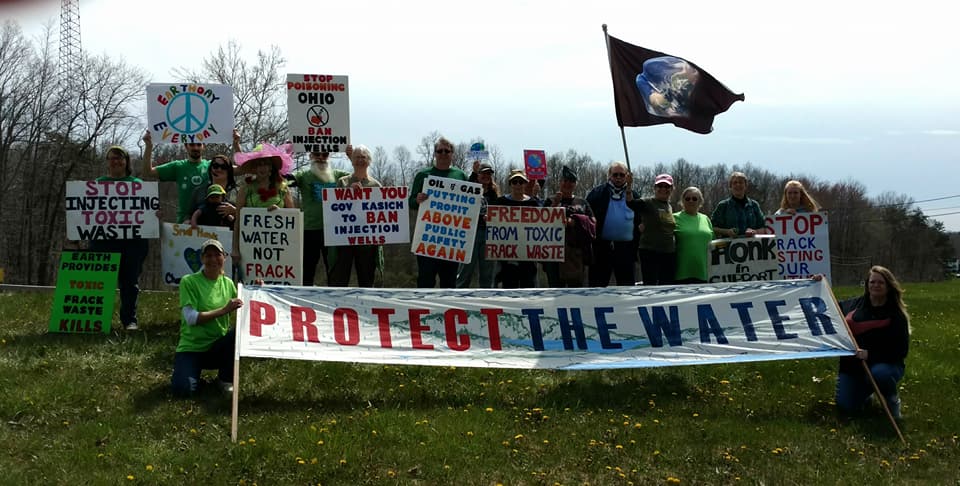
    Activists in Athens County rallied against the injection wells. (Photo provided by Roxanne Groff.)

    By:  Ohio Capital Journal

    After sounding the alarm on fracking waste injection wells for more than a decade, Roxanne Groff from Athens County is now finally starting to see some of the fruits of her and her friends’ labor.

    A handful of Athens County injection wells were suspended after Ohio Department of Natural Resources determined they pose an “imminent danger to the health and safety of the public and is likely to result in immediate substantial damage to the natural resources of the state,” according to letters from Chief of the Division of Oil and Gas Resources Management Eric Vendel.

    “I cried,” the 75-year-old activist said when she heard the news.

    Groff’s advocacy against injection wells started back in 2012 with the Hazel–Ginsburg well. It has since grown to include many Southeast Ohio residents who are also sounding the alarm — something Groff believes helped led to the wells being suspended.

    “All of us together, all of the community members stood up for themselves and pushed back,” Groff said. “We know that this is dangerous.”

    Injection wells in Athens

    There are seven class 2 injection wells in Athens County, but five are no longer in operation and the ODNR Division of Oil & Gas Resources Management expects those wells to be plugged, ODNR spokesperson Karina Cheung said in an email. Historically, three injection wells have been plugged in the county, she said.

    Class 2 wells are used to inject fluids — primarily brines — associated with oil and natural gas production, according to the EPA.

    Included in the five Athens wells that are out of operation are three K&H injection wells that were operational until a decision by the Oil and Gas Commission on April 19.

    The plugging permits for the three K&H wells will be issued soon and will be effective for two years once they are issued, Cheung said. She said the wells will be plugged this summer (according to the company Tallgrass Energy that owns the K&H wells).

    The Frost well was last used in 2021 and has been ordered to be plugged by the Chief of the Division of Oil & Gas Resources Management.

    “The company is in receivership and the Division has been in communication with the receiver about their obligation to plug the well,” Cheung said in an email.

    Plugging a well includes removing all uncemented casing and tubing from the well, and using cement to plug the well “ in a manner to isolate all oil, gas, and brine to formations that they originate in,” Cheung said.

    The exact cost of plugging a well is tough to determine.

    “Plugging costs vary due to differences in wells and the costs of abandonment and decommissioning of the surface storage facilities associated with the wells,” Cheung said in an email.

    But just because the wells will eventually be plugged doesn’t mean the environmental risks are gone, Athens County resident Susie Quinn said.

    “All the stuff that they’ve injected down there, it’s still down there,” she said. “This is not a cleanup. It’s just there stopping anymore from going in.”

    The Quinns got earthquake insurance for their house nearly a decade ago because “we’ve had so many little ones because of the fracking and injection wells.”

    Groff echoed Quinn’s sentiments about the plugged wells.

    “The threat remains … all that waste is there,” she said. “It’s down there. It’s under pressure. If it feels like going somewhere, it’s going to find a crack, and it’s going to keep going through that crack … until it gets to someplace where it either comes up to the surface or it just stops fracturing.”

    Advocacy against the wells

    The first Athens County injection well was the Hazel–Ginsburg well in 1984, Groff said. At the time Groff was an Athens County Commissioner, a role she served in from 1983 to 1995.

     Roxanne Groff (left) at the Mad Hatter’s Tea Party protest against the injection wells in Athens County. (Photo provided by Roxanne Groff.) 

    It wasn’t until 2012 when her advocacy related to fracking began, after Madeline ffitch was arrested for chaining herself to two barrels and blocking the driveway to the Ginsburg well.

    The Ginsburg well was last used in 2015, Cheung said.

    “The Division of Oil & Gas Resources Management granted a permit to plug the Ginsberg well, but the owner of the well did not plug it within the permit’s two-year expiration date,” Cheung said in an email. “The Division is conducting regulatory enforcement regarding the Ginsberg well.”

    Local environmental groups started popping up, like Athens County’s Future Action Network and Torch CAN DO, which stands for Torch Clean Air Now, Defend Ohio. These groups helped organize informational meetings with epidemiologists and geologists as well as protests to spread the word about fracking and raise awareness. One of their protests was a Mad Hatter’s Tea Party complete with a Queen of Hearts and little toxic tea bottles.

    Groff, along with the other activists who joined the fight, have been preaching for years about the environmental impact of injection wells.

    “You drill a hole into the ground and then you shove toxic radioactive waste under immense pressure,” Groff said. “Now what kind of fool do you think we are that you don’t think that that’s going to go somewhere?”

    There were more than 1,400 fracking incidents associated with oil and gas wells in Ohio between 2018 and September 2023, according to FracTracker Alliance — a nonprofit that collects data on fracking pipelines.

    There have been 26 incidents in Athens County during that same time period involving release, unintentional gas release and a fire, according to FracTracker.

    “Everybody knew that was going to happen,” Groff said. “We absolutely unequivocally knew that we were right. There was nothing that swayed anybody in this group from thinking that we were making stuff up.”

    The Athens County Commissioners also got involved and held meetings.

    “These wells are just terrible and what they’ve done and everything that was said that was going to happen, happened,” Athens County Commissioner Charlie Adkins said.

    Groff and the team of activists were overjoyed when ODNR ordered the injection wells to suspend operations.

    “The language they used is exactly what the people have been saying … they’re an imminent threat to the health and the welfare and well being of the environment and the people who live here,” Groff said.                            

    Quinn always believed they could make a difference.

    “We went from Torch CAN DO to Torch can done,” she said. “We’d like to pass our homesteads on to our children. We want to do this for our grandchildren.”

    Fight continues

    Even though some of the wells are no longer in use, Groff isn’t hanging up her activist hat just yet.

    For one, not all injection wells are suspended. The last two remaining wells in operation in Athens County are in Canaan Township and Lee Township, Cheung said.

    The long-term effects of the injection wells are not totally known at the moment and could not show up for years or decades, Groff said.

    Athens County Commissioner President Lenny Eliason said he would like to focus on long-term monitoring.

    “Appalachia has been extracted for years for a number of different materials and the pain of the short term gains sticks around a long time after,” he said. “So we have to get people that are more forward thinking about balancing what that short term gain is going to bring in the long term.”

    When asked if the drinking water had been affected by the injection wells, Groff and Quinn said they don’t know yet.

    Referring to the state, Groff said ““Your incompetence caused this to happen. If you want to assure people that this is not an imminent threat and danger, then prove it and the only way you can prove it is to continue to test the water.”

    Even though their advocacy is not quite done, they are relishing their victory.

    “It’s not only just a huge win for everybody here in Athens County, it’s a message to the rest of the people in the state that, with due diligence, you can be in control,” Groff said. “You just have to fight like hell to make yourself heard.”

    Follow OCJ Reporter Megan Henry on Twitter.


    Megan Henry
    Megan Henry

    Megan Henry is a reporter for the Ohio Capital Journal and has spent the past five years reporting in Ohio on various topics including education, healthcare, business and crime. She previously worked at The Columbus Dispatch, part of the USA Today Network.

    Ohio Capital Journal is part of States Newsroom, the nation’s largest state-focused nonprofit news organization.

    MORE FROM AUTHOR

  • “Who’s gonna want to move here?” How fracking around Ohio’s Salt Fork State Park is changing area

    “Who’s gonna want to move here?” How fracking around Ohio’s Salt Fork State Park is changing area

    BY:  Ohio Capital Journal

    Terri Sabo has a breathtaking view of Salt Fork State Park from her dining room window in Guernsey County.

    She and her husband Rick Sabo have lived in their ranch home since 1983 — three years after they moved to Cambridge from Canton.

    Terri loves the dark night skies the park provides, but more recently she sees the occasion flare from a fracking injection well about 14 miles away while standing on her front porch.

    “We thought we would always have beauty, but Cambridge is so different than the ’80s,” Sabo said. “I mean, it’s so industrialized now and every, every other pickup truck has an Oklahoma or Texas plate. And it’s, it’s very, very different than it used to be.”

    The presence of the oil and gas industry around Salt Fork and ongoing fracking have turned the Sabos into advocates trying to protect the land around Ohio’s largest state park. Well pads, injection wells and a couple of drilling rigs dot the area around Salt Fork and its winding roads.

    “I’m past the sadness,” Sabo said, as she drove around Salt Fork on a recent Friday morning. “I’m into acceptance now. And it’s gonna happen.”

    Fracking in Ohio

    Fracking is the process of injecting liquid into the ground at a high pressure to extract oil or gas. It has been documented in over 30 states, according to the Center for Biological Diversity.

    Former Ohio Gov. John Kasich signed a law allowing drilling companies to frack in state parks back in 2011. Under the law, potential drillers had to get permission from the newly created Oil and Gas Commission, but Kasich never appointed members to the commissions — effectively preventing anyone from drilling in parks.

    Then in 2022, an amendment to speed up the process for oil and gas companies to get a fracking lease in state parks was added to House Bill 507, which was originally written to reduce the number of poultry chicks that can be sold in lots from six to three.

    The bill (dubbed the “chicken bill”) made it to Ohio Gov. Mike DeWine’s desk and he signed the bill into law in January 2023. The law — which requires the Ohio Department of Natural Resources to allow fracking for natural gas in Ohio’s public lands and state parks — went into effect in April 2023.

    Within the same week DeWine signed the bill into law, the Sabos got a letter from Texas-based company Encino Energy asking to buy their mineral rights — which they still haven’t done.

    “You work all your life to build something and then they frack it,” Sabo said.

    Encino Energy, the largest oil producer and second-largest producer of gas in Ohio, did not respond to questions sent by the Ohio Capital Journal.

     COLUMBUS, OH — FEBRUARY 26: Terri Sabo (center) who can see Salt Fork State Park from her home, weeps and calls out after the Ohio Oil and Gas Land Management Commission voted to approve a bid to drill under the park and two wildlife areas, February 26, 2024, at the Ohio Dept. of Public Safety, Charles D. Shipley Building Atrium in Columbus, Ohio. (Photo by Graham Stokes for Ohio Capital Journal. Republish photo only with original article.) 

    Recently, the Ohio Oil and Gas Land Management Commission selected the “highest and best” bidders to lease part of Salt Fork State Park, Valley Run Wildlife Area, and Zepernick Wildlife Area. This gives the green light for ODNR to lease parcels to these companies.

    West Virginia-based Infinity Natural Resources had the winning bid to drill at least two parcels at Salt Fork for $58.4 million.

    Encino leased three different parcels at Valley Run Wildlife Area in Carroll County for $1.05 million and leased one parcel at Zepernick Wildlife Area in Columbiana County for $231,692.

    Sabo cried at the OGLMC meeting were the winning bids were announced.

    “It’s just a very sad day,” she said after the Feb. 26 meeting. “My biggest immediate concern, obviously, is the loss of the park to (reindustrialization). I’ve really seen it grow and come back.”

    Fracking incidents in Ohio

    There were more than 1,400 fracking incidents associated with oil and gas wells in Ohio between 2018 and September 2023, according to FracTracker Alliance — a nonprofit that collects data on fracking pipelines. About 10% of those incidents were reported as fires or explosions.

    During that same time period, there were 56 total incidents in Guernsey County (where Salt Fork is located), according to FracTracker.

    “When the activities first started moving into the town, we were concerned with explosions and exposures,” Sabo said.

    Encino Energy had five incidents during that time frame, and Washington County was the county with the most incidents in the state with 73, according to FracTracker.

    Changes to the area

    The Sabos first started coming to Salt Fork in the late 1960s and early 1970s, before they lived in Cambridge. They enjoy kayaking and biking at the park and have hiked almost every navigable trail in Salt Fork.

    “We really are outdoorsy people,” Sabo said. “The hiking trails are great. And they’re beautiful.”

    Fracking in the area has brought increased truck traffic, new power lines, and additional cell towers. In particular, it has brought brine trucks and Halliburton trucks that haul fracking sand.

    “Who’s gonna want to move here?” Sabo said. “I mean, who’s gonna want to raise their kids here?”

    They have two adult children and grandchildren, but none of them live in Guernsey County.

    Sabo has learned to pick up on various clues — trees being trimmed and power lines going up — to learn where a new well pad is going to be built.

    “You get suspicious of truck driving activity,” Sabo said. “And you will also see the infrastructure that starts getting built up for people to move in. Like they’ll put in new power lines and towers.”

    She usually sees something new being built when she drives around the Salt Fork area.

    “I wonder what they are doing?” she asked as she drove past new construction.

    She was recently taken aback when she spotted new pipeline being put down next to the Bears Den Steakhouse in Cambridge.

    “This is new since last time I went down this road, and we’re only talking pipeline right now,” Sabo said, visibly distraught. “Seriously, this was not here a week ago. Wow. … Forgive me if I’m shocked.”

    What’s next for the Sabos?

    The Sabos have turned their home into their own personal oasis by adding on to it throughout the years and their next addition will be a hot tub in the backyard.

    They seriously considered moving a couple of years ago, but after much thought they have decided to stay — despite what’s happening to the land around them with fracking.

    “It is beautiful here,” she said.

    Follow OCJ Reporter Megan Henry on X.


    Megan Henry
    MEGAN HENRY

    Megan Henry is a reporter for the Ohio Capital Journal and has spent the past five years reporting in Ohio on various topics including education, healthcare, business and crime. She previously worked at The Columbus Dispatch, part of the USA Today Network.

    Ohio Capital Journal is part of States Newsroom, the nation’s largest state-focused nonprofit news organization.

    MORE FROM AUTHOR