Tag: IVF

  • Ohio’s pro-abortion rights groups plan fights against total abortion ban bill

    Ohio’s pro-abortion rights groups plan fights against total abortion ban bill

    By:  Ohio Capital Journal

    Pro-abortion rights advocates are taking a proposed total abortion ban in Ohio to heart. Noting the celebration of Juneteenth and Black emancipation, they say the use of the 14th Amendment to try to exert state control over individual freedom and bodily autonomy is vile.

    The new bill a pair of freshman Republican House lawmakers are planning to introduce would ban abortion and criminalize it, along with in-vitro fertilization and certain types of contraception. The measure’s filing was first reported by WEWS.

    The bill is meant as a direct challenge to the state reproductive rights amendment passed by 57% of Ohio voters in 2023.

    Bill supporters say the current constitutional amendment that enshrined reproductive rights into the Ohio Constitution “should be treated as null and void” because, they claim, it violates the equal protection clause of the 14th Amendment “by denying pre-born persons the right to life.”

    The 14th Amendment of the U.S. Constitution protects citizenship and due process, along with equal protection under the law.

    “In appealing to the 14th Amendment, the Ohio Prenatal Equal Protection Act appeals to a higher law; the U.S. Constitution,” the anti-abortion group End Abortion Ohio, who is leading the charge on the bill, said in a statement.

    Austin Biegel, a member of End Abortion Ohio, argued that yes, the bill would go against the majority public opinion of Ohioans, but he justified it by arguing that slavery was once also supported and legal in the U.S.

    Lexi Dotson-Dufault, executive director of the resource and referral service Abortion Fund Ohio, called the use of the 14th Amendment as part of an abortion ban bill “vile.”

    “A bill that bans abortion while citing the 14th Amendment misuses a civil rights protection to justify state control over our marginalized community members, especially Black people,” Dotson-Dufault said.

    A report from the National Partnership for Women & Families in May of last year found that state abortion bans “exacerbate the existing Black maternal mortality crisis,” and “threaten” 7 million Black women nationwide.

    The study found that mothers who can’t access abortion care see negative impacts to their “economic security and development of their existing children.”

    ‘Canary in the coal mine’

    Dotson-Dufault and Ohio Women’s Alliance Deputy Director Jordyn Close believe Republican legislators are emboldened to attempt anti-abortion measures in part because of a Missouri Supreme Court ruling that reinstated a “de facto abortion ban” in May, lifting an injunction that had blocked abortion restrictions.

     Lexi Dotson-Dufault, executive director of Abortion Fund Ohio. Photo courtesy of Lexi Doston-Dufault. 

    The decision came months after that state also approved an amendment to its constitution that protected reproductive rights.

    The pro-abortion rights advocates see no legal standing for the new abortion ban bill, but they also see abortion rights as “the canary in the coal mine when it comes to … rights being stripped away from people.”

    “I don’t think that this bill has any legs to stand on, but I do think that it’s very important to highlight just how gross it is that they would even try it,” Close said. “Because if it’s not this bill, it will be another one introduced in the next session … it just continues because they do not respect Ohioans.”

    Ohio’s constitutional amendment, passed in 2023, protects abortion and other types of reproductive health like fertility treatments and miscarriage care, but more than 30 other regulations still sit on the books in Ohio law.

    Those statutes would have to be undone one by one, even though state courts have blocked some of the laws, as well as a six-week abortion ban that was on the books before Roe v. Wade was overturned by the U.S. Supreme Court.

    But Republicans in the state legislature are also trying to double-down on such regulations.

    State Reps. Mike Odioso and Josh Williams have already filed House Bill 347, a bill which targets informed consent, requiring that 24 hours before an abortion doctors provide not only “medically accurate information that a reasonable patient would consider material to the decision of whether to undergo the elective abortion” — which abortion providers have said they are already required to do — but also “alternatives to abortion, including adoption and parenting.”

    H.B. 347 also puts into law medically controversial and unproven language that “it may be possible to reverse the effects of the abortion-inducing drug” if a medication abortion is taking place.

    This isn’t the first time Ohio lawmakers have attempted to include this language in state law.

    The bill also requires a physician to notify the pregnant person, except in the case of rape or incest, “that the unborn child’s father has a child support obligation, even if the father has offered to pay for the elective abortion.”

    According to a recent midyear analysis from the Guttmacher Institute, 13 states have total abortion bans on the books, with another 28 that have bans between six weeks of gestation and “viability.”

    Ohio’s constitutional amendment places abortion legality at viability, as determined by an individual’s physician.

    The institute’s report also said the first half of 2025 has given rise to anti-abortion state lawmakers who “have continued to push the envelope toward pregnancy criminalization, restrictions on bodily autonomy and laws that recognize fetal and embryonic personhood,” while also reducing funding for resources like sex education.

     Jordyn Close, deputy director of Ohio Women’s Alliance. (Photo by Graham Stokes for Ohio Capital Journal. Republish photo only with original article.) 

    The state-level action comes as the Trump administration spent its first few months in office revoking Biden-era executive orders on abortion, including patient privacy protections, and rolling back guidance on access to emergency abortion care under the federal Emergency Medical Treatment and Labor Act.

    President Donald Trump also pardoned nearly two dozen people convicted under a federal law that bans threats, physical obstruction or force at the entrances to reproductive health clinics.

    The language of that federal law for which Trump issued pardons also bars interference, injury or intimidation for any exercise of First Amendment religious freedom, including at places of worship.

    Efforts to slash federal funding have also touched reproductive health, with cuts to Title X, which funds “family planning” grants and other reproductive health services for low-income individuals, including many services in Ohio.

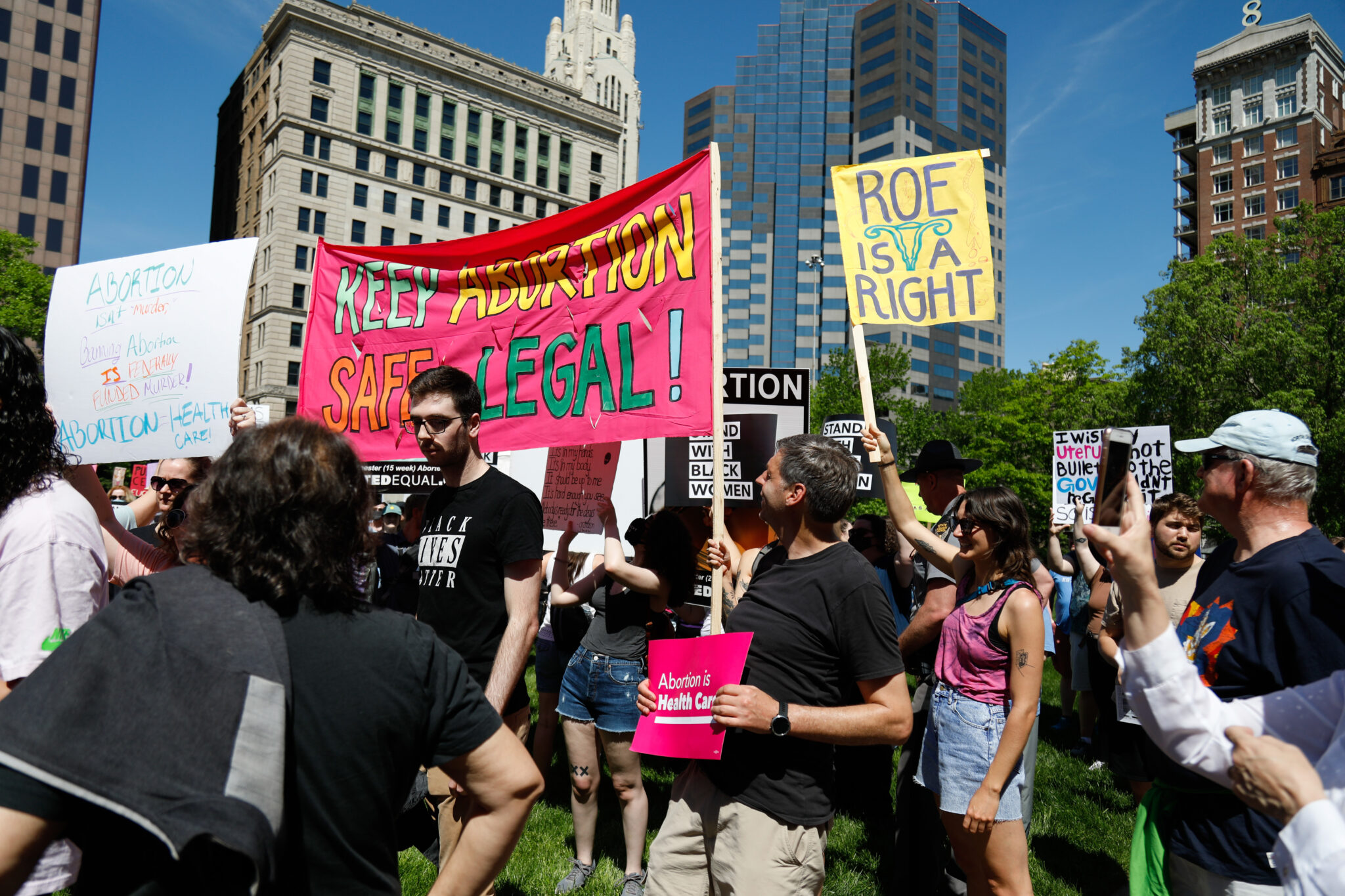
    Pro-abortion rights groups have already started their fight against the total abortion ban bill with a demonstration on Wednesday that interrupted an anti-abortion gathering in the Statehouse.

    They want to spend more time not only raising their voices in the halls of the legislature, but also educating the voters going into 2026 elections.

    “Even though we had a moment of victory in 2023, the fight is far from over,” Close said. “We have to look toward the next electoral (cycle) to protect our courts, because inevitably when we have these showdowns in the state legislature, the courts is where everything ends up.”

    A spokesperson for Oho House Speaker Matt Huffman said Huffman’s focus remains on the state operating budget until its July 1 deadline, and had no other information on the bill’s introduction or timeline.

    A request for comment from Senate President Rob McColley on whether he would consider such a bill went unanswered on Wednesday.

    Back in November 2024, just before he began his tenure as Senate president, McColley told the Capital Journal “the inaction on the issue kind of speaks for itself,” referring to any effort to undermine the constitutional amendment. He also said since the issue had passed the year before, “there really hasn’t been a lot of discussion about it.”

    “I think, by and large, people realize Ohioans spoke, and that’s the way it is right now,” McColley said then.

    The Ohio Democratic Party said they were staunchly against the abortion ban measure, questioning the priorities of state Republicans, and saying the party with the Statehouse supermajority is attempting to “drag our state into the past.”

    “Ohio women would die under this cruel, disastrous legislation,” said Ohio Democratic Party Chair Kathleen Clyde.


    Susan Tebben
    Susan Tebben

    Susan Tebben is an award-winning journalist with a decade of experience covering Ohio news, including courts and crime, Appalachian social issues, government, education, diversity and culture. She has worked for The Newark Advocate, The Glasgow (KY) Daily Times, The Athens Messenger, and WOUB Public Media. She has also had work featured on National Public Radio.

    Ohio Capital Journal is part of States Newsroom, the nation’s largest state-focused nonprofit news organization.

    MORE FROM AUTHOR

  • Ohio Dems try to repeal laws conflicting with reproductive rights amendment during lame duck

    Ohio Dems try to repeal laws conflicting with reproductive rights amendment during lame duck

    By:  Ohio Capital Journal

    Ohio Democratic lawmakers are asking the state legislature to undo laws on the books that they say conflict with the reproductive rights amendment passed by voters in 2023 that’s now part of the Ohio Constitution.

    Several of those laws have been struck down by judges, either temporarily as a lawsuit continues or in official court rulings, but the laws remain part of the Ohio Revised Code.

    Sponsors of the bills say the constitutional amendment passed last year negates these laws, therefore necessitating the repeal of regulations that require 24-hour waiting periods for abortions and transfer agreements of certain distances for physicians and hospitals who work with abortion clinics, for example.

    “We, the legislature, should not be making choices for all women in the state,” said state Rep. Beth Liston, D-Dublin. “The people of Ohio have said they want these decisions for themselves.”

    Republicans hold a 67-32 majority in the Ohio House and a 25-7 majority in the Ohio Senate, and state Republican leaders opposed the amendment.

     State Rep. Beth Liston, D-Dublin, speaks at a rally to protect abortion rights. (Photo from General Assembly website.) 

    Liston and fellow state Rep. Anita Somani, D-Dublin, both of whom are physicians, brought House Bill 343 to the House Public Health Policy Committee in hopes of “simply ensuring that all of our state laws are now in agreement with that amendment.”

    “Removing these barriers to care will reduce delays in care and actually allow health care providers to serve their patients properly,” Somani told the committee on Wednesday. “We have a health care access problem in Ohio and restrictive laws like these are part of the problem.”

    H.B. 343 wasn’t the only bill Somani presented to the Public Health Policy Committee in an effort to protect reproductive rights.

    House Bill 502, which also saw its first hearing in the committee on Wednesday, would protect access to “assistive reproductive technology,” which includes in-vitro fertilization. Fertility treatments were also listed as one of the rights covered by the constitutional amendment approved by 57% of Ohio voters last year.

    But an Alabama Supreme Court case from this year has caused nationwide concerns about the future of IVF and embryos saved by individuals going through fertility treatments. State supreme court justices in that case ruled that frozen embryos could still be considered children, an issue that has come to be known as “personhood” as federal and state-level entities debate fetal viability and regulation as a whole.

    The “personhood” issue is not foreign to Ohio, which saw a 2022 bill in which state Rep. Gary Click, R-Vickery, said “the unborn” is a “class of people” who have “erroneously been denied their constitutional rights.”

    Click said his legislation would consider a “zygote, embryo or whichever depersonalizing term you choose” a “human with potential” from the moment of fertilization.

    That bill died in the previous General Assembly, though Click has not ruled out bringing the idea back in a future GA.

    Back in March, after the Alabama decision came about, Senate President Matt Huffman, who will soon become Ohio’s House Speaker, said there hadn’t been “any discussion by any member of my caucus or anybody else as far as in the state of Ohio as far as I know” regarding “personhood” or IVF regulations.

    GET THE MORNING HEADLINES.


    But Somani said protection of the technology around IVF “should be explicitly stated in state law so that there is no confusion about the legality of the practice.”

    “We don’t want to make the same mistakes as other states,” she told the committee on Wednesday. “Equating embryos with people confuses those who practice evidence-based medicine and the reproductive care that they can provide.”

    The sponsors cited CDC statistics which showed 2,226 births in Ohio in which IVF was used in 2021. In that same year, more than 86,000 births nationally were attributed to IVF, with 42% of adults saying they have used fertility treatments or know someone who has, according to the CDC.

    “Experiencing infertility can be a mentally, emotionally and physically exhausting journey and we as lawmakers should not be doing anything to increase that stress,” Somani said.

    H.B. 502 would also prevent health care providers from “being compelled to release patient records to third parties, including out-of-state entities or law enforcement,’ and allow lawsuits from individuals who feel their privacy rights are violate with regard to medical information.

    The bill’s co-sponsor, state Rep. Beryl Brown Piccolantonio, D-Gahanna, acknowledged the tight timeline the bill is now under with less than a month before the current General Assembly ends, and all unapproved bills must be reintroduced in the new year. But, she said she hoped the committee would allow supporters of the bill to speak on IVF’s importance, especially with the possible impact of the Alabama Supreme Court ruling.

    “This decision has significant implications for reproductive rights and the legal status of embryos, influencing legislation and public policy across multiple states, including Ohio,” Piccolantonio said.

    YOU MAKE OUR WORK POSSIBLE.

    ____________
    Susan Tebben
    Susan Tebben

    Susan Tebben is an award-winning journalist with a decade of experience covering Ohio news, including courts and crime, Appalachian social issues, government, education, diversity and culture. She has worked for The Newark Advocate, The Glasgow (KY) Daily Times, The Athens Messenger, and WOUB Public Media. She has also had work featured on National Public Radio.

    Ohio Capital Journal is part of States Newsroom, the nation’s largest state-focused nonprofit news organization.

    MORE FROM AUTHOR

  • U.S. Veterans Affairs Department expands IVF access to unmarried and same-sex veterans

    U.S. Veterans Affairs Department expands IVF access to unmarried and same-sex veterans

     The U.S. Department of Veterans Affairs medical campus in Rapid City, South Dakota. (Photo by Seth Tupper/South Dakota Searchlight, States Newsroom.)

    BY:  – Ohio Capital Journal

    WASHINGTON — The Department of Veterans Affairs expanded access to in vitro fertilization on Monday, saying that eligible unmarried veterans and veterans in same-sex marriages can now access IVF at VA health care facilities.

    The announcement notes that federal law requires the VA only provide IVF treatments to veterans whose issues having children are due to a health condition from their military service.

    “Raising a family is a wonderful thing, and I’m proud that VA will soon help more Veterans have that opportunity,” VA Secretary Denis McDonough said in a written statement. “This expansion of care has long been a priority for us, and we are working urgently to make sure that eligible unmarried Veterans, Veterans in same-sex marriages, and Veterans who need donors will have access to IVF in every part of the country as soon as possible.”

    The VA has only provided IVF care for married veterans who were able to use their own eggs or sperm during the process, but the new announcement allows veterans to use donor eggs, sperm and embryos.

    The VA noted in its announcement the department doesn’t cover surrogacy costs.

    The VA also reiterated it provides up to $2,000 in adoption expenses for veterans with a disability connected to their military service that caused infertility.

    Legislative options

    Washington state Democratic Sen. Patty Murray said in a written statement the VA’s decision to expand access to IVF “is an important step forward that will help more veterans start and grow their families.”

    “I have fought for over a decade to expand fertility care and treatment to more veterans and servicemembers, and I’m thrilled that DoD, and now VA, are making progress toward expanding their IVF services with new policies will be life-changing for veterans and servicemembers who were for far too long excluded from care,” she said.

    Murray plans to go to the Senate floor this week to ask for quick approval through unanimous consent of a bill to further broaden access to fertility treatments.

    That bill, titled the Veteran Families Health Services Act, would allow the VA to permanently expand which veterans have access to IVF as well as provide the option for military members to freeze their eggs or sperm before deployment to combat zones or hazardous duty assignments.

    The legislation would expand adoption assistance for veterans and require both the VA and the Department of Defense to “facilitate research on the long-term reproductive health needs of veterans.”

    The Senate bill has 24 co-sponsors, all of whom are Democrats or are independents who align politically with the Democratic Party.

    House Committee on Veterans’ Affairs ranking member Mark Takano and the Health Subcommittee ranking member Julia Brownley, both California Democrats, said in a joint statement the expansion “is a step in the right direction to allow eligible unmarried veterans and veterans in same-sex marriages to receive IVF, but we think current law is still too restrictive.”

    “It is very difficult to prove that infertility has been caused by prior service to our country, and the onus is on the veteran to prove it,” the two wrote. “Most veterans with infertility have faced a difficult choice: pay the prohibitive cost of IVF out of pocket, or lose valuable treatment time pursuing a VA service connection.”

    The two then pressed for Congress to approve a different bill that would expand IVF access for veterans, dubbed the Veterans Infertility Treatment Act.

    That bill has 31 co-sponsors in the House, all of whom are Democrats.

    Takano and Brownley said that their legislation is necessary to ensure “any veteran, regardless of whether their infertility is service-connected,” has access to IVF “as part of VA’s comprehensive medical benefits package.”

    “Given what we recently saw in Alabama and the growing attacks on reproductive rights in our country, it is more clear than ever that we need to expand IVF access for veterans, regardless of where they live,” they wrote. “This new VA policy is an important step. We will continue to advocate for legislation that will ensure any veteran who wants to start a family can.”


    Jennifer Shutt
    JENNIFER SHUTT

    Jennifer covers the nation’s capital as a senior reporter for States Newsroom. Her coverage areas include congressional policy, politics and legal challenges with a focus on health care, unemployment, housing and aid to families.

    MORE FROM AUTHOR

  • Ohio legislative leaders brush off concerns over Alabama IVF ruling’s impacts

    Ohio legislative leaders brush off concerns over Alabama IVF ruling’s impacts

    The Ohio Statehouse, Columbus, Ohio. (Photo by Graham Stokes for the Ohio Capital Journal. Republish photo only with original story.)

    BY:  Ohio Capital Journal

    After an Alabama Supreme Court decision that ruled frozen embryos housed outside of a human body were still considered children, states across the country are debating the implications of such a decision.

    Ohio legislative leaders are saying bills that would ban IVF are not being considered, but one lawmaker who has introduced a “personhood” bill in the past says it’s still “great policy” that’s being blocked by politics.

    National groups have said the Alabama decision will have impacts on the work that embryologists do, with the Society of Reproductive Biologists and Technologists saying the state’s supreme court ruling “stands in stark contrast to scientific understanding and the experiences of individuals navigating fertility treatments.”

    The concept of “fetal personhood” is not a new one for Ohio. Long before the Alabama decision threw into question the concept of in-vitro fertilization treatments in that state, legislators in the Buckeye state were considering a bill that would consider life’s beginning at conception, a theory conservatives and pro-life politicians have long pushed.

    Ohio House Bill 704 was introduced in 2022 by state Rep. Gary Click, R-Vickery, who claimed “one class of people has erroneously been denied their constitutional rights: the unborn.”

    “From the moment of fertilization, that zygote, embryo or whichever depersonalizing term you choose to use is not merely a potential human but rather (a) human with potential,” Click said in a statement announcing the legislation.

    The bill died as the General Assembly’s two-year session ended, but the fact that the idea was broached is still being brought up by Democrats and pro-choice groups around the state.

    Click himself didn’t rule out the idea of reintroducing his personhood legislation, saying in a Feb. 23 tweet that reintroducing it has “not been my plan at the moment.”

    “But plans do change,” the tweet went on.


    The legislator — who was also the creator of a successful bill that bans gender-affirming care for transgender minors, a controversial bill that succeeded with a veto-override in January — also told the Statehouse News Bureau in February that while he supported IVF if all embryos are used, he considered his personhood bill “great policy” blocked by politics.

    Since Click’s bill was introduced (and subsequently foiled by time limits), however, 57% of Ohio voters passed November’s Issue 1, which not only enshrined abortion rights into the Ohio Constitution, but also listed “fertility treatment” as one of the rights Ohio individuals have to “make and carry out one’s own reproductive decisions,” according to the amendment.

    IVF patients represented a group of people who spoke out in favor of Issue 1 as a protection against unnecessary regulation and uncertainty in the IVF process.

    But Republican legislators in particular have not seen this development as the roadblock to reproductive rights legislation one might expect, as policymakers at the Statehouse have continued to push anti-abortion legislation and bills that target the rights now protected under the state constitution.

    The state’s legal representatives are also still pushing against a lawsuit that seeks to eliminate a six-week abortion ban that became law in 2019 (and has been tied up in court ever since).

    Still, Ohio’s legislative leaders have said the Alabama decision has yet to spur any policy in the state at this point.

     Left, Ohio House Speaker Jason Stephens. Right, Ohio Senate President Matt Huffman. (Photos by Graham Stokes for the Ohio Capital Journal. Republish only with original article.) 

    House Speaker Jason Stephens, R-Kitts Hill, said the chamber is “monitoring any potential ramifications the Alabama decision may have in Ohio,” but also said, from his perspective, “IVF provides hope and is 100% pro-family.”

    “We look forward to advancing our values and continuing our pro-life legislative agenda,” Stephens told the OCJ in a statement.

    Senate President Matt Huffman said he has not heard of any legislation and there hasn’t been “any discussion by any member of my caucus or anybody else as far as in the state of Ohio as far as I know.”

    “We seem to be in this national culture that if some court in Alabama or some other state says something that we all should be reacting to it,” Huffman said.

    The senate leader acknowledged that “we have a constitutional amendment that affects some of this.”

    “But you know, with other things going on right now, it’s just not a discussion that’s taking place,” he said.

    A spokesperson for Gov. Mike DeWine said his office would “continue to monitor any bills in this policy area,” but they were not aware of any at the moment.

    DeWine’s office did not respond to questions as to whether or not the governor supported the consideration of frozen embryos as children.

    Megan Henry contributed to this story.

    _____________

    Susan Tebben
    SUSAN TEBBEN

    Susan Tebben is an award-winning journalist with a decade of experience covering Ohio news, including courts and crime, Appalachian social issues, government, education, diversity and culture. She has worked for The Newark Advocate, The Glasgow (KY) Daily Times, The Athens Messenger, and WOUB Public Media. She has also had work featured on National Public Radio.

    MORE FROM AUTHOR