Tag: Jean Schmidt

  • Jean Schmidt sponsored bill will abolish the death penalty in Ohio

    Jean Schmidt sponsored bill will abolish the death penalty in Ohio

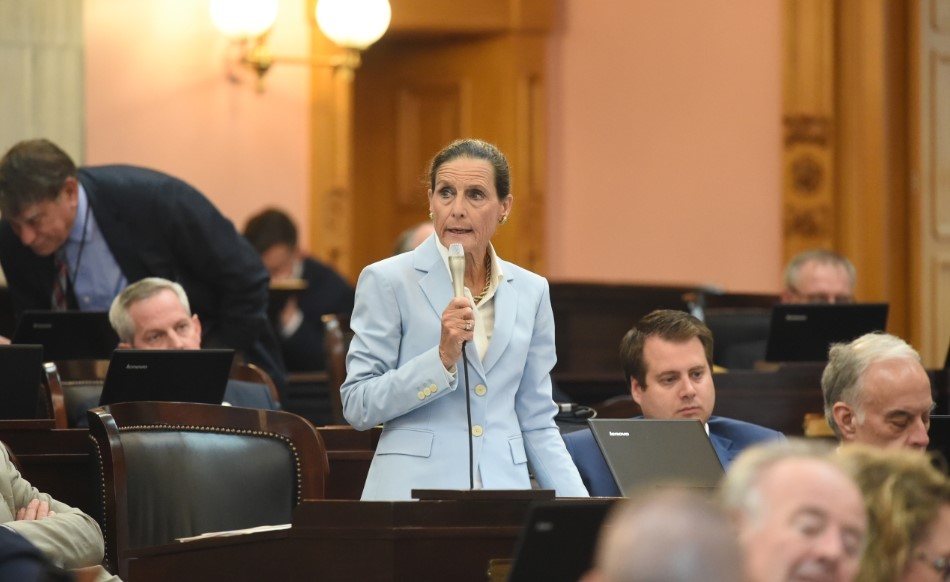
    Photo by Ohio House of Representatives

    The bill would also prohibit the use of state funds for assisted suicide, and clarify the state’s prohibition against the use of state funds for abortion

    Loveland, Ohio – State Representatives Adam Mathews (R-Lebanon) and Jean Schmidt (R-Loveland) held a press conference January 28th on soon-to-be introduced bipartisan legislation to prohibit the use of state funds to end the lives of Ohioans.

    All or Nothing

    The bill will abolish the death penalty in Ohio, prohibit the use of state funds for assisted suicide, and clarify the state’s prohibition against the use of state funds for abortion. The bill would link each issue with a non-severability clause, underscoring, “the sponsors’ unity of purpose through a comprehensive affirmation of life”.

    “This ‘first of its kind’ legislation will protect state dollars, and more importantly, human life,” said Schmidt during the press conference. “Decades of crusading against a culture of death have brought us here to affirm that protecting life must extend to every circumstance and stage of development. To be consistent in our pro-life principles, we must oppose the state funding of abortion, the death penalty, and assisted suicide.”

    “This is transformative legislation that represents a new era of fiscal and moral conservatism and responsibility,” said Mathews. “This is more than just policy; this is about the affirmation that where there is human life, there is dignity and hope. By prohibiting public funds from being used to terminate human life, this legislation sends a clear message that Ohio will not fund death.”

    The representatives were joined by State Senator Steve Huffman (R-Tipp City), Senate Minority Leader Nickie Antonio (D-Lakewood), and Senate Assistant Minority Leader Hearcel Craig (D-Columbus), as well as the Executive Director of the Catholic Conference of Ohio, Brian Hickey, and Founder of the Run the Race Club, Rachel Muha.

  • Transgender student bathroom ban bill passes out of Ohio House Higher Education Committee

    Transgender student bathroom ban bill passes out of Ohio House Higher Education Committee

    Getty Image

    House Bill 183 would require Ohio K-12 schools and colleges to mandate that students could only use the bathroom or locker room that matches their sex assigned at birth.

    Local Cosponsors are:

    Jean Schmidt, District 62 (R)
    Jennifer Gross, District 45 (R)
    Thomas Hall, District 46 (R)
    Bill Seitz, District, 30 (R)
    BY:  Ohio Capital Journal

    A bill that would ban transgender students from using the bathroom and locker room that matches up with their gender identity passed out of the Ohio House Higher Education Committee Wednesday by a 10-5 party line vote.

    State Reps. Beth Lear, R-Galena, and Adam Bird, R-New Richmond, introduced House Bill 183 which would require Ohio K-12 schools and colleges to mandate that students could only use the bathroom or locker room that matches their sex assigned at birth. It would also prohibit schools from allowing students to share overnight accommodations with the opposite sex.

    HB 183 now awaits further consideration in the House, which is next scheduled to be in session April 24.

    Parents, grandparents, and school superintendents asked Bird for this bill, he said.

    The American Medical Association officially opposes policies preventing transgender individuals from accessing basic human services and public facilities consistent with gender identity.

    HB 183 would not prohibit a school from having single-occupancy facilities and it would not apply to someone helping a person with a disability or a child younger than 10 years old being assisted by a parent, guardian, or family member.

    State Rep. Gayle Manning, R- North Ridgeville, thought about bringing an amendment to the committee that would have carved colleges and universities out of the bill, but she decided against it.

    “I’m hopeful we will continue to have these discussions on the removal of higher ed,” she said. “The reason being, we’re talking about adults. Universities are similar to a city with the number of students that they have. Frivolous lawsuits that will increase the cost of tuition eventually and the cost of our families.”

    Manning voted in favor of the bill even though she hopes lawmakers can continue conversations to “find a better solution.”

    Bird opposes taking the higher education component out of the bill.

    “The reason I oppose that is because we have college credit plus in Ohio,” he said. “We seventh graders going to college, kids in high school going to colleges and in that college environment, we got to make sure they are protected.”

    State Rep. Joe Miller, D-Amherst, vocalized his disdain for the bill before the committee voted.

    “Here we are again … taking away school districts and colleges’ ability and their leadership to make decisions that are best for providing safe, equitable access for all Ohio students,” Miller said. “I hope that this doesn’t see the floor and doesn’t see the governor’s desk.”

    More than 100 people submitted opponent testimony on HB 183 and more than 30 people submitted proponent testimony.

    “We do love and care about all kids,” Bird said when asked about all the backlash the bill has received. “Me and my Republican colleagues have heard from constituents all across the state. They may not have been loud. They may not have been vocal. They may not have come with a sign to the Statehouse, but we are here representing the vast majority of Ohioans who want protections.”

    Trans advocates speak out against HB 183

    Transgender advocates hosted a press conference following the House Higher Education Committee to voice their opposition to HB 183.

    Trans Ohio Board Member Carson Hartlage said HB 183 is harmful to all students, including cisgender students.

    “Most trans non binary and gender non conforming students only begin using restrooms that align with their gender identities after they’ve experienced some form of trauma when using a restroom that aligns with their sex assigned at birth,” Hartlage said.

    Thirty percent of LGBTQ+ students said they were prevented from using the bathroom that aligned with their gender, and 26% were stopped from using the locker room that aligned with their gender, according to Ohio’s 2021 state snapshot by GLSEN, which examines the school experiences of LGBTQ middle and high school students.

    When looking specifically at transgender and nonbinary students, 42% were prevented from using the bathroom that aligned with their gender and 36% couldn’t use the locker room that aligned with their gender, according to the Ohio GLSEN report.

    Ohio’s first openly transgender public official and member of the Gahanna-Jefferson Public Schools’ Board of Education Dion Manley shared his concerns.

    “As a trans man is I’ve been going into men’s restrooms for 25 years without incident,” Manley said. “I go visit the schools on a regular basis. So these legislators want me to go into a girls restroom in the elementary school, middle school, and high school.”

    Mallory Golski, civic engagement and advocacy manager at Kaleidoscope Youth Center, said how Ohio was recently at the center of history in a positive way with Monday’s eclipse.

    “We’re here reflecting on how we’re at the epicenter of another piece of history,” she said. “And unfortunately, we’re at the wrong place at the wrong time. Unlike the fleeting blackout of the total solar eclipse, the history I’m talking about here today at the statehouse leaves transgender youth in the dark.”

    Jeanne Ogden’s daughter would be directly impacted by this bill. Her daughter’s college classroom building does not have single-use restrooms in the building, forcing her daughter to go across the street to use the restroom.

    “These kids getting bullied and yes, their mental health is suffering,” said Ogden, the executive director of Trans Allies of Ohio. “Trans people are tired. Parents are exhausted.”

    Follow OCJ Reporter Megan Henry on Twitter.

    _______________

    Megan Henry
    MEGAN HENRY

    Megan Henry is a reporter for the Ohio Capital Journal and has spent the past five years reporting in Ohio on various topics including education, healthcare, business and crime. She previously worked at The Columbus Dispatch, part of the USA Today Network.

    Ohio Capital Journal is part of States Newsroom, the nation’s largest state-focused nonprofit news organization.

    MORE FROM AUTHOR

  • A “Women’s Wave” happened Sunday in Loveland

    A “Women’s Wave” happened Sunday in Loveland

    David Miller is the Managing Editor of Loveland Magazine

    by David Miller

    Loveland, Ohio – Adults and children from across the tri-state gathered in Nisbet Park along the Little Miami River in Historic Downtown on a sunny and warm Fall Sunday afternoon to be part of a “Women’s Wave” of activists out to change the course of voting patterns in our community. After speeches, they walked for an hour throughout our business district and along the Loveland Bike Trail engaging locals and tourists with the refrain of the sentiments they were so adamant about. It was a demonstration for human rights and as odd as that sounded throughout the streets of this quaint community nicknamed, “The Sweetheart of Ohio” it happened. “Human Rights” that have been taken away from themselves, their children, and those they love. The political agenda on most minds was the U.S. Supreme Court overthrowing Roe v Wade and a woman’s right to have an abortion, reproductive rights such as birth control, and how that decision led to even more extreme legislation and proposals from some elected officials at the Ohio Statehouse, and in D.C.

    Health care, including the sometimes life-saving medical care of needed abortions and the tangled net that women and their healthcare providers are caught in, gun violence, mass shooting in schools, the right to gender equality, LGBTQ people’s rights, and a safer future for young girls were all talking points throughout the afternoon.

    Many Democratic candidates for local and state offices spoke and a candidate for the U.S. House. Parts of Loveland are in Ohio Representative Jean Schmidt’s district and the local organizer, Bailey Moak, said that is why she chose downtown Loveland for the event location. She wants to show Schmidt where the unemployment line is. She believes that Schmidt and other currently serving politicians don’t align with Loveland’s values.

    I asked organizer Moak on Monday to send me some of her thoughts after the event had ended. You can also watch her speaking at the event and watch a photo essay of photos from the event below. The rally was certainly an appeal for local “pro-choice” residents to get to the polls on November 8 and vote for “pro-choice” candidates, however, the photo essay will explain why so many people gathered in the park, their myriad reasons, and then marched.

    I found the event to be a huge success. We met our goals to engage and educate voters, raise awareness to threats against women’s rights in our community and shed light on dangerous politicians like Jean Schmidt from Loveland who proposed legislation to ban medical care to women and children across Ohio (HB598), and ban access to curriculum on diversity and inclusion to students across our state (HB616). 
    
    We rallied, we celebrated the promise of what new leadership can do to preserve and expand our freedoms, and we marched in protest of extremism and hate. 
    
    During the March we disrupted some nice family dinners occurring on the patios of local businesses in Downtown Loveland with our passionate demonstration. This disruption is NECESSARY. All too often we side-step important discussions with our families, friends and community members to avoid feeling uncomfortable. The only way individuals, families and communities can grow is through engagement and vulnerability, which can result in a bit of discomfort. As demonstrators passed, families and friends breaking bread together were compelled to address important topics, which in my experience, leads to understanding and connection. 
    
    This is why we Listen. This is why we Speak. This is why we Act. We do it for our communities and families. 
    
    I want to thank our passionate volunteers and our speakers: Brian Flick, Dr. Jeanne Corwin, Dr. Vanessa Enoch, Dr. Nabila Babar, Joy Bennett, Jen Perez and Rep. Jessica Miranda, and our partnering organizations: Ohio Physicians for Reproductive Rights, Ohio ACLU, Ohio Red Wine and Blue, the Ohio Democratic Women’s Caucus and Democracy in Action for participating in this event.
    
    I also want to thank the City of Loveland, the Loveland Fire Department, and Loveland PD Chief, Michael Gabrielson for their support in working with event organizers to ensure this was a safe and successful event that this community can be proud of.
    

  • Women’s Wave March – coming to Loveland, Ohio

    Women’s Wave March – coming to Loveland, Ohio

    The event is in partnership with the Women’s marches being held across the country the weekend of October 8-9th. 

    by David Miller

    Loveland, Ohio – Bailey Moak asks you to join her on Sunday, October 9th for a day of action to help her and others send the message: “Women demand our rights and families demand reproductive freedom.”

    Moak said, “Women all around the country are uniting for a fall of reckoning. We will not sit back and accept the attacks on our families, future, and our freedom.” 

    This event is being held in Loveland because Jean Schmidt is the State Representative for the 65th Ohio house district, which includes northwestern Clermont County, specifically parts of Loveland. Schmidt is currently running for a seat in the 62nd District under the new Ohio maps. Moak says that Schmidt is the primary sponsor of HB 598, Ohio’s total abortion ban with no exceptions. “Women in the surrounding communities and across the state are more fired up than ever to elect more women and pro-choice candidates around the country. We’re ready for the Women’s Wave,” said Moak.

    Women’s Wave March – Loveland, Ohio

    October 9th

    3:30-6:00 PM

    Nisbet Park

    If you attend this “family friendly demonstration” in support of women’s rights and reproductive freedom you will hear from an array of Pro-Choice speakers. Moak encourages you to create signs before demonstrating along the sidewalks of downtown Loveland.

    Confirmed speakers include Brian Flick an Ohio State House candidate, and representatives from Ohio Physicians for Reproductive Rights, Ohio Red Wine & Blue, and Ohio ACLU, with several more commitments in progress. 

    “The organizers have been in communication with the City of Loveland Parks Department and Police Department to ensure a safe and successful event this community can be proud of,” said Moak.

    Further inquiries can be made to event organizer Bailey Moak at 513-532-7860 or Baileymoak@gmail.com.

  • Loveland Area lawmaker says baby born of rape, incest ‘still has the right to life’

    Loveland Area lawmaker says baby born of rape, incest ‘still has the right to life’

    State Rep. Jean Schmidt speaks on the floor of the Ohio House. Photo from the Ohio House website.

    BY: JAKE ZUCKERMAN –  Ohio Capital Journal

    The sponsor of legislation that would ban nearly all abortions in Ohio said babies conceived via rape or incest still have a right to life.

    Rep. Jean Schmidt, a Loveland area Republican, said on conservative talk radio earlier this week that her bill is likely to pass in the legislative session after the November elections.

    “I do believe we have the votes in both chambers, and we have the full support of the governor on this bill,” she said.

    The bill also creates a new misdemeanor crime of “promoting” abortion, for those who make, sell or distribute drugs or devices used to perform illegal abortions. Schmidt said in the interview this could be used to target some of the companies (including in Ohio) that have announced they will cover costs of employee travel to seek an abortion as needed.

    When pressed by 700WLW host Bill Cunningham on whether Ohio should pass legislation banning birth control pills or condoms, she said she’ll listen to both sides of the debate.

    House Bill 598, which Schmidt introduced, would ban most abortion in Ohio. Current Ohio law allows for abortions up to six weeks after a woman’s last period. The proposed legislation does not provide exceptions for pregnancies conceived by rape or incest.

    Providing any abortion under the bill could lead to a fourth degree felony charge. The law allows the accused to mount a defense, however, if they only did so to save the life of the mother. That physician would need to provide written certification of the woman’s medical need along with that of another physician from a separate practice.

    Likewise, the legislation requires at least two physicians present during the abortion: one to perform the abortion in the manner that provides the “best opportunity for the unborn child to survive,” and another to care for the fetus.

    Schmidt drew national attention in April when she referred to a hypothetical 13-year-old’s pregnancy spawned by rape as an “opportunity.” Her recent comments, however, come after the U.S. Supreme Court last week overturned a landmark 1973 ruling that established a constitutional right to abortion. That decision wiped out the federal protection and returned control over abortion to the states.

    A spokesman for Gov. Mike DeWine did not dispute Schmidt’s characterization of DeWine’s support for her bill, and noted that the governor has previously expressed support for conceptually similar legislation. Senate President Matt Huffman, R-Lima, said this week he expects an abortion ban of some sort to pass in late 2022.

    Schmidt’s remarks indicate no signs of a softened position, and a sense of opportunity after the removal of a major roadblock to restrictive abortion laws. They, and Cunningham’s questions, have been edited here for length and clarity.

    Cunningham: What about rape and incest [as a potential exception to a ban on abortion]?

    Schmidt: “Rape and incest is an ugly, ugly, ugly act of violence, and that woman is truly harmed and scarred, and those wounds will never go away and we need to make sure that she has all of the love and help and support. But to end the pregnancy of the child is not going to erase those wounds or those scars. That child still has the right to life.”

    So, as a leader in the House of Representatives, you would not vote to ban birth control pills in Ohio?

    “You know, that’s another issue for another day, and I’m going to have to listen to both sides of that debate. But right now, what I’m really concerned about is the life of the child, and the fact that we have the opportunity in Ohio to protect it from its conception until its natural death. That’s what I’m most excited about.”

    Would you vote against gay marriage in Ohio?

    “You know, Bill, that’s another decision for another day. The issue right now is abortion, and that’s one I want to make sure sees its end in Ohio in a very quick fashion.”

    [Cunningham for 90 seconds talks about various alternatives to surgical abortion, ending in a statement that companies are starting to “pay” their employees $4,000 to travel to more liberal states that allow them to obtain an abortion and other “workarounds”.]

    Do you know what I’m saying?

    “If those companies want to do that, they better make sure that they’re complying with the laws of the states that allow them to do that. Because in House Bill 598, it says anybody that promotes an abortion will be under the issues of criminal activity. They might have a problem with sending somebody outside the state with a paycheck in hand, because that would be – in some legal eyes – promoting abortion.”

    Follow OCJ reporter Jake Zuckerman on Twitter.

  • Jean Schmidt’s newest ‘divisive concepts’ bill enters Ohio House

    Jean Schmidt’s newest ‘divisive concepts’ bill enters Ohio House

    Prohibits all Ohio schools from “teaching or providing training that promotes or endorses divisive or inherently racist concepts.”

    BY: SUSAN TEBBEN –  Ohio Capital Journal

    The newest bill to regulate school curriculums and keep out what legislators see as “divisive concepts” entered the Ohio House on Tuesday.

    State Reps. Jean Schmidt, R-Loveland, and Mike Loychik, R-Bazetta, brought House Bill 616 to the State and Local Committee, which prohibits all Ohio schools from “teaching or providing training that promotes or endorses divisive or inherently racist concepts.”

    Though the co-sponsors said they want to deputize the State Board of Education with making decisions about what those concepts would be, the bill includes “critical race theory,” a misnomer used by conservatives to refer to the teaching of race in American history, and name the “1619 Project,” a New York Times project that laid out the chronology of slavery and racism, as concepts that would be prohibited under the bill.

    “Diversity, equity and inclusion learning outcomes” (DEI) are also named as “divisive or inherently racist concepts” under the bill. When asked to explain DEI and why it’s being prohibited, Loychik connected DEI to “critical race theory,” saying the two are connected based on research he and Schmidt had made.

    “The word ‘critical race theory’ was not very well accepted at that point in time, so it was re-developed into DEI – diversity, equity and inclusion – and based off our research, like I said before, it’s very, very similar to the teachings under critical race theory,” Loychik told the committee.

    DEI trainings have been used in schools to train employees about learning disparities that can happen in education.

    The well-known conservative public policy think tank The Heritage Foundation connects CRT and DEI, saying diversity trainings “pressure employees to become activists or to discuss controversial topics in the workplace.”

    Part of the bill prohibits teaching kindergartners about topics related to gender.

    “It ensures that sexual orientation and gender ideology are not taught in kindergarten through third grade,” Loychik said. “Starting in fourth grade it must be age appropriate.”

    Loychik has made his feelings on gender in schools clear through posts on his Twitter, in which he said “the left thinks a 6-year-old should be able to change their gender but an 18-year-old shouldn’t be able to buy a firearm,” and asks for support not to allow “teaching transgenderism or allowing teachers to discuss their sex life with kindergarteners.”

    Under the newest bill, the State Board of Education would also be required to “establish a procedure by which individuals may file complaints against a teacher, school, administrator, or school district superintendent alleging a violation of the bill’s prohibitions and to adopt rules to govern the implementation of and monitor compliance with the bill’s provisions,” according to Legislative Service Commission analysis of the bill.

    Democratic committee members pushed back on the bill’s language, decrying it as “censorship” and questioning the vague language used, and the state board of education’s role in defining the off-limits topics in school curricula.

    “That’s the responsibility of legislators to define these terms,” said state Rep. Mike Skindell, D-Lakewood.

    The co-sponsors said they would be willing to consider amendments to the bill, but said the focus of the bill is on curriculum, not disciplinary regulations or hallway disagreements.

    Loychik said the school district’s role would be to address disciplinary problems, and “hall monitors” could deal with school-day disagreements regarding “divisive concepts.”

    Schmidt said “invited guests,” such as state legislators, would be allowed to “talk about what they want to talk about,” because it’s not a part of the curriculum, answering a question from state Rep. Tavia Galonski, D-Akron.

    “There is a lot to discuss in the schools, and by no means would any kind of prohibition or any type of censorship be the answer for it,” Galonski said.

    Education groups like Honesty for Ohio Education have criticized the bill as a “nationally coordinated educational gag order.”

    This is the third “divisive concepts” bill to come through the Ohio legislature, with the last bill receiving heavy criticism after one of the co-sponsors said equal time should be given on both sides of Holocaust lessons. Neither bill has passed through the General Assembly.

  • Near total abortion ban proposed in Ohio mimics Texas law but goes further

    Near total abortion ban proposed in Ohio mimics Texas law but goes further

    BY: SUSAN TEBBEN and Ohio Capital Journal

    Jean Schmidt representing the Loveland Area is a co-sponsor

    A new abortion ban bill created in conjunction with a Virginia-based anti-abortion group has been introduced in Ohio that mimics a Texas law currently before the U.S. Supreme Court, but goes further by proposing to ban nearly all abortions.

    State Rep. Jena Powell, R-Arcanum, introduced House Bill 480 on Tuesday, which allows civil lawsuits against anyone who “knowingly engages in conduct that aids or abets the performance or inducement of an abortion,” including paying for an abortion even through the use of insurance, according to the language of the bill. State Rep. Thomas Hall, R-Madison Twp., is also a sponsor.

     State Rep. Jena Powell, R-Arcanum

    The bill allows a defense against civil action for abortions “designed or intended to prevent the death of a pregnant mother and the physician made reasonable medical efforts under the circumstances to preserve both the life of the mother and the life of her unborn child in a manner consistent with conventional medical practice.”

    In announcing the bill, Powell called the 1973 Roe v. Wade U.S. Supreme Court decision that legalized abortion nationwide a “constitutional fiction,” saying her bill “utilizes the enforcement mechanism from the successful Texas Heartbeat Act,” currently under court challenge with the U.S. Supreme Court.

     State Rep. Thomas Hall, R-Madison Twp.

    While the Texas case revolves around the detection of a noise during ultrasounds early in pregnancy that doctors describe as electric activity and anti-abortion advocates call a heartbeat — a characterization physicians say is inaccurate — Powell’s proposed legislation has no such standard and would constitute a near total abortion ban. With 33 Republican cosponsors alongside the two sponsors, support for the bill represents more than half the GOP caucus.

    The bill comes after Powell spoke at a Los Angeles event for the Arlington, Virginia-based anti-abortion non-profit LiveAction, which said they are partnering with “leaders across the nation starting with Representative Powell” in conjunction with the launch of their campaign.

    Cosponsors in the Ohio House of Representatives:

    Adam C. Bird,

    Thomas E. Brinkman Jr.

    Sara P. Carruthers

    Gary Click

    Rodney Creech

    Jon Cross

    Al Cutrona

    Bill Dean

    Ron Ferguson

    Sarah Fowler Arthur

    Haraz N. Ghanbari

    Timothy E. Ginter

    Diane V. Grendell

    Jennifer Gross

    Marilyn S. John

    Mark Johnson

    Kris Jordan

    Darrell Kick

    J. Kyle Koehler

    Mike Loychik

    Susan Manchester

    Riordan T. McClain

    Derek Merrin

    Kevin D. Miller

    Tracy M. Richardson

    Craig S. Riedel

    Jean Schmidt

    Reggie Stoltzfus

    D. J. Swearingen

    Scott Wiggam

    Bob Young

    Tom Young

    Paul Zeltwanger

    “The campaign, which kicked off in front of thousands at the Santa Monica Pier, aims to ensure every American knows that abortion is the leading cause of death for children, and to ultimately save every child,” LiveAction said in a press release about the bill.

    The CDC does not list abortion as a leading cause of death for children from age 1 to 14 years old. It lists accidents, “congenital malformations, deformations and chromosomal abnormalities” and cancer as the leading causes for children from age 1 to 9, with intentional self-harm (suicide) replacing congenital issues as a leading cause for children 10 to 14 years old.

    Ohio’s 2020 abortion report from the Ohio Department of Health showed 20,605 abortions in 2020, more than half of which were induced at less than nine weeks gestation. Of the 441 abortions induced in 19 or more weeks gestation, none were considered viable in medical testing, including ultrasounds.

    Abortion is legal in Ohio up to 22 weeks gestation.

    Planned Parenthood Advocates of Ohio say banning abortion would be catastrophic to communities across Ohio.

    “Lawmakers and anti-abortion vigilantes have no business making personal medical decisions for their neighbors,” said Lauren Blauvelt-Copelin, Vice President of Government Affairs and Public Advocacy for PPAO.

    Advocacy group NARAL Pro-Choice Ohio said the bill would have “dangerous” impacts on already marginalized communities in the state, and continue a targeted trend for elected officials in the state.

    “If all dominos fall in the wrong direction, abortion could be illegal in Ohio by July,” said NARAL executive director Kellie Copeland in a statement. “Every pro-choice Ohioans must register and vote.”

    The bill has all-Republican support, which gives it better odds of passage with the legislature’s Republican supermajority.

    The abortion ban is one of several pieces of abortion legislation making their way through Ohio’s General Assembly. A “trigger” bill that would ban abortion if Roe v. Wade is overturned is currently in Senate committee, and a bill targeting what sponsors called “failed” abortions, a statistically rare occurrence in Ohio, passed through the state Senate, and is headed for House consideration.

  • Ohio lawmakers reintroduce medically unproven ‘abortion reversal’ bill

    Ohio lawmakers reintroduce medically unproven ‘abortion reversal’ bill

    A study on the “reversal” method was suspended in 2019 after women had to be hospitalized for severe vaginal bleeding.

    By Susan Tebben and Ohio Capital Journal

    Ohio lawmakers are once again proposing that patients be made aware of a controversial and unproven “abortion reversal” method.

    State Reps. Kyle Koehler, R-Springfield, and Sarah Fowler Arthur, R-Ashtabula, are the main sponsors of a bill they are calling the “Abortion Pill Reversal Information Act.” Two-dozen Republicans in the Ohio House of Representatives have signed on as cosponsors.

    Jean Schmidt (R-Loveland) is a co-sponsor of the Abortion Pill Reversal Information Act.

    “This bill does not require women to reverse their abortions,” Koehler said in a provided statement released alongside the Ohio Right to Life group. “Instead, this legislation provides scientific and proven medical information to mothers in crisis.”

    House Bill 378 involves the medication abortion drug mifepristone, which is used in conjunction with a drug called misoprostol, to end pregnancy. Physicians would be required to tell patients about a method that anti-abortion advocates say would “reverse” the abortion.

    State Reps. Kyle Koehler, R-Springfield, and Sarah Fowler Arthur, R-Ashtabula.

    The so-called “abortion pill reversal protocol,” the sponsors say, involves administering additional progesterone to counteract the progesterone-blocking effects of the first dose of the medication abortion drug.

    But the method has not been proven effective and has been criticized by medical professionals. A study on the “reversal” method was suspended in 2019 after women had to be hospitalized for severe vaginal bleeding. Ohio Right to Life’s executive director Stephanie Ranade Krider, serving as vice president at the time, called the study “at best morally questionable and worst, coercive of these women who no doubt needed support when facing an unplanned pregnancy.”

    Advocates like Jen Moore Conrow, executive director for the Cleveland nonprofit abortion clinic Preterm, say the method is “untested, unproven and potentially unsafe,” and so is intervening on conversations between a doctor and a patient.

    “Any law that dictates what physicians must say to patients really interferes with the doctor-patient relationship, particularly if physicians are forced to give false information,” Moore Conrow told the Ohio Capital Journal.

    Jean Schmidt (R-Loveland) is a co-sponsor of the Abortion Pill Reversal Information Act

    A bill with similar aims was approved by the Ohio Senate in 2019, but never made it out of a House committee.

    Similar bills have been introduced or passed in several other states, with limited success. A federal judge blocked North Dakota’s law in 2019, and Arizona repealed its “abortion reversal” law in 2015 after the state failed to provide experts to defend the law in court.

    The American Medical Association felt compelled to challenge the North Dakota legislation, which it said would provide “false, misleading, non-medical information about reproductive health.”

    The American College of Obstetricians and Gynecologists also spoke out against legislator-prescribed medical advice.

    “Claims regarding abortion ‘reversal’ treatment are not based on science and do not meet clinical standards,” ACOG stated on the method.

    Abortion is legal in Ohio up to 20 weeks gestation.

    The Ohio General Assembly is currently on break for the summer, so consideration of the bill will not take place until the fall. There is a separate abortion-regulation effort in the Senate, in which Republican sponsors are seeking to criminalize physician inaction during “botched” abortions — or abortions in which a baby is born alive, something that is statistically rare.