

Tag: Jeff Longstreth

  • Ohio utility regulator front and center in massive bailout scandal

    Ohio utility regulator front and center in massive bailout scandal

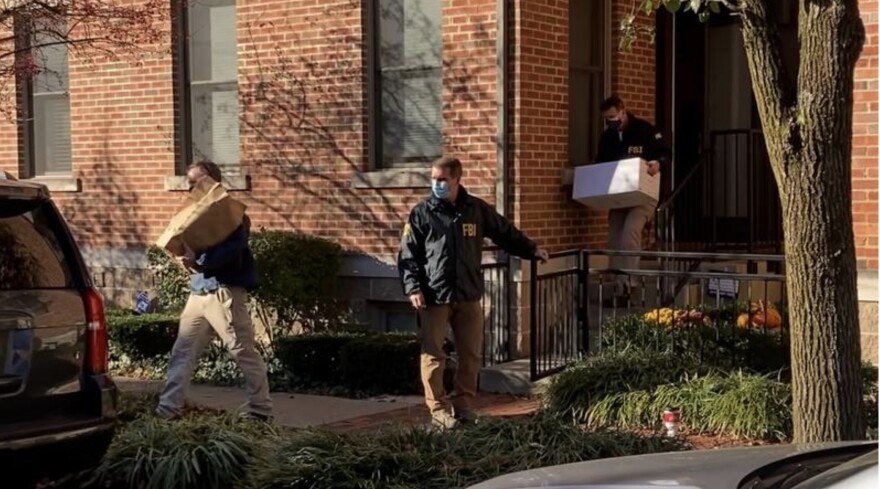
    FBI agents remove boxes of materials from PUCO Chairman Sam Randazzo’s condo in Columbus Nov. 17, 2020. Photo courtesy of Daniel Konik/Statehouse News Bureau.

    BY: MARTY SCHLADEN – Ohio Capital Journal

    CINCINNATI — Ohio’s utility regulator is at the center of a massive bribery and money laundering scandal that has been the focus of a trial here since late last month. In 2019, its chairman and a very recent senior official played a central role in writing corrupt bailout legislation that would give more than $1 billion in subsidies to companies the Public Utilities Commission of Ohio was supposed to be regulating.

    But did their role in the process violate any PUCO rules? The answer is unclear.

    When it comes to being a consumer watchdog, the PUCO doesn’t have the best track record. 

    Since 2008, it has granted more than $1 billion in electric rate increases that were later declared illegal by the Ohio Supreme Court. But, thanks to the way the increases — or “riders” — were written, there’s no way to force utilities to return those ill-gotten gains to ratepayers.

    In at least one of those instances, a regulator might have known the rate hike was illegal when he voted to grant it.

    In June of 2019 — as Akron-based FirstEnergy was funneling millions through dark-money groups to pass the bailout that is the subject of the trial here — the Supreme Court struck down an increase that had already paid the company a non-refundable $460 million. Asim Haque, who months earlier was chairman of the PUCO, sent a FirstEnergy executive a text suggesting that Haque knew the increase was illegal when he voted for it. Haque then said he was just kidding.

    Then, just last month, the PUCO approved an increase of more than 50% in fixed rates for Columbia Gas without making the company go through a formal process to show that it needs the money. That means that after five years throughout much of Ohio, it likely will cost nearly $60 a month just to have gas service  — regardless of whether you live in a 500 square-foot apartment or if you live in a mansion on a five-acre lot. Any payments for gas itself will be in addition to that amount.

    It doesn’t appear that Columbia owner NiSource needed the money. Last year, before the PUCO allowed the rate hike, NiSource’s profits came in $217 million — or 41% — higher than expected. Then, a month after the increase was granted, NiSource announced it was increasing its profit forecast for 2023.

    In a press release, the company boasted of “strong regulatory execution” — including by winning the fixed-rate increase from the PUCO.

    And then there’s House Bill 6, the 2019 law that is the subject of the trial in federal court here that has been ongoing since Jan. 23.

    Former Ohio House Speaker Larry Householder and former Ohio Republican Party Chairman Matt Borges are on trial for their participation in what prosecutors say is likely the biggest bribery and money laundering scandal in Ohio history. They allege that $61 million that mostly came from FirstEnergy was used to make Householder speaker in 2019, and then to pass and protect the $1.3 billion bailout. Most of that money was intended to prop up FirstEnergy’s failing nuclear and coal plants.

    No current or former PUCO employees have been charged in the scandal. But, to put it charitably, the conduct of at least two of them was puzzling — given that the agency’s mission is to protect ratepayers who don’t have a choice about buying the utilities’ products.

    In January 2019, Householder won the speakership and was beginning his push for a FirstEnergy bailout. At the same time,  FirstEnergy lobbyist Ty Pine sent PUCO senior advisor Pat Tully’s resume to Jeff Longstreth, Householder’s right-hand man, according to testimony in the trial. Within weeks, Tully had moved from his PUCO job to one as senior advisor for energy policy in the House Republican Caucus.

    Sam Randazzo, a former FirstEnergy consultant, was confirmed as Gov. Mike DeWine’s nominee to chair the utility commission in April 2019. When he nominated Randazzo, DeWine brushed off warnings that his nominee had “opaque and undisclosed” ties to FirstEnergy.

    In the Householder trial, Tully testified that while Randazzo was still a nominee, he met with Tully, Householder and Rep. Nino Vitale R-Urbana. From there, Tully worked with Randazzo to help draft the utility bailout, HB 6, and to reconcile it with draft legislation submitted by FirstEnergy. The bill secured final passage in July 2019 — months after Randazzo had taken the helm at the utility commission.

    In other words, Ohio’s top utility regulator helped write a law that gave a billion-dollar bailout to a company he was supposed to be regulating on the ratepayers’ behalf. And he was heading an agency that over the previous decade had awarded electric utilities more than $1 billion in illegal, non-refundable rate hikes.

    Randazzo would later resign after the FBI in 2020 raided his Columbus condo. And in a deferred prosecution agreement, FirstEnergy admitted that it paid him $4.3 million just before he became PUCO chairman.

    But does the PUCO have any rules against the role Randazzo played in drafting HB 6? 

    Asked if the agency had a policy prohibiting a commissioner from helping write legislation affecting a utility he or she is supposed to be regulating, spokesman Matt Schilling initially seemed to say that it did not.

    “The PUCO is a state agency and will always be responsive to requests for information or technical assistance to the Ohio General Assembly on matters related to utilities and commercial transportation,” Schilling said in an email last week.

    But in answer to a follow-up, Schilling seemed to say something different. He was asked if that means PUCO believes there was nothing inherently improper about its chairman helping to draft legislation creating subsidies for utilities the agency regulates.

    “No, I never stated anything like that,” Schilling replied. “The PUCO does not comment on ongoing proceedings or court cases.”

    So what about commission employees doing as Tully did when he had a FirstEnergy lobbyist passing out his resume? After all, you might pull punches as a regulator if you’re hoping to land a job with one of the companies you’re supposed to be regulating.

    Schilling’s response might not be very reassuring. He cited a law that “prohibits Commission employees from seeking employment with utilities regulated by the Commission.”

    But Schilling also sent along agency guidance that contains a pretty big loophole.

    “Although this law prohibits Commission employees from soliciting Commission-regulated utilities for employment, it does not prevent employees from considering employment opportunities with these utilities in instances in which the utility approaches the employee,” it said.

    It seems that, after the fact, it might be difficult for the PUCO to figure out who approached whom when an employee jumps ship for a well-paid utility job. And its protections against conflicts of interest during the hiring process don’t seem ironclad.

    “However, if you are contacted by a utility concerning a possible job offer, you must immediately advise your supervisor of the contact so that your supervisor can limit your duties to matters which do not involve the utility in question while any discussions are taking place,” the guidance said.

    In Tully’s case, he didn’t end up directly on FirstEnergy’s payroll. But he did help write a law that the company paid more than $60 million for.

  • Nearly a year after a racketeering indictment, Ohio House expels Larry Householder

    Nearly a year after a racketeering indictment, Ohio House expels Larry Householder

    By Jake Zuckerman and Ohio Capital Journal

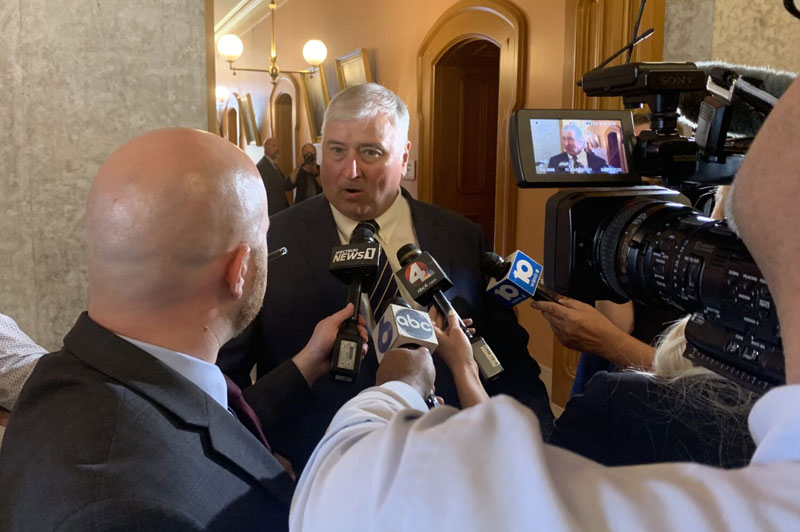
    Larry Householder addresses reporters June 16 after lawmakers voted to expel him from the General Assembly. Photo by Jake Zuckerman.

    Federal prosecutors accused the men of secretly accepting $61 million from FirstEnergy Corp

    The Ohio House voted Wednesday to expel Larry Householder, arrested on charges of public corruption nearly one year ago, from the chamber his Republican — and even some Democratic — colleagues thrice elected him to control.

    The expulsion could mark the end of Householder’s decades-long political career, which has included a previous tenure as speaker of the House in the 2000s that was derailed by a separate FBI investigation. No charges were filed.

    The House voted 75-21 to eject Householder. All but one Democrat voted in support.

    Wednesday’s vote extinguishes Householder’s political flame, but he remains innocent until proven guilty as his criminal trial draws nearer. Both he and former Ohio Republican Party chairman turned lobbyist Matt Borges await trial.

    Jeff Longstreth, Householder’s former political adviser, and Juan Cespedes, a lobbyist, both pleaded guilty to racketeering charges. Neil Clark, a lobbyist and once a towering figure in Ohio politics, was charged as well but pleaded innocent. He died by suicide before trial.

    Federal prosecutors accused the men of secretly accepting $61 million from FirstEnergy Corp via a dark money, pass-through entity. They allegedly used the funds for personal enrichment and to engineer the passage of House Bill 6, a coal and nuclear bailout worth an estimated $1.3 billion to the company.

    After his July 2020 arrest, House lawmakers quickly dethroned Householder as speaker. However, all but a handful of Republicans voted down an effort from Democrats to expel him. Speaking to House leadership on Tuesday, a confident Householder denied the allegations against him. On Wednesday, he listened from the House floor in silence as lawmakers publicly debated his fate.

    Those seeking his ouster emphasized the House is not a courtroom and thus can apply its own professional standards. They said the 43-page indictment and the plea deals entered into by two allies (and one dark money political entity) warrant his ouster from public office.

    “If selling legislation does not count as disorderly conduct, then frankly, nothing does,” said Rep. Brian Stewart, R-Ashville, who sponsored the expulsion resolution along with Rep. Mark Frazier, R-Newark.

    Rep. Kyle Koehler, a Republican who voted against HB 6, dismissed those trying to reduce Householder’s indictment as “allegations.” He identified himself as the anonymous “Representative 6” in the indictment itself, which describes the unnamed lawmaker subjected to political pressure funded by FirstEnergy for his vote.

    “These things occurred,” Koehler, one of few who have publicly demanded Householder’s ouster in recent months. “They’re not accusations. They’re not speculations.”

    Householder’s defenders argued it’s premature to punish Householder before he faces trial. Some argued that the allegations against him don’t qualify as “disorderly conduct,” the undefined Constitutional threshold for expulsion.

    “This is about due process. It’s about the Constitution. It’s not about that man sitting right over there,” said Rep. Al Cutrona, R-Canfield, pointing at Householder.

    What’s more, he won reelection in November, despite the indictment against him.

    “We do not get to choose who represents someone else’s district,” said Rep. Nino Vitale, R-Urbana, who chaired a committee specially created by Householder to review HB 6.

    At around 3 p.m., Householder began what would be his last floor speech of the 134th General Assembly.

    He reiterated a claim of his innocence, said that the allegations against him do not qualify as disorderly conduct, and criticized lawmakers for banishing from a chamber without gathering any evidence of their own.

    “I have not, nor have I ever, took a bribe, or provided a bribe,” he said. “I have not, nor have I ever, solicited a bribe. And I have not, nor have I ever, sold legislation.”

    After the vote, Householder approached the clerk and walked out from the chamber. He reiterated claims of his innocence to reporters gathered outside. There, he left open the possibility of a return to public office, and issued a warning to those who he feels crossed him.

    “Fellow elected officials who didn’t like public citizen Householder, are really not going to like private citizen Householder,” he said.

    This is a developing story and will be updated.

  • Utility and fossil fuel influence in Ohio goes beyond passage of bailout

    Utility and fossil fuel influence in Ohio goes beyond passage of bailout

    Dark money loopholes remain, while people linked to utilities and fossil fuels hold public office or enjoy ongoing access to government officials.

    by Kathiann M. Kowalski

    Dark money loopholes remain in Ohio law, despite last month’s surgical repeal of part of the law at the heart of a $60 million corruption scandal. Meanwhile, more evidence has emerged in recent months, detailing the flow of money by groups engaged in the House Bill 6 scandal and showing close ties between current and former utility lobbyists and Gov. Mike DeWine, as well as various lawmakers.

    “We need to learn from our mistakes,” said Catherine Turcer, executive director of Common Cause Ohio, a group that advocates for more transparency and accountability in politics. She noted that the House Bill 6 case is just the latest in a line of corruption scandals that have rocked state politics in the past two decades.

    A federal complaint released last July alleged an unlawful conspiracy to elect lawmakers who would favor Rep. Larry Householder as House speaker, secure passage of House Bill 6 and defend it against a referendum. A court filing by FirstEnergy in March admits that millions of dollars went from one of its subsidiaries either directly or indirectly to Generation Now, the primary dark money group at the center of the alleged scheme, or to other entities alleged to have played roles. Some funds were paid at the direction of FirstEnergy Solutions, the document claims.

    In addition to promptly repealing the whole law, legislators should have pursued action to prevent such a situation from happening again, Turcer said. Instead, “there was not any indication in place during the summer of a path of how to make sure we don’t create a space for misdeeds.”

    Efforts by FirstEnergy and others to make political contributions through dark money organizations — 501(c)(4) nonprofits and some political for-profits that are not required to disclose their donors — have touched numerous entities with connections throughout the Ohio government, according to data from various sources.

    The Accountability Project is a national database that collects records of federal campaign contributions, grants from nonprofits, expenditures by political action committees and more. The database also identifies shared addresses and other links among individuals and organizations.

    Among other things, the database reveals that Generation Now’s address shown on a 2017 corporate filing was the same as that for co-defendant Jeff Longstreth and his business JPL & Associates. JPL & Associates was shown as the president and secretary on an October 2019 IRS filing by Generation Now.

    The Accountability Project information also indicates that in 2018 Generation Now and JPL & Associates did business at a Capitol Square office tower. The same suite address was used at various times that same year for Friends of Larry Householder, the Committee to Elect Bill Roemer, Harris for Ohio and  Barhorst for Ohio.

    In earlier years the same suite address had been used by the Coalition for Growth and Opportunity, which received money from an American Electric Power-funded group. The office suite is unoccupied now, but at some earlier point the suite also had been the office address for a bespoke tailoring business. (The company moved out of the space years ago, Eye on Ohio and the Energy News Network learned.)

    Nonetheless, utilities and fossil fuel interests seek to continue to tailor Ohio energy policies to their benefit. Among other things, most candidates elected in 2018 whose campaigns got money from the alleged HB 6 scheme were reelected in 2020. Their incumbent statuses would have given them a bump, according to David Anderson, policy and communications director for the Energy and Policy Institute. Federal filings indicate substantial additional spending for the last election cycle as well, he added.

    FirstEnergy and its political action committee reported more than $1.1 million in campaign donations for 2019 and 2020, primarily to Republicans, the National Institute on Money in Politics reports. Nearly half a million of that went to candidates in Ohio.

    Those reported amounts don’t include spending by any dark money groups the company or other energy companies with utilities in Ohio might have donated to. The Growth & Opportunity political action committee had spent money in early 2020 to influence several Ohio primaries, Anderson noted.

    Close ties

    DeWine signed HB 6 into law within hours of its passage in July 2019. Even after HB 6 passed, close ties have remained between utilities and fossil fuel interests, on the one hand, and leadership in Ohio’s legislative and executive branches.

    Since the federal complaint was released last July 21, DeWine has stood by Dan McCarthy, whom he appointed as his director of legislative affairs in early 2019. As a lobbyist at the Success Group in Columbus, McCarthy had long been active in state politics and has contributed to a variety of campaigns, as data from the Accountability Project shows.

    McCarthy was a registered lobbyist representing FirstEnergy in 2017 and 2018, when the events alleged in the HB 6 conspiracy began, according to data from the Ohio Lobbying Activity Center. He also was president of Partners for Progress, the FirstEnergy-funded “Energy Pass-Through” organization that allegedly funneled millions of dollars into efforts to pass and preserve HB 6.

    The bio released by DeWine’s office when he appointed McCarthy in 2019 shows that he had previously managed several political campaigns in addition to working for the Success Group. McCarthy resigned from Partners for Progress before assuming his current government position. 

    His former Success Group colleague McKenzie Davis was a director for Partners for Progress through at least 2019, according to a November 2020 IRS filing by the group. The report also shows R. Scott Davis as president and secretary, and lawyer Michael Van Buren at Calfee, Halter & Griswold in Cleveland as treasurer. 

    The IRS filing showed that $13 million went from Partners for Progress to Generation Now in 2019, plus additional amounts to other organizations for “political campaign intervention,” lobbying and “educating the public about utility options.” Funds from two of those dark money groups supported DeWine’s campaign, as well as an unsuccessful campaign by his daughter Alice DeWine, the Cincinnati Enquirer has reported.

    Other lawyers at Van Buren’s firm represented FirstEnergy in cases before the Public Utilities Commission of Ohio, including one begun after news of the HB 6 scandal broke, for the purpose of determining if funds from FirstEnergy’s utility ratepayers were spent on HB 6 activities. Attorneys from Jones Day are now counsel in some of those cases.

    “It looks a bit different when the lawyers who defend you work for the firm that was part of that political spending,” Anderson said. Van Buren and a colleague did not respond to an inquiry about the reason for the change.

    On call

    FirstEnergy was not the only utility with ongoing links to the governor’s office. An October 2019 email recently released by Common Cause Ohio last month shows that the DeWine-Husted campaign held a weekly finance call, even though they’re not up for reelection until next year. The call list included multiple people with ties to utilities and fossil fuels, including FirstEnergy lobbyist Josh Rubin of the CJR Group, Duke Energy Business Services lobbyist Chip Gerhardt of Government Strategies Group, and Ohio Coal Association lobbyist Richard Hillis of Governmental Policy Group. The Governmental Policy Group’s address has been used by several political action committees throughout the years, Accountability Project data show.

    Also on the DeWine-Husted finance call list was J.B. Hadden, who has been president of Empowering Ohio’s Economy, one of the dark money groups that had also paid money to Generation Now. As of last summer, American Electric Power had contributed a total of $8.7 million to Empowering Ohio’s Economy since 2015, including $700,000 in 2019, according to company spokesperson Scott Blake. “We will continue to legally and ethically advocate on behalf of our customers and our company,” Blake said.

    AEP’s vice president for external affairs, Tom Froehle, also has been a board member of Empowering Ohio’s Economy, dating back to 2016, Blake confirmed.

    Froehle and AEP Director of Government Affairs Maria Haberman met with Householder in February 2020, after HB 6 was law but before the scandal broke last summer, Anderson noted. Householder’s calendar didn’t indicate what the meeting was about.

    As for Empowering Ohio’s Economy, its 2019 tax filing showed more than half a million dollars going to Generation Now. Donations to several other organizations included a $25,000 contribution to the Ohio Governor’s Residence & Office Fund, which is yet another dark money group. It has spent nearly $200,000 on meetings at the residence “to promote better and more efficient government.”

    Another $2 million went from Empowering Ohio’s Economy to another dark money group, Open Road Path, in 2019 “to promote economic and business development within Ohio.” Hadden did not respond to a request for additional information for this article.

    Regulatory connections

    Anne Vogel, former managing director of AEP’s government affairs office, became DeWine’s assistant director for energy and natural resources starting in March 2019. By July, HB 6 was passed. 

    In December 2020, Vogel became a finalist to replace Sam Randazzo as chair of the Public Utilities Commission of Ohio. Randazzo resigned the day after a FirstEnergy government filing stated that the company had paid $4 million in early 2019 to an entity apparently linked to Randazzo. After criticisms surfaced about last December’s list of PUCO nominees, DeWine ultimately asked for additional names and appointed Jenifer French to the post.

    The PUCO nominating council likewise has connections to utilities and fossil fuel interests. Chair Michael Koren was a registered lobbyist for FirstEnergy through 2019. He chaired the committee that nominated Randazzo for the PUCO in 2019. Ohio Lobbying Activity Center data shows Koren also has been a lobbyist for Columbia Gas and Boich Companies, which made its fortune in the coal industry.

    Randazzo’s calendar for the time he was PUCO chair shows multiple meetings with people from utility companies or their parent corporations, as well as with coal fleet lobbyist Michelle Bloodworth

    “I am unaware of any meeting in which a commissioner held a discussion of pending proceedings,” said PUCO spokesperson Matt Schilling, noting that meetings otherwise “could have been regarding any number of general energy or commercial transportation matters relative [to] the delivery of adequate, safe and reliable utility service.”

    Nonetheless, the Energy and Policy Institute’s Anderson said, the absence of detailed notations in the calendar presents “definitely a lot of potential conflicts.”

    Accountability Project data also shows that AEP’s Froehle, Randazzo and Scott Elisar, the PUCO’s current legislative and policy director, all had worked at the same law firm, McNees, Wallace & Nurick. The firm has long represented Industrial Energy Users-Ohio, which has pushed for limiting clean energy standards, and whose members have long enjoyed favorable rates from utilities.

    Still ahead

    Dark money loopholes made the alleged HB 6 scheme possible. “Dark money is a breeding ground for corruption,” former U.S. attorney David DeVillers said when the indictment was filed last July. The federal investigation continues, although the pandemic delayed some grand jury proceedings, he told the Ohio Consumers’ Counsel Governing Board on March 16. In-person meetings of the grand jury have recently resumed, he noted.

    “[For] a lot of these cases that have been on the back burner, you can expect to see a lot more indictments coming,” DeVillers said.

    This year, House Bill 13 aims to address some dark money issues. A hearing will be held in the coming week, so there’s at least some potential for lawmakers to take action this session. But so far, Turcer said, “it’s just that they have completely dragged their feet.”

    __________________________________

    This story is part of a collaborative journalism project produced by the Energy News Network and Eye on Ohio, the Ohio Center for Investigative Journalism. Funding is provided by the Cleveland Foundation, the George Gund Foundation, and the Accountability Project at American University’s Investigative Reporting Workshop.

    This article first appeared on Eye on Ohio and is republished here under a Creative Commons license.


    This article provided by Eye on Ohio, the nonprofit, nonpartisan Ohio Center for Journalism in partnership with the nonprofit Energy News Network. Please join our free mailing list or the mailing list for the Energy New Network as this helps us provide more public service reporting.