
Tag: Jefferson

  • Exercising your right to vote on Election Day

    Exercising your right to vote on Election Day

    Commentary by Michael Hamper III

    Michael Hamper III is a partner at Lemire & Hamper LLC, a firm in Jefferson, Ohio that focuses on the areas of bankruptcy, oil and gas, probate, real estate, and municipal law. Michael has served as the Solicitor for the Village of Jefferson since 2016 and has a passion for helping his local community that inspired him to run for office in 2018.

    Turn on the news or read a newspaper today and you will see political candidates and public officials making the rounds throughout the country trying to earn your vote. While the issues and formats are much different today, those candidates and public officials are participating in America’s time-honored tradition of democracy.

    When it comes to elections, both the voter and precinct election officials have responsibilities to protect voting rights. It is important to be prepared when you vote and to know what your rights are at the polling place in order to ensure a smooth Election Day.

    Voter Responsibilities

    In Ohio, you are generally eligible to vote if you are a citizen of the United States, a resident of Ohio for at least 30 days prior to the election in which you desire to vote, at least 18 years old on or before the next general election, and if you are not currently incarcerated for a felony conviction.

    You must be registered 30 days prior to Election Day to be able to vote. You can register to vote in future elections online at the Ohio Secretary of State’s website or visit your office, local Board of Elections office, Bureau of Motor Vehicles, or public library, among other places.

    In order to cast your ballot on Election Day, you must bring one of the following proofs of identification (note, though an option, it does not have to be a photo ID):

    • Current photo ID card with your name and address, such as a driver’s license or state ID;
    • Other government ID (but not a U.S. Passport or student ID as those do not prove current address);
    • S. Military ID card with your name and photo (address is not required); or
    • A form of identification that shows your name and address, such as a utility bill, bank statement, paycheck, government check or other government document, such as a benefits letter from the Social Security Administration or the Ohio Department of Job & Family Services.

    On Election Day, it is also your responsibility to show up at the correct precinct to vote. If you do not know this information, you can look it up on the Ohio Secretary of State’s website.

    Precinct Responsibilities: Protecting Your Rights

    If you are at the proper precinct, have registered to vote at least 30 days before the election and brought a proper form of identification (see list above), then you should have no problems at the polling place. However, it is still helpful to know some more details about your rights and the duty of precinct election officials to enforce them.

    If you are at the correct precinct and are eligible to vote, but you do not have the proper identification or are not on the poll list, then the precinct election official has the responsibility to allow you to vote by provisional ballot. You also have the right to vote by provisional ballot if you moved to a different precinct within Ohio in the 30 days before the election. A provisional ballot is like a regular ballot, except the board of elections will review the information for the voter and determine if the voter was eligible and should have their vote counted. Each provisional ballot voter must receive a provisional ballot notice that details how a voter can determine if their vote was counted and why or why not.

    There are several other voting rights that you should also be aware of, such as:

    • It is the responsibility of the polling place to allow you to vote as long as you are in line before the polls are scheduled to close.
    • You are not required to provide proof of citizenship in order to vote.
    • If you need assistance to vote due to blindness, disability or illiteracy, you are permitted to receive assistance from a person of your choice, so long as that person is not your employer, representing your union or a candidate whose name is on the ballot. You can also receive assistance from two precinct election officials (one from each political party).

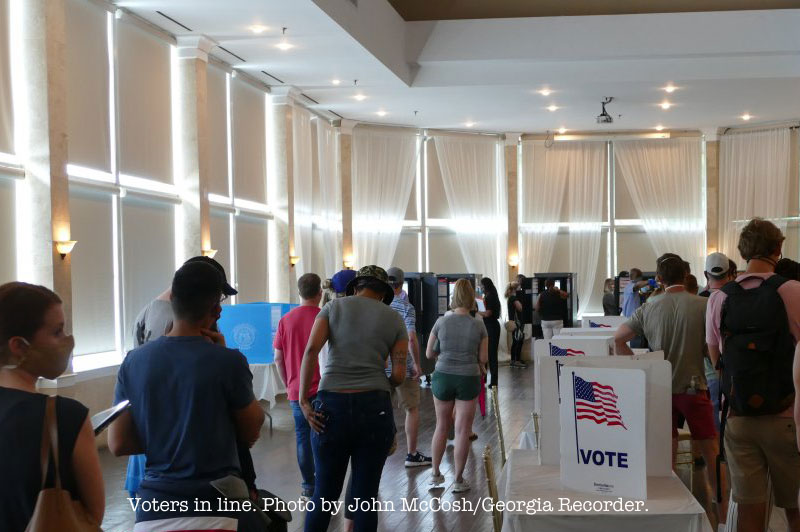
    It is also important for you to know that polling places are neutral ground. This means there should be no election official wearing campaign materials, attire or paraphernalia. Election officials cannot advise, instruct or educate voters on candidates or the issues. They are there to ensure a fair, unbiased voting process, and it is not their goal to influence voters in any way. Voters should also follow these rules and should not wear campaign materials, attire or paraphernalia. Candidates and volunteers are also not permitted to campaign within 100 feet of the polling place, which is often marked by small American flags.

    What Should You Do if You Believe Your Rights Are Being Violated?

    If you believe you are being wrongfully denied the ability to vote, ask to speak to the voting location manager and they will work with you to fill out the form to report the issue (Form 10-U) and then have you vote by provisional ballot.

    If you believe there are violations of voting laws occurring at a polling place, whether by candidates, advocates, precinct election officials or voters, you should report the violations to the local board of elections.

    How an Attorney Can Help

    Should you run into problems, an attorney can help you determine whether your voting rights have been violated and to decide on an appropriate course of action. An attorney can also help you make contact with the appropriate local and state officials to notify them of how your rights were violated and seek to resolve the matter and correct the issues before the next election so that no other voter experiences the same hardship. An attorney will also be able to advise you of the different methods of reporting election complaints to the local board of elections, Ohio Secretary of State and United States Department of Justice.

    A Note on COVID-19 and Voting

    In-person voting may look different this year in response to COVID-19. Be sure to check your polling place in advance, as it may have changed. You may also be required to wear a face mask, and there will likely be markers to keep you distant from the other voters. If you have questions, be sure to check with your county’s Board of Elections. For more information about voting by an absentee ballot, read this article.


    Clermont County Board of Elections

    Hamilton County Board of Elections

    Warren County Board of Elections

  • For Kristi Kinne-Hayes it wasn’t until their eldest daughter turned 16 that evil racism finally struck

    For Kristi Kinne-Hayes it wasn’t until their eldest daughter turned 16 that evil racism finally struck


    LOVELAND MOM’S LONG RACIAL AWARENESS JOURNEY AND WHY WHITE AMERICANS NEED TO FOLLOW HER PATH

    by Daniel P. Finney

    Kristi Kinne-Hayes grew up in Jefferson, a Green County, Iowa city made of 4,200 almost all white people. Kristi played six-on-six girls’ basketball and became one of the best players in the state.

    A Guest Column by Independent journalist Daniel P. Finney who writes for paragraphstacker.com
    She knew local police officers by their first names and thought of them as just another face in the crowd rather than law enforcement.

    Kristi played college basketball at Drake University, leading the Bulldogs to an NCAA Tournament berth her senior season in 1995. She seldom thought about race even though she played alongside and was friends with people of different races.

    She had a longtime friend who played softball at Drake who was mixed race and never knew until someone asked her friend about her race in a Kansas City bar.

    But life, love and motherhood changed her perspective and her long journey from racial indifference, maybe even racial ignorance, to awareness and empathy is one all Americans — especially whites — need to take right now.

    A background like Kristi’s makes it seem unlikely that she would comment on the ghastly death of George Floyd at the hands of Minneapolis police. But life, love and motherhood changed her perspective and her long journey from racial indifference, maybe even racial ignorance, to awareness and empathy is one all Americans — especially whites — need to take right now.

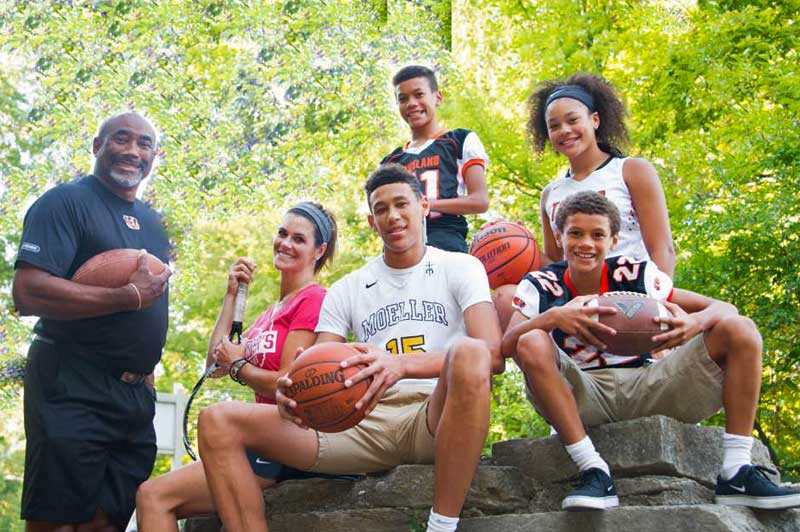
    Kristi graduated from Drake, survived ovarian cancer and met and married Jonathan Hayes, a former University of Iowa tight end who played for the legendary Hayden Fry during the famed coach’s revitalization of the program in the early 1980s.

    Hayes is also African-American. But a mixed-race relationship didn’t expose Kristi to the racial hatred the corrupts America’s soul.

    The first time Kristi brought Johnathan home to Jefferson to watch a ballgame, fans swarmed the Hawkeye hero for autographs.

    “That was so traumatic for me because when I was at the game, people came up for my autograph,” Kristi said. “I told Jonathan they only wanted his autograph because they already had mine.”

    The couple settled in Cincinnati, where Jonathan served as tight ends coach for the NFL’s Bengals.

    They had four children. Yet it wasn’t until their eldest daughter, the couple’s second child, turned 16 that evil racism finally struck the mother of four mixed-race children.

    Kristi and Jonathan bought a new car and gave their older vehicle to their daughter. They put the old plates on their daughter’s vehicle and paid the fees, but Ohio Department of Transportation computers hadn’t yet processed the transaction.

    One evening their daughter came home pale.

    She said, ‘I was sure they were going to shoot me.

    Kristi asked her what was wrong.

    She had been pulled over by police. The car tags were wrong.

    “She said, ‘I was sure they were going to shoot me,’” Kristi said. “I thought, ‘Why would you think they would shoot you?’”

    And the privilege of being a white star athlete from small town Iowa evaporated. She was now the mother of four children whose facial characteristics most white people would identify as black.

    “If there’s a little bit of brown, to other white people, you’re black,” Kristi said.

    Living with racism did not limit her children’s success. Eldest son, Jaxson Hayes, was a first-round draft pick by the NBA’s New Orleans Pelicans last year.

    Daughter Jillian is a highly prized women’s basketball recruit committed to the University of Cincinnati.

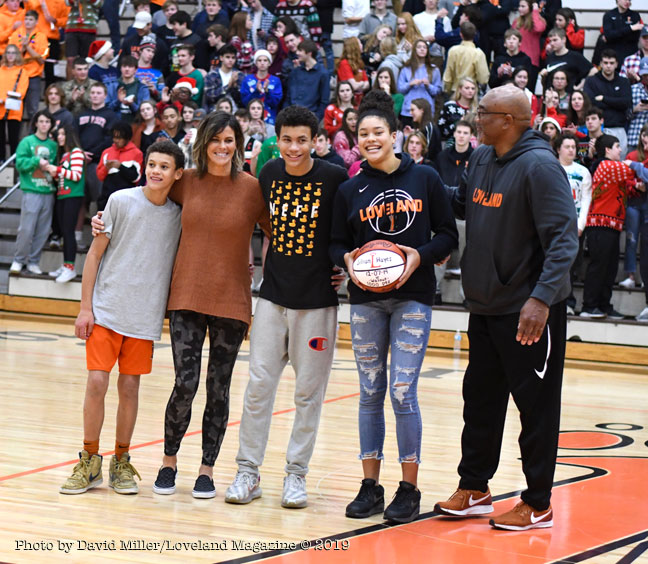
    Jillian Hayes and her family on the night she accepted her commemorative 1,000th point ball.

    Kristi reminds them that she doesn’t care if other people label them black only, just remember that their white mother and her family loves them just as much as their African-American father and his family.

    “Your name is clean,” Kristi tells her kids, “keep it that way.”

    Still, she worries. Jaxson is off in New Orleans, just turned 20 years old and having the time of his life as an NBA rookie despite the league shutdown due to coronavirus.

    She tells her children that if they are pulled over, put their hands at 10 o’clock and 2 o’clock on the steering wheel.

    “I never thought I would have to tell my children that,” Kristi said.

    The true horror of this event: None of those officers moved to stop their fellow officer from committing a crime. It was depraved indifference.

    Kristi saw the news reports and videos of a Minneapolis police officer putting his knee in the back of George Floyd, an African-American man suspected of forgery.

    Three other police officers stood by and did nothing. They were all fired. As of this writing, it’s unknown if they will be criminally charged.

    The killing of Floyd is a complete institutional failure by the Minneapolis police. That officer pressed his knee into the back of that handcuffed man’s neck as he pleaded for mercy, he could not breath and eventually lost consciousness and died.

    He stared into the crowd almost as if he was daring someone to tell him he was wrong. The crowd pleaded with him to render aid, to check Floyd for injury or get him some water.

    The officer refused.

    A friend of mine made this observation a few years ago: “There’s two things we learned from everybody having cameras on their phone: There are no UFOs and police sometimes kill people for no reason.”

    The true horror of this event: None of those officers moved to stop their fellow officer from committing a crime. It was depraved indifference.

    Here in Des Moines, some of my police sources told me they were aghast at another cop so drunk on power that his defiance led to the death of a man.

    “When you have him in cuffs, get him up and in a car and off to the station,” one cop told me. “That diffuses the situation right there.”

    Another cop told me police administrators were circulating a video by a top training instructor illustrating the dangers of the knee in the back hold and all Des Moines cops will have to sign off on having watched it.

    There’s been little local backlash at Des Moines police because of the Minneapolis killing, but the danger of using national stories to paint local pictures hangs over every police station.

    Kristi saw that news and it moved her. She lives in Cincinnati, a city that saw race riots in 2001 after police shot an unarmed African American teenager. Kristi and her family moved to Cincinnati after that terrible period.

    So what does all this have to do with Kristi Kinne-Hayes, the great Iowa basketball star?

    But motherhood long ago took the woman from Jefferson’s ability to be color blind.

    Moved by the story, Kristi posted to her Instagram a trending meme of the officer with his knee in the back of Floyd’s neck and former NFL quarterback Colin Kaepernick kneeling during the national anthem. The caption read: “This is why.”

    So what does all this have to do with Kristi Kinne-Hayes, the great Iowa basketball star?

    ESPN commentator Emmanuel Acho pleaded with white America in a video posted to his Twitter feed Tuesday.

    “My white brothers and sisters, we need y’all’s help,” Acho said. African-Americans have been outraged as people continued to die unnecessarily, but white Americans have remained mostly indifferent or hesitant to raise their voice in protest.

    We need to take the journey Kristi Kinne-Hayes took in her 46 years. She went from living blind to race because it never directly affected her to having a profound understanding of just how horrible racism is in this country.

    I’m not saying you need to repost the meme or start hashtagging everything #blacklivesmatter.

    But we must all do our very best to engage empathy for people who are not like us.

    It’s very hard for anyone to see life through the perspective of someone who has lived so differently.

    Our failure to do that is already too late for so many, the latest being George Floyd.


    Daniel P. Finney, independent journalist – Cut loose and cashiered by corporate media, lone paragraph stacker Daniel P. Finney makes his way telling stories about his city, state and nation. No more metrics or Google trends, he writes stories about people and life ignored by the oligarchy. ParagraphStacker.com is reader-supported media. Please consider donating at paypal.me/paragraphstacker.


    Ricky Mulvey’s new Podcast: “Total Fighter,” about Cincinnati’s Ezzard Charles

    Listen to the Latest Episode…