
Tag: Jennifer Gross

  • Transgender student bathroom ban bill passes out of Ohio House Higher Education Committee

    Transgender student bathroom ban bill passes out of Ohio House Higher Education Committee

    Getty Image

    House Bill 183 would require Ohio K-12 schools and colleges to mandate that students could only use the bathroom or locker room that matches their sex assigned at birth.

    Local Cosponsors are:

    Jean Schmidt, District 62 (R)
    Jennifer Gross, District 45 (R)
    Thomas Hall, District 46 (R)
    Bill Seitz, District, 30 (R)
    BY:  Ohio Capital Journal

    A bill that would ban transgender students from using the bathroom and locker room that matches up with their gender identity passed out of the Ohio House Higher Education Committee Wednesday by a 10-5 party line vote.

    State Reps. Beth Lear, R-Galena, and Adam Bird, R-New Richmond, introduced House Bill 183 which would require Ohio K-12 schools and colleges to mandate that students could only use the bathroom or locker room that matches their sex assigned at birth. It would also prohibit schools from allowing students to share overnight accommodations with the opposite sex.

    HB 183 now awaits further consideration in the House, which is next scheduled to be in session April 24.

    Parents, grandparents, and school superintendents asked Bird for this bill, he said.

    The American Medical Association officially opposes policies preventing transgender individuals from accessing basic human services and public facilities consistent with gender identity.

    HB 183 would not prohibit a school from having single-occupancy facilities and it would not apply to someone helping a person with a disability or a child younger than 10 years old being assisted by a parent, guardian, or family member.

    State Rep. Gayle Manning, R- North Ridgeville, thought about bringing an amendment to the committee that would have carved colleges and universities out of the bill, but she decided against it.

    “I’m hopeful we will continue to have these discussions on the removal of higher ed,” she said. “The reason being, we’re talking about adults. Universities are similar to a city with the number of students that they have. Frivolous lawsuits that will increase the cost of tuition eventually and the cost of our families.”

    Manning voted in favor of the bill even though she hopes lawmakers can continue conversations to “find a better solution.”

    Bird opposes taking the higher education component out of the bill.

    “The reason I oppose that is because we have college credit plus in Ohio,” he said. “We seventh graders going to college, kids in high school going to colleges and in that college environment, we got to make sure they are protected.”

    State Rep. Joe Miller, D-Amherst, vocalized his disdain for the bill before the committee voted.

    “Here we are again … taking away school districts and colleges’ ability and their leadership to make decisions that are best for providing safe, equitable access for all Ohio students,” Miller said. “I hope that this doesn’t see the floor and doesn’t see the governor’s desk.”

    More than 100 people submitted opponent testimony on HB 183 and more than 30 people submitted proponent testimony.

    “We do love and care about all kids,” Bird said when asked about all the backlash the bill has received. “Me and my Republican colleagues have heard from constituents all across the state. They may not have been loud. They may not have been vocal. They may not have come with a sign to the Statehouse, but we are here representing the vast majority of Ohioans who want protections.”

    Trans advocates speak out against HB 183

    Transgender advocates hosted a press conference following the House Higher Education Committee to voice their opposition to HB 183.

    Trans Ohio Board Member Carson Hartlage said HB 183 is harmful to all students, including cisgender students.

    “Most trans non binary and gender non conforming students only begin using restrooms that align with their gender identities after they’ve experienced some form of trauma when using a restroom that aligns with their sex assigned at birth,” Hartlage said.

    Thirty percent of LGBTQ+ students said they were prevented from using the bathroom that aligned with their gender, and 26% were stopped from using the locker room that aligned with their gender, according to Ohio’s 2021 state snapshot by GLSEN, which examines the school experiences of LGBTQ middle and high school students.

    When looking specifically at transgender and nonbinary students, 42% were prevented from using the bathroom that aligned with their gender and 36% couldn’t use the locker room that aligned with their gender, according to the Ohio GLSEN report.

    Ohio’s first openly transgender public official and member of the Gahanna-Jefferson Public Schools’ Board of Education Dion Manley shared his concerns.

    “As a trans man is I’ve been going into men’s restrooms for 25 years without incident,” Manley said. “I go visit the schools on a regular basis. So these legislators want me to go into a girls restroom in the elementary school, middle school, and high school.”

    Mallory Golski, civic engagement and advocacy manager at Kaleidoscope Youth Center, said how Ohio was recently at the center of history in a positive way with Monday’s eclipse.

    “We’re here reflecting on how we’re at the epicenter of another piece of history,” she said. “And unfortunately, we’re at the wrong place at the wrong time. Unlike the fleeting blackout of the total solar eclipse, the history I’m talking about here today at the statehouse leaves transgender youth in the dark.”

    Jeanne Ogden’s daughter would be directly impacted by this bill. Her daughter’s college classroom building does not have single-use restrooms in the building, forcing her daughter to go across the street to use the restroom.

    “These kids getting bullied and yes, their mental health is suffering,” said Ogden, the executive director of Trans Allies of Ohio. “Trans people are tired. Parents are exhausted.”

    Follow OCJ Reporter Megan Henry on Twitter.

    _______________

    Megan Henry
    MEGAN HENRY

    Megan Henry is a reporter for the Ohio Capital Journal and has spent the past five years reporting in Ohio on various topics including education, healthcare, business and crime. She previously worked at The Columbus Dispatch, part of the USA Today Network.

    Ohio Capital Journal is part of States Newsroom, the nation’s largest state-focused nonprofit news organization.

    MORE FROM AUTHOR

  • HEALTH CARE POLITICS & GOV Proposed Ohio abortion bills would impose new mandates, spread misinformation

    HEALTH CARE POLITICS & GOV Proposed Ohio abortion bills would impose new mandates, spread misinformation

    BY: and Ohio Capital Journal

    Returning from summer break, the Ohio legislature could review two GOP-led pieces of legislation that would place health mandates on patients considering abortions.

    One of the bills, recently introduced by state Rep. Jennifer Gross, would require physicians to dictate the results of a mandated ultrasound and also provide information about a link between breast cancer that has been disproven by multiple medical organizations.

    State Rep. Jennifer Gross, R-West Chester 

    Gross, usually known for and outspoken in her disapproval of health care mandates, introduced the bill this week.

    Patients already have to meet with a physician 24 hours before an abortion, but under this bill, along with hearing about the medical risks of the procedure and the probably gestational age, a patient would be told “the possible increased risk of breast cancer that is associated with women who have undergone an abortion,” along with the “short-term and long-term risk of psychological or emotional harm” from choosing to have an abortion.

    Multiple organizations, including the American Cancer Society, the American College of Gynecologists and the Susan G. Komen Breast Cancer Foundation have denied the link, citing research studies on the relationship between breast cancer and abortion.

    The American Cancer Society said these research studies “have not found a cause-and-effect relationship between abortion and breast cancer.”

    The Gross bill has not been assigned to a committee for consideration, but it has several sponsors, all Republican.

    Meanwhile, a separate bill seeking to notify abortion patients of possible risks was introduced during the legislature’s summer break, and has been assigned to the House Health Committee.

    House Bill 378  was introduced in July by state Reps. Kyle Koehler, R-Springfield, and Sarah Fowler Arthur, R-Ashtabula, and specifically targets medication abortion, which is done through a two-pill regimen, rather than surgery.

    The bill would require medical professionals to explain a controversial and medically unproven method of “reversing” the abortion by not taking the second of the two-pill regimen and giving additional progesterone to counteract the first pill.

    The American College of Obstetricians and Gynecologists said claims about the “reversal” method “are not based in science and do not meet clinical standards.”

    The bill is a reintroduction of a similar one that passed the Senate in 2019, but didn’t make it through the House.

    Abortion is legal in the state of Ohio up to 20 weeks gestation.


    Susan Tebben is an award-winning journalist with a decade of experience covering Ohio news, including courts and crime, Appalachian social issues, government, education, diversity and culture. She has worked for The Newark Advocate, The Glasgow Daily Times, The Athens Messenger, and WOUB Public Media. She has also had work featured on National Public Radio.

  • She says vaccines make you magnetized. This lawmaker invited her testimony

    She says vaccines make you magnetized. This lawmaker invited her testimony

    Republican Rep. Jennifer Gross of West Chester

    By Jake Zuckerman and Ohio Capital Journal

    Columbus, Ohio – After a discredited doctor’s conspiracy theories involving COVID-19 vaccines, magnetics and 5G towers made a mockery of the Ohio House of Representatives, the Health chairman blamed the sponsor of anti-vaccination legislation for inviting the doctor to testify before the committee.

    House Health Committee Chairman Scott Lipps, R-Franklin, said in an interview that fellow Republican Rep. Jennifer Gross of West Chester personally requested that Cleveland area physician Dr. Sherri Tenpenny testify in support of Gross’ bill, the “Vaccine Choice and Anti-Discrimination Act.”

    Lipps said he warned against Tenpenny, but Gross “vehemently” overrode his objections.

    Tenpenny is a prominent anti-vaccination advocate who was deemed “unreliable” by a special master in federal court, who forbade her testimony as an expert witness in an alleged vaccine injury case. 

    Gross also personally invited Fremont attorney Tom Renz to testify at the hearing. A federal judge similarly blasted as “incomprehensible” a federal lawsuit Renz filed alleging “tyranny” from Ohio’s government regarding the pandemic.

    Lipps said Gross and Stephanie Stock, president of anti-vaccination advocacy group Ohio Advocates for Medical Freedom, were adamant.

    “We did not include Tom Renz or Sherri Tenpenny on our agenda,” he said. “They protested, called me personally, and said they wanted Renz and Tenpenny.”

    Renz and Tenpenny both testified in support of Gross’ House Bill 248, which would prohibit colleges, insurers, hospitals, nursing homes, employers and others from requiring, incentivizing or asking about vaccination — all vaccines, not just for COVID-19. Public health experts have said in previous interviews the legislation would suppress Ohio’s vaccination rates against a number of diseases and increase the likelihood of outbreaks of infectious disease.

    The bill drew huge public interest, prompting the committee to allow only certain, invited witnesses to testify.

    Tenpenny, one of the few invited witnesses, unleashed a torrent of inaccurate and bizarre claims about purported dangers of the vaccine. She alleged that vaccinated people become “magnetized,” as evidenced by pictures on the internet of them with forks and spoons sticking to their persons.

    “There has been people who have long suspected there was some sort of an interface, yet to be defined, an interface between what’s being injected in these shots, and all of the 5G towers,” Tenpenny said.

    See footage of Tenpenny’s comments to the committee here

    The comments, which are not accurate, would soon drag the Ohio House through lampooning national media coverage and ridicule from late night comics like John Oliver and Stephen Colbert.

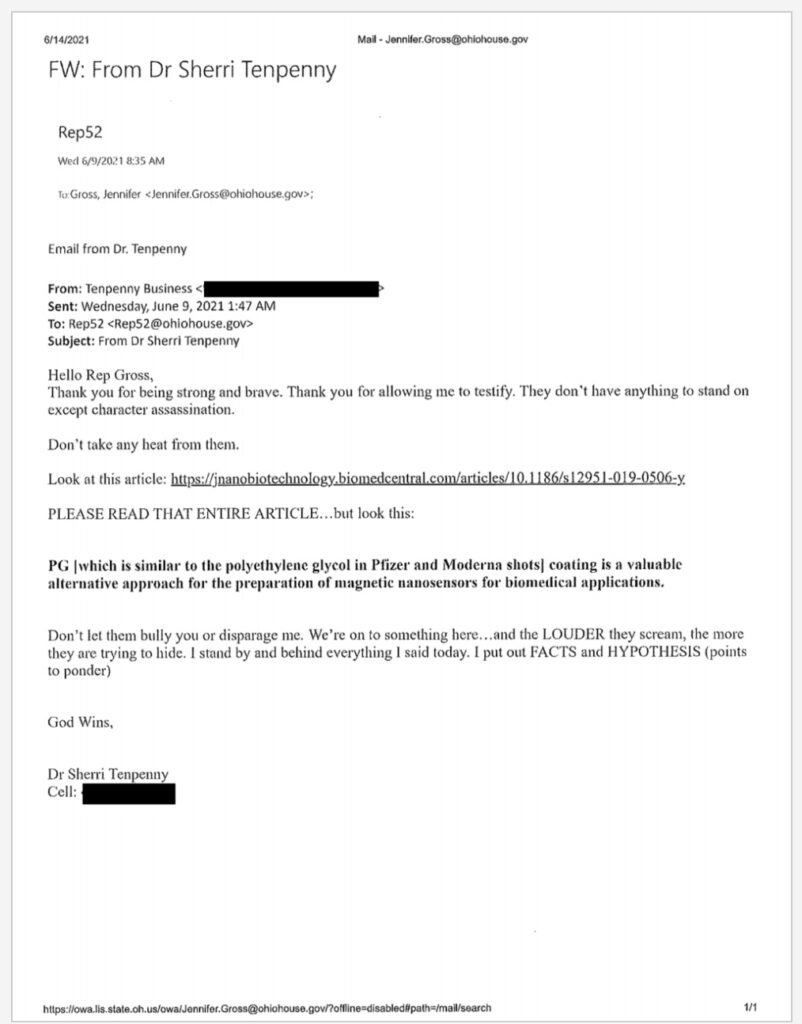
    At 1:47 a.m. the day after Tenpenny’s comments, the doctor emailed Gross to thank the lawmaker for being “strong and brave” and allowing her to testify, according to an email obtained in a public records request.

    In the email, Tenpenny sent a largely unrelated article from the Journal of Nanobiotechnology examining the biochemical functionality of magnetic particles as nanosensors, which are used in cancer diagnosis and treatment. Tenpenny seemed to claim it as proof of her comments regarding COVID-19 vaccines.

    “Don’t let them bully you or disparage me,” she wrote. “We’re on to something here… and the LOUDER they scream, the more they are trying to hide. I stand by everything I said today. I put out FACTS and HYPOTHESIS (points to ponder).

    God Wins,

    Dr. Sherri Tenpenny.”

    The day after the testimony, with the comments going viral online, Gross came to Lipps’ office and said she needed help with “damage control,” according to Lipps’ remarks in an interview. 

    Gross declined to confirm or deny Lipps’ account or answer emailed questions. She said she’s busy and considers the questions “old news.” However, she claimed Lipps praised Renz’s testimony and alleged he thought Tenpenny “sounds great.”

    Ohio House Health Chairman Scott Lipps. Source: Ohio General Assembly.

    Lipps denied saying this.

    “I would expect nothing different from Rep. Gross,” he said in a text message to the Capital Journal. “I have quickly learned she [accepts] no responsibility for her actions or decisions and is quick to blame anyone and everyone. Also, the first agenda we [put] out for proponent testimony had NO Renz and NO Tenpenny. Rep. Gross vehemently objected.”

    When the House Health Committee met a week after the comments went viral, Lipps defended the practice of bringing in witnesses like Tenpenny, even if doing so made people “uncomfortable.” He emphasized the importance of hearing from those one disagrees with.

    “Please step outside your own little world and understand that people are not all the same, and they don’t all believe the same,” he said. “You are not always right.”

    Ohio Advocates for Medical Freedom helped draft Gross’ HB 248 legislation and has paid for a spread of radio ads to gin up support for the bill, according to disclosures with the Federal Communications Commission.

    Stock — president of the group, which researchers found to be the fourth-largest purchaser nationwide of anti-vaccination ads on Facebook — declined to answer questions for this report.

    So who is Sherri Tenpenny?

    Most Ohioans had probably never heard of Tenpenny before video of her June 8 testimony went viral.

    In anti-vaccination corners of the internet, however, she’s something of a celebrity doctor. 

    She is close with Alex Jones, a conspiracy theorist and media figure who is facing libel lawsuits after claiming the Sandy Hook school shooting that left 20 young children and six adults dead at a Connecticut school was a “giant hoax.” The two have been friends for 20 years, they both said in a recent interview on Jones’ show.

    On a recent episode of her podcast, Tenpenny interviewed pillow magnate Mike Lindell, who is among the loudest backers of former President Donald Trump’s lie that the 2020 election was rigged. Lindell and his company are also facing libel suits related to these claims

    While Tenpenny has repeated similar claims of election fraud, her primary focus is vaccines and wrongfully depicting them as dangerous. 

    “Vaccines are now, and people, listen to this closely, always have been a method of mass destruction, a method of depopulation,” she claimed earlier in 2021.

    Tenpenny’s anti-vaccine activism has generated multiple related revenue streams for her. She hosted a “boot camp” this year for $623, training people to convince others to refrain from vaccination. In May, she hosted a live streaming training event to explain the “20 mechanisms of injury from the shots” — platinum package tickets went for $199. Her 2008 book, “Saying No to Vaccines: A Resource Guide for all Ages,” isavailable on Amazon for $877.95, one of several similar titles she has authored.

    Despite this work, Tenpenny does not follow acceptable scientific methodology, her testimony is “unreliable” and she is “unqualified” to address vaccine injury, according to Special Master Richard Abell, appointed by the U.S. Court of Federal Claims.

    Abell made these remarks in a 2010 ruling that blocked Tenpenny’s testimony on behalf of a man who alleged a hepatitis B vaccination gave him Guillain-Barre syndrome, a rare side effect of vaccination.

    The legal standard, he wrote, calls on judges to presume admissibility of testimony of an expert witness. However, he found her methodology “so divergent from the scientific method as to be nonsensical and confusing,” prompting his ruling.

    “Her ideas on vaccine injury have not been exposed to any critical analysis of those in the relevant field, let alone peer-reviewed medical journals,” he said. “There is no way to ascertain whether Dr. Tenpenny’s opinion is credibly accepted by those who would know; there are only the patent defects in her report that militate for the opposite.”

    Tenpenny did not respond to repeated phone calls.

    Tom Renz speaks to the House State and Local government Committee Feb. 17. Source: Ohio Channel.

    Who is Tom Renz?

    After Tenpenny wrapped up her testimony on June 8, Fremont attorney Tom Renz addressed the committee.

    Renz obtained his law license shortly before the pandemic began and his legal career has since wrapped around it. (He says he previously clerked for an Indian Supreme Court justice but doesn’t remember when.)

    He is currently representing clients in COVID-19 related lawsuits against:

    The lawsuits are sprawling, some stretching over 100 pages, and are rife with claims that the COVID-19 death count is “inflated,” that asymptomatic spread of disease is a “fallacy,” that masks don’t work and a deluge of other inaccurate and often debunked claims.

    No cases have yet received any significant rulings. U.S. District Judge James Carr described the first lawsuit against DeWine as “a jumble of alleged facts, conclusory and speculative assertions, personal and third-party allegations, opinions, and articles of dubious provenance and admissibility.”

    Renz withdrew the lawsuit and has since filed a similar case that awaits a ruling. Ohio Stands Up, a citizens group that acts as plaintiffs in the cases, created a crowdsourced legal fund to pay Renz and his partner, Robert Gargasz. The fund has raised nearly $140,000 since it launched around September 2020.

    Earlier this year, Renz testified before a separate committee regarding a pandemic-related bill. YouTube ultimately removed footage of the hearing from its site for violating its COVID-19 misinformation policy

    Renz didn’t respond to an email.

    Ohio Stands Up recently posted on Facebook a flier for an August fundraiser: “An Evening With Dr. Sherri Tenpenny and Attorney Thomas Renz.” Tickets cost $75.