Tag: Jennifer Shaftel

  • There weren’t enough napkins to clean up the tears when my Loveland school-children were called N——s!

    There weren’t enough napkins to clean up the tears when my Loveland school-children were called N——s!

    A true story by a Loveland resident presented by Loveland Magazine in collaboration with the Loveland Diversity Advisory Board. Contact them if you’ve a story to share.

    The family in this story has chosen to remain anonymous for fear of retaliation against their children.

    Part I of 2

    We arrived at school bright and early, just as my sons had requested. It was their last day of 2nd and 4th grade and the anticipation they felt for the occasion was palpable. The dew collected on the toes of their sneakers as they ran to line up, the unmistakable scent of spring perfuming the air. It would be the kind of summer children dream about, with lazy mornings, afternoon trips to the park, and visits to the local Whippy Dip where the cones melted and dripped down their small arms onto the picnic tables. We never got enough napkins. It was going to be the kind of summer they’d look back on years from now with a hint of nostalgia, remembering the carefree innocence of childhood. 

    The school day went by without a hitch; games were played, awards were dispersed, maybe there was a hint of sorrow from the teachers as they retreated back to their now-empty classrooms. But on the faces of my sons and their friends after the final bell had rung, I saw nothing but pure elation. As they played on the front lawn of the school, one last farewell before loading them up, a car slowed to a cruise on Loveland-Madeira. It was all decked out, congratulatory chalk paint on the windows; apparently the driver and his passengers were recently graduated seniors.

    The passenger leaned out of his open window as the car passed my sons and me. 

    “Have a good summer,” he shouted. My sons smiled back, visibly excited a ‘cool’ older kid was acknowledging them.

    But his sentence didn’t end there. 

    I wish his sentence had ended there. 

    “Have a good summer, you N——s!

     My heart dropped. I felt as though I’d been punched in the stomach. And then instinct kicked in.

    “Get in the car, boys,” I frantically stammered.

    “But mom–what did he say?”

    “I said GET IN THE CAR. NOW.” 

    “What did he call us mom? Why did he say that?” 

    I met the puzzled gaze of my younger son who had no idea what had just transpired. 

    My older son looked equally befuddled. This wasn’t the first time he’d encountered that vile term. He knew what it meant. The confusion on his face told me he just hadn’t heard the slur over all the commotion. 

    And here I was, flushed, sweating, and doing everything I could to keep from melting into a puddle of tears in front of them.

    There weren’t enough napkins to clean up the mess.

    With a single word, our perfect day was shattered.

    I tried to see the car’s plate number, but they’d sped away too quickly. I called the school to report the transgression, but, being the last day of school, I never heard back. I met with a police officer, but unfortunately his hands were tied; with what little information we had there was no feasible way to determine the identity of the culprits. As a last ditch effort, I tried doing my own reconnaissance work on a local moms’ group page on social media where my post was promptly removed after group members began chastising me. This isn’t the place for this, I was scolded. Well, where was the place? In the midst of a travesty, I’d turned to my community and in turn I was brushed off and chided.

    That night, instead of eating ice cream that dribbled down their chins and staying up past bedtime, my sons, my husband, and I had to have “the talk.” This is the talk that all parents of Black children, boys in particular, dread. We’d had conversations before but this time they’d been called out. This time it was personal. 

    We had to explain what they were called. What it meant. Where it originated. We had to explain that not everyone saw them as an equal. That prejudice exists.That stereotypes, to some people, are the stuff of truth. We had to sit down, the first night of summer, at the end of what began as a day full of promise, to explain racism to our elementary school-aged children. We had to explain that there are people who hate them for no reason other than the color of their skin. We had to explain that sometimes, inexplicably, people will respond differently to things they do, even if those things are exactly the same as those their Caucasian friends are doing. We had to explain injustice, an intrinsically unfriendly concept, in the most child-friendly way possible. 

    We were determined not to let racism win. This would not ruin our summer; it would not ruin our family. And ultimately, we have triumphed. This event and others like them, as upsetting, maddening and sorrowful as they are, have only served as teachable moments and life lessons. We turn the negativity into chances to fortify our familial bond and bolster our pride. 

    But make no mistake, there have been tears. There have been lots of tears. 

    And there are never enough tissues.

    With this horrifying experience behind them, this family hoped the worst was over.

    In Part II of this Diversity Story, we see that the trouble was only beginning. 

    Stay tuned for Part 2


    Read our first installment of a true story by a Loveland resident presented by Loveland Magazine in collaboration with the Loveland Diversity Advisory Board

    I felt the tears welling behind my eyes and willed them…


    For more information on talking to your kids about race and racism:

    Teaching and talking to kids

    Its never too early talk children about race

    Parenting/talking to your kids about racism

    For engaging story times on diversity (including race) for young learners, join the Loveland Diversity Advisory Board and the Cincinnati Hamilton County Library the 2nd Monday of every month for Bedtime Book Talks.

    Support for those feeling fearful, vulnerable, or uncomfortable upon reading these accounts:
    https://brenebrown.com/podcast/brene-with-aiko-bethea-on-inclusivity-at-work-the-heart-of-hard-conversations/
  • Residents urge BOE to form a Diversity Advisory Board

    Residents urge BOE to form a Diversity Advisory Board

    This statement was delivered by Leah Marcus at the Loveland Board of Education Meeting on 9/22/2020 on behalf of John Coburn, Julie Gebhart, Leah Marcus, Jennifer Shaftel, and Molly Simons, representing the Loveland Diversity Advisory Board (DAB) and the voices of their supporters in the Loveland Community.

    by Leah Marcus

    At the Loveland Board of Education Meeting on 9/22/2020 a group of community members, identifying as the Loveland Diversity Advisory Board made initial requests regarding the need to implement a Diversity, Equity, and Inclusion initiative within the School District. The statements delivered by community members are below:

    “As a part of the Diversity Advisory Board, I want to thank the Loveland Board of Education for hearing me today. This is a new group that started in the Loveland Area recently and our request is that there be an Advisory Board that looks at Diversity, Equity, and Inclusion concerns in our community, and more so, in our Loveland City School District. This effort would consist of school administrators working with the Advisory Board to talk and try to resolve some of these issues.

    I want to take a little bit of time to talk about my experiences in Loveland. I have lived here for six years and I want to talk about some things that have happened to me.

    One thing, when my wife and I first moved in, a neighbor asked my wife if we were the new neighbors.

    “Yes, we are the new neighbors.”

    “Oh, I will come by and ​see​ you.”

    I can’t tell you who that neighbor is.

    I have another neighbor. We just don’t talk. He doesn’t talk to me. I have said “Hi” to him, but we just don’t talk. He talks to the other neighbors-just not, to me.

    I have been at a stoplight here recently and I was called a “Nigger” when someone rolled their window down and felt like that was appropriate to do.

    There was another time that I was at a meeting, here in a Loveland school building, and I walked out with a couple of parents. We got lost in the building and we ended up going down a dark hallway. A community person walked up and said, “Oh, you’re used to being in dark places.”

    I think about that, and I think about the community where I grew up.

    I grew up in a community called Webster Groves, Missouri. I don’t know if anyone is familiar with that place, but it has similar demographics to what we have here, but we had a sense of belonging. Which I don’t necessarily feel here.

    This was in the 1970s, so Whites and Blacks got along. We talked to each other. We went to each other’s homes. We ate dinner together. We got to know each other, our parents got to know each other, and I don’t feel that sense of community here.

    Now don’t get me wrong, there are some wonderful things here in Loveland. There are wonderful things to do. I have met some wonderful people, but I am just saying that I don’t feel that.

    So when I think about my experiences I realize that I live in Loveland, but I work outside of Loveland. My church is outside of Loveland and my friends are outside of Loveland. I think about the kids that are in this environment every single day and I am wondering what data we are using to talk to the kids about their experiences that are here in the schools every single day.

    And again, I am just starting to become engaged in this environment. So let’s think about the long term ramifications of not having a Diversity, Equity, and Inclusion initiative.

    I am big on just reading my bible, and I pulled out a verse that says, “Whoever does not love their brother and sister, whom they have seen, cannot love G-d, whom they have not seen” (1 John 4:20). So what are those long-term ramifications and what are we teaching our kids? What kind of legacy are we leaving them? What if we don’t teach them that it is okay to engage with people who don’t look like them, whether it be someone who has special needs, or someone who identifies as LGBTQ, or someone who is Black or Brown?

    What kind of legacy are we leaving our children if we don’t say it is okay to engage with others that don’t look like you?​

    We are here tonight representing a diverse group of LCSD parents and community stakeholders to respectfully request the district’s action on two proposed initiatives:

    First

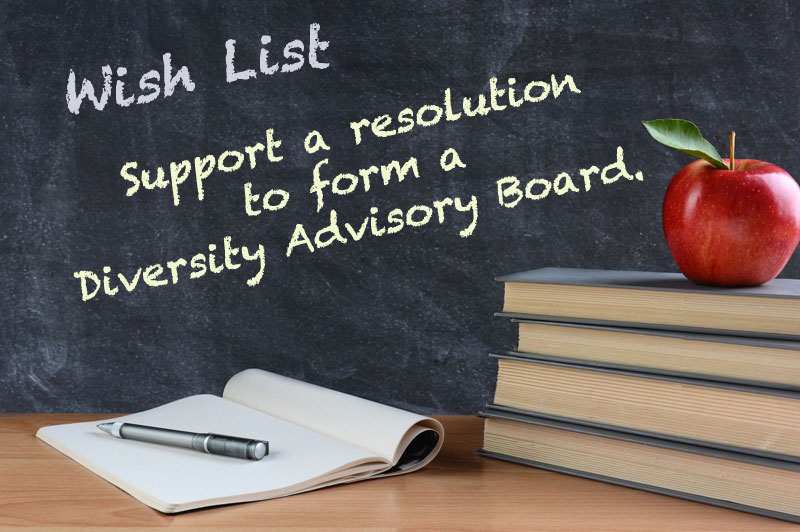
    We respectfully request that the District support a resolution to form a Diversity Advisory Board.

    Second

    We ask that the Board of Education facilitate a relationship between this group and school building administrators, so that a formal plan to address issues related to diversity, equity, and inclusion, that is, DEI, can be established, with parent input, and implemented, in the schools.

    We acknowledge that conversations regarding inclusion and diversity are already happening in the community with great frequency, whether that be on social media, our local written media, in our private homes, or  public forums such as this summer’s organized Peace Walk.

    Beyond these events, parents in our district, including many here tonight, have been meeting informally to educate ourselves and to understand how we can better leverage community resources to support our schools when it comes to creating an inclusive learning environment that prepares all students to succeed in an increasingly diverse workforce and world.

    Although our district’s values indirectly point to a shared commitment for inclusive education, informal and indirect commitment is not enough to make inclusion a reality in our schools. Achieving inclusion requires intention, including formal structures for engaging parents, students, and staff in conversations about what is needed to achieve this reality.

    Educational institutions have long acknowledged DEI initiatives as essential components of Social-Emotional Curriculum. Loveland, however, has yet to implement a permanent and intentional diversity statement or initiative. In fact, Loveland is one of only a handful of local districts with absolutely no DEI initiatives to speak of. The following districts have long-established comprehensive DEI plans: Sycamore, Indian Hill, Lebanon, Wyoming, Mason, Madeira, Kings, Cincinnati Public, Mariemont, Northwest, Fairfield, Forest Hills, Princeton, and Lakota.

    Compared to our neighboring districts, Loveland seems to be falling behind in this regard. It is time for Loveland to formally commit to addressing these issues.

    Institutional support for Inclusion and Diversity efforts have been shown to have positive outcomes for all students, including benefiting students’ critical thinking, decision making and cognitive skills, student success and engagement, as well as fostering a sense of belonging. On the flip-side, lack of DEI plans has been shown to result in hostile school and community environments, a lack of cohesion and consistency in dealing with district DEI issues, and, in some cases, costly lawsuits.

    Our Loveland Tigers do not want to be defined by a negative community incident, when we could be defined by the innovative, diverse leaders we educate in our district.

    Here, we present to you our proposal, along with letters from parents and community stakeholders who would like to see these initiatives come to fruition.”

    John Coburn, Julie Gebhart, Leah Marcus, Jennifer Shaftel, and Molly Simons, representing the Loveland Diversity Advisory Board (DAB) and the voices of our supporters in the Loveland Community.