Tag: Juan Cespedes

  • More signs that criminal investigation into Ohio utility bailout continues

    More signs that criminal investigation into Ohio utility bailout continues

    Davis-Besse Nuclear Power Station with electricity pylons, Ohio. Getty Images.

    BY:  Ohio Capital Journal

    Five have been charged and four have been convicted in a massive bribery and money-laundering scandal, but there were more signs this week that the federal criminal investigation is continuing.

    In court documents filed in a separate case on Monday, a special master said that a major player in the conspiracy — Akron-based FirstEnergy — continues to cooperate with federal prosecutors. The same documents order the major beneficiary of the conspiracy, a former FirstEnergy subsidiary, to do more to cooperate in a federal class-action suit.

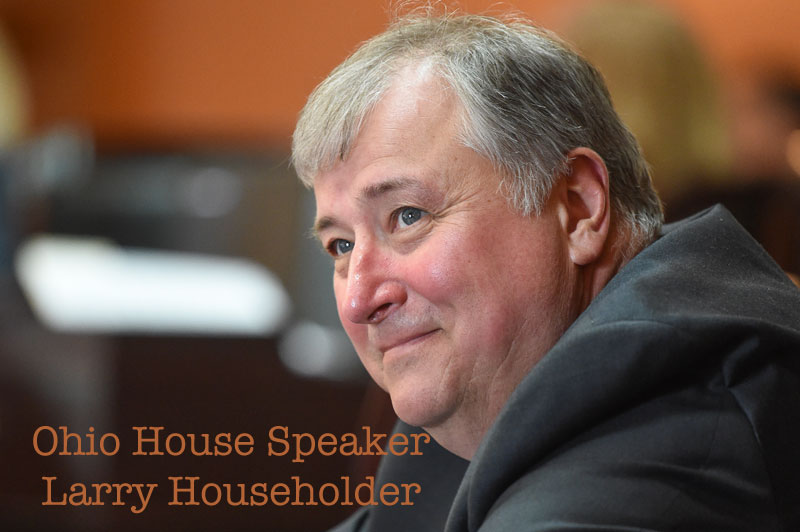
    Former House Speaker Larry Householder, R-Glenford, and former GOP Chairman Matt Borges in June were respectively sentenced to 20 and five years in federal prison for their roles in the conspiracy. Two others have pleaded guilty and await sentencing, while a third who was charged died by suicide.

    In the conspiracy, FirstEnergy and its then-subsidiary paid more than $60 million from 2017 to 2019 to make Householder speaker so he could pass and protect a $1.3 billion bailout. Of that sum, the vast majority was intended to prop up two nuclear plants owned by the subsidiary, then called FirstEnergy Solutions.

    Over the course of a six-week trial in Cincinnati early this year, prosecutors put on evidence that FirstEnergy found itself in a precarious state because its heavy investments in coal and nuclear-powered generation were being undercut by cheap natural gas. Top executives with the company — including then-CEO Chuck Jones and Vice President Michael Dowling — desperately sought a ratepayer bailout to prop up the nuclear plants so they could spin them off and get most of the liability associated with closing and cleaning them up off their books.

    In 2019, as Householder was shepherding the bailout through the legislature, FirstEnergy Solutions was in bankruptcy and emerged in February 2020. It had a new name, Energy Harbor, and it was no longer a subsidiary of FirstEnergy.

    Five months later, the FBI arrested Householder and the others. Then large pension and investment funds sued FirstEnergy, saying the reckless, undisclosed conduct of its top executives caused investors to lose billions when that conduct hit the public fan.

    FirstEnergy signed a deferred prosecution agreement admitting wrongdoing and agreeing to pay a $230 million penalty to the government. But that didn’t get it off the hook in the multiple civil suits it’s faced, including the class action filed in the Southern District of Ohio by large investors.

    As part of the suit, those investors have been battling FirstEnergy for communications and other information that might implicate officials other than Jones and Dowling, who were fired.

    They’re also battling Sam Randazzo. He isn’t named in the suit, but FirstEnergy said he took a $4.3 million bribe from Jones and Dowling just as Gov. Mike DeWine nominated Randazzo to chair the Public Utilities Commission of Ohio at the beginning of 2019. The class-action plaintiffs say Randazzo might be sitting on text messages and other communications relevant to the conspiracy.

    Jones, Dowling and Randazzo deny criminal wrongdoing in the scandal, but U.S. Attorney Kenneth L. Parker in June said that the investigation was continuing. On Monday, Special Master Shawn Judge also said in a court filing that the investigation continues — and that FirstEnergy is cooperating.

    “During this jury trial, the government highlighted Jones’s and Dowling’s purported relationships with Householder and involvement in the conspiracy,” Judge wrote, referring to the criminal trial earlier this year. “And multiple representations before the Court suggest that FirstEnergy’s cooperation with government investigations is ongoing.”

    Judge is helping to referee the numerous discovery disputes in the class-action case. In this instance, he ordered Energy Harbor to provide almost everything the FirstEnergy investors wanted.

    As a now-independent company, Energy Harbor said it’s not a defendant in the civil case, so it shouldn’t be put to the trouble and expense to provide the information the pension and investment funds are demanding.

    But Judge noted that while it was still a FirstEnergy subsidiary, the company “​​contributed $43 million of the $60 million paid to Householder and his affiliates in exchange for the official action of passing (the bailout law) and defending it from a repeal referendum.”

    In addition, Judge wrote, the subsidiary’s lobbyist, Juan Cespedes, helped direct some of those funds and pleaded guilty to his role in the racketeering conspiracy.

    Judge then ordered Energy Harbor to provide the plaintiffs with the information they requested, but reduced the time period the required documents span by several months.

    Marty Schladen
    MARTY SCHLADEN

    Marty Schladen has been a reporter for decades, working in Indiana, Texas and other places before returning to his native Ohio to work at The Columbus Dispatch in 2017. He’s won state and national journalism awards for investigations into utility regulation, public corruption, the environment, prescription drug spending and other matters.

    MORE FROM AUTHOR

  • Former associate testifies that ex-Ohio GOP Chair Borges paid to spy on bailout repeal effort

    Former associate testifies that ex-Ohio GOP Chair Borges paid to spy on bailout repeal effort

    BY: MARTY SCHLADEN – Ohio Capital Journal

    CINCINNATI — Former Ohio Republican Party Chairman Matt Borges paid $15,000 off the books in 2019, a witness testified Tuesday. It was in an attempt to gather inside information about the campaign to repeal a $1.3 billion utility subsidy that had just been passed by the legislature, a Borges associate said.

    In addition, the chairman of the company that benefited most from the subsidy in an email referred to the scheme as a “black op” and said he was prepared “to do whatever it takes” to defeat the repeal effort, the witness, Juan Cespedes, said. Coincidentally, the chairman, John Kiani, started his career at Enron, a Houston Energy company that collapsed under a wave of unmet contracts and accounting scandals in 2001.

    It was the 11th day in the federal court trial of Borges and former Ohio House Speaker Larry Householder, R-Glenford. Borges is accused of assisting Householder and others in a scheme to use $61 million from Akron-based FirstEnergy to make Householder speaker and pass the massive bailout.

    The bulk of the bailout was intended to benefit money-losing nuclear and coal plants owned by FirstEnergy subsidiary FirstEnergy Solutions. It was going through bankruptcy proceedings and executives with the parent company and the subsidiary desperately wanted the bailout to complete the bankruptcy, spin off FirstEnergy Solutions and possibly sell the nuclear plants.

    Gov. Mike DeWine signed the bailout the same day it passed in 2019, but a repeal effort started amid reports that it was “the worst energy bill of the 21st century.” Not only did it prop up 70-year-old coal plants under the guise of being a “Clean Air Program,” it also gutted the state’s renewable energy standards.

    Borges was part of a team of lobbyists who worked to pass and protect the bailout, House Bill 6. And, because of his long experience in Ohio politics, he was asked to make use of some of his relationships in the effort, Cespedes, another member of the team, testified.

    Cespedes was also charged with racketeering, but he pleaded guilty and is cooperating with prosecutors.

    The off-the-books payment

    One of the primary acts Borges is charged with has to do with a $15,000 payment he made during the repeal effort to Tyler Fehrman, who was helping manage the campaign to gather enough valid signatures to get the repeal on the ballot. 

    Inside information was valuable to the pro-H.B. 6 team because it enabled them to gauge the strategy and likelihood of success of the repeal effort.

    Cespedes testified that he tried to keep the plan to recruit Fehrman from Kiani, the FirstEnergy Solutions chairman whose company financed a big portion of the fight against the repeal. Kiani was a hard-charging executive and Cespedes believed that once he learned of the spying effort, he would press the operatives relentlessly. 

    However, Cespedes said, Borges told Kiani about it, and it seems Cespedes’s worries were well founded.

    In an Aug. 31, 2019 text, Kiani asked “what happened to the black ops?” in a reference that Cespedes said was to the spying effort. Then, in a Sept. 2, 2019 text, Cespedes told Borges that Kiani, “reiterated to do whatever it takes to get this information.”

    It appears that Fehrman was paid, but it’s unclear what he was paid for.

    In taped conversations played earlier in the trial, Borges discussed paying Fehrman, but he claimed to Fehrman that it was for work Fehrman might do some time in the future. But Borges made other statements that seemed to show that he knew the two were doing something wrong.

    “It would be bad for both of us if the story came out,” he told Fehrman in a recording that Fehrman made with the help of the FBI. “But it would be worse for you.”

    On Tuesday, Cespedes testified that he roughed out a budget at the time of the repeal campaign. He made an entry in it to pay $25,000 to an “employee.” Cespedes said the money was intended for Fehrman.

    Asked why he used “employee” to label the entry, Cespedes said, “I wasn’t going to write ‘bribe.’ I wasn’t going to write anything nefarious.”

    Prosecutors displayed a photograph of what they said was a contemporaneous budget that Borges roughed out in a notebook that Cespedes had photographed. Cespedes testified that when he asked Borges why a payment to Fehrman wasn’t in it, Borges “simply said it wasn’t something he wanted to write down.”

    Cespedes testified that Fehrman later went quiet on Borges and Cespedes assumed that their deal had fallen through. But after the repeal campaign had failed, an accounting showed that the $15,000 had been paid, Cespedes said. 

    When he asked Borges about it, “He said, ‘I just wanted to keep him quiet,’” Cespedes testified.

    Earlier in the HB 6 fight, Borges and Cespedes were struck by Kiani’s connections to Enron, which ceased to exist after one of the biggest corporate scandals to that point in American history.

    “The shocking thing last night was learning that Kiani came from Enron,” Borges said in a text.

    Kiani went from there to work as a hedge fund manager and then he made his way onto the FirstEnergy Services board as an activist investor. Cespedes testified that a Kiani aide told him that Kiani would make $100 million from the sale of FirstEnergy Solutions’ nuclear plants. 

    Regardless of whether that’s accurate, Kiani clearly was willing to spend lots of corporate money to win subsidies for them. To fund a statewide, eight-week media campaign for the bailout, bankrupt FirstEnergy Solutions approved a $15 million budget, Cespedes testified.

    That amount would grow after the bill passed and the repeal fight got underway.

    Kiani continues to be executive chairman of Energy Harbor, the new name for FirstEnergy Solutions after it emerged from bankruptcy. His company bio credits him with “the successful operational and financial turnaround of Energy Harbor into a leading, carbon free power infrastructure and energy supply company.”

  • Corruption trial texts: OH AG Yost didn’t speak out against bailout because of utility support

    Corruption trial texts: OH AG Yost didn’t speak out against bailout because of utility support

    BY: MARTY SCHLADEN – Ohio Capital Journal

    CINCINNATI — In June of 2019, Ohio Attorney General Dave Yost thought a proposed utility bailout was a bad law, but he didn’t publicly oppose it because of support he’d received from the bailout’s primary beneficiary, FirstEnergy, according to lobbyists’ text messages displayed in court on Friday.

    Prosecutors displayed the messages as part of the racketeering trial of former House Speaker Larry Householder and Matt Borges, a former Ohio Republican Party Chairman who was acting as a lobbyist at the time the utility bailout was debated and passed. They are accused in a scheme to use $61 million to make Householder speaker in 2019 so he could pass and protect a $1.3 billion bailout that mostly went to protect FirstEnergy’s failing nuclear and coal plants.

    At the time of the men’s July 2020 arrest, federal prosecutors said it was likely the biggest bribery and money laundering scheme in Ohio history. Two months later, as he announced a civil suit against FirstEnergy, Yost echoed those sentiments.

    “Corruption doesn’t happen on an industrial scale like this without cash,” he said in a press conference. “And it’s incredibly important at this moment in our state’s history to send a message that the Ohio political system, the Ohio law-making system, the regulatory environment is not for sale. If you shut off the money spigot, the corruption withers.”

    But behind the scenes 15 months earlier — according to text messages between Borges and lobbyist Juan Cespedes — Yost was pulling his punches on the bailout. Borges said Yost was doing so partly because of $24,000 he received from FirstEnergy and Borges in the cycle leading up to the 2018 election and the subsequent legislative session during which the bailout was passed. 

    Cespedes has pleaded guilty in the scandal and is expected to testify soon in the Householder trial.

    After the scandal broke, Yost announced that he would donate his FirstEnergy-related contributions to charity

    But according to Borges, who had run earlier campaigns for Yost, the FirstEnergy money spigot helped guide the attorney general’s conduct as the bailout was making its way through the legislature. Text messages indicate that Borges was assigned to try to enlist Yost’s help with the bailout.

    The legislation, House Bill 6, passed the Ohio House on May 29, 2019, and by the time of the June 26, 2019, text conversation between Borges and Cespedes, opposition to the bailout was growing as it was being debated in the Senate.

    One source of opposition was from outside groups that were planning a ballot initiative to repeal HB 6 if it passed. Borges and Cespedes discussed trying to make it exempt from repeal by treating it as a revenue bill and calling it a tax — based on a $1 subsidy built into the measure. 

    Cespedes asked Borges what the attorney general thought.

    “He’s sympathetic, but he wants to go back and look at the law,” Borges replied.

    As they discussed the matter further, Borges said “Don’t repeat this,” but Yost believed the bailout was a bad law.

    Yost “‘would be out front (in opposition) if not for (FirstEnergy) support and your involvement,’” Borges quoted Yost as saying.

    As attorney general, Yost also would have to approve any repeal language before it went on the ballot. The AG also wanted to help with that if he could, Borges said.

    “If there’s any way the law will allow him to reject the language, he will do it,” Borges texted.

    Yost has been subpoenaed in the case, and his spokeswoman on Friday declined to comment on the text messages.

    “He was subpoenaed to potentially be a witness in this case,” the spokeswoman, Bethany McCorkle, said in an email. “At this time it is inappropriate for him to comment.”

  • Nearly a year after a racketeering indictment, Ohio House expels Larry Householder

    Nearly a year after a racketeering indictment, Ohio House expels Larry Householder

    By Jake Zuckerman and Ohio Capital Journal

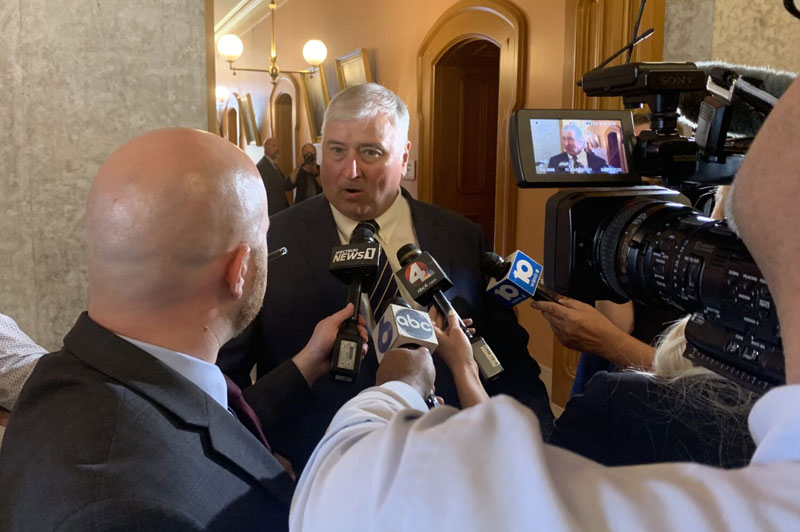
    Larry Householder addresses reporters June 16 after lawmakers voted to expel him from the General Assembly. Photo by Jake Zuckerman.

    Federal prosecutors accused the men of secretly accepting $61 million from FirstEnergy Corp

    The Ohio House voted Wednesday to expel Larry Householder, arrested on charges of public corruption nearly one year ago, from the chamber his Republican — and even some Democratic — colleagues thrice elected him to control.

    The expulsion could mark the end of Householder’s decades-long political career, which has included a previous tenure as speaker of the House in the 2000s that was derailed by a separate FBI investigation. No charges were filed.

    The House voted 75-21 to eject Householder. All but one Democrat voted in support.

    Wednesday’s vote extinguishes Householder’s political flame, but he remains innocent until proven guilty as his criminal trial draws nearer. Both he and former Ohio Republican Party chairman turned lobbyist Matt Borges await trial.

    Jeff Longstreth, Householder’s former political adviser, and Juan Cespedes, a lobbyist, both pleaded guilty to racketeering charges. Neil Clark, a lobbyist and once a towering figure in Ohio politics, was charged as well but pleaded innocent. He died by suicide before trial.

    Federal prosecutors accused the men of secretly accepting $61 million from FirstEnergy Corp via a dark money, pass-through entity. They allegedly used the funds for personal enrichment and to engineer the passage of House Bill 6, a coal and nuclear bailout worth an estimated $1.3 billion to the company.

    After his July 2020 arrest, House lawmakers quickly dethroned Householder as speaker. However, all but a handful of Republicans voted down an effort from Democrats to expel him. Speaking to House leadership on Tuesday, a confident Householder denied the allegations against him. On Wednesday, he listened from the House floor in silence as lawmakers publicly debated his fate.

    Those seeking his ouster emphasized the House is not a courtroom and thus can apply its own professional standards. They said the 43-page indictment and the plea deals entered into by two allies (and one dark money political entity) warrant his ouster from public office.

    “If selling legislation does not count as disorderly conduct, then frankly, nothing does,” said Rep. Brian Stewart, R-Ashville, who sponsored the expulsion resolution along with Rep. Mark Frazier, R-Newark.

    Rep. Kyle Koehler, a Republican who voted against HB 6, dismissed those trying to reduce Householder’s indictment as “allegations.” He identified himself as the anonymous “Representative 6” in the indictment itself, which describes the unnamed lawmaker subjected to political pressure funded by FirstEnergy for his vote.

    “These things occurred,” Koehler, one of few who have publicly demanded Householder’s ouster in recent months. “They’re not accusations. They’re not speculations.”

    Householder’s defenders argued it’s premature to punish Householder before he faces trial. Some argued that the allegations against him don’t qualify as “disorderly conduct,” the undefined Constitutional threshold for expulsion.

    “This is about due process. It’s about the Constitution. It’s not about that man sitting right over there,” said Rep. Al Cutrona, R-Canfield, pointing at Householder.

    What’s more, he won reelection in November, despite the indictment against him.

    “We do not get to choose who represents someone else’s district,” said Rep. Nino Vitale, R-Urbana, who chaired a committee specially created by Householder to review HB 6.

    At around 3 p.m., Householder began what would be his last floor speech of the 134th General Assembly.

    He reiterated a claim of his innocence, said that the allegations against him do not qualify as disorderly conduct, and criticized lawmakers for banishing from a chamber without gathering any evidence of their own.

    “I have not, nor have I ever, took a bribe, or provided a bribe,” he said. “I have not, nor have I ever, solicited a bribe. And I have not, nor have I ever, sold legislation.”

    After the vote, Householder approached the clerk and walked out from the chamber. He reiterated claims of his innocence to reporters gathered outside. There, he left open the possibility of a return to public office, and issued a warning to those who he feels crossed him.

    “Fellow elected officials who didn’t like public citizen Householder, are really not going to like private citizen Householder,” he said.

    This is a developing story and will be updated.

  • Consumer advocate wants to know where utility got $60M from in alleged bribery scandal

    Consumer advocate wants to know where utility got $60M from in alleged bribery scandal

    cccc

    Ohio’s official utility watchdog wants to know where Akron-based FirstEnergy got the $60 million that federal prosecutors say fueled the largest bribery scandal in Ohio history.

    The Office of Ohio Consumers’ Counsel on Tuesday evening filed several motions with the Ohio Public Utilities Commission

    • A request for an investigation and a management audit of FirstEnergy.
    • A requirement that the company show that it hadn’t misused consumer money to support the passage of a nuclear bailout. 
    • And that the regulator reopen a probe into how FirstEnergy spent money intended to upgrade the electricity grid.

    In July, the U.S. Attorney’s office charged then-House Speaker, Larry Householder, R-Glenford, in an alleged scheme to funnel FirstEnergy money through 509(c)(4) “dark money” groups in a corrupt effort to elect supportive lawmakers and make Householder speaker. 

    The feds say the goal was to pass House Bill 6, a $1.3 billion bailout that went primarily to two failing nuclear power plants, but also subsidized two failing coal-powered generators. In addition, the money was used to fund a xenophobic campaign to stop a voter repeal of HB 6 and to line the pockets of Householder and his alleged conspirators, federal officials said.

    Also charged were Matt Borges, a lobbyist who was formerly chairman of the Ohio Republican Party, Neil Clark, a lobbyist who owns Grant Street Consulting, Juan Cespedes, also a lobbyist, and Householder’s aide, Jeffrey Longstreth.

    In its filing, the consumers’ counsel said it was asking the utilities commission to do its job.

    “The (Public Utilities Commission of Ohio) has the right and duty to regulate public utilities, for the protection of the public,” it said. “The PUCO should require FirstEnergy to show that money it collected from consumers, including the distribution modernization charge money, was not improperly used regarding House Bill 6 and that it did not violate any utility regulatory laws or PUCO orders regarding House Bill 6.”

    A FirstEnergy spokeswoman said her company will comment through official channels.

    “We are unable to comment on pending litigation, but we will respond to the motion by September 23 as required,” External Communications Manager Jennifer M. Young said in an email.

    In its filings, the consumers’ counsel noted that “Long before the House Bill 6 subsidies, FirstEnergy was authorized to charge its consumers nearly $7 billion for these and other FirstEnergy power plants as part of the transition to power plant competition (and a supposed end to future power plant subsidies) under Ohio’s 1999 electric deregulation law.”

    The documents also focused on $465 million FirstEnergy was allowed to collect from Ohio ratepayers in 2017 and 2018 as a “distribution modernization rider.” In other words, the charge was meant to fund improvements to the lines and poles and other equipment needed to efficiently deliver electricity in Ohio.

    The consumers’ counsel pointed to an independent audit showing that at least some of the money was used for other purposes. For example, it was placed in FirstEnergy’s “Regulated Utility Money Pool,” where its out-of-state utilities could borrow from it.

    The dividends FirstEnergy paid shareholders also took a big jump once the company started collecting more from ratepayers, supposedly to improve the power grid. The money for dividends from FirstEnergy’s Ohio utilities went from $141 million in 2016 to $350 million in 2017 — the first year of the subsidy — to $400 million in 2018.

    The Ohio Supreme Court subsequently declared the charge to be unlawful, but the money wasn’t refunded to ratepayers. 

    After the court ruling, the utilities commission shut down an investigation into the extra charge and how the money was used. But now the consumers’ counsel says it “should be reopened in light of the new information alleged in the U.S. Criminal Complaint about FirstEnergy’s use of extraordinary amounts of money in its efforts for the passage of House Bill 6.”

    After other interested parties have a chance to respond to the consumers’ counsel motions the utilities commission will decide whether to approve them.


    Marty Schladen

    Marty Schladen has been a reporter for decades, working in Indiana, Texas and other places before returning to his native Ohio to work at The Columbus Dispatch in 2017. He’s won state and national journalism awards for investigations into utility regulation, public corruption, the environment, prescription drug spending and other matters.
  • Ohio House speaker, four others arrested amid massive dark-money, pay-to-play allegations

    Ohio House speaker, four others arrested amid massive dark-money, pay-to-play allegations

    All are charged with racketeering

    Make no mistake – the $61 million came from Company A’s ratepayers and ultimately extorted from every residential and commercial electrical utility user in Ohio. The racketeering scheme of lies and deception corrupted Ohio citizen’s ability to overturn corrupt legislation at the ballot box. – David Miller, Loveland Magazine Publisher

    By Marty Schladen The Ohio Capital Journal and David Miller/LovelandMagazine
    ddd

    Cincinnati, Ohio – Ohio House Speaker Larry Householder, four political operatives and a dark-money group were charged Tuesday in a criminal complaint that an Ohio energy company paid them $61 million to get a $1.5 billion nuclear bailout from taxpayers.

    Read the Press Release issued by the Department of Justice

    Neil Clark, a lobbyist who owns Grant Street Consulting – Photo from Grant Street Consulting who exclaim, “Clark’s decades of experience and role in shaping Ohio’s political landscape makes him an indispensable resource to Ohio’s elected leaders, to whom he often serves as a trusted and highly sought after campaign advisor.”

    Charged along with Householder were Matt Borges, a lobbyist who was formerly chairman of the Ohio Republican Party, Neil Clark, a lobbyist who owns Grant Street Consulting, Juan Cespedes, also a lobbyist, and Householder’s aide, Jeffrey Longstreth.

    All are charged with racketeering, which carries a prison sentence of up to 20 years.

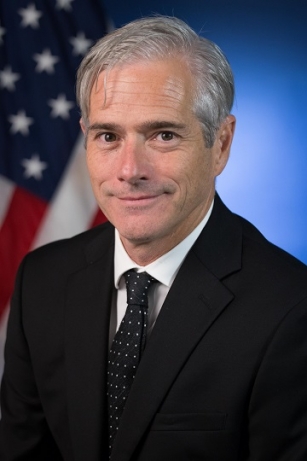
    David M. DeVillers, U.S. Attorney for the Southern District of Ohio

    The alleged conspiracy, which revolved around the bailout of two failing nuclear plants in Northern Ohio, is “likely the largest bribery and money-laundering scheme ever in the state of Ohio,” David M. DeVillers, U.S. Attorney for the Southern District of Ohio, said at a Tuesday afternoon press conference.

    Shortly after the press conference, Ohio Gov. Mike DeWine called on his fellow Republican to step down.

    “I am deeply concerned about the allegations of wrongdoing in the criminal complaint issued today by the U.S. Attorney’s Office,” DeWine, who last year signed the bailout into law, said in a written statement. “Every American has the presumption of innocence until proven guilty.  Because of the nature of these charges, it will be impossible for Speaker Householder to effectively lead the Ohio House of Representatives; therefore, I am calling on Speaker Householder to resign immediately. This is a sad day for Ohio.”

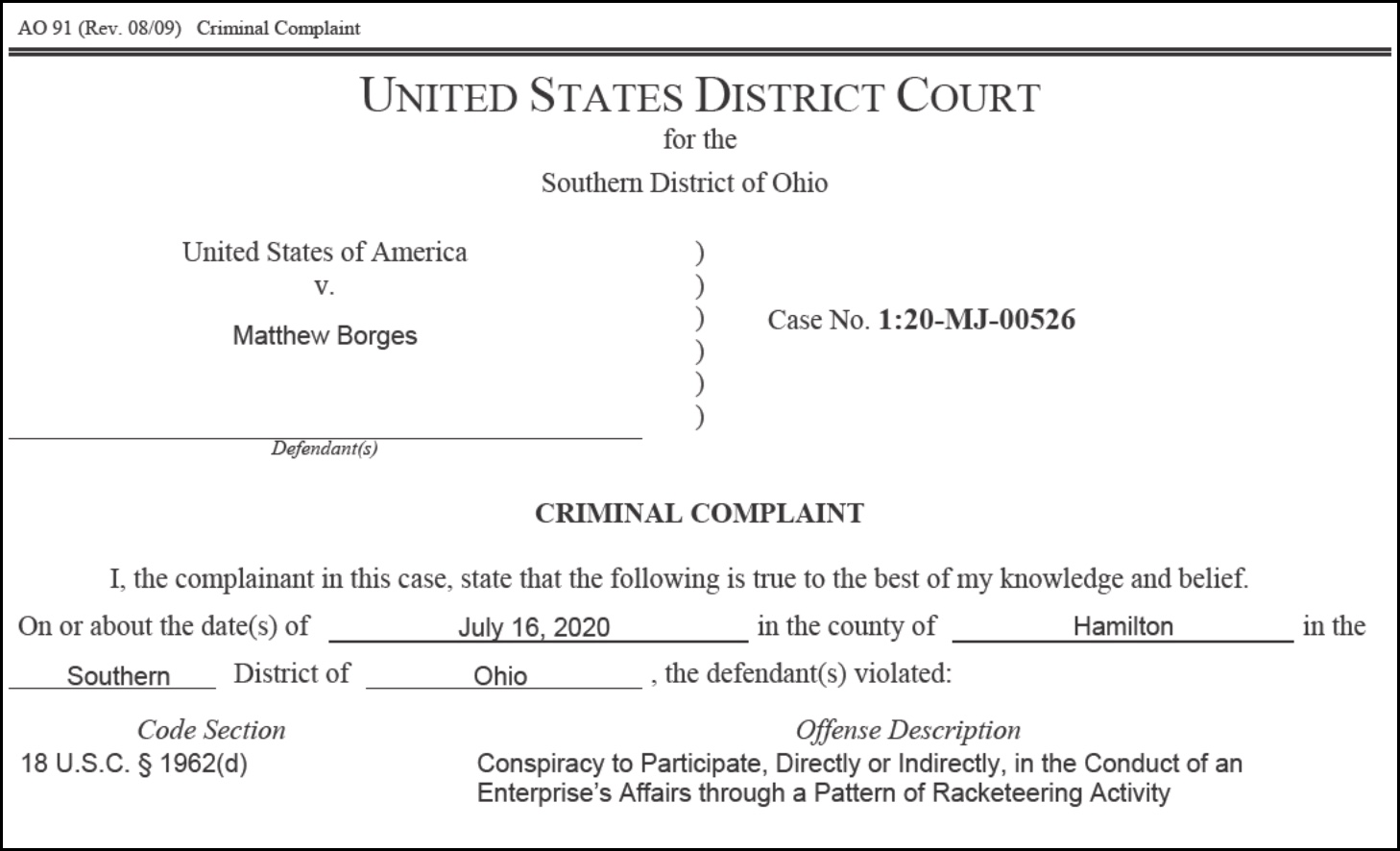
    Read the Criminal Complaint

    ccc

    The criminal complaint says that “Company A,” the former FirstEnergy Solutions of Akron, worked to save its failing nuclear plants by funneling $61 million into Generation Now, a 501(c)(4) “dark money” group controlled by Householder.

    On September 9, 2019, President Donald Trump nominated DeVillers for the United States Attorney in the Southern District of Ohio. The Senate confirmed the nomination in October, and DeVillers took his oath on November 1, 2019.

    “Make no mistake, this is Larry Householder’s 501(c)(4),” the U.S. attorney said.

    The money was used for three general purposes, the complaint said. First it was used to build “Team Householder” through campaign contributions and other measures that helped Householder win the speakership in 2019.

    “In exchange for payment from Company A, Householder’s enterprise helped pass House Bill 6, legislation described by an enterprise member as a billion-dollar ‘bailout’ that saved from closure two failing nuclear power plants in Ohio affiliated with company A,” the complaint said

    The money was also used for the personal benefit of Householder and the other conspirators, DeVillers said. Householder got about $500,000, he said.

    Despite the companies claims of poverty, the interests behind the bailout spent millions — much of it in the form of hard-to-trace dark money on campaign contributions, a xenophobic ad campaign and then on an aggressive effort to stymie a petition drive to repeal the bailout DeWine signed into law a year ago.

    And the money was used to fend off a petition effort to repeal HB6, going so far as to buy plane tickets for and pay $1,000 each to people circulating it to get out of town, DeVillers said.

    The federal prosecutor said that it was crucial to keep the investigation secret until Tuesday. Now it begins a new phase that might be causing some lawmakers, energy executives and some others to lose sleep.

    “We are not done with this case,” he said. “There were things we couldn’t do before. People we couldn’t interview. People we couldn’t subpoena. Documents and search warrants we couldn’t execute. 

    “As of this morning there are a lot of FBI agents knocking on a lot of doors asking a lot of questions, serving lots of subpoenas. That’s going to go on for days.”

    “It takes courage for citizens to assist law enforcement in the ways detailed in the affidavit,” U.S. Attorney David M. DeVillers said. “We are grateful to those who felt a moral duty to work together with agents in bringing to light this alleged, significant public corruption.”

    House Bill 6 is adding $1.5 billion in additional taxpayer bailouts to the $10.2 billion that Akron-based FirstEnergy Solutions and its former parent company, FirstEnergy Corp, have received from taxpayers since 1999. Most of the funds have gone to prop up the Davis-Besse and Perry nuclear power plants in Northern Ohio.

    The company that owns the plants was renamed Energy Harbor after emerging from bankruptcy earlier this year.

    Despite the companies claims of poverty, the interests behind the bailout spent millions — much of it in the form of hard-to-trace dark money on campaign contributions, a xenophobic ad campaign and then on an aggressive effort to stymie a petition drive to repeal the bailout DeWine signed into law a year ago.

    The interests behind the nuclear bailout also contributed heavily to the effort at the beginning of 2019 to elect Householder speaker. He ended up winning the support of 26 Republicans and 26 Democrats, His opponent, Ryan Smith, R-Bidwell, got the votes of 34 Republicans and 12 Democrats.

    The Ohio Republican Party didn’t respond Tuesday to requests for comment.

    The Ohio Democratic Party didn’t respond when asked about the fact that Householder wouldn’t have worn the speakership without Democratic votes. However, the party chairman, David Pepper called on Householder to step down as speaker.

    “As the U.S. attorney indicated, this investigation is ongoing, and we will wait to hear all the facts as they emerge. However, given what was revealed in today’s complaint and the taint of corruption over Ohio legislative activity, we believe Speaker Householder should step down from leadership immediately as he avails himself of his due process rights,” Pepper said in a written statement.

    House Bill 6, which passed 51-38, was quickly signed into law by Gov. Mike DeWine. Under the bill, from 2021 until 2027, every Ohio electricity customer will have to pay a new monthly surcharge that ranges from 85 cents for residential customers to $2,400 for large industrial plants. Ratepayers around the state would also have to chip in up to $1.50 monthly (and up to $1,500 per month for commercial and industrial users) to subsidize coal plants in Ohio and Indiana run by the Ohio Valley Electric Corporation.- cleveland.com

    Starting next January, ratepayers around the state would also have to chip in up to $1.50 monthly (and up to $1,500 per month for commercial and industrial users) to subsidize coal plants in Ohio and Indiana run by the Ohio Valley Electric Corporation.

    This isn’t Householder’s first encounter with federal law enforcement. 

    In 2006, the Justice Department told the FBI that it wouldn’t pursue charges against Householder. The FBI had been told two years earlier that Householder had used his post as head of the House Republican Campaign Committee to overpay some vendors in exchange for kickbacks from them.

    Nor is Householder, 61, of Glenford, the first Ohio House speaker to find himself in the FBI’s crosshairs. In 2018, Speaker Cliff Rosenberger, a Republican, resigned amid an FBI probe of his overseas travel. He has not been charged, but the investigation remains open.

    cccc