Tag: K-12

  • Teaching about race is good, actually. States need to stop banning it.

    Teaching about race is good, actually. States need to stop banning it.

    Getty Images

    by Ian Wright

    In this back to school season, millions of American students are returning to classrooms where the wrong course, lesson, or textbook can lead to deep trouble. Why? Because for the last several years, conservative activists and lawmakers have been waging a crusade against “critical race theory,” or CRT.

    Critical race theory is an academic concept acknowledging that racism isn’t simply the result of individual prejudice but is also embedded in our institutions through laws, regulations, and rules.

    As school districts have emphasized, it’s a higher education concept rarely taught in K-12 schools. But cynical activists have used CRT as a catch-all term to target a broad range of diversity, equity, and inclusion initiatives — and seemingly any discussion about race and racism in the classroom.

    Since January 2021, 44 states have “introduced bills or taken other steps that would restrict teaching critical race theory or limit how teachers can discuss racism and sexism,” according to Education Weekly. And as of this writing, UCLA has identified 807 anti-CRT “bills, resolutions, executive orders, opinion letters, statements, and other measures” since September 2020.

    ________________

    IN OHIO

    Bills that would have prohibited discussion of certain topics related to race and sex, forbid schools from awarding credit for student service learning with advocacy groups, and ban “any textbook, instructional material, or academic curriculum that promotes any divisive or inherently racist concept” all failed to pass during the 2021 and 2022 sessions.

    ________________

    Critics claim — falsely — that CRT teaches that all white people are oppressors, while Black people are simply oppressed victims. Many opponents claim it teaches white students to “hate their own race,” or to feel guilty about events that happened before they were born.

    In reality, CRT gives students of every race the tools to understand how our institutions treat people of different races unequally — and how we can make those systems fairer. That’s learning students of every race would be better off with.

    But instead, this barrage of draconian legislation is having a chilling effect on speech in the classroom.

    In 2022, Florida passed the “Stop W.O.K.E. Act,” which prohibits teaching that could lead to a student feeling “discomfort” because of their race, sex, or nationality. But the law’s vague language makes it difficult for educators to determine what they can or cannot teach, ultimately restricting classroom instruction. In my home state of Texas, SB3 similarly restricts these classroom discussions.

    Running afoul of these laws can get teachers and school administrators in trouble. As a result of this hostile environment, the RAND Corporation found that two-thirds of K-12 school teachers have decided “to limit instruction about political and social issues in the classroom.”

    Notably, this self-censorship extends beyond states with such policies: 55 percent of teachers without state or local restrictions on CRT have still decided to limit classroom discussions of race and history.

    As a student, I find this distressing.

    My high school history classes gave me a much richer understanding of race in our history, especially the discussions we had at the height of the Black Lives Matter protests. And in college, I’ve gotten to learn about racial inequalities in everything from housing and real estate to health care, politics, education, and immigration policy.

    As a person of color, I can’t imagine where I’d be without this understanding. Neither white students nor students of color will benefit from laws designed to censor their understanding of history, critical thinking, and open dialogue in the classroom.

    The fight against CRT is a fight against the principles of education that encourage us to question, learn, and grow. Rather than shielding students from uncomfortable truths, which they can certainly handle, we should seek to equip them with the knowledge to navigate the world, think critically about our history and institutions, and push for a more inclusive country.

    This column was originally published at OtherWords.org.


    Ian Wright

    Ian Wright

    Ian Wright is a Henry A. Wallace Fellow at the Institute for Policy Studies and a student at Rice University from Dallas, Texas.

    MORE FROM AUTHOR


  • Education budget debate begins as Jan. budget shows declines in higher ed, K-12

    Education budget debate begins as Jan. budget shows declines in higher ed, K-12

    Getty Images.

    By Susan Tebben and Ohio Capital Journal

    Subcommittees on K-12 and higher education are beginning their discussions on the new operating budget this week, and they have plenty of budgetary information to look at, including declines shown in the January budget report.

    The Ohio House Finance subcommittee on higher education will take their first look at the pieces of the state operating budget that touch on higher education this week

    As they look to the future of funding colleges and universities in the state, the Office of Budget and Management gave a look at last month’s disbursements, and year-to-date funding disbursements that were below estimates.

    According to the most recent OBM monthly budget data report, January disbursements for higher education was 3.9% below estimates, a total of $7.2 million less than the month before.

    The state budget agency said declines came from below-estimate spending in the Ohio College Opportunity Grant, Choose Ohio First Scholarship and National Guard Scholarship programs. These programs had “lower-than expected requests for reimbursement from higher education institutions,” according to the OBM.

    In his executive budget proposal, Gov. Mike DeWine wants to raise the Ohio College Opportunity Grant award total by $500, and build award 2,000 more scholarships the Choose Ohio First program.

    On the year, higher education institutions received 1.2% less than the year before, and compared to January 2020, they received 11.5% less in disbursements last month.

    The executive budget proposal increases the state’s share of instruction, the main source of direct state aid colleges and universities receive, by 1.8% over the biennium “to maintain quality and provide support services.”

    The House Finance subcommittee on primary and secondary education has the operating budget as the only measure on the agenda for its meeting, scheduled for Thursday morning.

    They will look at the governor’s proposals to disburse more than $13 billion through fiscal years 2022 and 2023, including $1.1 billion in student wellness services.

    DeWine’s budget proposal adds $125 million in foundation funding that were taken away during pandemic budget cuts.

    In January, the OBM reported disbursements of $7.2 million to the Ohio Department of Education, nearly 1% below estimates for the month.

    The declines were credited to lower spending on EdChoice private school voucher program expansion, early childhood education and pupil transportation.

    The OBM report said early childhood education has been shifted away from the general revenue fund, and the EdChoice and transportation drops were due to offset payments and overspending on transportation in December.

    “The below-estimated spending was partially offset by the above-estimated disbursements for the Foundation Funding line item as the College Credit Plus payment to colleges for the summer and fall 2020 terms was above estimate,” the report stated.

    The primary and secondary education subcommittee also has a bill overhauling the funding formula for the state’s public school system on their desk to be considered during this General Assembly.

    An overhaul of that formula would change the sources and methods of disbursement to schools, releasing some of the burden on property taxes, and creating a payment system that goes more directly through the state.

    State aid to the schools through the foundation funding totaled $715.1 million in January, $8 million above estimates, according to the OBM. But disbursements were 6.2% less than January of last year, accounting for a $50 million loss.

  • Loveland Board to hold special meeting Thursday to discuss reopening plan

    Loveland Board to hold special meeting Thursday to discuss reopening plan

    August 26 is the first day for all students.

    Loveland, Ohio – The Loveland City School District Board of Education will hold a special meeting on Thursday, August 6 at 5:30 PM to discuss the progress pertaining to the opening of Loveland Schools for the 2020-2021 school year.
    xxx
    The special meeting will be held virtually and live-streamed on the Loveland Board of Education’s YouTube channel.
    xxx

    The link for the meeting will be available in advance of the meeting on the district’s website at lovelandschools.org/BoardofEducation.aspx or go directly to the YouTube channel to view the meeting. The recording of the meeting will also be archived and available on YouTube.

    August 6 Board Special Meeting livestream link:
    https://youtu.be/rcCLCHcHWE0

    The district is currently offering both in-person and online learning options for the upcoming school year. Loveland parents/guardians must select the learning option (in-person or online) for their child(ren) for the first semester of the 2020-2021 school year. Loveland City School District has extended the deadline for online parent choice for all grade levels to August 9, 2020. Families can listen to the progress update at this special board meeting.

    “We want to ensure that our parents have the most current information and data available to support their decision-making for their child’s learning option this semester. We know many parents are struggling with this decision and we want to offer the best guidance possible,” said Loveland Superintendent, Dr. Amy Crouse.

    Loveland’s selection form for grades “K-12” will now be open until Sunday, August 9 at 11:55 p.m. Parents also have the option to change their selection by the August 9 deadline.

    August 26 is the first day for all students.

    Click on the links below to access the online selection forms.

    2020-2021 Selection Form: Grades K-4

    2020-2021 Selection Form: Grades 5-12

    The District also held a PK-4 virtual information meeting today and you can view it HERE.
  • Milford Schools will have new start & dismissal times next year

    Milford Schools will have new start & dismissal times next year

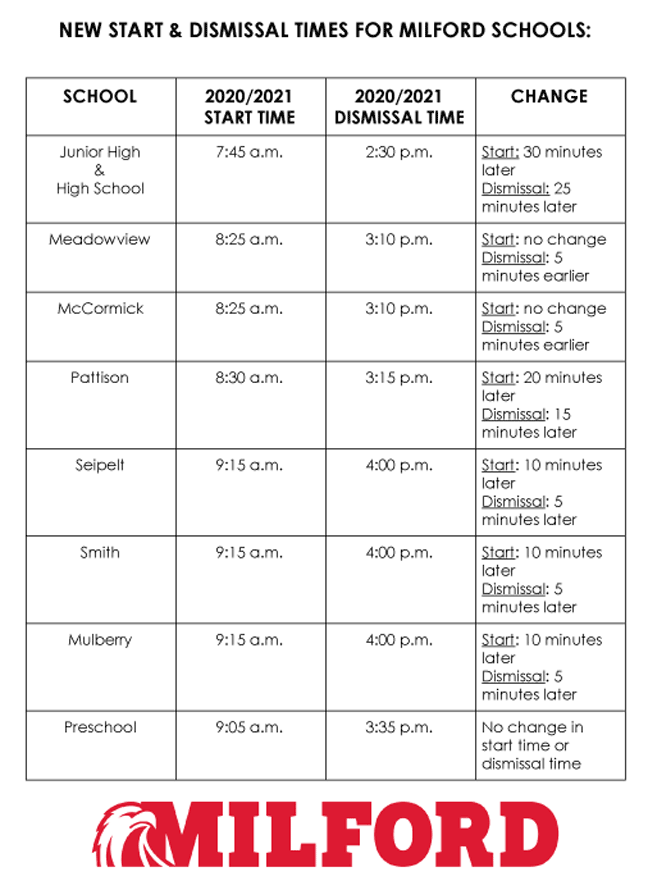
    Milford, Ohio – Last week Milford’s Board of Education approved new start and dismissal times for all of of Milford’s School buildings.

    Why are start times changing? 

    Teens typically go to bed later as they get older, but have to get up earlier to go to school. Research shows that teens require a minimum of 8 to 10 hours of sleep, with an optimum minimum of 9 and a quarter hours of sleep each night. However, surveys have shown that teens are only getting about seven hours of sleep per night or less. Sleep deprivation is a problem for teens: sleep deprivation increases the risk of injuries in sports, and increases the risks of hypertension, obesity, and depression. Research shows us the benefits of a good night’s sleep include: improved memory and learning, improved attention, emotional regulation, better weight control, and improved mental health.

    Why are the time changes not the same for each elementary building? 

    We currently operate our transportation routes on a three-tier system. Our junior high and high school routes are first, followed by two different elementary building routes. After working with a transportation consultant to look at routing our buses, it was determined that we could only start the junior high and high school later if the gap between those routes and the elementary routes remained. To maintain the cost-efficiency of a three-tier busing system, the elementary times had to be adjusted as well. Our elementary buildings have had three staggered start times, and that will continue with this new schedule to ensure efficiency. 

    Why change the start times now?

    Milford Junior High and Milford High School currently begin at 7:15 AM. Research shows that the optimum start time is 8:30 AM Pushing back the start time for our junior high and high schools means shifting the transportations schedules district-wide for eight of our school buildings K-12. Three years ago, our administrative team began investigating ways to delay start times while also being fiscally responsible. A phase-in approach to push back start times incrementally was suggested. The result is that, for the 2020/2021 school year, the junior high and high school will begin half an hour later, and the elementary buildings will shift five to 10 minutes earlier or later. Even these small adjustments will have a positive impact on students and minimum impact on district finances. 

    Why do the elementary building start times have to change to accommodate a later start time at the junior high and high school?

    In order to start the junior high and high school later, transportation routes will need to be adjusted. Buses will transport our secondary students later, therefore will be picking up and transporting our elementary students later. 

    Will the start times change again in the future?

    Research shows us that the optimum start time for junior high and high school is 8:30 AM. We would like to eventually reach the later start time of 8:30 AM and will continue to study that feasibility while also ensuring fiscal responsibility. Even this small adjustment of a half an hour later start time for our junior high and high school will have a positive impact on our teenage students. In addition, these new start times will ensure that our junior and high school students will be getting on the bus or driving to school during daylight hours for most of the school year.

    During last week’s meeting, Board President Chris Hamm said implementing the new start times now is a good first step. “We know this isn’t the finish line, but this is a very good start,” Mr. Hamm said. “We don’t know yet what next school year will look like, but we have to make plans as if we’re starting the year up normally and make contingency plans if we don’t.”