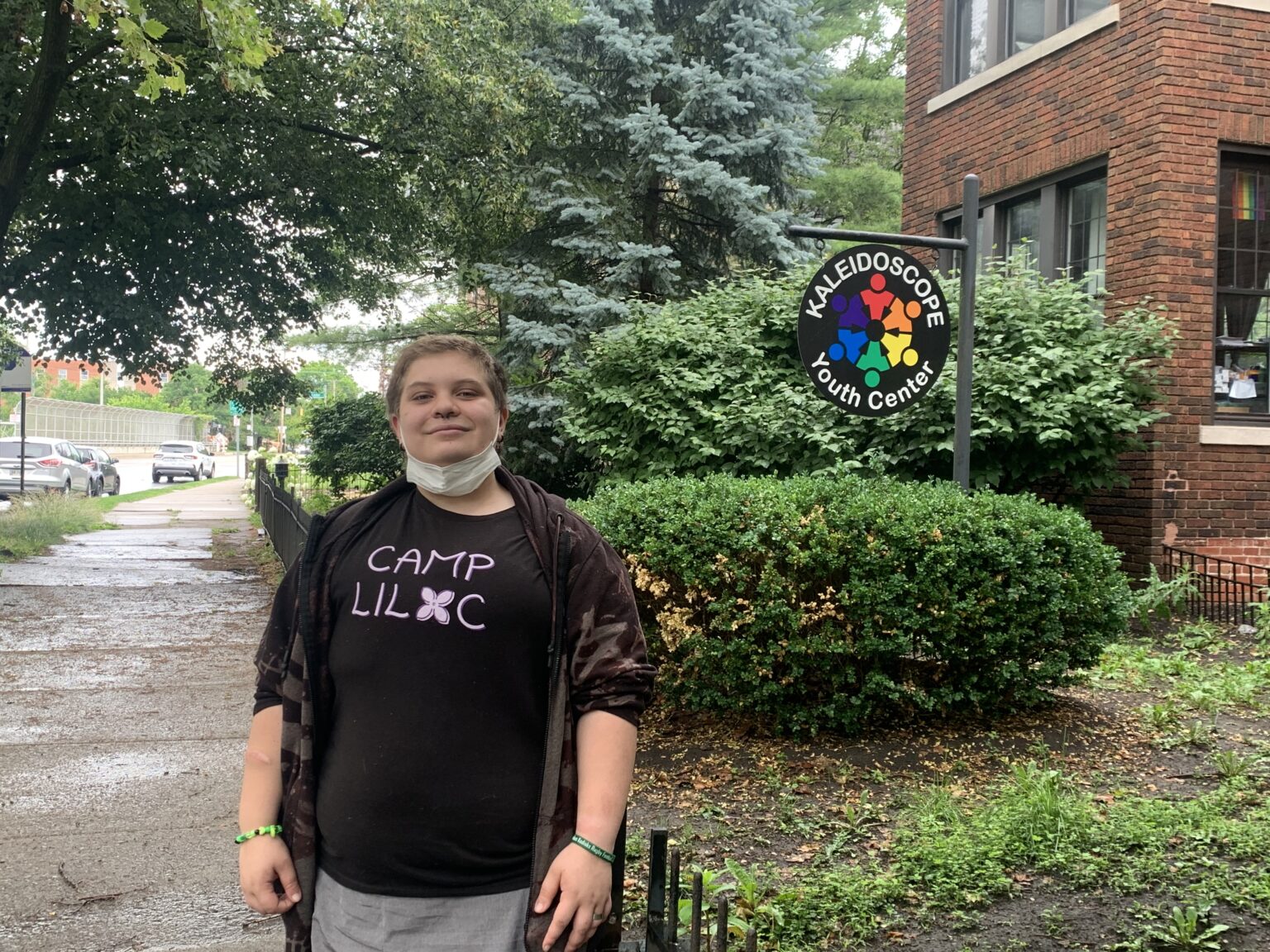
Tag: Kaleidoscope Youth Center

  • LGBTQ Ohioans and advocates are asking Gov. Mike DeWine to veto ‘Don’t Say Gay’ bill

    LGBTQ Ohioans and advocates are asking Gov. Mike DeWine to veto ‘Don’t Say Gay’ bill

    Requires school districts to create a mandatory religious release time policy

    By:  – Ohio Capital Journal

    Advocates condemned Ohio lawmakers for passing another anti-LGBTQ bill as the General Assembly wrapped up late Wednesday night, urging Gov. Mike DeWine to veto the legislation, though DeWine has indicated he will sign it.

    The Ohio Senate passed House Bill 8 and the Ohio House concurred with changes made to the bill, sending it to DeWine’s desk. He will have 10 days to either sign the bill into law or veto it, once he receives it. DeWine has indicated he favors the legislation.

    The controversial bill requires educators to out a students’ sexuality to their parents, requires public schools to let parents know about sexuality content materials ahead of time so they can request alternative instructions, and requires school districts to create a mandatory religious release time policy.

    “We are deeply disappointed that the legislature decided once again to attack LGBTQIA+ youth by passing yet another bill that will make schools less safe and inclusive for queer and transgender people,” Kaleidoscope Youth Center, an organization that serves LGBTQIA+ youth, said in a statement.

    TransOhio said passing H.B. 8 is a “harmful step backward” for students.

    “By requiring a religious release program and restricting discussions on gender and sexuality, the law imposes a narrow worldview on public education and limits teachers’ ability to provide inclusive, fact-based instruction,” TransOhio said in a statement. “By mandating the reporting of students’ assumed gender identities and behaviors to parents, the law breaches student privacy, erodes trust, and puts vulnerable children at risk of harm.”

    Those who supported H.B. 8 called it the ‘Parents’ Bill of Rights’, but those who opposed it called it the ‘Don’t Say Gay Bill,’ due to its similar language to Florida’s ‘Don’t Say Gay’ law that passed in 2022.

    “While this bill is presented as a “Parents’ Bill of Rights,” its provisions pose significant risks to the well-being of LGBTQ+ youth and raise troubling questions about the separation of church and state in public education,” Stonewall Columbus said in a statement.

    The Ohio Education Association said this bill will take time away from educators being able to teach students and will create more challenges for marginalized students.

    “It unnecessarily entangles state government in regulating communications between parents and educators, sowing distrust rather than fostering the collaboration needed to ensure all students can learn, grow, and thrive,” OEA President Scott DiMauro said in a statement.

    The bill, which underwent several changes since it was first introduced in February 2023, received much opposition.

    “Despite the outcry from hundreds of students, parents, and social workers, conservatives want to broaden curriculum censorship, weaken current civil rights protections for LGBTQ+ individuals, and impose new disclosure and alternative curriculum mandates on teachers and counselors,” Lauren Blauvelt, executive director of Planned Parenthood Advocates of Ohio, said in a statement.

    “These requirements would create conflicting, burdensome obligations for educators, making it overly difficult for them to comply,” Blauvelt said.

    The Ohio Center for Sex Education said this bill is at odds with studies that show comprehensive sexuality education programs reduce the rates of sexual activity, sexual risk behaviors, sexually transmitted infections, and adolescent pregnancy.

    “This bill’s vague language creates an environment of fear and division, putting LGBTQ+ students at risk and eroding the trust that educators work hard to build with their students and families,” Jenna Wojdacz, the center’s assistant vice president, said in a statement.

    Equality Ohio, along with several other organizations, is asking DeWine to veto the bill.

    “Overnight when most school-age children are asleep, the legislature rushed through another shameful attack on LGBTQ+ youth,” Equality Ohio Executive Director Dwayne Steward said in a statement.

    LifeWise Academy, a Hilliard-based religious instruction program, celebrated the passage of H.B. 8.

    “Families understand the benefits of Bible-based character education during school hours, given the increasing demand for our program in communities throughout Ohio and the country,” LifeWise CEO Joel Penton said in a statement.

    LifeWise enrolls 50,000 students across 29 states, including about 160 Ohio school districts.

    Follow OCJ Reporter Megan Henry on Bluesky.

    YOU MAKE OUR WORK POSSIBLE.

    ___________
    Megan Henry
    Megan Henry

    Megan Henry is a reporter for the Ohio Capital Journal and has spent the past five years reporting in Ohio on various topics including education, healthcare, business and crime. She previously worked at The Columbus Dispatch, part of the USA Today Network.

    Ohio Capital Journal is part of States Newsroom, the nation’s largest state-focused nonprofit news organization.

    MORE FROM AUTHOR

  • Transgender student bathroom ban bill passes out of Ohio House Higher Education Committee

    Transgender student bathroom ban bill passes out of Ohio House Higher Education Committee

    Getty Image

    House Bill 183 would require Ohio K-12 schools and colleges to mandate that students could only use the bathroom or locker room that matches their sex assigned at birth.

    Local Cosponsors are:

    Jean Schmidt, District 62 (R)
    Jennifer Gross, District 45 (R)
    Thomas Hall, District 46 (R)
    Bill Seitz, District, 30 (R)
    BY:  Ohio Capital Journal

    A bill that would ban transgender students from using the bathroom and locker room that matches up with their gender identity passed out of the Ohio House Higher Education Committee Wednesday by a 10-5 party line vote.

    State Reps. Beth Lear, R-Galena, and Adam Bird, R-New Richmond, introduced House Bill 183 which would require Ohio K-12 schools and colleges to mandate that students could only use the bathroom or locker room that matches their sex assigned at birth. It would also prohibit schools from allowing students to share overnight accommodations with the opposite sex.

    HB 183 now awaits further consideration in the House, which is next scheduled to be in session April 24.

    Parents, grandparents, and school superintendents asked Bird for this bill, he said.

    The American Medical Association officially opposes policies preventing transgender individuals from accessing basic human services and public facilities consistent with gender identity.

    HB 183 would not prohibit a school from having single-occupancy facilities and it would not apply to someone helping a person with a disability or a child younger than 10 years old being assisted by a parent, guardian, or family member.

    State Rep. Gayle Manning, R- North Ridgeville, thought about bringing an amendment to the committee that would have carved colleges and universities out of the bill, but she decided against it.

    “I’m hopeful we will continue to have these discussions on the removal of higher ed,” she said. “The reason being, we’re talking about adults. Universities are similar to a city with the number of students that they have. Frivolous lawsuits that will increase the cost of tuition eventually and the cost of our families.”

    Manning voted in favor of the bill even though she hopes lawmakers can continue conversations to “find a better solution.”

    Bird opposes taking the higher education component out of the bill.

    “The reason I oppose that is because we have college credit plus in Ohio,” he said. “We seventh graders going to college, kids in high school going to colleges and in that college environment, we got to make sure they are protected.”

    State Rep. Joe Miller, D-Amherst, vocalized his disdain for the bill before the committee voted.

    “Here we are again … taking away school districts and colleges’ ability and their leadership to make decisions that are best for providing safe, equitable access for all Ohio students,” Miller said. “I hope that this doesn’t see the floor and doesn’t see the governor’s desk.”

    More than 100 people submitted opponent testimony on HB 183 and more than 30 people submitted proponent testimony.

    “We do love and care about all kids,” Bird said when asked about all the backlash the bill has received. “Me and my Republican colleagues have heard from constituents all across the state. They may not have been loud. They may not have been vocal. They may not have come with a sign to the Statehouse, but we are here representing the vast majority of Ohioans who want protections.”

    Trans advocates speak out against HB 183

    Transgender advocates hosted a press conference following the House Higher Education Committee to voice their opposition to HB 183.

    Trans Ohio Board Member Carson Hartlage said HB 183 is harmful to all students, including cisgender students.

    “Most trans non binary and gender non conforming students only begin using restrooms that align with their gender identities after they’ve experienced some form of trauma when using a restroom that aligns with their sex assigned at birth,” Hartlage said.

    Thirty percent of LGBTQ+ students said they were prevented from using the bathroom that aligned with their gender, and 26% were stopped from using the locker room that aligned with their gender, according to Ohio’s 2021 state snapshot by GLSEN, which examines the school experiences of LGBTQ middle and high school students.

    When looking specifically at transgender and nonbinary students, 42% were prevented from using the bathroom that aligned with their gender and 36% couldn’t use the locker room that aligned with their gender, according to the Ohio GLSEN report.

    Ohio’s first openly transgender public official and member of the Gahanna-Jefferson Public Schools’ Board of Education Dion Manley shared his concerns.

    “As a trans man is I’ve been going into men’s restrooms for 25 years without incident,” Manley said. “I go visit the schools on a regular basis. So these legislators want me to go into a girls restroom in the elementary school, middle school, and high school.”

    Mallory Golski, civic engagement and advocacy manager at Kaleidoscope Youth Center, said how Ohio was recently at the center of history in a positive way with Monday’s eclipse.

    “We’re here reflecting on how we’re at the epicenter of another piece of history,” she said. “And unfortunately, we’re at the wrong place at the wrong time. Unlike the fleeting blackout of the total solar eclipse, the history I’m talking about here today at the statehouse leaves transgender youth in the dark.”

    Jeanne Ogden’s daughter would be directly impacted by this bill. Her daughter’s college classroom building does not have single-use restrooms in the building, forcing her daughter to go across the street to use the restroom.

    “These kids getting bullied and yes, their mental health is suffering,” said Ogden, the executive director of Trans Allies of Ohio. “Trans people are tired. Parents are exhausted.”

    Follow OCJ Reporter Megan Henry on Twitter.

    _______________

    Megan Henry
    MEGAN HENRY

    Megan Henry is a reporter for the Ohio Capital Journal and has spent the past five years reporting in Ohio on various topics including education, healthcare, business and crime. She previously worked at The Columbus Dispatch, part of the USA Today Network.

    Ohio Capital Journal is part of States Newsroom, the nation’s largest state-focused nonprofit news organization.

    MORE FROM AUTHOR

  • Kaleidoscope Youth Center: “Tell Gov DeWine to VETO HB68.”

    Kaleidoscope Youth Center: “Tell Gov DeWine to VETO HB68.”

    HELP STOP HOUSE BILL 68 FROM BECOMING LAW: Contact Governor Mike DeWine (614-466-3555, governor@governor.ohio.gov, or governor.ohio.gov/contact (https://t.co/J3VeRi8yb4) ) and tell him to VETO H.B. 68.

    Yesterday, the Ohio Legislature passed House Bill 68 to ban gender-affirming care for minors and ban trans women and girls from playing K-12 and college sports in Ohio. The bill now moves to desk of Governor Mike DeWine. Once received, he’ll have 10 days to sign or veto the bill.

    Kaleidoscope Youth Center is disgusted by H.B. 68 and we denounce and condemn its passage. Moving this legislation forward demonstrates a complete disregard and concern for the lives, futures, and – perhaps most importantly – the humanity of Ohio’s youth. We ask that Governor DeWine not sign this bill into law.

    H.B. 68 is blatant discrimination. This bill unnecessarily targets transgender and nonbinary youth, their families and allied providers and health professionals. H.B. 68 politicizes the lives of young people in Ohio with zero regard for their health and wellbeing. It is an egregious misuse of power and a breach of public trust in caring for the youth of Ohio.

    Legislation and policies such as H.B. 68 do nothing to protect any child or young person, and instead, only further marginalizes and promotes harm. This is bullying behavior. Ohio’s young people and their families deserve more.

    KYC is committed to standing with and for our young people and continuing to be a safe place where they can be affirmed and loved in community.

    https://www.instagram.com/p/C0z_iXup01k/
    SIGN THE OHIO IS HOME LETTER (https://tinyurl.com/OhioIsOurHome)
  • Ohio law banning gender-affirming care and trans athletes heads to Gov. Mike DeWine’s desk

    Ohio law banning gender-affirming care and trans athletes heads to Gov. Mike DeWine’s desk

    COLUMBUS, Ohio — DECEMBER 13: Advocates for the trans community protest outside the Senate Chamber while inside lawmakers debated and passed HB 68 that bans gender-affirming care for transgender youth and bars transgender kids from participating on sports teams, December 13, 2023, at the Statehouse in Columbus, Ohio. (Photo by Graham Stokes for Ohio Capital Journal. Republish photo only with original article.)

    BY:  Ohio Capital Journal

    A bill that would block doctors from providing gender-affirming care to trans youth and prevent trans athletes from participating in Ohio women’s sports is going to Ohio Gov. Mike DeWine’s desk.

    The Ohio Senate passed House Bill 68 in a 24-8 vote Wednesday afternoon and the Ohio House concurred with the Senate amendments in a 61-27 vote Wednesday night. DeWine now has 10 business days to sign or veto the bill.

    “We await a final bill to review before offering formal comment,” DeWine’s press secretary Dan Tierney said in an email Wednesday afternoon.

    State Senator Nathan Manning, R-North Ridgeville, was the lone Republican who joined Senate Democrats in voting against the bill.

    HB 68, introduced by Rep. Gary Click, R-Vickery, would block doctors from providing gender-affirming care to trans youth, including puberty blockers and hormone therapy.

    The bill would ban physicians from performing gender reassignment surgery on a minor, but many opponents have testified that no Ohio children’s hospital currently performs gender-affirming surgery on those under 18. An amendment was added to HB 68 Wednesday that added a grandfather clause that would allow doctors who already started treatment on patients to continue.

    Gender-affirming care is supported by every major medical organization in the United States. Children’s hospitals across Ohio, the Ohio Children’s Hospital Association and the Ohio Academy of Family Physicians all oppose HB 68.

    House Minority Leader Allison Russo, D-Upper Arlington, said she hopes DeWine will listen to the medical professionals who oppose the bill.

    “The bill is so cruel on so many levels but at the end of the day this violates parents rights to make decisions about their children’s own healthcare,” she said. “It’s putting the government in the middle of families and their healthcare providers.”

    Twenty-two other states have passed a law that blocks gender affirming care, according to the Human Rights Campaign.

    Gender-affirming surgery for minors is not common with less than 3,700 performed in the U.S. on patients ages 12 to 18 from 2016 through 2019, according to a study published in August in JAMA Network Open. It’s unclear how many of those patients were 18 when they underwent those surgeries.

    Ohio House Speaker Jason Stephens, R-Kitts Hill, said the bill empowers parents.

    “The important part is protecting children and making sure parents know what’s going on,” he said.

    State Senator Bill DeMora, D-Columbus, called HB 68 a disgusting piece of legislation.

    “Current hospital policies ensure gender-affirming care for minors who seek it is safe, medically necessary, and appropriate,” DeMora said in a statement. “It’s clear that this bill is targeting youth already at an increased risk of suicide and violence, and subjecting them to even more risk.”

    He took a moment to speak directly to transgender people during the Senate session.

    “Your life has meaning and purpose,” DeMora said. “You are seen, valued and loved.”

    Trans athlete ban

    House Bill 6 — which prevents trans athletes from participating in Ohio women’s sports — was rolled into HB 68 back in June. The would prevent males from playing female sports, but everyone would still be able to play on co-ed teams.

    There were only six transgender high school female student athletes in Ohio, the Capital Journal previously reported in the spring.

    If a trans girl wants to play on a team with cis girls in Ohio, she must go through hormone treatments for at least one year or show no physical or  physiological advantages, according to the Ohio High School Athletic Association.

    Twenty-three states have passed similar laws in regards to transgender athletes since 2020, according to ESPN.

     COLUMBUS, Ohio — DECEMBER 13: An advocate for the trans community protests outside the Senate Chamber while inside lawmakers debated and passed HB 68 that bans gender-affirming care for transgender youth and bars transgender kids from participating on sports teams, December 13, 2023, at the Statehouse in Columbus, Ohio. (Photo by Graham Stokes for Ohio Capital Journal) 

    “It is two bills, so much for single subject,” Senate Minority Leader Nickie J. Antonio, D-Lakewood, said.

    She sent a letter to Senators urging them not to pass the bill on Monday.

    “This bill strips rights away from parents and bans children’s access to evidence-based healthcare,” Antonio said in a statement after the bill passed the Senate. “Physicians need to be able to have comprehensive care discussions with patients and their families, but this bill puts them in an impossible position.”

    Hundreds of people submitted opponent testimony against the bill last week during a marathon Senate Government Oversight Committee meeting.

    “We don’t make laws just for the hundreds of people that come and testify,” Senate President Matt Huffman said when asked about this. “We make laws for over 11 million people.”

    Opponents speaks out and protest

    LGBTQ+ advocates who oppose HB 68 had a press conference Wednesday morning to speak out against HB 68 —  arguing families shouldn’t have to decide whether it’s safe to stay in Ohio.

    “Ohio is home and I will not be legislated to leave,” said Densil Porteous, Executive Director of Stonewall Columbus.

     COLUMBUS, Ohio — DECEMBER 13: Advocates for the trans community protest outside the Senate Chamber and repeatedly shouted “shame” when they heard that lawmakers had passed HB 68 that bans gender-affirming care for transgender youth and bars transgender kids from participating on sports teams, December 13, 2023, at the Statehouse in Columbus, Ohio. (Photo by Graham Stokes for Ohio Capital Journal) 

    This bill will make it more challenging for trans and non-binary people, said Dara Adkison, a member of TransOhio.

    “HB 68 will cause people to leave Ohio and no one should be forced from their home for any reason, but especially not because of extreme laws undermining their freedom and safety,” Adkison said.

    Mallory Golski, the civic engagement & advocacy manager for Kaleidoscope Youth Center, spoke in place of a high school student who couldn’t attend the event because they had school tests to take.

    “The people who this bill targets are teenagers,” Golski said. “They are young people who shouldn’t have to make a decision about whether they should show up to school or show up to the statehouse to convince lawmakers of their inherent dignity.”

    She knows many transgender kids who are happier when they receive gender affirmation or care.

    “Taking that away from trans minors would be a detriment,” Golski said.

    Evangelical Lutheran Deacon Nick Bates and father of a 13-year-old nonbinary child said bills like HB 68 force trans children and adults back into hiding.

    “Sadly, HB 68 and other bills targeting trans and non-conforming youth take this peace, comfort and joy up the chimney like the Grinch stealing the Christmas tree,” Bates said.

    Follow OCJ Reporter Megan Henry on Twitter.


    Megan Henry
    MEGAN HENRY

    Megan Henry is a reporter for the Ohio Capital Journal and has spent the past five years reporting in Ohio on various topics including education, healthcare, business and crime. She previously worked at The Columbus Dispatch, part of the USA Today Network.

    MORE FROM AUTHOR

  • “An attack on all trans people,” transgender youth speak out against Ohio legislation

    “An attack on all trans people,” transgender youth speak out against Ohio legislation

    Nathan Alvarez, 15, stands outside Kaleidoscope Youth Center on June 23. He is worried about a bill that would require K-12 schools and colleges to mandate that students could only use the bathroom or locker room that matches their sex assigned at birth. (Photo by Megan Henry, Ohio Capital Journal) Ohio Capital Journal talked to three transgender youths who are concerned about these bills and their potential implications.

    BY:  – Ohio Capital Journal

    Nathan Alvarez is used to people laughing or snickering at him when he uses the men’s bathroom.

    Despite that, the 15-year-old says his high school is one place he doesn’t have to worry about that happening because they have a couple of gender neutral bathrooms and anyone can use the men and women’s restroom.

    But a bill banning transgender students from being able to use the bathroom and locker room that aligns with their gender identity would change all that.

    State Reps. Beth Lear, R-Galena, and Adam Bird, R-New Richmond, recently introduced House Bill 183 which would require K-12 schools and colleges to mandate that students could only use the bathroom or locker room that matches their sex assigned at birth. HB 183 is still in House committee, awaiting sponsor testimony.

    “It would be hell (if the bill were to pass),” Alvarez said, who uses he/him pronouns. “Hearing about it disgusted me. Like it violently disgusted me.”

    HB 183 is one of a handful of anti-trans bills that have been introduced so far in the Ohio General Assembly.

    Doctors wouldn’t be able to give puberty blockers and hormone therapy to trans youth, trans athletes wouldn’t be able to participate in women’s sports, educators would be forced to out students to their parents and require public schools to give parental notification before teaching “sexuality content” if these various anti-trans bills pass through the Republican-controlled Ohio Statehouse.

    OCJ talked to three transgender youths who are concerned about these bills and their potential implications.

    “It’s an attack on all trans people,” said Ko Rupert, who uses she/it pronouns. “They are all uniquely bad, but their uniqueness is important.”

    And it’s not just happening in Ohio.

    There have been more than 220 bills introduced nationwide specifically targeting transgender and non-binary people, according to the Human Rights Campaign year-to-date snapshot from May 23.

    Fifteen laws have been enacted banning gender affirming care for transgender youth and four additional laws have been passed that censor school curriculum like books, according to HRC.

    “It’s very hard to see what’s been already happening in other states and how the bills that they are trying to pass here in Ohio are not even that different,” Jaylah Hollins, 19 said. “I feel like it’s not really in the interest of Ohioans, but only in the interest of anti-trans lobbyists from out of state.”

    House Bill 8

    Hollins is going to start attending Columbus State Community College this fall for social work and hopes to one day work for an organization that helps transgender people.

    “Hopefully if these bills don’t pass, we can try and make Ohio a place where it can be a refuge for trans kids and trans adults,” Hollins, said, who uses she/her pronouns. “Ensuring that trans kids have access to medical care and that adults have access to the facilities that align with their gender identity shouldn’t be politicized in the first place.”

     An advocate for the rights of trans children and their parents holds up a sign. Photo by Morgan Trau, WEWS. 

    While she said all the anti-trans bills are harmful, House Bill 8 stands out to her as the most damning.

    State Reps. D.J. Swearingen, R-Huron, and Sara Carruthers, R-Hamilton, introduced HB 8 which would require public schools to give parents a heads up before teaching “sexuality content” and school staff would have to out students to their parents. HB 8 recently passed the Ohio House.

    “I feel like they don’t see it as putting children in harm’s way when it most likely is because you can’t expect a parent to be able to deal with knowing that their child is within an LGBT umbrella and not have to try and resort to what they may not see at the time as harmful approaches to their child’s identity,” Hollins said.

    She said these bills would prevent children from learning more about themselves and make them feel as though they deserved to be punished because of how they identify.

    “It won’t allow children to be able to understand others who are maybe different from them,” Hollins said. “It will encourage isolation and I think the most devastating would be suicidal ideation, especially with trans and non-binaries who already know that they are coming from families who are unaccepting of those identities.”

    She’s said she’s still debating if she’ll stay in Ohio after college.

    “It’s still hard for me to think about, but for me, I think I would want to stay in Ohio and fight for trans youth,” Hollins said.

    Rupert, a 20-year-old Ohio State University graduate student, is also worried about HB 8 and the stripping away of youth rights.

    “Young people can make decisions, can know their bodies and understand and have a deep relationship with their gender and sexuality and romantic orientations,” Rupert said.

    Alvarez tries to speak out against the anti-trans bills when he gets the chance and even recently appeared on Good Morning America. But he’s not old enough to vote.

    “It’s upsetting to know that there are adults making choices for people to make choices about me. And I don’t have a choice,” Alvarez, of Reynoldsburg, said. “It’s scary.”

    He hopes to move out of Ohio one day and relocate to Washington.

    Anti-trans and anti-LGBTQ bills

    House Bill 68, also known as the  Save Adolescents from Experimentation Act (SAFE Act), would prevent doctors from giving puberty blockers and hormone therapy to trans youth. It would also ban physicians from performing gender reassignment surgery on a minor.

    Many opponents, however, have testified that no Ohio children’s hospital currently performs gender-affirming surgery on those under 18.

    House Bill 6 would prevent trans athletes from participating in Ohio women’s sports and was woven into HB 68, which recently passed the House and now awaits Senate committee consideration.

    Follow OCJ Reporter Megan Henry on Twitter.

    ______________________

    Megan Henry
    MEGAN HENRY

    Megan Henry is a reporter for the Ohio Capital Journal and has spent the past five years reporting in Ohio on various topics including education, healthcare, business and crime. She previously worked at The Columbus Dispatch, part of the USA Today Network.

    MORE FROM AUTHOR

  • Ohio representatives file new anti-trans bill, targeting health care providers

    Ohio representatives file new anti-trans bill, targeting health care providers

    BY: NICK EVANS and Ohio Capital Journal

    Ohio House lawmakers are running back a fight over trans youth in the state. But this time, instead of focusing on school sports, the proposal would prohibit offering minors any kind of gender affirming treatment — from hormones to surgery. The measure, H.B. 454, puts the onus on health care providers by defining that treatment as “unprofessional conduct” for state licensing boards, and making “actual or threatened violations” of the bill grounds for a lawsuit.

    Erin Upchurch, executive director of Columbus’ Kaleidoscope Youth Center, calls the bill dehumanizing.

    “I feel frustrated and angry and extremely disappointed that people who were voted into office to protect all Ohioans are using their platform and their power to actually attack a really specific portion of our communities,” she said. “It is a gross misuse of power and completely an overreach.”

    The bill’s sponsors, Rep. Gary Click, R-Vickery, and Diane Grendell, R-Chesterland, begin by enumerating a series of legislative findings—a laundry list of dubious assertions meant to cast doubt on trans identities and the safety of medical procedures.

    “The risks of gender transition procedures far outweigh any benefit at this stage of clinical study on these procedures,” the legislation claims.

    Upchurch disputes that, noting national organizations like the American Academy of Pediatrics support gender affirming care.

    In a 2018 policy statement on the issue, the organization’s very first recommendation contends transgender youth should have access, “to comprehensive, gender-affirming, and developmentally appropriate health care that is provided in a safe and inclusive clinical space.”

    In addition to punishing providers who offer care, H.B. 454 threatens school workers including teachers, nurses and counselors. The bill says they can’t “withhold” information about a student who is questioning their gender identity from that child’s parent or guardian. But Upchurch, who is a licensed social worker, explained the ethical standard is to maintain confidentiality unless a minor is harming themselves or others.

    “Are you withholding or are you protecting the young person’s confidentiality?” Upchurch asked. “So when we look at what’s accurate and what’s in there, language can be used in a lot of ways to serve our agendas.”

    The bill’s sponsors did not respond to a request for comment, but Sen. Nickie Antonio, D-Lakewood, was quick to condemn the move.

    “I am incredibly frustrated that some members of the General Assembly continue to challenge our most vulnerable children’s right to exist for a political soundbite,” she wrote in a statement.

    Antonio argued lawmakers do not have a role in the health care decisions of individual children.

    “Those decisions must be made in concert with medical experts and physicians,” Antonio said. “Frankly, it is time for the legislature to stop these unnecessary and hateful attacks on transgender youth once and for all.”

    Earlier this year, lawmakers put forward a so-called “Save Women’s Sports Act.” The bill would limit a student’s participation in sports to the team corresponding with the sex they were assigned at birth. Although the proposal got a few hearings, it never passed a committee.

    In June, bill sponsor Rep. Jena Powell (R-Arcanum) tried to force the issue by tacking the language onto an unrelated Senate bill dealing with name, image and likeness policy for college athletes. Her move scuttled the bill, and Gov. Mike DeWine instead issued an executive order giving athletes the green light to sign sponsorship deals.

    The latest proposal has yet to be assigned to a committee.