One of the largest utility scandals in U.S. history has remained largely unknown outside Ohio — until now.
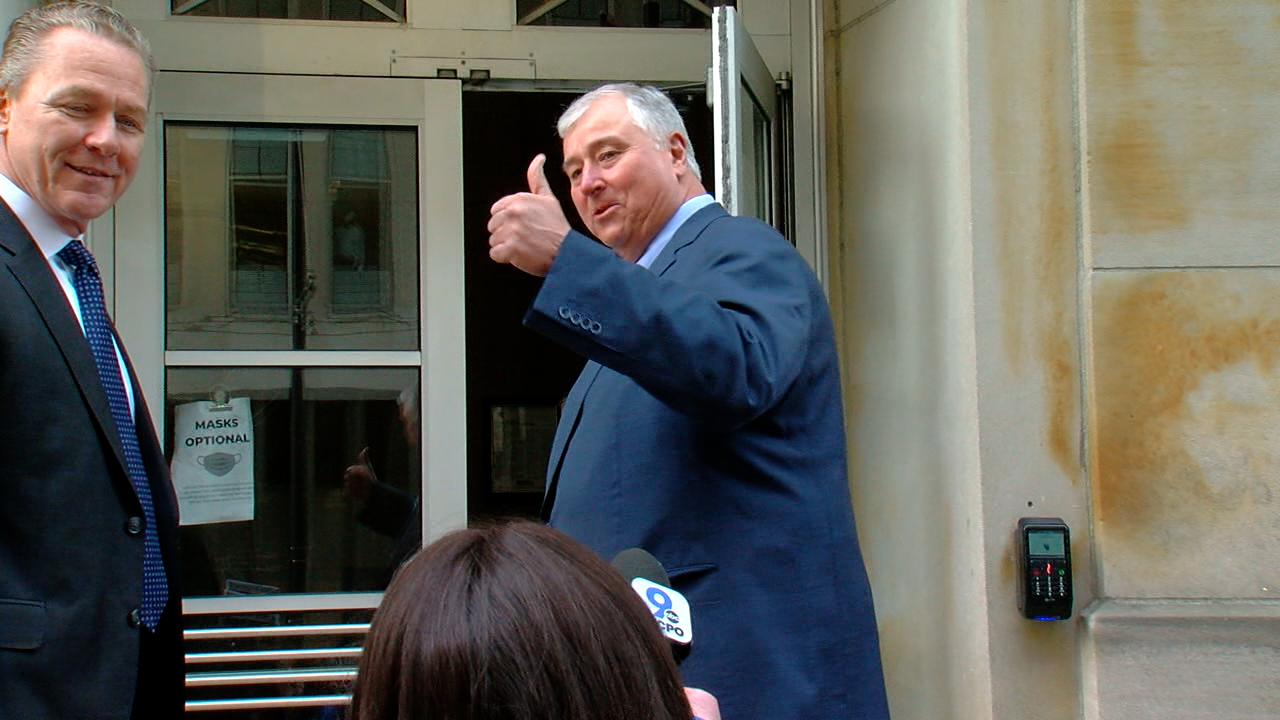
Last week, HBO released a documentary that covers the long, sordid saga, which led to the federal criminal convictions of a former speaker of the Ohio House of Representatives and a former head of the Ohio Republican Party.
“The Dark Money Game: Ohio Confidential” follows the story of how utility companies used roughly $60 million in bribes to public officials to secure more than $1.5 billion in ratepayer subsidies for aging, uneconomical coal and nuclear plants.
Canary Media contributing reporter Kathiann Kowalski has spent more than a decade covering the House Bill 6 saga and Ohio utilities’ other efforts to get ratepayer-funded bailouts. Dan Haugen, a senior editor at Canary Media, recently spoke with Kowalski about her reactions to the new film.
The following transcript has been edited slightly for length and clarity.
Haugen: So, you watched this new HBO documentary “Ohio Confidential” the other day. What about it is still on your mind today?
Kowalski: I was struck by the focus they used of how dark money and gerrymandering undermined voters’ will in the wake of a 2010 Supreme Court case that opened the door for unlimited corporate spending on political campaigns, subject to few conditions.
Haugen: Was there any factual information that wasn’t previously reported by you or others?
Kowalski: A lot of it was very familiar, given the fact that I had read through most of the exhibits, read Neil Clark’s book, gone to part of the trial, and been following this for years. There was an interesting scene where they were able to get footage of the FBI observing a private detective that former Ohio GOP Chair Matt Borges and company had apparently retained to follow Tyler Fehrman, who was a witness in the federal criminal case.
Haugen: Did the film change your understanding of the HB6 story in any way?
Kowalski: They did a decent job connecting some dots. I had not thought through how former Ohio House Speaker Larry Householder’s actions also enabled a far-right coalition in the Legislature to push through an anti-abortion law in 2019. It gave me a broader perspective on the anti-democracy angle of the public corruption, but my understanding of the basic story did not change.
Haugen: Where did the abortion legislation appear on the timeline?
Kowalski: The way that the filmmaker presents it is that once Householder helped these people get the anti-abortion legislation passed, he then had people who felt they owed him something. I looked at the timing, and Gov. Mike DeWine signed the anti-abortion legislation the day before House Bill 6 was introduced.
Haugen: One of the biggest unknowns still today is what, if any, role the governor’s office had in all this. You and others have reported on a December 2018 dinner with FirstEnergy executives, DeWine, and Jon Husted, just weeks before the latter two took office as governor and lieutenant governor. Neither has been charged nor accused of any wrongdoing. Does the film shed any new light on their connections?
Kowalski: The filmmakers include an allegation of $5 million going from FirstEnergy to help elect DeWine. And they note a disclaimer from DeWine’s office that it was all within the confines of what was allowed under the law. That’s basically about all they did. It was not a deep dive into the governor’s actions or Husted, who was recently appointed to fill Vice President JD Vance’s U.S. Senate seat. I think maybe they wanted to keep their story tightly focused on the legislature and what has been proven in the first federal criminal case. That also avoids having to include more disclaimers about how nothing’s been proven against others, everybody denies wrongdoing, etc., etc.
Haugen: So is this something you would recommend that your readers watch?
Kowalski: Yes. It’s compelling storytelling. It does a good job of explaining things in plain terms. There’s a limited cast of characters, and you can follow the story. If House Bill 6 is new to you, it’s definitely worth watching. And it’s certainly important now as we’re looking at not only the continued use of dark money in politics through either nonprofits or limited liability corporations, but also, with technology, likely more ways to cover up potential bribes. So, yes, people should be aware of this.
________________
Kathiann M. Kowalski, Canary Media
Kathiann M. Kowalski is a contributing reporter at Canary Media who covers Ohio. She reports on energy, science, and policy issues and is the author of 25 books. In addition to her journalism career, Kathi is an alumna of Harvard Law School and has spent 15 years practicing law. She is a member of the Society of Environmental Journalists, the National Association of Science Writers, and the Society of Professional Journalists.
Dan Haugen is a senior editor at Canary Media. He joined Canary Media as part of its 2025 merger with the Energy News Network, where he was managing editor and oversaw state and local reporting on clean energy policy. He previously worked as a newspaper reporter, freelance writer, and watchdog editor at a Gannett-owned newsroom in South Dakota. He currently lives with his wife and two kids in Minneapolis, where he enjoys reading books, collecting vinyl, and watching baseball.
A coal company got roughly $12.6 million above market prices to supply one of the 1950s-era plants subsidized by Ohio House Bill 6. That’s roughly 50 times the amount the company gave to the dark money group at the center of that coal and nuclear bailout law, according to a new analysis from the Checks and Balances Project.
In other developments:
An evidentiary hearing about the reasonableness and prudence of the subsidized coal plants’ costs wrapped up last week. But it’s unclear when regulators might issue rulings.
In a separate FirstEnergy case, opponents want regulators to deny or limit more customer charges, saying the rider items should be considered in the company’s full rate case to be filed next May. The evidentiary hearing is expected to continue until Nov. 21.
Former Ohio House Speaker Larry Householder and lobbyist Matt Borges have appealed their criminal convictions but still haven’t filed their briefs. The Department of Justice has not yet filed additional criminal charges related to HB 6, either.
Coal company overpayments
A new report highlights how much Resource Fuels has collected for coal supplied to one of the two 1950s-era coal plants subsidized by HB 6 and run by the Ohio Valley Electric Company, or OVEC.
OVEC paid roughly $12.6 million to Resource Fuels in above-market charges for coal, said Ray Locker, executive director of the Checks and Balances Project, which produced the report. And as a result of HB 6’s coal subsidies, Ohio ratepayers have been paying utilities for their share of OVEC’s costs that exceed their revenue.
In 2018, Resources Fuels also sent $250,000 to Generation Now, the main dark money group in the HB 6 corruption scandal. The Energy and Policy Institute reported that wire transfer earlier this year and connected Resource Fuels to the Boich Companies, which the Columbus Dispatch had earlier identified as “Company C” in the 2020 criminal complaint against Householder and others.
So, Resource Fuels “donated $250,000 to Generation Now to facilitate everything for Larry Householder. And the excess money they’ve been paid on this coal contract is 50 times more,” Locker said.
To back up his calculations, Locker reviewed testimony statements filed with the Public Utilities Commission of Ohio by Elizabeth Stanton, an expert witness for the Office of the Ohio Consumers’ Counsel, and from John Seryak, an expert witness for the Ohio Manufacturers’ Association Energy Group. The case file also includes redacted audit reports from London Economics International.
Stanton’s testimony showed that Clifty Creek, one of the two HB 6-subsidized coal plants, paid about one-fifth more per million BTUs (units of heat value) for coal bought from Resource Fuels, compared to another supplier of coal from the same mine. The price per million BTUs paid to Resource Fuels was also more than that paid to companies providing coal with a higher average heat value.
The PUCO had let some utilities collect OVEC costs from ratepayers even before HB 6 passed. Seryak’s testimony said London Economics “repeatedly found that the cost under the Resource Fuels coal contracts is unusually high.” OVEC had a long-term deal with Resource Fuels, but it was neither prudent nor reasonable, he added. In his view, Ohio utilities have used the HB 6 coal subsidy riders “to recoup losses resulting from an unreasonable decision.”
Seryak’s testimony also connected Resource Fuels to the Boich Companies and discussed the HB 6 corruption scandal.
American Electric Power and Duke Energy both want the PUCO to strike parts of the testimony, arguing against Seryak’s point that the PUCO should not authorize recovery of the coal subsidies while the HB 6 investigations continue. They also want to keep out evidence about cost reviews of pre-HB 6 OVEC riders, which supports points made by Seryak and others.
The PUCO’s hearing examiners struck those parts of Seryak’s testimony on Nov. 6 without a written opinion. The Ohio Manufacturers’ Association Energy Group appealed that decision to the full PUCO on Nov. 13.
“That’s a total smokescreen to divert people from the details of these contracts,” Locker said. “The information is out there. And now they’re trying to stick the genie back in the bottle and say it doesn’t matter.”
Representatives of the Boich Companies did not provide comments in response to Energy News Network’s questions.
The PUCO wrapped up its evidentiary hearing on the 2020 OVEC charges about which Seryak and Stanton provided testimony on Nov. 6. The hearing started on Halloween and took less than one week. Besides the above-market payments to Resource Fuels, challengers contended that other spending by the OVEC coal plants was not reasonable and prudent, including costs related to times when it was uneconomic to run them.
Briefs and reply briefs are due Jan. 8 and Jan. 29, said Matt Schilling, spokesperson for the PUCO. After that, parties will wait for regulators to decide whether to disallow any costs that have already been passed through to ratepayers. Adjustments would presumably be reflected in future charges for the OVEC plants, which run through 2030.
Costs for the coal subsidies continue to mount. The Office of the Ohio Consumers’ Counsel estimates those subsidies have cost ratepayers nearly $221 million since 2020 began.
The PUCO began another evidentiary hearing on Nov. 7 in a FirstEnergy rider case with roughly $1.4 billion at stake. The PUCO currently expects that hearing to continue through Nov. 21, Schilling said.
Among other things, FirstEnergy wants to extend a “delivery capital recovery” charge. That DCR rider is involved in one of four cases the PUCO has put on hold since August 2022 while the Department of Justice considers more criminal charges related to HB 6. The new case also presents questions about possible side deals that may affect settlements. That issue was raised in another of the stayed cases.
Despite the parallels, regulators declared on Oct. 18 that the rider case and two grid modernization cases “are completely unrelated” and refused to lift the stay. The PUCO also refused to put the rider case on hold, because it also deals with charges for customers who don’t choose a competitive electricity supplier. The current tariff for that is due to expire, and Ohio law requires a plan for those customers to be in place, the order said.
The case “introduces various mechanisms aimed at ensuring the ongoing investment and maintenance of the distribution system,” FirstEnergy spokesperson Lauren Siburkis said, talking about the case’s charges for all customers. Those include the DCR rider and an advanced metering infrastructure rider, plus charges for vegetation management and storm mitigation.
The increase for a residential customer using about 750 kilowatt-hours per month of electricity would initially be $3.11 per month. But witnesses for multiple challengers want regulators to deny various riders.
For example, Justin Bieber, an expert for Kroger, said in a filed testimony statement that the DCR rider is improper “single-issue ratemaking.” Instead, he said, it should properly be considered in a full ratemaking case, which would look at all of a utilities’ revenues and expenses. He had a similar view about the vegetation management rider. FirstEnergy is due to file a full ratemaking case next May.
Greg Meyer, an expert for the Office of the Ohio Consumers’ Counsel, similarly challenged the DCR rider, along with the advanced metering rider and storm recovery rider. Aside from the single-issue ratemaking problem, he noted that a process already exists for utilities to recoup major storm costs if they show the costs would impact their total operations.
Colleen Shutrump, another expert for the Ohio Consumers’ Counsel, objected to a proposed energy efficiency rider, saying customers could get efficiency services in a competitive market.
If approved, the riders would last eight years, with some possible adjustments in next year’s ratemaking case. A hearing on charges in a separate grid modernization case is set for January.
Former Ohio House Speaker Larry Householder and lobbyist Matt Borges appealed their criminal convictions related to HB 6 this summer. Yet their lawyers have sought multiple extensions to file legal briefs on the trial court’s alleged errors.
The filings are currently due next month, with the government’s responses due in January. For now, both remain in federal prisons.
Meanwhile, Borges and Householder are still defendants in the state of Ohio’s HB 6 civil case, along with former PUCO Chair Sam Randazzo, FirstEnergy, Energy Harbor (formerly FirstEnergy Solutions), two former FirstEnergy executives and others.
Borges’ amended answer filed on Oct. 25 denies liability for the state’s claims under the Ohio Corrupt Practices Act. The filing also says he wouldn’t be liable anyway because of the legal doctrines of in pari delicto or unclean hands. Those doctrines basically say plaintiffs can’t recover on a civil claim if they themselves engaged in wrongdoing.
Borges’ lawyers did not respond to the Energy News Network’s request for comments about which state actors and what conduct they say supports those defenses.
More charges?
The Department of Justice has not yet filed charges against anyone other than Householder, Borges and others named in their July 2020 criminal complaint and indictment. (Three of the other defendants named have settled, and one has died.) As noted above, four FirstEnergy regulatory cases remain stayed, although various civil cases against the company continue to move ahead.
A Nov. 6 order in one of the shareholder cases calls for Ebony Yeboah-Amankweh, a former lawyer and ethics officer for FirstEnergy, to answer plaintiffs’ lawyers’ questions under oath in a pretrial process called a deposition. The company ended her employment a few months after the 2020 complaint came out.
A separate Nov. 6 order requires Randazzo to turn over documents and information which plaintiffs in that case have sought for months. Randazzo will also have to pay costs arising from the documents dispute.
People from regulatory agencies or utilities “should not get to have their lawyers pick and choose what discovery and subpoena requests they will respond to, and what documents they will turn over,” said Dave Anderson, policy and communications manager for the Energy and Policy Institute.
This article first appeared on Energy News Network and is republished here under a Creative Commons license.
KATHIANN M. KOWALSKI, ENERGY NEWS NETWORK
Kathi is the author of 25 books and more than 600 articles, and writes often on science and policy issues. In addition to her journalism career, Kathi is an alumna of Harvard Law School and has spent 15 years practicing law. She is a member of the Society of Environmental Journalists and the National Association of Science Writers. Kathi covers the state of Ohio.
Refunds for unlawful utility charges are a top priority for Maureen Willis, the veteran litigator who became Ohio’s new consumers’ counsel this month.
The Office of the Ohio Consumers’ Counsel is a state-funded agency that represents ratepayer interests in gas and electric utility cases, including matters relating to House Bill 6, the 2019 law at the heart of Ohio’s nuclear and coal bailout scandal. The office also works for legislative reform to promote competition, eliminate subsidies and protect energy affordability for vulnerable groups.
Ohio Consumers’ Counsel Maureen Willis.
The Energy News Network spoke with Willis about her agenda as Ohio’s official advocate for residential ratepayers.
Why are refunds from utilities a big issue?
“If consumers are charged and there’s a decision by the court or even a federal agency that the charges were unlawful or unreasonable, we think they should get the refund all the way back to when they paid it,” Willis said.
Instead, a majority on the Ohio Supreme Court has held that a 1957 case against “retroactive rulemaking” forbids refunds of charges, called riders. That’s the case even if the court holds the charges are otherwise unlawful or unreasonable and even if the riders were not part of a full ratemaking case.
So, even though the Ohio consumers’ counsel has helped consumers avoid $433 million in charges since 2009, they’re still out $1.5 billion in refunds. That makes the wins something of a “hollow victory, because you’re not getting that money back,” Willis said. “But we will continue to fight.”
What is OCC’s position on renewable energy in Ohio?
“We want to advocate for consumers to get energy at the least cost,” Willis said, noting the agency generally considers itself agnostic on the source of electricity. Nonetheless, “renewables are becoming more and more economic, and that certainly is something that we take into account in the mix,” Willis said.
A 2023 report by Energy Innovation Policy & Technology found that 99% of U.S. coal plants are more costly to keep running than replacing them with new solar, wind or energy storage.
Yet HB 6 and regulatory rulings before it require Ohio ratepayers to subsidize costs for two 1950s-era coal plants. OCC continues to contest those charges.
“To the extent that there are subsidies built into the rate and those subsidies are attached to monopoly rates, it creates a problem” by undermining the market, Willis said. “In Ohio, we do rely on the competitive market to bring consumers lower prices and greater innovation.”
Ohio’s law and rules on utility energy efficiency programs have changed over the past decade. What is OCC’s current position on energy efficiency?
“From our perspective, energy efficiency is a good thing,” Willis said, noting that it can help reduce people’s utility bills. Ten years ago, Ohio law required utilities to meet an energy efficiency standard. Back then, OCC was among parties pushing regulators to require FirstEnergy to bid that energy efficiency into a capacity market auction, which lowered costs to consumers. But in 2019, HB 6 gutted Ohio’s energy efficiency standard.
Now, though, consumers can get energy efficiency products and services from competitive suppliers, Willis said. So, “we would say that the utility really has no business to be in the energy efficiency business anymore.” OCC also objects to “shared savings,” which it views as extra profits for utilities.
A bipartisan bill to let utilities run voluntary energy efficiency programs is pending in the General Assembly. Supporters say utility-run programs can make savings simpler for consumers and can produce benefits for all ratepayers by reducing system-wide demand.
What is OCC’s position on ratemaking reform?
OCC has “always battled” electric security plans, or ESPs, Willis said. “We believe they are crony capitalism.”
A traditional ratemaking case requires utilities to show all their projected costs and revenues, based upon actual data from a representative test year. ESP cases don’t require that detailed scrutiny. They allow utilities to raise rates for isolated issues, without presenting those charges in the context of all of a company’s financial activities. And utilities can reject any change regulators might try to make to a plan — effectively giving them unequal, outsized bargaining power, Willis said.
Along those lines, OCC supports Senate Bill 143, which would get rid of ESPs and strengthen corporate separation between utilities and their affiliates.
OCC opposes Senate Bill 102, which would require periodic rate cases but still allow multiple riders. And the bill would let utilities use projections instead of actual data from test years in full ratemaking cases. Challengers also would have fewer opportunities to conduct pre-hearing discovery from utilities and others.
Discovery procedures are “truth-finding tools,” Willis explained. “To the extent you put limits on those, you’re saying, ‘We don’t really want you to get to the truth; you’re just going to have to accept what the utility has filed.’”
Four HB 6-related cases remain frozen at the PUCO, while FirstEnergy seeks more rider money through another ESP. What’s OCC’s position on that?
“It’s really an unfair situation where we’re stayed when it comes to protecting consumers,” Willis said. “But when it comes to charging consumers rate increases, there’s no stay on those.”
A Sept. 22 filing by OCC asked the PUCO to lift the stay in the four HB 6-linked cases. An Oct. 2 filing by FirstEnergy opposed ending the stay but did not address the argument that it’s unfair to continue the stay while the company has a separate case seeking more money from ratepayers.
What is OCC working on at the federal level?
OCC filed a complaint with federal regulators last month, asking them to review utilities’ “supplemental” transmission projects. As things stand, neither the Federal Energy Regulatory Commission nor the grid operator PJM reviews charges for those projects before utilities ask state regulators to let them pass along the costs to ratepayers. Nor does the PUCO scrutinize the charges, Willis said.
Since 2017, Ohio utilities have added more than $6 billion for “supplemental” projects to their local transmission plans in Ohio, according to the complaint. By filing its complaint, OCC hopes “that someone starts looking at these projects for need, cost-effectiveness and prudence,” Willis said.
OCC is also concerned about the pending transfer of the Energy Harbor (formerly FirstEnergy Services) nuclear plants to Vistra for one of that company’s subsidiaries to run. “We want to make sure that the competitive market is protected,” Willis said.
Where does grid modernization fit in OCC’s agenda?
While the grid needs to be updated, Willis doesn’t want it done through “gold-plating.” Generally speaking, that involves adding pricey equipment that’s not really necessary. The added spending increases the base on which a utility earns a return on investment.
Instead, Willis wants regulators to scrutinize any grid modernization plan carefully: “Is it really needed? And who is benefitting? Is it really to the benefit of residential consumers?” she asks.
What special concerns come into play for consumers with low incomes?
“Payment assistance is something we’re always going to be looking at,” along with the prices charged to low-income customers, disconnection data and more, Willis said. “Part of our advocacy must certainly be to protect the at-risk consumers.”
This article first appeared on Energy News Network and is republished here under a Creative Commons license.
__________________
KATHIANN M. KOWALSKI, ENERGY NEWS NETWORK
Kathi is the author of 25 books and more than 600 articles, and writes often on science and policy issues. In addition to her journalism career, Kathi is an alumna of Harvard Law School and has spent 15 years practicing law. She is a member of the Society of Environmental Journalists and the National Association of Science Writers. Kathi covers the state of Ohio.
A bipartisan proposal advancing in the Republican-controlled Ohio House would allow gas and electric utilities to reintroduce programs designed to help customers save energy.
Prior utility-run programs to reduce electricity use ended after Ohio’s energy efficiency standard was gutted as part of House Bill 6, the 2019 law at the heart of the state’s still unfolding bribery and corruption scandal.
House Bill 79 would let utilities bring back some of those programs, but on a voluntary basis with capped monthly charges and smaller expectations for energy savings.
The legislation is co-sponsored by House Majority Floor Leader Bill Seitz, a Cincinnati Republican who was a perennial critic of the programs before HB 6 passed in 2019.
“The wide support that this bill has received from both sides of the aisle, all utilities, and all the environmental groups is a testimony to the fact that we have built a better mouse trap as we reintroduce responsible energy efficiency programming targeted to those who most need it — residential customers and small businesses,” Seitz said.
The other lead sponsor is a Democrat, Rep. Bride Rose Sweeney of Westlake.
While the bill has broad support, it has critics, too, including customer advocates who worry the programs will lack accountability and become another cash grab for utilities.
What’s in the bill
Under the new legislation, utilities would get to choose whether to offer a portfolio of energy efficiency programs. Utilities would need approval from the Public Utilities Commission of Ohio before offering their group of programs for a period of up to five years.
Residential customers would automatically be included unless they opt out, and their monthly charges would be capped at $1.50. Small commercial customers would also be automatically included, with a cap on monthly charges of $7.50. Mercantile customers would be automatically excluded unless they take action in writing to opt in.
Any portfolio of programs must be cost-effective. In other words, the charges to participating customers must be less than the programs’ combined savings on energy costs, reductions in energy market prices from lower demands, and other quantifiable system benefits. Utilities would have to make yearly filings with the PUCO to show if their portfolios were in fact cost-effective.
Any portfolio offered under HB 79 would have to be designed to achieve at least 0.5% of yearly energy savings, based on the prior year’s retail sales to participating customers. But for HB 6, utility energy efficiency programs would have had to show 2% savings per year from 2021 through 2027.
Additionally, at least one program and 15% of the proposed costs for residential customers must be geared toward low-income residential customers.
“The bill offers a balanced approach to lower energy use and is the result of the hard work of many parties,” said Scott Blake, a spokesperson for AEP Ohio. HB 79 would help “lower energy use for individual customers and the overall cost of energy.” Beyond that, “it creates economic opportunities and jobs through selling and installing energy-efficient equipment and offers opportunities for efficient new construction.”
Energy efficiency after HB 6
The lower targets mean the overall program savings and emissions reductions would be less than what utilities would have had to do without HB 6, but more than what’s been achieved in the last four years. Although some argue that Ohio law still allows voluntary energy efficiency programs, the PUCO rejected a voluntary plan by Duke Energy in June 2020, and agency staff balked about a proposed AEP plan that was ultimately withdrawn.
In some ways, though, HB 79 would improve on earlier programs, said attorney Rob Kelter of the Environmental Law & Policy Center. The bill would prohibit utilities from sending out energy savings kits to customers who don’t request them, and steps would be taken to avoid counting activities that customers would already take on their own.
“Moreover, HB 79 specifically emphasizes smart technologies that will help drive market changes,” Kelter said. In contrast to earlier programs that pushed customers to use different types of light bulbs, “today, the programs focus on innovative technologies that not only reduce overall usage, but reduce usage at peak times when prices are high.”
HB 79 would also complement federal rebates under the Inflation Reduction Act, said Nolan Rutschilling, managing director of energy policy for the Ohio Environmental Council Action Fund. For example, a 30% credit, subject to income restrictions, is already available for certain equipment, such as qualified heat pumps.
“Utility-run programs are easily accessible and navigable to consumers, establishing a ‘low hanging fruit’ that is necessary to create long-term buy-in,” Rutschilling said in his testimony on the bill. Without those programs, however, “only the most knowledgeable and experienced homeowners will enjoy the household benefits of efficiency.”
Critics are concerned about certain language in the bill and think the state should play a bigger role in connecting residents and businesses with efficiency funding and opportunities.
“Under the new federal programs, Ohio is receiving huge grants to administer its own programs,” attorney Thomas Hays said in his testimony for the Northwest Ohio Aggregation Coalition. “These programs are voluntary, the customer keeps every penny of the rebate or tax credit, and no charge is added to any electric bill.”
Rep. Sean Brennan, D-Parma, is among a dozen lawmakers who signed on as additional co-sponsors to the bill, but he became concerned after hearing opponent testimony from the aggregation coalition and the Office of the Ohio Consumers’ Counsel and voted against the bill in committee. Among other things, the groups object to provisions for utilities to collect “utility incentives” and “lost distribution revenue.” Vagueness or loopholes in the bill could turn energy efficiency programs into profit centers at customers’ expense, the groups fear.
Seitz said the bill won’t let utilities get incentives if they merely facilitate participation in the new federal programs. And allowing weather-normalized decoupling or lost distribution revenue aims “to keep the utilities whole against the declining sale of electrons brought about by the programs.”
But loose definitions for terms like “behavioral energy savings” are a problem, testified Lindsey Short, director of public policy services for the Ohio Manufacturers’ Association. “Moreover, electric utilities are already guaranteed to recover all of their costs through base distribution rates.”
The bill’s language calling for plans to improve “utility control to reduce demand or impacts of intermittent resources on the grid” also “stands out as odd,” Short said, noting that some types of renewable energy are intermittent resources.
The legislation cleared the Ohio House Public Utilities Committee on June 21. The next step would be a full House vote. The timing depends on whether Speaker Jason Stephens, R-Kitts Hill, schedules a vote right after negotiations on Ohio’s two-year budget wrap up, or if he opts to wait until September.
This article first appeared on Energy News Network and is republished here under a Creative Commons license.
____________________
KATHIANN M. KOWALSKI
Kathi is the author of 25 books and more than 600 articles, and writes often on science and policy issues. In addition to her journalism career, Kathi is an alumna of Harvard Law School and has spent 15 years practicing law. She is a member of the Society of Environmental Journalists and the National Association of Science Writers. Kathi covers the state of Ohio.
This article provided by Eye on Ohio, the nonprofit, nonpartisan Ohio Center for Journalism. Please join their free mailing list as this helps them provide more public service reporting. Loveland Magazine provides support for Eye on Ohio through membership in the Ohio News Media Association.
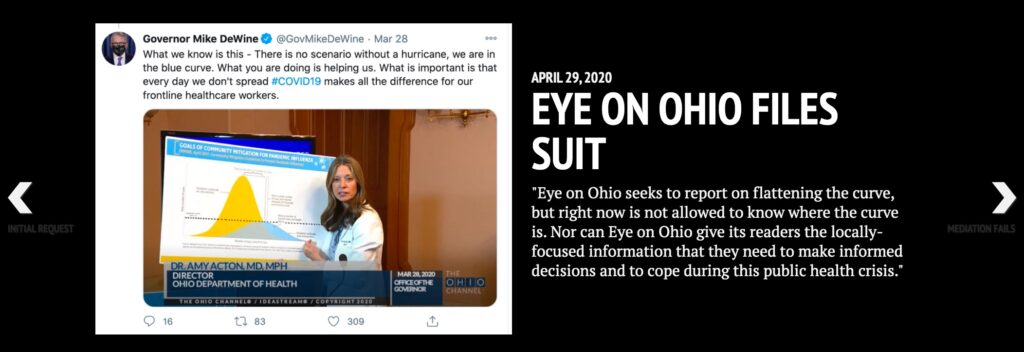
As the ongoing pandemic continues to surge, the Ohio Court of Claims ruled last week that the Department of Health must share public records with Eye on Ohio, showing the number of beds and ventilators available for COVID-19 patients at individual hospitals throughout the state.
The ruling comes seven months after Eye on Ohio initially sought the records.
“In times of crisis transparency is paramount,” said Rebekah Crawford, who has her Ph.D. in Health Communication, Relating & Organizing from Ohio University.
People want credibility and clear lines around what is known and what is uncertain. “When risk communicators are at their best,” Crawford said, “they remain credible by showing what is known and what is not known and by being clear about why we don’t know, and what we’re going to do to find out.”
When Eye on Ohio first requested records, at the end of March, the state had only about 2,200 confirmed cases and 55 deaths, according to the online Johns Hopkins Coronavirus Resource Center. As of November 12, Ohio had approximately 274,500 confirmed cases, and about 5,700 people had died from the disease.
“We are in the midst of our third wave in Ohio,” Gov. Mike DeWine said in his November 11 address to the state. There had been warnings that cases would climb when weather turned cooler and people spent more time indoors again. But, DeWine stressed, the surge is “much more intense, widespread, and dangerous.”
“As of today, every single one of our 88 counties has a high rate of virus spread, and areas of our state that were previously untouched—our rural areas—are being hit especially hard,” DeWine said.
If current trends don’t change, some parts of the state are “maybe two or three weeks out” from hospitals having to crowd out non-COVID-related care as they try to keep up with the surge, reported Andy Thomas, a medical doctor at Ohio State University’s Wexner Medical Center, during the governor’s November 9 press conference.
Eye on Ohio sought records with the data as a way to provide readers with timely, local information about the ability of healthcare facilities in their area to deal with the pandemic.
In a state with nearly 45,000 square miles, that local information could tell citizens more about Ohio’s readiness to deal with emergencies for all its residents. Availability of beds and respirators in Cincinnati, for example, would mean little if hot spots of emergencies were concentrated in Ashtabula, nearly 300 miles away by car.
Transparency Matters
Leaders in times of crisis tend to assume that the public is going to panic, Crawford said, even though “research actually shows that panic isn’t the most prominent or even in the top ten of reactions that people have to communications of risk. People are most likely to be in denial. Studies of 9-11 show that people were excessively polite as they exited the World Trade Center because people don’t panic, they get especially compliant and cooperative in high stress or high risk situations.”
Lack of transparency creates suspicion, hurts credibility, and diminishes trust-worthiness. Crawford said, “people who are untrained in risk communication go to that ‘don’t panic’ communication mode.”
Another misnomer is the assumption that people can’t understand how to interpret the information, so, Crawford said, “rather than taking it upon themselves to communicate in a transparent and understandable way they withhold information and say ‘we’ll make decisions for you’ which doesn’t work when people are anxious.”
“A risk expert cannot look at some numbers and then tell a community ‘this isn’t a problem for you’ because the community may decide that it is a concern ‘because you don’t speak for us or understand what we value,’” Crawford said.
Transparency is key for the public so individual communities can take the information given and decide for themselves what actions should be taken and individual needs addressed based on the needs and values of their demographic.
A Need for Transparency
Reporters initially sought information from individual hospitals but were told that all information was being funneled to the Ohio Hospital Association, which in turn provided it to the Department of Health. And the Department of Health had arranged for the data to be entered into a database called Surgenet.
According to a court affidavit, Surgenet was first developed by the Greater Dayton Area Health Information Network (GDAHIN). The software was subsequently enhanced to its present “all hazards” function as “a tool to be utilized during an emergency involving the public’s health which could severely impact hospital services.” Eye on Ohio was told that only the Department of Health would grant access to the materials.
Eye on Ohio then filed a formal public records request for access to the data or records with it. After cancelling a meeting that had been scheduled to discuss the request, the Department of Health then issued a flat-out denial, claiming the records were “security and infrastructure records” under an exception to the state’s public records law.
Eye on Ohio had no option but to file a case with the Ohio Court of Claims.
The court said the statutory language for that security exception just didn’t fit. That part of the Ohio Revised Code exempts security and infrastructure records that are prepared for the express purpose of protecting against or responding to terrorism, school shootings or similar acts of attack or sabotage. None of those apply to the COVID-19 pandemic.
“Exceptions to disclosure are strictly construed,” wrote Special Master Jeff Clark in his October 20 report and recommendation. “And, in this case, the Department of Health failed to connect the data sought by Eye on Ohio with the prevention, mitigation or response to any existing or anticipated act of terrorism.”
“To meet the burden of proof regarding alleged security records, ODH must offer more than its own conclusory labeling,” Clark wrote. He likewise rejected the Department of Health’s assertion that it should be able to stop release of the records because it didn’t want to discuss them.
“Even assuming, arguendo, that some hospitals would rather not disclose their bed and resource availability, it is well-settled that public offices may not withhold records merely because of a policy preference for confidentiality,” Clark wrote.
Court of Claims Judge Patrick McGrath approved the Special Master’s report and recommendation on November 10.
In 2020, so far there have been 24 public records cases resolved in Ohio. In 14 cases, the party dismissed the action because records were provided. In seven cases, the party just dismissed the case. It’s not clear if the records were provided or they just weren’t relevant any more. Just three were decided by the Court of Claims.
What’s next
Despite the court’s ruling, Eye on Ohio is still waiting for the records. In response to its journalists’ requests for access to the database, attorney Socrates Tuch wrote, “Instead, the Department is preparing a data extract to be provided on an Excel spreadsheet or sheets. Doing so is taking time as the Department staff attempts to accommodate this task with the COVID response.”
Ohio law generally requires a reasonable time for production of public records. However, Eye on Ohio first sought the records with the information at the end of March. And the Special Master’s October 20 report came out more than three weeks ago.
Eye on Ohio again pressed for production of the materials on Friday.
“We are working on gathering the records and when they are ready, we will send them along,” responded Press Secretary Melanie Amato at the Department of Health.
When Eye on Ohio finally gets the materials, it plans to provide further reports on it and on updated data. Its journalists hope that more complete, local information can help the public as the pandemic continues.
Disclosure of the mounting strain on hospitals in their vicinity might also make people more vigilant in their efforts to control the pandemic and to “flatten the curve” of cases. Otherwise, as scientists have previously warned, the pandemic will cause even more deaths that could have been avoided.
As for the resistance against complete transparency, “Far be it from me to criticize people who are providing care at a great risk to their own health in a time of heightened need,” Crawford said. “I’m not talking about the doctors and the nurses who are working in the hospitals, but the managers and administrators who are at the upper echelon of those really hierarchical corporations in some cases are motivated not to cooperate and share information. It really goes counter to public health needs and the demands in care and I would say ethical and medical provision.”


 Last week, HBO released a documentary that covers the long, sordid saga, which led to the federal criminal convictions of a former speaker of the Ohio House of Representatives and a former head of the Ohio Republican Party.