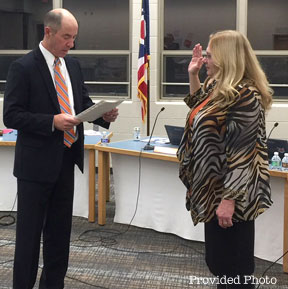
Loveland, Ohio – Due to the resignation of board member Kevin Daugherty, the Loveland Board of Education met on 17 June to fill his seat for the remainder of his term, which is through the end of the current calendar year, December 31, 2023.
The Board entered into an executive session to conduct phone interviews with the following candidates:
Josh Hendrickson
Christina Jeranek
Anna Bunker
Lynn Mangan
Elaine Hipps
Marcia Neumann
Brad Goldie
Roger Talyor
Elliot Grossman
Carly Tamborski
Brain Tibbs
After the executive session ended, Board President Dr. Kathryn Lorenz said that instead of choosing a candidate who said they would run for election in November, they chose a candidate who indicated they would not be seeking a permanent seat on the Board.
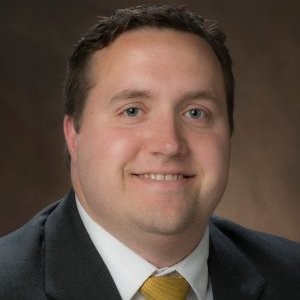
Lorenz, Rev. Jonathan Eilert, Dr. Eric Schwetschenau, and Eileen Washburn voted to appoint Dr. Brad Goldie to the vacant position.
Goldie is an Assistant Professor of Finance at Miami University and serves on the District Finance Committee.
Loveland, Ohio – At a meeting of the Loveland City School District held on December 10, both the current President of the Board, Kathryn Lorenz, and current Vice-President, Kevin Dougherty announced that it is their intention to not seek another term by running for re-election in the fall of 2023.
Here is the excerpt from the meeting where they announce their intentions:
I am an individual school board member in Loveland and am speaking as such.
I believe our world is full of wonderful people trying to navigate the dangerous territory of a global pandemic. I believe our country is full of great people trying to determine the course of our political landscape by voting this year. And I believe our school district is populated by a caring, diverse citizenry trying to support our schools.
In the past year, much has happened to affect the way the Loveland schools are viewed by our community. A November 2019 levy was the cause of much consternation and concern. A failed March 2020 levy did little to relieve concerns or move the district forward. Both losses were substantial and reflected deep disagreement within our community.
I am an individual school board member in Loveland and am speaking as such. I am unable to make statements either on behalf of the Board of Education that voted to put past levies on the ballot or on behalf of the current Board. I am speaking only for myself.
In November 2019, I ran for re-election, primarily to show support for the decision of the Board to put forward a combined levy that proposed a shift in direction for our district. That decision was based on information gathered from citizens and reports from hired architects as well as from the Ohio facilities commission. I will not try, with this statement, to repeat any justification for proposing that issue.
I will try, however, to again apologize to those who regarded that levy as an affront. While I felt that I was able to view the levy not only as a school board member but also as a retired, fixed income taxpayer, I was clearly not representing well all Loveland citizens. I was also not representing well those who were not in agreement with the vision I had for the future of the facilities and the educational experience for Loveland students.
But I was proposing a levy as a school board member, which was one of my duties. While both levies were considered by board members based on financial data, community input, research and the input of the Loveland superintendent and treasurer, the levies were placed on the ballots via school board resolution. As one of five board members, I am responsible for those levy proposals, just as the voters in Loveland are responsible for deciding that those levies would not pass, as is their right and their civic duty.
Over the course of the two levy campaigns, I was called many names. I was labelled a liar, a bully, and a money grabber. As an elected official, I would not expect everyone to agree with all the decisions I make, but I would expect that differences of opinion to be voiced with civility. I could have chosen to submit my resignation, as was called for by many vocal opponents of the levies.
I have chosen instead to continue to try to fulfill my responsibilities as an elected official, honorably and diligently, as I have done for many years. One of my current responsibilities is to evaluate the jobs being done by Dr. Amy Crouse and Mr. Kevin Hawley, as superintendent and treasurer of our district. Additionally, I consider it my duty to clarify the roles of those employees and to strongly support their work and the manner in which they are performing that work.
Currently, there are social media postings making a continued effort to discredit the Superintendent and Treasurer. I would not expect every constituent of the district to agree with every action taken by these employees. But again, I would expect differences of opinion to be voiced civilly based on true information. While it is important, when evaluating our direct reports, for a Board to consider input from other employees of the district, input from parents and students, and input from the community, it is equally important for a board member to attempt to point out information that is misleading or incorrect. Such information risks jeopardizing the ability of district employees to do their jobs and in fact jeopardizes the health and future of the district as a whole.
Again, I would not care to rehash all that was published and said by different sides of the levy issues, but I would like to point out a few misstatements that are being made currently.
One particular post states that the Board of Education that hired Dr. Crouse ignored the recommendations of a Community Advisory Board. As far as I remember, being part of the Board that hired her, and having researched records from the time period, there was no such Board that existed. The site further states that the Board ignored those recommendations based on the guidance of a paid Ohio State Department of Education (ODE) headhunter. The State Department of Education has no such employee and does not involve itself in such a manner with local school districts.
At the time of Dr. Crouse’s hiring, the Board did bring her forward as one of three candidates and those candidates met with staff and community members in open meetings. The Board collected written comments from attendees of those meetings and considered those comments when deliberating. The Board had used the services of the Ohio School Boards Association (OSBA) for the collection of applications and reference materials but never solicited a recommendation from them, nor did they offer one.
Other issues are still being raised about efforts to provide information concerning the 2019 and 2020 ballot issues. As an individual, I cannot speak accurately to all statements made by members of the community, district employees, participants in the Citizens for Loveland PAC, or participants in the PAC that was formed to present information in opposition to the levies. It would be foolish of me to state that no misstatements were made or that there was never an instance where corrections to figures needed to be made. There are many accusations about both the Superintendent and the Treasurer regarding statements they made. As I stated before, I am not able, in this format, to address those accusations, as I was not present at all meetings where questions were asked and answered. I am, of course, willing to consider all aspects of the performance of these two employees as I enter into the process of evaluation.
I can state, unequivocally, that according to my research and my recollection, there is no evidence of dishonesty on the part of the Board or on the part of the Superintendent or Treasurer. It is the Board of Education that voted to place those levies on the ballot and the Board of Education that was informed of all statements published regarding the performance and needs of the Loveland School District. While the plan behind the November 2019 levy was obviously not accepted by the voters of the district, it was the plan presented by the Board and that Board directed the Superintendent and Treasurer to articulate that plan. Nothing about either levy was proposed or supported with any ill intent.
While I continue to be open to hearing public comment on the past, I would prefer to move forward. The community has had the opportunity to vote and has thus indicated the direction they support for moving forward. I personally plan to move forward with integrity. I believe that, as an individual board member, I would look for that same integrity in any employee of the district. Our school district and our community deserve no less.
Loveland, Ohio – At a Special Meeting on Wednesday, July 15, with a unanimous vote, the Loveland Board of Education approved a reopening plan for the Loveland City School District for the 2020-2021 school year. Dr. Eric Schwetschenau moved to adopt the plan, and it was seconded by Eileen Washburn. Schwetschenau, Washburn, Board President Kathryn Lorenz, Vice President Michele Pettit, and Kevin Dougherty voted, “Yes”.
Preschool, kindergarten, and 1st through 12th grades will attend 5 days per week at “full capacity” (no “all-day” kindergarten) with the option of choosing to attend school online.
The first day of instruction for all students is Wednesday, August 26.
High school student arrival time will be 30 minutes later this Fall. Bus guidelines for COVID 19 protection have not been finalized. The District is waiting for State guidelines to be released.
Parents can make a choice each semester about their child attending the “in-person model” or remote learning.
A press release issued by the District said that parents will also have a “full” remote learning option for their children.
Source: 2020 Reopening Planning Updates
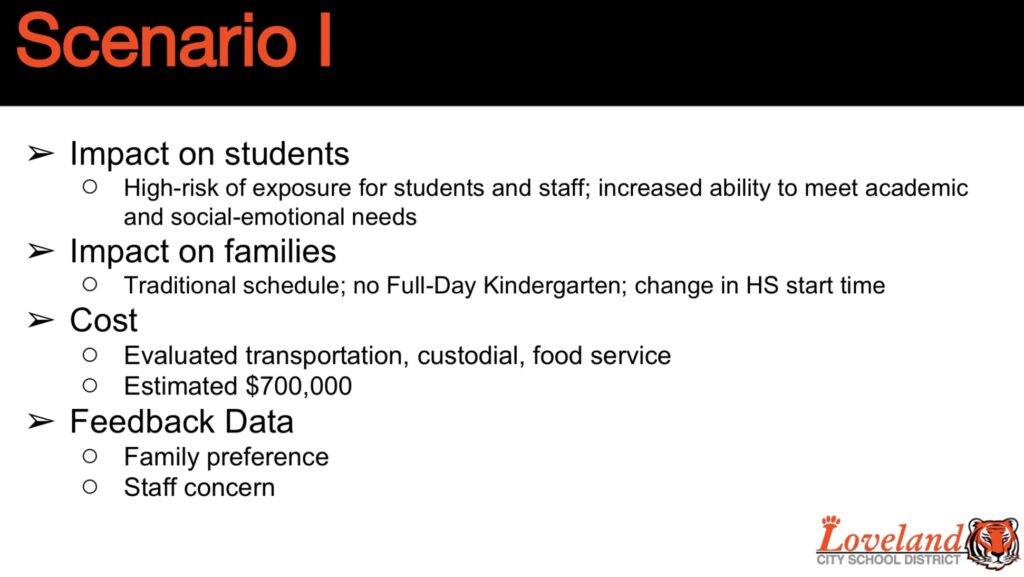
Here is the DOCUMENT the Board reviewed while making their decision. You can look in particular at Scenario I the re-opening model chosen by the Board. Under the headline “Impact on students” the first bullet point says, “High-risk of exposure for students and staff; increased ability to meet academic and social-emotional needs.”
There was no “Hearing of the Public” at the meeting.
Additional details of Loveland’s 2020-2021 Reopening Plan is expected to be released next week.
Parent Q & A sessions are being planned for July 27, 29, and 30.
Parents will be required to select either the in-person or remote learning model for the first semester. Each semester thereafter, parents can re-evaluate and choose a different option. The deadline for selection is Sunday, August 2.
Below is the resolution passed by the Board. Exhibit A referenced in the document was not available to the Board or public when the Board approved the Resolution to re-open the schools.
Jul 15, 2020 – Board Special Meeting
cc
Superintendent Resolutions
cc
Approve resolution adopting the 2020-2021 Academic Plans and Options Program for the Reopening of the Loveland City School District
cc
Motion to approve a resolution adopting the 2020-2021 Academic Plans and Options Program for the Reopening of the Loveland City School District and granting the Superintendent authority related thereto.
________________moved, seconded by ____________________ to approve a resolution adopting the 2020-2021 Academic Plans and Options Program for the Reopening of the Loveland City School District and granting the Superintendent authority relate thereto.
WHEREAS, COVID-19 is a respiratory disease that can result in serious illness or death and can easily spread from person to person between individuals who are in close contact with each other (within about 6 feet) or through the touching of a surface that has the virus on it then touching one’s own mouth, nose or eyes; and
WHEREAS, the Governor and the 133rd General Assembly of the Ohio Legislature have declared a state of emergency with respect to the spread of the novel coronavirus; and,
WHEREAS, during the 2019-2020 school year, the Ohio Department of Health ordered that all K-12 schools be closed to students but it is anticipated that schools will be permitted to reopen for the 2020-2021 school year; and
WHEREAS, boards of education in Ohio have been given substantial authority to revise their methods of instruction for the 2020-2021 school year to adopt to the pandemic.
NOW, THEREFORE BE IT RESOLVED, by the Board of Education of the Loveland City School District, Hamilton County, Ohio as follows:
SECTION I
The Board hereby authorizes and adopts the attached Academic Plans and Options Proposal identified as Exhibit A (to reflect the discussion under item 2.1) to provide for the learning opportunities either in-person, remote, or a combination in accordance with the authority granted by Am. Sub. H.B. 164 and blended learning opportunities authorized by R.C. 3302.41. The Superintendent is hereby authorized to take any and all actions necessary to implement the attached Academic Plans and Options Proposal. In addition, given the uncertain nature of the pandemic, the Superintendent shall be authorized to revise the Academic Plans and Options Proposal as necessary during the 2020-2021 school year so long as such revisions are not inconsistent with Ohio law, state and local health department orders, and orders of the Governor, and so long as the Superintendent updates this Board on any such revisions at the Board’s next public meeting after such revisions are made.
SECTION II
This Resolution shall be in full force and effect from and immediately after its adoption and shall supersede and replace any prior resolution or act of this Board of Education that may be inconsistent or duplicative with the provisions of this Resolution.
SECTION III
The Board of Education hereby finds and determines that all formal actions relative to the adoption of this Resolution were taken in an open meeting of this Board of Education, and that all deliberations of this Board of Education and of its committees, if any, which resulted in formal action, were taken in meetings open to the public, in full compliance with applicable legal requirements, including Section 121.22, ORC.
I’ve been a Loveland school board member since 1991 and just prior to being elected, I was a chairperson of the bond issue campaign that earned us our “new” high school. Over these past 28 years, I’ve seen quite a few operating levies and a couple of bond issues, almost all of which have been supported by our Loveland community. None of them have been small or seemed completely fair. “Why not?” might be the question.
Kathryn Lorenz is a Loveland School Board member. She is Professor Emerita of French at the University of Cincinnati, and the mother of two Loveland graduates and the grandmother of three current Loveland school students.
First of all, Loveland has a predominantly residential tax base. This means that the tax burden is mostly borne by homeowners, whether their houses are large or small, whether their incomes are growing or fixed, whether they are employed or retired, whether they have school age children or not. And tax collections, once approved, can’t grow with increased valuation of property or additional homes or additional students in the district. So tax levies and bond issues, which are very big questions for voters, have a lot of inherent inequity, regardless of the number of mills involved. They can seem unfair to taxpayers just as the state funding model appears unfair to the school district.
Furthermore, tax levies are always a big deal. There has never been, in any of the years that I have been a board member, a tax issue that was proposed lightly or without consideration for the taxpayers of the district. Every levy has been considered through the lens of the current economy, the promises made in previous levies, the real needs of the district and the fiscal soundness of the uses proposed for the taxes to be collected.
Questions about the levy/bond issue shouldn’t be feared, nor should there be anger. Some questions are answered by board vote or information on the district website. Some questions cannot be answered because they concern actions that the board has not yet been able to consider or take. The board is consistently trying to get information out and into the hands of our citizens.
Each board member is a Loveland taxpayer. That doesn’t make it any easier to ask more tax dollars of our families, neighbors or fellow citizens. We all know what we committed to in becoming a board member and we take our responsibility very seriously. Our job is to oversee the provision of a safe and adequate education for all the children of our community. We strive further for excellence in Loveland education and we believe our community deserves no less.
Over the years that I have been a board member, enrollment in our schools has more than doubled. I imagine that you have seen Loveland schools get bigger and stronger and yes, better. This progress can only be due to the work of our whole community – citizens, parents, teachers, students. We, the community as a whole, expect great things from our schools and we have overwhelmingly supported the district in these past years. During this time, we have seen districts all around us struggle and communities as a whole suffer, often taking many years to recover from failed support of their schools.
Let’s never take for granted what we have in Loveland today. It has taken tremendous effort to get here and will take resources to maintain our place. We are at a truly important moment and there is really no option for us other than to rely on support on Election Day to keep our schools running and improving. An investment is necessary.
This Board of Education has respectfully presented a big picture. A big ask. It is based on needs of space and programs. We are beyond capacity but not beyond our abilities. Please consider carefully the issue that is on the November 5th ballot. Our students and their futures deserve no less.
Mike Hunting is a resident of the Black Horse neighborhood
by Mike Hunting
The proposed school levy for Loveland has been extremely stressful for residents on both sides of the issue. I have no doubt the students, faculty, and staff at Loveland schools would love to work and study in newer facilities and use turf athletic fields. The folks opposed to the levy are extremely frustrated with what appears to be the largest tax hike in the history of Loveland and possibly in the state of Ohio. While I can sympathize with the frustrated faculty and want to support our schools (and have supported them), the tax implications of this levy are simply stated…ridiculous.
We need to realize this will break the bank for many people who are living in and around Loveland. I attended the meetings on September 9 at Loveland Middle School (LMS) and on September 12 at Loveland High School (LHS).
During the LMS meeting, I heard several couples say they would move if this levy passed. One couple was in dire straits because they had moved several times recently and cannot afford to move again. They are now simply stuck in Loveland and facing what appears to be the largest tax hike in the city’s (and possibly state’s) history. A tax hike that is certain to be followed again and again with MORE levies.
For those who paid attention to the words of Loveland Superintendent, Dr Amy Crouse, she said she hopes Clermont County and the City of Loveland will help with infrastructure costs for the new school. To date, Loveland and Clermont have not officially committed to these costs, at least not publicly to us. Expect another levy to cover this if and when they refuse (and even if they do we are STILL paying for it).
I would also expect a third levy to cover more teachers since this proposed levy adds several buildings but only two additional teachers. I strongly believe we have reached the breaking point in this community. We will likely see an exodus similar to what is happening in failed areas such as New York City, Detroit, Chicago, California, and much of New England.
Perhaps the most frustrating part of the meetings last week was the school board’s arrogant attempt to manipulate its audiences. At both meetings, members of the school board, the Treasurer, and Dr. Crouse kept saying, “The community wants this” or “the community voted for this.” Most of the community didn’t even know of this levy until the flyers arrived in their mailboxes in mid-August. Thus, the community certainly DID NOT vote for the levy or approve it. The only people I have spoken with who are in favor of this are school faculty or folks affiliated with the schools (although I have also spoken with school employees who are opposed).
The timeline of the release of information is interesting. My family and many of our peers didn’t even know about this levy until we received the flyers in our mailboxes around August 15. August 15 is a significant date because the deadline to place names on the ballot to run against Art Jarvis and Kathryn Lorenz was August 7. Once again, this is utterly ridiculous (albeit well played by Art and Kathryn and the other members of the Levy). Since they are now protected for at least two more years, expect more levy proposals even after this one is shot down.
The Treasurer, Kevin Hawley, stated he will propose another levy if this goes down.He doesn’t even live within this tax district, so why would he care? We must get people to run against this out of control board and Treasurer at the earliest opportunity.
Dr. Amy Crouse finished the meeting on Thursday by saying, “We hope we answered some of your questions, and we hope that you choose to support this when it comes time in November so that we can move forward.”Unfortunately, they failed to answer many of our questions. They would not allow us to voice questions and we had to submit index cards with questions written on them for Thursday’s meeting. Thus, they could selectively answer the easy questions and dodge the relevant questions. I know for a fact I saw roughly 30-40 index cards with questions on Thursday. I am guessing they answered at most 1/3 of these cards.My question was not answered. I merely wanted to confirm Dr. Crouse and Mr. Hawley live elsewhere and thus won’t be impacted by the increased taxes (which I have since learned is true).
The last part of Dr. Crouse’s statement is interesting. She recommends how we should vote from inside a government building and while serving in an official government capacity. Thus, the government is telling you how you should vote and not allowing the opposition to speak. This is on tape.
Editor’s Note: This story has been corrected to explain that, “Current Loveland School Board Vice-President Kathryn Lorenz has picked up a packet of petitions to run for one of two open seats, however, she had not yet submitted petitions.”
Loveland, Ohio – As of June 6, the local election for elected offices may only be a popularity contest. Neither school board or council races have competition for the number of seats open. There are 3, four-year council at large seats open, and 2 open, four-year terms for the Loveland Board of Education.
Current Loveland Mayor Kathy Bailey and current councilmember Kent Blair have submitted nominating petitions to the Hamilton County Board of Elections (BOE) with sufficient signatures to qualify for the ballot.
Andrew Bateman who ran an unsuccessful race in 2017, picked up nominating petitions, however, he has not yet submitted them to the BOE.
Current Loveland School Board Vice-President Kathryn Lorenz has picked up a packet of petitions to run for one of two open seats, however, she had not yet submitted petitions. No one else had picked up petitions as of June 6.
Firecracker Festival 2019 June 28, 2019 – June 29, 2019 Celebrate Your Independence at the Firecracker Festival at Home of the Brave and Symmes Park! Read more…
Cassie Mattia lives in Historic Downtown Loveland, Ohio.
If we don’t protect our youth who will? In May, Ohio Paul Zeltwanger and Thomas Brinkman proposed House Bill 658, which states:
“If a government agent or entity has knowledge that a child under its care or supervision has exhibited symptoms of gender dysphoria or otherwise demonstrates a desire to be treated in a manner opposite of the child’s biological sex, the government agent or entity with knowledge of that circumstance shall immediately notify, in writing, each of the child’s parents and the child’s guardian or custodian. The notice shall describe the total circumstances with reasonable specificity.”
gen·der dys·pho·ri·a
ˈjendər disˈfôrēə/
noun
MEDICINE
The condition of feeling one’s emotional and psychological identity as male or female to be opposite to one’s biological sex. How to pronounce gender dysphoria.
In plainer language House Bill 658, also known as the “Parent’s Rights Bill,” would make any school administrator or teacher who allows or offers gender dysphoria (the condition of feeling one’s emotional and psychological identity as male or female to be opposite to one’s biological sex) treatment, including resources on sex and gender or counseling, for a minor “without the written, informed consent of each of the child’s parents and the child’s guardian or custodian” they could be charged with a felony in the fourth degree. The parents of the student according to the bill would get the ultimate decision whether their child gets access to treatment, including educational materials, counseling or medical services.
If this House Bill is implemented it could have detrimental consequences for teachers and even more importantly for those students affected. Teachers are there to lend their students a helping hand educationally and emotionally in order to prepare them for what’s to come once they are out on their own, why take this from them?
A teacher’s take on House Bill 658
I spoke to one Loveland teacher who wishes to remain anonymous, a mom of a teenager. I’ll call her Susan. She told me that for many students their home life is a wreck and out of control with issues of poverty, broken families, and domestic abuse. “For many of my students, the only adult in their life that can be trusted may be their teacher. Teachers who lend an ear and can be trusted can be an enormous help that often reflects on their academic achievement. We care for the whole child.”
Susan told me that for many students their home life is a wreck and out of control with issues of poverty, broken families, and domestic abuse. “For many of my students, the only adult in their life that can be trusted may be their teacher.”
Susan told me that she just overheard a conversation between her daughter and a friend about a classmate they thought was transgender. “I wondered, do they know what that means? Are they friends with this young person? How do my kid and others treat her? Because I am a teacher, would I be required to file a report with the District? These are all questions that ran through my head as a mom and a teacher.”
Susan said she wants to protect and support all of her kids, her biological ones and the ones that are “her’s” for a school year. “I want to be able to do that freely and openly and with my heart.” She said that some of her students desperately need someone they can trust in their life and the last thing they need is another person that will let them down because politicians want school staff charged as felons if they don’t report that the student herself, or a classroom teacher, principal, gym teacher, bus driver, or classmate may be questioning her gender identity.
Susan asked, “Just what stereotypes am I going to be expected to police?
HB 658 is a harmful bill that takes aim at some of our most vulnerable — transgender youth — by forcing school officials to serve as ‘gender police’ and out them or risk getting a felony.” – Alana Jochum
LGBTQ advocacy
“HB 658 is a harmful bill that takes aim at some of our most vulnerable — transgender youth — by forcing school officials to serve as ‘gender police’ and out them or risk getting a felony,” said Alana Jochum, executive director of LGBTQ advocacy group Equality Ohio. Jochum told NBC News. “This exposes young people to discrimination, harassment, and bullying.”
Jochum couldn’t be more correct if you really take a look at the alarming statistics. One study done by the Cincinnati Enquirer showed that 64% of LGBTQ youth in Ohio heard “negative comments” about their gender identity or sexual orientation from their family and in result, according to another study done by National Transgender Discrimination, 41% attempted suicide. Though many transgender students
75% of transgender youth have felt unsafe at school after being outed and have lower GPA’s due to missing school in fear of their safety.
have experienced negative comments, violence has become the most popular form of dealing with transgender youth. Disturbingly enough 19% of transgender youth, according to the National Center for Transgender Equality, experience the majority of violent abuse in their home from their own family members. Along with dealing with all the dissension from family members 75% of transgender youth, according to a national survey done by GLSEN (pronounced “glisten”), have felt unsafe at school after being outed and in result have lower GPA’s due to missing school in fear of their safety. With all the facts at hand, The Ohio Education Association who represents 125,000 teachers and support professionals, have openly opposed the bill.
Violence has become the most popular form of dealing with transgender youth.
Kathryn Lorenz is the Loveland Board of Education Vice President
While researching House Bill 658 I managed to only get a response from two local representatives of the Loveland School Board, one being Kathryn Lorenz, the Board Vice President and the other being Loveland School Board Member, Ned Portune. Lorenz’s response was, “In the case of House bill 658, we would have to say that we do not yet have enough information, nor have we met as a board for a few weeks, so we do not yet have a Board statement to make.”
Ned Portune is a member of the Loveland School Board
Portune added that he, “…simply has not been fully informed at this point on HB 658 to have an educated opinion. There are several items in your statement that would certainly give me a gut reaction, and opinion on, if true as presented. But I need time to fully review the Bill, its implications and existing laws to have any formal statement.”
School Superintendent Amy Crouse, High School Principal Peggy Johnson, and assistant principals at the High School did not respond.
Studies show most transgender youth are fully aware of their gender identity by age 4.
After attempting several times to contact both Representatives Paul Zeltwanger and Thomas Brinkman through email and phone about House Bill 658, I, unfortunately, got no response. It wasn’t hard to find Brinkman’s opinion on the issue in several other publications though, voicing to WCPO, “Parents have the right to decide what is best for their children,” and telling WOSU Public Media, “And if somebody doesn’t like it, you’re emancipated at age 18 and you can go do whatever the heck you want.” Seems pretty harsh considering the transgender population represents about 0.3% (700,000) of Americans and studies show most transgender youth are fully aware of their gender identity by age 4. Are we encouraging parents and administrators to discard their students or child’s gender identity in fear of social rejection? Do these children not deserve to live an authentic life?
Fran Hendrick, PCC has offices at Wildflower House in the West Loveland Historic District.
House Bill 658 is expected to be presented to the Ohio General Assembly in the Fall and will be without a doubt one of the most controversial bills to date. Many have opinions on this issue one being Fran Hendrick, a respected and highly educated clinical counselor who specializes in assisting women and girls who are experiencing depression or anxiety triggered by a crisis or major life change. When I presented Fran with House Bill 658 and asked what her opinion was she had a lot to say and rightfully so considering one of her life missions, according to Fran’s website franhendrick.com, is to “gently help you find and shelter your spark (the essence of who you are at your core) and grow it so that it illuminates your person and is radiated through words, actions and decisions, big and small, that make up your daily life.”
In a culture such as ours, it is a matter of life and death for transgender youth to decide if and when to trust another person with their reality. – Fran Hendrick, PCC
“Being a parent takes great courage, even more so when your child presents you with something that you’re unfamiliar with – or even afraid of. In a perfect world, a child who feels somehow ‘different’ from their peers (‘their’ is deliberately gender-neutral), they could consult their parents, who would strive to deeply understand the child’s experience, would provide accurate empathy, and would go on a crash course to learn everything they could about the unfamiliar issue. And, so very fortunate for their children, there are many parents like these.
But in the real world, an adolescent boy saying to his father, ‘Dad, I think I’m a girl’ is very likely to encounter disgust, rejection, rage, or even violence, not empathy and understanding.
While the intent of this bill, giving benefit to grave doubt, could be a deeply uninformed and misguided attempt to protect children, that seems unlikely. My sense is that in truth it is more about attempting to hand parents the power to say no to their child’s gender identity,” Hendrick said, “But gender identity – and sexual orientation, for that matter – are not matters of choice. And in a culture where transgender people are assaulted and even murdered at a rate higher than their cisgender counterparts,where transgender youth are summarily shunned and rejected by their own parents (the rate of homelessness is, not surprisingly, very high), where the suicide rate that results from these atrocious facts is far higher than for other youth – in a culture such as ours, it is a matter of life and death for transgender youth to decide if and when to trust another person with their reality, and, most importantly, whom to trust.
To be “outed” for the choice to trust; or to be prosecuted for trying to be help – these are not protections. Actions like these support bigotry, and increase isolation and despair. – Fran Hendrick, PCC
To be “outed” for the choice to trust; or to be prosecuted for trying to be help – these are not protections. Actions like these support bigotry, and increase isolation and despair. Stopping a teacher from helping such a student, one who is likely alone with the reality of their gender identity, who stands to be emotionally and psychologically rejected, or even physically abused, by their own family is, quite simply, a cruelty. This, I strongly believe, is not what the overwhelming majority of parents want for their own or anyone else’s children. This is bad enough. However, this bill opens the door to much more far-reaching damage than this.”
Is he to be turned in to the gender police?
The talented young male artist who despises sports – is he to be turned in to the gender police? The girl who chooses overalls and a t-shirt rather than a dress and a mani-pedi –what of her? The sponsors of the bill have explicitly said that teachers should be required to inform on them, as well. We have an essential responsibility to ensure that proposed legislation protects vulnerable people from the bigotry endemic in our society.This legislation explicitly deprives them of protection.”
Ultimately what it comes down to is ensuring that our children are and feel safe when going to school. Teachers and administrators are the ones that take on the responsibility of creating that fun, loving and supportive atmosphere so that our children get the best opportunities in life. Passing a bill such as House Bill 658 only presents another obstacle that both teachers and administrators have to overcome. Don’t these professionals have enough obstacles to conquer as is?
Both Justin Haake and Tonya Schaeffer who are Professional Clinical Counselors for Hope Restored Counseling Services in Loveland couldn’t agree more.
Justin Haake is a Licensed Professional Counselor at Hope Restored Counseling Services in Loveland and works primarily with adolescents and adults, specifically during transitional periods in life.
Haake said, “For some, teachers and school administrators may be the only people in schools that feel safe for students to reach out to.Imagine the fear of asking for support, knowing that you’ll either be outed or put the teacher or administrator at risk of a felony.”
Schaeffer said, “From my perspective, this would most likely increase the level of bullying and possible harm to these students.There is already so much shame and stigma attached with Transgender people, and they need as much support as they can get,”
Tonya Schaeffer is a Licensed Professional Clinical Counselor and co-owner of Hope Restored Counseling Services in Loveland.
Schaeffer added, “Support is out there.In fact, we are offering a psycho-educational group starting in September that offers education, support and a safe environment for Transgender students to express themselves.” She said they hope to offer a similar group to parents who are trying to understand what their child is going through, explore what the parents are experiencing and provide support. “We currently serve the LGBTQ community, and we are expanding those services.I recently read a statement that it is estimated that 41% of trans men and women have attempted suicide. I don’t believe this bill would help–it seems like it could only hurt.”
Susan, the mom and teacher said, “I am thankful I live in a community where support services like those provided by Hope Restored, and Fran Hendrick at Wildflower House are nearby for my students and their families.”
Transgender youth have so many mountains to climb within their own scientific makeup and allowing a bill like House Bill 658 to go through in hindsight is taking away their basic rights as Americans and human beings.
“GLSEN (pronounced “glisten”) was founded in 1990 by a small, but dedicated group of teachers in Massachusetts who came together to improve an education system that too frequently allows its lesbian, gay, bisexual, transgender, queer and questioning (LGBTQ) students to be bullied, discriminated against, or fall through the cracks.”
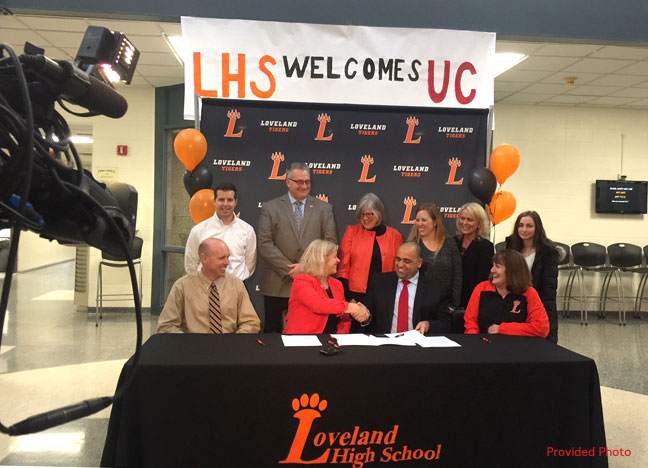
(First row, L to R:) Loveland High School (LHS) Teacher Phil Marchal, Loveland Interim Superintendent Dr. Amy Crouse, University of Cincinnati (UC) Director of School of Information Technology (IT) Dr. Hazem Said, LHS Principal Peggy Johnson; (Second row, L to R:) Patrick Keyser, Sogeti USA, Loveland Board of Education President Art Jarvis, Loveland Board of Education Vice President Dr. Kathryn Lorenz, Loveland Board of Education Member Eileen Washburn, Loveland Director of Secondary Programs Andrea Conner, UC Graduate Coordinator and Project Manager School of IT Lauren Kirgis
Pathway program will be ready for fall 2018
Loveland, Ohio– With cameras rolling to capture the significant moment, Loveland Interim Superintendent Dr. Amy Crouse and University of Cincinnati (UC) Director of School of Information Technology Dr. Hazem Said made formal the new partnership between the educational institutions that will equip the Loveland City School District to offer college-level Information Technology (IT) course work to high school students. The formal signing ceremony took place just before the State of Schools Open House Thursday, Feb. 22, at Loveland High School.
“This partnership places Loveland students in a unique position for advanced learning opportunities that will qualify for college credit – a win for our families both academically and financially with the ever increasing student-loan debt that UC is sensitive to,” said Dr. Crouse. “We are simply thrilled to sit at the table with a school as premier as UC.”
“The UC Information Technology Early College program is a unique and innovative program that will enable Loveland students to complete the first year of the UC BSIT program in high school,” said Dr. Said. “Those who receive a C or above will receive automatic admission to the BSIT program to study Software Development, Cybersecurity, Networking/Systems and Game Development & Simulation. We are excited to work with the leaders at Loveland City Schools to make this program available to Loveland parents and students.”
The partnership with UC creates an Information Technology (IT) Academic Pathway for Loveland High School (LHS) students, and is part of the district’s strategic plan to bring Academic Pathways to Loveland students beginning in middle school. LHS students will have access to post-secondary IT coursework starting in ninth grade. LHS students will have the ability to earn college credit through the College Credit Plus (CCP) program, and Advanced Placement (AP) courses.
“Ultimately this partnership enables LHS students taking these courses to earn a masters degree through UC with only four years of college; it includes the courses they take through their senior year of high school plus four years of college,” explained Loveland Director of Secondary Programs Andrea Conner. “It also provides our Tiger students with the opportunity to apply for paid co-ops related to their course work the summer following their senior year.”
Along with having the IT Pathway ready for fall of 2018, the district has clearly defined Academic Pathways for careers in: Arts, Audio/Video Technology and Communication; Business Management and Administration; Health Science; and Science, Technology, Engineering and Mathematics – with the phase-in of additional pathways in the 2018-2019 school year.
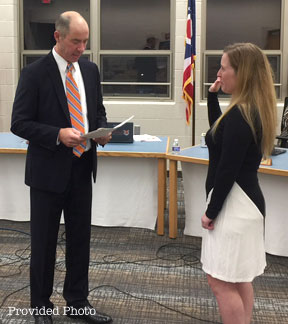
Judge Brad Greenberg administers the oath of office to Board Member Eileen Washburn.
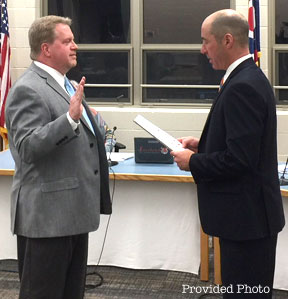
Loveland, Ohio – The Loveland City School District convened for their annual Organizational Meeting Thursday, Jan. 11, to elect new officers and establish the 2018 meeting calendar. Prior to voting, newly elected Board Members Ned Portune and Eileen Washburn were officially sworn in, along with re-elected Board Member Michele Pettit.
Judge Brad Greenberg administers the oath of office to Board Member Ned Portune.
The Board established 2018 leadership, electing Art Jarvis as president, and Dr. Kathryn Lorenz as vice president. In addition, the Board of Education appointed the following Board of Education members as
committee representatives for the 2018 calendar year:
Facilities Committee: Art Jarvis and Michele Pettit
Finance Committee: Art Jarvis and Ned Portune
Student Achievement Committee: Ned Portune and Eileen Washburn
Policy Committee: Dr. Kathryn Lorenz and Ned Portune
Judge Brad Greenberg administers the oath of office to Board Member Michele Pettit.
The Board also voted to conduct regular monthly business meetings for Calendar Year 2018 on the third Tuesday of each month unless otherwise noted* at 6 PM in the Media Center of the Loveland Intermediate School. Additional meetings during the month can be designated by the Board of Education at a time and place properly announced.
January 30, 2018 (4th Tuesday)
February 20, 2018
March 20, 2018
April 17, 2018
May 15, 2018
June 21, 2018 (3rd Thursday)
August 21, 2018
September 25, 2018 (4th Tuesday)
October 16, 2018
November 27, 2018 (4th Tuesday)
* No regular meetings are scheduled for July or December.
The Loveland Board of Education voted to conduct other regular monthly meetings primarily as work sessions for Calendar Year 2018 on the first Tuesday of each month unless otherwise noted on the following dates at 6 PM. in the Loveland Board of Education office:












 If you would like to explore the topic of Transgender youth and adults even further please check out “