Loveland, Ohio – Are you a student that has a passion for the world of Journalism? Do you often ask yourself how will I get the experience I need to get into a great college Journalism program? Well, look no further! Loveland Magazine is looking for both motivated and creative students that have the work ethic it takes to thrive in Journalism!
It is tough as a student to get career-based experience before filling out college applications so here at Loveland Magazine, we want to give students the necessary tools to stand out to the colleges their applying for! In our internship program, students will be able to get hands-on experience in all things Journalism including editing, developing a story, videography, conducting on-camera interviews, photography, advertising/marketing, social media content, media law, and much much more. The intern will also get the opportunity to shadow special events, assignments, and on-camera interviews! We want the next generation to thrive and succeed in their career paths and we feel this is the best way for us to impact the future of Journalism!
We have reached out to many of the local high schools to spread the word about our internship program, but if you know of a student, an organization, or school that would benefit from this internship please feel free to reach out and we can supply you with our internship flyers!
Although we may not fill all of the intern positions we would of course like to gain at least 2 new interns for 2022! Here are the following internships available:
Social Media Specialist
Sports News Intern
School News Intern
Editorial Intern
If you’re a student, a parent of a student, or simply just know of someone who would be a great candidate for one of our internships, click here to email us! If you are an organization or a school that is interested in hanging up our internship flyers in your building click the email link above!
Get real Journalism experience taught by professionally trained Journalists through Loveland Magazine’s internship program today! Let’s help our youth thrive!
Electric customers across Ohio collectively spent an estimated $211 million via add-on bill charges over the last two years to cover for losses from two coal-fired power plants that continue to bleed millions annually, according to new data from state regulators.
The money to the Ohio Valley Electric Corp. (OVEC) — an entity comprised of several investor-owned utilities from multiple states that operates the plants — flows thanks to a 2019 state law now at the center of a criminal bribery prosecution.
The Public Utilities Commission of Ohio began to allow three of the utilities that own and are contractually obligated to buy power from OVEC — American Electric Power (43% equity stake), Duke Energy (9%), and AES Ohio (4.9%) — to pass on their losses on OVEC to their customers, starting in the mid-2010s. The payments were originally only allowed through 2024. Through 2019, the three utilities’ customers were charged an estimated $159 million on OVEC.
House Bill 6, a law passed in 2019 that’s now the focal point of what prosecutors have said is the largest political corruption investigation in state history, extended the subsidies through 2030 and spread the three utilities’ (AEP, Duke and AES) losses to electric customers of all Ohio utilities (not just those that own OVEC).
In 2020, Ohio electric customers statewide paid $115 million to OVEC’s owners to cover their losses on the deal, according to data provided by a PUCO spokesman. In 2021, they paid about $97 million (July through December 2021 costs are estimates). Under the law, residential customers pay a maximum $1.50 per month to utilities to cover their OVEC losses. Industrial customers pay a maximum of $1,500.
OVEC operates two 1950s-era coal plants in Cheshire, Ohio and Madison, Indiana, originally built to power the federal government’s uranium enrichment facilities near Portsmouth. That agreement ended in 2003. The utility companies that own OVEC last renegotiated their contract in 2011 extending its life through 2040.
Technically, the OVEC plants could save utility customers money if OVEC could generate and sell electricity at below-market costs. However, a mix of market forces, environmental regulations and recently spending more than $1 billion on a “scrubber” system designed to limit emissions have left the plants selling electricity at costs well above those of PJM, an energy marketplace serving utilities in 13 states including Ohio.
“[Our] analysis shows that at this time, the OVEC plants cost customers more than the cost of energy and capacity that could be bought on the PJM wholesale markets,” wrote London Economics International, a firm the PUCO commissioned to audit the subsidies, in December.
A draft version of a 2020 PUCO-commissioned audit by the same firm found that “keeping the plants running does not seem to be in the best interests of the ratepayers.” The line was removed from the final version at the request of a PUCO staffer who asked the auditors to use a “milder tone and intensity of language,” according to emails obtained by the Ohio Consumers’ Counsel (OCC), which represents ratepayers in PUCO cases and has advocated ending the OVEC subsidies.
Along with the raw finances, Ohio consumers are subsidizing plants that have belched nearly 21 million tons of carbon dioxide, 21,000 tons of nitrogen oxide, and 12,000 tons of sulfur dioxide into the atmosphere since January 2020, plus smaller discharges of arsenic, lead, and mercury, according to data from the U.S. Environmental Protection Agency provided by the OCC.
“Why the hell is this still in place?” said Neil Waggoner, an advocate with the Sierra Club’s Beyond Coal campaign. “I think that this is utility capture in practice. This is the utilities in this state having a death grip on the regulators and people in power to the point that they’re getting exactly what they want.”
The Clifty Creek Power Plant, in Madison, Indiana, which is operated by OVEC. Photo taken by Rep. Casey Weinstein, D-Hudson, who visited the plant and has called for a repeal of state law forcing Ohio ratepayers to subsidize it.
A sticky bailout
FirstEnergy Corp. admitted in July to paying more than $60 million to an account controlled by the former House Speaker and his allies to ensure passage of HB 6. The prosecutors’ allegations have focused in court documents on an estimated $1.3 billion nuclear bailout and other non-coal related provisions of the sweeping bill that are favorable FirstEnergy. Former speaker Larry Householder, accused of using the money to engineer passage of the bill and shore up his own political aims, has pleaded not guilty. Two Householder allies involved in the alleged scheme have pleaded guilty to racketeering.
State lawmakers in early 2021 passed legislation repealing the nuclear bailout and “decoupling” provision (a ratepayer-backed revenue guarantee for FirstEnergy). However, the OVEC bailout was left intact.
There are bipartisan efforts in the House and Senate to repeal the OVEC bailout from state law, and the narrower PUCO-approved bailout that preceded them. Neither has come up for a vote and the sponsors are pessimistic on their chances.
Sen. Mark Romanchuk, R-Ontario, perhaps the plants’ most prominent critic and co-sponsor of the Senate legislation, said he is in negotiations with the utilities that own the plants and is not giving up. He declined an interview.
“Not sure where things will go but we’re not giving up,” Romanchuk said.
House Democrats have called for a repeal of the OVEC subsidies, though they only control 34 of 99 seats in the chamber. Rep. Jeff Crossman, a Parma Democrat who recently announced plans to run for attorney general, said the OVEC charges should be repealed but as much is unlikely.
“There’s probably not a will to undo the OVEC charges,” he said. “They donate gobs of cash to the right folks. There’s just no other reason to support these plants.”
House Speaker Bob Cupp, R-Lima, said in October he doesn’t believe there’s support in the House Republican caucus to repeal the coal bailout.
House Majority Leader Bill Seitz, R-Green Twp., has told several state media outlets the bailouts aren’t going anywhere. He did not respond to written questions about the uneconomic nature of the plants, or why ratepayers should cover their owners’ losses on them.
“We’ve beat this [OVEC] horse to death. It’s not going to change,” Seitz said to Cleveland.com in October. “They’ve introduced God knows how many bills — none of them are going anywhere, in my humble opinion.”
Michigan takes action
AEP is by far OVEC’s largest shareholder, with a roughly 43% equity stake in the company, and the two share several executives.
While repeal efforts in Ohio are at a lull, other states have signaled resistance to allowing utilities to continue to pass OVEC’s owners’ losses to customers.
The Michigan Public Service Commission in a November order noted that OVEC’s costs exceed the market price of electricity by tens of millions. It warned that AEP’s local utility may not be able to pass on all its OVEC losses to customers that are “incurred because of imprudent” decisions.
“The order today put I&M [an AEP unit] on notice that the Michigan share of these excess costs are unlikely to be permitted without additional evidence that continuing to purchase power from the units was in the best interest of its customers,” the Michigan regulators said in a news release.
AEP spokesman Scott Blake said in an email the OVEC plants are “critical resources that help ensure the reliability of the grid and offer protection from increases in the costs of other fuels.” He said AEP Ohio customers for decades benefitted from OVEC’s power via affordable electricity and good jobs. OVEC, he argued, insulates customers from cost spikes caused by things like a surge in natural gas prices or a shortfall of renewable energy supply.
“AEP Ohio customers benefited for decades from the power provided by OVEC in the form of affordable electricity and good jobs,” he said. “While there may be years where power from OVEC is more expensive than the market, as generation from natural gas and other sources becomes more expensive, customers could see refunds from OVEC in the future.”
Fitch Ratings determined OVEC’s outlook is “stable” in February — just one step above “speculative.” However, its analysts found that repealing HB 6 wouldn’t necessarily harm OVEC’s prospects. The analysts reasoned that for one, in the event of a repeal, AEP, Duke and AES would still be able to pass on their OVEC losses to customers. For two, the “sponsoring” utilities have already contractually agreed to purchase the power OVEC generates, regardless of who eats the losses.
Meanwhile, in a Virginia appeal of a public service commission rate case, Virginia Attorney General Mark Herring accused OVEC of charging an AEP utility in Virginia well beyond market costs for electricity. The case is ongoing.
Loveland, Ohio – Because of COVID 19, Loveland City Schools will be in asynchronous learning on Thursday, January 13, and Friday, January 14.
Teachers will be sending work home with their children at the end of their class day on Wednesday.
Asynchronous learning means Thursday and Friday are still learning days for students, but they will be learning from home.
Asynchronous learning is a term used to describe forms of education, instruction, and learning that do not occur in the same place or at the same time.
Superintendent Mike Broadwater said in a video message today that “Staff will be reporting to the buildings and be available to support students remotely.” He said that absences and illnesses have not only affected students, but also the teaching staff, bus drivers, food services, and custodial staff. He added that according to CDC guidelines that if a staff member tests positive for COVID 19 it means they must quarantine from the buildings or their workplace for 5-days.
Thursday, Friday, Saturday, Sunday, and the Martin Luther King Holiday will mean students will not be in the buildings for 5 straight days before returning on Tuesday, January 18.
Broadwater announced that the District will not change its current mask policy when students return on January 18. The current mask policy is that masks are optional for grades 7 through 12. Masking is required in grades PreK through 6th.
Despite this setback, the Superintendent added “I’m very proud of the fact that we have done such a good job at keeping our kids in school this year.
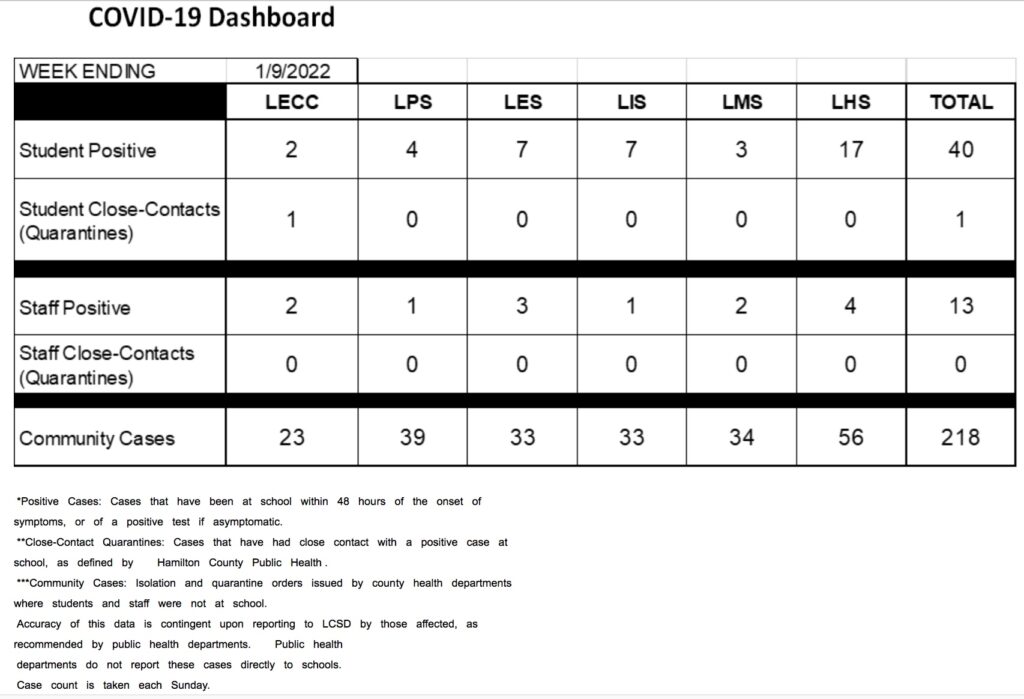
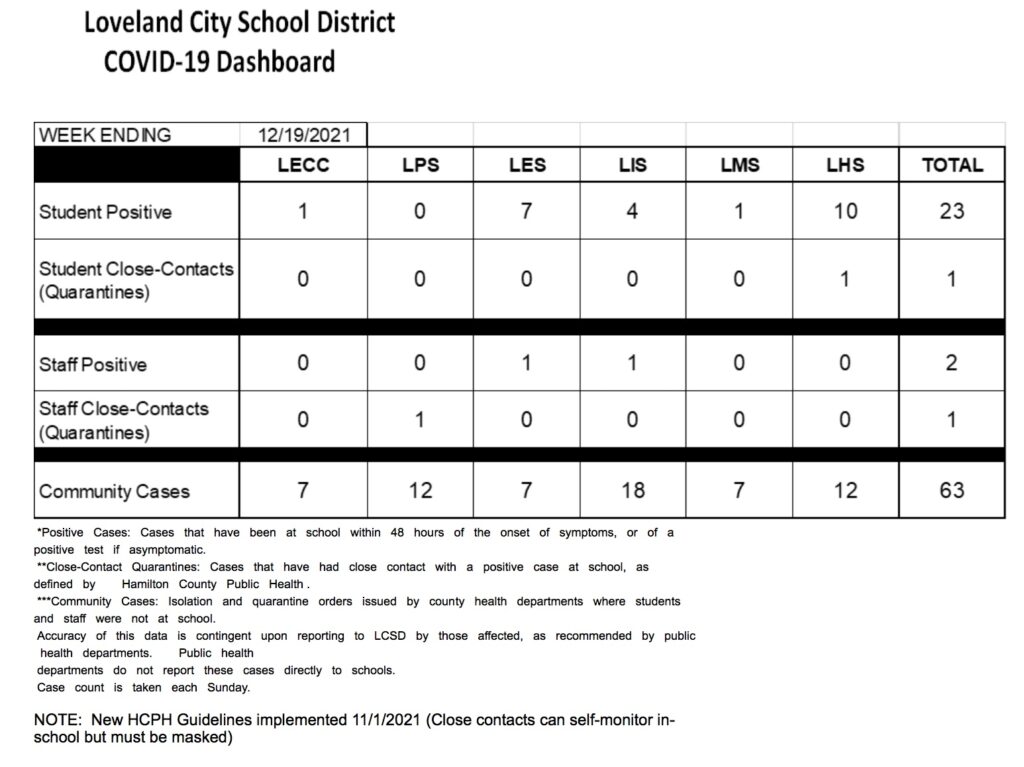
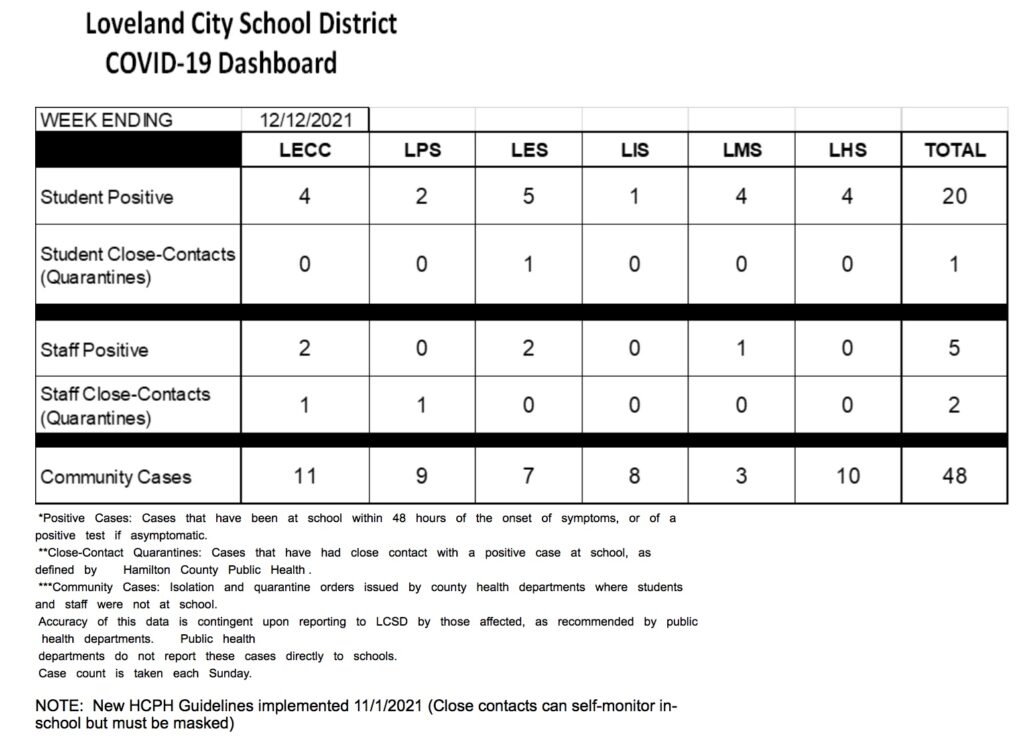
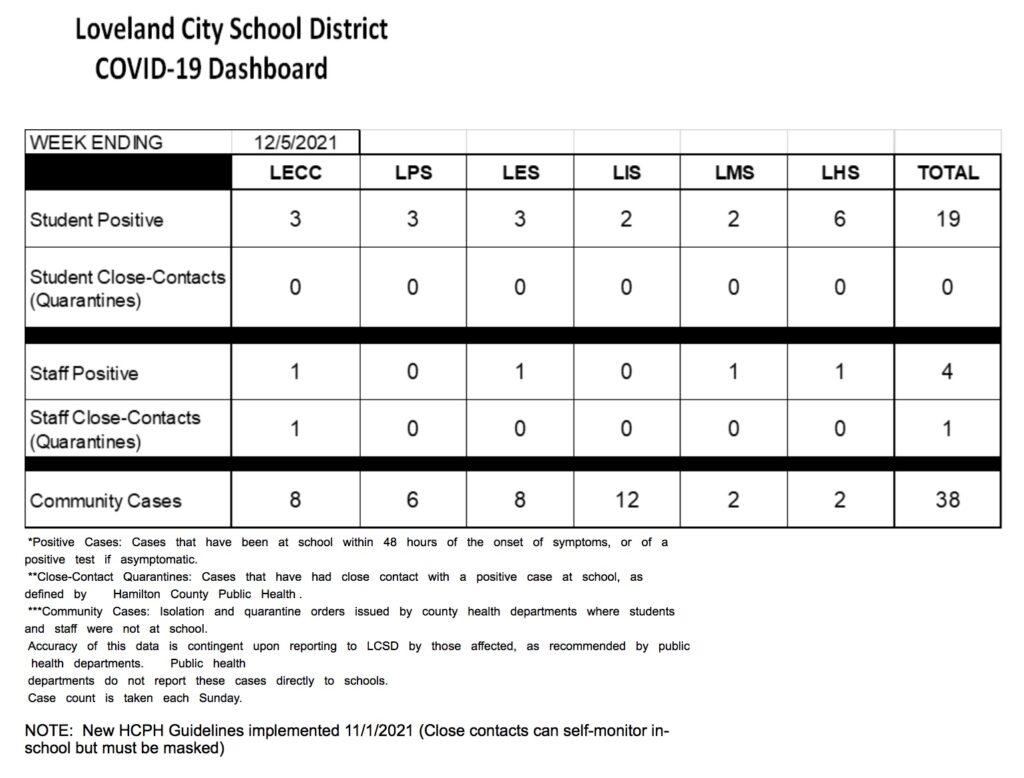
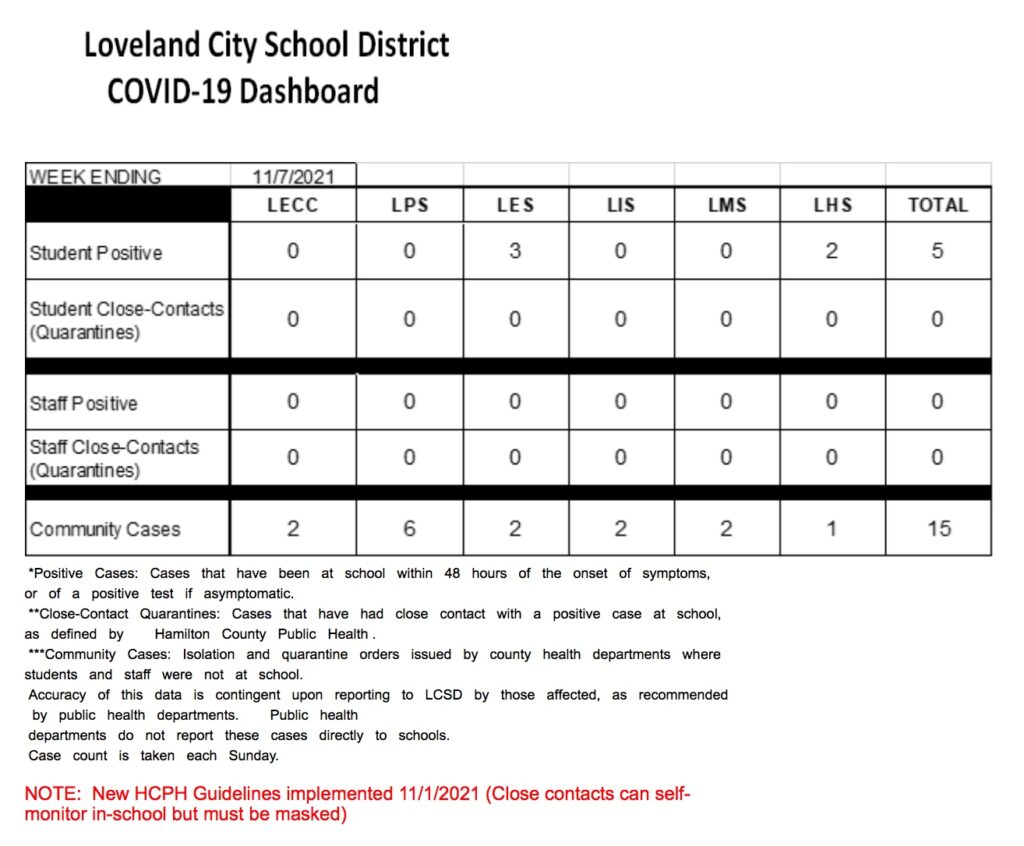
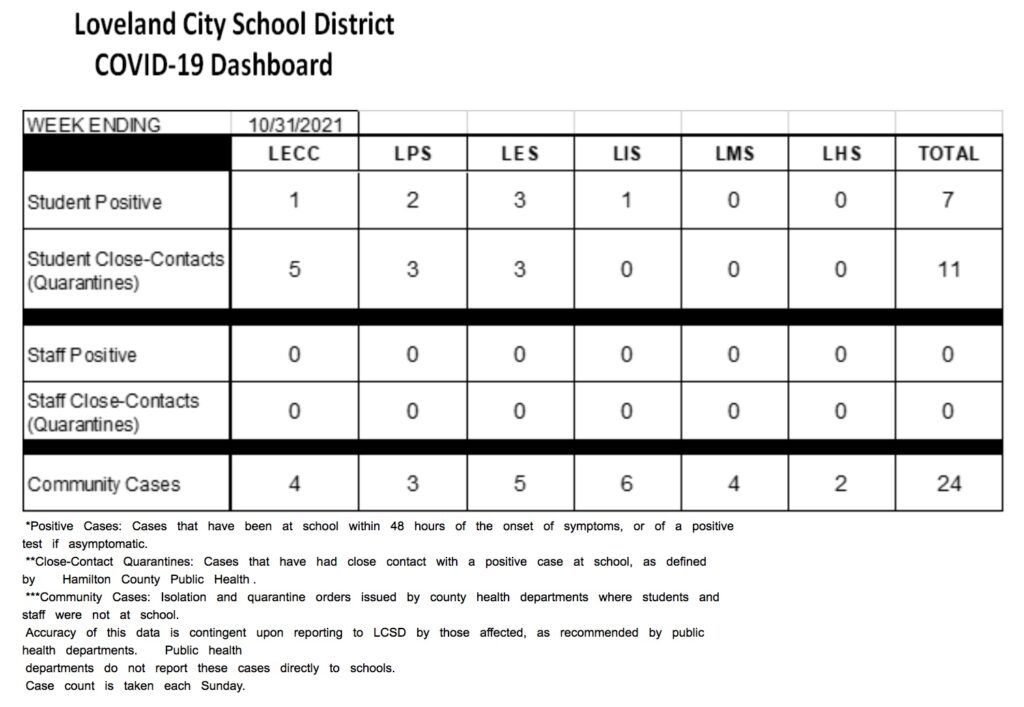
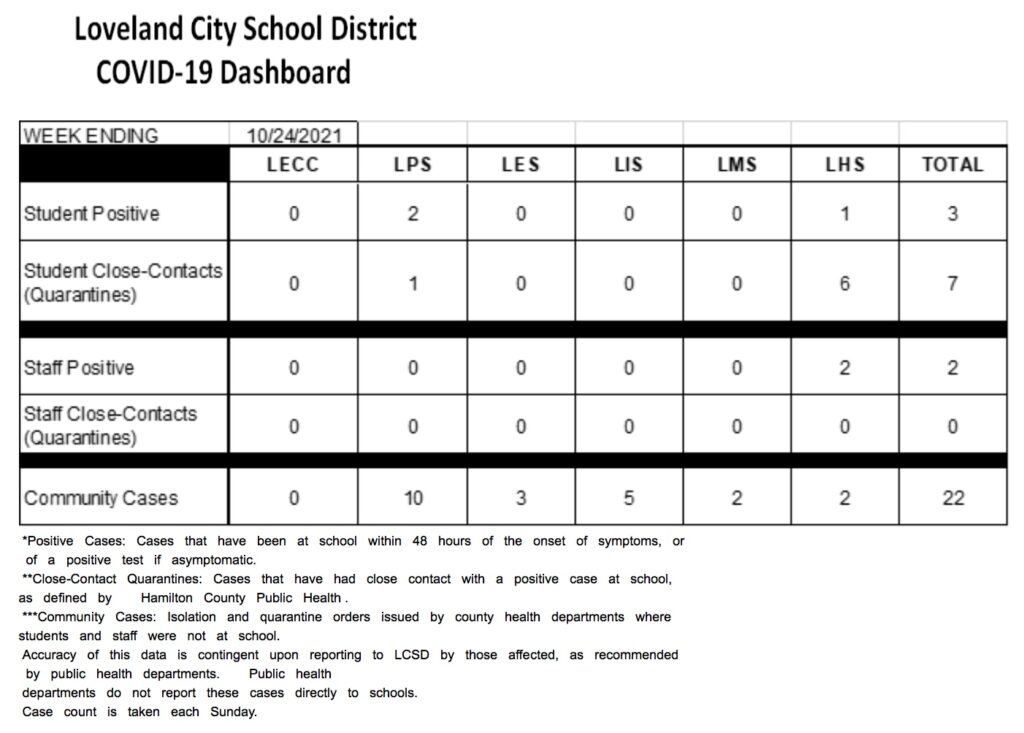
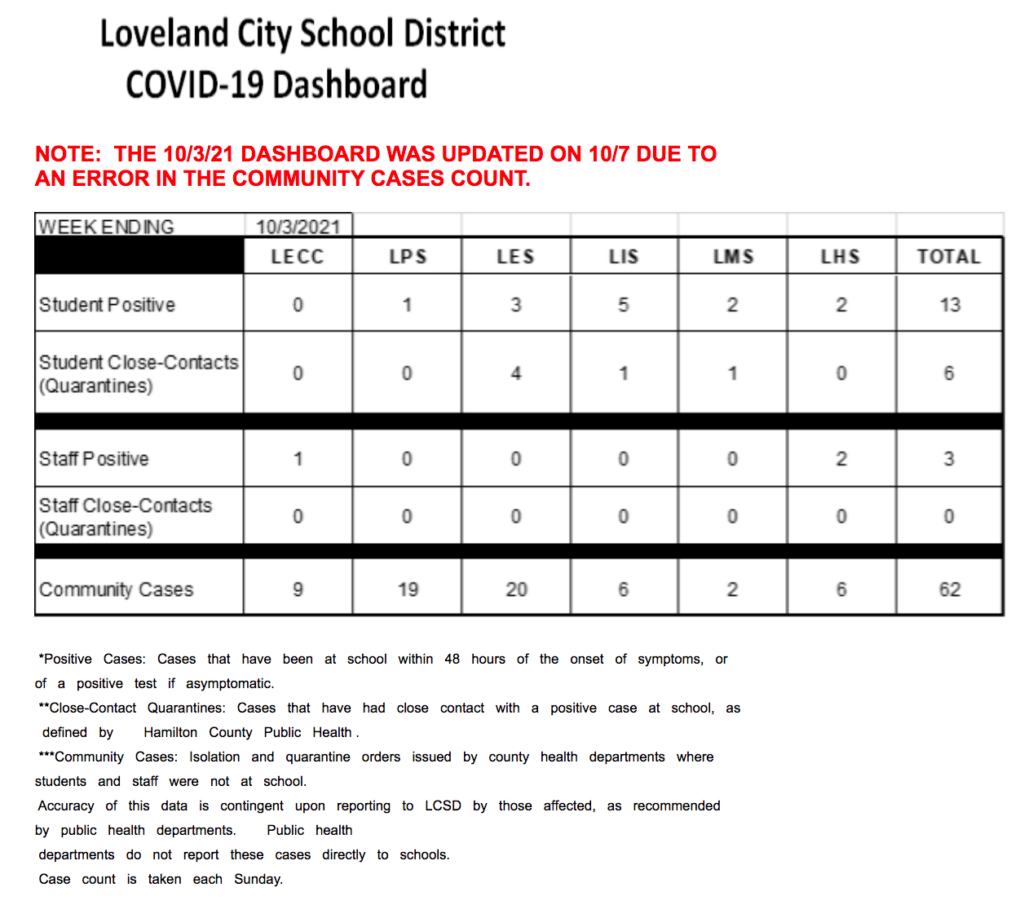
At the beginning of each week, the Loveland City School District releases its latest Covid 19 Dashboard. Below is the first COVID 19 report issued by the District since students returned to classes after their Winter Break. This story lets you review all of the Dashboard reports for the school year.
Loveland, Ohio – At the beginning of each week, the Loveland City School District releases their latest Covid 19 Dashboard. This is the first COVID 19 report issued by the District since students returned to classes after their Winter Break.
Note the correction to the 10/3/ report and that community cases increased from 51 to 62.
Loveland, Ohio – Here is a list of the LIFE Food Pantry needs – now that the holidays are over – donations will drop off but need will rise.
Thank you for supporting the pantry!
Spaghetti Sauce
Canned/Jarred applesauce
Canned Mandarin Oranges
Hamburger Helper
Ensure
Salad Dressing
BBQ Sauce
Crackers
White Sugar
Bisquick
Kleenex
Hand held can openers — easy to turn for our Seniors!
LIFE is a faith and community supported organization that provides food, financial assistance and programs to those experiencing hardship in the greater Loveland area.
Loveland, Ohio – On Tuesday, January 4 the Loveland City Schools Board of Education re-elected Dr. Kathryn Lorenz to another term as Board President. Kevin Dougherty was also elected to serve another term as Vice-President. Both votes were unanimous.
Before the leadership vote, a new member, Reverend Jonathan Eilert took his oath of office as well as returning members who were successfully reelected in the November general election; Kevin Dougherty, Dr. Eric Schwetschenau, and Eileen Washburn.
Hannah Halbert, executive director of Policy Matters Ohio, noted had Congress done the same when it set the federal minimum wage in 1968, it would now be worth about $13 an hour, and she pointed out $9.30 amounts to just over $19,000 annually for a full-time worker.
“That’s still more than $2,000 under the poverty guidelines for a family of three,” Halbert explained. “Even if they’re working full time, playing by the rules, doing what they can, they’re still not going to be able to break that poverty threshold.”
Ohio is among nine states where a 2022 minimum-wage increase is tied to the cost of living. California’s hit $15 Jan. 1, as part of an incremental increase. Eight other states are also in the process of incrementally raising their minimum-wage amounts to $15 an hour.
According to Policy Matters Ohio, raising Ohio’s minimum hourly wage to $15 by 2026 would benefit 1.6 million workers. Halbert is convinced it would help the overall economy and reduce income inequality.
“Thirty-six percent of working women in Ohio would see a pay increase, and 44% of Black working Ohioans would also see an increase,” Halbert outlined. “Raising the wage really does help clear up some of these drivers of inequality in the low-wage system.”
Halbert emphasized the impact of the pandemic on job market data makes it difficult to determine just how many Ohioans are affected by the 2022 increase. Some 84,000 workers benefited from a $0.15 minimum-wage adjustment in 2019.
Reporting by Ohio News Connection in association with Media in the Public Interest and funded in part by the George Gund Foundation.
Self-described “Dog Mom” Cassie Mattia lives in Historic Downtown Loveland with Nala, Dean, and her boyfriend Adam. Cassie is the Co-Owner and Associate Editor of Loveland Magazine.
Loveland, Ohio – We are pleased to present Loveland Magazine’s Pets of the Month for January! The community of Loveland provided us with some very festive Pet of the Month photos and we are beyond thrilled to celebrate these pets’ holiday photos with YOU the readers!
Introducing Cooper, a 13-year-old Cocker Spaniel, and Molly, a 7-year-old Lab-Mix that owner Cassie Sepello adopted from HART Cincinnati. Sepello told us that these two beautiful dogs are a huge part of her family’s lives, especially her kids!
“Cooper and Molly have grown up with our kids! They adore our kids and our kids adore them,” Sepello said, “They also love to go on walks around Loveland. Some of their favorite places include the Meade Park trail, Symmes park trails, and the bike path in Loveland, especially when they get to go behind Nisbet park and hop in the river!”
Sepello also shared that Molly is quite the athlete as she loves to go on runs around their neighborhood!
“Molly ran all my long runs with me when I was training for a half marathon. She was still wagging her tail after finishing a 12-mile training run! She’s definitely an endurance runner,” Sepello added.
Meet Cooper and Molly
Christmas Eve with the kids in matching holiday PJ’s!
Cooper’s 13th birthday party this past February
This past fall at Symmes Township park
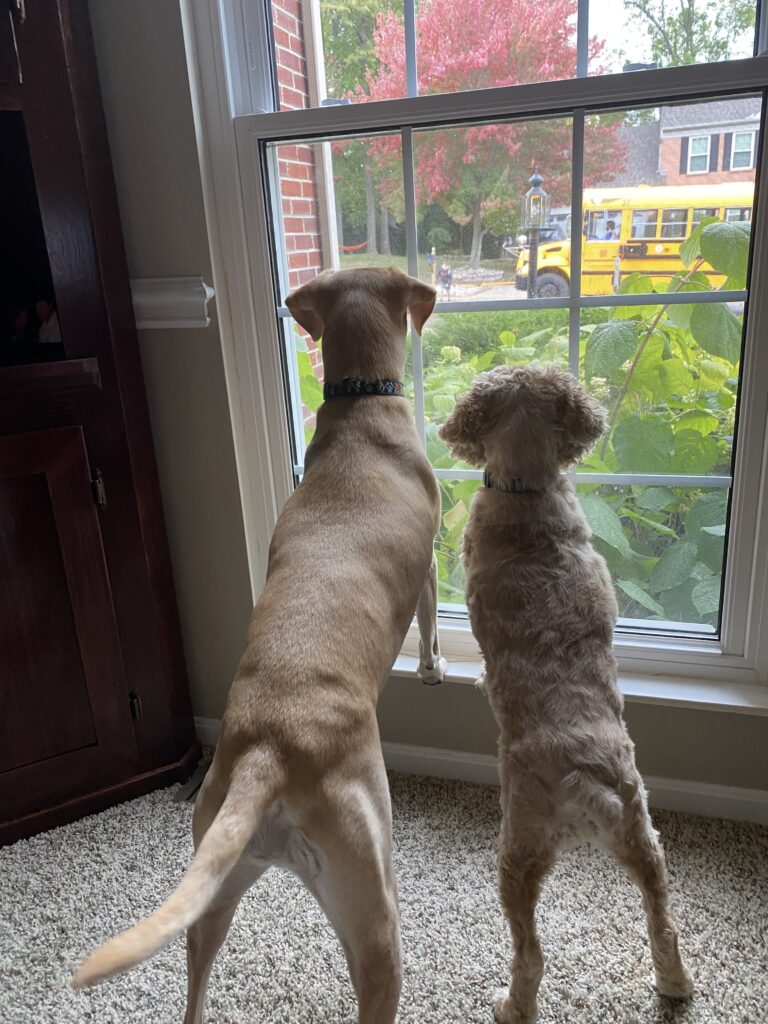
Their favorite time of day is when the school bus rolls up in the afternoon and the kids come home
Congratulations to the Sepello family, Cooper, and Molly for being the first pets in 2022 to be selected to represent Loveland Magazine’s Pets of the Month for January! The Sepellos and their furbabies will be rewarded with a Nothing Bundt Cakes Bundtlet Tower, a gift card to The Works Pizza, and an 8X10 framable photo keepsake! Cooper and Molly will not only be featured in our publication but will also be included in our weekly newsletter for the month of January and our social media pages.
We would like to thank everyone who sent in holiday photos of their pets as it was an absolute joy to see how many beautiful animals there are in our community! For those who sent in photos but weren’t selected this time around, don’t worry, as your entries will be entered back into the competition for the following month’s selection! For those that missed the deadline for January’s Pet of the Month, we will be taking entries from January 5th-25th for February’s Pet of the Month. Don’t be afraid to dress up your sweethearts in their finest Loveland Valentine’s Day gear!
Check out the video below created by David Miller that features Cooper and Molly as well as some of our favorite holiday Pet of the Month entries!
To enter into Loveland’s Pet of the Month contest you must email me, Cassie Mattia, at cmattia12@gmail.com 2-5 of your favorite photos of your pet along with a short bio about your pet. Share with us and the community why your pet is so special to you along with any other unique facts that set your little buddy apart from other pets! When sending in your pet photos and bios please include your pet’s name, age, and breed as well as your contact info with a short description of each photo you provide us with. If you want to share where your pet’s favorite spots are in Loveland that would be great as well! Remember we DO NOT discriminate against any pets; all pets are welcome to enter into the contest!
Join us in celebrating Cooper and Molly for the month of January!
We can’t wait to see whose pet will be featured in February for Loveland Magazine’s Pet of the Month Valentine’s Day Edition!
Here at Loveland Magazine, we would like to send a personal shout-out to The Works Pizza and Nothing Bundt Cakes Mason (nearby in Deerfield Township) for providing wonderful gifts to our winners!
Want to see previous Pets of the Month? Click here!