Tag: latest stories

  • How the bid to make it harder to amend Ohio’s constitution fell apart

    How the bid to make it harder to amend Ohio’s constitution fell apart

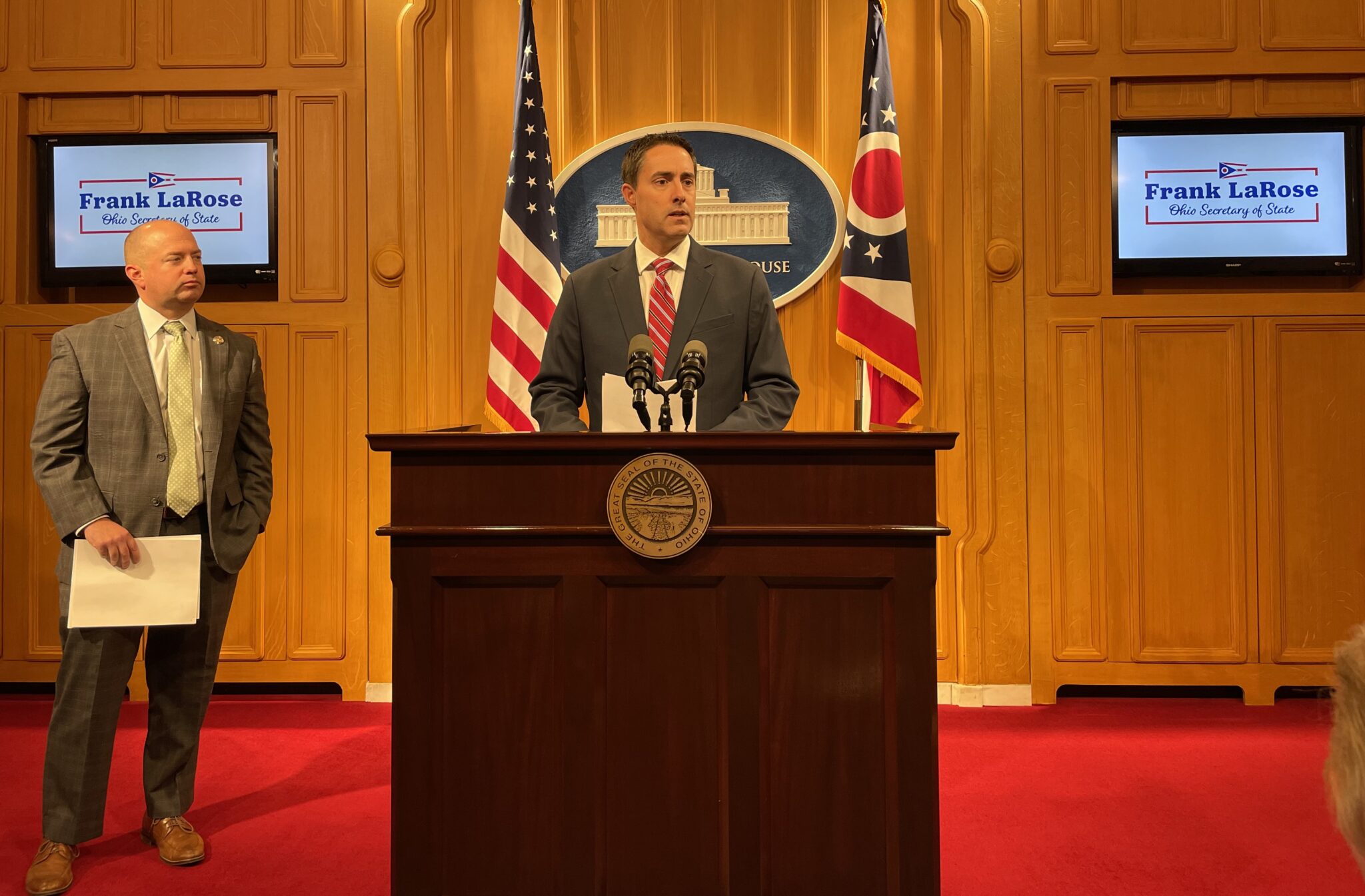
    Secretary of State Frank LaRose (speaking) alongside Rep. Brian Stewart, R-Ashville, introducing a constitutional amendment requiring a 60% supermajority for all future citizen-led ballot amendments. (Photo by Nick Evans, OCJ.)

    BY: NICK EVANS – Ohio Capital Journal

    Just before lawmakers took off for Thanksgiving last year, Secretary of State Frank LaRose and state Rep. Brian Stewart, R-Ashville, held a press conference. Details ahead of time were scant, but the advisory promised “reforms which will better protect Ohio’s constitution.”

    What they unveiled would dominate the chaotic final weeks of the lame duck legislative session and drive a wedge into the Republican supermajority.

    In less than a month, their resolution — requiring constitutional amendments receive 60% support to become law — was effectively dead. Supporters bitterly promised they’d be back, but the episode illuminated divisions within the GOP.

    This January, when Kitts Hill Republican Jason Stephens decided to make an upset bid for House Speaker, Democrats had little trouble discerning which candidate would be better for them.

    Communications between Secretary LaRose, Rep. Stewart, and their staffers shed light on the behind-the-scenes maneuvering to introduce and advance House Joint Resolution 6. The effort forced a fight that’s still playing out in the Ohio House as Republican factions struggle for control.

    Sixty percent

    It all started with a game of phone tag. On the morning of Friday, Nov. 11 last year, Stewart turned down an apparent phone call from LaRose.

    “About to give a Veterans Day speech, lol. Call you back,” Stewart texted.

    Both men are veterans, and LaRose joked back that it’s “not exactly a day off” for them. By the time Stewart returned the call, LaRose was in a meeting. When LaRose called Stewart back, he didn’t pick up.

    Saturday morning, Stewart sent a screen shot of an email to the Legislative Service Commission. In it, he requested a draft amendment to raise the threshold to 60% for passing citizen-initiated constitutional amendments.

    “Since it is a small drafting change,” he wrote, “my hope is that it could be ready this week.”

    Stewart’s next message went over talking points. He laid out their case for not applying that higher threshold to amendments initiated in the General Assembly. The change, he argued, put “interest group” amendments “on the same footing as GA-initiated amendments which require the super-majority vote at the outset.” He also asked LaRose’s office for data on constitutional amendments since 2000.

    LaRose’s team got right to work, returning with a spreadsheet breakdown of all 33 proposals during that timeframe. But his chief legal counsel, D. Michael Grodhaus, warned limiting the scope to citizen-initiated measures might leave the proposal open to court challenge.

    “It is possible that it may be challenged as violating Ohio’s version of the Equal Protection Clause,” he wrote, “I have not researched that point, but presumably LSC will.”

    In a text message, LaRose said “one piece of good news is that the vast majority pass with over 60%.” They arranged a video conference to go over details the next day. Their press conference unveiling what would become HJR 6 was the day after that.

    Building support

    Before LaRose and Stewart introduced their plan publicly, they began working on legislative leaders.

    The Monday after their discussion began, Stewart suggested they touch base with House Speaker Bob Cupp and Senate President Matt Huffman. LaRose said he’d already started.

    “I had a tentative conversation at the OSU game with the speaker (but didn’t tell him that I was working with you on it because I didn’t want to preempt you),” LaRose wrote. “I presented it to him as ‘an idea l’ve been thinking about and want to work with you guys to get done.’”

    “That’s perfect,” Stewart replied, adding that he would let the speaker know about his involvement and discuss timing. LaRose noted Cupp sounded supportive of the policy but worried about the politics.

    “Seems to think it will have opponents from both the left and the right,” LaRose said.

    “He had to be dragged to kicking and screaming to do the party labels for the Supreme Court as well,” Stewart responded, “but he saw the light eventually.”

    The next day, Stewart relayed a conversation with Attorney General Dave Yost.

    “He likes moving to 60% but thinks we will have a weak PR argument on only doing it for citizen initiatives and not legislative,” Stewart said. “He said he won’t weigh in against it, but thinks we should give that some thought.”

    LaRose, meanwhile, described his exchange with Huffman. The Senate President was enthusiastic enough that he patched in chief of staff John Barron and chief legal counsel Frank Strigari. As for whether to apply the higher threshold across the board, LaRose said they discussed the idea, but it was “not conclusive.”

    “He said he’d prefer 60% for initiative and 50% for legislative referral ‘if we can sell it,’” LaRose said.

     Aaron Baer, president of the Center for Christian Virtue, talks in an October press conference about a “backpack” bill to change a private school voucher program in Ohio. Behind Baer are state Rep. Marilyn John, left, and state Rep. Riordan McClain, center, who are co-sponsoring the bill.
    (Photo by Susan Tebben, OCJ)

    Working outside the Statehouse

    But at the very earliest stages — before legislative language was even complete — LaRose and Stewart were consulting power brokers outside of the Statehouse.

    At the same time they were discussing Speaker Cupp’s reticence, they were also talking about Center for Christian Virtue president Aaron Baer’s involvement.

    In an exchange with Stewart three days before they announced their proposal publicly, LaRose texted “I know that the life community is interested in this and Aaron Baer spoke with Huffman over the weekend.”

    “Baer and I discussed it before you called me initially, too,” Stewart said.

    The day before unveiling the resolution, LaRose reported speaking to Steve Stivers, who heads up the Ohio Chamber of Commerce.

    “He’s for it with some additional nuance I can explain later but he’s for it,” LaRose said.

    They picked up more conservative supporters after introducing the idea, but the response wasn’t unanimous.

    A few hours after their introductory press conference, LaRose shared a picture of a text exchange with American Policy Roundtable vice president Rob Walgate. He had reached out to say APR would oppose the effort. “Didn’t want it to be a surprise,” Walgate said.

    LaRose tried to win him over.

    “Kind of surprised that you’re not part of the group of many other conservatives who believe like that me that it’s just far too easy to amend our state constitution,” LaRose wrote.

    Other supporters, though, were a bit too enthusiastic. Chris Long from the Ohio Christian Alliance pitched Stewart on holding a press conference in support of the resolution.

    “I think I persuaded him to work more behind the scenes directly with members without a public statement yet,” Stewart said.

    LaRose agreed writing, “he should help work the conservative circles behind the scenes, but not make a big splash publicly.”

     Ohio House Speaker Bob Cupp (R-Lima) (right) December 13, 2022, at the Ohio Statehouse in Columbus, Ohio. (Photo by Graham Stokes for Ohio Capital Journal. Republish photo only with original story.)

    Heading to committee

    The Tuesday after Thanksgiving, Stewart made his pitch to the Republican caucus. He told LaRose that while the caucus was supportive, Cupp was still “dragging feet.”

    “But the sentiment in the room was that we should go to 60% for adoption across the board and undercut the ‘hypocrisy’ argument,” Stewart said.

    “Can you get Cupp some reassurance that resources will be spent to advance this in May?” Stewart added.

    LaRose said shifting to 60% across the board was fine with him, and that any reassurance for Cupp should come from the business community. He mentioned Steve Stivers and Ohio Business Roundtable president Pat Tiberi.

    “They both told me they’re behind this 100%,” LaRose said. “I guess at this point I need to ask them to tell the speaker that, too.”

    The Ohio Chamber submitted testimony in favor of HJR 6, but the Ohio Business Roundtable never took a formal position on the measure. Later that day, Stewart reported they would get their first committee hearing that week.

    He explained the chairman, Rep. Shane Wilkin, R-Hillsboro, and Rep. Bill Seitz, R-Cincinnati, both wanted to see the higher threshold applied to all amendments, regardless of whether they’re initiated by lawmakers or citizens. “Without them we don’t get it out of committee,” Stewart said, adding that he planned to introduce a sub bill with those changes at the start of the hearing.

    By the next day, before holding a single hearing, they’d already set their course to eventual passage.

    “Tomorrow is just sponsor (testimony),” Stewart said about the committee hearing on Thursday. “Plan I think (Wilkin was talking to Speaker) is for proponent/opponent to occur next week, and voted out at the end of next week or early the week of the 12th.”

    This was less than two weeks after the press conference introducing the resolution.

    Presaging the rift that would eventually consume the party, Stewart noted “Stephens told me he’s a no.”

    A few weeks earlier the caucus had selected Rep. Derek Merrin, R-Monclova Township, to be the next House speaker over Rep. Jason Stephens, R-Kitts Hill, and Rep. Phil Plummer, R-Dayton.

    “I’m going to try to ferret out if there’s more,” Stewart wrote, “There may be some post Speaker vote hangover here we are dealing with.”

     Rep. Brian Stewart, R-Ashville, speaking in committee. Photo by Nick Evans, OCJ.

    Hearings

    Thursday, Dec. 1, Stewart testified in the House Government Oversight Committee in favor of HJR 6. “It went really, really well,” he told LaRose later that day. “GOP members were very pleased, and the Dems couldn’t land a glove.”

    Meanwhile, they notched a significant endorsement as Heritage Action announced it “fully supports” the measure. In a text message, CCV’s Aaron Baer took credit, saying “a productive trip to Washington yesterday” with a link to the press release.

    LaRose promised to submit written testimony to the committee but wouldn’t be there in person. “First family vacation in close to two years,” he explained.

    “Honestly, I spent an hour engaging with them,” Stewart replied, “There’s not much ground left to plow in person.”

    The following Tuesday Stewart asked if they should get proponents to speak at a hearing scheduled for the next day.

    “I think the more the merrier who can come in and speak in favor… You know the opposition is going to pack the room,” LaRose wrote back.

    In the end, only one proponent showed up to testify in favor of the plan.

    A tactical pause

    This story relies on numerous images of LaRose and Stewart’s text exchanges collected through a public records request. In the initial version, many of those images are blurry and at times illegible. When LaRose’s office provided a new, legible copy those messages cut off at Dec. 6.

    The original version included a few more messages stretching into the following week.

    On Dec. 7, LaRose sent Stewart the contact card for the associate director of the American Petroleum Institute, without any additional comment.

    The following week, LaRose reached out to talk. His message appears to read that they “may be taking a tactical pause,” adding later “I heard we’re short on votes.”

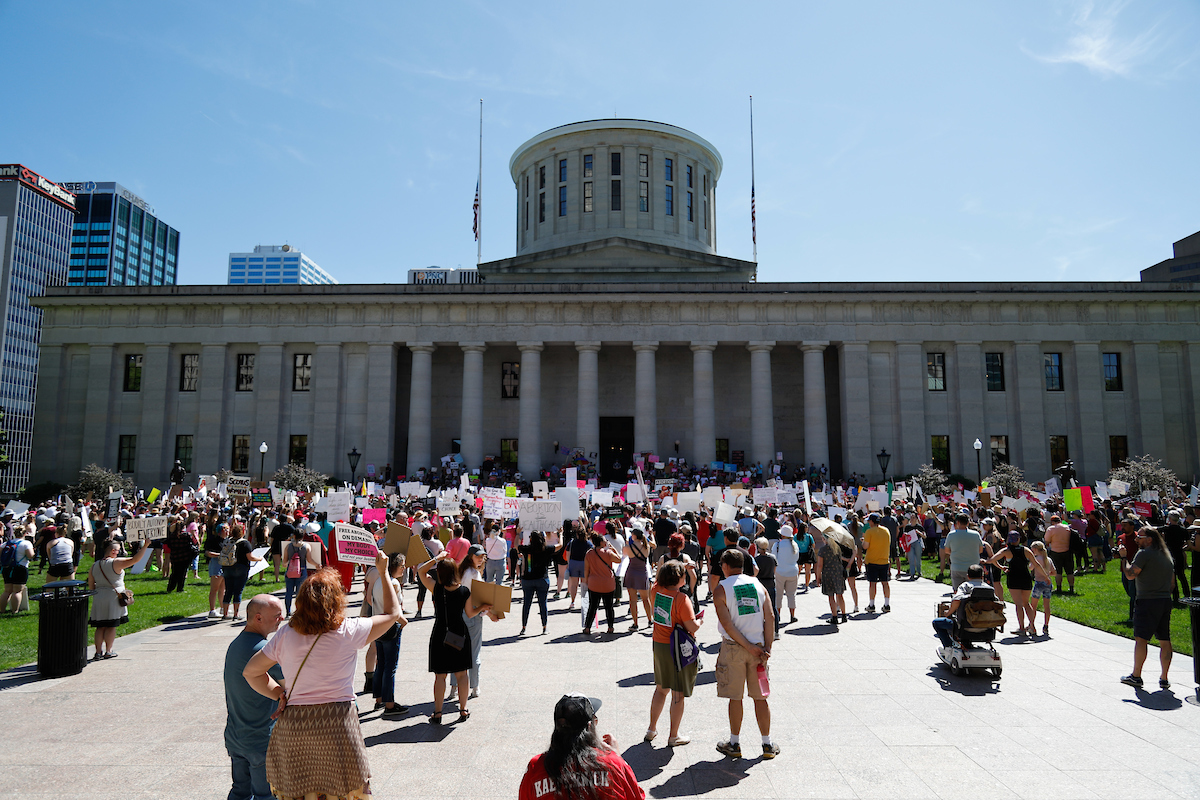
    HJR 6 made it out of committee, but hundreds of opponents staged a coordinated show of resistance at the Statehouse. Later that same day, Speaker Cupp explained it was “doubtful,” the resolution would go forward.

    In his response, however, Stewart remained optimistic. He wrote back to LaRose, “Merrin and I already scheduled multiple session days in January.” He added they could pass the resolution quickly “when we’ve got 67 votes” and what appears to be “several fewer hard heads to wrangle.”

    The next day, a letter from Stewart to fellow Ohio House Republicans was revealed by Cleveland.com’s Andrew Tobias.

    Though LaRose had denied that the resolution was about stopping proposed amendments to protect access to abortion or a new round of redistricting reform, in his letter Stewart cited two reasons for his colleagues to support raising the threshold for voters: protecting Ohio’s abortion ban and fighting further redistricting reform efforts.

     COLUMBUS, OH — FEBRUARY 15: State Rep. Brian Stewart, R-Ashville, flanked by House Republicans, talks to the press about the Ohio House Republican leadership, February 15, 2023, at the Statehouse in Columbus, Ohio. (Photo by Graham Stokes for Ohio Capital Journal. Republish photo only with original story.)

    Aftermath

    Stewart quickly shifting gears to a January timeline aligns with what he promised publicly at the time. But of course, with Merrin losing the speaker’s race to Rep. Stephens, those House sessions never happened.

    A little more than a week after Stephens took the gavel, Merrin and Stewart got their allies together at the statehouse to file a new version of the resolution. Merrin has repeatedly invoked that legislation since then as a point of differentiation between his allies and Stephens’ supporters.

    The proposal now requires organizers get signatures from all 88 counties instead of the 44 required under current law. It also eliminates the cure period in which organizations can collect additional signatures if their first submission falls short.

    However, the Feb. 1 deadline for amendments to get on the May ballot came and went without lawmakers holding a single hearing on Stewart’s resolution.

    Stephens said he’s “confident” the chairman of a new committee devoted to constitutional amendments “will be able to handle the gravity of this issue.” Still, he didn’t even refer the measure to the committee until Feb. 16.

    That committee still has yet to hold a hearing.

    Follow OCJ Reporter Nick Evans on Twitter.
  • Ohio Ballot Board moves abortion amendment initiative forward

    Ohio Ballot Board moves abortion amendment initiative forward

    Supporters now set sights on collecting enough signatures by July to put the measure to Ohio voters in November

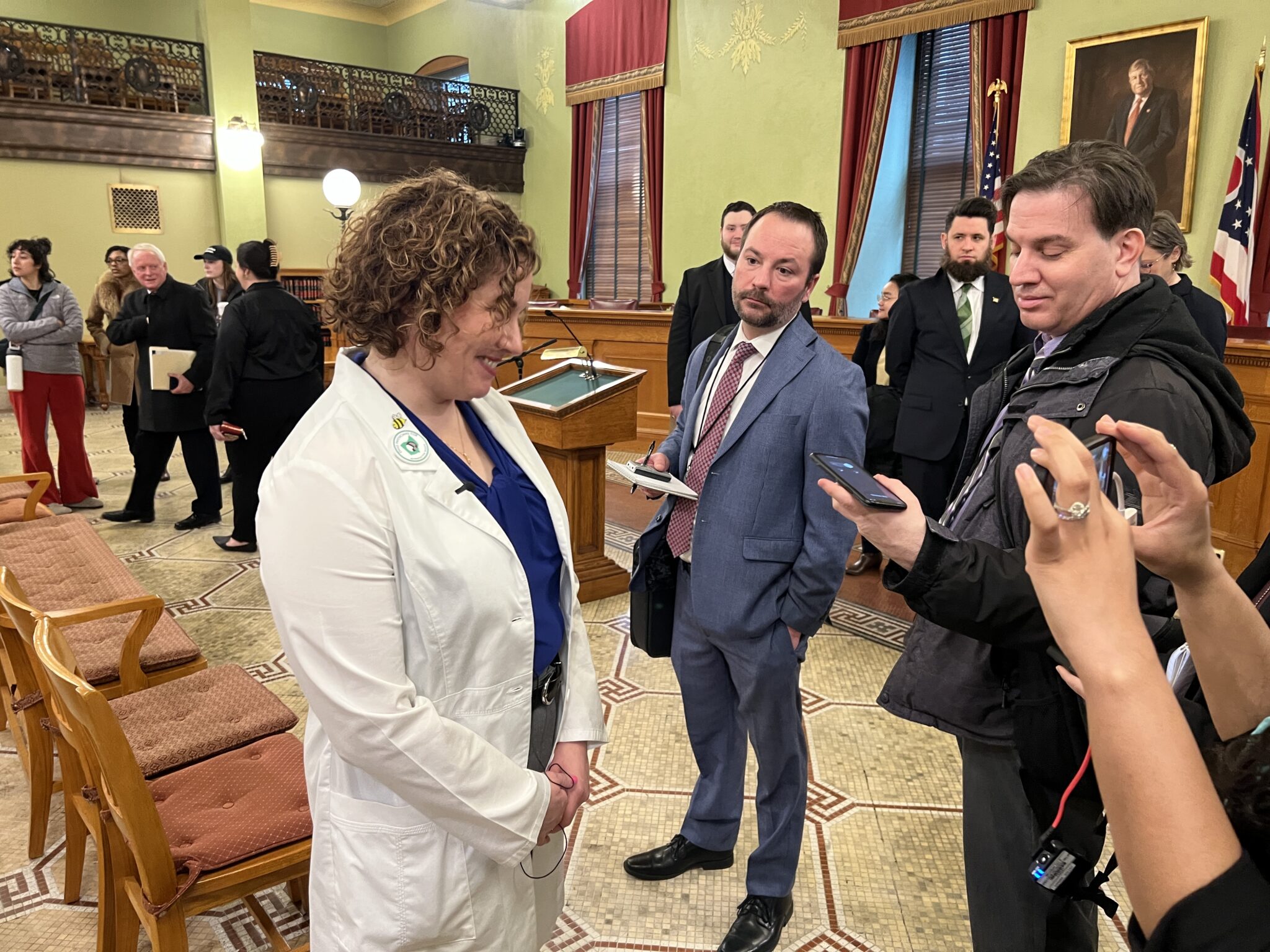
    Dr. Amy Burkett, OB/GYN and member of Ohio Physicians for Reproductive Rights, speaks to media Monday following the Ohio Ballot Board’s vote to verify the language of a proposed constitutional amendment on abortion. Photo: Susan Tebben, OCJ

    This article has been updated to include the proposed constitutional amendment (bottom)

    BY: SUSAN TEBBEN – Ohio Capital Journal

    The Ohio Ballot Board verified Monday that a proposed amendment for the November ballot to cement abortion rights in the Ohio Constitution can now move forward to the full signature-gathering stage.

    In a short Monday meeting, the board, composed of Secretary of State Frank LaRose; Republican state Sen. Theresa Gavarone, Democratic state Sen. Paula Hicks-Hudson, Democratic state Rep. Elliot Forhan, and Bill Morgan, voted unanimously that the proposed ballot initiative only involved one constitutional issue.

    The board only heard from two people outside of the board after LaRose insisted that content be kept away from the merits of the amendment or opinions about abortion itself.

    John Grove, of Cincinnati Right to Life, still took time to try to discredit the amendment itself, called it “intentionally unjust and misleading.”

    Attorney Don McTigue spoke on behalf of the groups proposing the amendment, choosing not to dive into the legal aspects of the amendment, instead saying the “common purpose of the amendment” was individuals having control of one’s own reproductive decisions.

    Gavarone acknowledged that the purpose of the Ballot Board business was “procedural,” but still input her opinion before the unanimous vote was recorded.

     COLUMBUS, OH — FEBRUARY 22: State Sen. Theresa Gavarone, R-Bowling Green, during the Ohio Senate session, February 22, 2023, at the Statehouse in Columbus, Ohio. (Photo by Graham Stokes for Ohio Capital Journal. Republish photo only with original story.)

    “I am horrified at the thought of this amendment, I mean, the right to kill babies being put into Ohio’s constitution,” Gavarone said.

    Now that the proposal has been certified by the Ohio Attorney General and verified by the Ohio Ballot Board, groups attempting to get the measure on the ballot can move forward with collecting the more than 400,000 valid signatures needed to officially get the measure to statewide voters.

    Laura Strietmann, executive director for Cincinnati Right to Life, said pro-life organizations throughout the state have joined together as well, with a full strategy to fight against the measure.

    “We are unified in protecting women in Ohio, in stopping this bill from becoming law,” Strietmann said after the vote.

    Abortion rights groups say they are prepared to go forward with field planning, volunteers and petition circulators as early as the end of this week, according to Jordyn Close, deputy director for the Ohio Women’s Alliance and board president for Abortion Fund of Ohio.

    The organizations are planning to hit the ground running to get more than enough signatures in a short amount of time. The deadline to submit signatures so the proposal can appear on the November ballot is July.

    Part of the plan to bring support to the measure includes informing voters about the true aims of the constitutional amendment on which they would be voting. Claims have already been made by opposition groups that the amendment would bar all abortions, including for baby’s who have reached full term, something supporters of the amendment say won’t happen.

    “We are not interested in doing full-term abortion,” said Dr. Amy Burkett, board-certified OB/GYN in northeast Ohio, and member of Ohio Physicians for Reproductive Rights. “This is about protecting the rights to reproductive health care including abortion, up to viability.”

    Viability, Burkett said, should be determined by the physician and patient “based on the technology that is available at the time.”

    Amendment supporters aren’t shying away from their pro-abortion stance, despite the trend toward using “pro-choice” as a way of including all options.

    “When we talk about reproductive freedom and bodily autonomy, we have to be really specific about what (opposition groups) are attacking,” Close said. “And that is abortion access.”

    ————————-

    Amendment Summary and Text:

    TITLE: The Right to Reproductive Freedom with Protections for Health and Safety

    SUMMARY
    The Amendment would amend Article I of the Ohio Constitution by adding Section 22, titled “The Right to Reproductive Freedom with Protections for Health and Safety.”

    The Amendment provides that:
    1. Every individual has a right to make and carry out one’s own reproductive decisions, including but not limited to decisions on contraception, fertility treatment, continuing one’s own pregnancy, miscarriage care, and abortion.
    2. The State shall not, directly or indirectly, burden, penalize, prohibit, interfere with, or discriminate against either an individual’s voluntary exercise of this right or a person or entity that assists an individual exercising this right, unless the State demonstrates that it is using the least restrictive means to advance the individual’s health in accordance with widely accepted and evidence-based standards of care.
    3. However, abortion may be prohibited after fetal viability. But in no case may such an abortion be prohibited if in the professional judgment of the pregnant patient’s treating physician it is necessary to protect the pregnant patient’s life or health.
    4. As used in this Section, “Fetal viability” means “the point in a pregnancy when, in the professional judgment of the pregnant patient’s treating physician, the fetus has a significant likelihood of survival outside the uterus with reasonable measures. This is determined on a case-by-case basis”; and “State” includes any governmental entity and political subdivision.
    5. This Section is self-executing.

    FULL TEXT OF PROPOSED AMENDMENT

    Be it Resolved by the People of the State of Ohio that Article I of the Ohio Constitution is amended to add the following Section: Article I, Section 22. The Right to Reproductive Freedom with Protections for Health and Safety

    A. Every individual has a right to make and carry out one’s own reproductive decisions, including but not limited to decisions on:

    1. contraception;
    2. fertility treatment;
    3. continuing one’s own pregnancy;
    4. miscarriage care; and
    5. abortion.

    B. The State shall not, directly or indirectly, burden, penalize, prohibit, interfere with, or discriminate against either:

    1. An individual’s voluntary exercise of this right or
    2. A person or entity that assists an individual exercising this right, unless the State demonstrates that it is using the least restrictive means to advance the individual’s health in accordance with widely accepted and evidence-based standards of care. However, abortion may be prohibited after fetal viability. But in no case may such an abortion be prohibited if in the professional judgment of the pregnant patient’s treating physician it is necessary to protect the pregnant patient’s life or health.

    C. As used in this Section:

    1. “Fetal viability” means “the point in a pregnancy when, in the professional judgment of the pregnant patient’s treating physician, the fetus has a significant likelihood of survival outside the uterus with reasonable measures. This is determined on a case-by-case basis.”
    2. “State” includes any governmental entity and any political subdivision.

    D. This Section is self-executing.

  • A proposal for directional signs to accessible parking in Historic Downtown Loveland

    A proposal for directional signs to accessible parking in Historic Downtown Loveland

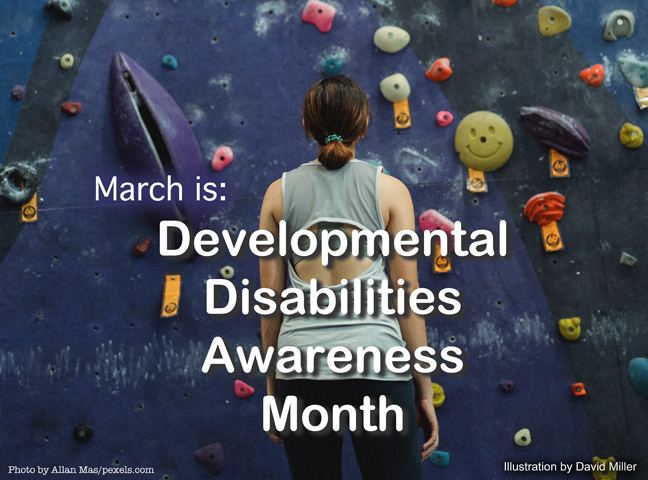
    March is National Developmental Disabilities Awareness Month

    by David Miller

    Dear City Hall,

    I ask you to install directional signs in our Historic District that point to accessible parking spaces.

    To honor National Developmental Disabilities Awareness Month I decided to revisit the draft of a proposal I worked on from 2014 until 2016. Most of the proposal was eventually approved by Loveland City Council and the Loveland Planning and Zoning Commission and is now adopted law in the City. I started the project in 2014 when resident, Amy Clawson raised concerns to me. Amy said that unfortunately, a very common problem for people who have different needs is in finding good, appropriate parking that can accommodate their physical or health issues. She pointed me to several instances of inadequate and poorly marked parking spaces in the Historic District. After taking an inventory around town, I published this story: Accessible parking; out of sight, out of mind, neglected and abused.

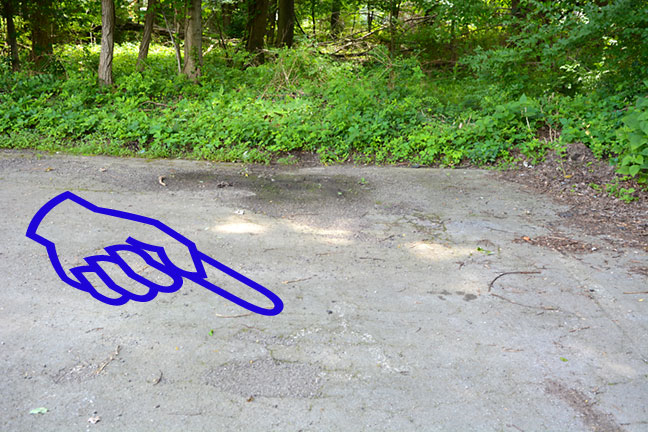
    This nearly invisible accessible parking space was at McCoy Park in 2014. There should have been a pole-mounted sign and the paint on the pavement had all but disappeared.

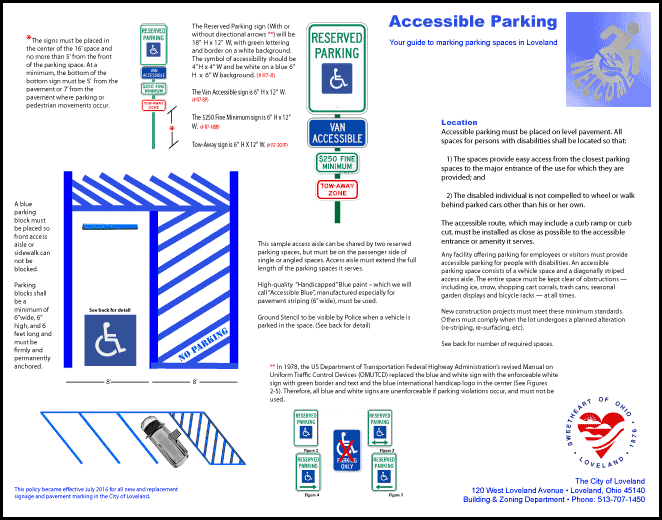
    Because most spaces in Loveland in 2016, whether on public or private parking lots were not in compliance with either Ohio or Federal law, the proposal was to mark all accessible parking spaces in the City in a consistent manner and for City Hall to choose a deliberate pathway to bring them all into lawful compliance.

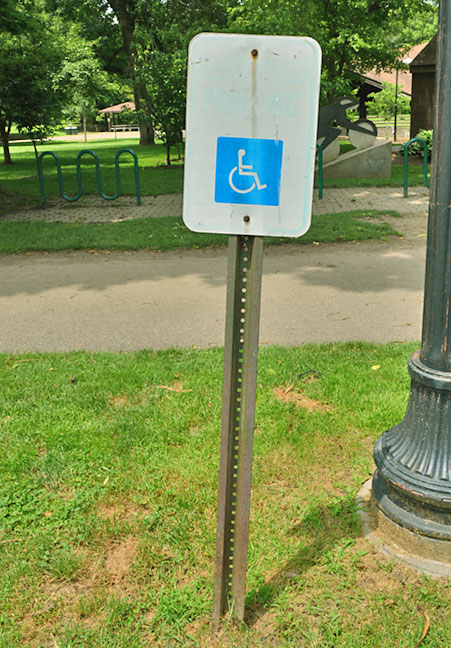
    This was the neglected condition of the accessible parking sign near the restroom at Nisbet Park in 2014.

    It’s intuition that leads you to rather easily locate the accessible parking spaces at Kroger or shopping centers, however, since most businesses in Historic Downtown do not provide their own parking, directional signs as well as signage at the parking spots themselves are needed.

    At the time I started my research, accessible parking was out of sight, out of mind, neglected, and abused. During special events, they are still mostly out of sight and mind.

    I received the full support and helpful suggestions from both City Manager Dave Kennedy and City Engineer Cindy Cindy Klopfenstein as I crafted and illustrated the plan. Kennedy from his end ensured that the planning commission and city council gave careful thought to the plan and secured their approvals.

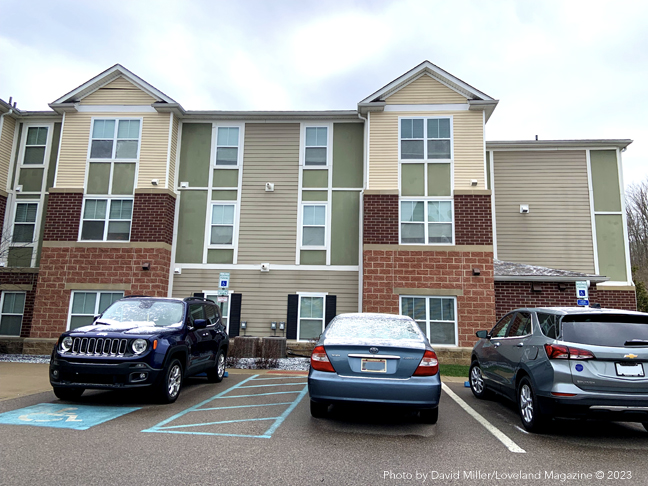
    When built, the Trails at East Loveland was the first new development to fully comply with the new requirements for accessible parking spaces.

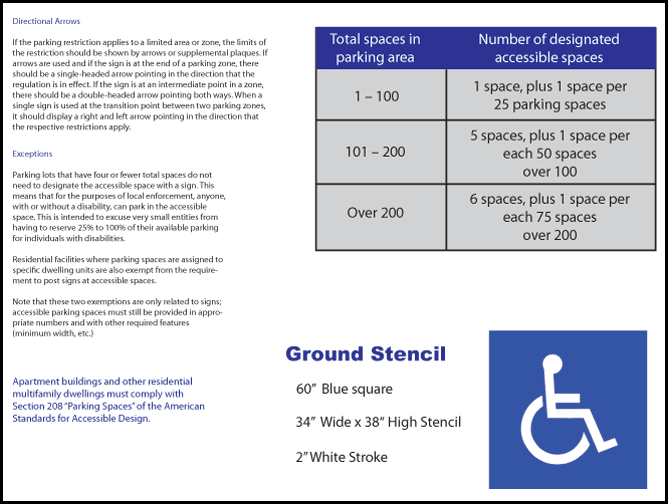
    The plan as adopted requires that all new parking spaces from new development must tell the Planning and Zoning Commission how they intend to comply with the new requirements. Any repaving, recoating, or new stripping of existing parking lots must now also use the guidelines.

    Also adopted at the time was a policy requirement that all applications, whether from private groups or City Hall who filled out an application for special events describe on the application how they will provide the number of accessible parking spaces based on their anticipated attendance.

    The Accessible Parking Sign used by the State of New York

    The original plan I proposed was to use a new universal design that at the time was being adopted around the country, but through research of Ohio Department of Transportation law, I discovered that although they were considering the new design they had not yet made it their design of choice. The newer “fluid movement” design is meant to accentuate a more positive image of accessible needs rather than an expression of one using the parking spot as being “handicapped”.

    Also, one idea I had in 2016 was to have directional signs placed throughout our Downtown Historic District pointing to where a person could find accessible parking, without driving around looking for them. 

    Thus, in light of it being National Disabilities Awareness Month I have revisited my earlier proposal and now suggest “wayfinding” directional signs in the Historic District so people can find the hidden gems closest to where they want to go.

    I propose permanently mounted signs as well as portable ones that would be brought out for special events such as Christmas in Loveland, parades, and the Independence Day event.

    The Direction Sign I propose for Historic Downtown Loveland would tell visitors and shoppers where to find an accessible parking space and that the Sweetheart City of Loveland, Ohio is a welcoming community.

    Thank you for considering my suggestion.

    Best regards,

    David Miller

    The Accessible Parking Space Guide Approved in 2016

  • Supporting people with developmental disabilities incredibly increases our value as a society

    Supporting people with developmental disabilities incredibly increases our value as a society

    Developmental Disabilities Awareness Month is the right time to talk about it

    by Lisa Guliano

    Before the 1950s, Ohio residents with developmental disabilities were often sent to institutions or kept at home, isolated and hidden from the public. Thanks to the advocacy efforts of parents who wanted better for their children, change was brought about. In 1952, parents in Butler County formed what would later become the Butler County Board of Developmental Disabilities (BCBDD).

    With such a start, BCBDD has always had a hand in advocating for people with developmental disabilities and despite progress, there are many ways that advocacy is still needed to this day.

    In 1986, the Ohio Legislature signed into law a Bill of Rights for people with developmental disabilities.  The statute includes 24 rights to legally reinforce the freedom to choose and experience life.  These are basic rights such as:  the right to participate in decisions that affect their lives; the right to social interaction with members of either sex; the right to food adequate to meet accepted standards of nutrition; and the right to privacy, including periods of privacy and places of privacy to name some examples. 

    It has always been difficult for me to accept that people with disabilities needed additional protection under the law to simply be treated equally as all citizens. 

    Given that reality, our Board’s mission focuses on supporting people to live, work and learn in their community.  What that looks like is different for every person depending on their goals and dreams for their future – just like you and me.  Our role as advocates is an honorable one — it is vitally important given the history of people with disabilities living in institutions and being hidden from the community for being different. 

    Supporting people with disabilities to access opportunities to develop their full human potential – language also included in the Bill of Rights – incredibly increases our value as a society.  Each person realizing their goals and dreams has an exponential effect on all of us. 

    If you’re trying to think of examples of what our mission looks like in the community, I’d encourage you to look at yourself, possibly your family members and even your friends.  Haven’t we all worked on a plan for our lives and accessed support from others along the way?  Are there times when you or someone you know faced challenges, or even barriers because of being different or not fitting a “typical profile?”  As you’ve walked your path in life, recall the times where your opportunities led you to reaching goals, getting closer to your full potential, contributing to your sense of worth, your family and your community. 

    Diversity doesn’t look all that different for people with disabilities as they focus on living their best lives – not defined by us – but supported by us.  We celebrate Developmental Disabilities awareness month in March and I’m challenging you to focus on the abilities, not the disabilities of people in our community, recognizing the unique ways all of us contribute to society.

  • A perspective on the Loveland School District levy

    A perspective on the Loveland School District levy

    by Tom Allen

    I’d like to take a few minutes of your time to share my perspective on the school levy that will be on the May ballot.

    I’m a 60-year-old, 30-year Loveland area resident with a home in the Loveland school district. I’m semi-retired and our children, who attended Loveland schools from K-12, are grown. Being semi-retired means, like many of you, I watch my spending closely. As someone who has always been proud of the Loveland Schools’ reputation and performance, the divide in our community from the past few levies has been disheartening. I have friends and neighbors on both sides of this issue. I have voted no in the past and I understand why people feel as they do about the situation.

    The perspective I want to share is fairly simple, and one that as fellow property owners I hope you will consider. I firmly believe it’s in all of our best interests to be more aligned this May.

    The premise is this: I understand that property values are subject to a variety of factors. I believe that school district performance is among the leading considerations of families looking to move to a new community. The way l see it a school district that does not support reasonable funding requests is destined for declining property values over time, as school performance and reputation declines. The reality is that things do cost more over time and it does cost to attract and retain top talent.

    Let’s say for the sake of argument that property values drop 10 percent over the next ten years. If your Loveland home was valued at the current Zillow average of $355,000, you will take a $35,500 hit when you sell it. That is a very significant loss. I would prefer to pay a few hundred dollars more each year to help maintain the good reputation of our schools, protect our property values and provide our students with a well-rounded educational experience.

    While each of us has reasons that affect our decisions about these levies, I believe what we have in common is that we all prosper when we have a high performing school district. I would like our state to provide a better funding mechanism for our public schools, but unfortunately, it doesn’t. I trust that our current school leaders are good stewards of our hard earned tax dollars and I believe that they reacted appropriately to our feedback when the District overreached.

    After voting against the oversized levy a few years ago, I will be voting yes on the May levy that will be on the ballot, mostly to help protect our property values. I’m willing to find the additional hundreds of dollars per year as an investment in education, our community and in all of our property values.

    I appreciate you giving this issue further consideration and I respect that each of you has the right to vote for what you believe is best for your situation.

  • Become a “credited” Producer of Samuel Wright Smith’s high-profile short film, Heartbreak on Murray hill

    Become a “credited” Producer of Samuel Wright Smith’s high-profile short film, Heartbreak on Murray hill

    by David Miller

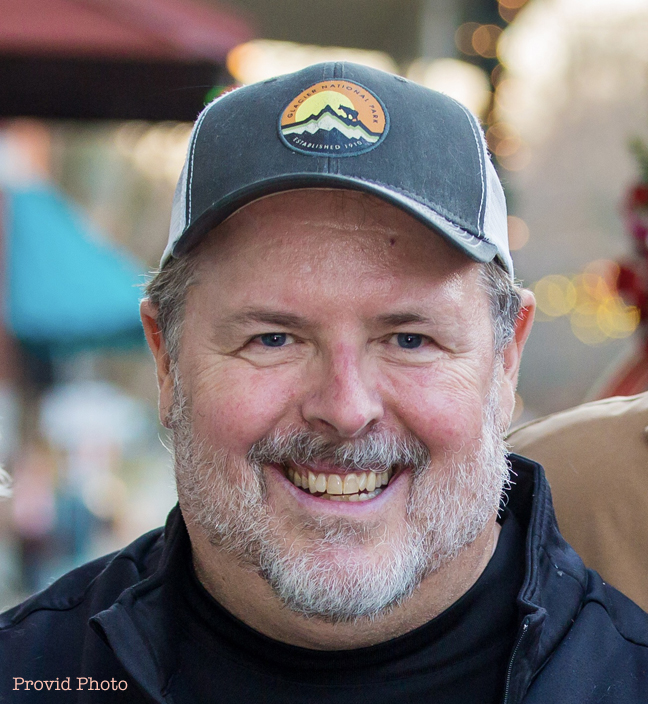
    Sam Smith graduated from Loveland High School in 2018

    Loveland, Ohio – Loveland High School graduate Samuel Wright Smith has been chosen to be the Director of Photography on the high-profile short film, Heartbreak on Murray Hill and fundraising has begun in earnest to support the costly production. Loveland area residents might be particularly interested in donating or becoming a “credited” producer.

    The film promises a slash of Edward Hopper-esque cinematography from Smith who will act as the eyes of the film, sculpting light, movement, and framing.

    The movie is the true story of the director’s (Malcolm Quinn Silver-Van Meter) grandmother’s childhood breakup in 1956 immigrant NYC.

    In preparing to begin shooting, Smith described his vision of how two scenes will be composed:

    “A smoggy evening light outlines a working-class mother, hunched over a sewing machine. A split composition: out of focus in the background of her 1956 New York tenement apartment, her children hug their father.”

    “Bobby, 11, donning a school uniform, stands over the camera with a note in her hand. A low-angle, wide-lens shot might indicate confidence, but not here. The note fills the frame and holds the power. Her body looks awkward and distorted—her hands are too big, torso too long, head too small.”

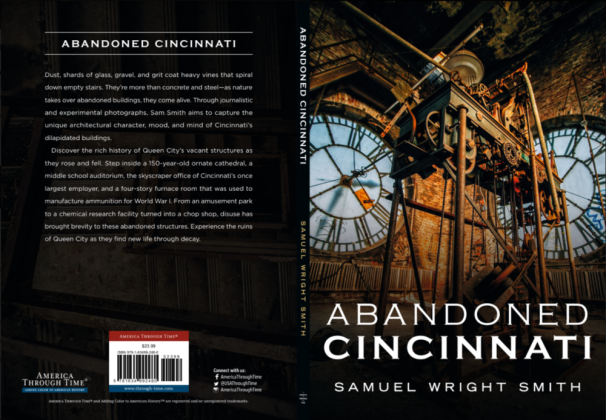
    Since leaving Loveland in 2018 for the prestigious New York University Tisch School of the Arts, Smith has been the cinematographer on numerous projects including Crimson Ties, directed by Francesca Scorcese, which premiered at Tribeca. In 2020, at only age of 19, he published a photo book titled Abandoned Cincinnati through Fonthill Publishing.

    Samuel Wright Smith is the author of Abandoned Cincinnati, a 2019 photo/commentary book available in Cincinnati bookstores and online through Amazon. The book explores the history, beauty, and implications of Cincinnati’s vacant structures.

    Recently, Smith shot a feature film with the Secoya indigenous community in the Ecuadorian rainforest. His work has garnered attention at other major festivals including Nashville Film Festival and Beverly Hills Film Festival.

    For Heartbreak on Murray Hill, the crew will build a replica 1956 tenement apartment. Smith describes the style as “warm realism”. Pulling inspiration from American Realist painters, he intends to create a style that is bold, believable, and magical.

    When shooting begins, Smith will be using a sound stage at the NYC landmark, Kaufman Astoria Studios* which has been making entertainment history for more than 90 years. Heartbreak on Murray Hill will be filmed on stage F which belongs to Sesame Street when they are in production.**

    Heartbreak on Murray Hill is the story of 11-year-old Bobby and her first breakup in 1950s NYC. It is based on a true story.

    Heartbreak is set to be one of NYU’s most ambitious thesis films ever. Seeking an indie budget of $150K, the film is fiscally sponsored and donations are tax-deductible.

    “Writing and photographing for Loveland Magazine in high school opened my eyes to the possibility of meaningful work through the lens of a camera. I owe so much of where I am to David Miller, the LM publisher. So many peers, teachers, and community organizers in the Loveland community gave me the push to pursue my dreams. I can’t believe that this is my life now. Living off of art seemed impossible once. But thanks to community: here I am,” said Smith.

    Contact Sam Smith via EMAIL if you need more information about your fully tax-deductible support of Heartbreak on Murray Hill.


    I just want to give to Heartbreak on Murray Hill.

    Choose your donation amount

    • $500.00
    • $1,000.00
    • $1,500.00
    • Other

    Donate $500 or more

    SUPPORTER

    Thank you so much for your support! For this generous donation you will receive a shout out on our social media!

    Donate $1,000 or more

    DONOR

    Thank you so much for your generosity! For this donation you will receive our Donor Package including behind the scenes content and a shout out on our social media!

    Donate $2,500 or more

    PATRON

    For this donation you will receive our Patron Package including behind the scenes content, and early access to stills and trailers of the film, as well as a shout out on our social media!

    Donate $5,000 or more

    BENEFACTOR

    For this donation, you will receive a Benefactor Package including behind the scenes content and early access to stills and trailers of the film, as well as an invitation to HBOMH red carpets and premieres!

    Donate $10,000 or more

    CO-PRODUCER

    For this donation, you will receive the Co-producer Package, including your name in the credits, your own IMDB page, behind the scenes content, and early access to stills & trailers of the film, as well as an invite to HBOMH red carpets and premieres!

    Donate $25,000 or more

    ASSOCIATE PRODUCER

    Associate Producer Package: an invitation to set, your name in the credits, your own IMDB page, behind the scenes content, as well as early access to the final cut of the film, and an invite to HBOMH red carpets and premieres!

    Donate $60,000 or more

    EXECUTIVE PRODUCER

    VIP Executive Producer Package: exclusive behind the scenes access and an invitation to the set, as well as your name in the credits, your own IMDB page, early access to the final cut of the film, and invitations to attend HBOMH red carpets and premieres!

    Learn more about Heartbreak on Murray Hill and meet the team

    DONATE and SUPPORT the Production of Heartbreak on Murray Hill

    * Today, KAS is the location for major motion pictures, independent film, television shows and commercials. The stages have been graced by actors such as Harrison Ford, Matt Damon, Ben Stiller, Meryl Streep, Al Pacino, Tom Hanks, Bill Cosby, Demi Moore and many other esteemed stars. Kaufman has also been the chosen production location of prominent directors including Martin Scorsese, Sydney Lumet, Norman Jewison, Woody Allen, Francis Ford Coppola, and Paul Greengrass. Today, KAS is the location for major motion pictures, independent film, television shows and commercials. The stages have been graced by actors such as Harrison Ford, Matt Damon, Ben Stiller, Meryl Streep, Al Pacino, Tom Hanks, Bill Cosby, Demi Moore and many other esteemed stars. Kaufman has also been the chosen production location of prominent directors including Martin Scorsese, Sydney Lumet, Norman Jewison, Woody Allen, Francis Ford Coppola, and Paul Greengrass.

    **In 2008, Martin P. Robinson, who plays Mr. SnuffleupagusTelly Monster, and Slimey the Worm on Sesame Street, married Annie Evans, a writer for the show on the Sesame Street set. The ceremony was performed on the steps of 123 Sesame Street and the reception was held throughout the rest of the set.

    Watch this promotion for the film Capulí, which Smith recently shot in the Secoya indigenous community in the Ecuadorian rainforest

  • Spring ahead Dawling

    Spring ahead Dawling

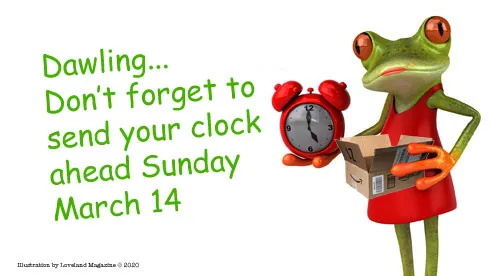
    Loveland, Ohio – When local standard time is about to reach Sunday, March 12, 2:00:00 AM clocks are turned forward 1 hour to Sunday, March 12, 3:00:00 AM local daylight time instead.

    Sunrise and sunset will be about 1 hour later on Mar 12, than the day before. There will be more light in the evening.

  • Strategies emerge as abortion rights fight ramps up

    Strategies emerge as abortion rights fight ramps up

    BY: SUSAN TEBBEN Ohio Capital Journal

    As abortion rights groups prepare to collect the amount of signatures needed to place a constitutional amendment on the ballot, anti-abortion rights groups may have shed light on statements they plan to use against the initiative.

    In three separate press releases sent by anti-abortion groups after the Ohio Attorney General approved proposed amendment language, the issue of parental rights came out in strikingly similar fashion as they spoke out against the measure.

    “If passed, it would cancel parental rights and measures in place to protect young girls; basic health and safety protections for women would be wiped out,” Ohio Right to Life CEO Peter Range was quoted as saying in a Thursday statement.

    “If passed, this amendment would cancel parental rights and measures in place to protect young girls; basic health and safety protections for women would be wiped out,” read a statement attributed to Mark Harrington, president of Created Equal.

    “It completely abolishes current Ohio law guaranteeing parental involvement before any abortion is performed on their minor daughter,” said religious lobby Center for Christian Virtue’s Ruth Edmonds, also in an email statement.

    The summary and proposed amendment approved by the Ohio AG does not mention minors or parental consent among the issues to be changed in Article I of the Ohio Constitution.

    “Every individual has a right to make and carry out one’s own reproductive decisions, including but not limited to decisions on contraception, fertility treatment, continuing one’s own pregnancy, miscarriage care and abortion,” the first part of the proposal states.

    The amendment would bar the state from doing anything to “directly or indirectly burden, penalize, prohibit, interfere with, or discriminate against either an individual’s voluntary exercise of this right or a person … unless the State demonstrates that it is using the least restrictive means to advance the individual’s health in accordance with widely accepted and evidence-based standards of care.”

    The anti-abortion groups did not specify how they came to the conclusion that parental consent was in danger with the proposed amendment.

    The issue could stem from a long-standing legal option called judicial bypass, in which a minor can get a judge to sign off on an abortion if the judge deems the minor to be “sufficiently mature and well enough informed to decide intelligently ” to consent to an abortion.

    The Ohio Supreme Court rules on judicial bypass went into effect in 2015.

    Yost’s two cents

    Ohio Attorney General Dave Yost threw his opinion in the mix in a notification to attorneys that the amendment summary language was approved on March 2. Yost emphasized his statutory duty to objectively review ballot initiatives, all while mentioning his personal views, publicly known to be against abortion.

    “I cannot base my determination on the wisdom or folly of a proposed amendment as a matter of public policy,” Yost wrote.

    The attorney general continued his letter with paragraphs about the rule of law and requirements that attorneys general use “a narrow law to make a decision about the truthfulness of a summary.”

    “In this matter, I am constrained by a duty to rule upon a narrow question, not to use the authority of my office to effect a good policy, or to impede a bad one,” the letter stated.

    The statements were abnormal for a certification statement coming out of Yost’s office. Since 2020, 12 initiative petitions (some of which were resubmissions) have been certified by the AG’s office, with issues ranging from medical rights, marijuana regulation, elections, and wage increases.

    None of the other certifications stretching back to 2020 included mentions of Yost’s personal opinion on the matter, or examinations of the attorney general’s duties. Those certifications were one-page approvals, specifying the Ohio Revised Code articles relevant to petition certification and a short certification statement.

    In concluding the letter affirming the certification of the abortion rights petition, Yost said included another warning to petition creators.

    “Indeed, there are significant problems with the proposed amendment, and if adopted it will not end the long-running litigation on this topic, but simply transform it,” he wrote.

  • Eastside Business Bash – largest business expo in area

    Eastside Business Bash – largest business expo in area

    Advertisement

    Attending the Expo is free

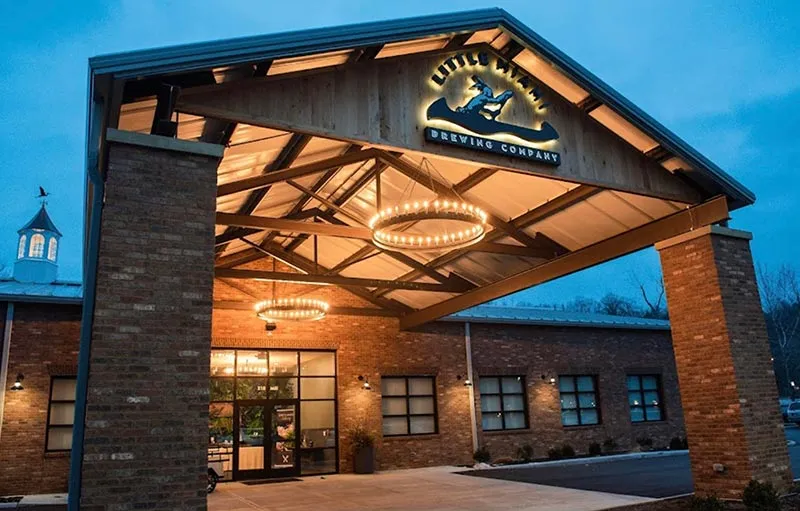
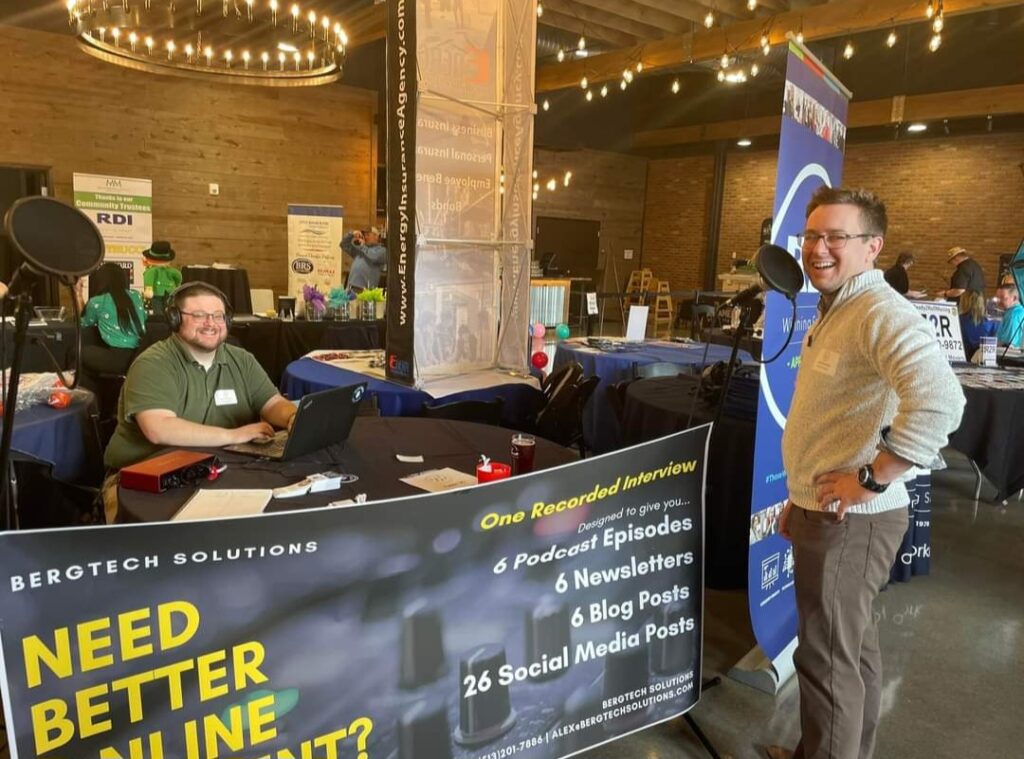
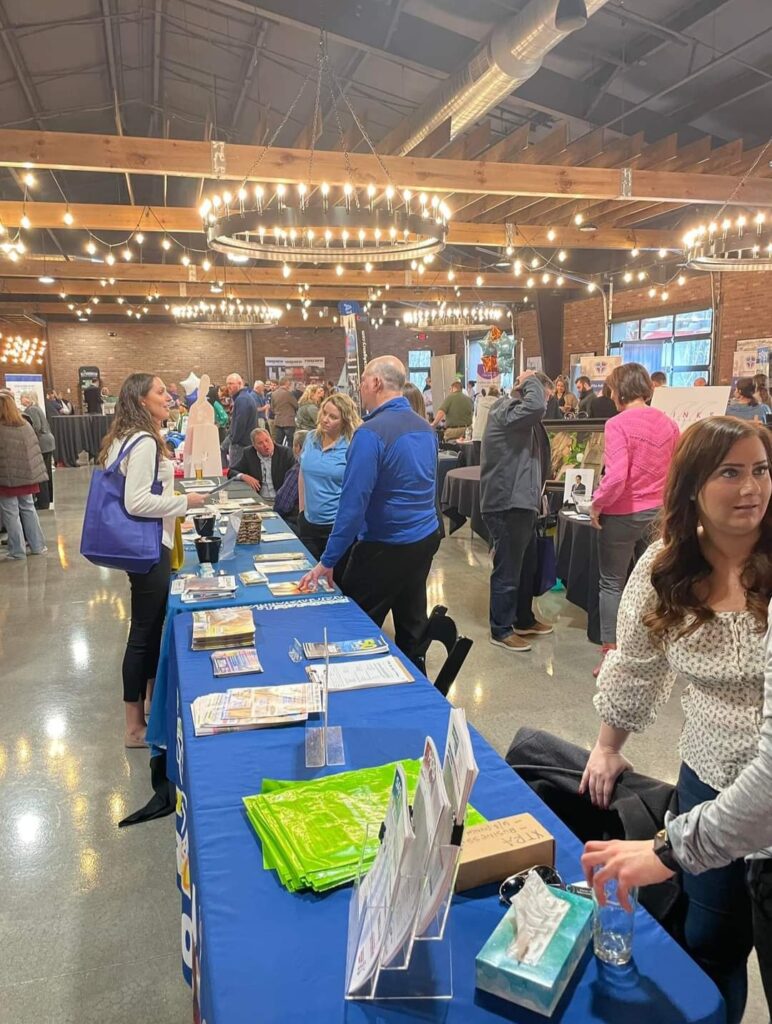
    The 2023 Eastside Business Bash, presented by the Milford Miami Township Chamber and Little Miami River Chamber Alliance will be hosted on March 9 between 4 and 7 pm, at the Little Miami Brewing Event Center, 310 Mill St in Milford, OH. This is the second year for this joint event which is the largest business expo in the northeast Cincinnati region, featuring 45 businesses from the area that provide both B2B and B2C services.

    Attending the Expo is free, and the first 50 people to arrive will receive a free beer, featuring Little Miami Brewing’s unique hand-crafted beers. Attendees may enjoy light bites and drinks from the cash bar as they browse the booths. Items from local businesses and attendees will be raffled off throughout the afternoon.

    This crossover event supports not only the entire Milford-Miami Township-Loveland area, but the entire east side of our region. Last year, over 200 people attended the Bash to explore the various businesses.

    “Last year was our first year, so we didn’t know what to expect,” says CeeCee Collins, President of the Little Miami River Chamber Alliance. “The high turnout validated that our local communities are very interested in learning more about and supporting our local businesses.”

    Andrea Brady, Executive Director of the Milford Miami Township Chamber, adds, “There are no ‘lines’ between our communities, and we want to reduce the number of times we think about an area as one place or another. We are one large region, and we are thrilled to support the entire area since increasing commerce supports us all.”

    The Event Center sits at the start of downtown Milford, a street lined with unique shops and restaurants. The DORA (Designated Outdoor Refreshment Area) allows alcoholic drinks to be carried on the street (in DORA cups), so visitors may browse the shops and wend their way to dinner after the event while enjoying their beverage.

    For more information, visit the Milford Miami Township and Little Miami River Chamber websites.

  • I want others with disabilities to have opportunities like I had

    I want others with disabilities to have opportunities like I had

    by Courtney Hineman

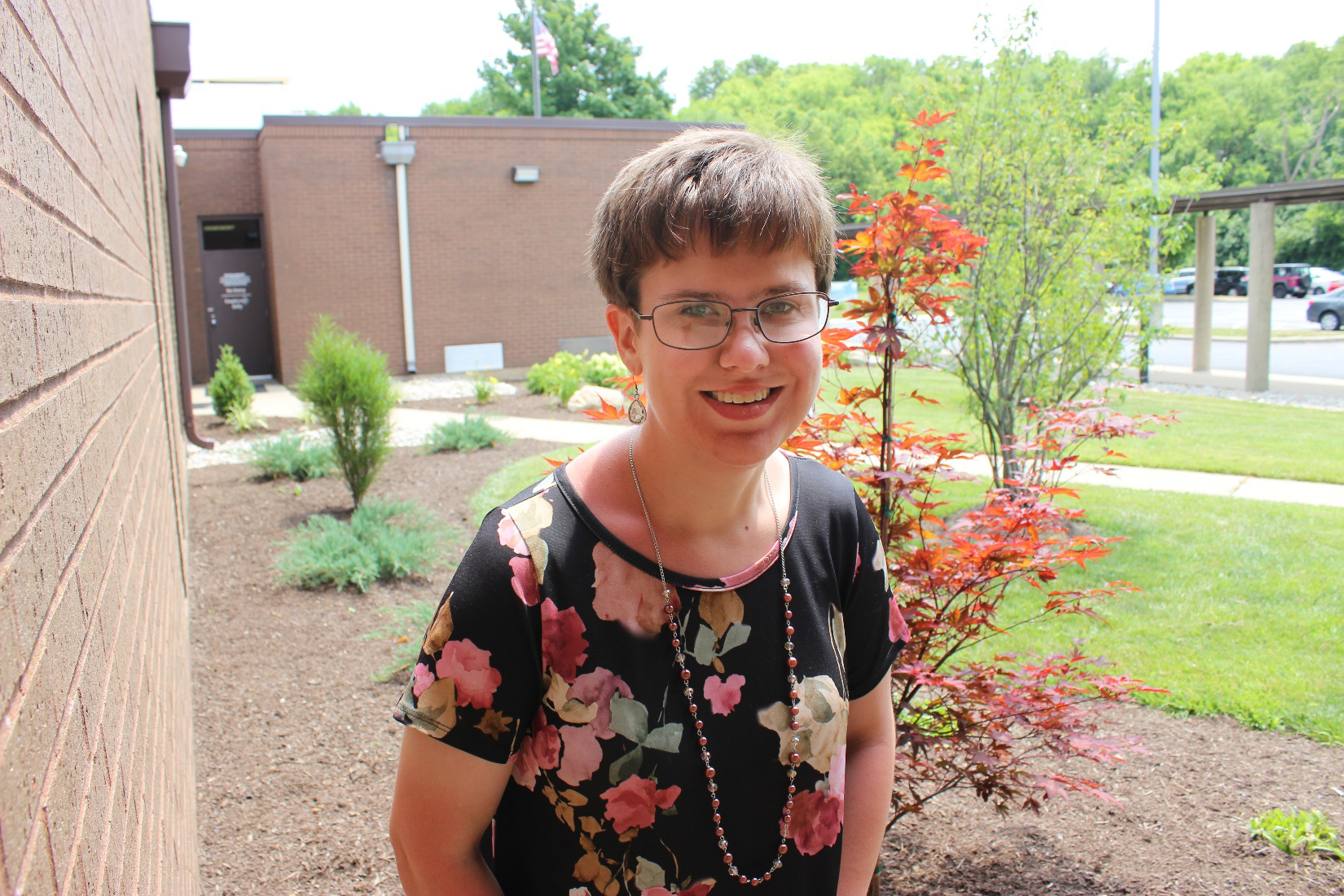
    March is Developmental Disabilities (DD) Awareness Month which makes it the perfect time to share how my community created opportunities for me and partly because of that, I’ve been able to flourish. As someone who lives with a developmental disability, I want others with disabilities to have similar opportunities for employment, leadership, and friendship.

    When I was younger, I got to be a part of a summer work program through the Butler County Board of Developmental Disabilities (BCBDD). My first job was cleaning toilets and tables at Barn N Bunk, and I cleaned at Camp Campbell Gard as well. Later, I worked at the East Butler YMCA at the customer service desk.

    I really enjoyed getting to interact with people and learn new things. For many people with disabilities, building friendships or gaining leadership skills can be difficult. For me, these work experiences helped create opportunities for both leadership and friendship. I feel my past work  experiences lead me to the job I have now because I was able to learn how to interact with customers and show others that I’m a hard worker.

    Sometimes, it can be hard for people with disabilities to develop friendships. For me, Best Buddies helped bridge that gap. Best Buddies is an international organization that matches people with and without disabilities for friendship. Through Best Buddies I have learned how to grow in a relationship with a friend, I’ve been able to try new things, and I’ve learned leadership skills. One of my favorite experiences through Best Buddies was painting pumpkins with my new friend.

    Through Best Buddies, I have attended leadership trainings which helped me in my role as Community Outreach Advocate at BCBDD. At those leadership trainings we learned how to share our story. We learned how to write a speech and how to present in front of others. This has given me confidence not only at work but also in my personal life. I now know that I can speak up for myself and that sharing my experience can help others with disabilities and their families.

    These opportunities helped me tremendously. You can create that for someone in your community. I hope that you take the time this month and every month to give someone with a disability an opportunity to grow in their skills and help them live the best life they can live.