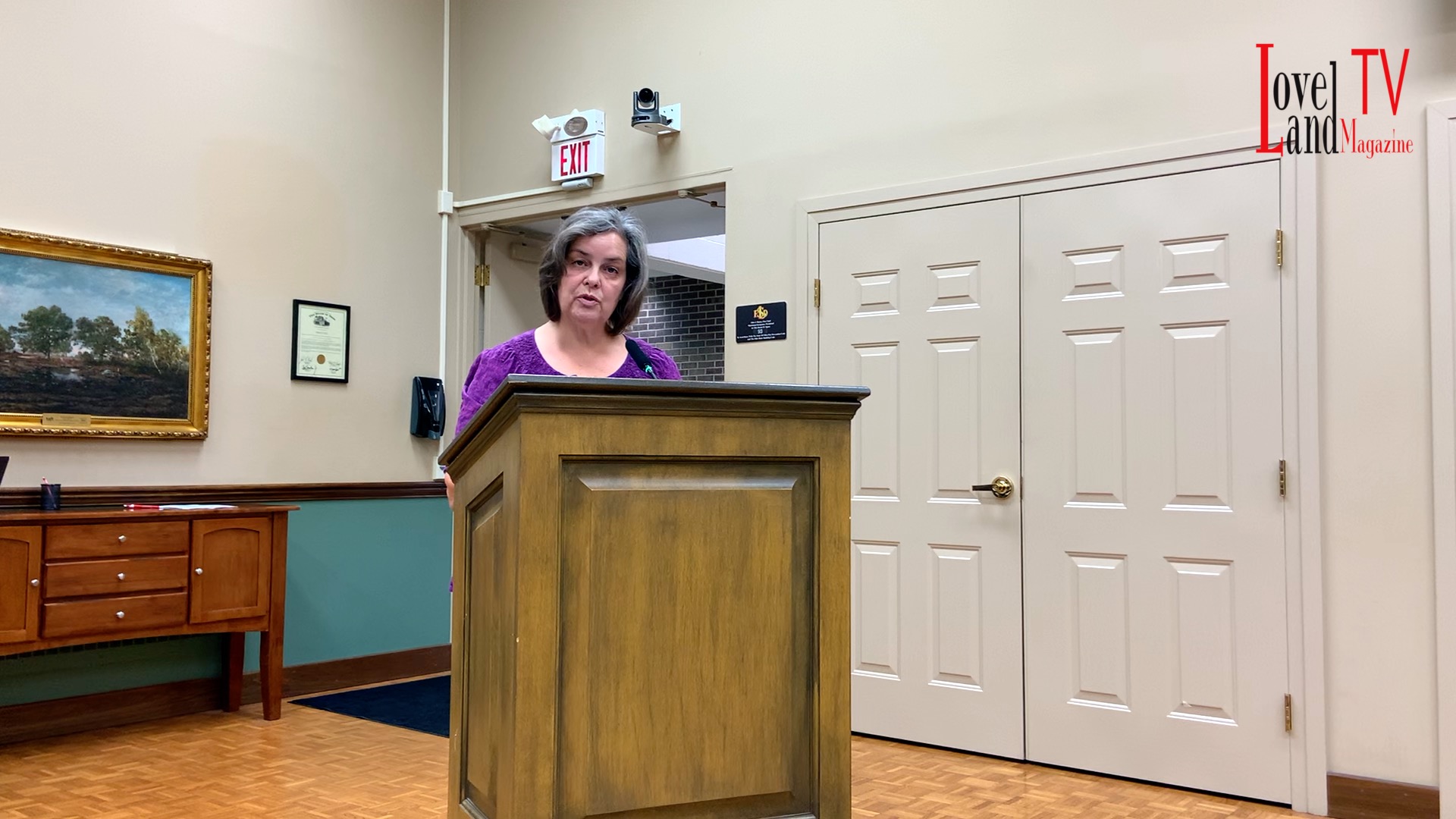
Loveland, Ohio – Resident Lauren Enda spoke at the council meeting on Tuesday. Enda said she retired in Loveland after working at the National Security Agency. She began by saying, “After thirty years of doing my part to protect the United States, I did not expect to continue to do that role in retirement, but here I am.”
She continued by outlining instances of Mayor Kathy Baily suppressing free speech at council meetings.
Enda spoke mostly about a proposed parking garage in Historic Downtown and the message she sees sent by voters via the recent election. “One council member indicated he was opposed to that garage and he won the most votes. The message is clear. Loveland voted against the garage,” Enda said.
Enda wants the question of building a garage put to a formal vote. She says Council should determine the will of the residents by putting the question on the May 3, 2022, ballot.
Loveland, Ohio– Resident Lauren Enda went to the council meeting on Tuesday evening and addressed concerns about a proposed parking garage in Historic Downtown. She said that more rain, flooding, and extreme weather events, and other potentially detrimental environmental impacts should be discussed after an independent environmental study has been conducted.
Enda offered sustainable construction methods as alternatives to concrete and asphalt in our urban environment that would be safer and less expensive.
She also spoke about contaminants like oil, leaking brake fluid, and trash which would be deposited directly into the Little Miami River and O’bannon Creek.
She spoke about the micro-climate of paved, concrete urban areas.
Enda suggested that the City should conduct a study of how the Linda Cox Parking lot functions regarding storm run-off into the Little Miami River.
Enda asked Council to allow residents to vote at the ballot box, “Yes” or “No” on whether it should be constructed.
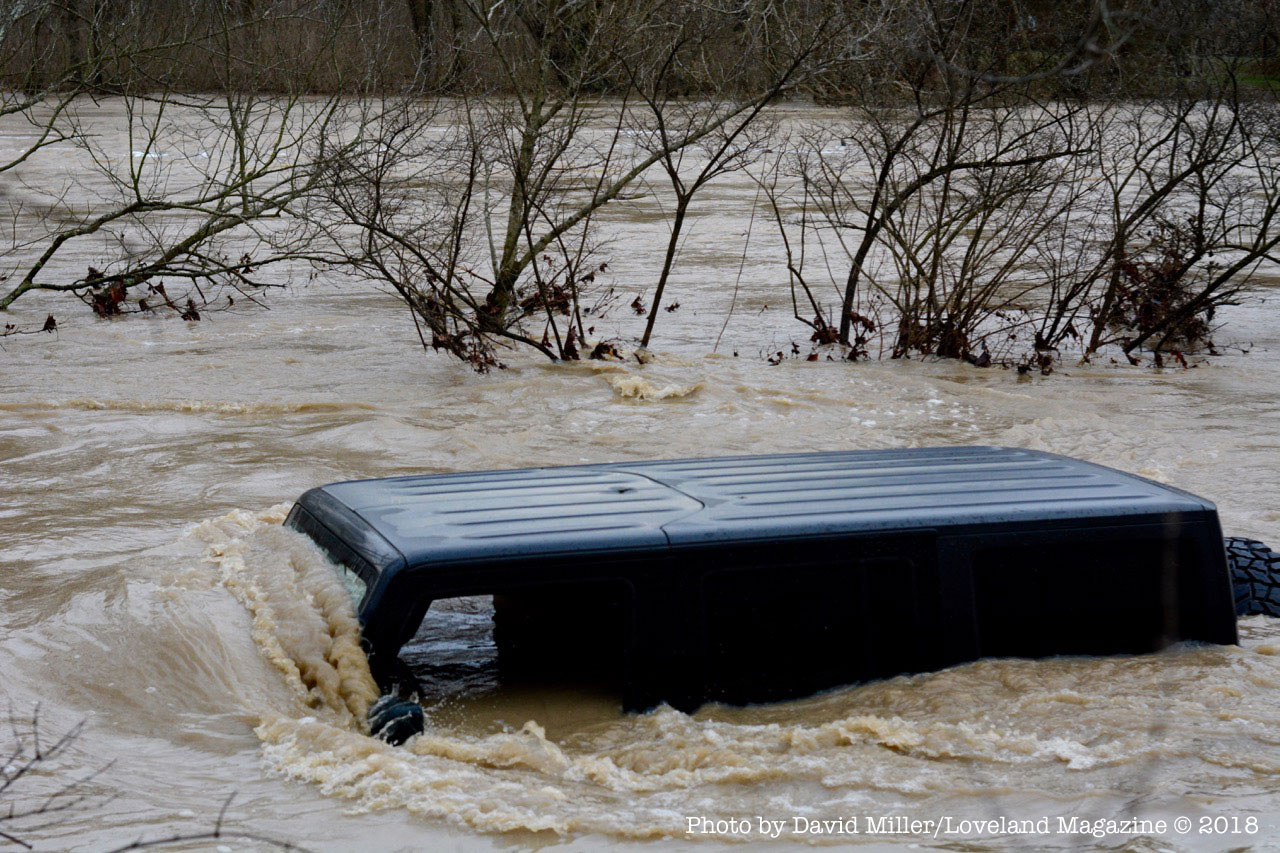
The above photo is of flooding in Loveland on February 25, 2018
“The notion of the common good also extends to future generations.
– Richard Rohr
Lauren Enda lives in Loveland at Hidden Creek
by Lauren Enda
Weather is changing in Ohio. According to Cincinnati’s Office of Environmental Sustainability, Ohio is getting hotter, wetter, and suffering with more extreme weather and periodic droughts. More storms and more rain increase runoff and flooding. Hamilton County has had nine 100-year storms in the last 10 years. This is a startling statistic and should be troubling for everyone, especially those who live near water. Therefore, the city of Loveland should be looking very closely at what, and how much, is developed. Replacing permeable surfaces (grass, gravel, earth) with impervious surfaces (concrete and asphalt) are a major cause of flooding in urban areas. This article will present a high-level overview of the environmental risks associated with the proposed parking garage.
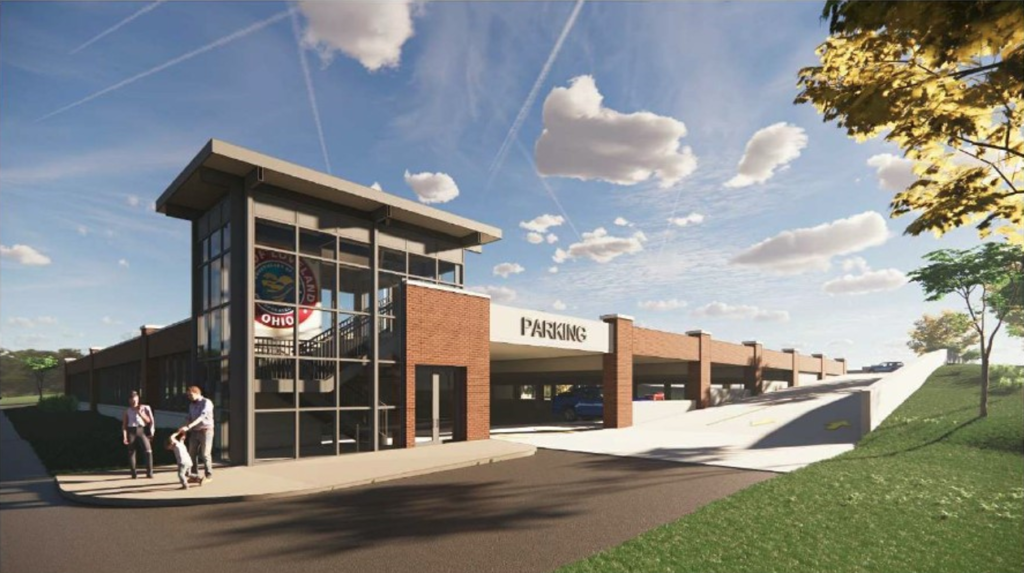
The proposed parking garage for Historic Downtown as envisioned by City Hall.
What happens when we heedlessly and perhaps needlessly, dig out trees, remove soil, disturb the water tables, and pour tons of concrete without appropriate studies? Replacing permeable surfaces with impervious surfaces could lead to unwanted and dangerous side effects.
Most dangerous to the residents and businesses of Loveland is water runoff and flooding. According to the United States Geological Survey, “…rainfall in forested watersheds is absorbed into soils, stored as groundwater, and slowly discharged to streams… Flooding is less significant in these more natural conditions because some of the runoff during a storm is absorbed into the ground, thus lessening the amount of runoff into a stream… As watersheds are urbanized, much of the vegetation is replaced by impervious surfaces, thus reducing the area where infiltration to groundwater can occur. More simply, in a developed watershed, much more water arrives into a stream much more quickly, resulting in an increased likelihood of more frequent and more severe flooding.”1
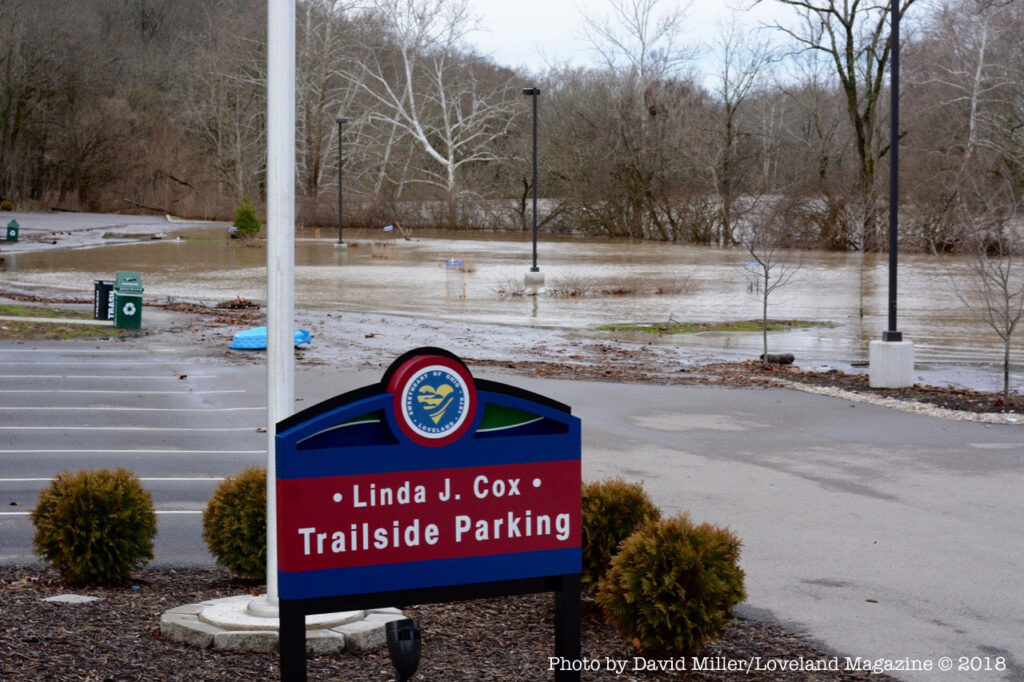
The Linda Cox Trailside Parking lot in February 2018
The Little Miami River and O’Bannon Creek could be at risk. Studying runoff, flooding and erosion in and near the Linda J. Cox parking lot may be a good place to start before Loveland adds more concrete or asphalt downtown. The increasing number and severity of storm events is not going away, but will worsen, raising the flood risk even higher. Can we afford to have more flood events? Is Loveland prepared for, or even starting to prepare for, this eventuality?
But flooding is not the only problem with water running from a massive parking garage into the Little Miami. The water itself brings contaminants from paved parking surfaces like oil, leaking brake fluid, antifreeze, and trash, which are then put directly into the river. The summary of a 2014 report in the journal “Environmental Challenges” quotes that, “Impervious car park surfaces represent a major source of urban water pollution.”2
The risk of increased flooding and contaminated runoff are bad enough, but the proposed garage will bring pollution to Loveland in other ways.
Air pollution: More cars downtown will mean more exhaust fumes rising into the air.
Noise pollution: More traffic and more cars will bring more noise to our tranquil downtown.
Light pollution: Parking garages are magnets for crime and other undesirable activities and therefore must be extremely well lit – 24 hours a day, 7 days a week. This light pollution will destroy the picturesque nighttime setting we currently enjoy.
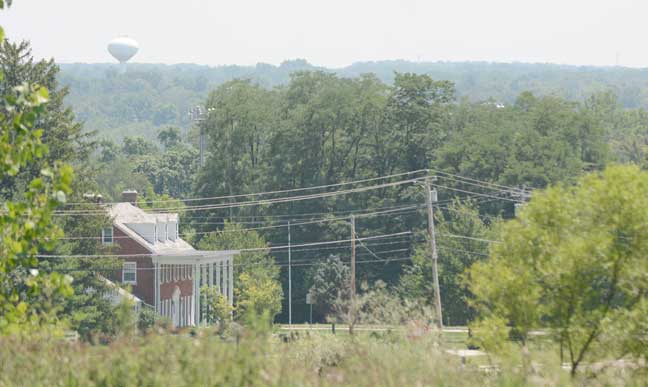
The smoggy Loveland horizon from Loveland High School during an Air Pollution Alert in July of 2016
An additional, but by no means trivial, impact on our environment, is the concrete itself. Concrete has a massive carbon footprint, which is concerning if we care about the future of our children and grandchildren. According to a 2018 report by the BBC, “Concrete is the most widely used man-made material in existence. If the cement industry were a country, it would be the third largest (carbon dioxide) emitter in the world – behind China and the US.”3 Let’s not make uninformed or hasty decisions about building with a material that is so hurtful to the environment.
Finally, expanses of concrete or asphalt create what is called a “micro-climate: “The climate of a small, specific place within an area as contrasted with the climate of the entire area.”4 According to multiple studies, urban areas with paved surfaces are hotter than the surrounding areas by as much as 7 degrees. We have all witnessed this phenomenon when standing in a parking lot in the summer. Does Loveland want to introduce a “heat island” to our downtown?
“Success can be measured in different ways.”
Loveland resident Lauren Enda
I do not claim to be an environmental scientist, a climate expert, or a soil or water conservation guru. Perhaps as a community we can learn more about the current, and future, environmental impacts of today’s decisions. What will these decisions look like in 2030 or 2040 when the problems facing Loveland will perhaps be much larger than simply having to park a block further away? Will our children be glad for more concrete, or will they wish for a safer, cleaner, more sustainable Loveland? Success can be measured in different ways.
An unbiased environmental study by experts who will not benefit with the building of the proposed garage would help Loveland make decisions for today, and for our future, in an uncertain and changing world.
Loveland, Ohio – Lauren Enda went to the Loveland City Council meeting Tuesday evening to talk about the proposed parking garage in Historic Downtown. Some of the concerns she expressed were about the negative impact she envisions for Loveland’s heritage and quaintness, and the environment.
She proposes that Loveland residents should be allowed to vote at the ballot box on what she describes as a “big city solution” that will take from the town things it will never get back.
She also suggestsed that an environmental impact study should be done to protect the “natural environment we love”.
My name is Lauren Enda and I am a resident of Loveland. Like many Loveland residents, I am concerned about the proposed parking garage and its effect on our city. The largest municipal project in Loveland’s history has not involved public opinion though it will affect the residents of Loveland for years to come. My concern is based on the following:
The residents of Loveland have not had a real voice in this conversation since it began in 2019. Residents will be forced to live with changes caused by the garage to the city’s character and natural environment that attract so many to the area. Residents should vote on whether the project should proceed. If the location, design or economics are unsuccessful, the garage would be a blight on our quaint downtown, degrading the town’s ambiance. Residents would be stuck with it for years.
2. The Loveland parking situation has not been properly studied. No data exists that outlines whether more parking is required. The city has provided no evidence, other than anecdote, that we have a parking problem. How can we possibly come up with a solution when we don’t know if there is a problem?
3. Cost estimates that the City Council is using could be grossly underestimated based on construction cost increases seen elsewhere. There are no actual quotes. The opinion of the firm who created the almost $7 million price tag clearly states that they have “no control over the cost of labor, materials, or equipment, or over the contractor’s methods of determining prices.” With the current COVID pandemic, we have seen that inflated costs and severe shortages are the norm, not the exception, which could cause a large overrun of the budget, adding even more to taxpayer’s burden. There is a new idea to use the $1.3 million Coronavirus Local Fiscal Recovery Funds to help cover some costs of this project. This fund is still needed by struggling businesses in Loveland. Why not help businesses that are failing instead?
4. An environmental impact study has not been done. Paved surfaces are one of the major causes of flooding. Increased storm strength and the numbers of storms will also make runoff and flooding worse. Some towns are removing parking areas to increase green space which absorbs water runoff. Why has the City Council not requested an environmental study?
5. A huge, expensive parking garage is a long term, permanent solution for a problem that may not exist. Loveland is not a big city. The garage will sit empty for much of the year when it is rainy, snowy and cold, and in the evenings and nights when businesses are closed. However, the eyesore will not disappear when no one is parked there. Accompanying lighting will be on 24/7, adding to light pollution that detracts from the beauty of our natural spaces that draw people to Loveland.
6. There is no guarantee, data or proof that this garage will decrease traffic in the downtown area or that it will create and retain good paying jobs. In fact, most of the traffic for Loveland will still traverse the downtown area from the west to access the garage. Only rural traffic from the north and east will access the garage without entering the downtown zone. It is a very expensive and intrusive plan for unknown benefit.
I am not against additional parking in downtown Loveland if it’s required. I am against a burden placed on residents without their approval for a project that has not been evaluated for cost, necessity, environmental impact, job creation, or traffic abatement. Residents deserve to know what criteria and data were used to make this project a priority for Loveland. As citizens, we need verifiable information, and we need to be part of the conversation.
Loveland is not, and does not wish to be, an urban center. The proposed garage will negatively and permanently alter the look and feel of Loveland’s most prized asset – our natural, historic downtown. Let’s open the conversation. I ask that City Council respect the citizens of Loveland enough to allow us to vote on the parking garage plan.


![[VIDEO] Lauren Enda: Democracy in Loveland is in trouble.](https://lovelandmagazine.com/wp-content/uploads/2021/11/l-3.jpg)
![[Video] Lauren Enda on “Complicated environmental issues of proposed parking garage](https://lovelandmagazine.com/wp-content/uploads/2021/11/lauren-enda-11-9-21.jpg)