Tag: lawsuit

  • Ohio clinics sue to bar new abortion bill

    Ohio clinics sue to bar new abortion bill

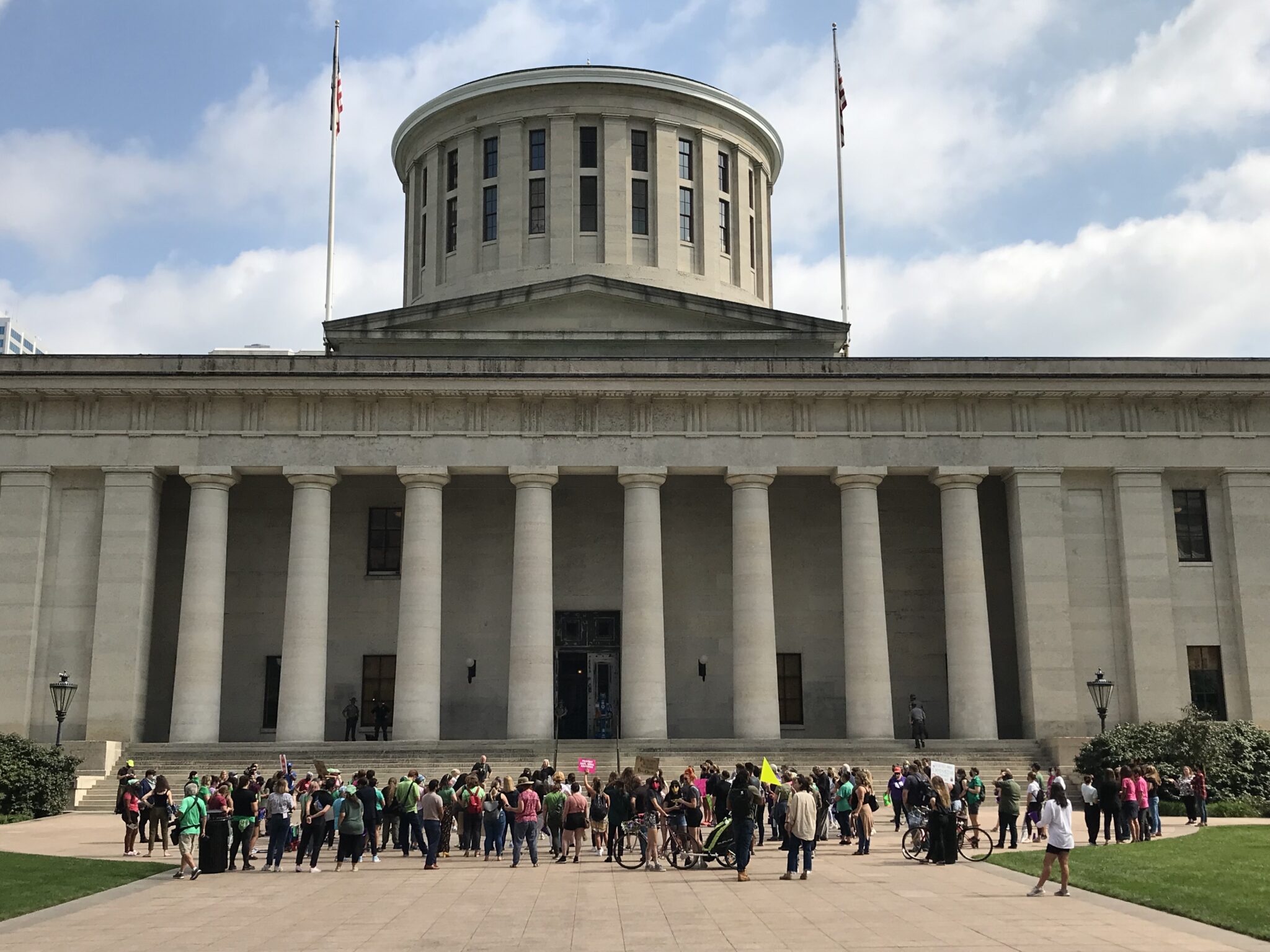
    Protesters of a bill to promote a total abortion ban with the overturning of Roe v. Wade demonstrate outside the Ohio Statehouse in September. Photo by Susan Tebben

    BY: SUSAN TEBBEN – Oho Capital Journal

    A lawsuit has been filed against the newest state abortion restriction and its regulation of doctors’ ability to practice medicine.

    The ACLU, Planned Parenthood Southwest Ohio Region and Women’s Med Dayton are asking a Hamilton County Common Pleas Court to keep the state from enforcing a law to create “onerous and unwarranted” restrictions to health care in Southwest Ohio in particular.

    The Ohio General Assembly passed Senate Bill 157 in December, and the law is set to be effective March 23, if the court doesn’t fulfill the lawsuit’s request.

    If the law goes into effect, doctors who work with state public universities or medical centers will not be allowed to also be affiliated with abortion clinics in the state.

    Abortion clinics that conduct surgical abortions are considered “ambulatory surgical facilities,” also the name of other outpatient facilities where procedures can be done.

    Clinics who conduct abortions are required to have a “written transfer agreement” with a local hospital to which a patient can be transferred should medical care “beyond the care that can be provided at the ambulatory surgical facility” is needed.

    Those hospitals need to be within 30 miles of the facility.

    To obtain a variance to the written transfer agreements, doctors are required to have hospital admitting privileges within those 30 miles. But these variance agreements could be made more complicated by this new law, originally pushed by bill sponsors as a way for the Ohio Department of Health to track so-called “failed abortions,” which the state already defines as abortion procedures in which the child is alive when removed from the pregnant person’s body.

    So-called “failed abortions” are rare, and state data shows none of the abortions conducted after 19 weeks – still not considered a gestation period when a baby would survive outside of the womb – were on viable pregnancies.

    In the new lawsuit, doctors argue not only would the law create constitutional conflicts by singling out abortion providers, but it would also keep physicians from being able to “operate their businesses and pursue their professions,” including caring for their patients.

    “Because of SB 157, many patients seeking procedural abortions will be significantly delayed in accessing this vital, time-sensitive and constitutionally-protected health care until later in pregnancy, when the procedure not only carries greater health risks, but is also more expensive,” the lawsuit states.

    The Ohio Department of Health already requires abortion clinics to have at least four backup physicians to obtain the medical variance agreement, something that’s been in place since 2015.

    That, alone, is a problem when there aren’t enough doctors to allow for four backup doctors.

    “The hostile climate in Southwest Ohio makes it extremely difficult to find even one backup doctor to support a variance,” the lawsuit states. “There has been a national campaign to harass and shame the Dayton doctors who provide backup services to patients of WMD.”

    If variances are lost, licenses to practice as an ambulatory surgical facility are lost. That would mean a lose of health care services in Southwest Ohio, meaning the patients would be the ones suffering.

    “If plaintiffs’ ASF licenses are revoked, people needing procedural abortions would be forced to travel hundreds of miles round-trip to the next closest procedural abortion providers, and, due to a statutory waiting period, make that trip twice, or stay overnight, in order to access procedural abortion,” the clinics wrote in the lawsuit.

    The fact that the lawsuit has been assigned to Judge Alison Hatheway could mean good things for abortion clinics. Hatheway has been the judge on two other lawsuits fighting against state abortion restrictions, and in both cases Hatheway has ruled in favor of temporary stops to state legislation clinics said hampered their right to provide care.

    Most recently, Hatheway stopped a fetal tissue disposal law for a second time, saying clinics are “substantially likely to succeed” in their suit against an Ohio law that would require clinics to pay for burial or cremation of fetal tissue resulting from an abortion.

    In April of last year, the judge blocked a law restricting telemedicine abortions in the state.

  • Man whose wife sued hospital to force it to administer ivermectin dies of COVID-19

    Man whose wife sued hospital to force it to administer ivermectin dies of COVID-19

    Prescription drugs sit on a pharmacist’s counter. Photo by John Moore/Getty Images.

    BY: JAKE ZUCKERMAN and Ohio Capital Journal

    Butler County, Ohio

    An Ohio man whose wife sued a Cincinnati area hospital for refusing to provide him ivermectin as he was intubated due to COVID-19 has died, according to one of her attorneys.

    Jeffrey Smith, 51, died Sept. 25, according to the family’s attorney, Jonathan Davidson.

    While he was on a ventilator, Julie Smith filed a lawsuit against West Chester Hospital for refusing to honor a prescription of ivermectin written by a physician who founded a controversial group that champions the drug.

    Ivermectin is an antiparasitic in humans and a dewormer in livestock. It has grown in popularity, egged on by conservative commentators and politicians, as a treatment and preventative against COVID-19. The CDC, Food and Drug Administration, American Medical Association, the drug’s manufacturer and more all warn against the drug’s use against COVID-19, given the lack of evidence to support the treatment and the risks the drug can pose to those who take it.

    Neither Julie Smith nor her husband were vaccinated, she testified at a court hearing.

    On Aug. 23, Julie Smith won an emergency judgement that forced the hospital to administer the ivermectin to her husband.

    Common Pleas Judge Michael Oster reversed that ruling 13 days later. He said in a ruling, siding with expert witnesses from the hospital network who testified, the judgement isn’t a determination that ivermectin will never be proven effective against COVID-19.

    “However, based upon the evidence, it has not been shown to be effective at this juncture,” he said. “The studies that tend to give support to ivermectin have had inconsistent results, limitations to the studies, were open label studies, were of low quality or low certainty, included small sample sizes, various dosing regiments, or have been so riddled with issues that the study was withdrawn.”

    At the time, Ralph Lorigo, a New York attorney who has filed similar lawsuits around the country, claimed victory regardless. He cited purported indications that Jeffrey Smith’s condition was improving, and attributed this to the temporary dosing of the drug.

    “This is a man who has been helped by the medication, and this is a judge who just doesn’t get it right,” Lorigo said.

    Click here for more in-depth coverage of Julie Smith’s lawsuit. 

  • Lawsuit accuses Ohio Redistricting Commission of violating constitution

    Lawsuit accuses Ohio Redistricting Commission of violating constitution

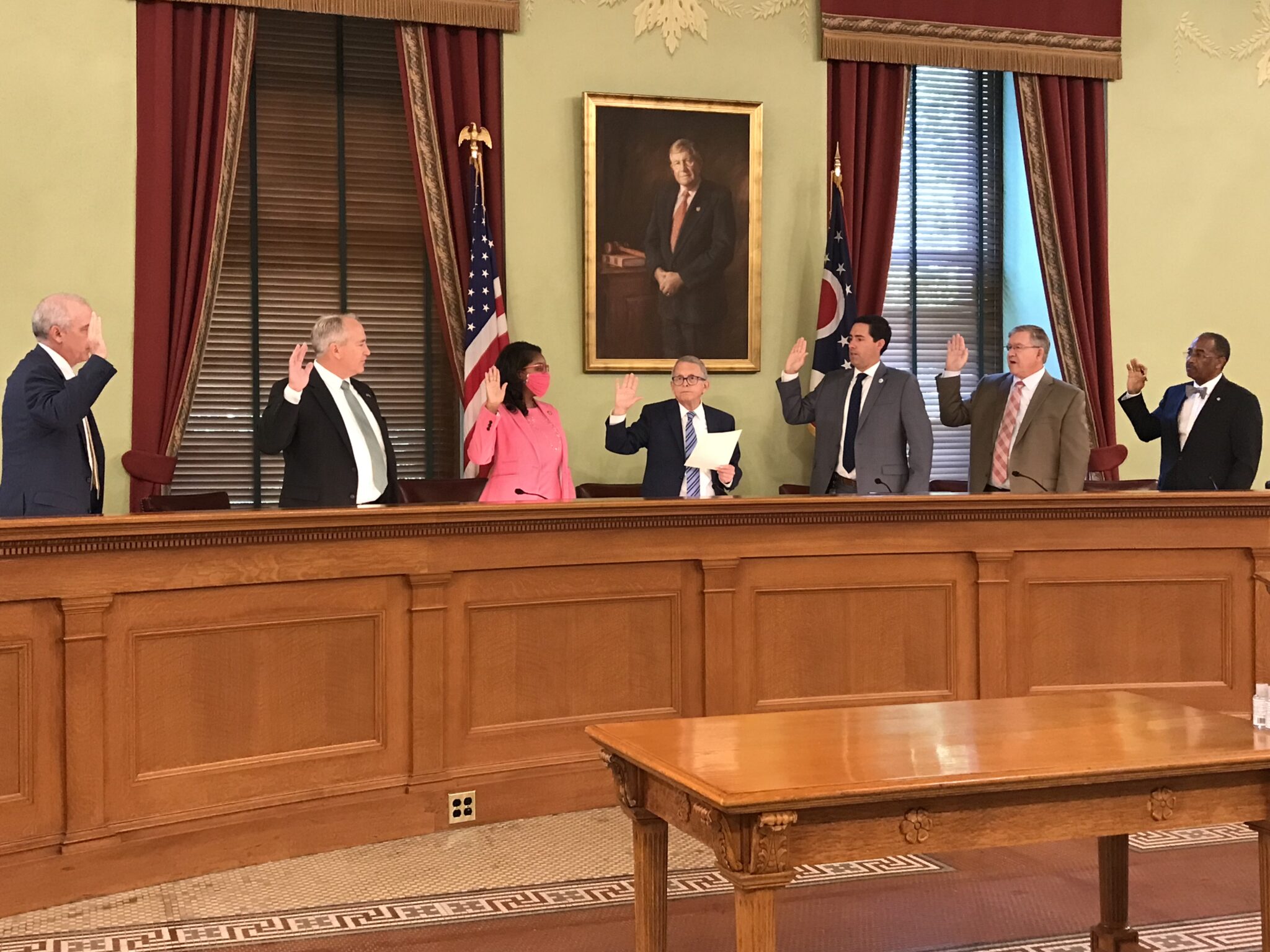
    Members of the Ohio Redistricting Commission are sworn in at the Ohio Statehouse. From left, Senate President Matt Huffman, state Auditor Keith Faber, House Minority Leader Emilia Sykes, Gov. Mike DeWine, Secretary of State Frank LaRose, House Speaker Bob Cupp and Sen. Vernon Sykes. Photo by Susan Tebben

    BY: and Ohio Capital Journal

    The ACLU has filed an expected lawsuit disputing the partisan legislative redistricting maps passed earlier this month by the Ohio Redistricting Commission.

    The Ohio and national chapters of the American Civil Liberties Union, along with law firm Covington & Burling, LLP, announced the lawsuit Thursday afternoon, accusing the Republican majority of “disrespecting the letter and spirit of the constitutional reforms passed overwhelmingly by Ohio voters in 2015.”

    The ACLU and Covington & Burling are presenting the lawsuit on behalf of the Ohio Chapter of the A. Philip Randolph Institute, unnamed individual plaintiffs and the League of Women Voters of Ohio.

    The parties in the court challenge contend that the maps violate the constitution by not accounting for the “partisan balance of House and Senate districts correspond closely to the statewide preferences of the voters of Ohio.”

    “This is an illegal map, plain and simple,” said Robert Fram, of Covington & Burling, in a statement.

    The lawsuit accuses the commission of a “brazen manipulation of district lines for extreme partisan advantage” that “doubly dishonors the honors of this state.”

    “After decades of working to end partisan gerrymandering in the Buckeye State, the League of Women Voters of Ohio asks the Ohio Supreme Court to defend the rights of everyday Ohioans to have legislative districts that serve and represent them rather (than) be rigged to favor the short-sighted and selfish interests of political parties and candidates,” said Jen Miller, president of the League of Women Voters said in a statement.

    A spokesperson for Senate President Matt Huffman, who presented the maps that were eventually approved by the redistricting commission on Sept. 16, said Senate Republicans “are confident the maps approved by the Redistricting Commission are constitutional and compliant.”

    Redistricting Commission co-chair state Sen. Vernon Sykes, one of the two Democrats to vote against the map said he, too, believes the maps are not constitutional.

    “Unfortunately, the maps adopted last week by the Republican members of the Redistricting Commission do not comply with those requirements,” he said in a statement. “They favor one political party and do not meet the litmus test of fairness and proportionality described by the Constitution.”

    A spokesperson for fellow co-chair and House Speaker Bob Cupp also defended the maps.

    “Lawsuits happen every time there is a new map,” said Aaron Mulvey deputy press secretary for the House GOP. “We knew this was coming, and the state will defend the constitutional maps approved by the Redistricting Commission.”

    If the Ohio Supreme Court finds the maps to be unconstitutional, they would return to the commission for a second time.

    The lawsuit comes as congressional redistricting is set to begin this month. If the state legislature can’t come to an agreement by Sept. 30, those maps will also go to the commission for consideration.

    Republican majority gerrymanders Ohio for another four years


    SUSAN TEBBEN is an award-winning journalist with a decade of experience covering Ohio news, including courts and crime, Appalachian social issues, government, education, diversity and culture. She has worked for The Newark Advocate, The Glasgow Daily Times, The Athens Messenger, and WOUB Public Media. She has also had work featured on National Public Radio.
  • Ohio AG Yost joins another national lawsuit, this time to overturn LGBTQ protections

    Ohio AG Yost joins another national lawsuit, this time to overturn LGBTQ protections

    Ohio Attorney General Dave Yost. (Photo by Justin Merriman/Getty Images)

    The state should be more focused on economic recovery than on lawsuits “fighting for the right to discriminate.”

    Equality Ohio

    BY: SUSAN TEBBEN and Ohio Capital Journal

    Joining 19 other state attorneys general, Ohio’s Dave Yost has jumped in on a lawsuit demanding that sexual orientation and gender identity not be included in discrimination protections.

    The complaint, filed in U.S. District Court for the Eastern District of Tennessee, argues “administrative agencies,” in this case the Biden administration, don’t have the power to change laws, but also challenges a recent U.S. Supreme Court ruling saying employers could not fire employees based on their sexual orientation or gender identity.

    “This case is not about the wisdom of the administration’s policy,” Yost said in a statement. “It is about power.”

    State Sen. Nickie Antonio, D-Lakewood, sent a letter to Yost on Tuesday expressing her disappointment in his decision.

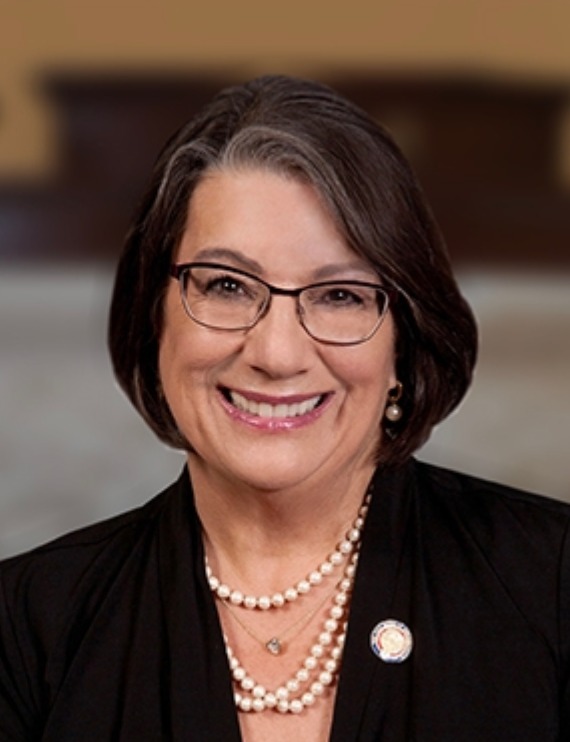
    State Sen. Nickie Antonio

    “It is the Attorney General’s duty as the state’s chief legal officer to protect our children and families, not to attack and malign hardworking Ohioans who happen to be from the LGBTQ community,” Antonio said in a statement.

    LGBTQ policy organization Equality Ohio said the state should be more focused on economic recovery than on lawsuits “fighting for the right to discriminate.”

    “AG Yost’s decision to participate in this misguided lawsuit against LGBTQ+ people pushes Ohio down the wrong path,” said Maria Bruno, public policy director for Equality Ohio.

    The Biden administration directed federal agencies through an executive order to review existing regulations, policies, and other directives for consistency with the U.S. Supreme Court decision.

    The lawsuit accuses the U.S. Department of Education and the Equal Employment Opportunity Commission of “flouting procedural requirements in their rush to overreach” by interpreting federal antidiscrimination law “far beyond what the statutory text, regulatory requirements, judicial precedent and the Constitution permit.”

    The attorneys general said guidance from the DOE and EEOC “concerns issues of enormous importance to the states,” according to court documents.

    “The guidance purports to resolve highly controversial and localized issues such as whether employers and schools may maintain sex-separated showers and locker rooms, whether schools must allow biological males (transgender females) to compete on female athletic teams and whether individuals may be compelled to use another person’s preferred pronouns,” the lawsuit states.

    With regard to the Supreme Court decision, the states say the court “narrowly held” that terminating an employee for being LGBTQ constituted sex discrimination, and the court “declined to consider whether employer conduct other than terminating an employee simply because the employee is homosexual or transgender — for example, ‘sex-segregated bathrooms, locker rooms and dress codes’” — would constitute discrimination.

    The states of Tennessee, Alabama, Alaska, Arizona, Arkansas, Georgia, Idaho, Indiana, Kansas, Kentucky, Louisiana, Mississippi, Missouri, Montana, Nebraska, Oklahoma, South Carolina, South Dakota and West Virginia are also represented in the lawsuit.

    Ohio’s legislature has brought its own movements — or lack thereof — on LGBTQ issues in the past few years. In June, the Ohio House pushed through a ban on transgender female athletes competing on the side that matches their gender identity. The Senate later rejected the addition, but the bill targeting the same goal remains up for consideration.

    A bill to add sexual orientation and gender identity to protected classes in the state, the Ohio Fairness Act, has been introduced multiple times, and has not made it past committee hearings.

  • BROWN HONORS LIFE OF SOUTHWEST OHIO CIVIL RIGHTS PIONEER, ELSIE STEWARD YOUNG, ON SENATE FLOOR

    BROWN HONORS LIFE OF SOUTHWEST OHIO CIVIL RIGHTS PIONEER, ELSIE STEWARD YOUNG, ON SENATE FLOOR

    In Case You Missed It: Last night, U.S. Sen. Sherrod Brown (D-OH) honored the life and memory of Ohio civil rights champion, Elsie Steward Young, on the Senate floor.

    “Miss Elsie is a legend in Southwest Ohio. Her courage and her leadership made a difference for children not only in her community, but all over the country.” said Brown on the Senate floor. “Our thoughts are with her three surviving daughters and two surviving sons, her 36 grandchildren, and all her family and friends and loved ones. We know her legacy will live on, through both the lives of all the students whose education she made possible, and through the future generations of young people she inspires to stand against injustice, wherever they see it.”

    Brown’s full remarks, as prepared for delivery, can be found below.

    Last week, we lost an Ohio champion for civil rights, Miss Elsie Steward Young, of Highland County, Ohio, just after her 105th birthday.

    Miss Elsie is a legend in Southwest Ohio. Her courage and her leadership made a difference for children not only in her community, but all over the country.

    In 1954, after the Supreme Court issued its landmark Brown v. Board of Education decision and ordered an end to segregation in America’s schools, the two all-white primary schools in Hillsboro, Ohio refused to integrate.

    The district continued to send Black students to a single all-Black school, which was in shambles.

    I remember the stories my mother would tell me, of growing up in Mansfield, Georgia – she said she knew all about busing.

    They would bus the Black students past the newer, better-kept white schools, to the segregated Black schools that were falling apart.

    That’s what was going on in Hillsboro, Ohio.

    And Elsie Steward Young wouldn’t stand for it.

    Miss Elsie and a group of mothers took matters into their own hands, and became the Marching Mothers of Hillsboro.

    Every single day for two long years, they marched for miles to the town’s all-white primary school.

    Every day, they were sent home.

    But they carried on, and eventually, the community and the state and the country noticed. They joined with the NAACP to file a lawsuit against the Hillsboro Board of Education, which made it all the way to the Supreme Court – and they won.

    Because of Miss Elsie and her fellow mothers’ advocacy, the Court ordered the schools to integrate, and paved the way for integration in other northern cities.

    Her activism shows us what ordinary citizens can achieve, when they join together to fight for justice.

    It’s a reminder of how far we have come – and how much work we still have to do, to achieve justice and opportunity for ALL children in our country.

    Three years ago, Elsie Steward Young was inducted into the Ohio Civil Rights Hall of Fame. And that fall, we honored the Marching Mothers of Hillsboro and the children—now adults—who marched with our office’s Canary Award, at our annual Ohio Women’s Conference.

    Then-Senator Harris, now Vice President Harris, was supposed to speak, and we were going to present Miss Elsie with the award. But we both had to stay in Washington at the last minute, because of Supreme Court votes.

    So many Ohioans at the conference told me later that, frankly, I’m not sure I was missed that much – not with Miss Elsie there. She not only filled the void, she provided so much energy with her forceful, inspiring words.

    And that was at 102 years old.

    Throughout the conference, people were lining up to get pictures with her. When a video played, depicting the bravery and determination of the marchers, and when Miss Elsie spoke accepting the award, there was scarcely a dry eye in the audience.

    She talked about how she and the other mothers only did what any mother would have done for their children.

    So many Ohioans will miss Elsie Steward Young. Our thoughts are with her three surviving daughters and two surviving sons, her 36 grandchildren, and all her family and friends and loved ones.

    We know her legacy will live on, through both the lives of all the students whose education she made possible, and through the future generations of young people she inspires to stand against injustice, wherever they see it.

    I ask all my colleagues to join me in honoring Miss Elsie Steward Young – Ohioan, mother, determined champion for civil rights.

  • Judge blasts COVID-19 lawsuit against health department as “incomprehensible”

    Judge blasts COVID-19 lawsuit against health department as “incomprehensible”

    By Jake Zuckerman and Ohio Capital Journal

    A federal judge expressed tremendous skepticism of a lawsuit alleging “absolute tyranny” of the Ohio Department of Health’s response to the COVID-19 pandemic, deeming the plaintiff’s arguments nearly “incomprehensible.”

    U.S. District Judge James G. Carr didn’t rule on ODH’s motion to dismiss the suit, which was filed by a self-described citizens group called Ohio Stands Up.

    However, Carr wrote in an order Tuesday that the plaintiffs didn’t satisfy a basic rule of courtroom procedure requiring them to clearly state what their legal problem is and what they want the court to do about it.

    Carr ordered plaintiffs to show cause for why he shouldn’t dismiss the lawsuit for failing to meet the basic minimum legal standard for a civil complaint.

    He described Ohio Stands Up’s arguments as “a jumble of alleged facts, conclusory and speculative assertions, personal and third-party allegations, opinions, and articles of dubious provenance and admissibility.”

    Ohio Stands Up, Carr wrote, created an “impenetrable thicket of often conclusory and speculative assertions, allegations, contentions, innuendo, and legal arguments and citations.”

    While he did not dismiss the case, he blasted the hundreds of pages of disorganized criticism the plaintiffs leveled against ODH and ordered them to make a case for why the suit shouldn’t be dismissed.

    “It’s simply not my job to try to discern from plaintiffs’ scattered, off-loaded stack of contentions and claims to envision what sort of plausible legal edifice a capable legal architect might erect,” he said.

    The lawsuit itself is rich in conspiracy theory and distortion, baselessly alleging COVID-19, which has killed more than 466,000 Americans since the pandemic started, is no different than the flu, which kills about 35,000 Americans per year.

    It claims the government is disseminating misleading information to fear-monger. The suit claims the true death count of COVID-19 (as of an October filing) is 15,000 — there is no evidence suggesting this is true. It makes similarly apocryphal claims about masks and their efficacy, the origins of COVID-19, and others.

    Earlier reporting from the Ohio Capital Journal identified several ties between Ohio Stands Up and Health Freedom Ohio, an anti-vaccine advocacy group.

    The lawsuit is the first on record for, Tom Renz, lead counsel for Ohio Stands Up. His co-counsel, Robert Gargasz, lost election in November for Lorain County prosecutor after calling for “Marxist anarchists” and “communists” to be shot and “stacked like cordwood.”

    Since filing the ODH suit, Ohio Stands Up has filed another lawsuit against the U.S. Department of Health and Human Services, the CDC, and the National Center for Health Statistics. Renz, Gargasz, and N. Ana Garner, a New Mexico attorney, are representing the group.

    Ohio Stands Up crowdsourced legal funds for its lawsuits. A GoFundMe page lists$120,000 in donations for the suit from 1,600 donors.

    Both Renz and an Ohio Department of Health spokeswoman did not respond to inquiries.

  • Ohio Attorney General says former Loveland car dealer failed to deliver vehicle titles to customers

    Ohio Attorney General says former Loveland car dealer failed to deliver vehicle titles to customers

    Loveland, Ohio – Ohio Attorney General Dave Yost has filed a consumer protection lawsuit against a former Loveland used car dealership after receiving about 80 complaints from Ohioans that the owners of the dealership failed to deliver vehicle titles to its customers.

    Consumers who wish to file complaints for deceptive business practices can do so here or by calling 800-282-0515.

    “Innocent people were taken for a ride of lies and deception,” Yost said. “People who do business like that better buckle up, because the next stop is justice.”

    The lawsuit was filed this week by Yost’s Consumer Protection section in Hamilton County Common Pleas Court against Worldwide Auto Sales, doing business as Cincinnati Auto Wholesale and its owners Anthony W. Blevins and Charles W. Reynolds.

    The dealership, which is no longer in operation, was located at 421 Loveland-Madeira Road in Loveland.

    The complaint alleges that dealership owned by Blevins and Reynolds sold vehicles, some of which did not have clear titles to complete ownership. The suit also accuses the defendants of failing to deliver vehicle warranties and misrepresenting details of the sale.

    Yost’s Consumer Protection Section administers the Title Defect Recision (TDR) fund which helps used car buyers resolve title problems. This fund provides remedies to consumers who were not given proper title within 40 days after a vehicle purchase.

    Yost’s office has made payments totaling $226,823.82 to date from the TDR fund to help those with issues who bought used cars from the defendants.

    The lawsuit alleges failure to deliver title, in violation of ORC 4505.181, and engaging in unfair and deceptive acts by failing to deliver titles and auto warranties, in violation of ORC 1345.02.

    The lawsuit seeks to recover the TDR funds paid out to consumers in addition to declaratory relief, injunctive relief and civil penalties.

    Yost is also seeking to prevent the owners from maintaining or obtaining a dealer or sales license until they comply with the Consumer Sales Practices Act and Certificate of Motor Vehicle Title Act and have reimbursed the TDR fund.

  • In Ohio, you can fight public records battles with one click and $25

    In Ohio, you can fight public records battles with one click and $25

    Don’t be shy. Just the act of following through when government says “no” helps keep public officials on their toes.

    By Dennis Hetzel

    Dennis Hetzel 2018
    Dennis Hetzel is the Executive Director of the Ohio News Media Association and President of the Ohio Coalition for Open Government.

    Ohio’s state and local governments likely hold hundreds of records that might be important to you or your family.

    However, it’s not something you’ll ponder until you urgently need access to documents like birth records, police reports, property records, the minutes of your school board’s last meeting, or any of countless other records in the government’s possession.

    Most government officials are honorable and try to fulfill requests, but that’s not always the case. Sometimes there are legitimate differences of opinion. Sometimes, officials are obstinate and don’t want to supply a record for any number of reasons, including often spurious claims of attorney-client privilege or protecting trade secrets.

    Sometimes, officials are obstinate and don’t want to supply a record for any number of reasons, including often spurious claims of attorney-client privilege or protecting trade secrets.

    Until 2016, the playing field in Ohio tilted heavily in the government’s direction. It was easy for officials to say “no” – even when they should’ve said “yes.”  That’s because they knew that most citizens did not have the financial resources to file a lawsuit and go to court. That was the only available path in contrast to many other states that had developed easy, affordable ways to appeal a records denial.

    Actually, the playing field tilted even more than you might think. If you tried to represent yourself to save money, you were at a huge disadvantage versus government attorneys, many of them quite experienced and crafty in the nuances of Ohio’s public records laws. If you sued a state agency, it was you vs. the attorney general’s office.

    On top of that, it remains extremely difficult under Ohio law, even when you’re right and you win, to get attorney fees reimbursed, so your battle was a crusade that required a fat checkbook.

    In the old days, media outlets willingly took up a lot of battles. Today, with resources stretched thin, dollars are lacking for all but the most critical cases. Our Ohio Coalition for Open Government, of which I’m president, helps organizations and individuals in major cases, but OCOG’s total resources are less than $80,000. One or two protracted court battles would drain us to zero.

    The Ohio News Media Association spent several years telling legislators that it was time to do something.

    The Ohio News Media Association spent several years telling legislators that it was time to do something. Keith Faber, then president of the Ohio Senate, drew on his background as a mediator to suggest a unique-in-America process that just might be the best appeals process in the country.

    Now, for $25 and the time to fill out an online form on the Ohio Court of Claims website, you can appeal a denial. Some cases get resolved with a phone call. Mediation comes next, which can be done remotely so you don’t have to make a trip to Columbus. If mediation fails, you’ll get a ruling that has legal authority. Both sides still have appeal rights.

    The process – nearly two years old now – has worked beyond our expectations. I have a few favorite cases already.

    Now, for $25 and the time to fill out an online form on the Ohio Court of Claims website, you can appeal a denial.

    The top of my hit parade is Shaffer v. Budish, a case in which Cuyahoga County tried to block a reporter’s access to body camera footage in a jail incident by arguing, in part, that the camera revealed confidential “security and infrastructure” imagery.

    The reporter pointed out that the county had let a documentary crew into the jail to film the same allegedly secret area. The court said you can’t have it both ways, and most of what was requested had to be released.

    In Chernin v. Geauga County Park District, the park district tried to make the absurd argument that a letter with complaints and recommendations was not a “public record” under Ohio law even though the document was cited in a public meeting. The citizen got the record.

    What’s important is that citizens now have a fighting chance – no matter their resources or standing.

    Government agencies win their share of cases, too, and that’s appropriate. What’s important is that citizens now have a fighting chance – no matter their resources or standing.

    To check it out, go to https://ohiocourtofclaims.gov/ and click on the “public records” tab. If the information on that website doesn’t answer your questions, OCOG and the ACLU of Ohio both offer online resources to citizens. OCOG also has a legal hotline service for its supporters. (Go to www.ohioopengov.com.)

    Don’t be shy. Just the act of following through when government says “no” helps keep public officials on their toes.

    Loveland Magazine is a member of the Ohio News Media Association which was established in 1933 and is the trade association for more than 250 Ohio daily and weekly newspapers. Their membership includes, The Columbus Dispatch, Plain Dealer, Cincinnati Enquirer, Akron Beacon Journal, Dayton Daily News, and The Toledo Blade.
    In 2013, Loveland Magazine became the first “digital only member” of The Ohio Newspaper Association

    How to Make a Public Records Request to any government agency in Ohio, including your City Hall or School District


      Take Home Tano is about fresh, wholesome food for the frenzied family   Our goal is to meet the needs of busy families.


  • Attorney General DeWine files lawsuit against opioid distributors for practices fueling opioid diversion

    Attorney General DeWine files lawsuit against opioid distributors for practices fueling opioid diversion

    Columbus, Ohio – Ohio Attorney General Mike DeWine today filed a lawsuit against four major prescription opioid distributors in Madison County Court of Common Pleas. The lawsuit alleges that the drug companies engaged in unsafe distribution practices that ignored their responsibility under law to provide effective controls against opioid diversion.

    “We believe the evidence will show that these companies ignored their duties as drug distributors to ensure that opioids were not being diverted for improper use. They knew the amount of opioids allowed to flow into Ohio far exceeded what could be consumed for medically-necessary purposes, but they did nothing to stop it,” said Ohio Attorney General Mike DeWine. “And much like the drug manufacturers who continue to fail to do the right thing, these distributors are doing precious little to take responsibility for their actions and help pay for the damage they have caused.”

    In 2016, the last year for which data is available, an average of more than 76 opioid doses was distributed for every man, woman, and child in Madison County.

    The four distributors which are listed as defendants include:

    • McKesson Corporation
    • Cardinal Health, Inc., and its subsidiaries
    • AmerisourceBergen Drug Corporation
    • Miami-Luken, Inc.

    The lawsuit alleges, among several counts, that the drug companies were negligent and created a public nuisance by using unsafe distribution practices and by irresponsibly oversupplying the market in and around Ohio with highly-addictive prescription opioids. The companies are alleged to have failed to act upon their responsibilities under both federal and Ohio law to stop such orders that would result in oversupply and report these suspicious orders to the United States Drug Enforcement Agency (DEA) and the Ohio Board of Pharmacy. The lawsuit also alleges that the companies should have known that the volume of opioids supplied far exceeded what could be responsibly used in markets in Ohio and would likely have contributed to the opioids being illegally diverted and abused. This behavior directly fueled the opioid epidemic Ohio is currently facing.

    In the lawsuit, Attorney General DeWine is seeking a number of remedies including punitive damages as well as compensatory damages for costs incurred by Ohio for its increased spending for healthcare, criminal justice, social services, and education. The lawsuit also seeks to enjoin the defendants from further improper conduct by complying with reporting requirements for suspicious orders and to undertake more complete reporting of suspicious orders to the DEA and the Ohio Board of Pharmacy as well as the Ohio Attorney General’s Office.

    The lawsuit was filed in Madison County, which has consistently had a higher number of opioids distributed to it than the statewide average. In 2016, the last year for which data is available, an average of more than 76 opioid doses was distributed for every man, woman, and child in Madison County, a rate that was 39% higher than the Ohio statewide average for that year.

    A copy of the lawsuit is available on the Ohio Attorney General’s website.