These laws have been challenged in Florida, Oklahoma, Idaho, and Tennessee. The U.S. Court of Appeals for the 9th Circuit blocked Idaho’s law in the fall.
Ohio’s bill would require K-12 schools and universities to mandate that students only be able to use the bathroom or locker room that matches their gender assigned at birth. It would not prohibit a school from having single-occupancy facilities and it would not apply to someone helping a person with a disability or a child younger than 10 years old being assisted by a parent, guardian, or family member.
The bathroom ban bill, which was tucked into Senate Bill 104 at the end of a marathon House session, heads back to the Ohio Senate for concurrence. The lawmakers are currently on summer break, so that won’t happen anytime soon.
Ohio Gov. Mike DeWine has indicated he would sign the bill if it came to his desk.
“As it stands now, I would sign the bill,” he told reporters on Friday.
Lawsuits would be filed if Ohio passes the bill, said Cleveland attorney Robert Chaloupka.
“There’s good reason to believe that if the (Ohio) Attorney General decides to defend this case, they’re going to lose, which means we’re spending taxpayer money on something that we have a good sense of how it’s going to go,” he said.
Chaloupka sees lots of legal challenges with Ohio’s bill.
“My most critical point about this is who’s going to police this?” Chaloupka asked.
He thinks this would be especially challenging in a university setting where there are non-traditional students.
“You’re going to regulate where a 75 year olds trans individual goes to the bathroom?” Chaloupka said.
The Supreme Court declined to weigh in earlier this year on whether schools can ban transgender students from using a restroom that reflects their gender identity. That denial left in place a U.S. Court of Appeals for the 7th Circuit decision that allowed a transgender middle school Indiana boy to use the boys’ restroom.
The American Medical Association officially opposes policies preventing transgender individuals from accessing basic human services and public facilities consistent with gender identity.
“Banning transgender students from freely and safely accessing public places, like bathrooms and changing rooms, sends the message that transgender children do not belong,” Ash Orr, spokesperson for the National Center for Transgender Equality, said in an email. “Everybody should be able to safely access public places without fear of persecution or harassment.”
Utah’s bathroom ban law — which went into effect in May— applies to K-12 schools and all government-owned buildings.
“Using the bathroom is a human function that everybody needs to be able to do, and bathrooms can tend to feel like vulnerable spaces, so I think the real concern is that people will feel uncomfortable in a bathroom setting and choose not to use the bathroom at all, which obviously can lead to health issues,” said Equality Utah’s Policy Director Marina Lowe.
What happened in North Carolina?
North Carolina was the first state to limit bathroom access to transgender people in 2016 when they enacted a law that banned transgender people from using the restroom that matched their gender identity in most public spaces.
Megan Henry is a reporter for the Ohio Capital Journal and has spent the past five years reporting in Ohio on various topics including education, healthcare, business and crime. She previously worked at The Columbus Dispatch, part of the USA Today Network.
Ohio Capital Journal is part of States Newsroom, the nation’s largest state-focused nonprofit news organization.
The road toward the November general election will include many more debates about abortion and reproductive rights in Ohio.
The conversation is taking shape in the form of campaigning candidates and their stances on upholding the constitutional amendment approved by 57% of voters last November, and the potential for a national abortion ban floated by Republicans on the federal level.
Several lawsuits and legislative measures are working their way through the Ohio Statehouse and the court system.
Most recently, Ohio Attorney General Dave Yost filed his opposition to a request in a Franklin County court by abortion providers that would pause a 24-hour waiting period required in state law before an abortion can be conducted, among other laws the suit challenges.
In the court documents, Yost acknowledged the new amendment to the Ohio Constitution that legalized abortion services and other reproductive treatments, and maintained a previous concession that the amendment “invalidated Ohio’s 2019 law prohibiting most abortions, absent certain exceptions, after a fetal heartbeat was detected – around six weeks after conception.”
That law is still the subject of its own lawsuit in Hamilton County, where clinics have asked for the six-week abortion ban to be eliminated, and for which the Ohio Supreme Court said it would not intervene in an enforcement pause“due to a change in law.”
But the attorney general would not bend to the idea he said was being argued by providers: that the amendment “bars all laws that touch on abortion – and even some laws that have nothing to do with abortion or anything else the amendment mentions.”
“Just as it is the state government’s duty to respect the will of the people by conceding the invalidity of a statutory provision that conflicts with the current language of the Ohio Constitution, it is also the state governor’s duty to respect the will of the people by defending statutory provisions that the amendment does not invalidate against meritless attack,” Yost’s office said in the court filing last week.
Yost also argues the abortion clinics “lack standing to challenge” laws like the waiting period provision, the requirement that patients attend in-person appointments to hear possible risks and other information about abortion, and a requirement that an ultrasound be conducted to identify a heartbeat.
Ohio Attorney General Dave Yost. Official photo.
Yost’s argument explains that though the amendment keeps the state from burdening, penalizing, prohibiting, interfering with or discriminating against anyone seeking an abortion or assisting with an abortion, “only the physician plaintiff must comply with the challenged statutes, and only she can be penalized for the violations of those laws.” Thus, the clinics as a whole can’t claim a violation of rights, only the physicians themselves.
“No party in this case has asserted a claim based on the individual right to obtain an abortion created by the amendment,” Yost’s office wrote.
Because the amendment was enacted to restore the rights from the national abortion legalization in Roe v. Wade, which was overturned in the U.S. Supreme Court’s Dobbs decision of June 2022, and not the laws of the state related to abortion, “these laws remain valid under the amendment,” the attorney general claims.
Responding to claims by clinics, which argued the 24-hour waiting period creates a situation in which “in practice, patients are often forced to wait much longer” based on physician availability, procedural requirements like fasting for sedation and anesthesia, and even things like transportation barriers for the patients, Yost said delays were not a legal issue.
“But the fact that patients often wait longer than 24 hours is not because of the law, but rather is attributable to several factors outside of the state’s control,” Yost’s filing stated.
The opposition filing further argues the requirement to check for a fetal heartbeat before an abortion “in no way acts to prevent any abortion, and indeed, plaintiffs have long admitted that they easily complied with that law for years.”
Blocking enforcement of the laws at issue in the lawsuit “would irreparably harm the public,” Yost concluded. The public interest would be at stake in the lawsuit as well, “because the General Assembly is democratically elected to represent the public interest of the state as a whole.”
Abortion and the 2024 general election
The General Assembly election and the race for the U.S. Senate seat that Sen. Sherrod Brown currently holds could become a referendum on how Ohioans feel about abortion and the candidates’ stances on it.
One legislator running for reelection in the 45th Ohio House district, the staunchly anti-abortion GOP state Rep. Jennifer Gross, has said she “will not swear allegiance” to the reproductive rights amendment included in the Ohio Constitution if she’s reelected. She also made comments to the public that she believes Issue 1 is unconstitutional, and helped author a bill in the legislature to take enforcement of Issue 1 away from the judicial branch and lay the authority upon the legislature itself. House Speaker Jason Stephens has dismissed concerns about the bill, or even the likelihood that the bill will be taken up.
Also up for reelection is state Sen. Sandra O’Brien, R-Ashtabula, in the 32nd state Senate district. She introduced a bill that would allow tax credits for those who donate to “pregnancy resource centers,” highly criticized centers who are often affiliated with anti-abortion entities, and does not allow for a tax credit for a donation going to any center that performs or is affiliated with abortion services.
The bill was brought to committee just weeks after the abortion amendment passed, and currently sits in the Senate Finance Committee.
Most recently, the incumbent up for reelection in the 41st House district, state Rep. Josh Williams, R-Sylvania, introduced a bill that would keep state funds from going to “any entity that supports, promotes or provides abortions,” even threatening to withhold local government funds from municipalities found to reimburse for abortion services. It’s been assigned to the Ohio House Government Oversight Committee, but has yet to receive a hearing.
Days after the constitutional amendment passed last year, the Ohio Democratic Party was already working to connect the anti-abortion rights views that failed to convince a majority of voters in Ohio on Issue 1 to the opinions of Brown’s November opponent, Bernie Moreno, and the other candidates in the March primary.
Fundraising emails and press releases sent out in the months that followed continued to spotlight Moreno’s anti-abortion views and comments about a national 15-week abortion ban that has been floated by Republicans.
Even in Ohio after the abortion amendment passed, Senate President Matt Huffman pondered the idea of a 15-week ban as a potential idea in the future.
Dr. Courtney Kerestes, an OB/GYN practicing in Columbus and a member of Physicians for Reproductive Health said there is “no medical significance” to the 15th week as a landmark to ban abortion, but sees the marker as merely a talking point to bolster supporters against abortion rights. The Mississippi case that would become the Dobbs case through which the U.S. Supreme Court overturned Roe v. Wade involved a 15-week ban.
According to the most recent induced abortion report released by the Ohio Department of Health, only 10.4% of all abortions happened between 13 and 22 weeks gestation, with a vast majority (67.4%) happening at less than nine weeks.
But the talk of an abortion ban at any gestational age causes confusion for patients in Ohio, who also know the amendment exists with a provision stating the decision about pregnancy and abortion is left up to the patient and their treating physician based around fetal viability.
Kerestes said patients who had “strongly desired pregnancies” came to her afraid that a fetal anomaly could arise in their pregnancy, and that the decision as to whether or not they were allowed a say in the fate of the pregnancy may not be up to them. The same would not be said of someone getting a colonoscopy, or those in need of cardiac care, she said.
“It’s important to think of all of these unfortunate complications that can come with pregnancy,” Kerestes said. “I don’t want to be sitting there wondering if I need to refer to a lawyer before I provide care.”
Moreno did not respond to requests for comment from the Capital Journal, but has previously said he would support a national 15-week abortion ban and has called himself “100% pro-life, no exceptions.”
On Twitter, he called Roe v. Wade “a terrible decision made over 50 years ago that led to the ending of millions of unborn lives.”
A statement from Brown’s campaign said the incumbent U.S. senator “stands with the overwhelming majority of Ohioans who voted to protect abortion rights in Ohio’s constitution last year.”
SUSAN TEBBEN
Susan Tebben is an award-winning journalist with a decade of experience covering Ohio news, including courts and crime, Appalachian social issues, government, education, diversity and culture. She has worked for The Newark Advocate, The Glasgow (KY) Daily Times, The Athens Messenger, and WOUB Public Media. She has also had work featured on National Public Radio.
Ohio Capital Journal is part of States Newsroom, the nation’s largest state-focused nonprofit news organization.
Ohio’s House Speaker said Wednesday legislation is not coming to change the May primary date.
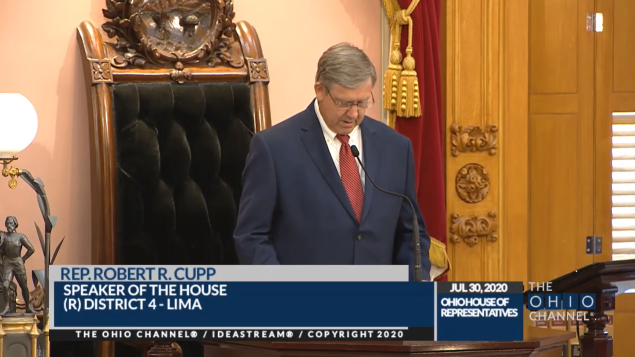
Speaker Bob Cupp said the process was “in the hands of the federal court,” despite various court documents in which he argued that the election is a legislative issue and any changes should be made in the General Assembly.
The Ohio Capital Journal asked Cupp directly to confirm the House had no plans for legislation to set a new primary date in the next two weeks.
“That is correct, we’re not in session,” Cupp said during a gaggle after Wednesday’s House session.
He was asked about potential changes to the election earlier in the press gathering, and he deferred the job.
“We’ll let the federal court process proceed,” Cupp said.
A federal lawsuit was filed by GOP voters earlier this year, claiming voters are losing their right to vote with the chaos surrounding redistricting. Originally, the plaintiffs, including Ohio Right to Life leader Michael Gonidakis, asked for the third map adopted by the Ohio Redistricting Commission to be forced into use by a three-judge panel of the U.S. District Court.
That map was rejected by the Ohio Supreme Court before the federal lawsuit was filed, but the process of adopting a fourth version of legislative districts had not come to fruition.
The fourth map ended up being a near-copy of the third, rejected version, with Senate President Matt Huffman acknowledging as he moved for its approval that the map had “97%” similarity to the third version.
Because the process, which started in September, has taken so long, the Secretary of State’s Office was forced to remove legislative races from ballots for the May 3 primary, all but assuring a split primary.
Lawsuits have been filed with the Ohio Supreme Court asking for the fourth map to be invalidated for many of the same reasons the third map was, and map challengers have also asked the court to hold GOP commission members in contempt for violating court orders.
Cupp and Senate President Matt Huffman argued in previous court filings that the power for elections and drawing maps lies solely with the redistricting commission and legislators, seemingly contrary to Cupp’s Wednesday statements.
“It is the commission and the general assembly who solely possess the legislative authority to create legislative and congressional districts,” attorneys for the legislative leaders wrote in a court filing for lawsuits on congressional districts.
Secretary of State Frank LaRose in more recent court filings urged the judicial system to stay out of the process. In his filing countering objections to the most recent maps, he posited that the Ohio Redistricting Commission has more time to figure out legislative maps.
“More importantly, there is still time for the legislature to take steps to extend the time within which such a decision must be made,” LaRose said. “This court should not give up on the constitutional process even if the petitioners have.”
The federal court has chosen twice not to intervene in the state process to give it time to come to a resolution. The first time the court withheld judgment was just before the March 28 deadline for the commission to complete new maps.
At a hearing before Chief Judge Algenon Marbley, Judge Benjamin Beaton and Judge Amul Thapar last Wednesday, parties from the Secretary of State’s Office gave Aug. 2 as a potential date for a second primary to include the legislative races.
The judges entertained the idea of not just the third map, but also the map drawn by independent mapmakers during the latest redistricting commission hearings, and also debated whether or not the 2010 map could be used for one more year.
They decided to give the state until April 20 to come up with an official map and to give the state’s highest court time to make its rulings. A status conference was scheduled for April 11.
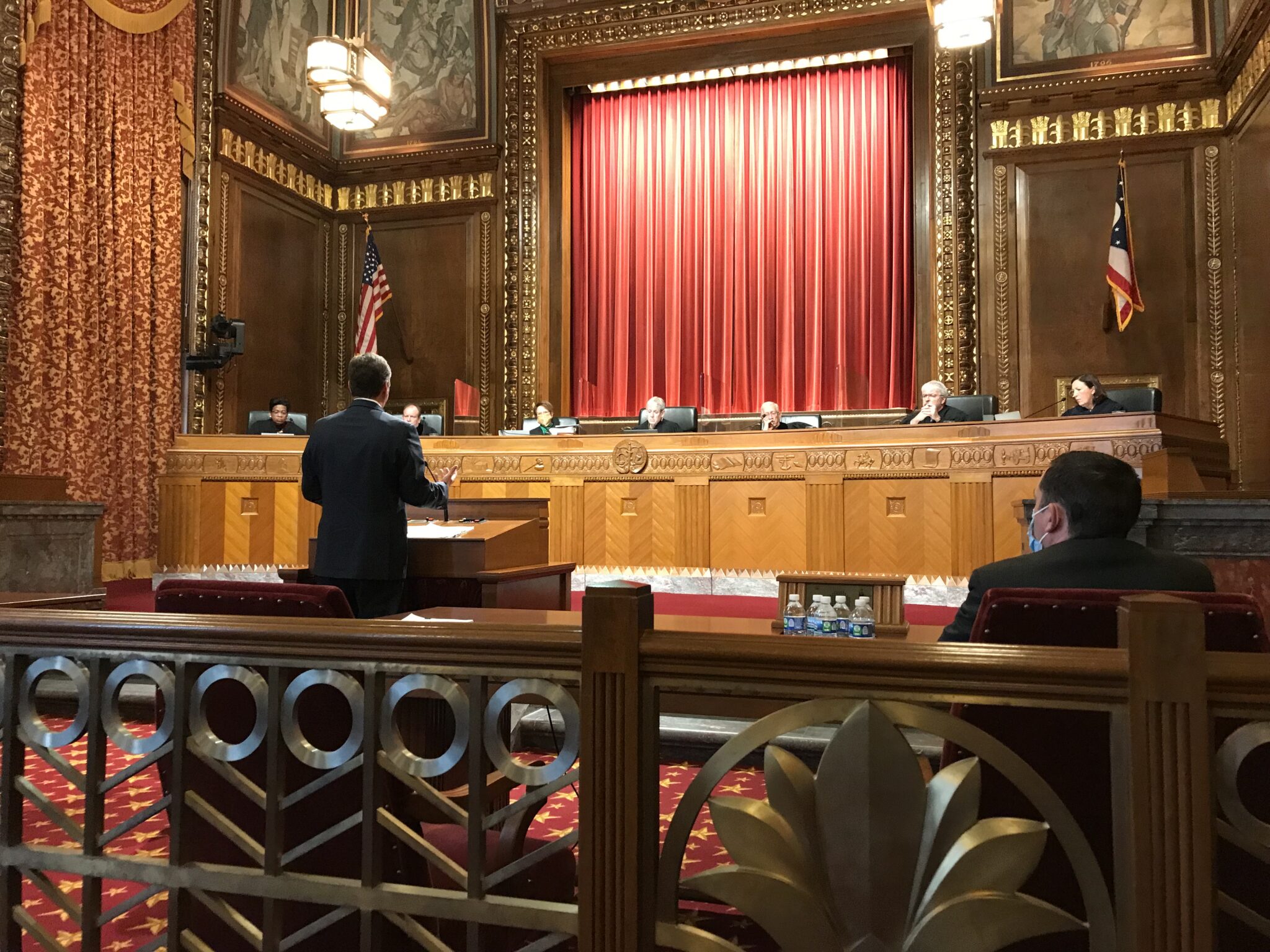
Attorney Phillip Strach speaks before the Ohio Supreme Court, arguing for the constitutionality of legislative district maps. The court heard arguments on three cases asking it to reject the maps approved in September. (Photo: Susan Tebben, OCJ)
The Ohio Supreme Court weighed in on the redistricting battle on Friday evening, asking the members of the Ohio Redistricting Commission why it shouldn’t hold them in contempt of court for defying its order.
Chief Justice Maureen O’Connor signed an entry in all three of the lawsuits against the ORC on legislative redistricting, asking Gov. Mike DeWine, Secretary of State Frank LaRose, Auditor Keith Faber, Senate President Matt Huffman, House Speaker (and commission co-chair) Bob Cupp, state Sen. (and commission co-chair) Vernon Sykes and House Minority Leader Allison Russo, to explain the “failure to comply with this court’s February 7, 2022 order,” and why they shouldn’t face anything from fines to jail time, the consequences for contempt of court.
The court had been asked by the League of Women Voters, the Ohio Organizing Collaborative and a group of Ohio residents – the parties in the three lawsuits originally filed to challenge maps approved by the ORC – to order the commission to give specific reasons for their choice to adjourn without maps on Feb. 17.
The ORC members now have until noon on Feb. 23 to tell the court why they shouldn’t be held in contempt.
The groups also asked for justification for the commission’s lack of action on any sort of map, despite being presented with a map by the Democratic House and Senate caucuses, which they shot down along party lines on the day of the deadline.
Huffman accused drawers of the Dem map of racial gerrymandering to the benefit of Democrats in certain districts, including the district that holds Lake County, typically a strongly GOP area. Russo wholly denied the accusations.
The GOP commission members said during the meeting that they could not find a way to draw maps that complied with all the redistricting provisions of the constitution, while also complying with the rules the supreme court had given in their majority opinion invalidating the previous maps. Mainly, the GOP said they couldn’t hit the target of 54-46 partisan breakdown asked for by the court justices, a number based on statewide voter preferences over the last 10 years.
But some of the commission members, of both parties, disagreed with the decision to leave before approving a map.
“I think it is a mistake for this commission to stop and basically say that we’re at an impasse,” Gov. Mike DeWine said on Thursday. “I don’t think that is an option that the law gives us.”
Co-chair Sykes agreed that contempt was a possibility for the commission members, and said he was willing to do whatever could be done to move forward.
Asked after the commission adjourned if that included contempt of court: “Including whatever we can do.”
The choice to adjourn didn’t require a majority vote, but was met with no formal objections.
The supreme court ordered the ORC to come up with “entirely new” maps after invalidating not one but two different sets of legislative district maps. Their deadline to file with the Secretary of State’s Office was Feb. 17, with those maps then being sent to the court for review by the next day.
The order came the same day a federal lawsuit was filed by Ohio residents, some of whom are also anti-abortion advocates in the statewide lobby group Ohio Right to Life. That lawsuit asks the district court to take over the process, and accuses the redistricting commission of preventing them from advocating for candidates, running for office, and even voting.