Ohioans have had the right to direct democracy since 1912, but now lawmakers and Secretary LaRose are going after the power of the people. Because of gerrymandering and dark money, Ohioans have faced years of unpopular and unjust legislation related to democracy, women’s reproductive rights, public education, and so much more.
Yesterday, Rep Brian Stewart and Secretary of State LaRose proposed a bill that would require a 60% yes vote to pass a citizen initiated constitutional amendment, while maintaining that constitutional amendments referred by the Legislature would still only require a simple majority vote to pass.
LaRose claims that this measure is necessary to protect the Ohio Constitution, and that the time is right. We say ABSOLUTELY NOT!
Ohio citizens must already overcome extreme challenges to placing an issue on the ballot. The process requires hundreds of thousands of verified signatures and a strict geographical distribution across at least half of Ohio’s 88 counties.
The process is not overused. In fact, since 1950, only ten out of 44 ballot measures have passed (23%). If so few citizen initiated amendments pass, what problem are we looking to solve?
If this measure passes the Ohio Legislature, it will be on the ballot in May 2023; primary elections in odd numbered years have always historically had very low voter turnout. As little as 10% of the electorate will likely decide how Ohio citizens can practice direct democracy and affect change.
Send a message to your elected leaders and demand that they stop this threat to democracy!
More about the proposal to restrict access to Ohio Voters…
Secretary of State Frank LaRose (speaking) alongside Rep. Brian Stewart, R-Ashville, introducing a constitutional amendment requiring a 60% supermajority for all future citizen-led ballot amendments. (Photo by Nick Evans, OCJ.)
Legislative Republican leaders also negotiating other changes, nix plan for automated voter registration
Lawmakers raised two ideas Thursday with massive implications for Ohio voters. One is an initiative requiring citizen-led constitutional amendments gain a 60% supermajority at the ballot for passage, the other is a House bill aimed at rewriting the underlying infrastructure of how the state conducts elections.
The amendment
State Rep. Brian Stewart, R-Ashville, joined Ohio Secretary of State Frank LaRose to introduce their plan to “safeguard Ohio’s constitution from special interests,” by proposing the supermajority for passage.
“We have repeatedly watched as special interests buy their way onto the statewide ballot and then spend millions of dollars drowning the airwaves to secure fundamental changes to our state by a vote margin of 50% plus one vote,” Stewart argued.
Their plan singles out the citizen-led process for amending the state constitution and raises the threshold for passage to 60%. The signature threshold for making the ballot would remain unchanged. LaRose argued lifting that benchmark would give the same interest groups a relative advantage.
Ohio Secretary of State Frank LaRose. Official photo.
“If a special interest group can afford to pay, you know, million dollars to hire people with clipboards,” LaRose reasoned, “they can afford to pay a million and a half dollars to hire more people with more clipboards.”
The stakes are high for any groups whose ideas have fallen on deaf ears in Columbus. The prospects for abortion protection, recreational marijuana, minimum wage increases, gun violence prevention, or further redistricting reform provisions are effectively non-existent in the GOP-controlled Statehouse. LaRose and Stewart’s proposal would move the goal posts for any of those ideas.
The proposal itself, of course, will need to go to voters and get just 50% plus one to alter the Ohio Constitution. It will follow a different process, too. Stewart’s resolution would make the ballot through a General Assembly vote rather than the citizen signature-gathering process.
That lawmaker-led process won’t see any changes in the threshold for passage, either. LaRose and Stewart dismissed any suggestion their approach is unfair. Lawmakers have to meet a supermajority benchmark, too, they argued. It’s on “the front end” where they have to clear a 2/3 supermajority to make the ballot.
Under maps declared to be unconstitutional gerrymandering by a bipartisan majority on the Ohio Supreme Court, Ohio Republicans once again won rock-solid supermajorities in the Ohio House and the Ohio Senate last week.
LaRose and Stewart highlighted how 11 of 16 citizen-led amendments have failed since 2000, so it wasn’t clear exactly why they want to raise the bar higher as they also noted of the five measures that passed, three cleared 60% at the ballot box.
The legislation
Republican Ohio House Majority Leader Bill Seitz. Official photo.
Meanwhile, state Rep. Bill Seitz, R-Green Township, kicked off Thursday morning by proposing sweeping changes to an already sweeping elections bill. The biggest move involved nixing the automated voter registration language contained in the initial proposal.
Those provisions would’ve leaned heavily on the Bureau of Motor Vehicles to help voters register or update their registration any time they interact with the agency. If voters’ registration is regularly updated, the thinking goes, there will be fewer names to purge. But Seitz said after months of negotiations, the Ohio Senate hasn’t budged.
“If we’re going to get anything done,” Sietz said, “we’ve got to have an agreement between two chambers, and the Senate does not yet feel comfortable with automated voter registration, even though I am comfortable with it.”
“But it takes two to tango as they say,” he added with a wry chuckle.
Among other changes, voters would be able to request absentee ballots online, but they’d have to submit paper requests on a specific form. The deadline for requesting one would be seven days before an election. The bill trims the deadline for absentee ballots to arrive post-election to seven days as well.
Drop boxes would be available for the duration of early voting, but they’d be restricted — no more than three, all on board of elections premises and under 24/7 video surveillance.
The bill eliminates the final day of early voting but distributes those hours in the week prior by extending weekday hours.
Seitz also dropped a number of ID provisions from the original bill. He noted Senate legislation plans to offer free photo-ID to anyone — not just poor Ohioans as his bill envisioned.
“They can be, you know, Leslie Wexner or Carlin Lindner III and they could still get a free photo ID,” he quipped referencing the founder of The Limited and the co-CEO of American Financial Group.
Pushback
A slew of press releases were released Thursday afternoon from good government groups and voters rights organizations slamming the Stewart and LaRose proposal to increase the passage threshold for citizen-initiated amendments.
As for the Seitz proposal, voting rights advocates applauded the inclusion of online ballot requests and funding for electronic poll books. But League of Women Voters of Ohio Director Jen Miller warned the proposal would make elections “more complicated, expensive and inefficient.”
She urged lawmakers to expand in person voting hours during the final weekend of early voting. Miller argued boards will get more bang for their buck expanding weekend voting compared to tacking on extra early morning hours during the week.
Miller also pushed them to reconsider the automated voter registration they’d just removed. She argued 22 other states have similar policies including West Virginia, Georgia and Michigan.
“It removes barriers to registration, but it also helps every voter because the accuracy of voter rolls are improved and it can reduce administrative costs for the boards of elections,” Miller explained. “And we reduce our provisional ballot counts which are typically very high in Ohio.”
Miller returned to the idea of excessive provisional ballots in a discussion of stricter voter ID requirements.
“When someone votes provisionally, which of course we support, that actually takes away all workers from the process,” Miller explained. “It increases lines, and it also increases a lot of post-election work for boards of elections. So we think that the system as is works.”
Speaking afterward, Seitz rejected out of hand the idea that more stringent voter ID requirements could increase the number of provisional ballots cast.
“I don’t buy that at all, that’s crap,” he said, “look at everything you need a photo ID for in life, okay?”
The Republican majority members of the Ohio Redistricting Commission. Top row from left, Ohio Gov. Mike DeWine and Secretary of State Frank LaRose. Bottom row from left Ohio Auditor Keith Faber, House Speaker Bob Cupp, and Senate President Matt Huffman. Official photos.
Anti-gerrymandering groups are again asking the Ohio Supreme Court to determine if the Ohio Redistricting Commission should be held in contempt, and to force the commission to meet by the end of the week to redraw legislative maps.
The ACLU, on behalf of several groups including the League of Women Voters of Ohio and the A. Philip Randolph Institution of Ohio and some individual Ohio voters, asked the court to yet again demand answers from the Ohio Redistricting Commission as to why they shouldn’t be held in contempt for making no moves to meet a deadline to draw “entirely new” legislative maps.
The fourth effort by the ORC was rejected by the Ohio Supreme Court on April 14, and found not to be an “entirely new map” they were ordered to create, but merely a tweak of the third attempt, which was also rejected as unduly partisan.
The commission has until May 6 to adopt and submit a map, but the groups say the urgency of the situation has “dramatically increased” because of a federal court’s decision to implement the third map found unconstitutional by the supreme court as the map to use during the 2022 election season. The U.S. District Court said they would order the use of the map, which was found to be unduly advantageous to Republicans, if no plan was adopted by May 28.
“Based on the commission’s conduct to date, this appears to be exactly what the commission is trying to do,” the ACLU wrote to the supreme court. “The Court should not allow the commission to intentionally avoid its constitutional obligations.”
GOP members of the commission argued that the court did not have the authority to hold them in contempt for several reasons, most important of which was the fact that the commission had passed a map by the court-ordered March 28 date. They said they conducted their legislative duties, and also were protected by the separation of powers doctrine from being held in contempt.
One member of the state supreme court, Justice Sharon Kennedy, has consistently sided with the Republican members in saying they should not be held in contempt and the court does not have the power to do so.
The Ohio Supreme Court rejected a previous request to hold the ORC in contempt at the same time they rejected the fourth map by the group.
The ACLU, however, argues in their most recent challenge for contempt that legislative immunity is not “unlimited” and separation of powers principles do not “constitute an insurmountable barrier to a contempt order against the majority of the commission.”
“In ordering (the ORC) to reconvene and to draft and adopt a constitutionally valid General Assembly-district plan, this Court is not ‘asserting control’ over purely legislative duties … but simply ensuring that the commission itself undertake those duties,” attorneys said in their Monday filing.
GOP members of the ORC told the court in the last debate over contempt that they could not be charged as individuals for something decided by the commission as a whole.
The ACLU called the argument an “improper attempt to evade responsibility” in their Monday filing. The argument also does not hold when it comes to calling a meeting of the commission, the court challengers said. Calling a meeting only requires three commission members, leaving five others “fully responsible for the defiance of the court’s order,” court documents stated.
Attorneys urged the court to force the commission to convene no later than Friday if they are held in contempt, as a way to “purge” their contempt charges.
The commission has not announced any plans to meet on or before the May 6 deadline. Democrats, including commission co-chair state Sen. Vernon Sykes, attempted to bring a meeting together on Monday, but ended up alone in front of the room where the ORC has met in the past, having had their offer rejected by every other member of the commission.
A representative with House Speaker and commission co-chair Bob Cupp said no meetings have been scheduled, and a spokesperson for Senate President Matt Huffman said meeting dates were up to the co-chairs.
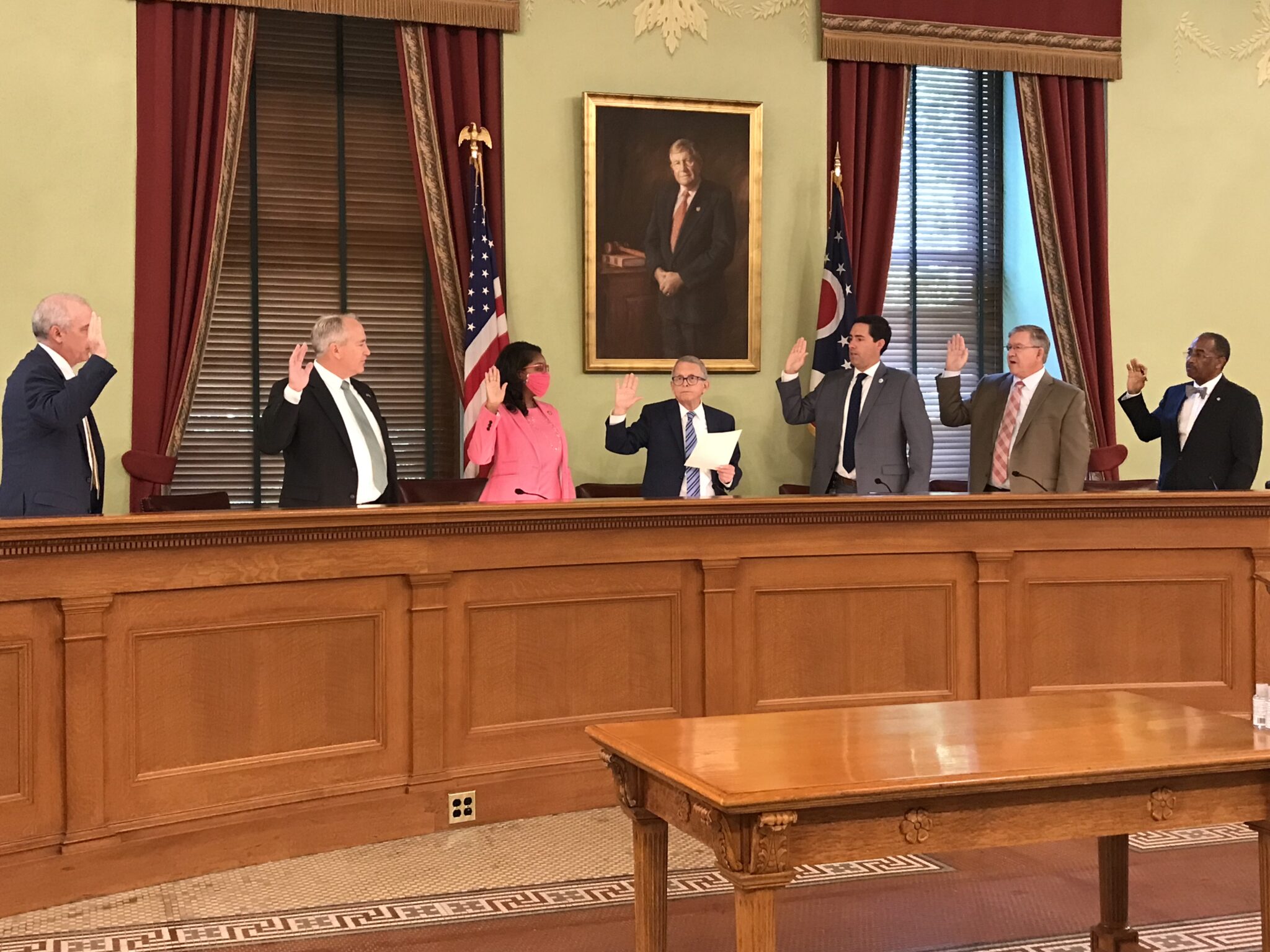
Members of the Ohio Redistricting Commission are sworn in at the Ohio Statehouse. From left, Senate President Matt Huffman, state Auditor Keith Faber, House Minority Leader Emilia Sykes, Gov. Mike DeWine, Secretary of State Frank LaRose, House Speaker Bob Cupp and Sen. Vernon Sykes. Photo by Susan Tebben
The ACLU has filed an expected lawsuit disputing the partisan legislative redistricting maps passed earlier this month by the Ohio Redistricting Commission.
The Ohio and national chapters of the American Civil Liberties Union, along with law firm Covington & Burling, LLP, announced the lawsuit Thursday afternoon, accusing the Republican majority of “disrespecting the letter and spirit of the constitutional reforms passed overwhelmingly by Ohio voters in 2015.”
The ACLU and Covington & Burling are presenting the lawsuit on behalf of the Ohio Chapter of the A. Philip Randolph Institute, unnamed individual plaintiffs and the League of Women Voters of Ohio.
The parties in the court challenge contend that the maps violate the constitution by not accounting for the “partisan balance of House and Senate districts correspond closely to the statewide preferences of the voters of Ohio.”
“This is an illegal map, plain and simple,” said Robert Fram, of Covington & Burling, in a statement.
The lawsuit accuses the commission of a “brazen manipulation of district lines for extreme partisan advantage” that “doubly dishonors the honors of this state.”
“After decades of working to end partisan gerrymandering in the Buckeye State, the League of Women Voters of Ohio asks the Ohio Supreme Court to defend the rights of everyday Ohioans to have legislative districts that serve and represent them rather (than) be rigged to favor the short-sighted and selfish interests of political parties and candidates,” said Jen Miller, president of the League of Women Voters said in a statement.
Redistricting Commission co-chair state Sen. Vernon Sykes, one of the two Democrats to vote against the map said he, too, believes the maps are not constitutional.
“Unfortunately, the maps adopted last week by the Republican members of the Redistricting Commission do not comply with those requirements,” he said in a statement. “They favor one political party and do not meet the litmus test of fairness and proportionality described by the Constitution.”
A spokesperson for fellow co-chair and House Speaker Bob Cupp also defended the maps.
“Lawsuits happen every time there is a new map,” said Aaron Mulvey deputy press secretary for the House GOP. “We knew this was coming, and the state will defend the constitutional maps approved by the Redistricting Commission.”
If the Ohio Supreme Court finds the maps to be unconstitutional, they would return to the commission for a second time.
The lawsuit comes as congressional redistricting is set to begin this month. If the state legislature can’t come to an agreement by Sept. 30, those maps will also go to the commission for consideration.
SUSAN TEBBEN is an award-winning journalist with a decade of experience covering Ohio news, including courts and crime, Appalachian social issues, government, education, diversity and culture. She has worked for The Newark Advocate, The Glasgow Daily Times, The Athens Messenger, and WOUB Public Media. She has also had work featured on National Public Radio.
There are lots of rules around voting, but the League of Women Voters of Ohio is here to help! They offer all the “Get Ready to Vote” basic information you’ll need to cast your ballot with ease and success.
Ohio law requires that every voter, upon appearing at the polling place to vote on Election Day, must announce his or her full name and current address, and provide proof of identity. The forms of identification that may be used by a voter who appears at a polling place to vote on Election Day include:
An unexpired Ohio driver’s license or state identification card with present or former address, so long as the voter’s present residential address is printed in the official list of registered voters for that precinct;
A military identification;
A photo identification that was issued by the United States government or the State of Ohio, that contains the voter’s name and current address and that has an expiration date that has not passed;
(For the following forms of identification, “current” is less than 12 months old.)
An original or copy of a current utility or cell phone bill with the voter’s name and present address;
An original or copy of a current bank statement with the voter’s name and present address;
An original or copy of a current government check with the voter’s name and present address;
An original or copy of a current paycheck with the voter’s name and present address; or
An original or copy of a current other government document (other than a notice of voter registration mailed by a board of elections) that shows the voter’s name and present address, including license renewal and other notices, fishing and marine equipment operator’s license, court papers, or grade reports or transcripts.
If you do not have any of the above forms of identification you may cast a provisional ballot. To do so you must provide either your Ohio driver’s license number, state identification number (which begins with two letters followed by six numbers), or the last four digits of your Social Security number. Once the information is reviewed and verified by the board of elections, your ballot will be counted.
If you do not provide one of the above documents, your driver’s license/state identification number, or the last four digits of your Social Security number at the precinct, you will still be able to vote using a provisional ballot. However, in order for that ballot to be counted, you must return to the board of elections no later than seven days following Election Day to provide a qualifying form of identification. Follow this link for more information on provisional ballots.
Voting by Mail
All Ohio voters whose registration information is up-to-date have the opportunity to vote in any election from the convenience of their own home by requesting an absentee ballot. Voters must fill out and return an application to vote by mail and their absentee ballot will be mailed to them so they may make their selections at their leisure and return their ballot to the board of elections ahead of Election Day. The deadline to request an absentee ballot is three days before the election in which you want to vote, but be sure to give yourself plenty of time and send your application as soon as possible if you choose to vote by mail!
Absentee ballots must be postmarked by the day before the election in order to be counted. You can also return your absentee ballot in-person to your county board of elections before the close of the polls at 7:30pm on Election Day.
You must complete and submit a separate application for each election in which you want to vote.
Mail the form back to your local county board of elections.
Wait to receive your ballot in the mail from your county board of elections. If you have questions about your absentee ballot request, you should call your county board of elections or you can track the status of your ballot request as well as your voted absentee ballot through the Voter Toolkit.
Return your voted ballot. You can send it by U.S. Mail or deliver it in person to your county board of elections, but the return envelope containing your marked ballot must either be received by your county board of elections prior to the close of the polls on Election Day, or postmarked no later than the day before the election and received by the board of elections no later than 10 days after the election.
To make sure your absentee ballot is counted, it must be received by your board of elections by 7:30 p.m. on Election Day OR be postmarked by the day before Election Day.
Starting the day after the close of voter registration, all registered voters can vote early at their local county Board of Elections office.