Tag: League of Women Voters

  • Federal judge scraps Ohio’s narrow list of helpers for disabled voters

    Federal judge scraps Ohio’s narrow list of helpers for disabled voters

    The 2022 Ohio law requiring photo voter ID also established a list of close family members who can assist voters with their absentee ballots.

    BY:  Ohio Capital Journal

    A federal judge this week blocked part of a sweeping 2022 Ohio elections law that placed sharp restrictions on who may return an absentee ballot. Under that law, only certain close relatives can assist someone with absentee ballots. Anyone outside that narrow list would face a fourth-degree felony if they were caught with someone else’s ballot.

    The challenge, brought by disabled Ohio resident and activist Jennifer Kucera and the League of Women Voters, argued federal law allows a disabled voter to seek assistance from whoever they want — so long as that person isn’t their employer or union leader.

    In her order, U.S. District Court judge Bridget Meehan Brennan determined the Voting Rights Act grants disabled voters that broad discretion, and permanently enjoined enforcement of Ohio’s absentee ballot assistance provisions for disabled voters.

    But she cautioned her order is narrow in scope.

    “The limited injunction relates only to: (a) disabled voters; (b) who want to utilize absentee voting; and (c) who do not want or cannot obtain assistance from one of state’s specified assistors.” Brennan wrote.

    The Ohio law’s strict photo strict photo ID requirements, for instance, are not affected by the order.

    Nature of the case

    At the heart of the challenge is Kucera, a woman living a form of muscular dystrophy that leaves her wheelchair bound with limited motor function. She relies on the help of in-home caregivers for many daily tasks like bathing, dressing and cooking.

    Under Ohio’s law, the only eligible family member who could return Kucera’s ballot is her mother who is elderly, lives half an hour away and faces her own health and mobility issues. Kucera argued her caregivers should be able to assist her with absentee voting under Section 208 of the Voting Rights Act.

    Ohio Secretary of State Frank LaRose and Attorney General Dave Yost argued those provisions only applied to assistance at the ballot box — not for absentee voting. Judge Brennan rejected that narrow interpretation.

    “As written, the statutory language encapsulates absentee voting since it refers to ‘all action necessary to make a vote effective,’” Brennan wrote, adding later, “The broad language chosen by Congress is determinative. Section 208 applies in equal force to absentee voting.”

    State officials also argued Ohio law doesn’t conflict the VRA because the state can define who qualifies as a “person” under the law. Because section 208 refers to “a person” rather than “any” or “the” person, they argued, the statute presumes some “undetermined or unspecific particular” that state lawmakers may define. But Brennan said Ohio’s leaders are focusing on the wrong part of the phrase.

    “Congress has already defined for the states — and the courts — who the unspecified person is: “a person of the voter’s choice,” Brennan wrote.

    The judge added that because Congress included exceptions (a voter can’t look to their boss or an agent of their union) in the legislative text, the appropriate supposition is that those carve outs are the only ones lawmakers wanted — not that state officials are free to add more.

    Looking around the country, Brennan added, courts have reached similar conclusions. In Arkansas, a law criminalizing people from assisting more than six voters “essentially added a clause to Section 208 that is not there.” In Wisconsin, a court rejected a legal interpretation prohibiting any third party from returning ballots, and in Texas a judge invalidated a law limiting who could serve as an interpreter.

    “Use of an indefinite article is not an invitation for states to act in contravention of Congress’ clear intent: allowing disabled voters to choose for themselves a person to assist them with voting,” Brennan insisted.

    “If Congress wanted to allow states to modify or this right, it would have said so,” she added.

    “It did not.”

    Relief & Response

    In addition to Ohio officials defending the state’s restrictions, the Republican National Committee and the Ohio Republican Party intervened in the case. They argued enjoining the state law “would erode ‘Republican voters’ confidence,’” and could threaten GOP turnout.

    “Intervenors cite no evidence that Republican voters would be dissuaded from voting if disabled voters are able to choose who assists them in submitting an absentee ballot,” Brennan wrote. “In any event, the clear violation of a federally guaranteed voting right in this case outweighs any harm.”

    The parties and state officials also argued it’s too close to an election to make any changes. Judge Brennan applied a multi-factor test from an earlier case known as Purcell — timing, potential confusion, and burdens. Brennan determined with months to go until early voting begins timing isn’t a problem, and doing nothing would create confusion for disabled voters because of the disagreement between state and federal law. As for burdens following from her order, Brennan emphasized that protecting disabled voters who need assistance amounts to a subset of a subset of voters.

    In a flurry of statements, leaders from the organizations challenging the state law praised the ruling. Jen Miller who heads up the League of Women Voter of Ohio, hailed it as a “victory for voters.”

    “We applaud the court for upholding the Voting Rights Act because grandkids, roommates, and other common-sense helpers should be able to assist their loved ones without fear of a felony sentence,” she said. “Many Ohio voters with disabilities cannot easily travel to the one -county drop box while others may struggle to reach their mailbox or seal the ballot envelope.”

    ACLU of Ohio’s legal director Freda Levinson said, “We are thrilled that the court ordered the state to stop denying Ohioans with disabilities the opportunity to cast their ballots via assistance from a trusted person of their choice. This is the correct reading of the Voting Rights Act and a validating decision for Ohio voters.”

    Secretary of State Frank LaRose did not respond to a request for comment.

    Follow OCJ Reporter Nick Evans on Twitter.


    Nick Evans
    NICK EVANS

    Nick Evans has spent the past seven years reporting for NPR member stations in Florida and Ohio. He got his start in Tallahassee, covering issues like redistricting, same sex marriage and medical marijuana. Since arriving in Columbus in 2018, he has covered everything from city council to football. His work on Ohio politics and local policing have been featured numerous times on NPR.

    Ohio Capital Journal is part of States Newsroom, the nation’s largest state-focused nonprofit news organization.

    MORE FROM AUTHOR

  • Ohioan who serves as US League of Women Voters co-CEO says voting is the baseline for democracy

    Ohioan who serves as US League of Women Voters co-CEO says voting is the baseline for democracy

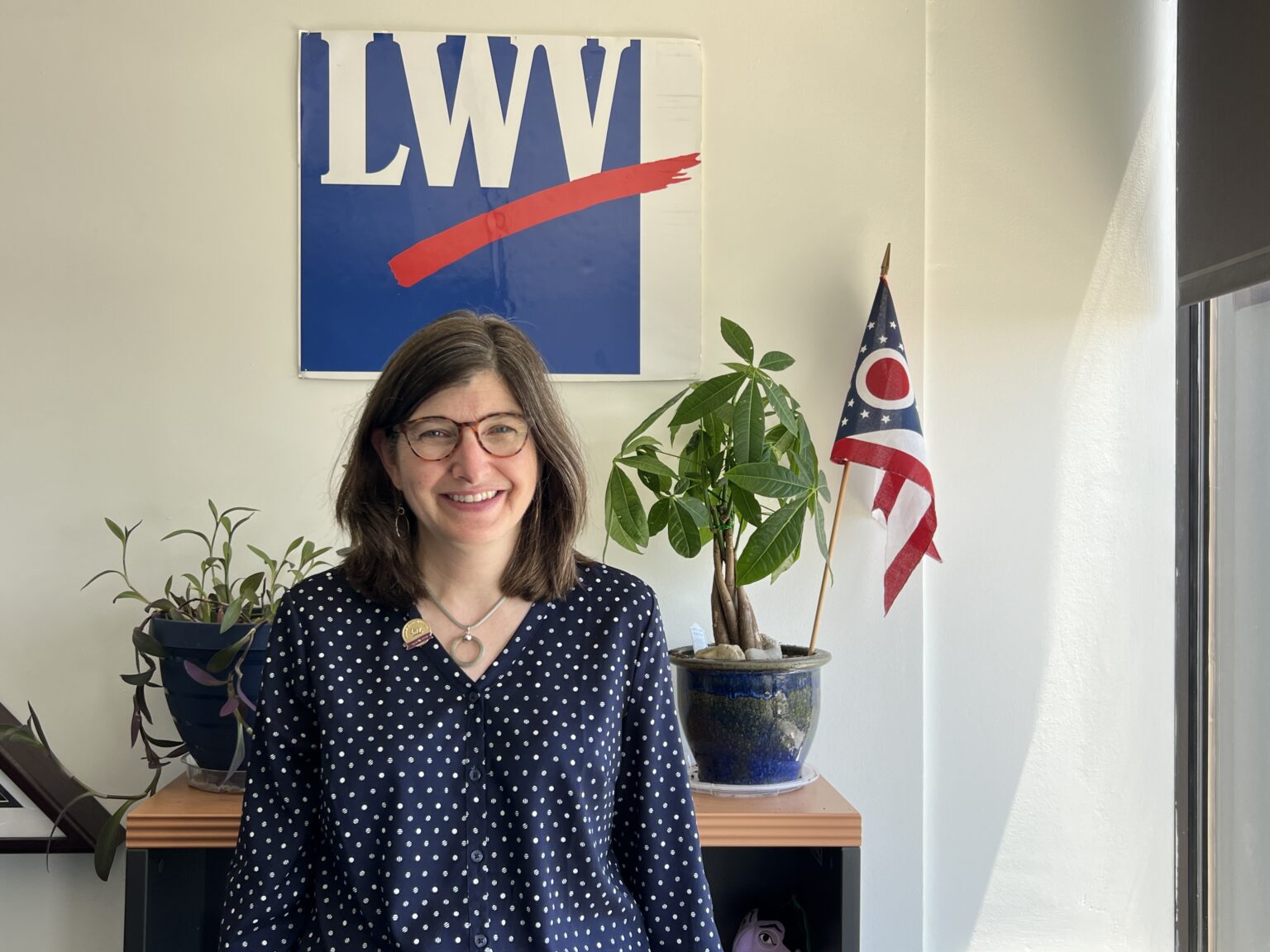
    Kelly McFarland Stratman, interim co-CEO and chief of staff for the League of Women Voters of the U.S., pictured in the offices of the LWV of Ohio. (Photo by Susan Tebben / Ohio Capital Journal)

    by Susan Tebben – Ohio Capital Journal

    Twenty years ago, Kelly McFarland Stratman was among the Ohioans working on reform to the state’s redistricting process as a member of the League of Women Voters. Now she’s the co-CEO of the national group.

    In a way, things haven’t changed for her.

    Since leaving her kindergarten teaching job, McFarland Stratman has stood as executive director of the Ohio chapter and made her way up to chain to her current role: chief of staff and interim co-CEO of the League of Women Voters of the United States.

    The 104-year-old organization has held a reputation of non-partisanship and focus on voter education that appealed to McFarland Stratman then, and continues to be at the center of her drive with the organization.

    “The mission of the league could not be more critical or more needed,” she told the Capital Journal in an interview amid a return visit to the state that started it all for her. “Our democracy is a gift and it is something that is fragile, and it requires care and attention.”

    McFarland Stratman was in Ohio to update local chapters on the work of the national group. While she heads the national arm of the organization, the co-leader recognizes that the storied history of the advocacy group wouldn’t be present without the state-level and community-level factions.

    “We are really run by our volunteers, who are giving their time and their talent and their energy and their passion to the important work that has to be done,” she said.

    The divisiveness that is present in the country may seem to make it difficult to hold fast to the nonpartisanship the league strives for, but working with every league chapter and encouraging comprehensive conversations among all the groups before the national organization makes a “measured opinion” is one of the guardrails McFarland Stratman says keeps the LWV out of the depths of divisiveness.

    “I feel like I learn everyday from our leaders across the country,” she said.

    The idea that the league was borne out of the women’s suffrage movement means the vitality of women in the democratic process certainly drives the organization as well.

    “We believe in the power of women to create a more perfect democracy,” McFarland Stratman said. “The way that women work, having their voice at the table is just critically important; it is not at enough tables, not enough voices certainly when they are at the table.”

    Ohio’s chapters of the League of Women Voters have been active in voting rights campaigns, in election protection at polling locations on election day and, of course, in keeping tabs on the redistricting process that overtook the last two years in the state.

    That process saw six Ohio Statehouse map proposals, only one of which was deemed constitutional by the Ohio Supreme Court, and two congressional maps, neither of which passed court muster.

    During that process, the LWV of Ohio participated in lawsuits along with public hearings and outcry against the process that was then led by elected officials as part of the Ohio Redistricting Commission.

    Issues like redistricting, whether or not voters should be required to bring IDs to polling locations and votes on ballot initiatives are all watched by the LWV, and McFarland Stratman said the changing democratic landscape involves adaptation.

    “Each state has to fight their own fight in terms of preserving those really foundational rights,” the co-CEO said. “It means we are fighting 50 battles, or, I’ll say 51, because we are still fighting for D.C. statehood.”

    But the fact that the LWV is still, after 80 years, counting Washington, D.C., statehood as one of their fervent goals, shows McFarland Stratman that holding firm to original values and having faith in the motivations that keep the league going can only help them, and the country, ride out the wave of unpredictability that is American politics.

    “Whole generations have been impacted by (a lack of statehood in D.C.), but we have to keep fighting because it is the right thing to do,” she said.

    In an organization with more than a century of existence, fighting for longterm goals isn’t unfamiliar to the LWV. The current political environment, where McFarland Stratman said “some of the things that we have … come to expect or assume, maybe are things we can’t expect or assume anymore,” means pushing forward with things like voter education and engagement seems all the more important.

    Reassuring voters about the power of the vote remains a big issue, and McFarland Stratman said voting is “the baseline for folks to enter into the process,” but shouldn’t be the end of the line.

    “This should not be that people go off to office and that’s the end of the story, we have to stay engaged in the process even after the election,” she said.

    For the LWV, that involves not only creating resources to help voters know where to vote and how to vote, but also encouraging voters to pay attention to those issues and races that may not be at the top of the headlines.

    “We tend to put all of the attention at the top of the ticket, but the lower-ticket races or some of the lower-ticket issues even – the school bonds and other things – those are things that affect people’s lives daily, maybe even more so than some of the other issues,” McFarland Stratman said.

    And while redistricting in Ohio may have disenfranchised voters to the idea of representation in elections, the potential of a citizen-led process should be encouraging and galvanizing for residents, according to McFarland Stratman.

    “Whoever’s in power, we want to make sure that citizens are at the table to make sure the redistricting process happens,” she said.

    The U.S. Census Bureau is once again starting the process of collecting data for 2030, when the redistricting process will begin anew across the country, which means the league has eyes toward 2030, and every legal case on redistricting that comes in the meantime.

    Creating a new system to bring the power further into voters’ hands is a big part of the league’s plans, as they recently launched a digital campaign to abolish the Electoral College.

    “We know that’s a longterm goal, but again, that’s a systemic problem that’s got to be addressed so that we can really get to the democracy we want to have for everyone,” McFarland Stratman said.

    As another election approaches, Ohio residents can focus on shorter-term goals, like researching candidates, considering being a poll worker on Election Day, and teaching a new generation about the right to vote by bringing them to the polls.

    “I think it is critically important that people do use their power, use their voice and vote,” McFarland Stratman said. “The fight continues.”


    Susan Tebben
    SUSAN TEBBEN

    Susan Tebben is an award-winning journalist with a decade of experience covering Ohio news, including courts and crime, Appalachian social issues, government, education, diversity and culture. She has worked for The Newark Advocate, The Glasgow (KY) Daily Times, The Athens Messenger, and WOUB Public Media. She has also had work featured on National Public Radio.

    Ohio Capital Journal is part of States Newsroom, the nation’s largest state-focused nonprofit news organization.

    MORE FROM AUTHOR

  • GOP redistricting attorneys ask court to make decision on congressional map after 2022 election

    GOP redistricting attorneys ask court to make decision on congressional map after 2022 election

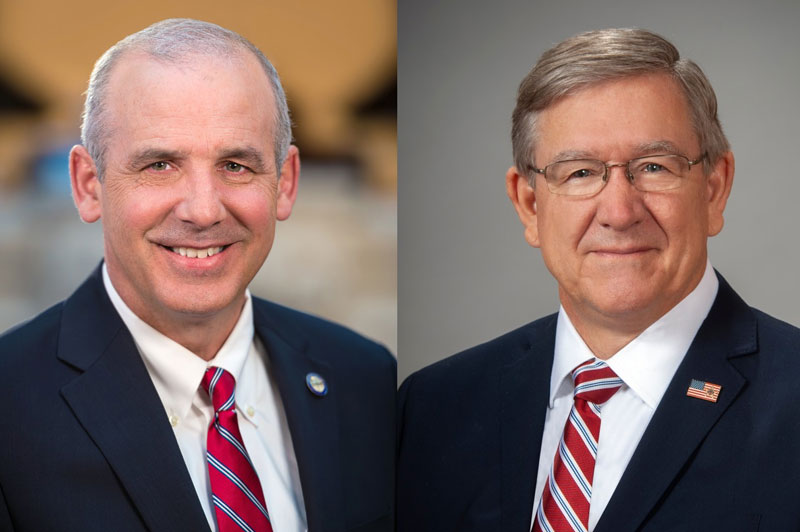
    Ohio Senate President Matt Huffman and Ohio House Speaker Bob Cupp, both Lima Republicans. Official photos.

    BY: SUSAN TEBBEN – Ohio Capital Journal


    Legislative leaders and the state’s chief elections officer dug their heels in on continuing on with the May primary election, even as Ohio groups seek invalidation of the latest congressional redistricting map.

    Secretary of State Frank LaRose, Senate President Matt Huffman and House Speaker Bob Cupp have responded to requests by the League of Women Voters and a group of Ohio citizens represented by the National Redistricting Action Fund that the Ohio Supreme Court invalidated the newest congressional district map.

    Huffman and Cupp submitted their response together, starting by saying the Ohio Redistricting Commission “does not exist to simply rubberstamp redistricting plans favored by (court challengers).”

    “It is entitled to exercise reasonable discretion in balancing the highly complex factors that go into congressional redistricting,” attorneys for Cupp and Huffman wrote.

    While also arguing that the congressional map passed at the beginning of March is constitutional, Cupp and Huffman’s attorneys took the stance that the commission is the only authority in map-making in the state.

    The LWV and NRAF had differing opinions on next steps if the court invalidated the map, with the NRAF asking the court to take over, but the LWV saying the map should be sent back to the courts for very specific revisions.

    The legislative leaders argued that the Ohio Redistricting Commission is a “creature of the Ohio Constitution,” but with duties provided to it “independent of any other branch of government in Ohio.”

    “It is the commission and the general assembly who solely possess the legislative authority to create legislative and congressional districts,” attorneys wrote.

    It’s not fair, nor is it in line with the law, to compare the commission-adopted map to other maps that may have been submitted to the commission, but were never brought up for a vote or formally considered, Cupp and Huffman state in their court filing.

    In their objections to the map, challengers had offered up maps from Stanford and Harvard political science professors as models for a replacement map.

    Republican leaders flatly disagreed with the idea.

    “It is now plainer than ever that it is dangerous and disingenuous to base Ohio constitutional law and the voting rights of millions of citizens on this untested and contradictory evidence conceived of by paid-for-hire mathematicians and social scientists,” Cupp and Huffman argued.

    LaRose echoed the comments made in Cupp and Huffman’s filings that the map is constitutional and “needs no revision.”

    But if the court rejected the map, LaRose said, it does not have the power to “unilaterally implement its own congressional district plan.”

    “Again, Secretary LaRose will administer the 2022 congressional primary and general elections in accordance with a constitutional congressional district plan,” attorneys for LaRose wrote.

    In this vein, Cupp and Huffman’s attorneys asked that the court “defer any action” on the congressional map until after the 2022 election.

    They blamed the new state redistricting process, along with “significant logistical challenges” and even the U.S. Census delays brought on by the COVID-19 pandemic for exacerbating an “already challenging scenario” and leading to the adoption of the new congressional plan only days before the candidate filing period for the May 3 primary.

    The Ohio Supreme Court is considering court challenges for not only the congressional map, but also the legislative maps. The ORC adopted the maps one week after the court-ordered February 17 deadline, risking contempt charges.

  • Congressional map challengers ask court to stop map use

    Congressional map challengers ask court to stop map use

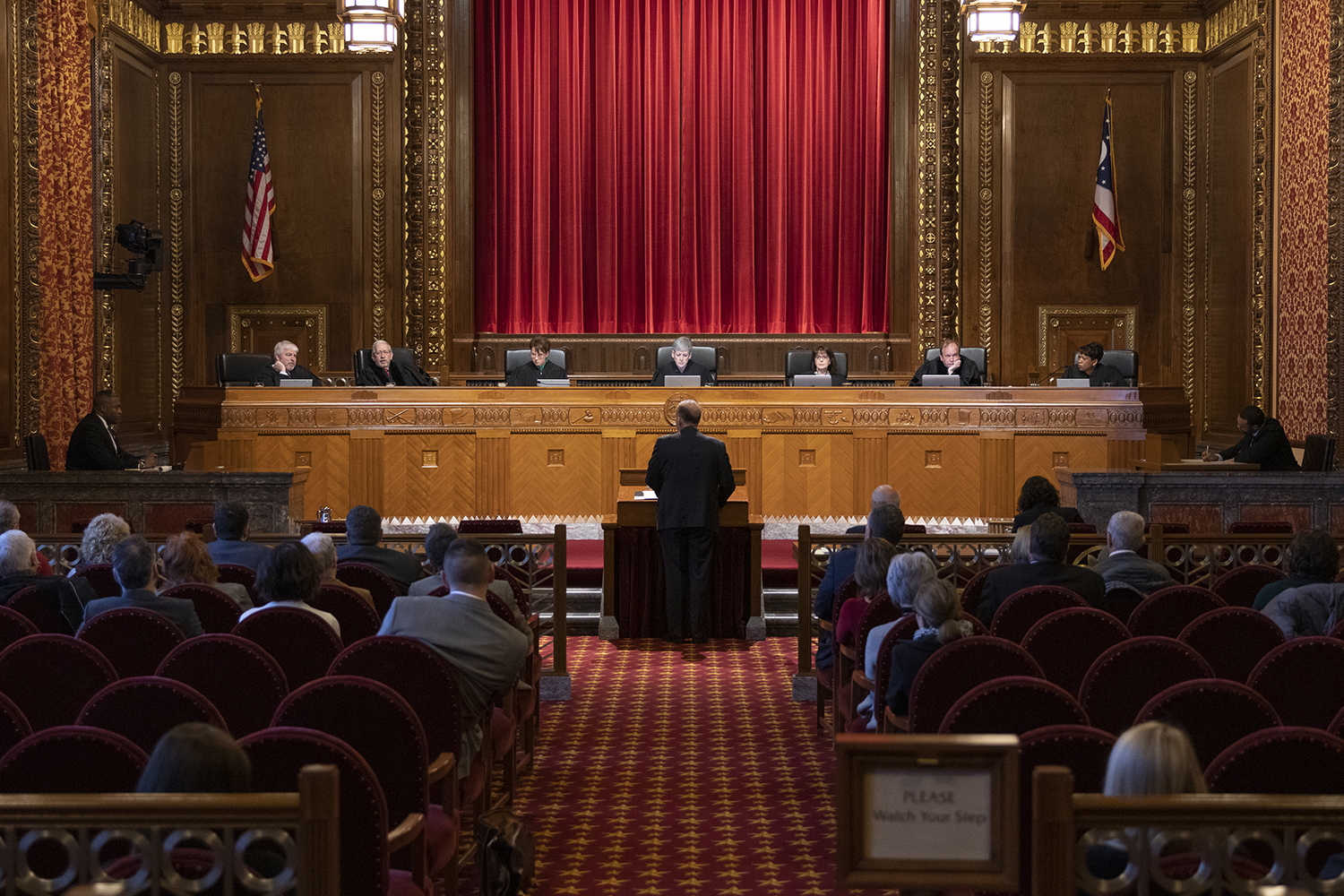
    Photo: Courtesy of the Ohio Supreme Court

    Attorneys for League of Women Voters proposed that the commission be given the maps again, but with specific instructions to fix District 1 in Hamilton County

    BY: SUSAN TEBBEN – Ohio Capital Journal


    The League of Women Voters and a group of Ohioans represented by a national redistricting group have asked the Ohio Supreme Court to keep the state from using recently approved congressional maps.

    “Having embarked on its latest map-drawing journey with an irredeemably broken compass, it is no surprise that the (Ohio Redistricting) Commission has once again found itself lost,” Ohioans led by the National Redistricting Action Fund stated in their court filing.

    The group called the newest map – which breaks the state down into 10 Republican districts, three Democratic districts and two “tossup” districts  – “an extreme partisan outlier again,” putting the state at a “partisan advantage at odds with Ohio’s voting patterns.”

    Because of this, they ask the court to strike down the Ohio Redistricting Commission’s second try at congressional districts, move the candidate filing deadline that was March 4 and “if necessary, itself adopt a constitutional plan as early as March 17.”

    “At this point, the commission cannot be trusted behind the wheel,” attorneys for the group wrote.

    The League of Women Voters stopped short of asking for the court to take over the process, saying “it is premature at this juncture for the court itself to implement a plan.”

    Attorneys for the Ohio league proposed that the commission be given the maps again, but with specific instructions to fix two districts: District 1 in Hamilton and Warren counties and District 15, which stretches from the western and southern sides of Franklin County to the Southern half of Shelby County.

    The LWV, represented by the ACLU of Ohio, also argued an alternative plan written by Harvard professor Dr. Kosuke Imai was brought up to to the commission “but was ignored.”

     A congressional redistricting plan proposed by Harvard professor Dr. Kosuke Imai. The League of Women Voters said this map was “ignored” by the Ohio Redistricting Commission, despite following constitutional redistricting requirements.

    The plan had a 10-6 partisan breakdown, but was never brought up for a formal vote by the commission.

    In court documents included with the LWV’s objection to the newest congressional map, Dr. Imai said his map “demonstrates that it is possible to generate a redistricting plan that is free of partisan bias and compactness problems while complying with the other redistricting criteria.

    Imai was also mentioned in the legislative redistricting court battle, when attorneys said the professor conducted 5,000 simulations of Ohio districts and never came up with the same amount of GOP partisanship in any of the simulations.

    Attorneys for the National Redistricting Action Fund said Ohio’s Republican caucus chose to “let the clock run out” on any efforts by the General Assembly to create a congressional plan, and were slow to act even as the ORC began its first week back after the GA made no decision.

    “The General Assembly seemingly took no action to even attempt to draw a plan itself because it was unwilling to attempt to reach the bipartisan agreement that would be necessary to pass emergency legislation,” Adams’ attorneys wrote.

    After the commission adopted a GOP-created map along party lines, the map challengers say Secretary of State Frank LaRose moved forward with “implementing the new gerrymandered plan,” despite the fact that it hadn’t been (and still hasn’t been) given the go-ahead by the state supreme court.

    The NRAF also argues the map continues to violate the constitution, specifically the provision prohibiting the favoring or disfavoring of one political party over another.

    “This disparity between statewide vote share and congressional seat share is astounding,” attorneys wrote.

    Asking for the court to take over the process is not a new argument state redistricting challengers have made. Attorneys arguing against legislative maps also asked the court to take charge after three attempts by the redistricting commission.

    The NRAF also asked the court to postpone “relevant election deadlines” for the May 3 primary, saying the court has “broad authority to issues orders postponing election deadlines to address harm that would occur if elections were to proceed under an unconstitutional map.”

    Republican commission members have said the power to change elections lies with the General Assembly.

  • Ohio Supreme Court to redistricting commission: Why shouldn’t we hold you in contempt?

    Ohio Supreme Court to redistricting commission: Why shouldn’t we hold you in contempt?

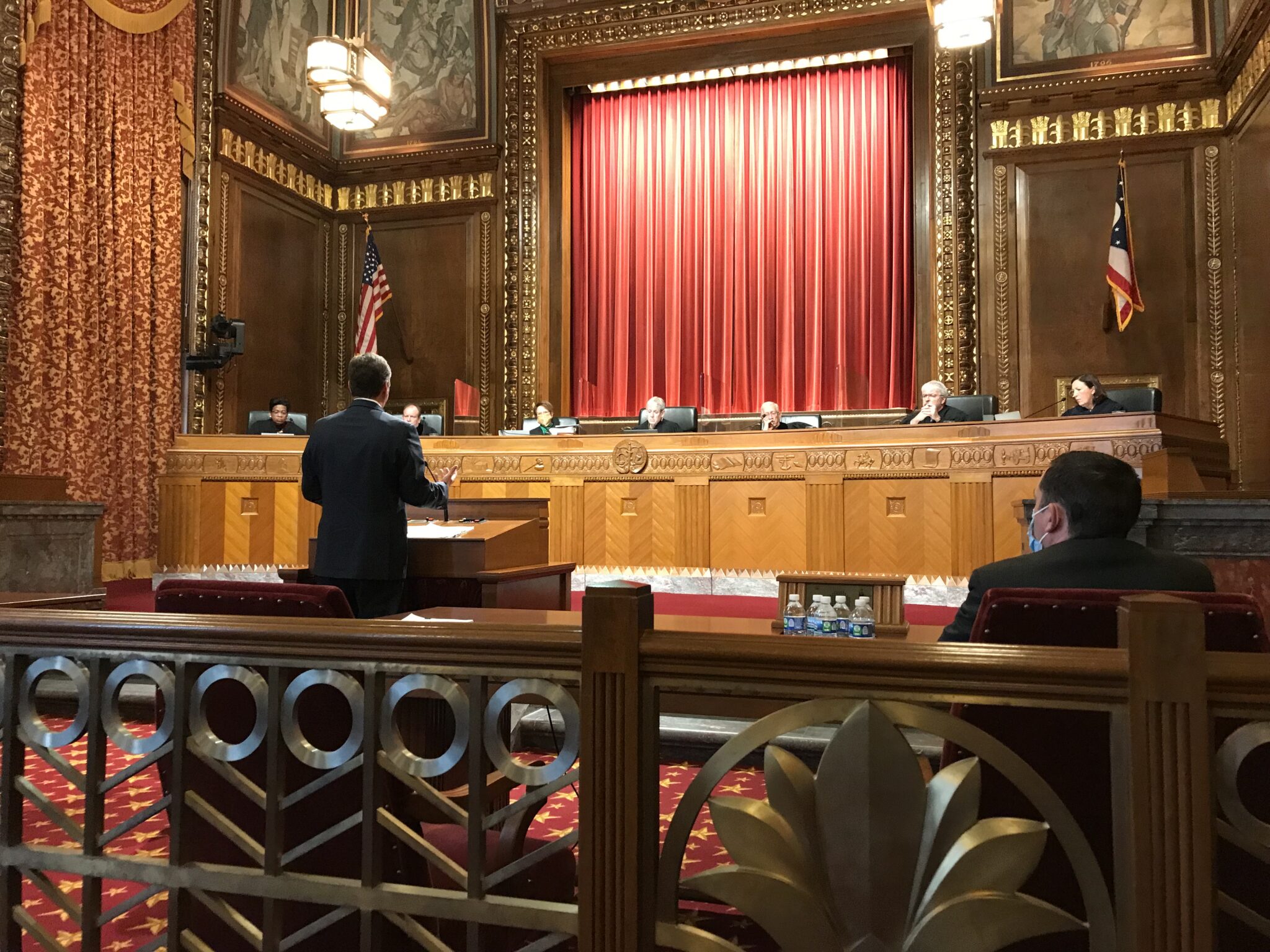
    Attorney Phillip Strach speaks before the Ohio Supreme Court, arguing for the constitutionality of legislative district maps. The court heard arguments on three cases asking it to reject the maps approved in September. (Photo: Susan Tebben, OCJ)

    BY: SUSAN TEBBEN – Ohio Capital Journal

    The Ohio Supreme Court weighed in on the redistricting battle on Friday evening, asking the members of the Ohio Redistricting Commission why it shouldn’t hold them in contempt of court for defying its order.

    Chief Justice Maureen O’Connor signed an entry in all three of the lawsuits against the ORC on legislative redistricting, asking Gov. Mike DeWine, Secretary of State Frank LaRose, Auditor Keith Faber, Senate President Matt Huffman, House Speaker (and commission co-chair) Bob Cupp, state Sen. (and commission co-chair) Vernon Sykes and House Minority Leader Allison Russo, to explain the “failure to comply with this court’s February 7, 2022 order,” and why they shouldn’t face anything from fines to jail time, the consequences for contempt of court.

    The court had been asked by the League of Women Voters, the Ohio Organizing Collaborative and a group of Ohio residents – the parties in the three lawsuits originally filed to challenge maps approved by the ORC – to order the commission to give specific reasons for their choice to adjourn without maps on Feb. 17.

    The ORC members now have until noon on Feb. 23 to tell the court why they shouldn’t be held in contempt.

    The groups also asked for justification for the commission’s lack of action on any sort of map, despite being presented with a map by the Democratic House and Senate caucuses, which they shot down along party lines on the day of the deadline.

    Huffman accused drawers of the Dem map of racial gerrymandering to the benefit of Democrats in certain districts, including the district that holds Lake County, typically a strongly GOP area. Russo wholly denied the accusations.

    The GOP commission members said during the meeting that they could not find a way to draw maps that complied with all the redistricting provisions of the constitution, while also complying with the rules the supreme court had given in their majority opinion invalidating the previous maps. Mainly, the GOP said they couldn’t hit the target of 54-46 partisan breakdown asked for by the court justices, a number based on statewide voter preferences over the last 10 years.

    But some of the commission members, of both parties, disagreed with the decision to leave before approving a map.

    “I think it is a mistake for this commission to stop and basically say that we’re at an impasse,” Gov. Mike DeWine said on Thursday. “I don’t think that is an option that the law gives us.”

    Co-chair Sykes agreed that contempt was a possibility for the commission members, and said he was willing to do whatever could be done to move forward.

    Asked after the commission adjourned if that included contempt of court: “Including whatever we can do.”

    The choice to adjourn didn’t require a majority vote, but was met with no formal objections.

    The supreme court ordered the ORC to come up with “entirely new” maps after invalidating not one but two different sets of legislative district maps. Their deadline to file with the Secretary of State’s Office was Feb. 17, with those maps then being sent to the court for review by the next day.

    The order came the same day a federal lawsuit was filed by Ohio residents, some of whom are also anti-abortion advocates in the statewide lobby group Ohio Right to Life. That lawsuit asks the district court to take over the process, and accuses the redistricting commission of preventing them from advocating for candidates, running for office, and even voting.

  • Local Election Results: Nov. 5, 2019

    Local Election Results: Nov. 5, 2019

    If you find value in reading these Election Results and the expense involved in putting it together, please…These results have been posted after the Clermont, Hamilton, and Warren County Boards of Elections have published their “Unofficial Results” and all precincts have reported 100% unless noted as of 12:30 AM. Official results must be certified by the various Boards in the coming weeks.

    Local School Taxes

    Loveland City School District

    Combined Operating and Bond Levy

    Clermont Co.

    YES – 1219

    NO – 4101

    Hamilton Co.

    YES – 1185

    NO – 4394

    Warren Co.

    YES – 43

    NO – 139

    TOTAL

    YES – 2447

    NO –  8634

    Goshen Local School District

    Bond Levy 5.24 mills – 34 years

    Warren Co.

    YES – 91

    NO – 106

    Clermont Co

    YES – 1264

    NO – 1668

    TOTAL

    YES – 1355

    NO – 1774


    Kings Local School District

    4.96 mills Bond Levy

    YES – 3508

    NO –  3675

     Sycamore School (34 of 36 precincts)

    4 mills Bond Issue

    YES –  6067

    NO – 3758

    Lebanon City Schools

    Additional Levy 4.99 mills for 4 years

    YES – 5522

    NO –  4389

    Local Candidates

    Loveland City Council at Large – 3 elected to a 4-year term

    Pat Ahr

    Clermont Co. – 249

    Hamilton Co. – 866

    Warren Co. – 68

    TOTAL – 1183

    Kathy Bailey

    Clermont Co. – 659

    Hamilton Co. – 1840

    Warren Co. – 143

    TOTAL – 2642

    Andy Bateman

    Clermont Co. – 581

    Hamilton Co. – 1493

    Warren Co. – 116

    TOTAL – 2190

    Kent G. Blair

    Clermont Co. – 481

    Hamilton Co. – 1290

    Warren Co. – 102

    TOTAL – 1873

    Cory O’Donnell

    Clermont Co. – 216

    Hamilton Co. – 509

    Warren Co. – 44

    TOTAL – 769

    Angela L. Settell

    Clermont Co. – 243

    Hamilton Co. – 931

    Warren Co. – 73

    TOTAL – 1247

    Loveland Board of Education – 2 elected to a 4-year term

    Arthur R. Jarvis

    Clermont Co. – 2631

    Hamilton Co. – 2241

    Warren Co. – 81

    TOTAL – 4953

    Kathryn Lorenz

    Clermont Co. – 2931

    Hamilton Co. – 2611

    Warren Co. – 85

    TOTAL – 5627

    Symmes Township Trustee – 1 elected to a 4-year term

    Phil Beck – 2459

    CJ Carr – 1745

    Symmes Township Fiscal Officer – 1 elected to a 4-year term

    Joseph C. Grossi – 2968

    Milford Council at Large – 4 elected to a 4-year term

    Edward J. Haskins – 670

    Kyle Mitchell – 626

    Benjamin Redman – 600

    Sandra Russell – 753

    Milford School Board – 2 elected to a 4-year term

    Emily Chestnut

    Clermont Co. – 3659

    Hamilton Co. – 0

    TOTAL – 3659

    Mike Durkee

    Clermont Co. – 1789

    Hamilton Co. – 0

    TOTAL – 1789

    Dave Meranda

    Clermont Co. – 3572

    Hamilton Co. – 0

    TOTAL – 3572

    James Rhodes

    Clermont Co. – 1606

    Hamilton Co. – 0

    TOTAL – 1606


    Goshen Township Trustee

    Bob Hausermann – 1999

    Bill Pitman – 953

    Goshen Township Fiscal Officer

    Laura Engled – 2449

    Goshen School Board – Full term – 2 elected

    John Benthien – 

    Warren Co. – 142

    Clermont Co – 1323

    TOTAL – 1465

    Julie Casey – 

    Warren Co. – 106

    Clermont Co. – 1709

    TOTAL – 1815

    Derrick Holmes – 

    Warren Co. – 37

    Clermont Co. – 1116

    TOTAL – 1153

    Goshen School Board (unexpired term) – 1 to be elected

    Deborah S. Gray – 

    Warren Co. – 152

    Clermont Co. – 2308

    TOTAL – 2460

    Miami Township (Clermont County) Trustee

    Ken Tracy – 6356

    Miami Township (Clermont County) Fiscal Officer

    Eric C. Ferry – 6249

    Judge of Hamilton County Municipal Court – 1 to be elected per district – 6-year term (District 5) (93.46% precincts reporting)

    Kari L. Bloom – 10014

    Heather S. Russell – 17396

    Local Issues

    Loveland Revised Charter

    Clermont Co. –

    YES – 697

    NO – 281

    Hamilton Co. –

    YES – 1909

    NO – 1044

    Warren Co. –

    YES – 165

    NO – 59

    TOTAL

    YES – 2771

    NO – 1384

    Milford City

    Renewal with an Increase 17 mills – for Fire & EMS – for 5 years

    For – 915

    Against – 310

    Hamilton County

    Tax Levy (Renewal) – .34ml 5yr – Family Services & Treatment Programs

    For – 111,399

    Against – 48,980

    Tax Levy – (Renewal) – 4.13ml 5yr – Developmental Disabilities

    For – 121,513

    Against38,881

    Hamilton Township Fire Levy Additional 1.0 mill CPT.PDF

    For – 3922

    Against2370

    Hamilton Township Police Levy Additional 1.0 mill CPT.PDF

    For – 3082

    Against2239


    Helpful Links and to view results of ALL area issues and candidates:

    Clermont County Board of Elections

    Hamilton County Board of Elections

    Warren County Board of Elections

    Ohio Secretary of State

    League of Women Voters

    League of Women Voters of Cincinnati Area

    Smart Voter


    If you find value in reading these Election Results and the expense involved in putting it together, please…

  • Loveland Magazine “Local Voter Guide” to issues and candidates

    Loveland Magazine “Local Voter Guide” to issues and candidates

    If you find value in this Voter Guide and the expense involved in putting it together, please…Loveland, Ohio – Below you can read the ballot language for the increase in taxes the Loveland Board of Education is asking you to approve. You can also read the text of current and proposed changes City Council wants you to approve to the City Charter.

    Loveland City Council at Large – 3 to be elected – 4-year term

    Pat Ahr

    Clermont Co. –

    Hamilton Co. –

    Warren Co. –

    TOTAL

    Kathy Bailey

    Clermont Co. –

    Hamilton Co. –

    Warren Co. –

    TOTAL

    Andy Bateman

    Clermont Co. –

    Hamilton Co. –

    Warren Co. –

    TOTAL

    Kent G. Blair

    Clermont Co. –

    Hamilton Co. –

    Warren Co. –

    TOTAL

    Cory O’Donnell

    Clermont Co. –

    Hamilton Co. –

    Warren Co. –

    TOTAL


    Angela L. Settell

    Clermont Co. –

    Hamilton Co. –

    Warren Co. –

    TOTAL


    Loveland Board of Education – 2 to be elected – 4-year term

    Arthur R. Jarvis

    Clermont Co. –

    Hamilton Co. –

    Warren Co. –

    TOTAL –

    Kathryn Lorenz

    Clermont Co. –

    Hamilton Co. –

    Warren Co. –

    TOTAL

    Symmes Township Trustee – 1 to be elected – 4-year term

    Phil Beck

    CJ Carr

    Symmes Township Fiscal Officer – 1 to be elected – 4-year term

    Joseph C. Grossi

    Milford Council at Large – 4 to be elected – 4-year term

    Edward J. Haskins

    Kyle Mitchell

    Benjamin Redman

    Sandra Russell

    Milford School Board

    Emily Chestnut

    Clermont Co. –

    Hamilton Co. –

    Warren Co. –

    TOTAL

    Mike Durkee

    Clermont Co. –

    Hamilton Co. –

    TOTAL

    Dave Meranda

    Clermont Co. –

    Hamilton Co. –

    TOTAL

    James Rhodes

    Clermont Co. –

    Hamilton Co. –

    TOTAL

    Goshen Township Trustee

    Bob Hausermann

    Bill Pitman

    Goshen Township Fiscal Officer

    Laura Engled

    Goshen School Board – Full term 2 to be elected

    John Benthien

    Julie Casey

    Derrick Holmes

    Goshen School Board (unexpired term) – 1 to be elected

    Deborah S. Gray

    Miami Township (Clermont County) Trustee

    Ken Tracy

    Miami Township (Clermont County) Fiscal Officer

    Eric C. Ferry

    Judge of Hamilton County Municipal Court – 1 to be elected per district – 6-year term (District 5)

    Kari L. Bloom

    Heather S. Russell

    ISSUES

    Loveland City Council will ask voters to approve a Revised Charter.

    Clermont Co. –

    YES –

    NO –

    Hamilton Co. –

    YES –

    NO –

    Warren Co. –

    YES –

    NO –

    TOTAL

    YES –

    NO –

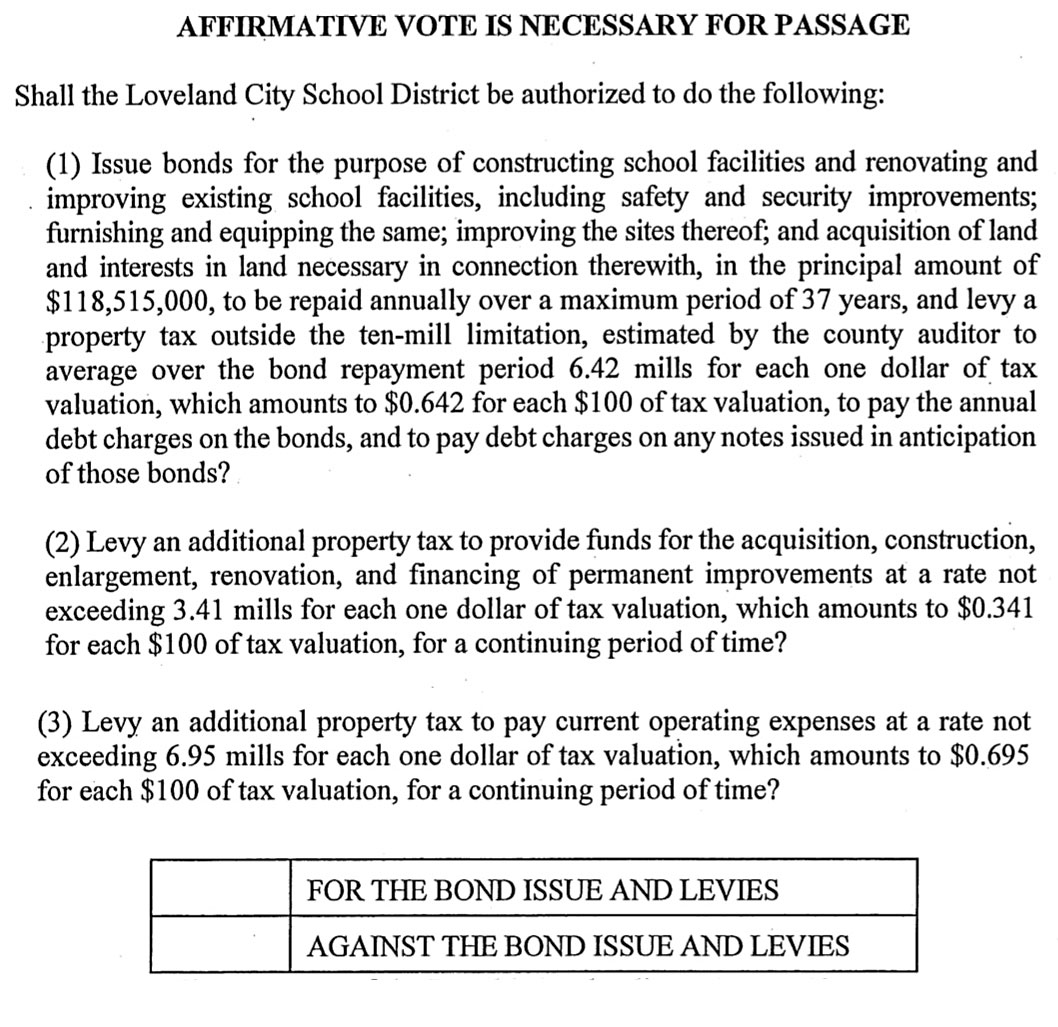
    Loveland Board of Education is asking voters to approve a combined Operating and Bond Levy.

    Clermont Co.

    YES – 

    NO – 

    Hamilton Co.

    YES – 

    NO – 

    Warren Co.

    YES – 

    NO – 

    TOTAL

    YES – 

    NO – 

    Goshen Local School District

    Bond Levy 5.24 mills – 34 years

    For –

    Against –

    Milford City

    Renewal with an Increase 17 mills – for Fire & EMS – for 5 years

    For –

    Against

    Goshen School Bond Levy

    Shall bonds be issued by the Goshen Local School District, Counties of Clermont and Warren, for the purpose of site acquisition, new construction, improvements, renovations and additions to school facilities and providing equipment, furnishings and site improvements therefor, in the principal amount of thirty‐one million dollars ($31,000,000), to be repaid annually over a maximum period of thirty‐four (34) years, and an annual levy of property taxes be made outside of the ten‐mill limitation, estimated by the county auditor to average over the repayment period of the bond issue five and twenty‐four hundreds (5.24) mills for each one dollar of tax valuation, which amounts to fifty‐two and four‐tenths cents ($0.524) for each one hundred dollars of tax valuation, commencing in 2019, first due in calendar year 2020, to pay the annual debt charges on the bonds, and to pay debt charges on any notes issued in anticipation of those bonds?

    YES

    NO

    Kings Local School District

    Shall bonds be issued by the Kings Local School District, for the purpose of site acquisition, new construction, improvements, renovations and additions to school facilities and providing equipment, furnishings and site improvements therefor, in the principal amount of $89,975,000 to be repaid annually over a maximum period of 37 years, and an annual levy of property taxes be made outside the ten‐mill limitation, estimated by the county auditor to average over the repayment period of the bond issue 4.96 mills for each one dollar of tax valuation, which amounts to $0.496 for each one hundred dollars of tax valuation, commencing in 2019, first due in calendar year 2020, to pay the annual debt charge on the bonds, and to pay debt charges on any notes issued in anticipation of those bonds?

    YES

    NO

    Hamilton County

    Tax Levy (Renewal) – .34ml 5yr – Family Services & Treatment Programs

    For –

    Against

    Tax Levy – (Renewal) – 4.13ml 5yr – Developmental Disabilities

    For –

    Against

    Sycamore School Bond Issue

    Shall bonds be issued by the Sycamore Community City School District for the purpose of new construction, improvements, renovations, and additions to school facilities, and providing equipment, furnishings, and site development and improvements, and all necessary appurtenances therefor, in the principal amount of one hundred twenty-seven million five hundred thousand dollars ($127,500,000), to be repaid annually over a maximum period of thirty (30) years, and an annual levy of property taxes be made outside of the ten-mill limitation, estimated by the county auditor to average over the repayment period of the bond issue four (4) mills for each one dollar of tax valuation, which amounts to forty cents ($0.40) for each one hundred dollars of tax valuation, commencing in 2019, first due in calendar year 2020, to pay the annual debt charges on the bonds, and to pay debt charges on any notes issued in anticipation of those bonds?

    FOR THE BOND ISSUE

    AGAINST THE BOND ISSUE


    Nearby Warren County Issues

    Hamilton Township Fire Levy Additional 1.0 mill CPT.PDF

    For –

    Against

    Hamilton Township Police Levy Additional 1.0 mill CPT.PDF

    For –

    Against

    Kings Schools Bond and Tax Levy $89,975,000 averaging 4.96 mills for 37 …

    For –

    Against

    Lebanon City Schools Additional Levy 4.99 mills for 4 years

    For –

    Against

    Helpful Links:

    Clermont County Board of Elections

    Hamilton County Board of Elections

    Warren County Board of Elections

    Ohio Secretary of State

    League of Women Voters

    League of Women Voters of Cincinnati Area

    Smart Voter

    Register to vote, find your polling place, ballot info, and more:


    If you find value in this Voter Guide and the expense involved in putting it together, please…