

Tag: legal challenges

  • Gov. DeWine signs Republican congressional map with huge GOP advantage

    Gov. DeWine signs Republican congressional map with huge GOP advantage

    BY: DAVID DEWITT – Ohio Capital Journal

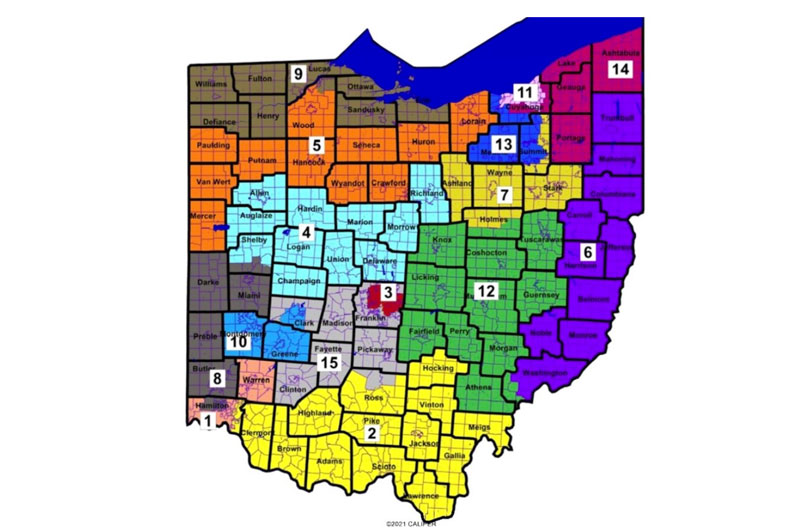
    Ohio Gov. Mike DeWine has signed Statehouse Republicans’ congressional map for Ohio giving the GOP a substantial advantage, claiming that of all the maps presented it “makes the most progress to produce a fair, compact and competitive map.”

    DeWine pointed to fewer county splits in the map and the number of Ohio cities the map keeps whole.

    “With seven competitive congressional districts in the SB 258 map, this map significantly increases the number of competitive districts versus the current map,” DeWine said.

     The GOP congressional map signed by Gov. Mike DeWine. (Right-Click to enlarge map)

    Without bipartisan support, the map is slated to only be in place for four years. With DeWine’s signature, legal challenges are expected to be forthcoming. Statehouse legislative maps approved by the Ohio Redistricting Commission with only Republican support in September are facing legal challenges currently before the Ohio Supreme Court.

    DeWine’s son, Justice Pat DeWine, has refused to recuse himself from the case, making Chief Justice Maureen O’Connor the potential swing vote on the constitutionality of the Republican plans that continue Republican supermajorities in the Ohio House and Senate and now an 11-2 advantage in congressional maps with two potential toss-up districts.

    Ohio voters passed redistricting reform for state legislative maps in 2015, with more than 70% support, and congressional redistricting reform in 2018 with nearly 75% support. Those reforms called for maps that do not “unduly favor or disfavor” one political party or another.

    The map approved Thursday in the House was introduced just Monday night as an amendment replacing the maps previously discussed in committee hearings. After the map was unveiled, it had one hearing in which a committee heard public comment. Every speaker was an opponent. The Princeton Gerrymandering gave the map a flunking grade.

    An analysis of the map on Dave’s Redistricting App shows seven Republican districts, two Democratic districts and six districts listed as competitive for being within a 54-46 margin. Five in six of the “competitive” districts lean Republican, and the one that leans Democratic, Ohio’s 13th district, does so by 0.88%. It was passed along partisan lines in both the Ohio Senate and Ohio House this past week.

    DeWine’s signing of the GOP congressional maps was criticized by anti-gerrymandering advocates.

    “Once again, Gov. DeWine has failed to stand up to the extremists in his party. He could have rejected gerrymandered maps, but chose weakness instead,” said Desiree Tims, president and CEO of Innovation Ohio. “These rigged districts will lead to more extreme politicians who pass dangerous laws that devastate Ohio communities.”

    The map will give Republicans 80%  to 87% of Ohio’s congressional seats, the advocates noted, despite the fact that Republicans only win about 55% of Ohio’s statewide vote.

    “Regardless of our skin color or zip code, everybody deserves to have a meaningful influence on our political process and choosing who gets to represent us,” said Jeniece Brock, Policy and Advocacy Director of the Ohio Organizing Collaborative. “By cracking and packing communities of color, this congressional map dilutes the power and voices of Black and brown Ohioans.”
  • A presidential election like none other, and now an inauguration like none other

    A presidential election like none other, and now an inauguration like none other

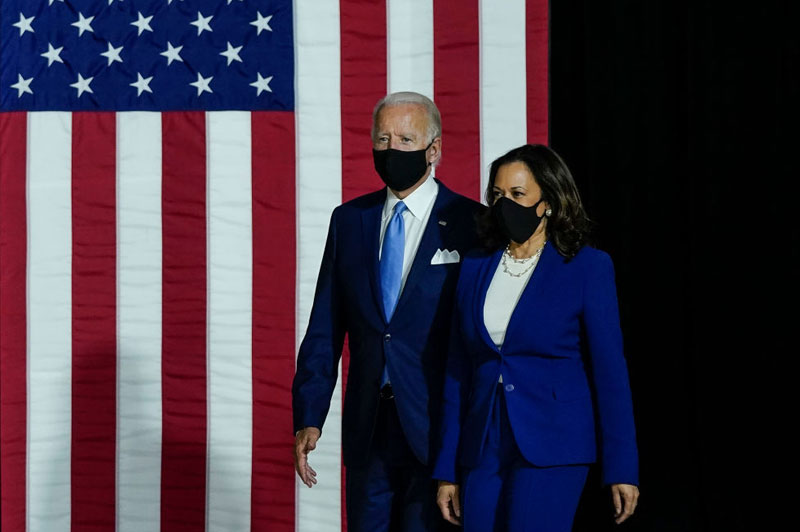
    President-elect Joe Biden and Vice President-elect Kamala Harris. Photo by Drew Angerer/Getty Images

    By Laura Olson and Ohio Capital Journal

    Washington D.C. – As with so many other events during the year preceding it, the inauguration of President-elect Joe Biden will be a ceremony unlike those of his predecessors.

    Tempering the celebratory tone is a directive from Biden’s inaugural team for supporters to refrain from traveling to D.C. for the Jan. 20 swearing-in. Instead, they’ve urged Americans to participate in the inaugural activities from home.

    It’s not yet clear what exactly those virtual festivities will include — or if President Donald Trump will attend Biden’s swearing-in. But the event will be scaled down in size, with an emphasis on safety precautions.

    “First and foremost, my objective is to keep America safe but still allow people to celebrate,” Biden said at a news conference this month.

    The crowd on the platform of the west front of the Capitol will be far less crowded than a typical inauguration. The Joint Congressional Committee on Inaugural Ceremonies typically would be distributing 200,000 tickets, but instead will hand out enough for each of the 535 members of Congress to attend with only one guest each.

    U.S. Sen. Roy Blunt (R-Mo.), who is chairman of the joint committee, said in a statement this month that the ongoing coronavirus pandemic and rising case counts “warranted a difficult decision to limit attendance.”

    Blunt added that the committee is “working on enhanced opportunities to watch the ceremonies online, in addition to the traditional televised national broadcast.”

    “The election of President-elect Biden and Vice President-elect Harris was historic and we know that many Americans would have wanted to attend the inauguration in-person,” said Sen. Amy Klobuchar (D-Minn.), who also serves on the inaugural committee. “At the same time, safety must be our top priority.”

    Biden’s inaugural committee has tapped medical experts to oversee safety precautions, including former Food and Drug Administration Commissioner David Kessler as its chief medical adviser.

    The details released so far have been vague beyond the limited number of tickets. A news release from Biden’s inaugural team described an “extremely limited” footprint for the swearing-in ceremony, and a parade that will be “reimagined.”

    That revamped parade could look similar to the Democratic National Convention’s virtual roll call, which featured video clips of delegates in their home states.

    “There probably will not be a gigantic inaugural parade down Pennsylvania Avenue,” Biden said. “But my guess is you’ll see a lot of virtual activity in states all across America, engaging even more people.”

    Crowded inaugural balls also are likely out of the question due to the pandemic.

    The Walter E. Washington Convention Center that typically would host soirees was once again prepped this month for use as a COVID-19 field hospital.

    Another question looming over the inauguration: What will Trump do?

    Traditionally, the outgoing president and first lady would meet with the incoming first family at the White House, and then ride together to the Capitol for the noontime ceremony.

    But Trump has refused to accept the election results, launching a failed series of legal challenges and posting unfounded claims of election fraud, even after the Electoral College certified his defeat. Asked in a Fox News interview this month if he’ll attend Biden’s inauguration, Trump replied: “I don’t want to talk about that.”

    The last time a president did not participate in their successor’s inauguration was in 1869, when President Andrew Johnson left office and Ulysses S. Grant was sworn in.