Tag: legislative maps

  • Court challengers push contempt charges against redistricting commission

    Court challengers push contempt charges against redistricting commission

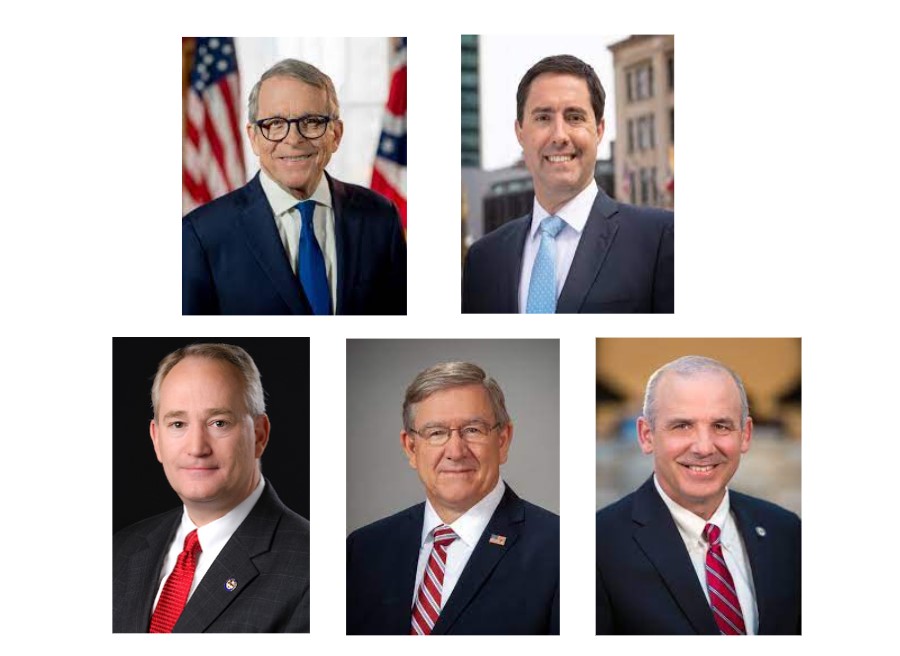
    The Republican majority members of the Ohio Redistricting Commission. Top row from left, Ohio Gov. Mike DeWine and Secretary of State Frank LaRose. Bottom row from left Ohio Auditor Keith Faber, House Speaker Bob Cupp, and Senate President Matt Huffman. Official photos.

    BY: SUSAN TEBBEN – Ohio Capital Journal

    Anti-gerrymandering groups are again asking the Ohio Supreme Court to determine if the Ohio Redistricting Commission should be held in contempt, and to force the commission to meet by the end of the week to redraw legislative maps.

    The ACLU, on behalf of several groups including the League of Women Voters of Ohio and the A. Philip Randolph Institution of Ohio and some individual Ohio voters, asked the court to yet again demand answers from the Ohio Redistricting Commission as to why they shouldn’t be held in contempt for making no moves to meet a deadline to draw “entirely new” legislative maps.

    The fourth effort by the ORC was rejected by the Ohio Supreme Court on April 14, and found not to be an “entirely new map” they were ordered to create, but merely a tweak of the third attempt, which was also rejected as unduly partisan.

    The commission has until May 6 to adopt and submit a map, but the groups say the urgency of the situation has “dramatically increased” because of a federal court’s decision to implement the third map found unconstitutional by the supreme court as the map to use during the 2022 election season. The U.S. District Court said they would order the use of the map, which was found to be unduly advantageous to Republicans, if no plan was adopted by May 28.

    “Based on the commission’s conduct to date, this appears to be exactly what the commission is trying to do,” the ACLU wrote to the supreme court. “The Court should not allow the commission to intentionally avoid its constitutional obligations.”

    GOP members of the commission argued that the court did not have the authority to hold them in contempt for several reasons, most important of which was the fact that the commission had passed a map by the court-ordered March 28 date. They said they conducted their legislative duties, and also were protected by the separation of powers doctrine from being held in contempt.

    One member of the state supreme court, Justice Sharon Kennedy, has consistently sided with the Republican members in saying they should not be held in contempt and the court does not have the power to do so.

    The Ohio Supreme Court rejected a previous request to hold the ORC in contempt at the same time they rejected the fourth map by the group.

    The ACLU, however, argues in their most recent challenge for contempt that legislative immunity is not “unlimited” and separation of powers principles do not “constitute an insurmountable barrier to a contempt order against the majority of the commission.”

    “In ordering (the ORC) to reconvene and to draft and adopt a constitutionally valid General Assembly-district plan, this Court is not ‘asserting control’ over purely legislative duties … but simply ensuring that the commission itself undertake those duties,” attorneys said in their Monday filing.

    GOP members of the ORC told the court in the last debate over contempt that they could not be charged as individuals for something decided by the commission as a whole.

    The ACLU called the argument an “improper attempt to evade responsibility” in their Monday filing. The argument also does not hold when it comes to calling a meeting of the commission, the court challengers said. Calling a meeting only requires three commission members, leaving five others “fully responsible for the defiance of the court’s order,” court documents stated.

    Attorneys urged the court to force the commission to convene no later than Friday if they are held in contempt, as a way to “purge” their contempt charges.

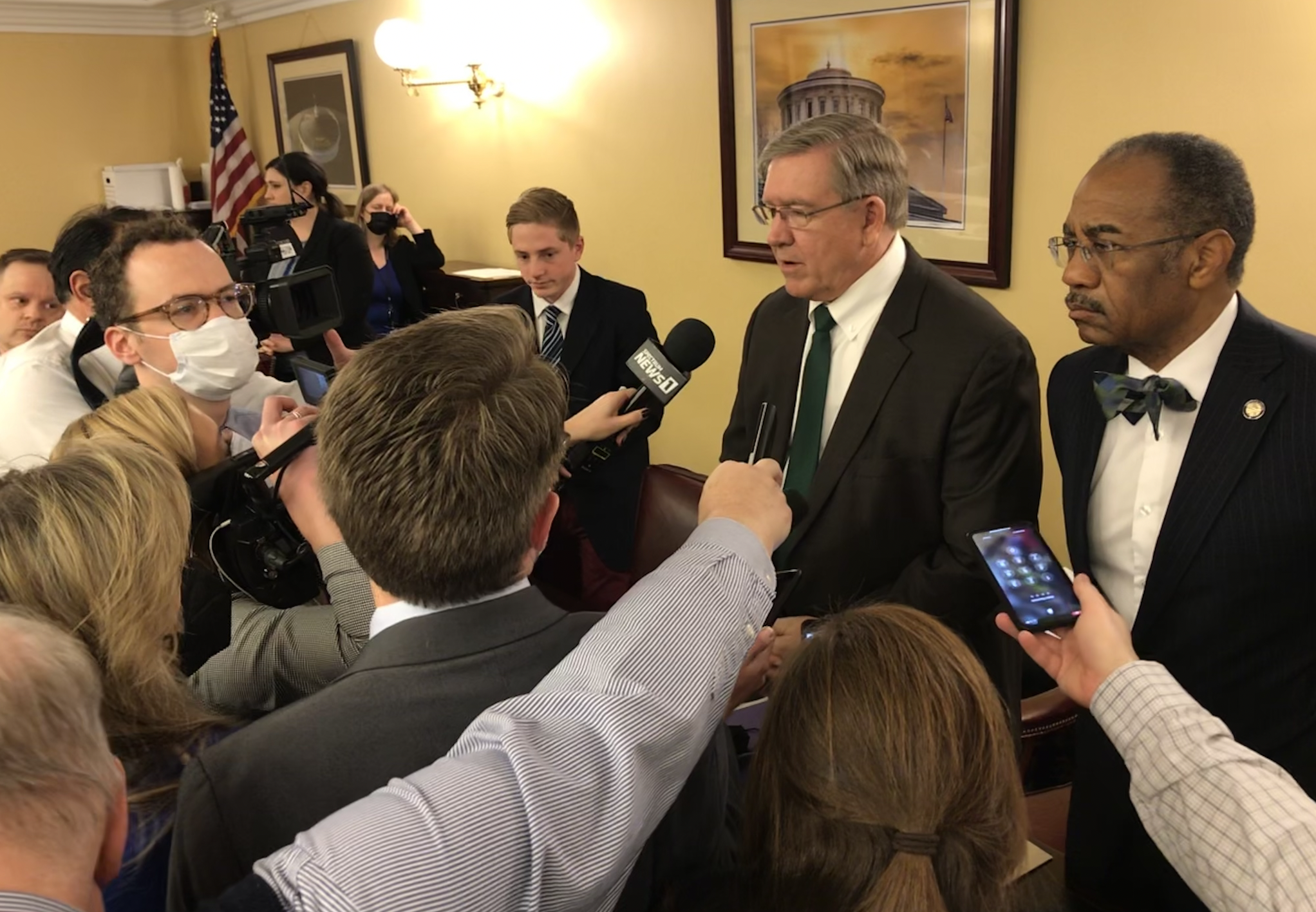
    The commission has not announced any plans to meet on or before the May 6 deadline. Democrats, including commission co-chair state Sen. Vernon Sykes, attempted to bring a meeting together on Monday, but ended up alone in front of the room where the ORC has met in the past, having had their offer rejected by every other member of the commission.

    A representative with House Speaker and commission co-chair Bob Cupp said no meetings have been scheduled, and a spokesperson for Senate President Matt Huffman said meeting dates were up to the co-chairs.
  • No Ohio redistricting meetings in sight, despite Dem demands

    No Ohio redistricting meetings in sight, despite Dem demands

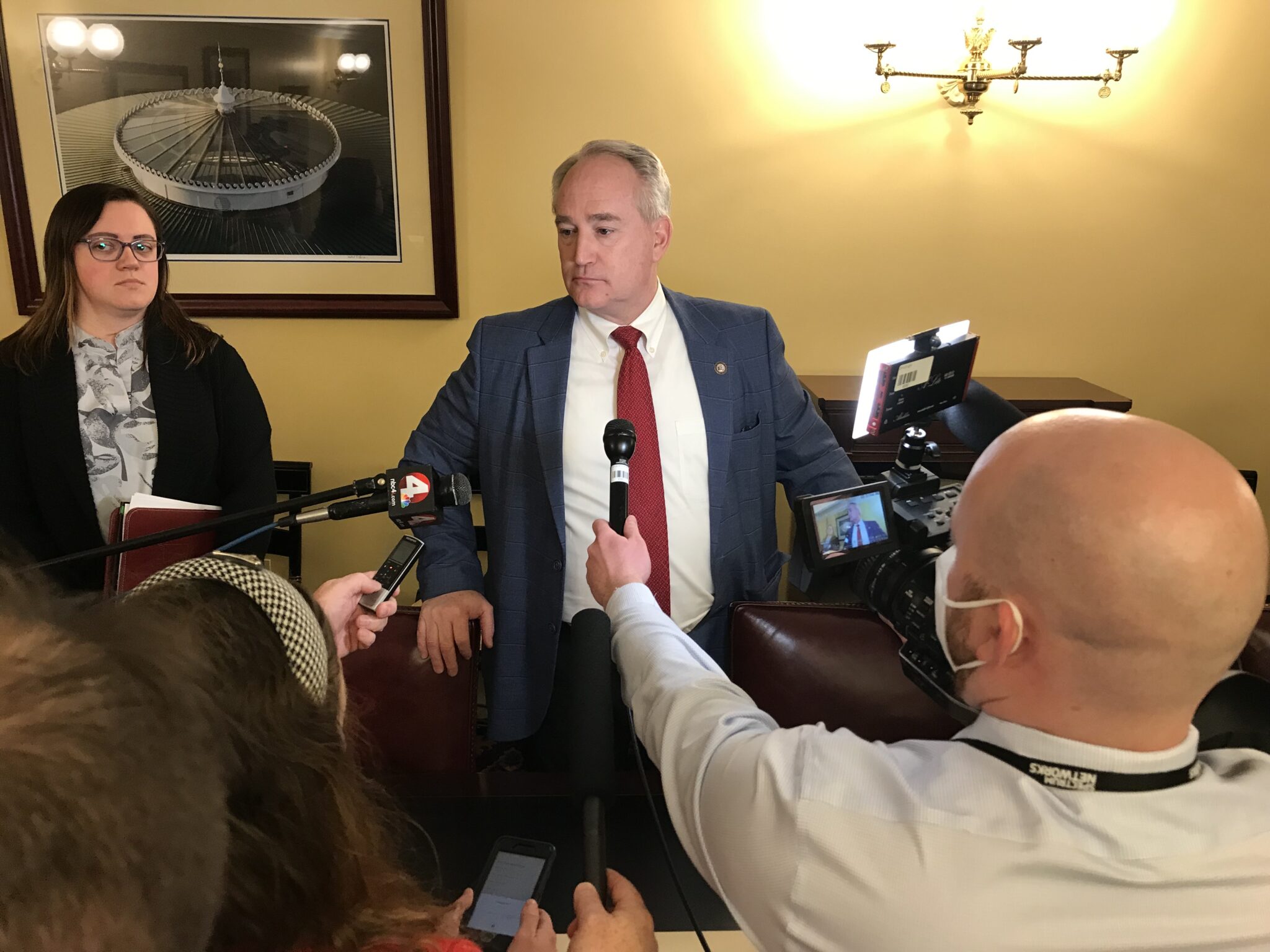
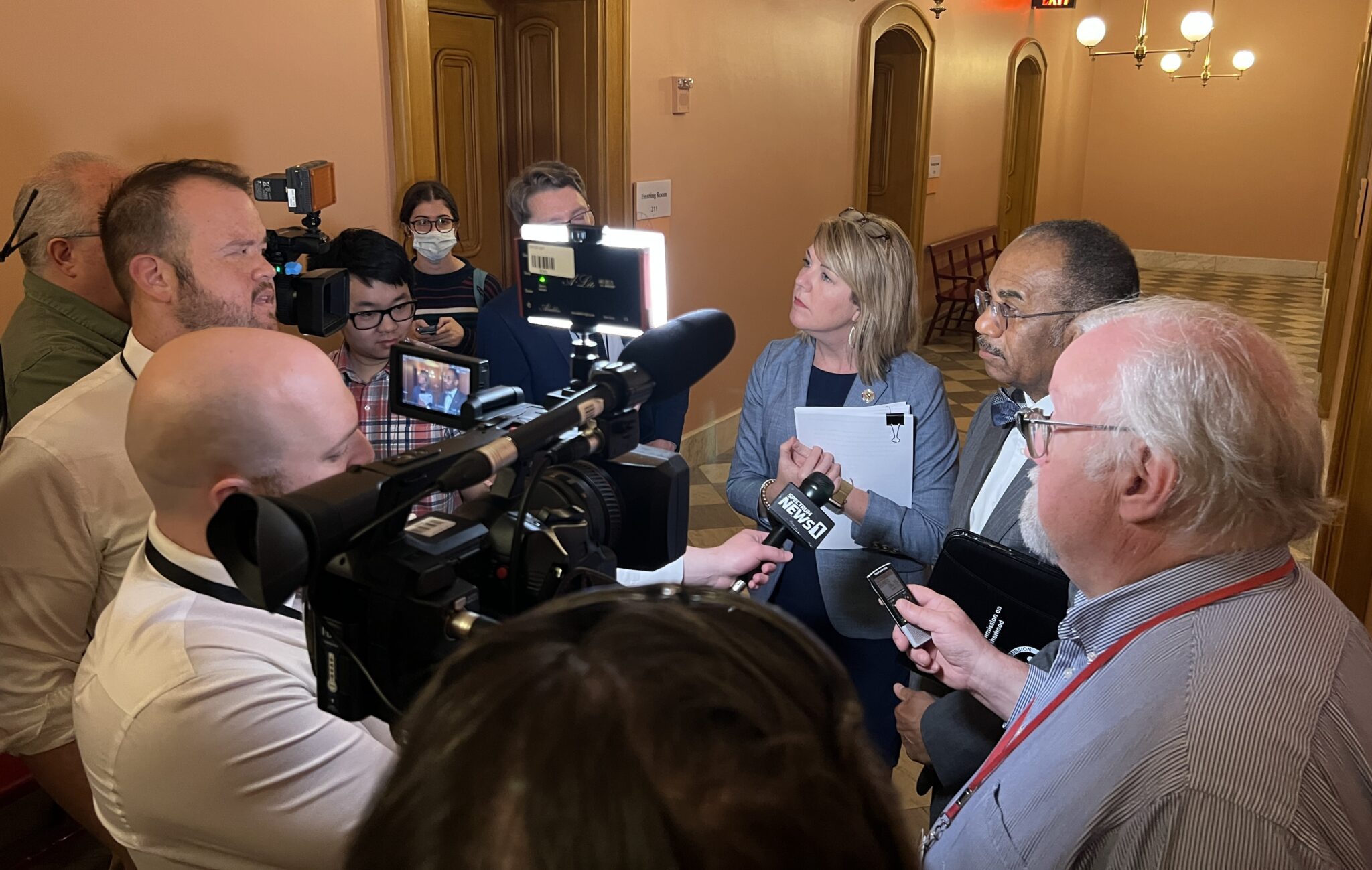
    House Minority Leader Allison Russo and state Sen. Vernon Sykes speak to media outside of Room 313 of the Ohio Statehouse. The two Dem members of the Ohio Redistricting Commission tried to convince GOP members to renew talks on legislative redistricting plans, but no other members showed. (Photo: Susan Tebben, OCJ)

    BY: SUSAN TEBBEN – Ohio Capital Journal

    Members of the Ohio Redistricting Commission have not publicly announced any plans to meet and discuss legislative redistricting, despite requests by Democratic members, and a mandate by the Ohio Supreme Court.

    Commission co-chair, state Sen. Vernon Sykes, D-Akron, and House Minority Leader Allison Russo, D-Upper Arlington, met with reporters Monday outside the committee room that has been used for ORC meetings, the most recent of which was March 28, when a simple majority passed a fourth version of legislative maps.

    Those maps were subsequently rejected as unconstitutional by a majority of Ohio Supreme Court justices, who then gave the commission until May 6 to come up with a new plan.

    Since then, a three-judge panel in U.S. District Court has said unless a plan is in place by May 28, the state will be ordered to use the third set of maps passed by the ORC, also rejected by the state’s high court.

    “This is a state process, these are state legislative maps,” Russo said. “This is, I think, terrible precedent that is being set that we will have federal courts come and overrule what our state process is in these partisan gerrymandering cases.”

    The two Democrats asked the rest of the commission members to meet with them and start the legislative process again, but no other members showed up Monday morning. Commission rules state that three members are needed to call for a meeting of the whole.

    Sykes said fellow co-chair, House Speaker Bob Cupp, agreed to talk with Sykes this week about the future of the process. A spokesperson confirmed the Friday conversation, but said a public meeting has yet to be scheduled.

    “We’ll be sure to let you know when a meeting is scheduled,” said Aaron Mulvey, spokesperson for Cupp.

    Secretary of State Frank LaRose’s spokesperson simply said he had no plans to attend the Monday event with Sykes and Russo, and a spokesperson for Senate President Matt Huffman said there was “no meeting scheduled this morning.”

    Any questions about official meetings would be for the co-chairs, spokesperson John Fortney said.

    Gov. Mike DeWine’s office had previously told reporters he had a scheduling conflict.

    Requests for follow-up comments from Auditor Keith Faber’s office went unanswered, but he had previously stated through a spokesperson he would not be available Monday morning.

    While the date for Statehouse races to be on a primary ballot is still up in the air, all other races in the state are continuing on the May 3 primary ballots. Early and absentee voting is ongoing for those races.

  • Common Cause Ohio: “State Supreme Court Rules State Legislative Maps Drawn to Unduly Favor Party in Power”

    Common Cause Ohio: “State Supreme Court Rules State Legislative Maps Drawn to Unduly Favor Party in Power”

    The statement of Catherine Turcer, Common Cause Ohio Executive Director that was released today.


    Earlier today, the Ohio State Supreme Court struck down gerrymandered Ohio House and Senate maps for an astonishing fourth time. The court’s decision is no surprise since these maps were nearly identical to the previous set of Ohio General Assembly maps that had already been ruled unconstitutional by the court.

    The now-struck-down fourth Ohio House and Senate maps were created not by the Commission or the independent mappers, but by the GOP majority of the Ohio Redistricting Commission (Governor DeWine, Secretary of State LaRose, Speaker Cupp, and Sen. Pres. Huffman) in a secret process that directly contravened the court’s directive to work in a transparent and bipartisan fashion. The maps were produced just hours before the March 28 deadline in a bait-and-switch maneuver that killed the independent mappers’ district plans and sabotaged the first transparent redistricting process in the state.

    Ohio voters are tired of being manipulated. It is time for the Ohio Redistricting Commission to take the orders from the Ohio Supreme Court seriously. We have been waiting for fair districts since 2015—when the new rules for mapmaking were overwhelmingly approved by voters. Ohio voters repudiated gerrymandering and put good rules in the Ohio Constitution to ensure fair maps going forward. We expect the members of the Ohio Redistricting Commission to abide by those rules, follow the Ohio Constitution, and obey the orders of the Ohio Supreme Court. The sooner the majority members of the Commission get to work and do their jobs as required, the sooner this redistricting nightmare will draw to a close, and Ohioans will finally be able to vote using the fair maps they need and deserve. 


  • Legal mediators added to the Ohio redistricting fold

    Legal mediators added to the Ohio redistricting fold

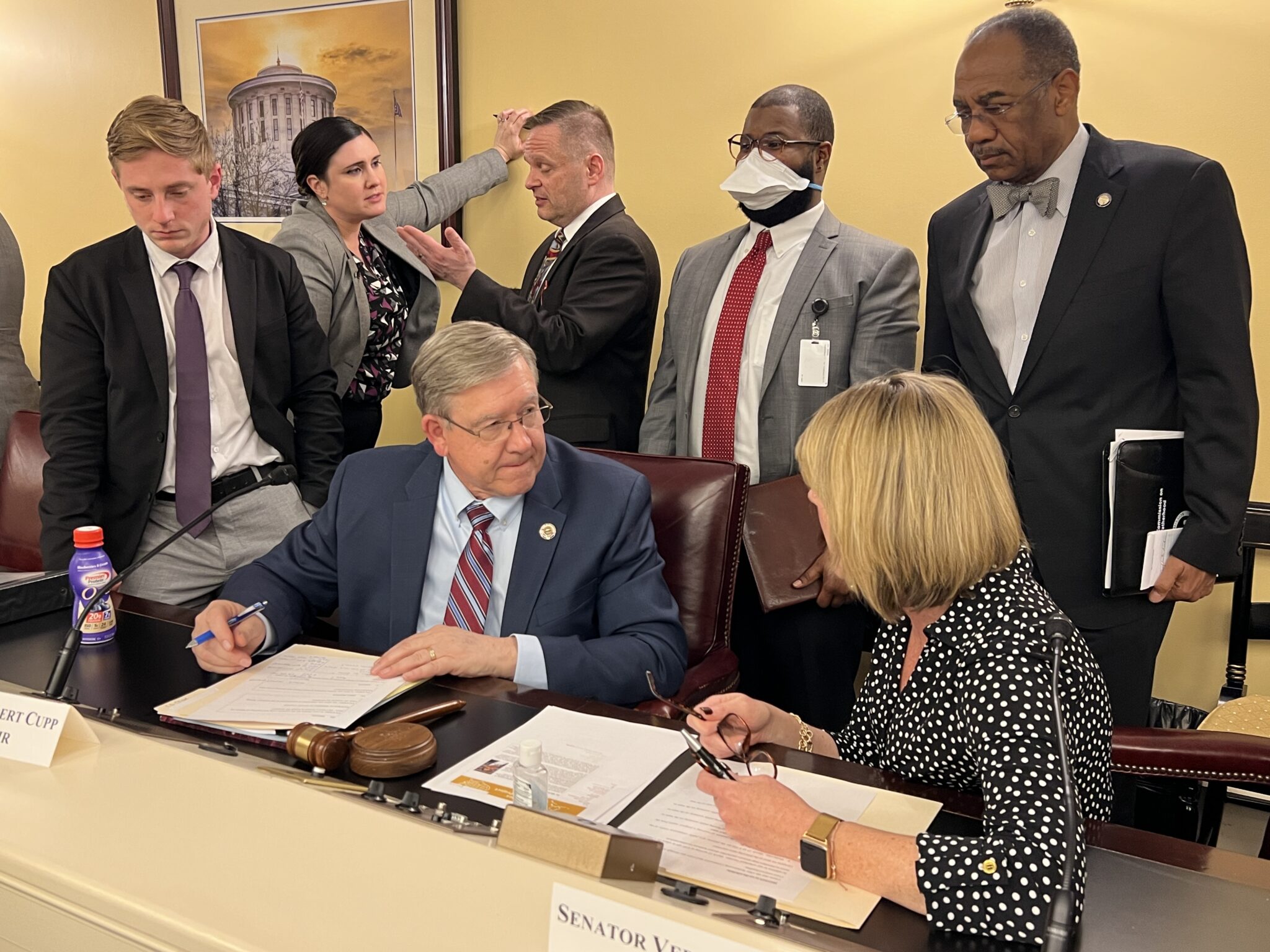
    House Speaker and Ohio Redistricting Commission co-chair Bob Cupp, center seated, speaks with House Minority Leader Allison Russo, right seated, as fellow co-chair state Sen. Vernon Sykes looks on. The ORC agreed to hire two outside mapmakers to assist in the process of legislative redistrict after a third set of maps was struck down by the Ohio Supreme Court. (Photo: Susan Tebben, OCJ)

    BY: SUSAN TEBBEN –  Ohio Capital Journal

    Legal mediators were added to the mapmaking team on Tuesday by the Ohio Redistricting Commission.

    Two members of the U.S. 6th Circuit Court of Appeals were approved by the commission to act as mediators as the process of creating a fourth map dictating legislative maps.

    Catherine C. Geyer and Scott Coburn were chosen after talking with the commission at their Tuesday meeting. They both are listed as circuit mediators on the 6th Circuit’s website, with Geyer listed as having alternative dispute resolution experience and Coburn noted for his work in civil mediation since 2005.

    “Mediators manage the process and the parties manage the solution,” Geyer said when explaining their role.

    Neither of the mediators have experience with redistricting cases, they told the commission.

    The legal mediators act as neutral parties to address issues that come up as the mapmakers come up with map ideas and commissioners wish to register input in the process, or when disagreements come up.

    “I think the advantage you have in this scenario … here, there’s the advantage of everyone trying to get to the shared goal,” Coburn told the commission.

    The mediators are “the best deal you can get,” according to Geyer, because they are “on loan from the court,” so come at no cost to the commission.

    House Speaker Bob Cupp and other GOP members of the commission asked about confidentiality rules and legal privilege when it comes to the mediators. He said it may be necessary for commissioners to be able to have confidential conversations, even as the Ohio Supreme Court directed them to make the process even more transparent.

    Geyer said the commission and the mediators would have to lay down rules on what constitutes legal privilege and confidentiality, but state Sunshine Laws on public meetings would still apply, meaning any decision making would have to be done in the open.

    The mediators also emphasized that while the process has a lot to do with the mapmakers, the commission members should be committed to being available as well.

    “I think access to the decision-makers would be the most important thing from the mediator’s perspective,” Geyer said. “We could get headed down a particular path, only to find out that one of the commissioners is not in agreement.”

    Geyer and Coburn will now join the original four caucus mapmakers, along with Professor Michael McDonald and Douglas Johnson, chosen by the commission on Monday night to act as independent mapmakers.

    Also at its Tuesday meeting, the commission set a schedule up to their March 28 deadline. Meetings are set for:

    • Wednesday – 5 p.m.
    • Thursday – 7 p.m.
    • Friday – 2 p.m.
    • Saturday – 4 p.m.
    • Sunday – 4 p.m.
    • Monday – 10 a.m.

    Thursday and Friday’s meetings are set to have virtual options, so members of the commission who may not be able to attend in-person can still call in. They will also be streamed for the public on The Ohio Channel.

  • Ohio Supreme Court rejects GOP-drawn Statehouse district maps for the third time

    Ohio Supreme Court rejects GOP-drawn Statehouse district maps for the third time

    Photo courtesy Wikimedia Commons..

    A bipartisan majority on the Ohio Supreme Court has for the third time rejected Statehouse district maps passed along partisan lines by Republicans on the Ohio Redistricting Commission.

    The most recent versions of legislative maps that had been approved by the ORC were struck down in a 4-3 decision Wednesday night by the state’s high court.

    A majority of the court justices said the map challengers had shown “beyond a reasonable doubt” that the most recent maps violated the constitution, particularly the provisions prohibiting partisan favoritism.

    “Substantial and compelling evidence shows beyond a reasonable doubt that the main goal of the individuals who drafted the second revised plan was to favor the Republican Party and disfavor the Democratic Party,” the majority wrote in its Wednesday opinion.

    The court sent the job back to the commission with a March 28 deadline to file an “entirely new” district plan for the General Assembly with the Ohio Secretary of State’s Office. A copy of the plan should then be sent to the court the next day.

    The breakdown of votes matched previous votes by the court striking down maps, with Chief Justice Maureen O’Connor, Justice Michael Donnelly, Justice Melody Stewart and Justice Jennifer Brunner forming the majority opinion. Justices Sharon Kennedy and Patrick Fischer dissented. Also dissenting was Justice Patrick DeWine, son of governor and commission member Mike DeWine.

    Justice DeWine recused himself from an issue in the case in which the commission members could be held in contempt of court for not filing new maps within the last deadline, but did not recuse himself from the entire case.

    The justices in the majority once again pointed to Senate President Matt Huffman and House Speaker Bob Cupp as controllers of the map-making process, saying the evidence in this case “is just as strong, if not stronger” than it was in previous map-making attempts.

    “The Democratic members of the commission had no opportunity to provide input in creating the second revised plan, and they had no meaningful opportunity to review and discuss it or to propose amendments once it was presented at the commission hearing on February 22, 2022,” the majority wrote.

    The court said they have “identified a flawed process” in all three of its rulings on the legislative maps, plans adopted after being the “product of just one political party.”

    “The evidence shows that the individuals who controlled the map-drawing process exercised that control with the overriding intent to maintain as much of an advantage as possible for members of their political party,” according to the ruling.

    With these new maps, the court agreed with arguments made by anti-gerrymandering groups who said a disproportionate number of so-called “Democratic-leaning” districts were actually toss-ups, with less than a 1% advantage for the Democrats.

    The newest plan had 19 House districts considered toss-ups, and seven Senate districts in the same toss-up range.

    “The result is that the 54 percent seat share for Republicans is a floor, while the 46 percent share for Democrats is a ceiling,” the court wrote (italics their own).

    That amount of toss-up districts, the court found, is “evidence of an intentionally biased map,” and is just one piece showing partisan lopsidedness on the part of the GOP.

    Justices also made a point to single out Huffman in saying he appears to have voted against a Democratic map proposal “based, at least in part, on a misunderstanding” of the constitutional provisions regulating redistricting in the state.

    Huffman called out the plan introduced by commission co-chair state Sen. Vernon Sykes and House Minority Leader Allison Russo because, according to him, the plan would have impacted the ability of Republican incumbents to keep their seats.

    “Making that observation demonstrates, beyond a reasonable doubt, that Senate President Huffman misunderstands the requirements of Article XI and the reasons for their adoption,” the majority stated. “Senator Huffman’s concern for protecting incumbents is not grounded in Article XI.”

    Kennedy and DeWine wrote their own dissent, that shamed the majority opinion for issuing a judgment “guaranteed to disrupt an impending election and bring Ohio to the brink of a constitutional crisis.”

    The Ohio Secretary of State, yet another member of the redistricting commission, has issued frequent warning about the lateness of the redistricting effort, though he has yet to go against the Republican majority vote.

    With the May 3 primary approaching quickly, Secretary Frank LaRose all but begged the General Assembly to approve extra money to speed up the delivery of absentee ballots to overseas and military Ohioans, and to extend the amount of time the county boards of elections have to send out the ballots, from 45 days before the election to 30.

    In previous court filings and public comments, LaRose said the primary likely couldn’t withstand another map delay.

    In shutting down the most recent map effort, the dissenting court justices say the majority of the court did much of what it did in previous rejections of redistricting maps by allegedly overriding the power of the constitution with its own interpretation.

    In previous dissents, Kennedy and DeWine accused the majority justices of “moving the goalposts” by putting requirements in the constitution where none could be found, but this time, they say, “the majority tears down those goalposts altogether.”

    “Through its actions today, the majority undermines the democratic process, depriving the voters of the constitutional amendment they enacted and leaving in its place only the majority’s policy preferences,” Kennedy and DeWine wrote. “In so doing, it threatens the very legitimacy of this court.”

    The majority of the court added a new level to the next steps in redistricting by ruling the map-drafting “should occur in public” and that the commissioners should “convene frequent meetings to demonstrate their bipartisan efforts to reach a constitutional plan within the time set by this court.”

    Dissenting justices say that the majority finding the most recent maps unconstitutional because this transparency method didn’t happen the first (or second) time “is ludicrous.”

    “Nothing in the constitution requires the seven commissioners to sit down together to draft the plan – effectively handing each one of them an unbridled veto power,” Kennedy and DeWine wrote in their dissent.

    The majority on the court also had a suggestion for the commission: “The commission should retain an independent map drawer — who answers to all commission members, not only to the Republican legislative leaders — to draft a plan through a transparent process.”

    After the Ohio Redistricting Commission passes a new plan, map challengers will once again have three days to object after the maps are submitted.

    The Secretary of State’s office declined to comment on the court ruling Wednesday night.

    The Ohio Supreme Court’s isn’t done: It is still considering court challenges to congressional maps passed earlier this month. The court also hasn’t said whether it will reschedule a contempt of court hearing it brought up after the ORC didn’t come up with legislative maps by its February 17 deadline.


  • GOP majority passes third round of Ohio Statehouse maps in 4-3 vote

    GOP majority passes third round of Ohio Statehouse maps in 4-3 vote

    Democrats, Auditor Faber vote against maps

    BY: SUSAN TEBBEN – Ohio Capital Journal

    Four Republican members of the Ohio Redistricting Commission passed a third round of legislative maps Thursday, exactly one week after the Ohio Supreme Court’s deadline passed.

    The maps just introduced Thursday afternoon passed with a 4-3 vote, with both Democrats voting against as with previously passed maps.

    The House map presented on Thursday shows a 54-45 GOP advantage in the House and an 18-15 advantage in the Senate. While 19 of the Democratic House districts and seven in the Senate are considered competitive political “toss-ups” in the 50% to 52% advantage range, none of the Republican districts are, with all of them having a Republican advantage more than 52%.

    Auditor Keith Faber was the lone Republican to vote against the maps, which he said is for the same reasons he didn’t support the Democratic maps last week.

    “I think there are some issues that I have concerns with and so for that reason, I didn’t think, to be consistent, I could overlook them in this map,” Faber said.

    Those issues included compactness and political subdivision splits.

     The Ohio Senate districts as shown on the newest GOP redistricting proposal. The map was brought forward Thursday during a meeting of the Ohio Redistricting Commission.
    Source: Ohio Redistricting Commission

    “I understand the desire to have a map, I understand the desire to send a map to the supreme court that they will uphold, but again, I’m not going to violate my view of the constitution merely to get a map done,” Faber said.

    While the Ohio Redistricting Commission originally met this week to talk congressional maps, for which they have another few weeks to meet the supreme court deadline, legislative maps took the attention away.

    Senate President Matt Huffman joined with Gov. Mike DeWine and Faber in bringing up the legislative matter amidst talks on congressional district lines.

    The commission is constitutionally required to use statewide state and federal elections data from 2016 to 2020 to come up with the data for their maps.

    The passage comes mere days before the commission members must appear before the supreme court and answer for missing the deadline of Feb. 17.

     The Ohio House districts as shown on the GOP map proposal presented during a Thursday meeting of the Ohio Redistricting Commission.
    Source: Ohio Redistricting Commission

    The court asked for all members to come to a March 1 hearing on the possibility of contempt of court for ORC members.

    The commission members adjourned a meeting that deadline day with no maps approved. GOP leaders, including commission co-chair House Speaker Bob Cupp, said no agreement could be made and compliance with the orders of the court and the Ohio Constitution weren’t possible in the 10 day window they were given after the last legislative maps were struck down.

    Democrats maintained throughout Thursday that they were left out of the process, and the map that Republicans presented does not address toss-up districts.

    “We have been and continue to be willing to work with them if they want to collaborate at any time to produce a commission map,” co-chair state Sen. Vernon Sykes, D-Akron.

    In their statement supporting their maps, the GOP refuted the Democratic comments.

    “The final adopted plan contains input from those members of the commission, directly or through their staff, who chose to participate,” Cupp read from the statement.

    Without bipartisan agreement, if the supreme court accepts the maps this time around, they will last four years.

    After the maps were passed, Secretary of State Frank LaRose asked the commission to allow him to distribute a statement for candidates whose residency might change because of the district changes.

    Now the commission will move back to congressional maps. Cupp said the commission plans to meet on Tuesday, the same day as their contempt hearing.

  • Confidence wanes in legislature’s ability to pass new congressional map

    Confidence wanes in legislature’s ability to pass new congressional map

    BY: SUSAN TEBBEN – Ohio Capital Journal

    House Speaker Bob Cupp, center right, and state Sen. Vernon Sykes, far right, co-chairs of the Ohio Redistricting Commission, speak to media after a January meeting to restart the legislative redistricting process. The process is set to start again next week. (Photo: Susan Tebben, OCJ)

    The tide seems to be turning on congressional redistricting, with legislative leaders saying the process lacks needed support in the General Assembly, and will likely head back to the Ohio Redistricting Commission.

    A day after legislative maps were sent back to the ORC for a third time, a co-chair of that commission says the congressional map is headed that way as well.

    House Speaker Bob Cupp told media at the Statehouse on Tuesday that a two-thirds vote would not be possible in the legislature, which is necessary to be able to pass a congressional map in the General Assembly.

    Because of that lack of support, a redistricting plan could not include an emergency clause, which would be needed for the plan to take effect immediately. The legislature was on the clock to pass a revised plan by Feb. 13 (Super Bowl Sunday), and for that plan to become effective in time for the May primary.

    Bills typically take effect 90 days after the governor’s signature, which would conflict with the primary deadlines.

    A spokesperson for Senate President Matt Huffman said because a commission vote doesn’t need an emergency clause, “it makes sense for the congressional map to go to the commission” if a two-thirds vote isn’t possible.

    House Democrats said the GOP made agreement difficult, having never shared a Republican proposal with the other party.

    “Democrats cannot support a map that we have not seen,” Maya Majikas, deputy communications director for the House Democratic Caucus, told the OCJ.

    Yesterday, House Minority Leader Allison Russo spelled out her expectations for the congressional redraw, which included work by the General Assembly.

    “There is a clear path to producing a fair, constitutional map that allows for the equal representation that all Ohio voters deserve. Now, it is the duty of this General Assembly to uphold our Constitutional responsibility and deliver a fair map,” Russo said in a statement.

    Democrats in both chambers spent Tuesday pushing their proposal for congressional districts, releasing a map with a GOP majority 8-7 split. One district covering Cuyahoga County is considered Dem-leaning, according to the caucus numbers, but only gives Dems a 50.9% to 49% advantage.

    Should the legislature continue to hold until the Feb. 13 deadline, the Ohio Redistricting Commission will have 30 days to come up with a congressional plan to replace the one rejected by the court.

    This deadline comes alongside a Feb. 17 deadline for the commission to submit a third version of the legislative district plan to the Ohio Secretary of State’s office, and submit it back to the court for review.

    In their Monday decision striking down the newest version of the legislative maps, the Ohio Supreme Court said they maintain jurisdiction over the maps. They also addressed the timeline for the May primary and 2022 elections in their decision.

    Republican members of the redistricting commission had asked the court to decide the case by Feb. 11 or to hold their decision until after the 2022 general election, using the now-rejected plan until that time.

    In their 4-3 decision, the majority justices on the court said the General Assembly “has the authority to ease the pressure that the commission’s failure to adopt a constitutional redistricting plan has placed on the secretary of state and on county boards of elections by moving the primary election, should that action become necessary.”

    Secretary of State Frank LaRose’s office confirmed that it is solely on the legislature to decide when an election conducted, though the secretary of state can advise them on “cascading events” that would be impacted by changing an election, according to spokesperson Rob Nichols.

    There is precedent for moving an election day, as LaRose did during the COVID-19 pandemic.

    In the ORC response to objections to the legislative maps, the commission laid out the impact the redistricting maelstrom may have on the 2022 election season.

    “Ohio’s expansive early voting framework amounts to an election season that begins with early in-person and absentee voting 29 days before the primary,” they wrote in court documents.

    That date would be April 5 this year, meaning before that date county boards of election need to print and prepare ballots under Uniformed and Overseas Citizen Absentee Voting Act (UOCAVA), for which federal law requires boards to begin mailing the ballots at least 45 days before the primary.

    Those ballots need to be sent by March 19 this year.

    “Though the General Assembly can, and has, temporarily amended Ohio law to move some of Ohio’s election deadlines for the primary election, the federal UOCAVA deadline is set by federal statute (and) it cannot be moved by the General Assembly or the Secretary,” the ORC wrote.

    Without districts to determine the voting precincts for those uniformed and overseas citizens, the ballots can’t be sent.

    Still, LaRose has only asked the General Assembly for the authority to shift some administrative deadlines having to do with the primary, not to move the election entirely.

    “His job right now is to administer an election on May 3,” Nichols told the OCJ.

    LaRose is also a member of the Ohio Redistricting Commission, so he’ll be multi-tasking as the redistricting process continues.