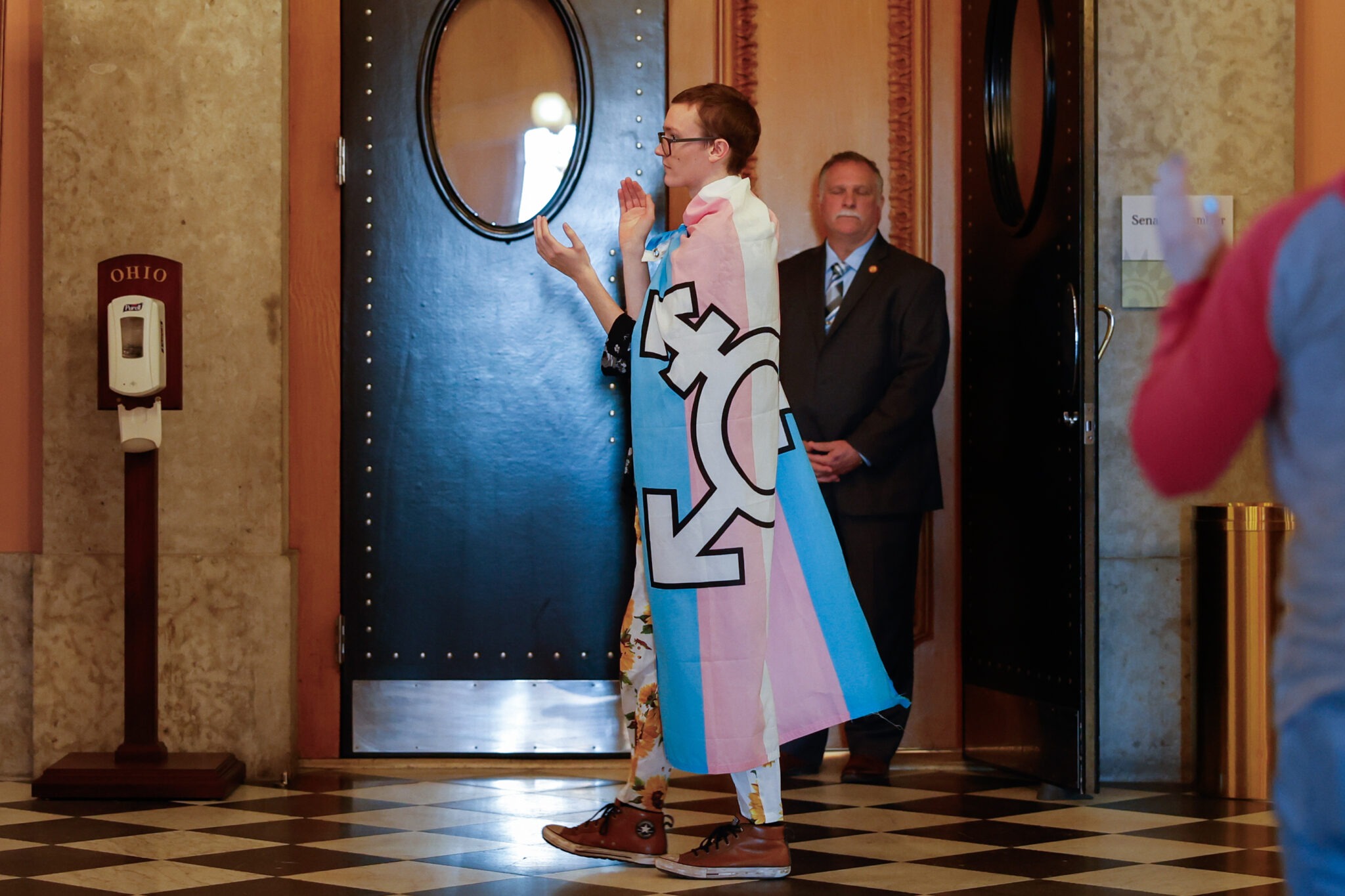
Nearly 50 anti-LGBTQ incidents happened in Ohio in a year, according to a new report by the Gay and Lesbian Alliance Against Defamation.
GLAAD’s Anti-LGBTQ Extremism Reporting Tracker (ALERT) documented 932 anti-LGBTQ incidents nationwide from May 1, 2024 to May 1, 2025. A little more than half of all nationwide incidents targeted transgender and gender non-conforming people.
GET THE MORNING HEADLINES.
These incidents led to 84 injuries (including one in Ohio) and 10 deaths, according to the report.
ALERT tracked these incidents through self-reports, media, social media posts and data sharing from partner organizations and law enforcement.
“This year, rollbacks in LGBTQ visibility and challenges to our rights are coupled with a sharp rise in anti-LGBTQ rhetoric and disinformation across social media and political campaigns,” GLAAD President & CEO Sarah Kate Ellis said in a statement. “It’s only through awareness, collective action, and community that we can turn the tide toward greater safety and acceptance.”
Nearly half of the incidents in Ohio involved the Dayton Street Preachers hosting anti-LGBTQ protests at universities, events, street corners, Pride events, or outside the Great American Ballpark in Cincinnati.
Many of the Ohio incidents involved Pride flags being stolen last summer.
A transgender woman was injured while bartending a drag show in Columbus last July, according to the report. A man disrupted the show and was kicked out by the bartender, but the man punched the bartender and kicked down the glass door while yelling homophobic slurs, according to NBC4.
Back in March, someone threatened to shoot up an upcoming drag show event in Columbus in the comments of a Facebook event, according to the report.
Ohio bills
In terms of anti-LGBTQ legislation, some anti-LGBTQ laws took effect in Ohio earlier this year, including banning Ohio transgender students from using school bathrooms and locker rooms that align with their gender identity. It also bans students from sharing overnight accommodations with people of the opposite sex from their assigned sex at birth at a K-12 school.
Republicans have introduced other measures targeting the LGBTQ community this year.
Ohio House Bill 190 would prohibit school employees from calling a student a name that is not listed on their birth certificate and would ban them from using pronouns that do not align with their biological sex.
Ohio House Bill 172 would not allow minors age 14 and older to receive mental health services without parental consent. Currently, mental health professionals are permitted to provide outpatient mental health services to minors 14 and older on a temporary basis without parental consent.
On the Democratic side, state Reps. Eric Synenberg and Anita Somani recently introduced the Marriage Equality Act which would place put a constitutional amendment on the November 2026 ballot that would enshrine marriage equality in the state constitution. This is in response to a constitutional amendment Ohioans passed in 2004 that defines marriage as “only a union between one man and one woman.”
Megan Henry is a reporter for the Ohio Capital Journal and has spent the past five years reporting in Ohio on various topics including education, healthcare, business and crime. She previously worked at The Columbus Dispatch, part of the USA Today Network.
Ohio Capital Journal is part of States Newsroom, the nation’s largest state-focused nonprofit news organization.
Yesterday was beyond disheartening as legislators put politics over the safety of some of our most vulnerable children. The Senate passed an amended HB 68, and the House concurred. We applaud that lawmakers from both sides of the aisle voted no, but it was not enough to prevent passage.
We still have hope to block this from becoming law, but we have to act NOW.
Here is a sample text to personalize for your email to the Governor:
I am a business leader, and I urge you to veto HB 68, which would ban clinical best practices by prohibiting affirming healthcare to transgender youth and would ban transgender athletes from participating in sports. This bill harms Ohio’s youth and families—people who make up our workforce and whom we are trying to attract and retain as part of our workforce.
We are already seeing an exodus of LGBTQ+ and ally young adults who are seeking a more welcoming place to call home. Families of school-age children are making plans to leave Ohio in order to access essential medical care. HB68 is modeled after laws passed in other states — five of which have injunctions against their implementation. Legislation like HB68 will put Ohio in the national spotlight for all the wrong reasons, further harming employee recruitment and retention.
Additionally, the Ohio High School Athletic Association (OHSAA) has been regulating transgender individuals playing sports for years without incident or issue. This is government overreach at its worst; let all kids play sports via the existing OHSAA guidelines, which are working.
HB 68 will harm Ohio’s families, perception, and bottom line. Please use your power to stop this harmful bill from becoming law. Please VETO HB 68 and support Ohio’s families and a thriving economic workforce.
We know these bills are bad for business. It’s not too late to stop this.
Business voices matter. After you email, please call Gov. DeWine’s office at (614) 466-3555 or (614) 644-4357 to voice your opposition to this bill. You can also release an independent public statement condemning this bill, or have meetings and conversations directly with lawmakers.
If your business, organization, or association would like to make a statement condemning this legislation, please contact Policy@equalityohio.org for more information.
Thank you for being with us. We need your voice now more than ever.
COLUMBUS, Ohio — DECEMBER 13: Advocates for the trans community protest outside the Senate Chamber while inside lawmakers debated and passed HB 68 that bans gender-affirming care for transgender youth and bars transgender kids from participating on sports teams, December 13, 2023, at the Statehouse in Columbus, Ohio. (Photo by Graham Stokes for Ohio Capital Journal. Republish photo only with original article.)
A bill that would block doctors from providing gender-affirming care to trans youth and prevent trans athletes from participating in Ohio women’s sports is going to Ohio Gov. Mike DeWine’s desk.
The Ohio Senate passed House Bill 68 in a 24-8 vote Wednesday afternoon and the Ohio House concurred with the Senate amendments in a 61-27 vote Wednesday night. DeWine now has 10 business days to sign or veto the bill.
“We await a final bill to review before offering formal comment,” DeWine’s press secretary Dan Tierney said in an email Wednesday afternoon.
State Senator Nathan Manning, R-North Ridgeville, was the lone Republican who joined Senate Democrats in voting against the bill.
HB 68, introduced by Rep. Gary Click, R-Vickery, would block doctors from providing gender-affirming care to trans youth, including puberty blockers and hormone therapy.
The bill would ban physicians from performing gender reassignment surgery on a minor, but many opponents have testified that no Ohio children’s hospital currently performs gender-affirming surgery on those under 18. An amendment was added to HB 68 Wednesday that added a grandfather clause that would allow doctors who already started treatment on patients to continue.
Gender-affirming care is supported by every major medical organization in the United States. Children’s hospitals across Ohio, the Ohio Children’s Hospital Association and the Ohio Academy of Family Physicians all oppose HB 68.
House Minority Leader Allison Russo, D-Upper Arlington, said she hopes DeWine will listen to the medical professionals who oppose the bill.
“The bill is so cruel on so many levels but at the end of the day this violates parents rights to make decisions about their children’s own healthcare,” she said. “It’s putting the government in the middle of families and their healthcare providers.”
Twenty-two other states have passed a law that blocks gender affirming care, according to the Human Rights Campaign.
Gender-affirming surgery for minors is not common with less than 3,700 performed in the U.S. on patients ages 12 to 18 from 2016 through 2019, according to a study published in August in JAMA Network Open. It’s unclear how many of those patients were 18 when they underwent those surgeries.
Ohio House Speaker Jason Stephens, R-Kitts Hill, said the bill empowers parents.
“The important part is protecting children and making sure parents know what’s going on,” he said.
State Senator Bill DeMora, D-Columbus, called HB 68 a disgusting piece of legislation.
“Current hospital policies ensure gender-affirming care for minors who seek it is safe, medically necessary, and appropriate,” DeMora said in a statement. “It’s clear that this bill is targeting youth already at an increased risk of suicide and violence, and subjecting them to even more risk.”
He took a moment to speak directly to transgender people during the Senate session.
“Your life has meaning and purpose,” DeMora said. “You are seen, valued and loved.”
Trans athlete ban
House Bill 6 — which prevents trans athletes from participating in Ohio women’s sports — was rolled into HB 68 back in June. The would prevent males from playing female sports, but everyone would still be able to play on co-ed teams.
If a trans girl wants to play on a team with cis girls in Ohio, she must go through hormone treatments for at least one year or show no physical or physiological advantages, according to the Ohio High School Athletic Association.
Twenty-three states have passed similar laws in regards to transgender athletes since 2020, according to ESPN.
COLUMBUS, Ohio — DECEMBER 13: An advocate for the trans community protests outside the Senate Chamber while inside lawmakers debated and passed HB 68 that bans gender-affirming care for transgender youth and bars transgender kids from participating on sports teams, December 13, 2023, at the Statehouse in Columbus, Ohio. (Photo by Graham Stokes for Ohio Capital Journal)
“It is two bills, so much for single subject,” Senate Minority Leader Nickie J. Antonio, D-Lakewood, said.
“This bill strips rights away from parents and bans children’s access to evidence-based healthcare,” Antonio said in a statement after the bill passed the Senate. “Physicians need to be able to have comprehensive care discussions with patients and their families, but this bill puts them in an impossible position.”
Hundreds of people submitted opponent testimony against the bill last week during a marathon Senate Government Oversight Committee meeting.
“We don’t make laws just for the hundreds of people that come and testify,” Senate President Matt Huffman said when asked about this. “We make laws for over 11 million people.”
Opponents speaks out and protest
LGBTQ+ advocates who oppose HB 68 had a press conference Wednesday morning to speak out against HB 68 — arguing families shouldn’t have to decide whether it’s safe to stay in Ohio.
“Ohio is home and I will not be legislated to leave,” said Densil Porteous, Executive Director of Stonewall Columbus.
COLUMBUS, Ohio — DECEMBER 13: Advocates for the trans community protest outside the Senate Chamber and repeatedly shouted “shame” when they heard that lawmakers had passed HB 68 that bans gender-affirming care for transgender youth and bars transgender kids from participating on sports teams, December 13, 2023, at the Statehouse in Columbus, Ohio. (Photo by Graham Stokes for Ohio Capital Journal)
This bill will make it more challenging for trans and non-binary people, said Dara Adkison, a member of TransOhio.
“HB 68 will cause people to leave Ohio and no one should be forced from their home for any reason, but especially not because of extreme laws undermining their freedom and safety,” Adkison said.
Mallory Golski, the civic engagement & advocacy manager for Kaleidoscope Youth Center, spoke in place of a high school student who couldn’t attend the event because they had school tests to take.
“The people who this bill targets are teenagers,” Golski said. “They are young people who shouldn’t have to make a decision about whether they should show up to school or show up to the statehouse to convince lawmakers of their inherent dignity.”
She knows many transgender kids who are happier when they receive gender affirmation or care.
“Taking that away from trans minors would be a detriment,” Golski said.
Evangelical Lutheran Deacon Nick Bates and father of a 13-year-old nonbinary child said bills like HB 68 force trans children and adults back into hiding.
“Sadly, HB 68 and other bills targeting trans and non-conforming youth take this peace, comfort and joy up the chimney like the Grinch stealing the Christmas tree,” Bates said.
Megan Henry is a reporter for the Ohio Capital Journal and has spent the past five years reporting in Ohio on various topics including education, healthcare, business and crime. She previously worked at The Columbus Dispatch, part of the USA Today Network.
Amy Schneider, Dayton native and Jeopardy! champion, leaves the Ohio House Families, Aging and Human Services Committee after testifying against House Bill 454. Schneider, who is a trans woman, said the bill would be “tragic” for Ohio children. Photo: Susan Tebben, OCJ
A packed and stuffy Families, Aging and Human Services committee room was flanked by multiple overflow rooms, where applause could be heard after parents, trans advocates and individuals implored the committee not to approve of House Bill 454, a bill created by committee member state Rep. Gary Click, R-Vickery.
One of the testimonies came from Dayton native Amy Schneider, a trans woman who went on to become a Jeopardy! super champion, and has used her platform to support her fellow LGBTQ+ community members.
“To be given the chance in Ohio, where I spent 30 years of my life, to have a chance to make a difference and have a chance to actually, if nothing else, slow down these laws and give trans kids a little bit longer to be safe, then I’ve just got to do it,” Schneider told the OCJ before she gave her testimony to the committee.
In her testimony, she sought not to demonize those who support the bill, but to ask that they do what they claim is the main goal of the bill: protecting children.
“But if you do share that goal, then passing this bill would be a tragic mistake,” Schneider said. “Because far from protecting children, this bill would put some of them in grave danger, a danger that not all them would survive.”
Several of those that testified, including Schneider, called gender-affirming care “life-saving” care, in that it would help suicide rates among trans individuals, and the overall mental health of those attempting to live as they want to live.
“With this bill, I wouldn’t be able to appear as I want to appear to the public with a form that would greatly appeal to me,” said 15-year-old Cass Steiner, who appeared alongside her mother, Kat. “This would likely send me, and everyone else who is expecting treatment, into another deep depression.”
State Rep. Gary Click, R-Vickery, looks on as the House Families, Aging and Human Services Committee, of which he’s a member, listens to testimony against his bill restricting gender-affirming care, House Bill 454. The bill did not see a vote on Wednesday. Photo: Susan Tebben, OCJ
In the middle of two hours of testimony, Click introduced a substitute version of the bill, that he said was an attempt to “meet in the middle” of opposition and support.
In the new version, puberty blockers or hormone therapy is allowed for minors, but only after a doctor confirms that the child “has received on a routine basis and for at least a two-year period counseling related to gender dysphoria, mental health and the risks of gender transition,” according to the sub bill’s analysis by the Legislative Service Commission.
A doctor must also screen for other things that “may be influencing the minor’s gender dysphoria,” including depression, autism or ADHD, and “ensure that these comorbidities are treated and stabilized for at least two years.”
Along with conducting other physical, sexual, mental and emotional abuse screenings, a second doctor must be consulted and agree to the treatment plan.
Asked twice how the two-year time frame was decided on, Click told reporters it was “discussed by some other folks who came up with that and I thought that sounded reasonable.”
He did not specify who he consulted with to come to that amount of time.
The substitute bill also seeks to keep track of the number of medical and therapy appointments the minor attended before a physician recommended hormones or puberty blockers, any mental health conditions before being diagnosed with a “gender-related condition” and any follow-up the minor received after treatment.
The bill also requires physicians to report “the number of minors who resumed identification with their biological sex,” and “the number of minors for whom the physician previously prescribed drugs or hormones who have not been prescribed those hormones or drugs for one year or more,” according to the LSC analysis.
That information would be reported on a yearly basis to the General Assembly and to the Ohio Department of Health.
Like the abortion ban that is currently held up in court, violating HB 454 could put doctor’s medical licenses at risk, and the state Attorney General would be authorized to bring against anyone violating the bill, should it become law.
The bill was not voted on during Wednesday’s committee meeting, with chair Susan Manchester, R-Waynesfield, adjourning the meeting immediately after the last witness of the day finished.
It’s not clear what the fate of the bill will be from here, with the General Assembly’s session ending at the end of December. More hearings could be scheduled, which Click supports because he said there are more people to hear from, particularly those who have been “damaged” by gender-affirming care.
He said the testimony he heard on Wednesday wasn’t anything he hadn’t heard before, but it didn’t change his mind on the bill.
“(Children) have to have that period to work through this to make sure this isn’t a phase, it’s not a social contagion … we want to give them that legitimate chance to work through this,” Click said.
He said he won’t “write anything off” in terms of new amendments to the bill, but he feels the bill has come as close to “the middle” as possible.
“There are proponents of this bill who are not happy with some of the concessions that we made, and of course the opponents aren’t happy with the fact that we didn’t make enough,” Click said.
For Schneider, she sees attempts to keep trans folks from getting the care they need as a negative response to success and progress the trans community has had over the last few decades. Progress that will continue, she says.
“The momentum will continue to be on our side and there’s this pain right now, but this is just sort of the last gasp of that resistance,” Schneider said.
Students in one Pennsylvania school district were not allowed to read a biography of the first Black President, Barack Obama. (The ban was reversed following student protests.)
In some Tennessee classrooms, a nonfiction comic book about the atrocities of the Holocaust is banned.
And one school district in Wisconsin banned from libraries a picture book about a gay rights activist who was assassinated.
In the last nine months, hundreds of books across dozens of states are being banned at an alarming rate. A majority of the bans feature books written by authors who are people of color, LGBTQ+, Black and Indigenous, and feature characters from marginalized groups.
And now, state Republicans lawmakers are joining the movement, spurred by ultra conservative groups, to ban books from public schools and libraries.
This year in Arizona, state Republicans put forth a measure that would ban schools from teaching or directing students to study any material that is “sexually explicit.” In Florida, Gov. Ron DeSantis recently signed a bill to allow parents greater opportunity to review, and potentially object to, school library books that they find “inappropriate.”
And in Idaho, state House Republicans passed a bill that would allow librarians to be prosecuted for allowing minors to check out material deemed harmful.
Some of the states with the most aggressive book bans include Texas with 713 bans, Pennsylvania with 456 bans and Florida with 204 bans.
Deborah Caldwell-Stone, the director of the American Library Association’s Office for Intellectual Freedom, said book bans the last 10 years have dealt “with the lives of LGBTQIA persons, either reflecting their experiences, or talking about issues of concern to the LGBTQIA community.”
She said those bans have ranged from picture books depicting same-sex couples to young adult books talking about gender identities.
Caldwell-Stone said, “the one thing that has interrupted this” trend of banning books centered around LGBTQ+ themes comes after the 2020 murder of George Floyd by Minnesota police officer Derek Chauvin.
“There was an increased number of challenges to books dealing with race and racism that accelerated when we started seeing complaints from organized groups about critical race theory,” she said.
“And so when I say critical race theory, I’m not using it in the sense that it actually should be used, which is to describe a graduate level academic analysis of law and political systems, but this use of it to describe books and materials that offer alternative perspectives on American history that reflect the lives of Black persons and their experience of slavery, their experiences with police violence, and so we’ve seen a rising number of challenges to those books.”
Some of those groups that have challenged school boards include Moms for Liberty, an organization that has strong GOP ties and has local chapters that “target local school board meetings, school board members, administrators, and teachers” to push right-wing policies, as reported by Media Matters. Moms for Liberty has more than 100 local chapters across 35 states.
“We’re seeing nationally organized groups create local chapters, and use social media to amplify their demands,” Caldwell-Stone said. “They will tell you that they’re asserting parental rights to direct their children’s education, but the impact of their activities is to deny other parents the right to make decisions about their own children’s education, and particularly for older adolescents denying the First Amendment rights and agency for elder adolescents to read and access the materials they find important for their lives.”
Congressional Democrats have also raised concerns about the increase in book bans across the country. At a recent hearing, Maryland Democrat Rep. Jamie Raskin, cited a report by PEN America — an organization that advocates for the protection of free speech — that found from July 2021 to the end of March this year, more than 1,500 books were banned in 86 school districts in 26 states.
Ruby Bridges, a civil rights icon who was the first Black child to desegregate an all-white Louisiana school, was a key witness at the hearing. Children’s books about her story – “Brand New School, Brave New Ruby,” and “The Story of Ruby Bridges” – have been banned from classrooms in Pennsylvania.
“The truth is that rarely do children of color or immigrants see themselves in these textbooks we are forced to use,” Bridges told lawmakers. “I write because I want them to understand the contributions their ancestors have made to our great country, whether that contribution was made as slaves or volunteers.”
Banning books is not a new thing, and since the 1980s, the American Libraries Association has celebrated those books that are taken off the shelves for its yearly “Banned Books Week.”
Books have been banned for racist depictions or language, such as “Huckleberry Finn” by Mark Twain and “Of Mice and Men” by John Steinbeck because of its racial slurs. And in 2021, Dr. Seuss Enterprises announced it would no longer reprint six Dr. Seuss books, including “And to Think That I Saw It on Mulberry Street,” and “If I Ran the Zoo.”
“These books portray people in ways that are hurtful and wrong,” Dr. Seuss Enterprises said in a statement.
But the uptick and rate at which books are now being challenged and banned in schools, has alarmed many freedom of speech advocates such as Jonathan Friedman, the Director of PEN’s Free Expression and Education program, and author of the report Raskin referred to during a House hearing.
“It’s not just a parent getting angry about a book in a one off fashion,” he said in an interview with States Newsroom.
Friedman said some parents or local activists will submit hundreds of books to be challenged and removed off shelves.
“It’s happening all over, so it’s not just one part of the country. A list of books that might be deemed illicit by a group of parents in one state is being used in other states as well,” he said.
Friedman said he’s noticed most of the escalation of book banning happened in the fall of 2021, and pointed to a large swath of book bans that started in Leander, a school district in Texas.
“I think a lot of the energy around that (trend), set off of anti-mask energy, and you know, sort of frustrations of a pandemic,” Friedman said.
During a school board meeting, a parent read an excerpt of “Out of Darkness” by Ashley Hope Pérez that has a euphemism for anal sex that is historically accurate for the time the book takes place in, which is the 1930s.
That book was one of 120 that students could choose from based off of an optional curriculum, such as a book club.
“And in response, the district suspended the entire curriculum and launched a review, a kind of book by book review, much of it seemingly developing on the fly,” he said. “So they went through a year-long process, but some have serious questions about how much that process was conducted in a way that was fair.”
Banning books in the classroom is an issue the Supreme Court took up in 1982 in Island Trees School District v. Pico. In a 5-4 decision, the Court ruled in the student’s favor, affirming that the First Amendment limits the power of junior high and high school administrative officials to remove books from school libraries based on the books’ content.
But in that court decision, because “given the sensibilities of young people” schools were given discretion to remove books that were deemed “pervasively vulgar,” or “educationally unsuitable,”Caldwell-Stone said.
“Because the court really didn’t define these terms, they become a kind of magic word,” she said. “If we say those magic words that will make it legal for us to remove this book when, in fact, the actual motivation behind removing the book is because the book is about two gay teens finding each other and falling in love.”
Two bills are working their way through the Ohio General Assembly that do not solve any pressing issues in high school athletics; they simply target and needlessly victimize five Ohio children in a cynical attempt to score cheap political points.
I’m referring to Ohio House Bill 61 and Senate Bill 132, which would ban transgender girls from joining female teams in high school and college athletics. They are sponsored by state Rep. Jena Powell, R-Arcanum, and state Sen. Kristina Roegner, R-Hudson.
As OCJ has reported, out of about 400,000 Ohio high school athletes competing this year, five transgender girls opted to follow their gender identity and compete in women’s sports. Four transgender girls obtained approval in 2019-2020, two in 2018-2019, and none were approved between 2015 and 2017, according to the Ohio High School Athletic Association (OSHAA).
OSHAA Director of Compliance Kristin Ronai (LinkedIn photo)
OSHAA already has a policy regarding transgender athlete eligibility, and it seems to be working fine as OSHAA Director of Compliance Kristin Ronai told OCJ, “I personally, and the rest of our office, have not received one complaint about transgender athlete participation in the state of Ohio.”
There’s no evidence of transgender girls taking scholarship opportunities away from anyone, she added, saying OSHAA’s policy for this exceedingly small population was crafted by experts, and no real problem exists for the legislation to solve.
Meanwhile, an expert who helped the NCAA establish its policy for transgender participation in 2011 and also advised the International Olympic Committee on the issue told NPR recently these bills are discriminatory when school sports are supposed to be about inclusivity, team-building and personal well-being, and they have no basis in science.
“We know that men have, on average, an advantage in performance in athletics of about 10% to 12% over women, which the sports authorities have attributed to differences in levels of a male hormone called testosterone. But the question is whether there is in real life, during actual competitions, an advantage of performance linked to this male hormone and whether trans athletes are systematically winning all competitions. The answer to this latter question, are trans athletes winning everything, is simple — that’s not the case. And higher levels of the male hormone testosterone are associated with better performance only in a very small number of athletic disciplines: 400 meters, 800 meters, hammer throw, pole vault — and it certainly does not explain the whole 10% difference,” said Dr. Eric Vilain.
“And lastly, I would say that every sport requires different talents and anatomies for success. So I think we should focus on celebrating this diversity, rather than focusing on relative notions of fairness. For example, the body of a marathon runner is extremely different from the body of a shot put champion, and a trans woman athlete may have some advantage on the basketball field because of her height, but would be at a disadvantage in gymnastics. So it’s complicated.”
So why are Ohio Republicans and their colleagues in roughly 35 state legislatures around the country pursuing these bills?
Well, it’s about the only LGBTQ+ issue remaining that polls well for them — and by “well” I mean it still polls in favor of the discrimination that they support. Complicated issues require thoughtfulness. Cultural hate-baiting does not.
So if it’s no longer politically popular to promote discrimination against the LGBTQ+ community at-large, what is? Targeting transgender athletes and, really, targeting transgender people in general.
Given the polls and their own words, I have no doubt many of these Republican politicians are earnest in their support for discriminating against transgender people, but they also know it’s good politics for them. Perhaps they believe this is an actual issue that needs addressed. Perhaps. But the facts do not bear that out, and if they did an honest evaluation of the situation based on facts, expert testimony and science instead of political calculations and polling they would know that.
So it remains that our Republican supermajority state legislature is spending its days crafting legislation to needlessly attack five children.
These proposals victimize and attempt to villainize in the public mind an already vulnerable minority not to solve any real issue but for cynical political point-scoring. In essence, these politicians are saying that exploiting outrage politics is more important than acknowledging transgender people’s basic humanity and the harmful consequences of needlessly promoting discrimination against them.
Driving public policy with this intentional wedge issue at the expense of children is at the least highly unethical and at worst horribly immoral. It’s bullying, and it encourages more bullying.
Although it is legal in Ohio for LGBTQ+ couples to adopt, some GOP legislators want the state law to only acknowledge the adoption rights of heterosexual couples.
A dispute over a single line in the 2,057-page state budget bill — passed by the Ohio House of Representatives on Wednesday — has some civil rights advocates frustrated as they continue urging the enactment of an anti-discrimination law in this state.
Married LGBTQ+ couples have been allowed to adopt children in Ohio since the U.S. Supreme Court’s 2015 Obergefell v. Hodges ruling legalized same-sex marriage across the country.
Ohio’s adoption law, last updated in 1996, states that “a husband and wife together” may adopt so long as one of them is an adult.
State Rep. Scott Oelslager, R-North Canton, leads the House Finance Committee.
As part of his comprehensive budget plan, Gov. Mike DeWine proposed to update the language to instead read that any “legally married couple” can adopt.
Republican lawmakers rejected that change and opted to keep the “husband and wife” language in place.
House Finance Chairman Scott Oelslager said doing so carries no legal weight and that LGBTQ+ couples retain their right to adopt children.
“It’s a semantic issue. It does not prevent adoptions (for) same-sex couples,” the North Canton Republican said. “It’s just simply a semantic definition so to speak, or semantic statement that was in the code.
“It was just something some of our members wanted and part of my job as Finance Chairman, and the Speaker’s job, is to listen to our membership … our members feel strongly about it and that’s why we kept it in,” Oelslager continued.
Oelslager was asked by reporters on Thursday to identify the Republican lawmakers who requested the state adoption law keep its “husband and wife” wording. He declined to name them.
Later on Thursday, the Ohio Capital Journal obtained the budget amendment requests. Two Republican state representatives in particular asked that budget drafters strike the “legally married couple” reference and reinsert “husband and wife” — Reps. Reggie Stoltzfus, R-Paris Twp., and Derek Merrin, R-Monclova.
Both EqualityOhio and the ACLU of Ohio oppose this decision from the House Republicans.
“To uphold ‘husband and wife’ language in the budget plan is not only inaccurate, it’s also antiquated and exclusionary,” ACLU of Ohio executive director J. Bennett Guess said in a provided statement.
Seen is an original draft of the budget considered by the Ohio House of Representatives. Gov. Mike DeWine proposed changing the adoption eligibility language to read “legally married couple,” but GOP Reps. Reggie Stoltzfus and Derek Merrin requested the decades-old “husband and wife” language remain in state law.
Guess said it is “essential that inclusive, equality-based definitions” be reflected in state law.
Dominic Detwiler, the public policy strategist for EqualityOhio, too said the organization would like to see the language updated.
More broadly, Detwiler said EqualityOhio is focused on the enactment of the Ohio Fairness Act — proposed legislation that would prohibit discrimination on the basis of sexual orientation or gender identity. The bill would protect LGBTQ+ Ohioans from housing and job discrimination.
Lawmakers have worked toward passing this anti-discrimination legislation for two decades, though advocates are encouraged by the bill’s prospects this time around.
That’s partially due to the bipartisan support it has received in what is now the 10th attempt, as both the House and Senate versions are sponsored by a Republican and Democratic legislator. Every other Democrat in the Ohio General Assembly has signed on as a cosponsor, while three Republicans have done so.
“The momentum is building and I think everybody understands that protecting people from discrimination isn’t really a partisan issue,” Detwiler said.
There has yet to be a committee hearing on the Ohio Fairness Act, which is endorsed by the Ohio Chamber of Commerce and other organizations.
Oelslager said Thursday that besides those supporting the legislation, there are also groups in Ohio that “push back very hard” against prohibiting LGBTQ+ discrimination.
“That’s the balance that we have to, the legislature would have to address here,” he said, adding there is not just “one side” to this issue. “Both sides are very sincere in their efforts.”





 Dear Business Leaders,