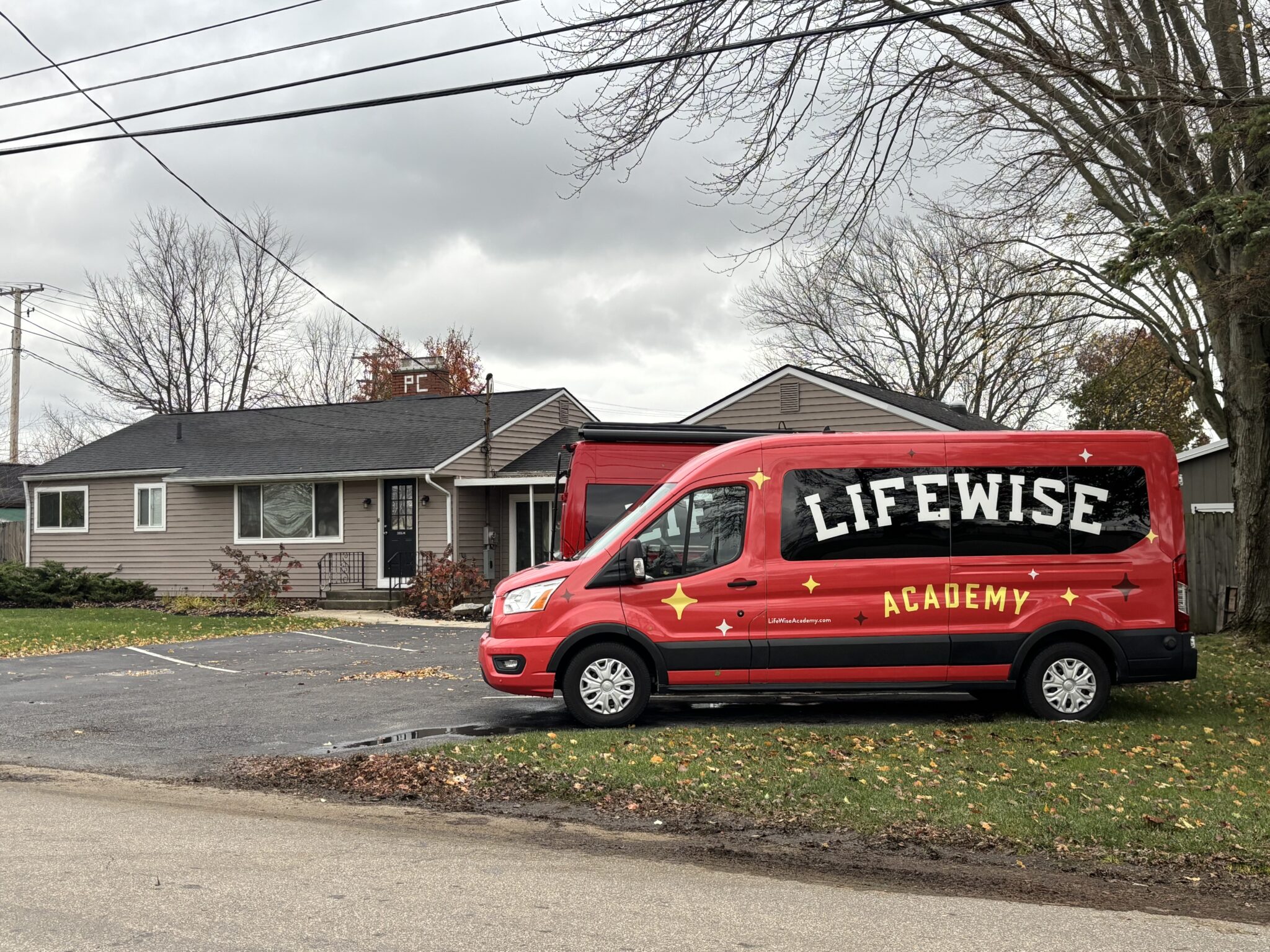
LifeWise Academy is a Hilliard-based religious instruction program that started in 2019 and now enrolls 50,000 students across 29 states. (Photo by Megan Henry, Ohio Capital Journal.)
Ohio Senators have added a public school mandatory religious release time policy bill to a piece of legislation that would force educators to out a students’ sexuality to their parents.
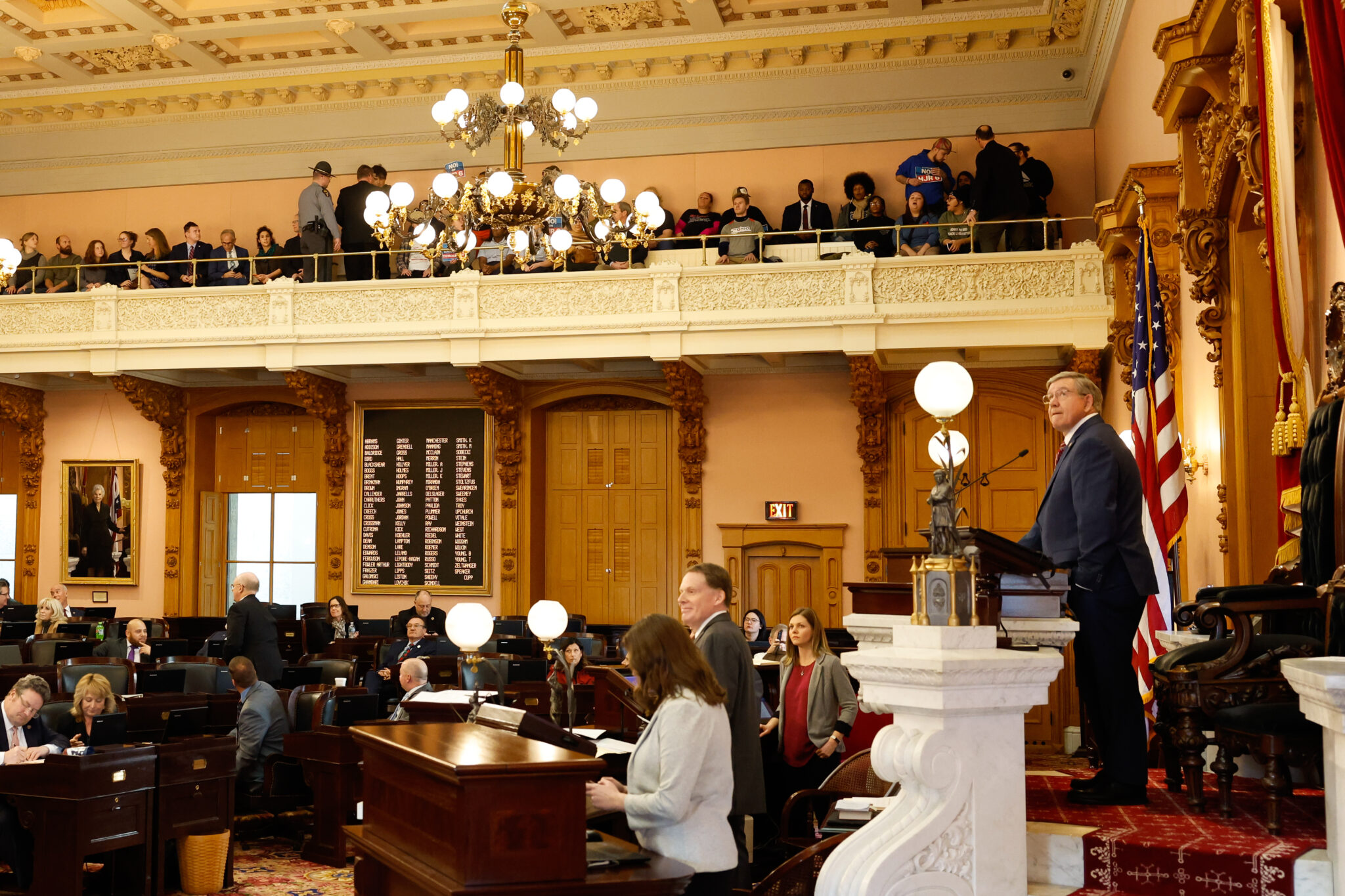
The amendment to require Ohio public school districts to put a policy in place to release students for religious instruction was added to House Bill 8 during last Tuesday’s Senate Education Committee Meeting. The two Democrats on the committee, Catherine Ingram and Vernon Sykes, voted against the amendment.
“A school district shall, rather than may, have a policy governing religious release time instruction,” said state Sen. Sandra O’Brien, R-Ashtabula.
Ohio law currently permits school district boards of education to make a policy to let students go to a course in religious instruction, but this would change the wording in the Ohio Revised Code from “may” to “shall” — meaning this would be a mandate for Ohio school districts.
State Reps. D.J. Swearingen, R-Huron, and Sara Carruthers, R-Hamilton, introduced H.B. 8, which passed in the Ohio House last year. The bill would require public schools to let parents know about sexuality content materials ahead of time and give them the option to request alternative instructions.
GET THE MORNING HEADLINES.
It would also ban any sexuality content from being taught to students in kindergarten through third grade. The bill defines sexuality content as “oral or written instruction, presentation, image, or description of sexual concepts or gender ideology.”
Senate Minority Leader Nickie Antonio, D-Lakewood, said H.B. 8 is not what Ohio needs.
“It’s certainly not what the children and the teachers and the parents of Ohio need,” she said. “I think we need to maintain the ability of children to be able to talk to teachers, social workers, counselors, with some confidentiality, and parents need to be able to be involved with their children, but also know that sometimes children need somebody to talk to.”
There were 62 parental-rights bills in 24 states last year, according to FutureEd, an independent think tank at Georgetown University’s McCourt School of Public Policy.
More amendments were added to H.B. 8 during Wednesday’s Senate Education Committee meeting.
“This amendment creates exceptions for disclosure requirements where they would conflict with federal law,” O’Brien said. “It also clarifies that nothing in House Bill 8 prohibits mandatory reporting under state law. Lastly, the amendment clarifies that nothing in House Bill 8 prohibits or limits career and academic mentoring between a teacher and student.”
Religious release time
The amendment language was taken from two companion bills regarding religious release time — Senate Bill 293 and House Bill 445. Hundreds of people have submitted opponent testimony against both bills, which are in committee.
Two central Ohio school districts, Westerville and Worthington, recently rescinded their religious release time policy. Both districts formerly allowed LifeWise Academy to take public school students off-campus for Bible classes during school hours.
The United States Supreme Court upheld released time laws during the 1952 Zorach v. Clauson case, which allowed a school district to have students leave school for part of the day to receive religious instruction.
Release time in the middle of the school day is problematic, Antonio said.
“It disrupts the flow of (students) dealing with their studies,” she said. “I think it needs to be on an individual school district basis to make those kinds of decisions.”
About 170 people submitted opponent testimony against the newly amended H.B. 8 at Tuesday’s Senate Education Committee. H.B. 8 was up for a possible committee vote, but no vote was taken. The bill has had six hearings in the Senate Education Committee.
The two-year General Assembly wraps up at the end of the month, so any bill that doesn’t pass will die and would have to be reintroduced in the next General Assembly. The final House and Senate sessions of the year are currently scheduled for next week.
State Rep. Gail Pavliga, R-Portage County, recently introduced House Bill 686, which would also prohibit a public university from asking a job candidate their preferred pronoun on an employee application. Ohio has 14 public universities.
“There is no need for a university to require this information, it is clearly not a sufficient indicator of someone’s college readiness,” Pavliga said in her sponsor testimony at a recent Ohio House Higher Education Committee meeting. “So why should it be included in our applications? Providing an optional field for pronoun usage outrightly distinguishes groups based on their political ideology.”
Anecdotally, she said she has talked to many young Republicans who said they don’t fill out pronoun questions on applications.
“Those who do not respond to the pronoun prompt are much more likely to lean right on a political spectrum and those who do answer the prompt are much more likely to lean left on a political spectrum,” Pavliga said. “Applicants should not be declined admission based on their political ideology, yet without this bill that is a strong reality.”
H.B. 686 addresses bias in higher education, she said.
GET THE MORNING HEADLINES.
“We are trying to assess the readiness of an individual, whether it be for employment at the university or for admission as a student,” Pavliga said. “The usage of a pronoun really provides no indication of that readiness or that qualification.”
State Rep. Beryl Brown Piccolantonio, D-Gahanna, said people generally prefer to be addressed in the way they identify and said there is sometimes confusion around her name, causing her to sometimes receive correspondence addressed to her as Mr. Piccolantonio.
“Beyond the issue of bias, do you think that there is any purpose to making sure that when we address people, that we’re addressing them in the way that they actually live in the world?” she asked.
Pavliga responded by saying although a person’s preferred pronoun wouldn’t be asked on the application, she said nothing in H.B. 686 would prohibit a question from being asked about a person’s preferred pronouns at any other time.
The Common App, an online portal many students use to apply to several colleges and universities, has an optional pronoun question. More than 1,000 colleges and universities nationwide use the Common App as part of the application process — including 13 of Ohio’s public universities. Northeast Ohio Medical University does not use the Common App.
“I am sure if some of the biggest colleges in the country request for the field to be deactivated for their institution, that wouldn’t be a problem,” Pavliga said.
Even though the bill is introduced by a Republican, Higher Education Committee Chair Rep. Tom Young, R-Washington Twp., said H.B. 686 isn’t a Democrat or Republican bill.
“It’s a matter of choice and options on the applications,” he said.
Megan Henry is a reporter for the Ohio Capital Journal and has spent the past five years reporting in Ohio on various topics including education, healthcare, business and crime. She previously worked at The Columbus Dispatch, part of the USA Today Network.
Ohio Capital Journal is part of States Newsroom, the nation’s largest state-focused nonprofit news organization.
Next year is sure to be a busy one when it comes to education in Ohio, with potential state agency overhauls and funding changes still on the agenda for the state legislature.
The end of 2022 was capped by an 11th-hour push and ultimately failure for an attempted overhaul of the Ohio Department of Education and the state Board of Education. Senate Bill 178 was never passed in an Ohio House committee, so it was folded into another bill with controversial provisions, House Bill 151.
House Bill 151 included bans for trans youth in participating in sports based on their gender identity, and after SB 178 was included, the bill came in at more than 2,000 pages. But despite delaying the vote until after 2 a.m. on the last day of the legislative session, the bill and its many provisions failed to garner enough votes in the House.
LGBTQ advocates hailed the failure of House Bill 151, which still would have required the use of birth certificates to prove a student’s gender, despite the elimination of a provision that would have required a genital exam.
“I can not begin to express my gratitude to the hundreds of community members and advocates who stood up for the rights of all transgender youth to participate in all parts of life as whole people, including sports, just like everyone else,” said Alana Jochum, executive director of Equality Ohio, after the bill failed to pass.
Dr. Rhea Debussy, director of external affairs for Equitas Health and former facilitator for the NCAA’s Division III LGBTQ OneTeam Program, said the thrill of seeing the legislation voted down was tempered by concern that the bill even existed.
“It’s very alarming that a group of legislators thought bullying gender expansive and intersex youth was an urgent need for the final hours of Ohio’s 134th General Assembly,” Debussy said in a statement.
Senate Bill 178
Education officials not only celebrated the failure of HB 151’s anti-trans legislation, but the downfall of the rapid-fire education overhaul they overwhelmingly said needed more time and more vetting.
“OEA believes it is worth taking a hard look at how Ohio’s schools are governed and supported at the state level,” said OEA President Scott DiMauro in a statement. “However, collaboration is key.”
Senate President Matt Huffman said he was “disappointed that our school reform bill and our attempt to do something about girls’ sports … I’m disappointed that those things failed.”
But Huffman maintained the stance he took after the Senate passed HB 151 on to the House for a vote earlier this month, that if the education overhaul part of the bill didn’t pass during the 134th GA, it would move on to the 135th.
“I’m glad we took the vote because we kind of have on the record who’s where, and there probably is a lot more due diligence that needs to be done on that issue,” Huffman said.
Some ups, more downs
While some funding changes were implemented — such as $56 million in state funding for Disadvantaged Pupil Impact Aid, increases in Elementary and Secondary School Emergency Relief funds and federal monies for school security and safety — public schools are still looking for full funding of the Fair School Funding Plan (formerly called the Cupp-Patterson plan, after Speaker Bob Cupp and former state Rep. John Patterson, the legislators who created it). The plan was previously funded for the two years of the current General Assembly, but needs another four-year commitment of funds to be fully phased in.
That plan, according to the OEA, “represents the first constitutional school funding system in the state in decades.”
The effort for better public school funding is flanked by a lawsuit moving forward in Franklin County Common Pleas Court that seeks to nullify the EdChoice private school voucher system in the state. A coalition of school districts and individuals joined together to file the lawsuit, and Franklin County Judge Jaiza Page recently ruled against the Ohio Attorney General’s Office, who argued the lawsuit should not be allowed to continue.
“This means we will put vouchers on trial in a court of law,” the coalition behind the lawsuit, Vouchers Hurt Ohio, wrote in an email newsletter, though the timeline for the court case could go on for some time.
Private school vouchers are on the minds of congressional Ohioans as well, with U.S. Sen. Sherrod Brown pushing for more investment in federal Head Start programs and more funding for public schools.
“We have a state government, one of whose major aims seems to be to privatize public schools,” Brown said in a press call. “They have moved more and more money out of public education into religious schools and other private schools … and really undermined what state government should be doing and that is funding public education for the great majority of students in our state.”
Teachers unions and public officials alike wanted to see efforts to stem the state’s teacher shortage, a rise in the teacher wages that have stagnated over the last 25 years and changes to the third-grade reading guarantee, both of which saw action in the legislature, but did not come to fruition.
As the state’s Board of Education awaits the fate of the department and the board itself, they still have a decision to make: the search for a superintendent of public instruction.
The board spent months on issues such as a resolution condemning racism in education, then a resolution repealing that racism measure, and finally a resolution urging the federal government not to include gender identity in anti-discrimination language that would impact education policy.
But in their December meeting, they decided to punt on the issue of hiring a search firm to select candidates to fill the open position that heads the department.
The board voted to wait until SB 178 was passed or rejected by the legislature, for fear that candidates for the position might change their minds once they found out how the roles of superintendent would change under the new bill.
The Ohio House did not agree to Senate amendments to a bill banning trans athletes from participating in youth sports based on their gender identity, leaving behind more than a thousand pages of state education overhauls loaded in at the last minute.
House Bill 151, with language from Senate Bill 178 attached to it was voted down in the House by a 46-41 vote after 2 a.m. on Thursday morning following an entire day of hemming and hawing.
The education overhaul is not completely done yet. Even if lawmakers decline to move forward in the current General Assembly, Senate President Matt Huffman previously pledged to bring the bill back in the new year, with a General Assembly that will have an even larger GOP supermajority.
The education overhaul part of the bill, which entered the House as a standalone this week after passing the Senate last week, would have restructured the Ohio Department of Education into the Department of Education and Workforce, and reduced the state Board of Education roles down to superintendent searches, teacher conduct and licensure issues.
“The system is not working, it doesn’t prioritize our students,” said bill sponsor state Rep. Don Jones, R-Freeport.
The department, and most of the roles currently under the state board of ed and state superintendent’s purview would have been put under the governor’s office umbrella, according to the bill.
The State Board of Education put off hiring a search firm for the next superintendent due to concerns about budgetary changes SB 178 might bring and fears the legislative uncertainty might “pollute” the marketplace of candidates.
The bill also received pushback from public school education advocates and some homeschooling groups. The Ohio Education Association and the Ohio Federation of Teachers both spoke against the bill in committee hearings, not only decrying claims that the ODE was unresponsive and inaccessible, but also criticizing the pace at which the bill came through the General Assembly.
SB 178 sponsor state Sen. Bill Reineke, R-Tiffin, said attempts to redo the state agencies have been years in the making and urgency is needed to help improve student success.
“I’m not looking at growing an organization; I’m looking at making it more efficient and more structurally purposeful,” Reineke said on Tuesday as he defended his bill in House Primary and Secondary Education Committee.
It was up to that committee to pass the standalone bill over to the House for a full vote, something that didn’t happen in a Tuesday night committee that went until about 9 p.m., or a Wednesday morning meeting that recessed before the House’s session began, and didn’t return even after multiple recesses in that body.
When committee chair state Rep. Gayle Manning, R-North Ridgeville, was asked the status of the bill or the committee at about 9 p.m. Wednesday night, she said she was waiting to see what the GOP caucus was thinking on the matter.
Amidst the day-long discussion, the Senate decided to take matters into its own hands, inserting SB 178 into HB 151, originally meant to be a teacher mentorship bill that was made to include a ban on athletes competing on teams based on their gender identity.
The Senate also tried to slide in language from a bill that would have banned COVID-19 vaccine mandates for K-12 students.
After the additions, HB 151 passed on a party-line 23-7 vote in that chamber, moving it back to the House.
The controversial part of HB 151 was added in another late-night move in June, when HB 151 was up for passage in the House before moving on to the Senate. The trans athletes part of the bill no longer includes a requirement for genital inspections of children suspected of being transgender, something Senate President Matt Huffman previously said he wouldn’t support.
Verification of a student’s gender will be done using a birth certificate in the new version of the bill.
“This bill only applies to K-12 education, so our daughters in grades kindergarten through 12 will not have to compete with biological males in primary and secondary schools,” Jones said.
The bill would impact very few Ohio students and policies are already in place to keep equality in youth sports, causing LGBTQ advocates, education leaders and the Ohio High School Athletic Association to stand against the bill as unnecessary.
The original language of the bill would make changes to the Ohio Teacher Residency Program and teacher mentorship.
Democrats pushed hard for the House not to support the bill as amended, saying stakeholders needed to be involved and more time was needed to find out the impact of it.
State Rep. Phil Robinson, D-Solon, continued an argument made by critics of the bill that the volume of the bill didn’t get the proper review by legislators or individuals in Ohio education.
“Passing something at 1 o’clock or 2 o’clock in the morning that no one’s read and no one’s seen … is not the way to change education in the state of Ohio,” Robinson said.
State Rep. Jeff Crossman, D-Parma, said the bill was “moving deck chairs on a sinking ship” by addressing issues that don’t solve the true problems in Ohio education.
State Rep. Juanita Brent, D-Cleveland, said the bill would impact economic success in Ohio by making conferences question coming to the state and businesses wonder whether or not to bring employees to the state. She also said passage of the bill in the middle of the night would send a message to current Ohio voters as well.
“We’re telling Ohioans who elected us that they can’t be seen in this process,” Brent said.
David Miller is the Managing Editor of Loveland Magazine
by David Miller
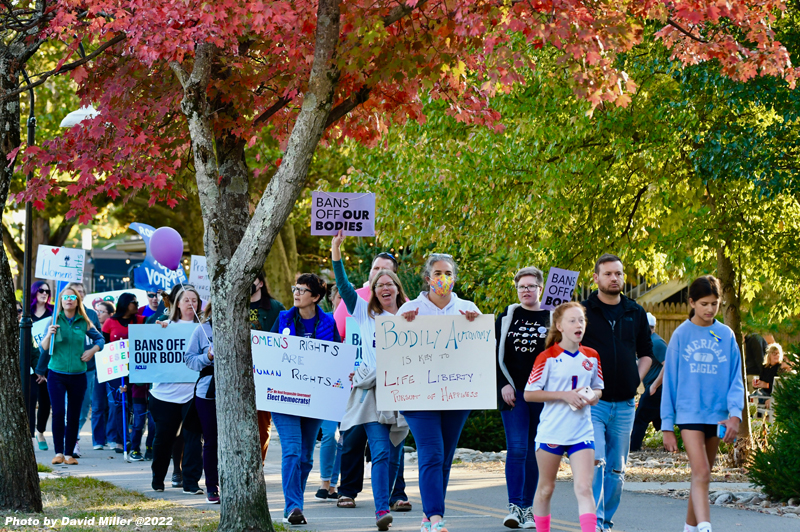
Loveland, Ohio – Adults and children from across the tri-state gathered in Nisbet Park along the Little Miami River in Historic Downtown on a sunny and warm Fall Sunday afternoon to be part of a “Women’s Wave” of activists out to change the course of voting patterns in our community. After speeches, they walked for an hour throughout our business district and along the Loveland Bike Trail engaging locals and tourists with the refrain of the sentiments they were so adamant about. It was a demonstration for human rights and as odd as that sounded throughout the streets of this quaint community nicknamed, “The Sweetheart of Ohio” it happened. “Human Rights” that have been taken away from themselves, their children, and those they love. The political agenda on most minds was the U.S. Supreme Court overthrowing Roe v Wade and a woman’s right to have an abortion, reproductive rights such as birth control, and how that decision led to even more extreme legislation and proposals from some elected officials at the Ohio Statehouse, and in D.C.
Health care, including the sometimes life-saving medical care of needed abortions and the tangled net that women and their healthcare providers are caught in, gun violence, mass shooting in schools, the right to gender equality, LGBTQ people’s rights, and a safer future for young girls were all talking points throughout the afternoon.
Many Democratic candidates for local and state offices spoke and a candidate for the U.S. House. Parts of Loveland are in Ohio Representative Jean Schmidt’s district and the local organizer, Bailey Moak, said that is why she chose downtown Loveland for the event location. She wants to show Schmidt where the unemployment line is. She believes that Schmidt and other currently serving politicians don’t align with Loveland’s values.
I asked organizer Moak on Monday to send me some of her thoughts after the event had ended. You can also watch her speaking at the event and watch a photo essay of photos from the event below. The rally was certainly an appeal for local “pro-choice” residents to get to the polls on November 8 and vote for “pro-choice” candidates, however, the photo essay will explain why so many people gathered in the park, their myriad reasons, and then marched.
I found the event to be a huge success. We met our goals to engage and educate voters, raise awareness to threats against women’s rights in our community and shed light on dangerous politicians like Jean Schmidt from Loveland who proposed legislation to ban medical care to women and children across Ohio (HB598), and ban access to curriculum on diversity and inclusion to students across our state (HB616).We rallied, we celebrated the promise of what new leadership can do to preserve and expand our freedoms, and we marched in protest of extremism and hate.During the March we disrupted some nice family dinners occurring on the patios of local businesses in Downtown Loveland with our passionate demonstration. This disruption is NECESSARY. All too often we side-step important discussions with our families, friends and community members to avoid feeling uncomfortable. The only way individuals, families and communities can grow is through engagement and vulnerability, which can result in a bit of discomfort. As demonstrators passed, families and friends breaking bread together were compelled to address important topics, which in my experience, leads to understanding and connection. This is why we Listen. This is why we Speak. This is why we Act. We do it for our communities and families.I want to thank our passionate volunteers and our speakers: Brian Flick, Dr. Jeanne Corwin, Dr. Vanessa Enoch, Dr. Nabila Babar, Joy Bennett, Jen Perez and Rep. Jessica Miranda, and our partnering organizations: Ohio Physicians for Reproductive Rights, Ohio ACLU, Ohio Red Wine and Blue, the Ohio Democratic Women’s Caucus and Democracy in Action for participating in this event.I also want to thank the City of Loveland, the Loveland Fire Department, and Loveland PD Chief, Michael Gabrielson for their support in working with event organizers to ensure this was a safe and successful event that this community can be proud of.
Since 2008, Hope Restored Counseling Services has proudly served the residents of Loveland and our surrounding communities, providing therapy to individuals, couples and families. We continue to grow in both size and capabilities, and we have established a variety of groups to address the various needs of our clients. We counsel children, adolescents and adults in order to address issues including, but not limited to, depression, anger, anxiety, grief and loss, substance abuse and spectrum disorders. All of our therapists are experienced, professional, and consistently develop strong bonds with those who seek our services. Hope Restored Counseling Services. Hope for Today, Change for Tomorrow.
Cassie Mattia lives in Historic Downtown Loveland, Ohio.
If we don’t protect our youth who will? In May, Ohio Paul Zeltwanger and Thomas Brinkman proposed House Bill 658, which states:
“If a government agent or entity has knowledge that a child under its care or supervision has exhibited symptoms of gender dysphoria or otherwise demonstrates a desire to be treated in a manner opposite of the child’s biological sex, the government agent or entity with knowledge of that circumstance shall immediately notify, in writing, each of the child’s parents and the child’s guardian or custodian. The notice shall describe the total circumstances with reasonable specificity.”
gen·der dys·pho·ri·a
ˈjendər disˈfôrēə/
noun
MEDICINE
The condition of feeling one’s emotional and psychological identity as male or female to be opposite to one’s biological sex. How to pronounce gender dysphoria.
In plainer language House Bill 658, also known as the “Parent’s Rights Bill,” would make any school administrator or teacher who allows or offers gender dysphoria (the condition of feeling one’s emotional and psychological identity as male or female to be opposite to one’s biological sex) treatment, including resources on sex and gender or counseling, for a minor “without the written, informed consent of each of the child’s parents and the child’s guardian or custodian” they could be charged with a felony in the fourth degree. The parents of the student according to the bill would get the ultimate decision whether their child gets access to treatment, including educational materials, counseling or medical services.
If this House Bill is implemented it could have detrimental consequences for teachers and even more importantly for those students affected. Teachers are there to lend their students a helping hand educationally and emotionally in order to prepare them for what’s to come once they are out on their own, why take this from them?
A teacher’s take on House Bill 658
I spoke to one Loveland teacher who wishes to remain anonymous, a mom of a teenager. I’ll call her Susan. She told me that for many students their home life is a wreck and out of control with issues of poverty, broken families, and domestic abuse. “For many of my students, the only adult in their life that can be trusted may be their teacher. Teachers who lend an ear and can be trusted can be an enormous help that often reflects on their academic achievement. We care for the whole child.”
Susan told me that for many students their home life is a wreck and out of control with issues of poverty, broken families, and domestic abuse. “For many of my students, the only adult in their life that can be trusted may be their teacher.”
Susan told me that she just overheard a conversation between her daughter and a friend about a classmate they thought was transgender. “I wondered, do they know what that means? Are they friends with this young person? How do my kid and others treat her? Because I am a teacher, would I be required to file a report with the District? These are all questions that ran through my head as a mom and a teacher.”
Susan said she wants to protect and support all of her kids, her biological ones and the ones that are “her’s” for a school year. “I want to be able to do that freely and openly and with my heart.” She said that some of her students desperately need someone they can trust in their life and the last thing they need is another person that will let them down because politicians want school staff charged as felons if they don’t report that the student herself, or a classroom teacher, principal, gym teacher, bus driver, or classmate may be questioning her gender identity.
Susan asked, “Just what stereotypes am I going to be expected to police?
HB 658 is a harmful bill that takes aim at some of our most vulnerable — transgender youth — by forcing school officials to serve as ‘gender police’ and out them or risk getting a felony.” – Alana Jochum
LGBTQ advocacy
“HB 658 is a harmful bill that takes aim at some of our most vulnerable — transgender youth — by forcing school officials to serve as ‘gender police’ and out them or risk getting a felony,” said Alana Jochum, executive director of LGBTQ advocacy group Equality Ohio. Jochum told NBC News. “This exposes young people to discrimination, harassment, and bullying.”
Jochum couldn’t be more correct if you really take a look at the alarming statistics. One study done by the Cincinnati Enquirer showed that 64% of LGBTQ youth in Ohio heard “negative comments” about their gender identity or sexual orientation from their family and in result, according to another study done by National Transgender Discrimination, 41% attempted suicide. Though many transgender students
75% of transgender youth have felt unsafe at school after being outed and have lower GPA’s due to missing school in fear of their safety.
have experienced negative comments, violence has become the most popular form of dealing with transgender youth. Disturbingly enough 19% of transgender youth, according to the National Center for Transgender Equality, experience the majority of violent abuse in their home from their own family members. Along with dealing with all the dissension from family members 75% of transgender youth, according to a national survey done by GLSEN (pronounced “glisten”), have felt unsafe at school after being outed and in result have lower GPA’s due to missing school in fear of their safety. With all the facts at hand, The Ohio Education Association who represents 125,000 teachers and support professionals, have openly opposed the bill.
Violence has become the most popular form of dealing with transgender youth.
Kathryn Lorenz is the Loveland Board of Education Vice President
While researching House Bill 658 I managed to only get a response from two local representatives of the Loveland School Board, one being Kathryn Lorenz, the Board Vice President and the other being Loveland School Board Member, Ned Portune. Lorenz’s response was, “In the case of House bill 658, we would have to say that we do not yet have enough information, nor have we met as a board for a few weeks, so we do not yet have a Board statement to make.”
Ned Portune is a member of the Loveland School Board
Portune added that he, “…simply has not been fully informed at this point on HB 658 to have an educated opinion. There are several items in your statement that would certainly give me a gut reaction, and opinion on, if true as presented. But I need time to fully review the Bill, its implications and existing laws to have any formal statement.”
School Superintendent Amy Crouse, High School Principal Peggy Johnson, and assistant principals at the High School did not respond.
Studies show most transgender youth are fully aware of their gender identity by age 4.
After attempting several times to contact both Representatives Paul Zeltwanger and Thomas Brinkman through email and phone about House Bill 658, I, unfortunately, got no response. It wasn’t hard to find Brinkman’s opinion on the issue in several other publications though, voicing to WCPO, “Parents have the right to decide what is best for their children,” and telling WOSU Public Media, “And if somebody doesn’t like it, you’re emancipated at age 18 and you can go do whatever the heck you want.” Seems pretty harsh considering the transgender population represents about 0.3% (700,000) of Americans and studies show most transgender youth are fully aware of their gender identity by age 4. Are we encouraging parents and administrators to discard their students or child’s gender identity in fear of social rejection? Do these children not deserve to live an authentic life?
Fran Hendrick, PCC has offices at Wildflower House in the West Loveland Historic District.
House Bill 658 is expected to be presented to the Ohio General Assembly in the Fall and will be without a doubt one of the most controversial bills to date. Many have opinions on this issue one being Fran Hendrick, a respected and highly educated clinical counselor who specializes in assisting women and girls who are experiencing depression or anxiety triggered by a crisis or major life change. When I presented Fran with House Bill 658 and asked what her opinion was she had a lot to say and rightfully so considering one of her life missions, according to Fran’s website franhendrick.com, is to “gently help you find and shelter your spark (the essence of who you are at your core) and grow it so that it illuminates your person and is radiated through words, actions and decisions, big and small, that make up your daily life.”
In a culture such as ours, it is a matter of life and death for transgender youth to decide if and when to trust another person with their reality. – Fran Hendrick, PCC
“Being a parent takes great courage, even more so when your child presents you with something that you’re unfamiliar with – or even afraid of. In a perfect world, a child who feels somehow ‘different’ from their peers (‘their’ is deliberately gender-neutral), they could consult their parents, who would strive to deeply understand the child’s experience, would provide accurate empathy, and would go on a crash course to learn everything they could about the unfamiliar issue. And, so very fortunate for their children, there are many parents like these.
But in the real world, an adolescent boy saying to his father, ‘Dad, I think I’m a girl’ is very likely to encounter disgust, rejection, rage, or even violence, not empathy and understanding.
While the intent of this bill, giving benefit to grave doubt, could be a deeply uninformed and misguided attempt to protect children, that seems unlikely. My sense is that in truth it is more about attempting to hand parents the power to say no to their child’s gender identity,” Hendrick said, “But gender identity – and sexual orientation, for that matter – are not matters of choice. And in a culture where transgender people are assaulted and even murdered at a rate higher than their cisgender counterparts,where transgender youth are summarily shunned and rejected by their own parents (the rate of homelessness is, not surprisingly, very high), where the suicide rate that results from these atrocious facts is far higher than for other youth – in a culture such as ours, it is a matter of life and death for transgender youth to decide if and when to trust another person with their reality, and, most importantly, whom to trust.
To be “outed” for the choice to trust; or to be prosecuted for trying to be help – these are not protections. Actions like these support bigotry, and increase isolation and despair. – Fran Hendrick, PCC
To be “outed” for the choice to trust; or to be prosecuted for trying to be help – these are not protections. Actions like these support bigotry, and increase isolation and despair. Stopping a teacher from helping such a student, one who is likely alone with the reality of their gender identity, who stands to be emotionally and psychologically rejected, or even physically abused, by their own family is, quite simply, a cruelty. This, I strongly believe, is not what the overwhelming majority of parents want for their own or anyone else’s children. This is bad enough. However, this bill opens the door to much more far-reaching damage than this.”
Is he to be turned in to the gender police?
The talented young male artist who despises sports – is he to be turned in to the gender police? The girl who chooses overalls and a t-shirt rather than a dress and a mani-pedi –what of her? The sponsors of the bill have explicitly said that teachers should be required to inform on them, as well. We have an essential responsibility to ensure that proposed legislation protects vulnerable people from the bigotry endemic in our society.This legislation explicitly deprives them of protection.”
Ultimately what it comes down to is ensuring that our children are and feel safe when going to school. Teachers and administrators are the ones that take on the responsibility of creating that fun, loving and supportive atmosphere so that our children get the best opportunities in life. Passing a bill such as House Bill 658 only presents another obstacle that both teachers and administrators have to overcome. Don’t these professionals have enough obstacles to conquer as is?
Both Justin Haake and Tonya Schaeffer who are Professional Clinical Counselors for Hope Restored Counseling Services in Loveland couldn’t agree more.
Justin Haake is a Licensed Professional Counselor at Hope Restored Counseling Services in Loveland and works primarily with adolescents and adults, specifically during transitional periods in life.
Haake said, “For some, teachers and school administrators may be the only people in schools that feel safe for students to reach out to.Imagine the fear of asking for support, knowing that you’ll either be outed or put the teacher or administrator at risk of a felony.”
Schaeffer said, “From my perspective, this would most likely increase the level of bullying and possible harm to these students.There is already so much shame and stigma attached with Transgender people, and they need as much support as they can get,”
Tonya Schaeffer is a Licensed Professional Clinical Counselor and co-owner of Hope Restored Counseling Services in Loveland.
Schaeffer added, “Support is out there.In fact, we are offering a psycho-educational group starting in September that offers education, support and a safe environment for Transgender students to express themselves.” She said they hope to offer a similar group to parents who are trying to understand what their child is going through, explore what the parents are experiencing and provide support. “We currently serve the LGBTQ community, and we are expanding those services.I recently read a statement that it is estimated that 41% of trans men and women have attempted suicide. I don’t believe this bill would help–it seems like it could only hurt.”
Susan, the mom and teacher said, “I am thankful I live in a community where support services like those provided by Hope Restored, and Fran Hendrick at Wildflower House are nearby for my students and their families.”
Transgender youth have so many mountains to climb within their own scientific makeup and allowing a bill like House Bill 658 to go through in hindsight is taking away their basic rights as Americans and human beings.
“GLSEN (pronounced “glisten”) was founded in 1990 by a small, but dedicated group of teachers in Massachusetts who came together to improve an education system that too frequently allows its lesbian, gay, bisexual, transgender, queer and questioning (LGBTQ) students to be bullied, discriminated against, or fall through the cracks.”
We can all help prevent suicide. The Lifeline provides 24/7, free and confidential support for people in distress, prevention and crisis resources for you or your loved ones, and best practices for professionals.
You can #BeThe1To help someone in crisis.
You don’t have to be a mental health professional to help someone in your life that may be struggling. Learn the Lifeline’s 5 steps that you can use to help a loved one that may be in crisis.
CAPS 24 hour Consultation and Crisis Helpline: Evenings, weekends, and other times when we are closed, you may call our direct number at 513-556-0648 and press 1, to speak with a counselor 24/7. For more information on services for students in crisis
National Suicide Prevention Lifeline: 1-800-273-TALK (8255)
NAMI: National Alliance on Mental Illness is the largest grassroots mental health organization dedicated to improving the lives of individuals with mental health concerns. www.nami.org
Suicide Prevention Phone Apps
LifeBuoy – This unique app is designed specifically to assist suicide survivors after a recent attempt. It offers a daily mood diary, suggestions for decreasing social isolation, and other ways to monitor increased warning signs of suicidality. (iP)
Virtual Hope Box – This app provides help with emotional regulation and coping with stress via personalized supportive audio, video, pictures, games, mindfullness exercises, positive messages and activity planning, inspirational quotes, coping statements, and other tools. (iP,A)
ReliefLink – This award-winning suicide prevention app assists users with tracking daily mood/thoughts, creating a safety plan, locating the nearest hospitals, and obtaining quick-access to coping methods. (iP)
National Hotlines
A Friend Asks – This app offers tips for getting help for a friend (or yourself). Helpful information includes what to do RIGHT NOW as well as what NOT to do. (iP,A)













 If you would like to explore the topic of Transgender youth and adults even further please check out “