At least one pair belonged to you
She always slipped back into her own
by David Miller
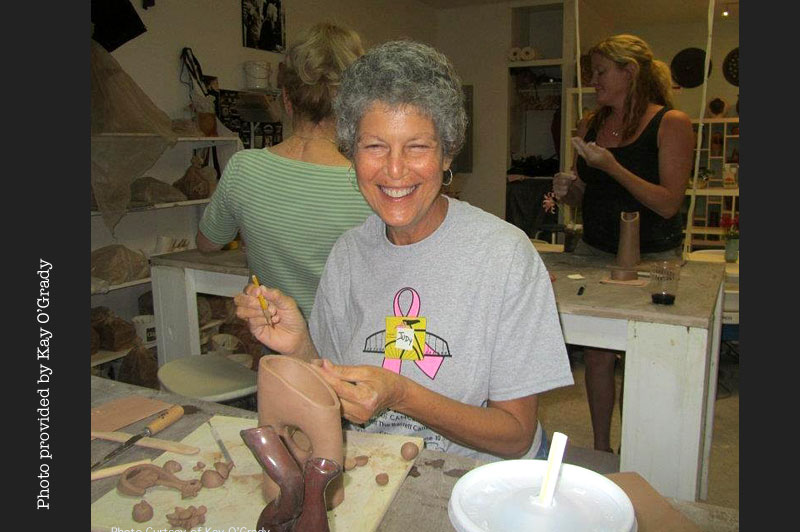
A reoccurring theme rang at the visitation, funeral, and two nights of Shiva for Loveland resident Judy Leever.
This is a reprint of an Editorial Published in Loveland Magazine on October 17, 2012. October 12 is the anniversary of Judy Leever’s passing
Judy always made us see things from the perspective of others, and we all tried to plant in our subconscious, the lessons of her life and vowed to attempt to spend our remaining days living a life wearing HER shoes.
Judy owned a thousand pairs of shoes, nearly all belonging to other people. She possessed an uncanny ability to make these shoes fit our own feet as well.
We wore each other’s shoes three weeks ago, during our mourning time. We listened to one another’s other’s sadness at her too early passing at age 59 on September 29, 2012 after battling breast cancer and its drugs – because we were sure she had more to teach us. Truth be told however was that if we were listening and watching – her life was one lived, always… with certitude and steadfastness. She had nothing more to teach, because Judy wasn’t going to change and suddenly teach a more profound lesson. She had already lived her quite profound life. She saw life’s complexities and confusion, it’s conundrums, its needs filled, from the perspective of others.
About 400 family and friends, standing room for the late arrivers, attended the service, at midweek, a mid-morning service at Congregation Beth Adam, just outside of Loveland. A hundred or more helped bury her humble poplar coffin; waiting in silence until a entire mound of earth was put back in place by family and friends shoveling, not departing until finished by a backhoe at the United Jewish Cemetery in Montgomery.
Later, hundreds gathered in the side yard at her downtown home in Loveland for two nights of Shiva. Prayers, and songs on the bank of a popular stream. Lovers holding hands. On one side O’Bannon Creek. On one side the “Loveland Bike Trail”. A fitting setting now decorated for Judy with homegrown flower bouquets, brought by mourners and adorers in simple household jars scattered about and placed on any available ledge, garden rock, or garden table. Loud crashing walnuts thumped to the earth on this late summer evening looking to get to the earth and begin a new life – punctured the sometimes silence like drumbeats. From the not to distant Nisbet Park, children sounds of late summer evening play. Muffled chinwag from couples walking nearby. Runners, joggers, and bicyclists along the Little Miami Scenic Trail, most unaware of the contributions Judy made to preserve its natural beauty and oblivious to the sadness nearby.
During prayer, “It’s a dangerous thing to love what death will take away.”
Six stacked canoes on top of one another nearby. A bicycle leaning against a tree. A clothes line with faded brownish grey pins. Sparks from the fire pit near the creek aided conversation. Wooden garden cart. A weeping willow. A hammock tied to Maples starting to turn. A sitting bench also. All of it spoke to the family lifestyle. Absent her home was a TV. Inside the home was now packed almost beyond capacity as mourners filled plates of potluck. Two by two faces, memories shared until they had to again go outside to make room for others. Outside again… resumed these intimate, quiet, two on two conversations. The downtown chimes on top of the nearby, old water works plant wept sentiment. Newborns clenched to mother’s breasts.
Judy’s mate was her husband Bruce. They shared a real estate business. They lived in a passive solar home they crafted in Maineville before moving to Loveland in 1994. The Leever family once spent the entire summer living in a modest tent in their back yard in Maineville, to “teach their children well.” They were married for 32 years. Three tall proud successful sons, Glen, Will, and Michael. A brother Robert from Silver Spring Maryland. And, a cast of thousands of close friends and acquaintances; recipients of her generosity of devoted personal time, a gentler community because of her console, a cleaner river, cleaner drinking water, green space that condo projects and “progress” once threatened, food on the food bank shelves.
She welcomed teens into her home. She loved and nurtured her close religious community, helped organize concerts in the park and celebrations of Martin luther King Day in Loveland. She sang in the Martin Luther King Chorus in Cincinnati’s celebration.
We were recipients of her grace as she lost the fight with her disease.
Was Judy the community weaver? Didn’t she straighten our fibers? Did she stretch our seams?
The town cobbler?
All that aside, even though more than enough public service for ten long lifetimes, Judy left behind shoes to fill. What was it about Judy? How did she so often see that you would fit into the shoes of others if only given some of her wise second thoughts? No one quite had the answer to “How” but, non-the-less it was the subject of most of the conversation, because most knew it was her most inspiring legacy – that should be imitated in a fair, just, town… for raising children and growing old in.
Judy genuinely loved the outdoors… loved walking errands, walking on the grounds of Grailville several times a week. Walked 400 miles of the Appalachian Trail. It felt as if she belonged on the ground some how or another. Rode her bike to the library and Kroger.
Judy made you feel at home in her own house as if you belonged. “Yes. Yes.” She was well grounded.
Judy hosted meet the candidate nights for presidential campaigns, locals, and judges – and grant writing workshops for non-profits.
She was active in fermenting plans for “Heartland Eco Village” at Grailville. She wrote the first prospectus for what may some day be a worldwide example of self sustainable community living. She volunteered in the organic Grailville Gardens.
She wrote the 501-C-3 the application for the Loveland Farmers Market and often volunteered on market day.
She and family were early members of Leaves of Learning, a cooperative home school network. Her sons were home schooled, or “unschooled” until they entered high school. Each son has since graduated with honors from prestigious liberal arts colleges. Judy earned a teaching degree in Special Education from the University of Maryland, and a Masters Degree from the University of Cincinnati in Special Education. She taught middle school in Maryland for three years, and at Mason Middle School for four years. She was born in Hyattsville, Maryland, near D.C.
When Loveland’s annual Martin Luther King Day celebration seemed faltering, Judy dove head long. When efforts to save the Simpson Farm from a condo project seemed faltering, Judy put on muck boots and got muddy. She was that kind of person. She would change shoes – jump in anywhere she was needed. A doer.
Judy was a faithful volunteer with the Shalom Initiative (now the Loveland Initiative) opening her house to their Teen Group for meetings, games, and just relaxing. She served them a Passover meal one year, teaching them her Jewish traditions. One of those young teens, Judy placed under her wings as she graduated high school; helping her apply for college and financial aid, continuing to mentor into young adulthood. Sobbing uncontrollably now with the reality of moving on without Judy. She said, “Judy was like a mother to me. I always wanted to live here with her family. I will miss her so much.”
Years ago Judy taught GED classes for adults at the Shalom Initiative. She recently jumped in again when the Initiative was going through a difficult transition.
She served as a Trustee for Little Miami Inc., for twenty-years. The Little Miami is 125 miles long. A lot of property owners, swimmers, canoers, kayackers, fishers and hunters benefit from the work of Judy Leever. A lot of birds, critters, and fish as well. We drink cleaner water along those 125 miles because of Judy. She participated in annual river cleanup programs adopting the river banks nearest her home. In the early 90’s, she brought regional attention to areas around the Peters Cartridge site along the Little Miami Scenic Trail and adjacent to Kings Island, that was contaminated with hazardous waste. It was her first foray fighting city halls, township commissions, county commissioners, the EPA, and the Army Corps of Engineers. The men who scoffed, eventually crowded before TV cameras to be aside the truth teller because they were now wearing Judy’s shoes. A few weeks before her death, the site was at last placed on the USEPA’s Super Fund Priorities List for cleanup.
Judy was active in the Loveland Greenbelt Community Council’s establishment of the East Loveland Nature Preserve.
Her house was opened for a week to “Open House” an international Jewish, Arab, and American teen exchange program.
Judith Barbara Leever, nee Ginsberg often spoke about community issues at city council meetings, and was on city committees that directed downtown development. She was passionate about keeping downtown comfortable for existing residents. She wanted more housing downtown not overshadowed by boutiques and bars. Leaders listened to her because she wore all of our shoes in these roles, seeing each perspective through the eyes of a diverse community and its needs.
When people went to Judy seeking personal advice about a community problem, she always made the person see the problem through the eyes of the perceived problem maker. She said in her insightful way, “Try to put the other fella’s shoes on for a moment.” When leaving, your own shoes felt more comfortable, because she stretched them a bit for you.
Late after Shiva, the basketball court in the Cul-de-Sac again filled with young people.
Judy could put a businessman’s shoes on a housewife. Put the renter’s shoes on the landlord. Put the water drinker’s shoes on the polluter. Because she did these things, she lived a life of extreme optimism.