Tag: local news

  • New in 2023 at Kings Island

    New in 2023 at Kings Island

    Mason, Ohio – New at the Kings Island amusement park in 2023 will be Adventure Port, “where the myths of an ancient civilization and its mighty city carved out of stone have lured travelers from around the globe to a bustling port community.”

    Adventure Port is located between Coney Mall and Action Zone, the park’s newest themed area will feature two new family rides, enhanced theming for Adventure Express, Enrique’s quick service restaurant, and the Mercado.


    Calling all explorers!

    Warnings of unchartered lands and surprise encounters beckon adventure seekers to board the Adventure Express for a journey that travels 3,000 feet of track twisted between trees and nestled into a hillside in the Oktoberfest area of the park.

    As the adventure begins, passengers depart from the station for what seems to be a leisurely ride, but after a quick plunge into the dense foliage of a damp rainforest, it becomes obvious this is no average coaster ride.

    As the train leaves the rainforest, a quick turn sends passengers into an old, boarded-up mine shaft. The train exits the tunnel only to enter another, narrowly escaping before being hoisted up the ride’s first lift hill where the train tiptoes its way over the track’s decrepit rickety structure then dives 60 feet below where passengers find themselves spinning through a helix of ruins.

    Riders next experience another tunnel, beginning a 40-foot climb up the second lift. The walls of this enclosed lift are lined with drummers and a giant figure holding a cauldron of molten lava is directly ahead.

    As the train avoids the lava, it’s hurled into a dark cave that leads riders back to civilization.

    Sol Spin

    This recently discovered mechanism appears to be an immense sun disk created by an ancient civilization. Climb aboard these open air, suspended passenger vehicles to experience the thrill of flying 60 feet through the air at 25 m.p.h.

    Sol Spin

    Cargo Loco

    Need a company to ship your goods? Look no further than the Arrow Cargo Company. Their methods might be a little dizzying, but they’ll get your freight from Point A to Point B…eventually. Check out the shipping barrels for yourself and get ready for the trip of your life!

    Cargo Loco

    The Mercado

    Cultures come together at the Mercado, a melting pot where guests simply celebrate being alive. Whether you’re an explorer just passing through, or a tourist checking out the local scene, the local purveyor is your source for dining, drinking, cargo transport and more.

    The Mercado

    Enrique’s

    A trip to Adventure Port isn’t complete unless you experience the local cuisine. Stop by Enrique’s quick serve restaurant for a menu that features traditional burritos, burrito bowls, tacos, salads and sides.

    Enrique’s

    Adventure Port Debuts in 2023

    Resting in the foothills of overgrown mountains and dense tropical terrain, Adventure Port is a hub for explorers searching for the ruins of an ancient civilization, its forbidden temple and mysterious wonders. If asked, the locals will tell tales of those who came before you and vanished. Did they unwittingly disturb ancient spirits and fall victim to an age-old curse?

  • Spread the word: Important Clermont County, Ohio internet survey/test

    Spread the word: Important Clermont County, Ohio internet survey/test

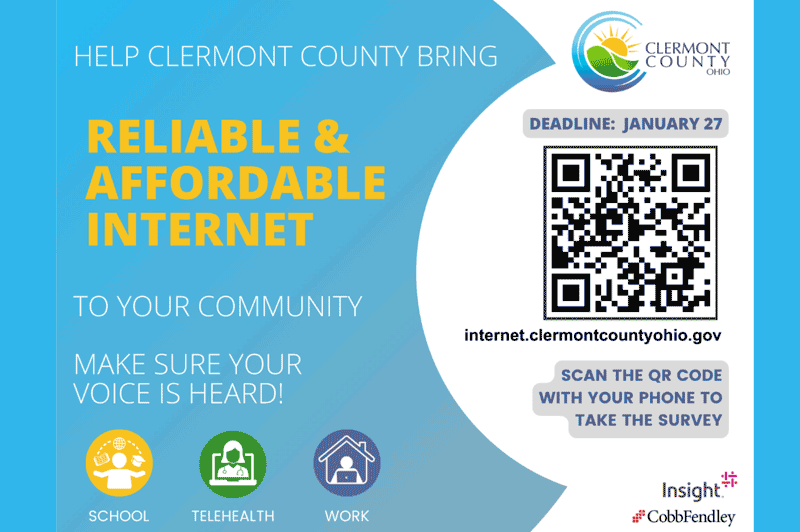
    Clermont County, Ohio – Clermont County Commissioners want to have strong, high-speed Internet access county-wide.

    According to a media release they say that based on raw census data and comparisons of other regions, thousands would benefit from available and affordable broadband.

    “Many are not served or under-served.”

    An online survey and Internet speed test will help the county achieve its goal and will help the county secure funding for broadband expansion.

    You can complete this online survey and Internet speed test so the county can understand Internet access and needs. They ask that you be sure to do the speed test at home. The survey and test are at: https://internet.clermontcountyohio.gov. They take less than a minute to complete.

    Forward the survey to friends and neighbors who live or do business in Clermont County.

    The more people who complete the survey and test, the better picture the county will have of its strengths and weaknesses for coverage.

  • Full stop traffic signal coming to Loveland Bike Trail Crossing in Loveland, Ohio

    Full stop traffic signal coming to Loveland Bike Trail Crossing in Loveland, Ohio

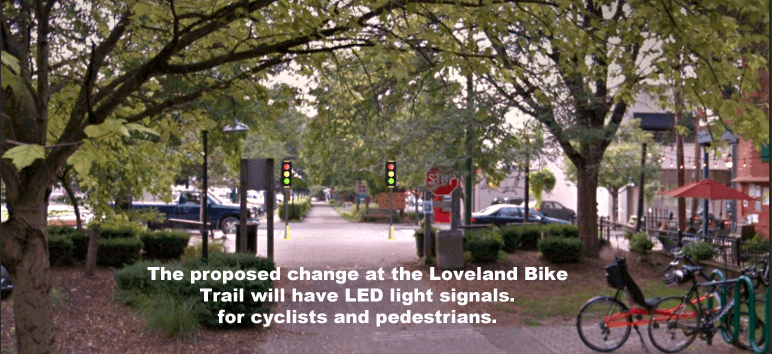
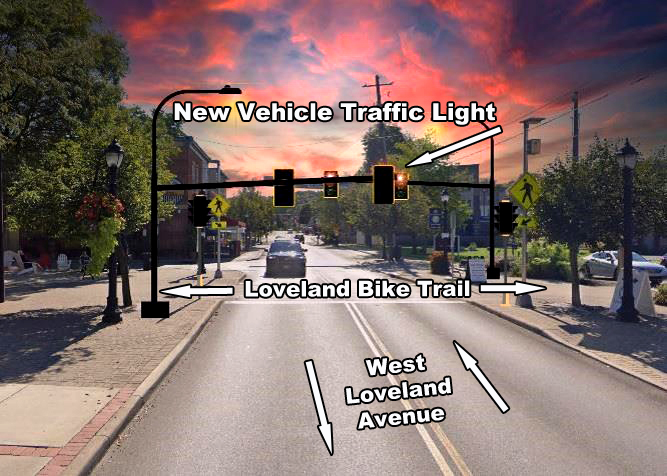
    Loveland, Ohio – The city has been awarded a grant to install an automated traffic signal system at the Loveland Bike Trail crossing at West Loveland Avenue. To create the new system, two types of signals will be installed — traditional overhead traffic light signals for vehicles and a traffic light signal for trail users. According to a release issued by City Hall, the system will deliver automatic traffic control and establish the right of way.

    Currently, the Trail and West Loveland Avenue crossing has a pedestrian-activated flashing crosswalk system.

    The new system will be coordinated with the “smart” traffic signals already installed at West Loveland Avenue/State Route 48, Second Street/Broadway Street, and West Loveland Avenue/Karl Brown Way intersections. The traffic lights will be able to “talk” to each other through radar vehicular detection, activating a new overhead signal at the trail crossing to “ebb and flow” with vehicle traffic volume.

    “Adding the automized signalization at the West Loveland Avenue crossing brings the plan for downtown’s traffic lights full circle. The traffic lights will work together as a network and can adjust within seconds to improve vehicle flow,” said City Manager David Kennedy in a press release.

    For instance, when the vehicular traffic lights are red at the West Loveland Avenue/Karl Brown Way intersection and vehicle traffic is paused, the trail crossing’s signal automatically will turn green for cyclists and pedestrians to pass.

    The new signalization is funded through an Ohio-Kentucky-Indiana Regional Council of Governments (OKI) grant totaling $281,898. It is one of 34 transportation infrastructure projects funded in 2022 by OKI, a metropolitan planning organization responsible for distributing federal money for regional projects.

    According to City Hall, the technology used in the project requires very specific engineering, which the city will do throughout 2023. The city will coordinate with the Ohio Department of Transportation (ODOT) and Ohio Department of Natural Resources (ODNR) throughout the design process.

    “We anticipate there will be an education period when the signal system is first installed, but this project is a true ‘win’ for pedestrian and cyclist safety, as well as a way to help improve traffic congestion in the downtown area,” Kennedy said. 

    Loveland has three Loveland Bike Trail crossings in Historic Downtown:

    1. One at Harrison Avenue near Nisbet Park.
    2. One with the proposed full-stop signal at West Loveland Avenue that currently has a pedestrian-activated flashing crosswalk system.
    3. One at Broadway Street near the Linda J. Cox Trailside Parking Lot.  

    Design work will take place in 2023 with the proposed installation in 2024.

    All images provided by the City of Loveland – text graphics added by Loveland Magazine.

  • In Deerfield Township, Ohio recycle your Christmas Tree at 3 park locations

    In Deerfield Township, Ohio recycle your Christmas Tree at 3 park locations

    Deerfield, Township, Ohio – Deerfield Township will have 3 Christmas Tree Drop Off locations setup in the Township. These locations will be at Cottell, Fleckenstein, and Landen-Deerfield Parks.

    Deerfield Township Parks are open daily from dawn until dusk. Areas will be sectioned off and posted with signs for township residents to drop off their Christmas trees. Christmas trees will be accepted for recycling during park hours from January 3rd, 2023 through January 20, 2023. 

    Find a Deerfield park near you.


    Walking Christmas png tree sticker

    Loveland, Ohio Christmas Tree Removal

  • Loveland, Ohio Area Holiday Light Recycling

    Loveland, Ohio Area Holiday Light Recycling

    Holiday Light Recycling

    City of Loveland, Miami Township, and Symmes Township residents can recycle their used holiday lights Nov. 26-Jan. 20 at the following locations:

    • City of Loveland residents: City Hall (120 W. Loveland Ave.) 
    • Miami Township residents: Move2Loveland/Keller Williams (6377 Branch Hill Guinea Pike)
    • Symmes Township residents: Symmes Administration Building (9323 Union Cemetery Road)
  • Loveland, Ohio Christmas Tree Removal

    Loveland, Ohio Christmas Tree Removal

    Loveland, Ohio – The City of Loveland provides residents with an annual Christmas tree removal service. The 2023 collection will take place from January 3-16, 2023. City Hall asks that you please remove all decorations, lights, tree stands, and tree bags before placing your Christmas trees at the curb.

    For questions about the Christmas tree recycling program, call City Hall at 513-707-1442.


    Holiday Light Recycling

    City of Loveland, Miami Township, and Symmes Township residents can recycle their used holiday lights Nov. 26-Jan. 20 at the following locations:

    • City of Loveland residents: City Hall (120 W. Loveland Ave.) 
    • Miami Township residents: Move2Loveland/Keller Williams (6377 Branch Hill Guinea Pike)
    • Symmes Township residents: Symmes Administration Building (9323 Union Cemetery Road)
  • What will DeWine sign? Lawmakers passed more than 30 bills on last day of session

    What will DeWine sign? Lawmakers passed more than 30 bills on last day of session

    BY: NICK EVANS – Ohio Capital Journal

    Barring an emergency, Ohio’s lawmakers have headed home for the holidays. That puts the ball in Gov. Mike DeWine’s court to sign or veto the final burst of legislation passed in the Statehouse. If the governor does nothing, legislation will take effect without his signature. But he has ten days after receiving the bills — not counting Sundays — to take action if he chooses.

    He’ll have a lot to work through between now and then. During the legislature’s overnight final session, they approved more than 30 pieces of legislation now heading to the governor. The highlights have gotten extensive coverage, but there was a lot of other legislative action as well.

    Thursday, DeWine’s office received a raft of 24 bills. The deadline for action on those is January 3.

    Here’s what passed:

    HB 513: Tax deduction for cigarette wholesalers when retailers fail to pay. A late amendment tacked on prohibitions for local tobacco regulations.

    HB 45: Began as a two month amnesty window for delinquent state taxes. Amendments appropriated $6 billion in federal COVID relief.

    HB 66: Numerous tweaks to local taxing authority and reporting as well as $30 million for minor league sports teams.

    HB 254: Established domestic violence fatality review boards.

    HB 558: Modified state’s donated drug repository program

    HB 107: Revised Ohio’s elevator laws

    HB 343: Modified crime victim’s rights

    HB 353: Ohio’s “Testing Your Faith Act” which directs higher ed institutions to develop accommodations for students who need to be absent for religious reasons.

    HB 392: Authorized transport of police dogs injured in the line of duty. An amendment made provisions for riding in a fifth wheel trailer and mounting safety devices on a windshield.

    HB 578: Created new specialty license plates and memorial highway designations.

    HB 567: Required common pleas courts post their docket online.

    HB 504: Raised penalties for disrupting religious services.

    HB 545: Privileged peer support communications.

    HB 554: Allowed state board of education to issue temporary licenses to teachers with expired certificates or licenses.

    HB 281: Updated statutory terms related to people with disabilities or suffering from mental illness.

    HB 569: Allows higher ed institutions to offer scholarships to people serving as family caregivers.

    HB 575: Set policy for regulating the solvency of fraternal benefit societies.

    HB 35: Permitted Ohio mayors to solemnize marriages.

    HB 279: Shortened timeline for filing certain wrongful death claims.

    HB 487: Altered bidding process for Ohio ballot printing contracts to allow out of state vendors/printers to participate.

    HB 462: Prohibited “swatting

    HB 150: Establish a rural practice incentive program to pay student loans for attorneys working in public offices or underserved communities.

    SB 63: Allowed county probation offices to accept credit card payments. A House amendment added on a new liquor permit for auto-sports facilities.

    SB 131: Required the issuance of certain occupational licenses if a person has experience in that field in a different state.

    SB 202: Prohibited restricting parental rights due to the parent’s disability. House amendments gave lawyers credit toward judicial eligibility for out of state practice time and created a bail study task force.

    SB 302: Made changes to the state unemployment compensation system.

    SB 288: Made numerous changes to the criminal code.

    SB 33: Changed Community Reinvestment Area policy to allow greater deduction to 529 education savings plans.

    SB 164: Altered animal cruelty laws and prohibited shelters from using gas chambers to put down pets.

    SB 16: Increased penalties for assault or menacing when the victim is a first responder. The measure also gave local governments explicit authorities when dealing with a riot or mob and prohibited any limitations on firearm rights due to a state of emergency.

    HB 405: Clarified rules of county hospital boards, gave coroners access to a law enforcement database and allowed treasurers to send bills electronically.

    HB423: Designated the American Soap Box Derby Ohio’s official gravity racing program.

    HB 501: Made a series of changes related to township authorities including allowing them to regulate small solar facilities.

    HB 509: Updated numerous occupational licensing provisions.

    HB 458: Began as a measure eliminating August special elections except for Congress. The Senate amended the bill to include strict new photo-ID requirements for voters as well as tighter limitations on returning absentee ballots.

    HB 364: Changed application process for sewer and water infrastructure surcharges

    Plaudits and veto calls

    Already, forces are gearing up inside the statehouse and out urging Gov. DeWine to veto certain measures. Others are lending their support.

    Attorney General Dave Yost applauded the anti-swatting legislation saying, “these prank calls are designed to do one thing — cause a panic.” The Ohio Association of Election Officials meanwhile thanked lawmakers for a $7.5 million appropriation for electronic poll books.

    Democrats zeroed in on a different part of the same bill. The measure would disqualify developments using the federal low income housing tax credit from using a state credit for rehabbing historic buildings.

    “These provisions, added at the eleventh hour of a lame duck session, were added with zero input from developers and affordable housing advocates. The policies are bad for Ohioans and bad for Ohio business,” they wrote in a press release.

    Democrats also urged DeWine to veto HB 458 which would impose strict new photo ID requirements for voters.

    At the city level, mayors have criticized the bill barring local tobacco regulations. The city of Columbus approved a flavored tobacco ban just days before state lawmakers acted. And the mayors might be in luck. DeWine has hinted at a potential veto, citing his past work fighting big tobacco.

    Clarification: an earlier version of this story stated DeWine’s deadline for vetoing any legislation was December 26. That calculation was incorrectly based on when the legislature passed legislation rather than when DeWine receives it.

    Follow OCJ Reporter Nick Evans on Twitter.

  • Cradle Cincinnati Promotes Infant Safe Sleep During the Winter Holidays

    Cradle Cincinnati Promotes Infant Safe Sleep During the Winter Holidays

    Holiday travel and cold weather can lead to higher risk of unsafe sleep

    Cradle Cincinnati, Cincinnati Health Department and Hamilton County Public Health are encouraging families to practice safe sleep during this holiday season. New sleeping environments and colder temperatures can increase a baby’s risk of sleep-related death. Babies sleep safest Alone, on their Backs, and in Cribs.

    When visiting relatives or friends this holiday season, Cradle Cincinnati recommends travelling with a portable crib. Many homes lack safe sleeping spaces for babies and sleeping in a bed with a baby or placing a baby on a couch for sleep greatly increases his or her risk of a sleep- related death. Co-bedding, or sleeping with another person, accounted for more than half of all sleep-related infant deaths in Hamilton County over the past five years.

    As well, frigid temperatures may lead parents to wrap their babies in bulky blankets or layer on clothing. However, babies can accidentally suffocate from loose blankets or overheat under multiple layers.

    Families can take the following steps to keep their baby warm and safe this holiday season:

    Baby should have his or her own sleep space. Bring a safety-approved portable crib, Pack n Play, or bassinet with you on your travels. Babies should never sleep with another person.

    Place baby on his or her back for every sleep. The risk of sleep-related death increases when infants are placed in new sleep positions (i.e. stomach or back). Infant sleep guidelines have changed in the last 30 years; it’s important to share ‘back to sleep’ messaging with older generations.

    Don’t overheat your baby. Dress your baby in a wearable sleeper or one-piece pajama, instead of using a blanket. Wearable sleepers can be layered over an undershirt or onesie.

    Keep baby’s room at a comfortable temperature, usually between 68° and 72°F.

    Don’t smoke around your baby. Exposure to secondhand smoke increases the risk of Sudden Infant Death Syndrome.

    Qualifying families can receive a FREE Pack n Play through the Cincinnati Health Department by calling (513) 564-BABY.

    Sleep-related infant deaths have been on the rise the past several years, reaching a ten-year high of 21 deaths in 2020. Cradle Cincinnati promotes the ABCs of safe sleep for every sleep – naptime and nighttime.

  • Lorenz and Dougherty indicate they will not run for school board in 2023

    Lorenz and Dougherty indicate they will not run for school board in 2023

    Loveland, Ohio – At a meeting of the Loveland City School District held on December 10, both the current President of the Board, Kathryn Lorenz, and current Vice-President, Kevin Dougherty announced that it is their intention to not seek another term by running for re-election in the fall of 2023.

    Here is the excerpt from the meeting where they announce their intentions:

    You can watch the full Board meeting below.

  • Ohio health care leaders want child health investment by year’s end

    Ohio health care leaders want child health investment by year’s end

    Adobe Stock photo.

    BY: SUSAN TEBBEN – Ohio Capital Journal

    A coalition of health care advocates want to see congressional investment in child health care by the end of the year, including permanent funding for the Children’s Health Insurance Program.

    The coalition, Protect Our Care Ohio, held a press event to push for improvements to maternal health, child outcomes and the issues like discrimination that can increase mortality and lower birth rates, particularly in Black Americans and Black Ohioans.

    “Our Black babies are dying at a rate of three times that of which babies, even here in Toledo/Lucas County,” said Celeste Smith, former coordinator of the Toledo/Lucas County Commission on Minority Health.

    An 2020 analysis by the Commonwealth Fund showed that maternal deaths have been increasing in the U.S., but that most of those deaths are preventable. They found that a “relative undersupply of maternity care providers, especially midwives” and a lack of “comprehensive postpartum supports” contributes to the mortality rates in the country.

    The study also found that more than half of pregnancy-related deaths happen after birth.

    The CDC found that Black babies make up the highest number of deaths per live births in the country as well, with a maternal death rate for Black mothers of three to four times the rate of white mothers.

    Part of the problem, Ohio health advocates say, is the price of health care. For those families that have insurance, often the plans they can afford leave holes in coverage. Many plans chosen for their affordability have high deductibles, even those provided by an employer.

    “Employee-sponsored health care is no longer the gold standard,” said Erika White, chair of the Healthy Lucas County CHIP (Children’s Health Insurance Program). “In reality, many families can not afford their employer health plans and that means the care that we need for our children is falling to the side.

    It is for that reason that the CHIP program through Medicaid is such a needed resource, White said.

    The CHIP program works through Medicaid and separate CHIP programs and is funded both through states and federal block grants.

    According to an annual report filed with the U.S. Department of Medicaid, Ohio’s child enrollment in CHIP rose more than 4% between 2020 and 2021. The increase was due to “economic and policy changes related to the COVID-19 pandemic,” according to the report.

    The Ohio Department of Medicaid has “educated state agency partners and numerous community stakeholders that work with low-income families” to increase outreach efforts, but in terms of reaching uninsured children, Ohio “does not have an effective way to measure” the outreach methods, the report stated.

    One way the problem could be helped is through the permanent authorization of funds for CHIP, which is currently active through June 2023.

    “CHIP is a block grant program, meaning Congress must act periodically to extend funding for the program,” White said.

    A lapse in the funding could mean a lack of health care access for millions of children, more than 9 million nationally in most recent figures from the U.S. Department of Medicaid.

    spending bill being considered by Congress could be the way forward for child health care funding, and an easy way for lawmakers to show their priorities, Smith says.

    “As we reach the end of the year, Congress has not just an opportunity but an obligation to take meaningful action to confront this preventable crisis,” Smith said.