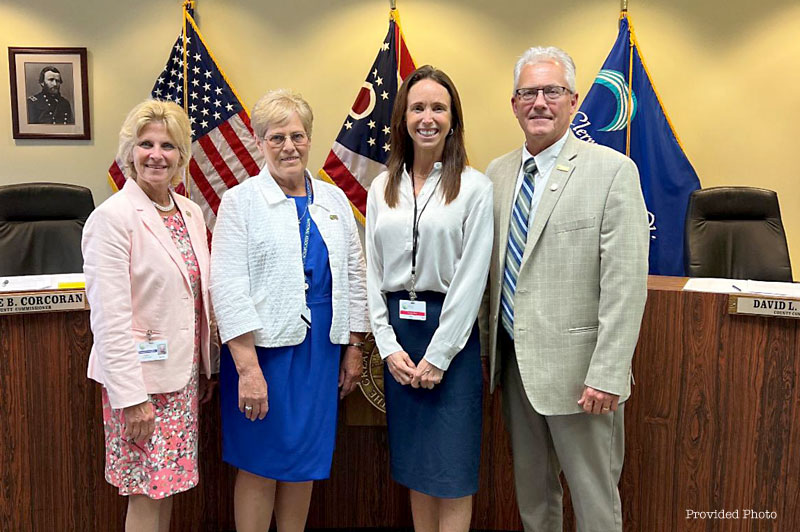
Commissioner Claire Corcoran, Commissioner Bonnie Batchler, Walther, Commissioner David Painter.
Clermont County, Ohio – The Board of County Commissioners on June 15 welcomed new Department of Job and Family Services Director Susan Walther. She comes to Clermont County after serving as director of Warren County Children Services for five years.
Walther began her career as a caseworker at Hamilton County Children Services, 1992-2002. She served as a caseworker, supervisor, and deputy director in Warren County Children Services before becoming Director.
Walter holds a Bachelor of Science in Psychology from the University of Cincinnati and a Master of Science in Management and Leadership from Western Governors University in Salt Lake City.
“I feel very fortunate to be here to serve Clermont County,” said Walther, who started her duties on June 13.
Cincinnati-based nonprofit encourage area educators to submit applications for Mussels in the Classroom and River Explorer programs for the 2022-23 school year
Purple warty backs? Pyramid pigtoes? Monkeyfaces? No, not fictitious creatures from a fantasy novel, just the very real—and important—river species coming to a classroom near you next school year as part of Ohio River Foundation’s Mussels in the Classroom program.
With successful programs dedicated to protecting and improving the water quality and ecology of the Ohio River and its entire watershed, Cincinnati-based nonprofit Ohio River Foundation (ORF) has opened registration for its popular hands-on educational programs for the 2022-23 school year. Along with improving academic STEM skills, the goal of these programs is to help kids—the next generation of environmental stewards, voters, and government leaders—foster a lifetime interest in protecting the environment in their communities and beyond.
May marked the end of another successful school year, so registration is officially opened for 2022-23 and area educators are encouraged to apply. This year, more than 4,700 students were able to take part in ORF’s Mussels in the Classroom and River Explorer programs.
Mussels in the Classroom
Through ORF’s Mussels in the Classroom program (MIC), students get the chance to play host to and learn about freshwater mussels and their importance to river ecosystems. ORF launched MIC, the only program of its kind, in 2017. Since then, nearly 7,000 students in the Greater Cincinnati, Greater Columbus, and Greater Lexington areas have experienced the program.
The program kicks off with an in-person or virtual visit by an ORF educator, who describes the freshwater mussels’ unusual characteristics and significance to their ecosystems. While freshwater mussel species may have some interesting and humorous names, these small but mighty creatures have an important job to do. Although they clean water, acting as a natural filter for our waterways, most people know little about these important animals. Many species are threatened or endangered. Following the educator visit, mussels remain in the classroom for two weeks so students can care for and study them.
“We hope that participating students come away with not only a better understanding of complex aquatic ecosystems but also an appreciation for these amazing animals,” said Rich Cogen, ORF’s executive director. “With increasing scientific interest in repopulating rivers with native mussels, it’s critical for the public to understand the important role they fill.”
MIC is open to grades K-12, and applications are accepted on a rolling basis on the program’s web page. Availability is Sept. 1 through Dec. 15 and Jan. 15 through June 1.
River Explorer
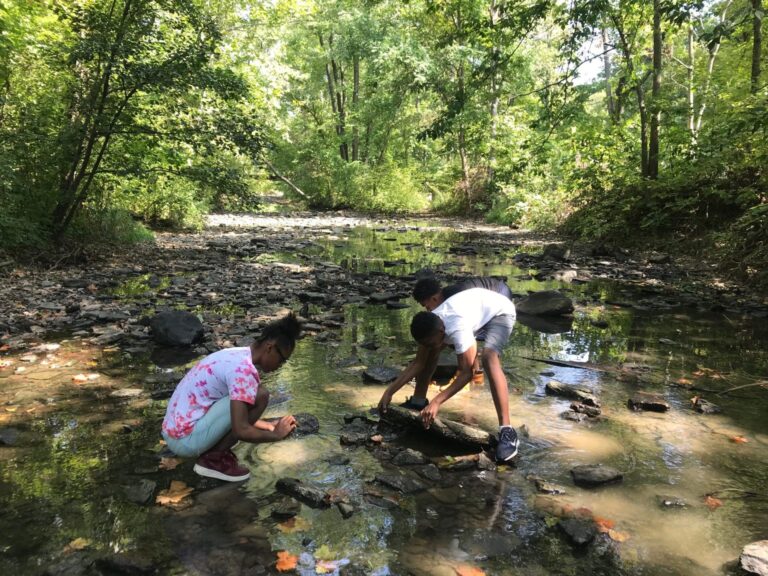
In addition to MIC, ORF offers its perennially popular River Explorer program in Greater Cincinnati and Columbus. The trips let students be junior scientists for a day as they learn about the ecology and importance of the Ohio River and its watershed at area creeks, streams, and rivers. Open to grades four through 12, River Explorer includes three hands-on stations:
1) Catching, examining, and identifying fish;
2) Collecting and identifying macroinvertebrates; and
3) River chemistry (grades six through 12) or water use and the water cycle (grades four and five).
All but the youngest students also take part in habitat assessments as part of their day, and ORF educators touch on issues such as water pollution and environmental stewardship with all students.
The River Explorer program is offered in September, October, April, and May. Greater Cincinnati field trips take place at Nisbet Park and Lake Isabella Park in Loveland; Sycamore Park in Batavia; Sharon Woods Park in Sharonville; Pioneer Park in Covington; and Guilford Covered Bridge Park in Guildford, Indiana. Columbus programs are at Highbanks MetroPark and Gahanna Friendship Park.
Registration for fall River Explorer field trips is open through Monday, August 15 on the program’s web page.
So far more than 55,000 students have participated in Mussels in the Classroom and River Explorers.
Russel the Mussel
Rounding out ORF school programs is an environmental literacy offering, courtesy of ORF team member, Russell the Mussel. He’s a freshwater mussel not unlike those that inhabit the creeks, streams, and rivers of the Ohio River watershed.
Russell himself is a character in a Virginia Tech/U.S. Fish & Wildlife Service children’s book that bears his name. ORF spearheaded efforts to resurrect the book, which was previously out of print. The nonprofit distributes copies as part of its Mussels in the Classroom program. It’s most appropriate for students on fourth through sixth-grade reading levels or for teachers who wish to read the book to younger students.
“Adding the Russell the Mussel book as a leave-behind lets us share information about freshwater mussels in a new way that will benefit students who are reading/writing learners,” said Cogen. “Because the book will remain in the classroom after our program ends, it will also reinforce what we teach and serve as a continuous reminder about this critical species.”
Support for ORF education programs is provided by the Charles H. Dater Foundation, Elsa Heisel Sule Foundation, Harrison Family Foundation, Toyota, Inc., Honda Manufacturing, International Paper, The Gardner Family Foundation, PNC Charitable Trusts, Marge & Charles Schott Foundation, Thomas Anthony Sullivan Foundation, and Valvoline, Inc.
Start enrolling in January for the August program!
All major areas of required ASE expertise will be covered including tune-up and front-end alignment, engine performance, suspension and steering, transmisson, brakes, colling system, and electricial/electronics trouble-shooting. An ASE (Automotive Serivce Excellence) Certified Program.
Start enrolling in January for the August program!Learn machine tool set-up and basic machining skills, basic computer numeric control (CNC) and computer-assisted drafting (CAD), plus blueprint reading and interpretation of drawings and symbols. Students are eligible to learn CPR/First Aid, OSHA, NIMS (National Institute for Metalworking Skills), and FANUC CNC certifications.
Start enrolling in January for the August program!Learn residental carpentry, electrical, and plumbing skills as you earn NCCER credentials. Master a wide range of hand and power tools and read building plans. Students are eligible to earn NCCER, CPR, and OSHA certifications.
Start enrolling in January for the August program!Join a fast growing profession! Learn to assist chairside during operative and specialty procedures, understand X-ray processes, learn basic types of impression materials, and identify and use basic types of dental lab equipment. Review office receptionist duties. Learn CPR, first aid, oral hygiene, and preventative dentistry techniques. Students prepare to take exams for radiographer, CODA, and DANB. BCI and FBI record checks are required prior to enrollment.
Start enrolling in January for the August program!Learn the all-important aspects of electrical and electronic repair and maintenance. Besides learning how to use test instrumentation such as digital voltmeters, oscilloscopes, and logic probes, you will also learn how to program PLCs and troubleshoot electrical motors and motor control circuitry. In addition, you will learn how to read ladder-logic diagrams and be introduced to pneumatics, hydraulics, and robotics. Students are eligible to earn the MSSC safety certification.
The Fire Academy offers 675 hours/18 weeks of EMS, fire, fire pumper, hazardous materials training, and technical rescue instruction from our nationally and internationally recognized faculty. All graduates of the accredited program recieve Pro Board certifications and are eligible to take examinations for Ohio FF, EMT, Hazard Recognition Officer (FIre Inspector I), and National Registry of EMT credentials. Must pass a physical exam and background check (at additional cost) before enrollment into the program.
Start enrolling in January for the August program!Learn to install, service, and maintain gas, oil, and electric furnaces, boilers, air conditioners, and heat pumps, preparing you for industry-required certification and employment. Accredited by PAHRA (Partnership for Air Conditioning, Heating, and Refrigeration Accreditation). Students are eligible to earn ICE and EPA certifications.
Start enrolling in now for the February program!Heavy Equipment Operations is one of the highest paying careers in the construction industry. Using state-of-the-art heavy equipment, students receive extensive training to operate power construction equipment: dozers, scrapers, backhoes, excavators, skid steers, compactors, tractors, and front-end loaders. Students earn NCCER certifications.
Start enrolling in January for the August program!Learn all aspects of diesel engine service and repair on buses, trucks, over-the-road trucks, construction equipment, emergency service vehicles, aircraft tuggers, and railroad equipment. Assemble, adjust, repair, and maintain hydraulic systems and drive trains, electrical and cooling systems, and steering and suspension systems. Students are eligible to earn ASE certifications. NATEF accredited.
The Police Academy offers over 800 hours of police training under the direction of a State Certified Police Academy Commander. Succesful completion of this course and passing the Ohio Peace Officer Certification Exam is the first step to certification in the State of Ohio by the Ohio Peace Officer Training Commision. This certification eligibility is the gateway to inclusion in a class of individuals who are sought by many police recruiters. This program is accredited by OPOTA and Ohio Peace Officers Training Academy. Candiates must pass a physical exam before enrollment into the academy.
The Police Academy offers over 800 hours of police training under the direction of a State Certified Police Academy Commander. Succesful completion of this course and passing the Ohio Peace Officer Certification Exam is the first step to certification in the State of Ohio by the Ohio Peace Officer Training Commision. This certification eligibility is the gateway to inclusion in a class of individuals who are sought by many police recruiters. This program is accredited by OPOTA and Ohio Peace Officers Training Academy. Candiates must pass a physical exam before enrollment into the academy.
The Police Academy offers over 800 hours of police training under the direction of a State Certified Police Academy Commander. Succesful completion of this course and passing the Ohio Peace Officer Certification Exam is the first step to certification in the State of Ohio by the Ohio Peace Officer Training Commision. This certification eligibility is the gateway to inclusion in a class of individuals who are sought by many police recruiters. This program is accredited by OPOTA and Ohio Peace Officers Training Academy. Candiates must pass a physical exam before enrollment into the academy.
Start enrolling in January for the August program!Precision and excellent hand/eye coordination are important for the welding program. You will learn various types of welds and cutting operations as well as fabrication, quality control, weld testing, and blueprint reading. Through this program, you will have the opportunity to become a certified welder. Other career pathways might include welding inspector, metal fabricator, or sales. Students are eligible to earn AWS certifications.
Luciano Acosta, of FC Cincinnati, grabs his leg after being challenged by a Red Bull defender
Cincinnati, Ohio – FC Cincinnati and the visiting New York Red Bulls played to a 1-1 draw Saturday night in front of 24,476 fans at TQL Stadium, the largest home crowd of the season.
FCC move to 7-7-5 (26 points) with the club’s third straight draw. The Red Bulls hold on to first place in the Eastern Conference with a 9-5-6 mark (33 points).
FC Cincinnati scored first in the 20th minute with the team-high ninth goal of the season from Brandon Vazquez.
The forward got in behind the Red Bulls defense and ran on to a through ball from Luciano Acosta. Vazquez’s initial shot on target was saved by New York goalkeeper Carlos Coronel, but Vazquez followed up on the rebound and tapped in the contest’s opening goal.
FC Cincinnati and the visiting New York Red Bulls played to a 1-1 draw Saturday night in front of 24,476 fans at TQL Stadium, the largest home crowd of the season.
FCC move to 7-7-5 (26 points) with the club’s third straight draw. The Red Bulls hold on to first place in the Eastern Conference with a 9-5-6 mark (33 points).
FC Cincinnati scored first in the 20th minute with the team-high ninth goal of the season from Brandon Vazquez.
The forward got in behind the Red Bulls defense and ran on to a through ball from Luciano Acosta. Vazquez’s initial shot on target was saved by New York goalkeeper Carlos Coronel, but Vazquez followed up on the rebound and tapped in the contest’s opening goal.
Luciano Acosta of FC Cincinnati claps as he walks off the field after receiving a red card during their game agains the New York Red Bulls at TQL Stadium, in Cincinnati, Ohio, on Saturday, July 9, 2022. [Alex Eicher | Loveland Magazine]FCC midfielder, Álvaro Barreal, takes a shot on New York Red Bulls’ goal at TQL Stadium, in Cincinnati, Ohio, on Saturday, July 9, 2022. [Alex Eicher | Loveland Magazine]FCC forward, Brandon Vázquez, dribble the ball after fouling Red Bulls defender, Dylan Nealis, at TQL Stadium, in Cincinnati, Ohio, on Saturday, July 9, 2022. [Alex Eicher | Loveland Magazine]New York Red Bull, Cristian Cásseres Jr, heads the ball away from FC Cincinnati forward, Brenner, at TQL Stadium, in Cincinnati, Ohio, on Saturday, July 9, 2022. [Alex Eicher | Loveland Magazine]Brandon Vázquez, of FC Cincinnati, takes a shot on goal where he later scores off a deflection at TQL Stadium, in Cincinnati, Ohio, on Saturday, July 9, 2022. [Alex Eicher | Loveland Magazine]Luciano Acosta, of FC Cincinnati, grabs his leg after being challenged by Red Bull defender John Tolkin at TQL Stadium, in Cincinnati, Ohio, on Saturday, July 9, 2022. [Alex Eicher | Loveland Magazine]FC Cincinnati defender, Raymon Gaddis, clears the ball away from the New York Red Bulls at TQL Stadium, in Cincinnati, Ohio, on Saturday, July 9, 2022. [Alex Eicher | Loveland Magazine]Luciano Acosta, of FC Cincinnati, takes a shot on the Red Bulls’ goal at TQL Stadium, in Cincinnati, Ohio, on Saturday, July 9, 2022. [Alex Eicher | Loveland Magazine]New York Red Bull defender, Cristian Cásseres Jr, reaches for the ball at TQL Stadium, in Cincinnati, Ohio, on Saturday, July 9, 2022. [Alex Eicher | Loveland Magazine]Luciano Acosta of FC Cincinnati works around New York Red Bull defender, Aaron Long, at TQL Stadium, in Cincinnati, Ohio, on Saturday, July 9, 2022. [Alex Eicher | Loveland Magazine]
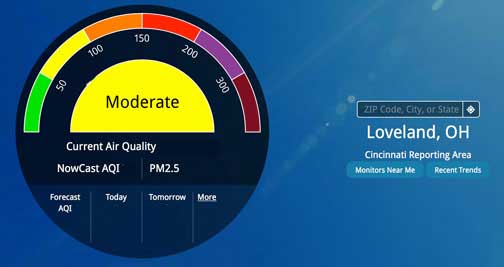
Current Air Quality is the most recent air quality in your area. It’s updated hourly. Check your current air quality to see if now is a good time for outdoor activities. More about Current Air Quality.
Primary Pollutant
This pollutant currently has the highest forecasted AQI in the area.
OZONE
105
Unhealthy for Sensitive Groups
Have flexibility in your schedule?
Even if the forecast is Orange (unhealthy for sensitive groups), there may be times during the day when air quality is OK for outdoor activities. Ozone is often lower in the morning. Check current air quality to see if now is a good time for you to be active outdoors.
Can’t change your schedule?
People with lung disease such as asthma, children and teens, older adults, and people who are routinely active outdoors for six or more hours a day: Reduce your exposure by choosing lessstrenuousactivities or shortening the amount of time you are active outdoors. Everyone else: Enjoy your outdoor activities.
Active children and adults, and people with respiratory diseases, such as asthma, should be avoiding all outdoor exertion; everyone else, especially children, should limit outdoor exertion.
Activities for children, who can be especially harmed by high levels of ozone because of their developing lungs and that some activities such as sports result in them breathing in quite a large amount of the chemical irritants should be suspended.
Do Your Share
• Take the bus, carpool, bike or walk instead of driving • Refuel your vehicle after 8 p.m.; do not top off when refueling and tighten the gas cap • Avoid idling your vehicle • Combine trips or eliminate unnecessary vehicle trips • Keep your vehicle maintained with properly inflated tires and timely oil changes • Avoid use of gasoline-powered lawn equipment on Air Quality Alert days • Avoid use of oil-based paints and stains on Air Quality Alert days • Never burn leaves or other yard trimmings • Always burn clean, seasoned wood in outdoor fire pits, fireplaces and wood stoves • Do not use fire pits or fireplaces for non-essential home heating on Air Quality Alert days • Conserve electricity
An analyst working for Ohio retired teachers went to court last week seeking records relating to the state pension funds.
The analyst is trying to determine whether teachers’ pension money is being squandered on high-fee “alternative” investments such as private equity and hedge funds. He is also investigating whether external consultants directing such investments are also being paid by the firms in which retirement system money is being invested.
Edward Siedle is president of Benchmark Financial Services, which investigates pension funds on behalf of their members. Last week, former Ohio Attorney General Marc Dann filed for a writ of mandamus on Siedle’s behalf to get records from the State Teachers Retirement System.
If successful, Ohio’s 10th District Court of Appeals will order the teachers retirement system, or STRS, to turn over a boatload of documents relating to its investments.
In an interview, Dann said Siedle has been seeking the records since last year.
“We’re not some gadfly trying to throw a wrench in the operation of STRS,” Dann said. “These are members of STRS who hired a professional to analyze the work that STRS is doing on their behalf. We want documents that will help that expert give an honest and accurate analysis.”
He added, “To the extent that they say our requests are trade secrets or are too voluminous, it makes you think maybe they don’t want us to look so closely at this.”
However, STRS spokesman Nick Treneff said that his agency has been working with Siedle and has already turned over many records.
“We did try to work with Siedle on his request,” Treneff said.
In a report last year, STRS said it had already turned over a boatload of information.
“Over a period of three months, from February to May 2021, STRS Ohio sent 24 emails and a thumb drive to counsel, amounting to 812 documents and over 22,000 pages,” it said, adding that remaining requests are “overly broad.”
Lawyers for Ohio state agencies commonly use such language in response to records requests. It will be up to the court to determine whether in this case STRS is using it, as Dann says, to stonewall.
But the stakes are pretty high.
STRS is managing $92 billion on behalf of 166,000 active members. And, as benefits have become stingier, some of those members have become suspicious that the agency is making dubious investments through politically connected entities.
The governor and the leaders of the General Assembly appoint “investment experts” to the STRS board of directors, and many of the state’s retired teachers believed the investments made on their behalf have underperformed.
The distrust was evident in a newsletter written last August by Robin Rayfield, executive director of the Ohio Retired Teachers Association.
“STRS has overstated investment returns while under-reporting the fees and costs associated with those investments,” he said.
Part of the distrust surely stems from the fact that the pension fund stopped paying cost-of-living increases in 2017 — although it is planning a 3% increase this year.
Treneff, the STRS spokesman, said the freeze was due to new rules set down by the legislature in 2012. State and local governments were still reeling from the Great Recession and there were nationwide concerns about unfunded pension liabilities.
The retired teachers association points out that the General Assembly hasn’t increased its contribution rate to the pension fund in 38 years.
But it did act to shore STRS up by cutting benefits. The cost-of-living hike was cut from 3% to 2% and teachers were made ineligible for any increases until they’ve been retired for five years.
The General Assembly also required that the system have enough assets to pay off any liabilities within 30 years. In 2017, when the fund didn’t appear likely to meet that requirement, the living increase was suspended.
Treneff said it was due to reduced investment-return assumptions, longer lifespans and lower-than-expected payroll growth.
“That was painful for sure,” he said. “It wasn’t an easy decision.”
And, with the U.S. Securities and Exchange Commission in January finding a raft of problems with the transparency and honesty of private equity funds, it’s also probably understandable that pension fund members have turned their suspicions on its alternative investments.
Treneff, the system spokesman, was quick to point out that those investments are providing the system’s second-best returns.
The best? The American stock market.
Over the past decade, it has provided a 14.8% return on investments, while the system’s alternative investments have provided 11.84% once fees are subtracted, Treneff said.
So why make a substantially worse-performing investment with teachers’ money? To avoid putting too many eggs in one basket, Treneff said.
“The goal is to build this (pension) fund as fast as you can without taking wild risks,” he said, adding, “you don’t want one downturn in the stock market to destroy you.”
t appears that a 10-year-old rape victim had to leave Ohio for an abortion. But Ohio Gov. Mike DeWine isn’t commenting on the fact that a law he signed making that necessary if she didn’t want to become a mother.
Shortly after the U.S. Supreme Court overturned Roe v Wade and cleared the way for the law to take effect, the child was on her way to Indiana for an abortion because she couldn’t get one in Ohio, an Indianapolis OB-GYN told the Indianapolis Star. The doctor, Caitlin Bernard, told the paper that an Ohio child-abuse doctor had called, saying the child was six weeks and three days pregnant and needed help.
That was three days after the six-week limit the DeWine-signed law places on abortion in Ohio. It makes no exceptions for women and children who are victims of rape and incest.
The story has made national news. But DeWine seemed unprepared Wednesday to discuss whether legislation he championed is forcing children out of state if they don’t want to have their rapists’ babies.
“Yeah, first of all, I have no more information than you do or anybody does. Reading in the in the paper, it came came as you know, from a story out of out of Indiana from from a doctor over there,” he said as part of a rambling answer to a question from the Cincinnati Enquirer, according to a transcript.
DeWine went on to say it was “gut-wrenching” as a father and grandfather to think about a 10-year-old being raped, and that he hoped the doctors caring for her reported the assault to law enforcement. But he didn’t address the fact that a law he signed put girls like her in such an onerous situation.
In a follow-up on Thursday, DeWine Press Secretary Dan Tierney was asked whether the governor thinks juvenile rape victims who become pregnant should be able to get abortions, or whether he believes they should be forced to carry their pregnancies to term. Tierney didn’t answer directly.
“You have access to Governor DeWine’s recent comments on these issues, including that the only information available on the Indiana matter was from Indiana media reports,” Tierney said in an email. “I do not have further comment for you beyond yesterday’s remarks and the Governor’s numerous and extensive comments since the” Supreme Court decision overturning Roe v Wade.
While DeWine and his spokesman underscored that media reports were all they knew about the incident involving the Ohio 10-year-old, there have been warnings that something like this was likely to happen.
Shortly after DeWine signed the six-week ban in 2019, CBS News reported on an Ohio 11-year-old who was repeatedly raped by a 26-year-old, impregnating her. If the Ohio law was cleared by the Supreme Court, the story said, the girl could be left with few options after six weeks of pregnancy.
The story also describes victim-blaming the child experienced at a “pregnancy care center.” It cited a police report quoting an employee describing the 11-year-old rape victim as “rebellious” and that she “refuses to listen to her mother and runs away from home all the time.”
At six weeks, as many as a third of women don’t know they’re pregnant, and it’s a safe bet that even fewer girls do. And while statistics on pregnancies resulting from rape are sparse, it seems likely that Ohio and other states that don’t allow abortions in cases of rape or incest are going to force more children into the most difficult of situations.
The U.S. Centers for Disease Control and Prevention estimates that about 18 million women experience vaginal rape in their lifetimes and that almost 3 million become pregnant from it. The 2018 research from which those statistics were drawn said it was “the first in over 20 years to offer a nationally representative prevalence estimate of (rape-related pregnancy) of U.S. women…”
That’s an apparent reference to a 1996 paper published in the American Journal of Obstetrics and Gynecology. It was based on a three-year survey of 4,008 women that sought to determine “the prevalence and incidence of rape and related physical and mental health outcomes.”
Its findings relating to young rape victims are not reassuring.
“Among 34 cases of rape-related pregnancy, the majority occurred among adolescents and resulted from assault by a known, often related perpetrator,” an abstract of the study said. “Only 11.7% of these victims received immediate medical attention after the assault, and 47.1% received no medical attention related to the rape.”
It added that almost a third of adolescent rape victims didn’t know they were pregnant for 12 weeks — more than double the point at which their abortions would now be illegal in Ohio.
“A total 32.4% of these victims did not discover they were pregnant until they had already entered the second trimester; 32.2% opted to keep the infant whereas 50% underwent abortion and 5.9% placed the infant for adoption; an additional 11.8% had spontaneous abortion,” the paper said.
DeWine and his spokesman were reluctant this week to say whether he thinks young rape victims should be forced to carry pregnancies to term. But his office earlier this month confirmed his support of a bill restricting abortion in Ohio even further — and also making no exceptions for rape and incest.
For Aileen Day, communications director for Planned Parenthood Advocates of Ohio, DeWine owns the consequences of the abortion bills he signs — whether he addresses them directly or not.
“DeWine signed the six-week ban into law and he is the reason the 10-year-old Ohioan had (to) jump through repeated obstacles to get the health care she needed,” Day said in an email. “It is truly disgusting that he’s not being held accountable for all the harm he has caused Ohio. DeWine’s team has bragged that he is the most anti-abortion governor in Ohio’s history and his history backs that up by signing 10 dangerous abortion restrictions and bans into law.”
WASHINGTON — President Joe Biden, who has repeatedly been criticized as slow to respond to a widely expected U.S. Supreme Court decision that ended the nationwide right to an abortion, signed an executive order Friday that could preserve some access to abortion in states where the procedure remains legal.
Biden in a White House speech also brought up the case of a 10-year-old rape survivor from Ohio who was forced to travel out of state to access abortion care in Indiana, questioning if that’s actually the will of a majority of the state’s residents.
“Does anyone believe that it’s Ohio’s majority view that that should not be able to be dealt with? Or in any other state in the nation? A 10-year-old girl should be forced to give birth to a rapist’s child?” Biden said. “I can tell you that I don’t. I can’t think of anything that’s much more extreme.”
Ohio Republican Gov. Mike DeWine declined to comment on the state law’s impact in the case this week, saying he had read about it in the paper. He did say he found it “gut-wrenching” that a man raped a child.
Biden, who began his speech from the White House’s Roosevelt Room more than 30 minutes late by talking about the morning’s jobs report, said the fastest way to reestablish nationwide protections for abortion is by voting in November’s midterm election.
“Based on the reasoning of the court, there is no constitutional right to choose — the only way to fulfill and restore that right from women in this country is by voting,” Biden said. “We need two additional pro-choice senators and a pro-choice House to codify Roe at federal law.”
Biden acknowledged the frustration and anger many abortion rights advocates and Democrats expressed after he gave a speech the day of the Supreme Court decision, calling on Americans to vote on the issue in November.
He doubled down on that message during his remarks Friday, saying the Supreme Court opinion in the case, Dobbs v. Jackson Women’s Health Organization, “made clear it will not protect the rights of women.”
“It’s my hope and strong belief that women will in fact turn out in record numbers to reclaim the rights that have taken from them by the court,” Biden said, opting not to call on men, who are needed for pregnancy to take place, to turn out at the ballot box.
Executive order
Biden’s executive order would direct the U.S. Health and Human Services secretary to make sure abortion medication “is as widely accessible as possible,” according to a White House fact sheet.
The president has also “asked the Chair of the Federal Trade Commission to consider taking steps to protect consumers’ privacy” when seeking information about abortion services and will request HHS “consider additional actions” to protect “sensitive information related to reproductive health care.”
As part of those efforts, the administration has posted websites to try to help patients protect information their cell phones may store about reproductive health care and about the type of health care records that are protected under the federal law known as the Health Insurance Portability and Accountability Act, or HIPAA.
The White House is hoping to combat misinformation that has become more common since the Supreme Court’s ruling, with Biden directing the HHS secretary, the attorney general and chair of the Federal Trade Commission “to consider options to address deceptive or fraudulent practices, including online, and protect access to accurate information.”
The executive order, Biden said, would direct the federal government to look into tech privacy.
“Now when you use a search engine, or the app on your phone, companies collect your data, they sell it to other companies and even share it with law enforcement,” Biden said. “There’s an increasing concern that extremist governors and others will try to get that data off of your phone, which is out there in the ether, to find what you’re seeking, where you’re going and what you’re doing with regard to health care.”
House to vote on abortion access
The Democratic-controlled U.S. House is set to vote on two bills next week addressing abortion access, though it’s unlikely either will get past the U.S. Senate’s legislative filibuster.
The first bill, the Women’s Health Protection Act of 2022, would reestablish a nationwide right to an abortion. The second bill, the Ensuring Access to Abortion Act of 2022, would block state governments from making abortion travel illegal and protect health care providers in states where the procedure remains legal.
Congress is also slated to have a series of hearings on the impact of the Supreme Court’s decision to overturn Roe v. Wade, including next week in the U.S. Senate Judiciary Committee as well as the Senate Health, Education, Labor and Pensions panel.
Washington state Democratic Sen. Patty Murray, chair of the HELP panel, said in a written statement Friday following Biden’s speech that while the executive order is an important step, the “fight is far from over.”
“The reality is that the President’s executive authority is limited — so the surest way to protect every woman’s right to abortion is electing two more pro-choice Democratic senators and protecting our pro-choice majority in the House so that we can codify Roe,” Murray said.
A federal judge in Akron has refused to dismiss a lawsuit between FirstEnergy Corp. — which has admitted that it bribed two top Ohio politicians with $64 million — and some of its shareholders.
U.S. District Judge John R. Adams denied a motion Tuesday, filed jointly by the company and its investors, asking him to dismiss the case in light of a proposed settlement preliminarily agreed to by another federal judge.
Adams accused the parties of “forum shopping,” or looking for a friendly judge given his previous skepticism of the settlement. He also implicitly accused FirstEnergy of protecting its former CEO’s riches, and the plaintiff’s lawyers of cashing in without properly investigating the company’s scheme.
The lawsuit traces back to the 2019 passage of state House Bill 6, which included several provisions favorable to FirstEnergy worth an estimated $1.3 billion to the company. This included a massive, ratepayer funded bailout for nuclear plants it owned at the time.
The agreement required the company to admit to a lengthy proffer of facts, cooperate with ongoing criminal probes, and pay a $230 million penalty to avoid a criminal charge of wire fraud.
Shareholders have brought three derivative suits against the company over their losses incurred by the scandal — one in state court and two in federal court. In March, FirstEnergy announced it reached a settlement with the shareholders. It called for the company to oust six board members and receive $180 million from company insurers.
U.S. District Judge Algenon L. Marbley preliminarily approved the settlement in May but said he had no authority over other judges’ cases.
In Adams’ order Tuesday, he expressed incredulity at the lack of investigative efforts from the plaintiffs and the lack of consequences for some of the defendants.
The shareholders’ lawyers have claimed, defending the proposal, that this would be the largest settlement of its type in Ohio.
Big whoop, Adams said.
FirstEnergy already paid a $230 million penalty, he said. The case record indicates shareholders lost more than $1 billion in value when the news of the initial criminal arrests in the scandal broke and the company’s share price plummeted. The insurance payout is a fraction of these losses. He noted that the small army of plaintiffs’ lawyers on the case could take a sizable chunk of the proposed settlement.
“Given that counsel is permitted under the settlement to seek up to $48,600,000 in attorney fees, it is hardly surprising that the parties would seek out what they believe to be a more favorable forum,” he said.
He also noted a finding in a recent regulatory audit that found FirstEnergy could have reclaimed some of the $55 million it paid to then-CEO Chuck Jones during the roughly three-year span of the criminal allegations. Though the company fired Jones, it never invoked the contractual provision allowing it to reclaw the compensation, the audit found.
In his order, Adams also cited uncomplete exchange of evidence between parities, no testimony under oath from any defendants, and an incomplete forensic examination to identify “possible missing communications” from Jones’ phone.
While FirstEnergy as a company faces criminal consequences, its executives to date have not. The deferred prosecution agreement the company entered, meanwhile, doesn’t specifically identify who organized the bribery operation.
Earlier this year, Adams refused to allow any settlement — and at one point stormed off during a hearing — until someone in the case admitted who specifically orchestrated the bribery operation. Counsel representing plaintiffs identified both Jones and fellow executive Mike Dowling as the central operators. The two men are named defendants in the shareholder lawsuit.
John Camillus, an attorney and “liaison counsel” for some of the plaintiffs, declined to comment.









![[Photos by Alex Eicher] FC Cincinnati take third straight draw in 1-1 result with New York Red Bulls](https://lovelandmagazine.com/wp-content/uploads/2022/07/alex-eicher-fc-cincinnati.jpg)