Loveland, Ohio – World Frog Day is an annual celebration celebrated on March 20. All of us in Loveland, Ohio love frogs for their looks, appearance, and, their croak.
There may be a reason other than the fear of being shot while trying to cross Kemper Road that the Loveland Frog has not been seen since the 70s.
Most often they are tiny creatures, small in body, and will make us scrunch up our faces. Frogs are amphibians that can be found both on land and in water. They are considered to be predators and play an important role in preserving the environment throughout their lives. In recent years, however, frogs have been critically endangered for several reasons. World Frog Day is an awareness day celebrated to save these living beings and provide them with a safer environment to survive. (1)
March 20th is World Frog Day, which was created in 2009 to increase awareness of the plight of threatened frog species around the world. All amphibians, including frogs, are important components of the global ecosystem, as indicators of environmental health and contributors to human health. More than one third of them are currently threatened with extinction. Addressing the amphibian extinction crisis represents the greatest species conservation challenge in the history of humanity.
How many frogs are there?
We know there are at least 7,400 species of frogs (AmphibiaWeb), but sadly, we also know that at least 2,000 (28%) of these are threatened with extinction (IUCN Red List). The actual number of threatened species is no doubt considerably higher, because around 1,000 species (14%) have not yet been assessed for their threat categories, and for another 1,000 (14%) of them, so little is known about their status in the wild that they cannot be accurately assessed.
Many things are causing frog populations around the world to decline, and in fact, at least 35 species that we know of have gone extinct in recent times. Habitat loss and destruction is one of the worst problems, not only for frogs, but for many other species of animals and plants.
Many human activities contribute to habitat destruction and the decline of amphibians, including water pollution, the introduction of non-native species, climate change, agriculture, and urban development. Diseases, especially chytridiomycosis, which is caused by the chytrid fungus, are also having a massive effect on frogs, many of which are already under stress from the threats mentioned above.
What is Amphibian Ark doing?
The Amphibian Ark was created in 2007 to carry out the ex situ (captive) components of the IUCN Amphibian Specialist Group’s Amphibian Conservation Action Plan.
AArk plays a key role in the ACAP, by evaluating the conservation needs for amphibian species and regions for conservation work; leading development and implementation of training programs for building capacity of individuals and institutions; and developing communications strategies, newsletters and other messages, and materials to promote understanding and action on behalf of amphibian conservation.
Since 2010, we have worked with scientists and researchers from 48 countries to develop conservation needs assessments and conservation recommendations for over 3,500 amphibian species. This work helps amphibian conservationists in those countries to develop and implement action plans for the most threatened species.
An important aspect of helping to implement amphibian conservation programs is to develop and lead amphibian husbandry training workshops, to build capacity of individuals and institutions in countries which have the highest numbers of threatened amphibians. Amphibian Ark staff and our partners have delivered 75 training courses, which included 2,680 participants, in 40 countries. These people are now using the skills they have learned to create and manage conservation programs in their own countries.
Who else is helping?
There are many local and federal government departments, universities, scientists and researchers, zoos and aquariums, and private organizations that are all doing their bit to contribute to saving amphibians and protecting their environments. Many, many dedicated Amphibian Advocates and Ambassadors who care for captive and wild amphibians are making a huge difference, helping to protect our most threatened amphibian species and their environments.
Yes, there is! Try to be a good environmental steward. As our environmental indicators, amphibians are telling us that we are doing damage to the health of the planet. Clearly, promoting better environmental stewardship will benefit our thin-skinned friends as well as human populations.
Get together with friends and collect the garbage from your local rivers, forests and wetlands. Make a new wetland in your backyard – even a small pond will help. If you build it, frogs will come! If you are surrounded by development and they don’t come, rescue eggs and tadpoles from local pools and use them to seed new populations – but only collect them from local areas!
Try to manage your yard without using pesticides, fertilizers and weed killers, most of which are poisonous to amphibians. Try to use less water (e.g. turn off the tap when you brush your teeth or while you wash your hands), and follow the three R’s – Reduce, Reuse and Recycle. Plant native plants in your garden which use less water and need less pesticides and fertilizers.
Your support is crucial to saving threatened species and we invite you to become an Amphibian Ark donor, helping to keep these species afloat! 100% of funds donated to Amphibian Ark will be spent on ensuring a long-term future for threatened amphibians, and donations to the Amphibian Ark are tax-deductible for most US tax-payers.
We must all work together to protect our precious environment and to prevent more species, including frogs, from declining and facing extinction! (2)
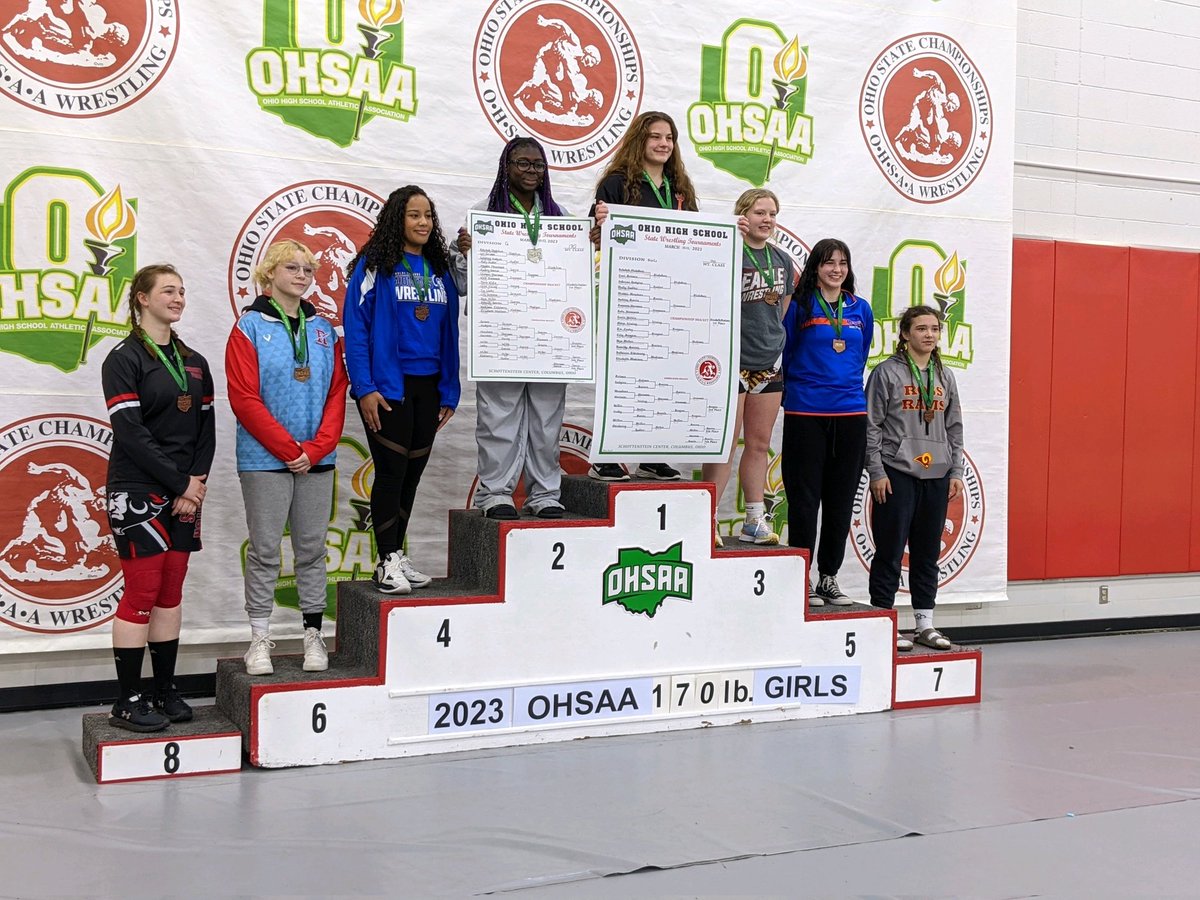
Elizabeth Madison on the stand after capturing the State Title (Photo @CoachSwitzer)
Loveland, Ohio – Head Coach Chris Switzer said on FaceBook after Elizabeth Madison completed her perfect season, “So proud of this kid…. what a year – undefeated State Champ as a freshman.” He was exclaiming his esteem for Madison after she defeated every opponent in Columbus at the Schottenstein Center at Ohio State University during the DI OHSAA State Wrestling Championships.
Madison won every match she entered as a 170 lb. ninth grader and finished the season 42-0 with 40 pins. This was the inaugural season for the Ohio High School Athletic Association to host a Women’s wrestling tournament. Madison will forever be remembered as Ohio’s first 170-pound champion.
In January 2022, the OHSAA announced that Women’s wrestling and Men’s volleyball would be added as sanctioned sports beginning with the 2022-23 school year. The Ohio High School Athletic Association averages more than 50,000 fans for the weekend of wrestling.
Watch Elizabeth Madison pin 4-time State qualifier DeSales High School senior Rebekah Oladakun, to become Ohio’s first 170-pound champion
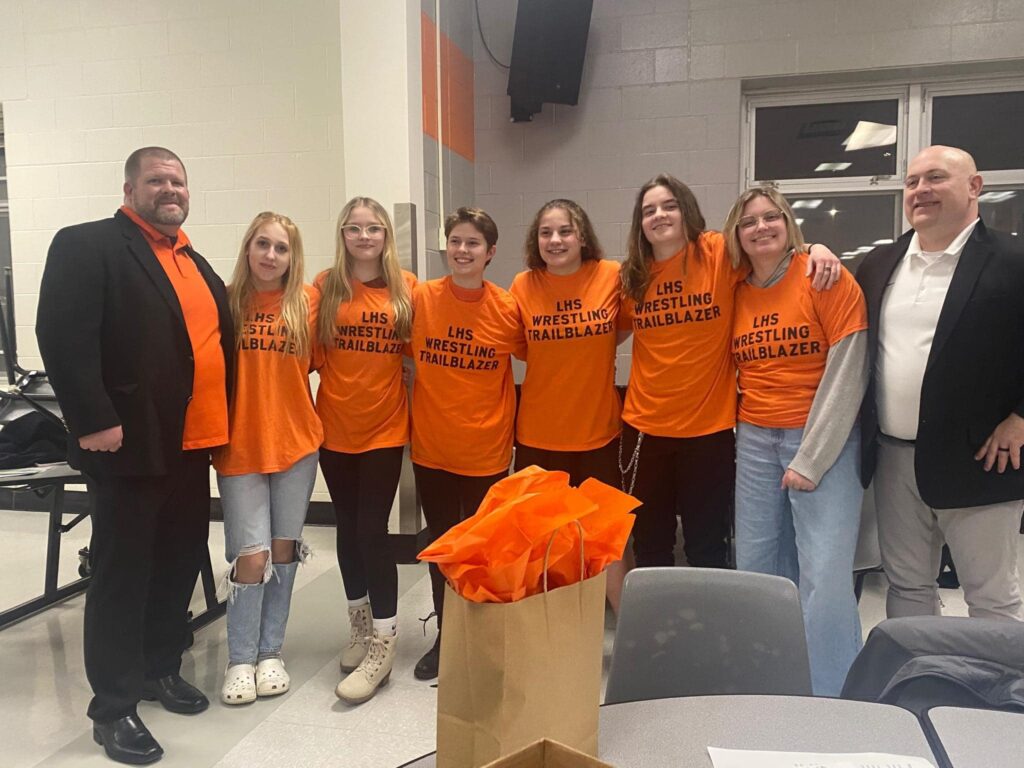
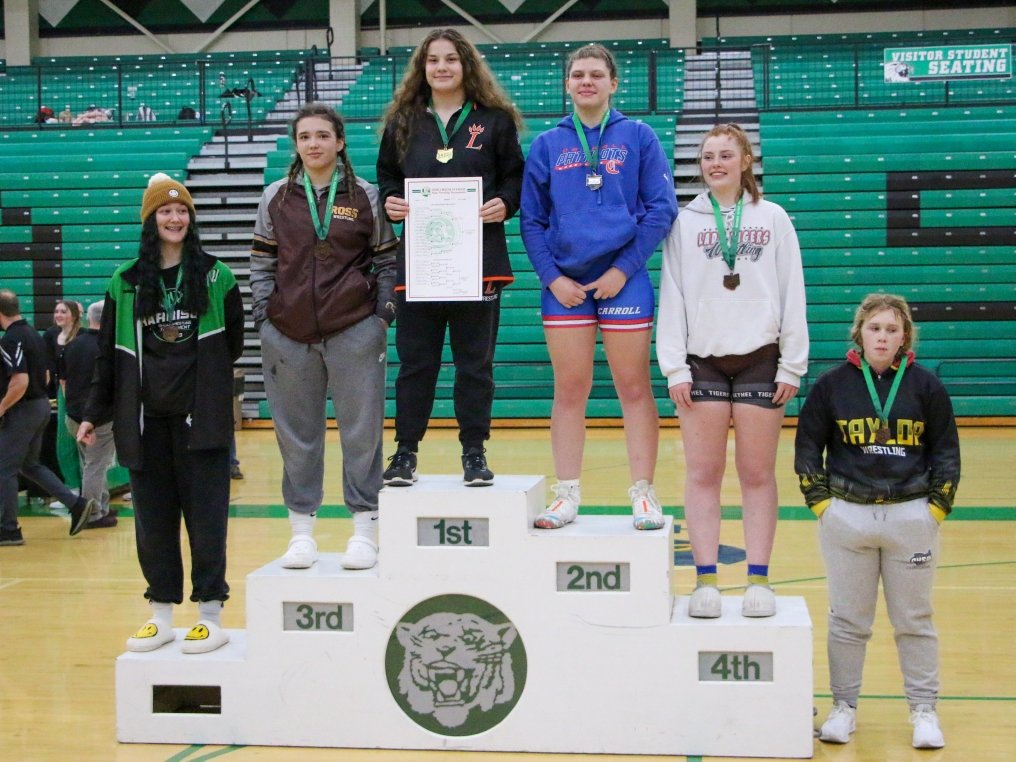
Loveland High School’s first Women’s Wrestling Team at the Winter Sports Awards. (Photo by Loveland Tiger Wrestling)Elizabeth Madison on the stand after capturing the Regional Title (Photo @CoachSwitzer)
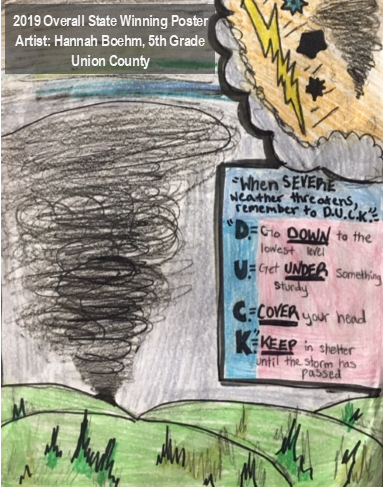
The 2023 Ohio Severe Weather Poster Contest is accepting submissions until April 21.
For students grades 1-6
This poster contest is a valuable tool to help students learn about severe weather safety and preparedness. The contest is open to all Ohio students in grades 1-6, and individualized instruction (special education) classes. All public, private, charter and home schools are encouraged to participate.
Regional winners are invited to attend the Ohio Committee for Severe Weather Awareness (OCSWA) awards ceremony at the Ohio State Highway Patrol Academy on the Ohio State Fairgrounds.
Prizes for regional winners: Prizes include admission passes to the Ohio State Fair, a certificate of appreciation from the National Weather Service, and more (prizes vary per year).
Prizes for state winners (one student each from grades 1-6): Same prizes as regional winners, plus a National Oceanic and Atmospheric Administration (NOAA) weather radio, a smoke alarm, a congratulatory letter from Gov. Mike DeWine, and the student’s poster framed.
Prizes for state winners (one student each from grades 1-6): Same prizes as regional winners, plus a National Oceanic and Atmospheric Administration (NOAA) weather radio, a smoke alarm, a congratulatory letter from Gov. Mike DeWine, and the student’s poster framed.
Prizes for overall state winner: Same prizes as regional and state winners, including a personalized trophy, four tickets to the Center of Science and Industry (COSI) museum in Columbus, and a backpack. In the fall, OCSWA members will present a “traveling trophy” to the overall state winner’s school to be displayed throughout the school year.
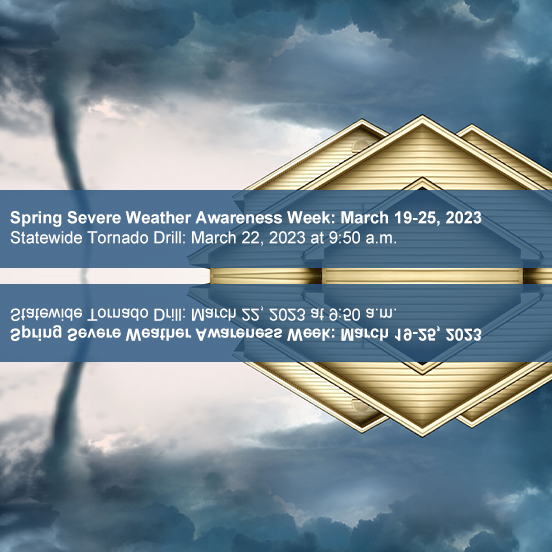
SPRING SEVERE WEATHER AWARENESS WEEK IS MARCH 19-25
Severe weather can occur at any time of the year and Spring Severe Weather Awareness Week allows Ohioans the opportunity to learn the best ways to be prepared and stay safe during inclement weather.
“Severe weather can impact Ohio at any time of year, so it’s important that residents are prepared for the possibility of a weather emergency,” said Governor Mike DeWine. “Spring Severe Weather Awareness Week allows Ohioans the opportunity to learn more about severe weather and be prepared before, during, and after a storm.”
In a coordinated effort with the Ohio Committee for Severe Weather Awareness (OCSWA), the Ohio Emergency Management Agency, and the National Weather Service, Governor DeWine has proclaimed March 19-25 as Spring Severe Weather Awareness Week and is encouraging all Ohioans to prepare themselves for spring and summer weather hazards and home emergencies.
“Ohio’s weather can often be unpredictable, especially in the spring when temperatures fluctuate between warm and cold which can be a recipe for severe weather, or even tornadoes,” said Ohio Emergency Management Agency Executive Director Sima Merick. “We encourage all Ohioans to make or review an existing emergency plan and be prepared.”
At 9:50 AM on Wednesday, March 22, local communities can participate in a statewide tornado drill and test their emergency and sheltering plans. Ohio counties may use this time to sound and test their outdoor warning sirens and mass notification systems. Businesses, schools, and households are also encouraged to practice their tornado drills and emergency plans at this time.
Safety & Preparedness Tips
Know the Terms:
Tornado Watch – Be Prepared: When conditions are favorable for the development of tornadoes. Be ready to move to a place of safety if the watch is upgraded to a warning or if threatening weather approaches.
Tornado Warning – Take Action: When a tornado is imminent or has been sighted. Warnings indicate impending danger to life and property. Seek safe shelter immediately.
Prepare for Severe Weather and Home Emergencies:Build a kit and make a plan. This includes having a severe weather kit for home and vehicle and creating an emergency plan/or updating your existing plan
Be Aware of Hazards in Your Area: Ohio’s weather hazards from early spring into summer include snowmelt and flooding, tornadoes, and thunderstorms. Visit the OCSWA website to learn more about severe weather safety and preparedness.
Prepare for a Flood: Learn and practice evacuation routes, shelter plans, and flash flood response. Gather supplies, including non-perishable foods, cleaning supplies, and water for several days, in case you must leave immediately or if services are cut off in your area.
Flooded Roadways: Never attempt to cross a flooded road on foot or in a vehicle. It only takes six inches of water to knock an adult off their feet, one foot of moving water can float a vehicle, and two feet of water can carry away most vehicles including pickup trucks and SUVs. Don’t chance it, find an alternative route! Turn Around Don’t Drown®.
Outdoor Warning Sirens: Many Ohio counties have outdoor warning sirens that sound when severe weather is imminent. Outdoor warning sirens are designed to be heard outdoors.
Alerts and Notifications: Getting weather and emergency information from trusted sources is important. Have multiple means of receiving communications and always get your information from reliable sources such as the National Weather Service, local broadcast radio and television stations, and phone apps from trusted agencies. Other great sources for communications are the Emergency Alert System (EAS) which are messages sent over television and radio channels, Wireless Emergency Alerts (WEA) which are free notifications delivered to mobile devices as part of a public safety system, and a NOAA All-Hazards Weather Radio.
To download a copy of Governor DeWine’s Spring Severe Weather Proclamations, click here or visit the Ohio Committee for Severe Weather Awareness website.
Loveland, Ohio – What better way to know spring has sprung than to see yard sales springing up around town? And, this is the topper with jewelry, collectibles, furniture, tools, electronics, household stuff, and much more.
March 25 is the Loveland Presbyterian Church’s Giant Yard Sale
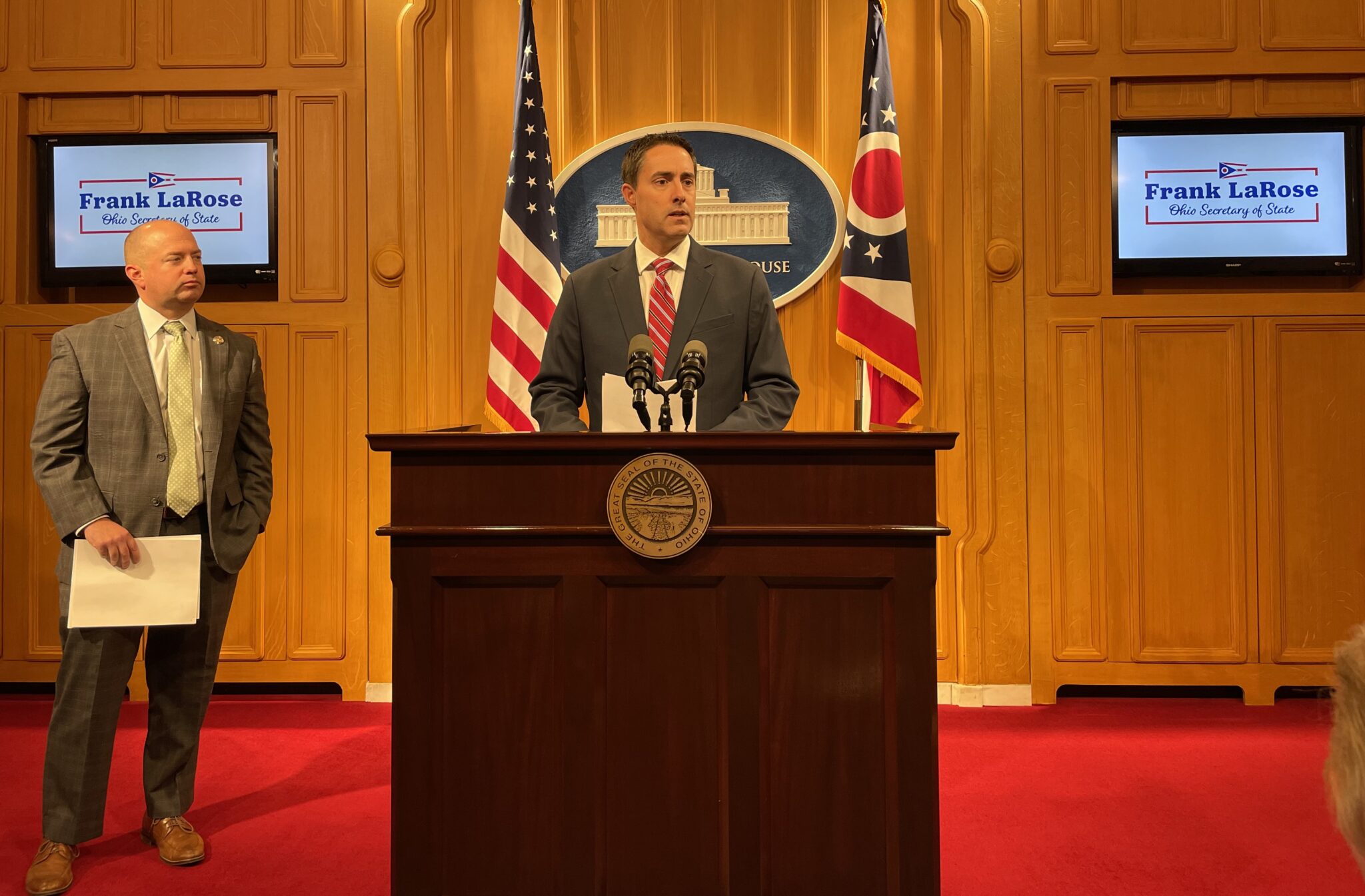
Secretary of State Frank LaRose (speaking) alongside Rep. Brian Stewart, R-Ashville, introducing a constitutional amendment requiring a 60% supermajority for all future citizen-led ballot amendments. (Photo by Nick Evans, OCJ.)
Just before lawmakers took off for Thanksgiving last year, Secretary of State Frank LaRose and state Rep. Brian Stewart, R-Ashville, held a press conference. Details ahead of time were scant, but the advisory promised “reforms which will better protect Ohio’s constitution.”
What they unveiled would dominate the chaotic final weeks of the lame duck legislative session and drive a wedge into the Republican supermajority.
This January, when Kitts Hill Republican Jason Stephens decided to make an upset bid for House Speaker, Democrats had little trouble discerning which candidate would be better for them.
Communications between Secretary LaRose, Rep. Stewart, and their staffers shed light on the behind-the-scenes maneuvering to introduce and advance House Joint Resolution 6. The effort forced a fight that’s still playing out in the Ohio House as Republican factions struggle for control.
Sixty percent
It all started with a game of phone tag. On the morning of Friday, Nov. 11 last year, Stewart turned down an apparent phone call from LaRose.
“About to give a Veterans Day speech, lol. Call you back,” Stewart texted.
Both men are veterans, and LaRose joked back that it’s “not exactly a day off” for them. By the time Stewart returned the call, LaRose was in a meeting. When LaRose called Stewart back, he didn’t pick up.
Saturday morning, Stewart sent a screen shot of an email to the Legislative Service Commission. In it, he requested a draft amendment to raise the threshold to 60% for passing citizen-initiated constitutional amendments.
“Since it is a small drafting change,” he wrote, “my hope is that it could be ready this week.”
Stewart’s next message went over talking points. He laid out their case for not applying that higher threshold to amendments initiated in the General Assembly. The change, he argued, put “interest group” amendments “on the same footing as GA-initiated amendments which require the super-majority vote at the outset.” He also asked LaRose’s office for data on constitutional amendments since 2000.
LaRose’s team got right to work, returning with a spreadsheet breakdown of all 33 proposals during that timeframe. But his chief legal counsel, D. Michael Grodhaus, warned limiting the scope to citizen-initiated measures might leave the proposal open to court challenge.
“It is possible that it may be challenged as violating Ohio’s version of the Equal Protection Clause,” he wrote, “I have not researched that point, but presumably LSC will.”
In a text message, LaRose said “one piece of good news is that the vast majority pass with over 60%.” They arranged a video conference to go over details the next day. Their press conference unveiling what would become HJR 6 was the day after that.
Building support
Before LaRose and Stewart introduced their plan publicly, they began working on legislative leaders.
The Monday after their discussion began, Stewart suggested they touch base with House Speaker Bob Cupp and Senate President Matt Huffman. LaRose said he’d already started.
“I had a tentative conversation at the OSU game with the speaker (but didn’t tell him that I was working with you on it because I didn’t want to preempt you),” LaRose wrote. “I presented it to him as ‘an idea l’ve been thinking about and want to work with you guys to get done.’”
“That’s perfect,” Stewart replied, adding that he would let the speaker know about his involvement and discuss timing. LaRose noted Cupp sounded supportive of the policy but worried about the politics.
“Seems to think it will have opponents from both the left and the right,” LaRose said.
“He had to be dragged to kicking and screaming to do the party labels for the Supreme Court as well,” Stewart responded, “but he saw the light eventually.”
The next day, Stewart relayed a conversation with Attorney General Dave Yost.
“He likes moving to 60% but thinks we will have a weak PR argument on only doing it for citizen initiatives and not legislative,” Stewart said. “He said he won’t weigh in against it, but thinks we should give that some thought.”
LaRose, meanwhile, described his exchange with Huffman. The Senate President was enthusiastic enough that he patched in chief of staff John Barron and chief legal counsel Frank Strigari. As for whether to apply the higher threshold across the board, LaRose said they discussed the idea, but it was “not conclusive.”
“He said he’d prefer 60% for initiative and 50% for legislative referral ‘if we can sell it,’” LaRose said.
Aaron Baer, president of the Center for Christian Virtue, talks in an October press conference about a “backpack” bill to change a private school voucher program in Ohio. Behind Baer are state Rep. Marilyn John, left, and state Rep. Riordan McClain, center, who are co-sponsoring the bill. (Photo by Susan Tebben, OCJ)
Working outside the Statehouse
But at the very earliest stages — before legislative language was even complete — LaRose and Stewart were consulting power brokers outside of the Statehouse.
At the same time they were discussing Speaker Cupp’s reticence, they were also talking about Center for Christian Virtue president Aaron Baer’s involvement.
In an exchange with Stewart three days before they announced their proposal publicly, LaRose texted “I know that the life community is interested in this and Aaron Baer spoke with Huffman over the weekend.”
“Baer and I discussed it before you called me initially, too,” Stewart said.
The day before unveiling the resolution, LaRose reported speaking to Steve Stivers, who heads up the Ohio Chamber of Commerce.
“He’s for it with some additional nuance I can explain later but he’s for it,” LaRose said.
They picked up more conservative supporters after introducing the idea, but the response wasn’t unanimous.
A few hours after their introductory press conference, LaRose shared a picture of a text exchange with American Policy Roundtable vice president Rob Walgate. He had reached out to say APR would oppose the effort. “Didn’t want it to be a surprise,” Walgate said.
LaRose tried to win him over.
“Kind of surprised that you’re not part of the group of many other conservatives who believe like that me that it’s just far too easy to amend our state constitution,” LaRose wrote.
Other supporters, though, were a bit too enthusiastic. Chris Long from the Ohio Christian Alliance pitched Stewart on holding a press conference in support of the resolution.
“I think I persuaded him to work more behind the scenes directly with members without a public statement yet,” Stewart said.
LaRose agreed writing, “he should help work the conservative circles behind the scenes, but not make a big splash publicly.”
Ohio House Speaker Bob Cupp (R-Lima) (right) December 13, 2022, at the Ohio Statehouse in Columbus, Ohio. (Photo by Graham Stokes for Ohio Capital Journal. Republish photo only with original story.)
Heading to committee
The Tuesday after Thanksgiving, Stewart made his pitch to the Republican caucus. He told LaRose that while the caucus was supportive, Cupp was still “dragging feet.”
“But the sentiment in the room was that we should go to 60% for adoption across the board and undercut the ‘hypocrisy’ argument,” Stewart said.
“Can you get Cupp some reassurance that resources will be spent to advance this in May?” Stewart added.
LaRose said shifting to 60% across the board was fine with him, and that any reassurance for Cupp should come from the business community. He mentioned Steve Stivers and Ohio Business Roundtable president Pat Tiberi.
“They both told me they’re behind this 100%,” LaRose said. “I guess at this point I need to ask them to tell the speaker that, too.”
The Ohio Chamber submitted testimony in favor of HJR 6, but the Ohio Business Roundtable never took a formal position on the measure. Later that day, Stewart reported they would get their first committee hearing that week.
He explained the chairman, Rep. Shane Wilkin, R-Hillsboro, and Rep. Bill Seitz, R-Cincinnati, both wanted to see the higher threshold applied to all amendments, regardless of whether they’re initiated by lawmakers or citizens. “Without them we don’t get it out of committee,” Stewart said, adding that he planned to introduce a sub bill with those changes at the start of the hearing.
By the next day, before holding a single hearing, they’d already set their course to eventual passage.
“Tomorrow is just sponsor (testimony),” Stewart said about the committee hearing on Thursday. “Plan I think (Wilkin was talking to Speaker) is for proponent/opponent to occur next week, and voted out at the end of next week or early the week of the 12th.”
This was less than two weeks after the press conference introducing the resolution.
Presaging the rift that would eventually consume the party, Stewart noted “Stephens told me he’s a no.”
A few weeks earlier the caucus had selected Rep. Derek Merrin, R-Monclova Township, to be the next House speaker over Rep. Jason Stephens, R-Kitts Hill, and Rep. Phil Plummer, R-Dayton.
“I’m going to try to ferret out if there’s more,” Stewart wrote, “There may be some post Speaker vote hangover here we are dealing with.”
Rep. Brian Stewart, R-Ashville, speaking in committee. Photo by Nick Evans, OCJ.
Meanwhile, they notched a significant endorsement as Heritage Action announced it “fully supports” the measure. In a text message, CCV’s Aaron Baer took credit, saying “a productive trip to Washington yesterday” with a link to the press release.
LaRose promised to submit written testimony to the committee but wouldn’t be there in person. “First family vacation in close to two years,” he explained.
“Honestly, I spent an hour engaging with them,” Stewart replied, “There’s not much ground left to plow in person.”
The following Tuesday Stewart asked if they should get proponents to speak at a hearing scheduled for the next day.
“I think the more the merrier who can come in and speak in favor… You know the opposition is going to pack the room,” LaRose wrote back.
This story relies on numerous images of LaRose and Stewart’s text exchanges collected through a public records request. In the initial version, many of those images are blurry and at times illegible. When LaRose’s office provided a new, legible copy those messages cut off at Dec. 6.
The original version included a few more messages stretching into the following week.
On Dec. 7, LaRose sent Stewart the contact card for the associate director of the American Petroleum Institute, without any additional comment.
The following week, LaRose reached out to talk. His message appears to read that they “may be taking a tactical pause,” adding later “I heard we’re short on votes.”
In his response, however, Stewart remained optimistic. He wrote back to LaRose, “Merrin and I already scheduled multiple session days in January.” He added they could pass the resolution quickly “when we’ve got 67 votes” and what appears to be “several fewer hard heads to wrangle.”
COLUMBUS, OH — FEBRUARY 15: State Rep. Brian Stewart, R-Ashville, flanked by House Republicans, talks to the press about the Ohio House Republican leadership, February 15, 2023, at the Statehouse in Columbus, Ohio. (Photo by Graham Stokes for Ohio Capital Journal. Republish photo only with original story.)
A little more than a week after Stephens took the gavel, Merrin and Stewart got their allies together at the statehouse to file a new version of the resolution. Merrin has repeatedly invoked that legislation since then as a point of differentiation between his allies and Stephens’ supporters.
The proposal now requires organizers get signatures from all 88 counties instead of the 44 required under current law. It also eliminates the cure period in which organizations can collect additional signatures if their first submission falls short.
However, the Feb. 1 deadline for amendments to get on the May ballot came and went without lawmakers holding a single hearing on Stewart’s resolution.
Stephens said he’s “confident” the chairman of a new committee devoted to constitutional amendments “will be able to handle the gravity of this issue.” Still, he didn’t even refer the measure to the committee until Feb. 16.
Supporters now set sights on collecting enough signatures by July to put the measure to Ohio voters in November
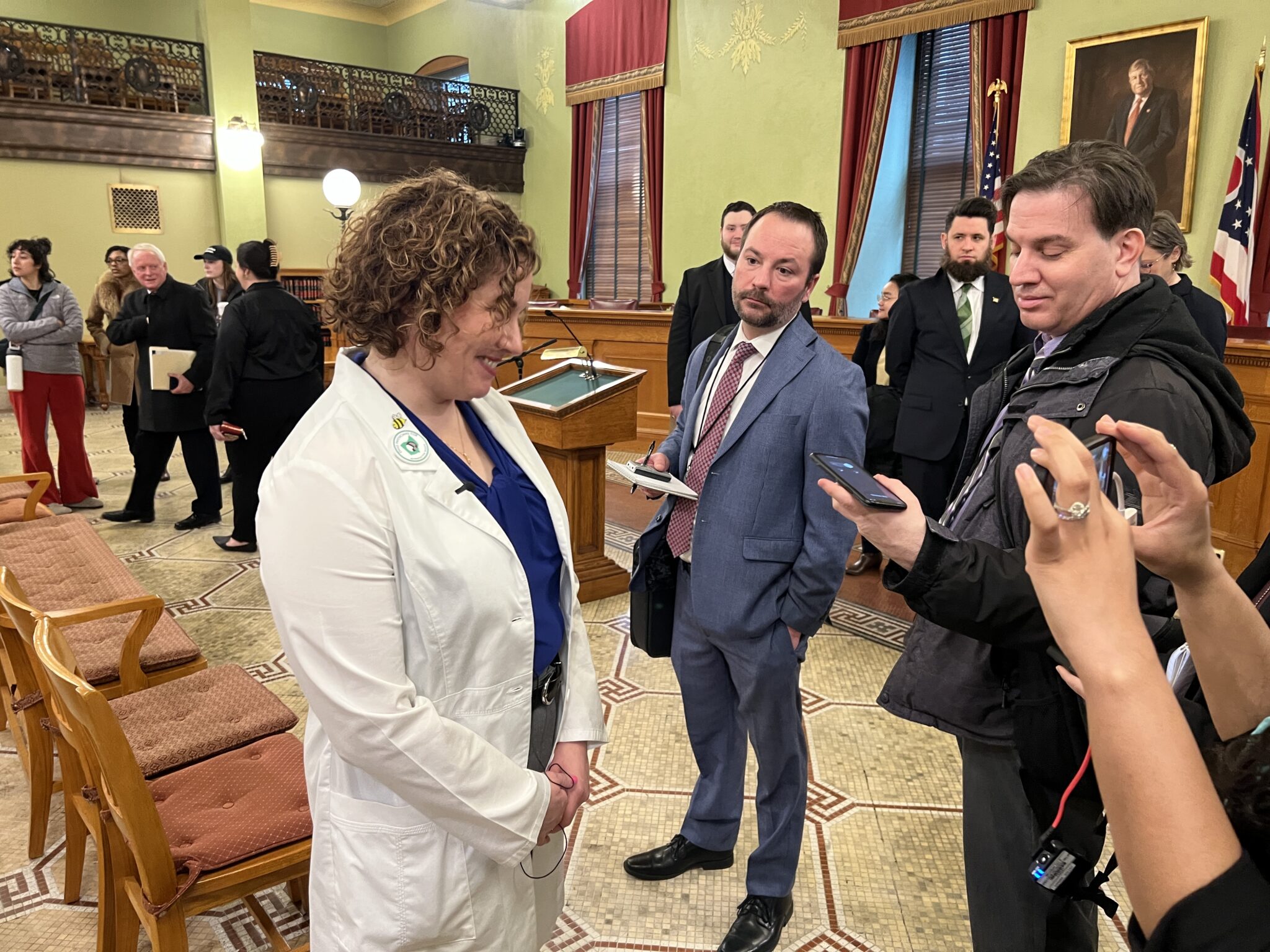
Dr. Amy Burkett, OB/GYN and member of Ohio Physicians for Reproductive Rights, speaks to media Monday following the Ohio Ballot Board’s vote to verify the language of a proposed constitutional amendment on abortion. Photo: Susan Tebben, OCJ
This article has been updated to include the proposed constitutional amendment (bottom)
The Ohio Ballot Board verified Monday that a proposed amendment for the November ballot to cement abortion rights in the Ohio Constitution can now move forward to the full signature-gathering stage.
In a short Monday meeting, the board, composed of Secretary of State Frank LaRose; Republican state Sen. Theresa Gavarone, Democratic state Sen. Paula Hicks-Hudson, Democratic state Rep. Elliot Forhan, and Bill Morgan, voted unanimously that the proposed ballot initiative only involved one constitutional issue.
The board only heard from two people outside of the board after LaRose insisted that content be kept away from the merits of the amendment or opinions about abortion itself.
John Grove, of Cincinnati Right to Life, still took time to try to discredit the amendment itself, called it “intentionally unjust and misleading.”
Attorney Don McTigue spoke on behalf of the groups proposing the amendment, choosing not to dive into the legal aspects of the amendment, instead saying the “common purpose of the amendment” was individuals having control of one’s own reproductive decisions.
Gavarone acknowledged that the purpose of the Ballot Board business was “procedural,” but still input her opinion before the unanimous vote was recorded.
COLUMBUS, OH — FEBRUARY 22: State Sen. Theresa Gavarone, R-Bowling Green, during the Ohio Senate session, February 22, 2023, at the Statehouse in Columbus, Ohio. (Photo by Graham Stokes for Ohio Capital Journal. Republish photo only with original story.)
“I am horrified at the thought of this amendment, I mean, the right to kill babies being put into Ohio’s constitution,” Gavarone said.
Now that the proposal has been certified by the Ohio Attorney General and verified by the Ohio Ballot Board, groups attempting to get the measure on the ballot can move forward with collecting the more than 400,000 valid signatures needed to officially get the measure to statewide voters.
Laura Strietmann, executive director for Cincinnati Right to Life, said pro-life organizations throughout the state have joined together as well, with a full strategy to fight against the measure.
“We are unified in protecting women in Ohio, in stopping this bill from becoming law,” Strietmann said after the vote.
Abortion rights groups say they are prepared to go forward with field planning, volunteers and petition circulators as early as the end of this week, according to Jordyn Close, deputy director for the Ohio Women’s Alliance and board president for Abortion Fund of Ohio.
The organizations are planning to hit the ground running to get more than enough signatures in a short amount of time. The deadline to submit signatures so the proposal can appear on the November ballot is July.
Part of the plan to bring support to the measure includes informing voters about the true aims of the constitutional amendment on which they would be voting. Claims have already been made by opposition groups that the amendment would bar all abortions, including for baby’s who have reached full term, something supporters of the amendment say won’t happen.
“We are not interested in doing full-term abortion,” said Dr. Amy Burkett, board-certified OB/GYN in northeast Ohio, and member of Ohio Physicians for Reproductive Rights. “This is about protecting the rights to reproductive health care including abortion, up to viability.”
Viability, Burkett said, should be determined by the physician and patient “based on the technology that is available at the time.”
Amendment supporters aren’t shying away from their pro-abortion stance, despite the trend toward using “pro-choice” as a way of including all options.
“When we talk about reproductive freedom and bodily autonomy, we have to be really specific about what (opposition groups) are attacking,” Close said. “And that is abortion access.”
————————-
Amendment Summary and Text:
TITLE: The Right to Reproductive Freedom with Protections for Health and Safety
SUMMARY The Amendment would amend Article I of the Ohio Constitution by adding Section 22, titled “The Right to Reproductive Freedom with Protections for Health and Safety.”
The Amendment provides that: 1. Every individual has a right to make and carry out one’s own reproductive decisions, including but not limited to decisions on contraception, fertility treatment, continuing one’s own pregnancy, miscarriage care, and abortion. 2. The State shall not, directly or indirectly, burden, penalize, prohibit, interfere with, or discriminate against either an individual’s voluntary exercise of this right or a person or entity that assists an individual exercising this right, unless the State demonstrates that it is using the least restrictive means to advance the individual’s health in accordance with widely accepted and evidence-based standards of care. 3. However, abortion may be prohibited after fetal viability. But in no case may such an abortion be prohibited if in the professional judgment of the pregnant patient’s treating physician it is necessary to protect the pregnant patient’s life or health. 4. As used in this Section, “Fetal viability” means “the point in a pregnancy when, in the professional judgment of the pregnant patient’s treating physician, the fetus has a significant likelihood of survival outside the uterus with reasonable measures. This is determined on a case-by-case basis”; and “State” includes any governmental entity and political subdivision. 5. This Section is self-executing.
FULL TEXT OF PROPOSED AMENDMENT
Be it Resolved by the People of the State of Ohio that Article I of the Ohio Constitution is amended to add the following Section: Article I, Section 22. The Right to Reproductive Freedom with Protections for Health and Safety
A. Every individual has a right to make and carry out one’s own reproductive decisions, including but not limited to decisions on:
contraception;
fertility treatment;
continuing one’s own pregnancy;
miscarriage care; and
abortion.
B. The State shall not, directly or indirectly, burden, penalize, prohibit, interfere with, or discriminate against either:
An individual’s voluntary exercise of this right or
A person or entity that assists an individual exercising this right, unless the State demonstrates that it is using the least restrictive means to advance the individual’s health in accordance with widely accepted and evidence-based standards of care. However, abortion may be prohibited after fetal viability. But in no case may such an abortion be prohibited if in the professional judgment of the pregnant patient’s treating physician it is necessary to protect the pregnant patient’s life or health.
C. As used in this Section:
“Fetal viability” means “the point in a pregnancy when, in the professional judgment of the pregnant patient’s treating physician, the fetus has a significant likelihood of survival outside the uterus with reasonable measures. This is determined on a case-by-case basis.”
“State” includes any governmental entity and any political subdivision.
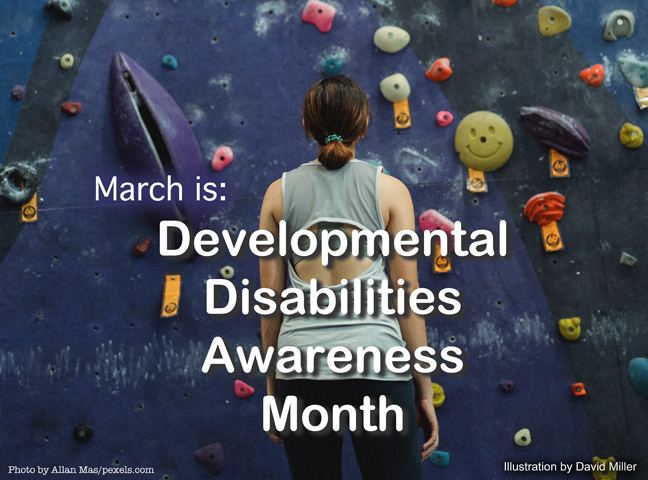
March is National Developmental Disabilities Awareness Month
by David Miller
Dear City Hall,
I ask you to install directional signs in our Historic District that point to accessible parking spaces.
To honor National Developmental Disabilities Awareness Month I decided to revisit the draft of a proposal I worked on from 2014 until 2016. Most of the proposal was eventually approved by Loveland City Council and the Loveland Planning and Zoning Commission and is now adopted law in the City. I started the project in 2014 when resident, Amy Clawson raised concerns to me. Amy said that unfortunately, a very common problem for people who have different needs is in finding good, appropriate parking that can accommodate their physical or health issues. She pointed me to several instances of inadequate and poorly marked parking spaces in the Historic District. After taking an inventory around town, I published this story: Accessible parking; out of sight, out of mind, neglected and abused.
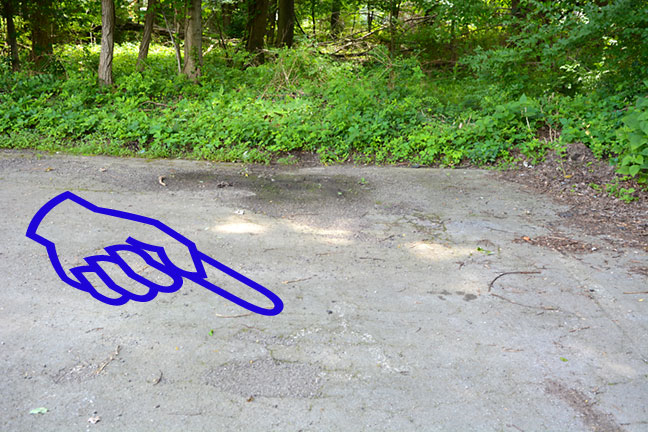
This nearly invisible accessible parking space was at McCoy Park in 2014. There should have been a pole-mounted sign and the paint on the pavement had all but disappeared.
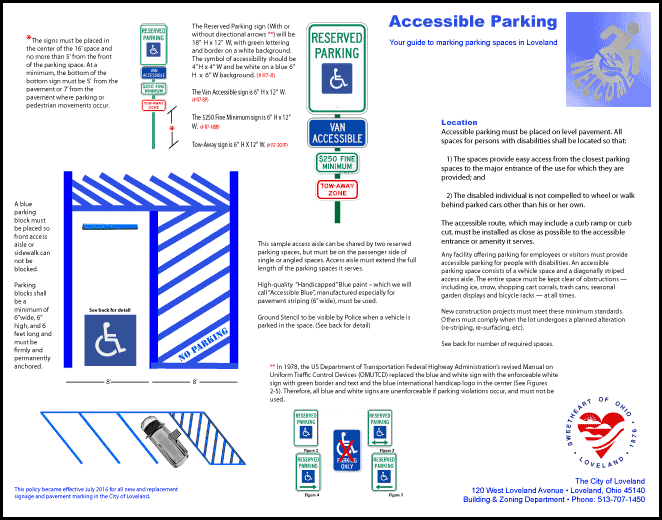
Because most spaces in Loveland in 2016, whether on public or private parking lots were not in compliance with either Ohio or Federal law, the proposal was to mark all accessible parking spaces in the City in a consistent manner and for City Hall to choose a deliberate pathway to bring them all into lawful compliance.
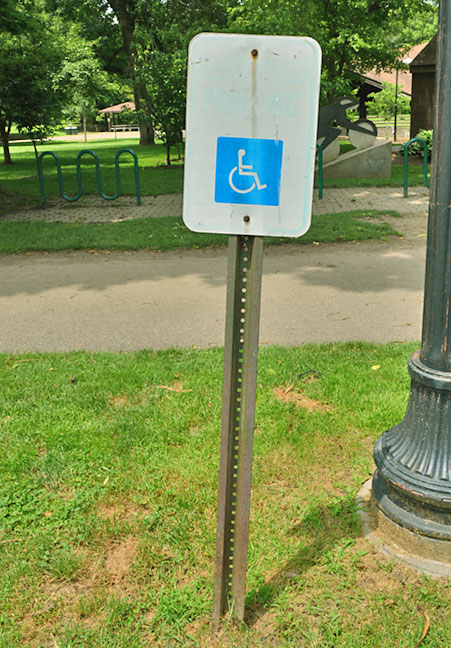
This was the neglected condition of the accessible parking sign near the restroom at Nisbet Park in 2014.
It’s intuition that leads you to rather easily locate the accessible parking spaces at Kroger or shopping centers, however, since most businesses in Historic Downtown do not provide their own parking, directional signs as well as signage at the parking spots themselves are needed.
At the time I started my research, accessible parking was out of sight, out of mind, neglected, and abused. During special events, they are still mostly out of sight and mind.
I received the full support and helpful suggestions from both City Manager Dave Kennedy and City Engineer Cindy Cindy Klopfenstein as I crafted and illustrated the plan. Kennedy from his end ensured that the planning commission and city council gave careful thought to the plan and secured their approvals.
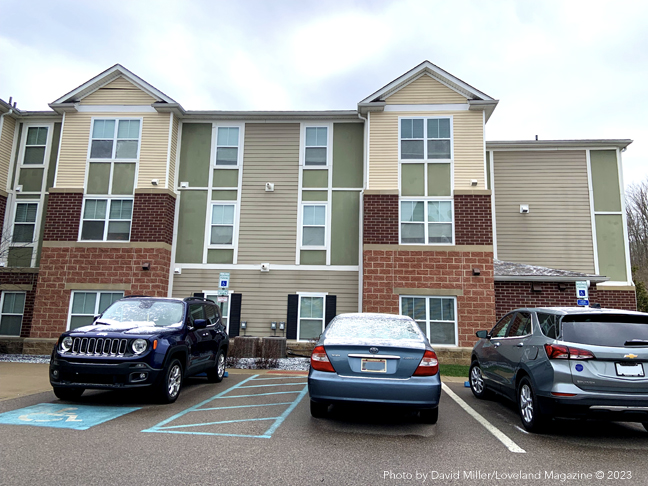
When built, the Trails at East Loveland was the first new development to fully comply with the new requirements for accessible parking spaces.
The plan as adopted requires that all new parking spaces from new development must tell the Planning and Zoning Commission how they intend to comply with the new requirements. Any repaving, recoating, or new stripping of existing parking lots must now also use the guidelines.
Also adopted at the time was a policy requirement that all applications, whether from private groups or City Hall who filled out an application for special events describe on the application how they will provide the number of accessible parking spaces based on their anticipated attendance.
The Accessible Parking Sign used by the State of New York
The original plan I proposed was to use a new universal design that at the time was being adopted around the country, but through research of Ohio Department of Transportation law, I discovered that although they were considering the new design they had not yet made it their design of choice. The newer “fluid movement” design is meant to accentuate a more positive image of accessible needs rather than an expression of one using the parking spot as being “handicapped”.
Also, one idea I had in 2016 was to have directional signs placed throughout our Downtown Historic District pointing to where a person could find accessible parking, without driving around looking for them.
Thus, in light of it being National Disabilities Awareness Month I have revisited my earlier proposal and now suggest “wayfinding” directional signs in the Historic District so people can find the hidden gems closest to where they want to go.
I propose permanently mounted signs as well as portable ones that would be brought out for special events such as Christmas in Loveland, parades, and the Independence Day event.
The Direction Sign I propose for Historic Downtown Loveland would tell visitors and shoppers where to find an accessible parking space and that the Sweetheart City of Loveland, Ohio is a welcoming community.
Thank you for considering my suggestion.
Best regards,
David Miller
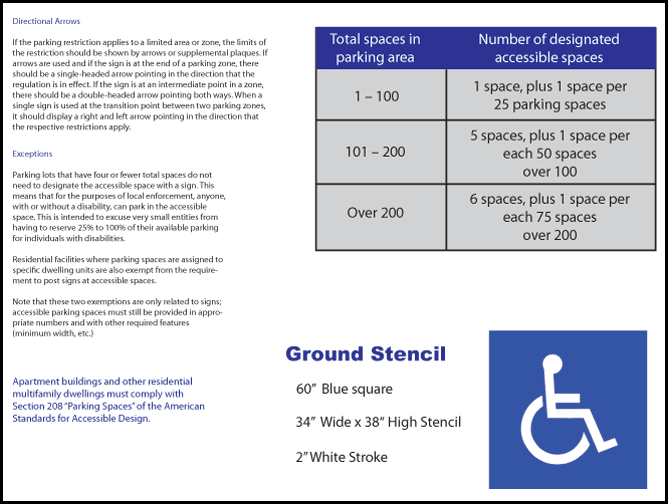
The Accessible Parking Space Guide Approved in 2016
Developmental Disabilities Awareness Month is the right time to talk about it
by Lisa Guliano
Before the 1950s, Ohio residents with developmental disabilities were often sent to institutions or kept at home, isolated and hidden from the public. Thanks to the advocacy efforts of parents who wanted better for their children, change was brought about. In 1952, parents in Butler County formed what would later become the Butler County Board of Developmental Disabilities (BCBDD).
With such a start, BCBDD has always had a hand in advocating for people with developmental disabilities and despite progress, there are many ways that advocacy is still needed to this day.
In 1986, the Ohio Legislature signed into law a Bill of Rights for people with developmental disabilities. The statute includes 24 rights to legally reinforce the freedom to choose and experience life. These are basic rights such as: the right to participate in decisions that affect their lives; the right to social interaction with members of either sex; the right to food adequate to meet accepted standards of nutrition; and the right to privacy, including periods of privacy and places of privacy to name some examples.
It has always been difficult for me to accept that people with disabilities needed additional protection under the law to simply be treated equally as all citizens.
Given that reality, our Board’s mission focuses on supporting people to live, work and learn in their community. What that looks like is different for every person depending on their goals and dreams for their future – just like you and me. Our role as advocates is an honorable one — it is vitally important given the history of people with disabilities living in institutions and being hidden from the community for being different.
Supporting people with disabilities to access opportunities to develop their full human potential – language also included in the Bill of Rights – incredibly increases our value as a society. Each person realizing their goals and dreams has an exponential effect on all of us.
If you’re trying to think of examples of what our mission looks like in the community, I’d encourage you to look at yourself, possibly your family members and even your friends. Haven’t we all worked on a plan for our lives and accessed support from others along the way? Are there times when you or someone you know faced challenges, or even barriers because of being different or not fitting a “typical profile?” As you’ve walked your path in life, recall the times where your opportunities led you to reaching goals, getting closer to your full potential, contributing to your sense of worth, your family and your community.
Diversity doesn’t look all that different for people with disabilities as they focus on living their best lives – not defined by us – but supported by us. We celebrate Developmental Disabilities awareness month in March and I’m challenging you to focus on the abilities, not the disabilities of people in our community, recognizing the unique ways all of us contribute to society.
I’d like to take a few minutes of your time to share my perspective on the school levy that will be on the May ballot.
I’m a 60-year-old, 30-year Loveland area resident with a home in the Loveland school district. I’m semi-retired and our children, who attended Loveland schools from K-12, are grown. Being semi-retired means, like many of you, I watch my spending closely. As someone who has always been proud of the Loveland Schools’ reputation and performance, the divide in our community from the past few levies has been disheartening. I have friends and neighbors on both sides of this issue. I have voted no in the past and I understand why people feel as they do about the situation.
The perspective I want to share is fairly simple, and one that as fellow property owners I hope you will consider. I firmly believe it’s in all of our best interests to be more aligned this May.
The premise is this: I understand that property values are subject to a variety of factors. I believe that school district performance is among the leading considerations of families looking to move to a new community. The way l see it a school district that does not support reasonable funding requests is destined for declining property values over time, as school performance and reputation declines. The reality is that things do cost more over time and it does cost to attract and retain top talent.
Let’s say for the sake of argument that property values drop 10 percent over the next ten years. If your Loveland home was valued at the current Zillow average of $355,000, you will take a $35,500 hit when you sell it. That is a very significant loss. I would prefer to pay a few hundred dollars more each year to help maintain the good reputation of our schools, protect our property values and provide our students with a well-rounded educational experience.
While each of us has reasons that affect our decisions about these levies, I believe what we have in common is that we all prosper when we have a high performing school district. I would like our state to provide a better funding mechanism for our public schools, but unfortunately, it doesn’t. I trust that our current school leaders are good stewards of our hard earned tax dollars and I believe that they reacted appropriately to our feedback when the District overreached.
After voting against the oversized levy a few years ago, I will be voting yes on the May levy that will be on the ballot, mostly to help protect our property values. I’m willing to find the additional hundreds of dollars per year as an investment in education, our community and in all of our property values.
I appreciate you giving this issue further consideration and I respect that each of you has the right to vote for what you believe is best for your situation.