


Tag: longer school days

  • Moving Halloween to Saturdays

    Moving Halloween to Saturdays

    by David Miller

    Let’s return ‘All Hallows’ Eve to the Church where it belongs and has meaning, “witch” is not about candy, costumes, and ghouls. It’s religious to honor the “saints” who have gone to heaven, not hell.

    The religious holiday has always belonged to them anyway.

    The secular Halloween is a 2000-year-old pagan festival that celebrated Summer’s end by believing the dead could walk among us.

    We 2022 pagans and heathens celebrate Halloween by walking like the dead or otherwise scaring little innocent children ghoulishly and then ease our guilt by rewarding them with sugary or chocolatey treats. And, it works because we in turn allow our children to enter a fantasy world of costume play by going house to house begging to be scared and being rewarded for it.

    All Hallows’ Eve, the religious event, is always on October 31, and November 1 is All Saints Day.

    Halloween (Trick or Treat) is “officially” declared by local governments between certain hours each year on October 31, and six out of seven years the day is either on a work or school day or when the next morning is either a work or school day. They choose dangerous dark hours when children should not be walking the streets in hard-to-see costumes many of “witch” are hard to see out of.

    Celebrating Halloween on the last Saturday of October would allow the traditional parades through subdivisions. And, let children and pets “trick or treat” in other neighborhoods, begging between the hours of 4-6 PM. It would allow the backyard unveiling of the bucket contents around a bonfire complete with hotdogs and smores.

    Then when the children pass out from exhaustion and their sugar highs, the adults can continue partying late into the night acquiring the hangover every pagan will have in the morning. The difference is that the next day is not a school or a work day. The non-heathens will still be in good shape to attend church in the morning.

    Saturday Halloweens would allow trick-or-treating to begin in the daylight hours, eliminating the need for costume safety alterations and flashlights.

    It eliminates the stress of hastily heading home from school and work preparing or buying dinner, doing homework, and preparing school lunches. Who needs cranky children and their parents?

    Gets children off the street before most drivers begin drinking.

    A developmental disability friendlier day.

    You can throw more elaborate neighborhood parties.

    Halloween deserves its own full-blown witching day brewed with more family fun.

    An interesting fact is that Halloween began in this country when folks went door to door asking for prayers. Let’s make this year the day we go door to door praying that “Halloween Saturday” becomes a new tradition by urging our local governments to wake up from the dead. And since Election Day follows so soon, treat them with a “NO” vote if they don’t agree.
  • State education testing shows declines, may be waived in new legislation

    State education testing shows declines, may be waived in new legislation

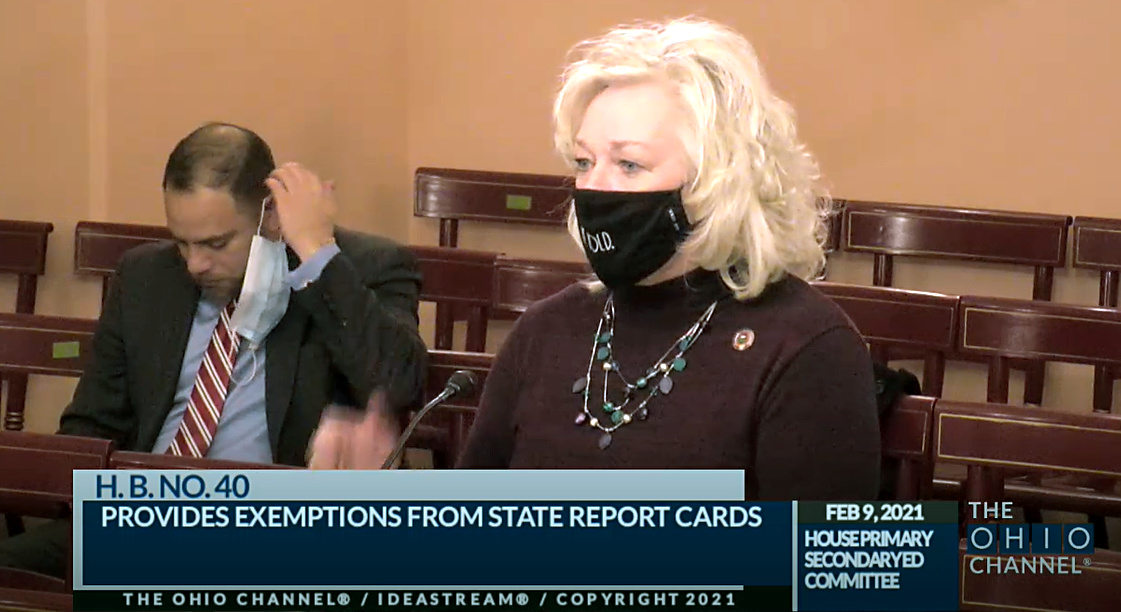
    Ohio state Rep. Lisa Sobecki testifies before the House Primary & Secondary Education Committee on Tuesday, on a bill seeking waivers on state and federal testing.

    by Susan Tebben and Ohio Capital Journal

    As state officials look for solutions to an education gap caused by the COVID-19 pandemic, two pieces of legislation introduced Tuesday hope to give more leniency on state and federal testing.

    Rep. Lisa Sobecki, D-Toledo, is a co-sponsor with Rep. Jeffrey Crossman, D-Parma on House Bill 40, to make exemptions for students in taking state report cards.

    The bill would waive state testing for the 2021-2022 school year and direct the Ohio Department of Education to seek a waiver for federal testing, as well as holding school districts harmless on state report cards to determine funding levels and eligibility for EdChoice private school vouchers and academic distress commissions.

    “We do need to see where our kids have been left behind, but I don’t need a test that’s going to tell us something after the kids have left,” Sobecki told the House Primary & Secondary Education Committee.

    She said the waiver of testing “appears to have broad, bipartisan support” within the legislature.

    Bipartisan support for state testing waivers came in the same Tuesday meeting, in the form of a separate bill brought by Republican state reps. Kyle Koehler and Adam Bird, to ask for many of the same things, including state and federal testing exemptions.

    “I am not asking to waive test requirements because we don’t need to know how testing will go,” Koehler told the committee. “I think we know it’s not going to go well. Students are going to be behind.”

    In further support of testing pressure relief, State Board of Education member Dr. Christina Collins released a proposed resolution directing the ODE limiting the use of state testing, and to “include a district designation of online, hybrid, or in-person on school building and district level report cards.”

    In the resolution, Collins writes that COVID-19 “has affected every student in Ohio, disrupting the structure of teaching and learning and emphasizing children’s dependency upon adults for nurture, protection and providing for health and well-being.”

    Along with the district designation, the board member asks that a disclaimer on state reports say that data “are for the purpose of understanding how learning was impacted as a result of extreme circumstances.”

    Earlier in the day, ODE Superintendent Paolo DeMaria said the test scores coming out of a pandemic’s worth of learning styles emphasize the need for students to get back to in-person instruction.

    DeMaria acknowledged a lower participation rate in the state testing, saying the ODE promoted a “safety first” mentality in taking the tests. But from the testing that did occur, the state saw an 8% increase in kindergarten-readiness scores considered “not on track.”

    Third-grade English Language Arts proficiency scores were also lower, which was also shown in a study released by the Ohio State University’s John Glenn College of Public Affairs.

    This third-grade test is set to occur this year starting from March 22 to April 23, part of why Sobecki said their legislation needs to be quickly moved through the statehouse and set up to be signed by the governor.

    “It’s February, folks,” Sobecki said.

    DeMaria, and the study itself, noted that the declining scores were even lower in minority and economically disadvantaged groups.

    State reports also showed a decrease in enrollment of 3%, particularly in pre-school and kindergarten.

    DeMaria spoke during Gov. Mike DeWine’s Tuesday press conference, in which he spent most of the time presenting the progress of vaccinating school teachers and personnel, something that the state started this month. While the state continues to vaccinate those 70 and older, they set aside some of the approximately 100,000 per week the state receives to give to school districts.

    Also on Tuesday, DeWine added a new project for school districts across the state, asking them to come up with an individualized plan to help students catch up on last year’s losses.

    “We need to be bold in our ideas, and we need to work with the Ohio General Assembly,” DeWine said, adding that a total of $2 billion in federal funding has been made available to schools to help with this problem.

    DeWine left the decisions up to the individual districts, but offered examples such as longer school years, longer school days, summer classes, tutoring, or even remote options as ways to fill the education gap.

    Districts have until April 1 to make their plans public and accessible to the General Assembly.