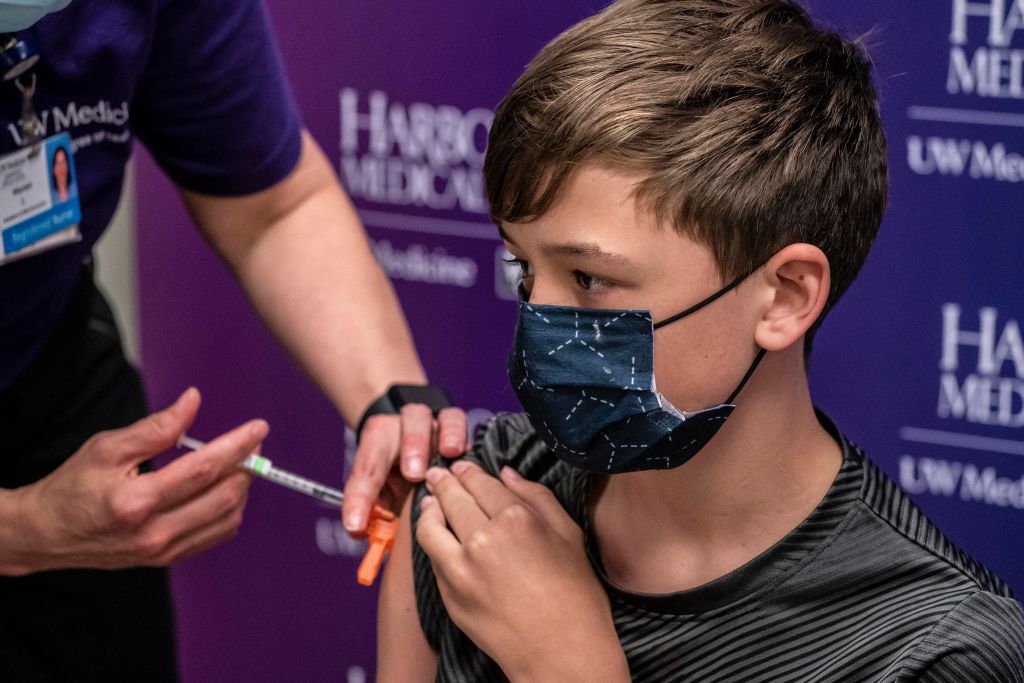
Gavin Smits receives a first dose of the Pfizer COVID-19 vaccine at Harborview Medical Center on May 13, 2021 in Seattle, Washington. (Photo by David Ryder/Getty Images)
WASHINGTON — The federal government on Wednesday recommended an updated COVID-19 booster for kids between 5 and 11, expanding use of the new bivalent shots beyond people 12 and older.
The U.S. Food and Drug Administration first authorized the updated vaccines use in the morning before the Centers for Disease Control and Prevention recommended them in the afternoon, completing the two-step process needed before shots could begin
CDC Director Rochelle Walensky announced her recommendation in a tweet, saying it’s “a critical step in our fight against COVID-19.”
“An updated vaccine can help bolster protection for our children this winter,” she added, encouraging parents to talk to their child’s healthcare provider.
The announcement Wednesday for kids between 5 and 11 follows the FDA authorizing and the CDC recommending the bivalent booster dose for people 12 and older in early September.
“While it has largely been the case that COVID-19 tends to be less severe in children than adults, as the various waves of COVID-19 have occurred, more children have gotten sick with the disease and have been hospitalized,” Peter Marks, director of the FDA’s Center for Biologics Evaluation and Research, said in a statement.
“Children may also experience long-term effects, even following initially mild disease,” Marks added.
The shot is updated to provide protection against the latest omicron variants of COVID-19, known as BA.4 and BA.5.
The move comes as public health officials are monitoring new variants that could cause disruptions this winter during the annual cold and flu season.
Winter surge in cases possible
White House COVID-19 Response Coordinator Ashish Jha said Tuesday during a press briefing that everyone eligible for the latest booster should get it as soon as they can, though he declined to list any goals for the new shot.
Jha then warned that a surge of COVID-19 cases could be on the horizon this winter.
“We have seen an increase in COVID infections, hospitalizations, and deaths each of the last two winters. And we are carefully monitoring the rise of several subvariants that are evolving rapidly and emerging around the world, including ones that evade some of our treatments,” Jha said.
The Biden administration, he said, is tracking COVID-19 variants that “either have a lot more immune invasiveness or they render many of our treatments ineffective.”
The good news, however, is that the variants public health officials are tracking come from omicron strains BA.2 and BA.5, Jha said.
“That means our updated bivalent vaccines should provide a much higher degree of protection than the original prototype vaccine would have,” he said. “Obviously, we’re going to do the studies to figure out how much protection, but I’m confident that our vaccines will continue to work very well.”
No vaccine goals set
Despite encouraging everyone eligible for the updated COVID-19 bivalent booster dose to get vaccinated, Jha said the White House hasn’t set any goals for how many people it wants to get the shot.
“We’re not setting targets,” Jha said. “We are focused on driving deaths down, getting more people vaccinated.”
The U.S. Centers for Disease Control and Prevention’s website shows that 11.5 million people have received the updated booster dose, a fraction of those eligible.
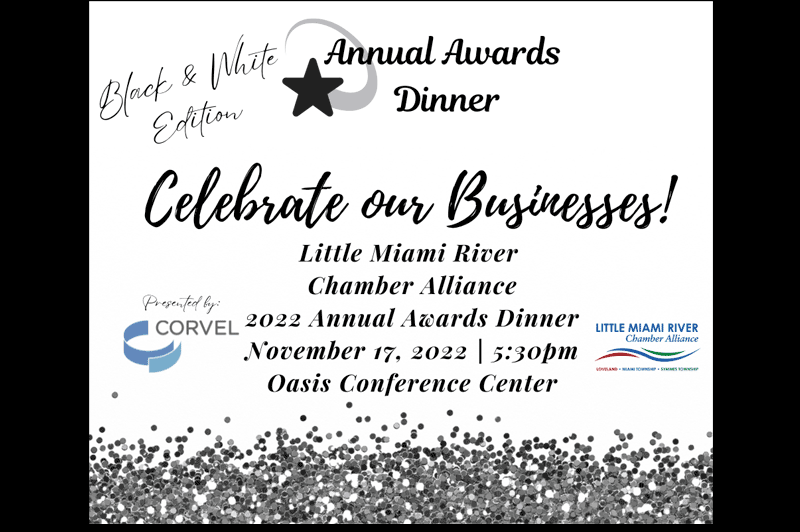
Please join Loveland Magazine and the Little Miami River Chamber Alliance as we honor those who have made significant contributions to enhance our quality of life and make our community a better place to live. The Annual Awards Dinner is an evening for all area businesses to come together and celebrate their successes and community contributions.
Joins us this year for our “Black & White Edition”–wear black and white to this event for a fun twist!
The event includes cocktails, networking, silent auction, dinner, and awards. It is a great networking opportunity!
Loveland, Ohio – Coming soon to the pages of Loveland Magazine is the love story of how the Simpson Farm in the West Loveland Historic District was preserved in its pristine beauty. Local residents banded together and fought hard to establish a 41-acre conservation covenant that was eventually placed on the Simpson Farm deed.
You will learn how the Drees’ bulldozers and proposed condos eventually lost traction and were steered away from Loveland.
It was a four-year “labor of love” to keep the acreage in the heart of our “Sweetheart City” untouched by human hands so all future generations of girls and boys could fall in love with it as well.
“This is a love story. As often happens, love stories often mingle with their nightmares and the familiar sleepless nights. First, the love story though, and perhaps at a later time what the current heartache is.”
In the meantime, you can watch the accompanying video that will be part of the documentary. Featured are the sights and sounds of the wildlife that resides on the “Farm”. The primary reason for the effort that began 25 years ago was to provide a sanctuary and a peaceful place for the animals you see in this video.
Join Interact for Health and Starfire to learn about our new learning cohort opportunity. Starfire will facilitate a six- month learning cohort with the goal of fostering an inclusive culture within nonprofit organizations. The cohort will run from early December 2022 to early June 2023.Nonprofits interested in organizational culture; diversity, equity and inclusion; and community building may apply for the cohort. Each of the five organizations chosen will receive $5,000 to use toward their goals. This session will be used to share information about the upcoming learning cohort and how to apply. If you are interested but cannot attend on Oct. 27, please register for the event and we will send you a link to a recording of the webinar to watch at your convenience. The deadline to apply for the cohort is Thursday, Nov. 17, 2022.This event is intended for our community partners, grantees or anyone with interest in Interact for Health’s 20 county service area and beyond.
There is no cost to attend, however, registration is required. Registration closes 5 PM Wednesday, Oct. 26.
Former Cincinnati Councilmember and Hamilton County Commissioner Phil Heimlich is part of a coalition of Ohio Republicans encouraging voters to reject Trump-aligned candidates like J.D. Vance.
With November’s election looming, a group of Republicans are hitting the campaign trail this week. But instead of stumping for the GOP, they’ll be encouraging voters to back the Democrat, Tim Ryan, in Ohio’s race for U.S. Senate.
They’re working with an organization called Welcome PAC which emphasizes Democratic Party outreach to independents and “future former Republicans.” LinkedIn co-founder Reid Hoffman is the group’s primary donor. The PAC contends there’s a large pool of swing voters who reject former President Donald Trump. They’ve made it their mission to encourage those voters to reject Trump allied candidates as well.
And that’s how Phil Heimlich found himself teaming up with a handful of other Ohio Republicans campaigning for Tim Ryan. Among them are two high level former staffers for outgoing U.S. Sen. Rob Portman — chief of staff John Bridgeland and legislative affairs director Jonathan Petuchowski. Former state Auditor James Petro, former state Rep. Rocky Saxbe, retired Major General Dennis Laich, and former Shelby County GOP chairman Chris Gibbs round out the list.
There are a lot of “formers” in that lineup, though. While they’re pitching a return to a different era of Republican politics, it’s possible the party has picked up and moved on without them. Vance’s campaign makes no bones about its position on WelcomePAC:
“Ohioans shouldn’t be fooled: this bogus organization isn’t ‘Republican’ — it’s a Democrat trick funded by a far-left super donor,” campaign spokesman Luke Schroeder said in a statement.
Heimlich himself is a former Cincinnati city councilmember and Hamilton County Commissioner, and he argued his conservative credentials are rock solid.
“I was never considered a kind of a wishy-washy RINO type,” he said.
Heimlich continues to describe himself as a loyal Republican, but said he can’t support nominees who deny the 2020 election or countenance the Jan. 6 insurrection.
“We’re taking a stand against the wing of the Republican Party that engages in crazy conspiracies like Q-Anon, and, most importantly, we are choosing to put country over party,” Heimlich said. “J.D. Vance is lined up with the crazies, with the traitors. He has lined up with the people who tried to overthrow this government, the people who tried to overturn a legitimate election.”
“We are supporting Tim Ryan because we’re putting country first,” he continued. “Tim Ryan is not only a moderate Democrat, but he is a pro-democracy Democrat and he’s running against an anti-democracy Republican.”
This isn’t the first time Heimlich has made this sort of pitch. He and some of the same Republicans campaigning against Vance urged voters to reject Donald Trump in 2020. That effort, known as Operation Grant, invoked former president and civil war general Ulysses S. Grant’s role unifying the country.
Heimlich explained this latest coalition doesn’t oppose Republicans reflexively, but it isn’t just Vance he opposes.
Heimlich unsuccessfully challenged Ohio Republican U.S. Rep. Warren Davidson in the primary and criticized Davidson’s vote to overturn the 2020 election. He called out Ohio U.S. Rep. Jim Jordan, too, describing him as a Republican who “put party over country.”
“In fact, they put one particular person, Donald Trump, over the interest of our country,” he added.
Split-ticket voting
When it comes to DeWine, Heimlich is more amenable. He expressed disappointment DeWine hasn’t made a more forceful stand against the former president, but credited him for not denying the election or praising insurrectionists.
“One of the things we’re saying to people is, look, if you’re a patriot, don’t vote the party line, vote the country line,” Heimlich said. “So, if you want to vote for Mike DeWine for governor, fine, but please don’t vote for an election denier like J.D. Vance. Vote for DeWine and then vote for Tim Ryan.”
Schroeder, with the Vance campaign, questioned the coalition’s Republican credentials. He argued it’s disingenuous to continue presenting themselves as part of the party.
“(The) individuals involved are donors to Tim Ryan, Pete Buttigieg, Joe Biden, and liberal PACs, and one member even served as a political appointee for President Obama,” Schroeder said. “It’s a shame that these individuals have chosen to lie to Ohioans about who they really are.”
In 2020, the Operation Grant pitch didn’t move Ohio into the win column for Joe Biden. Trump won the state by a margin nearly identical to his 2016 win. But in the aftermath, the organization argued it forced the Trump campaign to expend resources in Ohio, which they say helped Biden win elsewhere.
This cycle, with the election limited to Ohio, they won’t have the same leeway. But then again, it’s far from clear Vance commands the same allegiance as the former president.
Organizers of the group expect to make stops in Youngstown, Toledo, Cleveland, Akron, and Dayton in the coming weeks.
$137,500 – will be awarded to Loveland-based Little Miami Conservancy
by David Miller
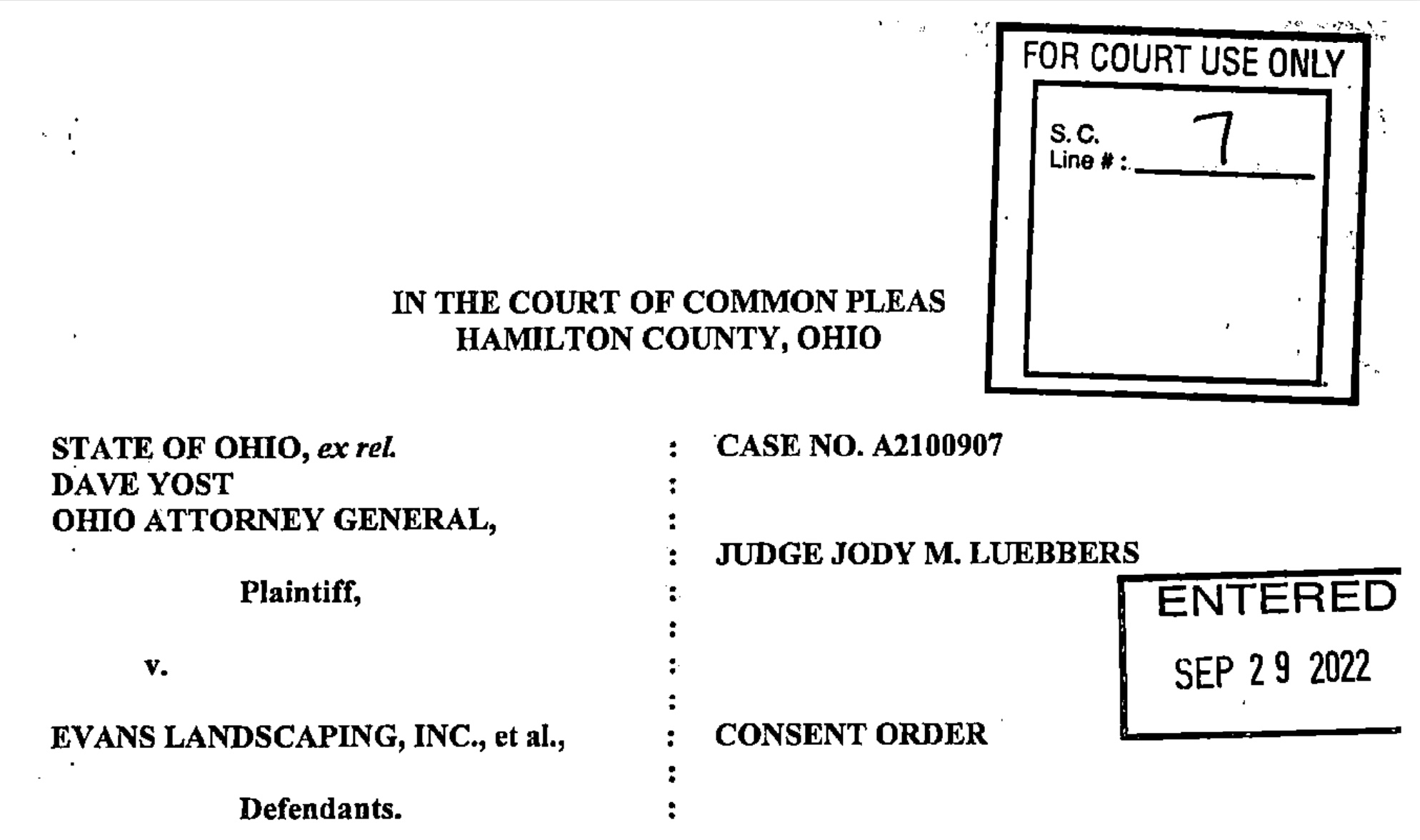
Symmes Township, Ohio – A Cincinnati business owner with a location in Symmes Township just on the outskirts of Loveland, who used his four companies to illegally discard waste at three sites – and whose dumping may have polluted the Little Miami River – has been ordered to pay a civil penalty of $550,000 and clean up his mess, Attorney General Dave Yost announced on September 30. (Read the Consent Order)
One-fourth of the penalty – $137,500 – will be awarded to the Loveland-based environmental organization, Little Miami Conservancy. The order did not involve polluting the Little Miami River in Symmes Township or Loveland. The illegal dumping occurred near Newtown and Terrace Park. The Little Miami River has State and National “Scenic and Wild River” designations.
“When it comes to protecting the state’s waterways, we do not just go with the flow,” Yost said. “Illegally dumped waste doesn’t just sit there on the land – it breaks down into toxins that find their way into the water. This remedy will make sure that doesn’t happen, and the fine will hit him hard where it hurts – his wallet.”
The civil penalty stems from a lawsuit filed by the Ohio Attorney General’s Office (AGO) in Hamilton County Common Pleas Court. The suit maintains that Douglas Evans – through Evans Landscaping and three other businesses he owns – violated Ohio laws regulating the disposal of solid waste and construction and demolition debris at properties on Mount Carmel Road, Broadwell Road, and Round Bottom Road.
The case was referred to the AGO from the Ohio Environmental Protection Agency and the Hamilton County Public Health District.
During multiple inspections over several years, health district officials saw that parts of demolished buildings, garbage, and other solid wastes had been dumped or buried at the three sites, none of which is licensed as a facility for disposal.
As part of the consent order worked out with the AGO and approved by the court, Evans agreed to clean up his properties and correct violations according to a plan authorized by Ohio EPA and the Hamilton County health district.
At the Mount Carmel site, he will build a cap over areas where construction and demolition debris were illegally disposed – to prevent water from reaching the debris and causing harmful chemicals to leach out.
At the Broadwell site, under the supervision of the Ohio EPA and health district, he will dig out and remove illegally disposed waste.
At the Round Bottom site, he will conduct groundwater monitoring to ensure that waste from his property is not affecting groundwater quality or the Little Miami River. If it is, Evans will perform the necessary remediation.
If Evans fails to comply with any requirements of the order, he will immediately be liable and have to pay additional penalties.
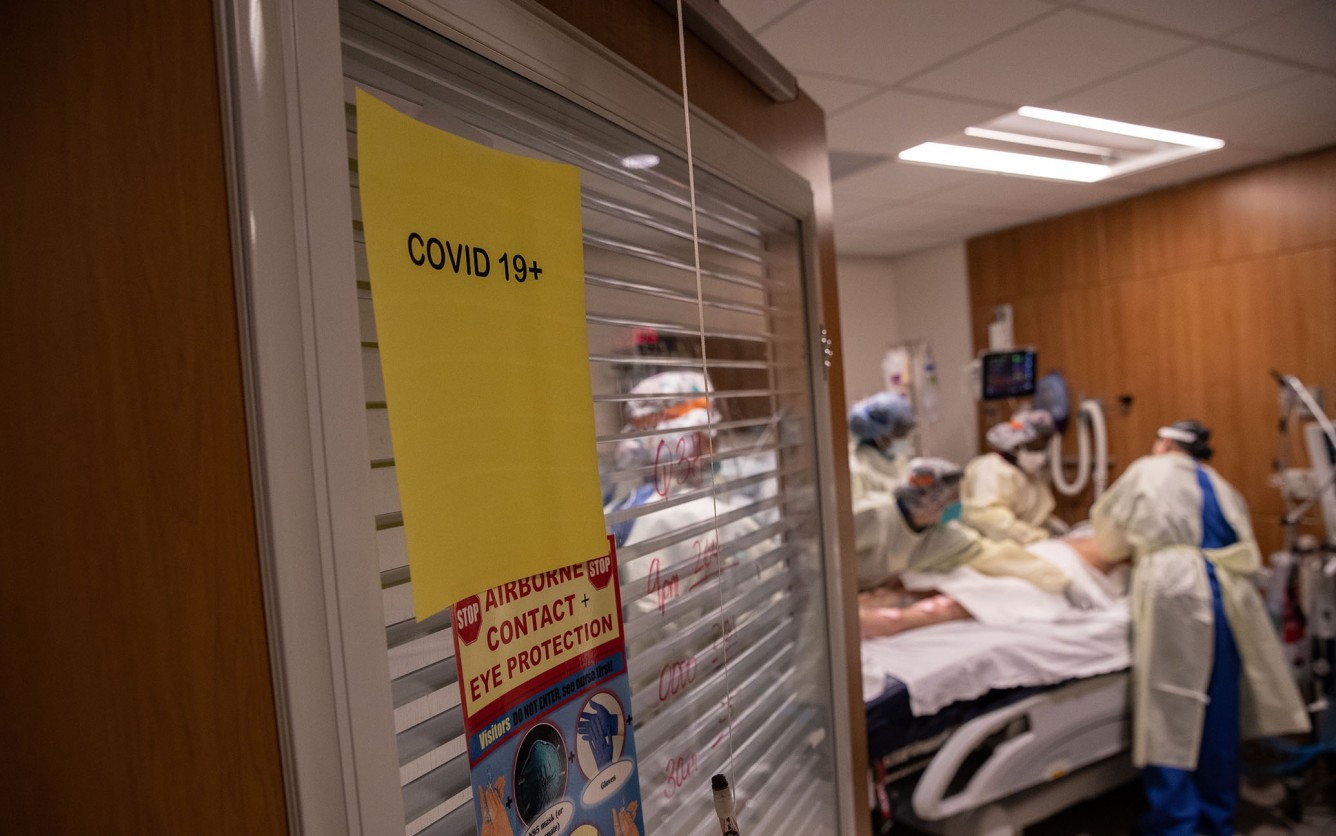
A “prone team,” wearing personal protective equipment, prepares to turn a COVID-19 patient onto his stomach in a hospital intensive care unit in Stamford, Conn. (John Moore/Getty Images/TNS)
by Shaun Heasley | September 26, 2022 – disabilityscoop.com
New research finds that people with developmental disabilities were much more likely to die from COVID-19 at the height of the pandemic than others.
A review of death certificates nationwide for 2020 shows that COVID-19 was the top cause of death among people with intellectual and developmental disabilities.
By comparison, the virus was the third leading cause of death following heart disease and cancer for those without such disabilities.
“Even when we adjusted for age, sex and racial-ethnic minority status, we found that COVID-19 was far deadlier for those with IDD than those without,” said Scott Landes, an associate professor of sociology at Syracuse University and lead author of the study published this month in the Disability and Health Journal. “Furthermore, people with IDD were dying at much younger ages.”
Loveland, Ohio – It’s not too early to start thinking about Valentine’s in the land of love! Nominate a local lady to serve as 2023’s Valentine Lady or submit original artwork to the theme of “There is nothing in the world so sweet as love.” Nominations are due by November 18 to the chamber office.
Nominate a local lady to serve as 2023’s Valentine lady by submitting your letter of recommendation to the LMRCA office or by emailing us at meredith@lmrchamberalliance.org.
Little Miami River Chamber Alliance | 113 Karl Brown Way, Loveland, OH 45140
Valentine Lady History
The Valentine Program began in 1972 and has grown over the years to include a variety of Valentine community activities, as well as our nationally-known cachet stamping and postmark program.
Valentine Ladies are women who have distinguished themselves in community, school, or family endeavors. Being nominated for Valentine Lady is quite an honor!
The Valentine Lady is the ambassador for the Chamber’s Valentine Program, and visits area businesses, nursing homes, and schools, among her duties as Valentine Lady.
Annual Valentine Card Design
Original artwork may be submitted by any individual who is interested!
Artwork must reflect or incorporate the theme: “Love is…..” and must also include (or provide space for) the phrase, “There is nothing in this world so sweet as love.” One-color, two-color and full-color entries are acceptable.
Artwork must be flat (two-dimensional) and reduce proportionately to fit within a 5 inch by 3 ¾ inch space, the size of the printed Valentine’s Day cards.
All entries must be submitted in person to the Little Miami River Chamber Alliance at 113 Karl Brown Way, Loveland, OH 45140 or by mail to the Little Miami River Chamber, 113 Karl Brown Way, Loveland, OH 45140.
Submit artwork for the design contest (deadline is November 18, 2022).
Entry forms and contest rules are available at the Little Miami River Chamber Alliance, 113 Karl Brown Way, Loveland, OH 45140. If you would like one sent to you, please call the Little Miami River Chamber Alliance at 683-1544.
The winner will receive design credit on the back of the 2023 Valentine’s Day cards, recognition at the Valentine Kick off, other local recognition, media recognition and two complimentary invitations to the Little Miami River Chamber Alliance Annual Valentine Breakfast.
Entries not selected may be picked up after December 10, 2022.
The Ladies
Due to the COVID-19 Pandemic, the current Valentine lady is serving a 2-year term. Nominations will begin in the fall of 2022 for the 2023 Valentine lady.
These women are chosen by community nomination, then picked by a committee of the Little Miami River Chamber Alliance. Stay connected with them through the Valentine Ladies on Facebook.
2021-2022: Jeannie Schumaker 2020: Debbie Murray 2019: Dr. Kathy Lorenz 2018: Kay Bolin 2017: Carol Williams 2016: Laurie Gordon 2015: Sue Lundy 2014: Janis Fogle 2013: Marge Henderson 2012: Jan Ranard 2011: Avery (Winkie) Foster 2010: Bonnie Larson 2009: Linda Cox 2008: Kay Napier 2007: Sue Newburger 2006: Peggy Goodwin 2005: Lu Boike 2004: Helen Gosch 2003: Kathryn Undercoffer 2002: Patricia Furterer 2001: Marirose Stiver 2000: Anne Fowler 1999: Winona Franz 1998: Barbara Dee 1997: Bobbie Books 1996: Jo Ann Richardson 1995: Mary McDonnell 1994: Margaret Keifer 1993: Kathryn Sidney 1992: Doris Osborne 1991: Martha Hockman 1990: Rose Wene 1989: Pat Randolph 1982-88: Ruth Jackson (Doris’s daughter) 1982: Doris Pfiester
Many things about school funding and finance are made to be more complicated than they should be. When 86% of your Public School District’s budget is comprised of employee compensation and benefits (of which the majority is teacher pay) it pays to be informed (no pun intended). We constantly need new levies because the union-negotiated salary schedule is designed to perpetuate substantial and ever-increasing teacher costs. No one is denying that we have good teachers at Loveland. They should be paid decently but they are clearly not underpaid. The Loveland district has been generous in compensating teachers for years. It would be a benefit to the Loveland Community to address this issue openly in terms of ever rising costs and the ability of our community to reasonably afford them. To that end, here is a deeper look at how the teacher pay scale is structured and compares to the top schools in our area.
WHO OR WHAT GOVERNS TEACHER PAY
The LCSD Master Contract (available publicly) governs teacher pay and is typically negotiated every 1-3 years. Teachers are called “certified staff’ but the union who bargains for their contract refers to them as “bargaining unit members”. The current Master Contract is 87 pages long, but bargaining unit members sign a single sheet of paper which designates their individual compensation package. Pay is negotiated by the Loveland Education Association, the local union, which is an affiliate of the Southwestern Ohio Education Association (SWOEA), the Ohio Education Association (OEA) and the National Education Association (NEA).
HOW PAY IS CALCULATED
Appendix I of the Master Contract is a single page dedicated to the Loveland City Schools Teacher Pay Scale for years 2021-2022 & 2022-2023. Think of the Pay Scale as a grid. Across the top of the grid are six column headings designating increasing education levels from a bachelor (Group I) to a Master’s degree plus 30 semester hours (Group VI). Down the side in rows are the numbers 1-35 designating years of teaching (also called “steps”).
Group I
Group II
Group III
Group IV
Group V
Group VI
1-35 – Years of teaching experience (“steps”)
Bachelor (BA)
BA with 150 semester hours
Master’s (MA)
MA + 10 semester hours
MA + 20 semester hours
MA + 30 semester hours
A bargaining unit member’s pay is determined by 3 things:
1) the base salary (everything hinges on this),
2) education level (graduate semester hours or degree) a teacher has earned, and
3) years of teaching or number of steps.
Each contract year Bargaining unit members may receive up to three different kinds of increases:
1) a negotiated increase in the base salary, which is not limited and may be different for each year of the contract,
2) an education level increase of a pre-calculated percentage amount based on the new Group (see chart above), and
3) a percentage increase for the number of years of teaching or steps.
There are 20 raises in the current Master Contract up until a teacher has been teaching for 27 years. There are no new increases between 27 and 35 years of teaching, but if the base pay is increased at any time, all years up to year 27 are increased proportionally.
To determine the yearly total pay for a teacher, the equation would be:
Salary = Base Pay + Education Level increase + Number of Years Teaching increase (steps).
The value of teacher pay is determined automatically by years of teaching and education level. Classroom performance, class size, subject matter, grade level, and student needs have no bearing on teacher pay.
DID LOVELAND TEACHERS RECEIVE ZERO PAY RAISES?
The School District’s statement on its website that there has been “0% increase in the pay scale for teachers” should be clarified. This does not mean that teachers are being paid no more this year than they were paid last year, as one might naturally suppose. The current LCSD Pay Scale has remained the same for the two-year contract period of 2021-2023. During this current period there have been no increases in the base salary of $44,167 (what a first-year teacher with a Bachelor’s Degree would receive).
However, the current Master Contract which was negotiated in 2021 modified the years of teaching experience or steps. To align Loveland more closely with other districts, LCSD expanded the steps so that it now takes a teacher 26 years to reach the top salary level, whereas previously only 20 years were required. In the previous contract’s pay scale a teacher could receive 17 raises to reach the top salary for years of teaching. In the current contract’s pay scale a teacher can receive 20 raises to reach the top salary for 27 years of teaching. As a consequence, every teacher with more than 20 years’ teaching experience received one or more of these new raises. Moreover, in transferring teachers from the previous 20-year schedule to the new pay scale according to their salaries at the time of the change (so that no teacher would receive a pay cut), a number of teachers were reassigned to a level higher than their actual years of teaching would indicate. In the first year of the new contract everyteacher received a boost to their pay due to these administrative adjustments. Finally, any teacher achieving the next milestone of educational level received the usual related salary increase. So clearly, even in a year when the “pay scale has not increased,” the cost of teacher compensation increased substantially.
Teachers who have reached the top of the pay scale (maxed out both education levels and years’ experience) can receive a raise only when an increase in the base salary is negotiated. When the base salary is raised (as a percentage in the contract), it then raises every other category on the pay scale, amplifying the increase to all salaries. Although some teachers did not see any salary increase in the current or second year of the Master Contract, year-to-year 0% increases in the pay scale still result in pay increases for the majority of teachers who received an increase for another year of teaching.
FAST TRACK TO A MASTER’S DEGREE
Individual school districts vary in the way they compensate teachers for educational level. Whereas Loveland’s top salary group is a Master’s Degree plus 30 semester hours, Indian Hill’s and Forest Hills’ top salary level is a Doctorate. Sycamore tops out at a Master’s Degree plus 45 semester hours. In every top performing district other than Loveland it takes longer for teachers to achieve the highest educational level.
Moreover, there is a “multiplier” between each of the education levels which determines the increase in pay for that level. On Loveland’s pay scale the cumulative percentage increase in the base salary between the lowest education level attained and the highest education level is equivalent to 27.25%. Of the top performing schools in southwest Ohio only Indian Hill comes close to Loveland with a 22.5% cumulative education level increase. Sycamore Schools hand out a cumulative education level increase of only 11.35% from a bachelor to a doctorate.
By obtaining one’s Master’s Degree a teacher can increase his or her salary and move up the pay scale more quickly. In fact, many Loveland teachers do so. The District assists in this, as the Master Contract attests. It states: The Board will provide 100% tuition reimbursement to bargaining unit members, up to a maximum of three (3) credit hours each and up to a total Board contribution of $60,000 during a contract year. So teachers not only increase their salaries by obtaining a Master’s Degree but also can obtain semester hours at the school’s expense. This also assists a teacher in obtaining a “Continuing Contract” (job for life) which the majority of Loveland’s teachers possess.
The following chart demonstrates the high percentage of Master’s Degrees in the Loveland District compared to the top performing schools in our area even though research cannot conclude that an advanced degree makes one a better teacher or improves classroom performance.
PERCENTAGE OF TEACHERS WITH MASTER’S DEGREES (with local rankings)
LOVELAND
SYCAMORE
INDIAN HILL
WYOMING
FOREST HILLS
MADEIRA
2022
86.9% (2)
68.1%(6)
93.2% (1)
70.5%(5)
78.6%(3)
74.6%(4)
2021
90.2%(2)
67.7%(6)
91.6%(1)
71.0%(5)
78.5%(3)
77.0%(4)
2020
86.2%(2)
70.5%(6)
91.7%(1)
74.2%(5)
76.0%(4)
77.7%(3)
2019
86.5%(2)
69.4%(6)
91.3%(1)
75.0%(4)
73.8%(5)
76.5%(3)
2018
84.9%(2)
69.8%(6)
91.4%(1)
75.1%(4)
74.6%(5)
78.7%(3)
COMPARING AVERAGE PAY AND YEARS EXPERIENCE
In Fiscal Year 2021 Loveland ranked 20 out of all 607 districts in the state of Ohio for highest average teacher pay (96th percentile) and was ranked 4th out of the 49 districts in southwest Ohio. Currently Loveland ranks 39 out of 607 districts for average teacher pay putting us in the 93rd percentile. This ranking is in spite of having both a lower base pay and a lower top salary than these same schools. Here is how Loveland compares to the other top performing districts in our area:
AVERAGE TEACHER SALARY (with local rankings)
LOVELAND
SYCAMORE
INDIAN HILL
WYOMING
FOREST HILLS
MADEIRA
2022
$81,511(5)
$73,726(6)
$85,758(1)
$82,733(3)
$81,946(4)
$84,757(2)
2021
$82,624(3)
$73,804(6)
$83,647(1)
$81,094(4)
$80,039(5)
$83,097(2)
2020
$82,156(3)
$74,359(6)
$82,234(2)
$80,136(4)
$76,742(5)
$82,388(1)
2019
$78,248(3)
$72,714(6)
$79,884(2)
$78,242(4)
$73,582(5)
$80,131(1)
2018
$74,224(4)
$71,577(5)
$77,872(2)
$76,930(3)
$70,299(6)
$78,079(1)
The reason Loveland ranks high for average pay is that we have a larger number of teachers at the higher level of the pay scale than other schools, with the majority of our teachers possessing a Master’s Degree (Indian Hill being the only local district higher than Loveland). Interestingly enough, we have on average fewer years teaching experience than most of the other top schools except for Sycamore. Sycamore, however, has far fewer Master’s Degrees and has a much lower average teacher salary. No other district in the State of Ohio has the percentage of teacher’s with Master’s Degrees that Loveland has for the comparably low years of teaching experience.
AVERAGE YEARS TEACHING EXPERIENCE
LOVELAND
SYCAMORE
INDIAN HILL
WYOMING
FOREST HILLS
MADEIRA
2022
13
13
18
17
18
15
2021
14
14
18
17
18
15
2020
14
14
18
18
17
15
2019
14
14
12
18
15
18
2018
13
12
12
17
15
14
OBSERVATIONS
Loveland compares favorably with other top local districts in our area for base salary. Even when the base salary itself is not increased, most teachers receive a salary increase from either years of teaching (steps) or advanced education levels or both. Loveland is exceptionally generous with its raises related to education level and subsidizes a portion of that advanced education. Loveland ranks in the 93rd percentile in Ohio for average teacher pay, even though its teachers have on average fewer years of teaching experience than is true in other districts.
While it is good that our Board re-negotiated to expand the teaching years (steps) in the pay scale they did not address the short time frame to rise through the educational levels. In the end they just “kicked the can” down the road. Although it will take a bargaining unit member longer to reach the top salary he or she will go through an additional series of increases and if and when the base pay rises all other education level and step increases will go up accordingly.
How long can the Loveland community sustain the expenses of our current educational system? When 86% of the budget is personnel and 60% of that 86% is a pay scale with both negotiated and built-in automatic raises, it can only become more and more difficult for the community to pony up the ever-increasing amounts of money needed to pay the cost.
Resources: All data in this analysis was derived from the Loveland Teacher’s Master Contract, The Ohio Department of Education, the State Employment Relations Board and interviews with local teachers.
Loveland, Ohio – The Little Miami River Chamber of Commerce Alliance recently voted (15-0 in favor) to promote Meredith Taylor to Vice President of Operations for the chamber.
Taylor has been serving the chamber as the program director for almost 6 years.
Chamber President CeeCee Collins said, “Meredith has been a tremendous asset to the chamber since her arrival. She brought customer service experience as well as an advertising and promotion background. Her skills have helped the chamber grow tremendously. The event that stands out the most is the Loveland Frogman Race. This race now sells out every year! Meredith has helped create several new events to benefit the economic development of the Loveland, Symmes and Miami Township areas.”
Vince Colaluca, 2022 Chairman of the LMRCA Board of Directors added, “Meredith always tries to improve an event year after year. She reflects on the event and analyzes what can happen to make it better. She truly cares about adding value to the businesses and the community.”
Meredith graduated from Miami University in 2006 with a degree in Business Marketing. After graduation, she began her career as an admission counselor for the University, working with high school students who were in the college decision process, while also managing university communications with students and parents.
After her time at Miami, she then worked for a B2B marketing agency for 2 years as a senior account executive on national digital advertising campaigns. Desiring to return to non-profit work combined with her interest in working with small businesses, she joined the staff of the Little Miami River Chamber Alliance (LMRCA) in the fall of 2016.
As VP of Operations, she manages communications and marketing, event planning, and general office management. When not in the office, Meredith can be found taking a cycling class at Power Ryde, dining at one of our local eateries, or planning her next travel destination. She lives in Symmes Township with her husband, JR and their sons, Luke and Max.


![[Coming Documentary] How our Simpson Farm was preserved in its pristine beauty](https://lovelandmagazine.com/wp-content/uploads/2022/10/newman-brief-feature.jpg)