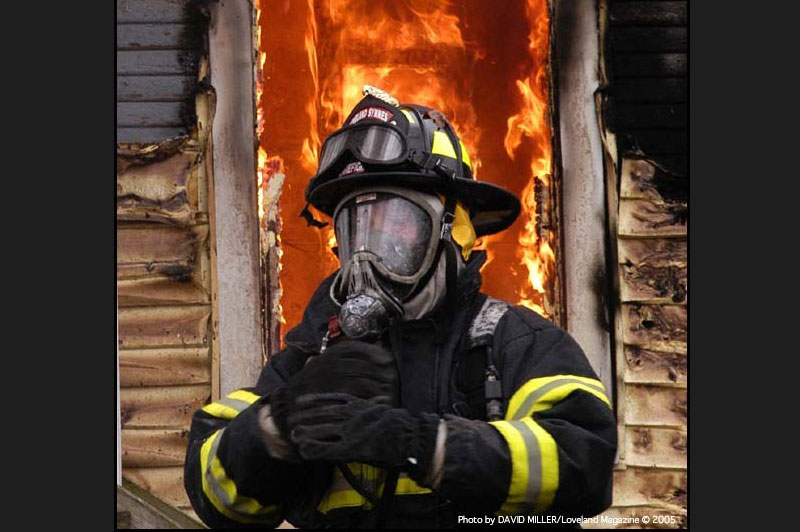
Loveland Magazine photo from the May, 2017 Memorial Day Weekend fire
Loveland, Ohio – At their October 23 meeting, City Council approved a program that would incentivize owners of commercial, office, and industrial structures to retrofit existing buildings with fire sprinkler systems by waiving connection, permit, and inspection fees.
The purpose of this program is to protect structures within the City by offsetting a portion of the expenses related to installing a sprinkler system into an existing building. City Manager David Kennedy said, “Any added fire protection to the City’s commercial, industrial, or office building stock is added safety to the community, it’s occupants, and our firefighters.”
Following the May, 2017 Memorial Day Weekend fire in Historic Downtown that almost destroyed the two affected buildings that did not have sprinklers, City Council waived all fees associated with the installation of sprinkler systems including water connection and inspection fees for the damaged buildings when they were remodeled.
After the fire, Loveland/Symmes Fire Chief, Otto Huber reinforced the importance of sprinkler systems and the need to incentivize more building owners within the Downtown Historic District and the adjacent West Loveland Historic District to retrofit their buildings to include sprinklers. This led to discussions of the feasibility of creating a Fire Sprinkler Installation Assistance Program. At a recent City Council meeting, Huber said that a sprinkler system typically utilize a six-inch water tap/connection which based on the City’s current fee schedule would cost $21,500. Additional city costs include a building permit fee of $210 plus $.63 per square feet. Huber said that these city fees, along with the owner’s installation costs are largely the reason why very few existing buildings are retrofitted with sprinkler systems.
The intent of the proposed program would be to waive city fees for existing commercial, office, and mixed-use structures if approved Fire Sprinkler Systems are installed within the designated area.
The program is not for new construction.
Anyone can apply. To qualify for participation in the assistance program, a completed application is required and submitted to the Office of the City Manager. All applications for participation in the city’s Fire Sprinkler Installation Assistance Program are to be reviewed by a three (3) person panel consisting of the following:
Assistant City Manager
Fire Chief
Chief Building Official (CBO)
Applications will be reviewed based upon the age and condition of the building and its economic contributions to the City. Appeals of the decisions made by the three (3) person panel shall be submitted within forty-five (45) days in a written form to the City Manager.
Accounting Plus–Bingaman Accounting and Tax Service, LLC is a tax preparation, payroll and bookkeeping company locally based in Loveland, OH.
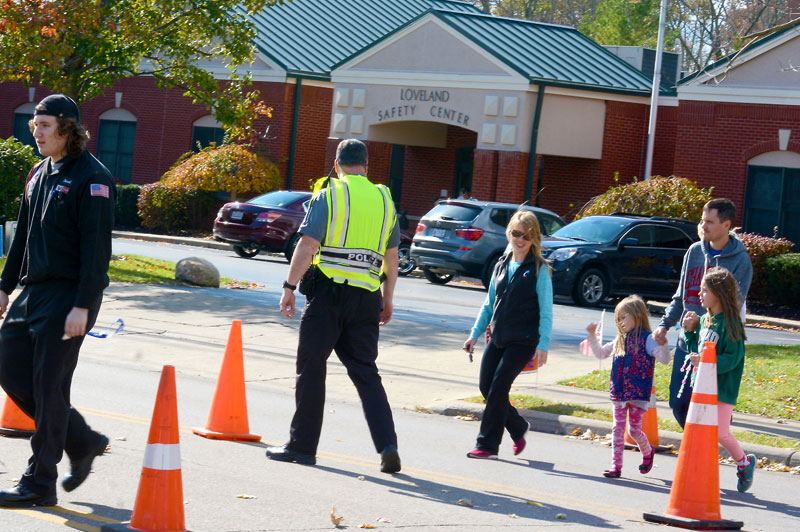
The Loveland Safety Service Center was a busy polling location yesterday during the mid-term election.
Cassie Mattia is a resident of Historic Downtown Loveland
Loveland, Ohio– For nearly 20 years, The Loveland Safety Center has been committed to providing the best emergency services to the community of Loveland. Now the local police and fire department are finally being rewarded with much needed renovations to the emergency hub located at 126 South Lebanon Road.
The Loveland Safety Center has been the home to both The Loveland Symmes Fire Department and The Loveland Police Department since 1998. The center has also provided a place for many other local operations such as, The Loveland Mayor’s Court, Loveland’s Emergency Operations Center, a polling location for Hamilton County Board of Elections, many training events and a natural disaster emergency shelter location. In 2004, the roof of the safety center collapsed taking down an entire section of the building. Surprisingly, since the roof collapse there hasn’t been any major repairs made making the employee living and working conditions not compliant with professional standards. Chief of Police, Dennis Sean Rahe, says the renovations are long overdue.
“The repairs to the center are vital to its continued operations. The roof of the Safety Center is a combination of pitched metal and flat membrane. The flat roof portion has not been significantly repaired or replaced in over twenty years and leaks on a regular basis,” Rahe explained, “The water that intrudes into the internal workings of the building continues to cause even more damage. The Center has seven roof mounted heating and ventilation systems that are also more than twenty years old. They require repair several times a year to keep in operation. In addition, the City included several security enhancements after an audit by the Department of Homeland Security.”
The Center has seven roof mounted heating and ventilation systems that are also more than twenty years old.
Chief Rahe joined the Loveland Police Department in 1998 after serving as a Hamilton County Sheriff Deputy for a year.
“After joining the department, I became active in in bike patrol and served as a field training officer. I was promoted to Sergeant in 2007 and Captain in 2010. I was appointed the Chief of Police in 2016. I received a Bachelor of Science in Criminal Justice from the University of Cincinnati, attended the Federal Bureau of Investigations National Academy, and graduated from the Certified Law Enforcement Executive (CLEE) program,” Rahe said.
In 2018, the City of Loveland finally added funding to the budget for significant Safety Center renovations.
“In July 2018 The City of Loveland secured the architect services of McGill Smith Punshon to design the necessary repairs. Major repairs are needed on the heating and ventilation system, roof, and parking lot. The project also includes construction to bring Safety Center prisoner processing, evidence, armory, and employee living and working conditions into compliance with professional standards. Finally, lighting and security enhancements are planned for the campus,” Rahe said.
The Loveland City Council approved a bond for up to 1.35 million dollars to complete all the repairs to the Safety Center. In addition, The City of Loveland and The Loveland Symmes Fire Department applied for a FEMA grant for the Safety Center project.
According to Chief Rahe the benefits of the project are endless.
“The entire Loveland community will benefit from these repairs. Although the City team members use the facility the most, the Safety Center is used for a variety of public community events,” Rahe shared, “It is the primary method the community members use to interact with the Loveland Police and Loveland Symmes Fire Department administration offices. The three primary repairs to the heating and ventilation, roof, and concrete will ensure our community can park at the Center, have heat and air conditioning, and a roof that is not leaking on them. The security enhancements will ensure the safe and continued operations of the facility. Finally, the lighting efficiency enhancements will save the community money in operating costs,” Rahe said.
Not only will the upgrades to the Loveland Safety Center naturally make the building safer for the employees working inside, but it will also allow law enforcement and emergency responders to exceed the Loveland community’s needs and expectations.
“We are proactively looking forward to our community’s emergency service needs for the next twenty years. Law enforcement is being asked to provide more services than ever, to do some quickly, professionally, and cost effectively. LPD is continuously looking for ways to meet, and exceed, our growing community’s needs,” Rahe explained, “Twenty years ago the Loveland Police Department held prisoners at the Safety Center, processed their own evidence, and did not have any need for an armory. Today, LPD no longer keeps arrested persons at the Safety Center, we never process evidence (that is transported to a State of Ohio crime lab,) and we now train with a wide variety of tools, equipment, and evidence, each which have specific storage needs.”
Loveland Symmes Fire Chief, Otto Huber, also weighed in on the Safety Center renovations and how excited both the police and fire department are about the upgrades.
As we move forward to upgrading the building to meet the needs of both agencies today and into the future we are excited about continuing to share the facility with the Loveland Police.
“Twenty years ago, the Police and Fire Departments merged their operations under one roof. At that time, the Police Department was in City Hall and the Current Fire Station on Lebanon Road needed to be replaced,” Huber said, “A committee of police officers and firefighters met for several months to design the current Safety Center. Several meetings were held with the public on the location and design of the facility. At that time, the public and the Council chose the current location and design from three different options. For the Fire Department, it has been a great experience being alongside our counter parts in the Police Department. As we move forward to upgrading the building to meet the needs of both agencies today and into the future we are excited about continuing to share the facility with the Loveland Police.“
The Loveland Safety Center renovations are expected to be completed in the summer of 2019. If you would like to explore the world of the Loveland Police Department or the Fire Department you can visit Loveland Ohio Police Department or Loveland Symmes Fire Department on Facebook.
Advertisement Sangha is a place to experience skillfully designed, fun, and inspirational hatha yoga classes close to home.
Loveland, Ohio – Today, President Trump signed U.S. Sen. Sherrod Brown’s (D-OH) bipartisan legislation to establish a voluntary cancer registry for firefighters into law. Brown’s bill, the Firefighter Cancer Registry Act, requires the Centers for Disease Control and Prevention (CDC) to create and maintain a voluntary registry to collect data on cancer incidence among firefighters.
Loveland/Symmes Fire Chief Otto Huber said in reaction to the announcement, “Any data collection that will assist the national fire service in evaluating the risk associated with Firefighting will go along way to improving how we manage risk on the fire ground.”
The data collected by the registry will be used with existing state data to better assess and prevent cancer among firefighters. The Senate passed Brown’s bill by unanimous consent in May.
“Ohio firefighters put their lives on the line every day,” said Brown. “The enactment of the Firefighter Cancer Registry Act will help ensure we’re using all of the tools at our disposal to prevent and treat cancer in first responders who sacrifice their own safety to protect others.”
Huber said, “Today’s modern construction and products of combustion from petroleum based furnishing place our members in a higher risk then ever. We must rethink how we deploy and how we protect our members against today’s risks.”
In addition to establishing the volunteer registry, Brown’s bill requires the CDC to develop a strategy to maximize participation, develop guidance for state agencies, encourage inclusion among participants and to seek feedback from nonfederal experts. The CDC would also be required to ensure the data collected is made public and accessible for research.
“I am pleased that the national spot light is on this subject. We need to work collaboratively to improve fire ground safety and reduce the exposure to our members of the products of combustion,” said Huber.
Findings from a Study of Cancer among U.S. Fire Fighters
In 2010, the National Institute for Occupational Safety and Health (NIOSH) began a multi-year study of nearly 30,000 fire fighters from the Chicago, Philadelphia, and San Francisco Fire Departments to better understand the potential link between fire fighting and cancer. The study was a joint effort led by researchers at NIOSH in collaboration with researchers at the National Cancer Institute and the University of California at Davis Department of Public Health Sciences, and supported in part by the U.S Fire Administration. This study was completed in late 2015.
What we found
The fire fighters we studied showed higher rates of certain types of cancer than the general U.S. population.
Based on U.S. cancer rates:
●● Fire fighters in our study had a greater number of cancer diagnoses and cancer-related deaths.
○● These were mostly digestive, oral, respiratory, and urinary cancers.
●● There were about twice as many fire fighters with malignant mesothelioma, a rare type of cancer caused by exposure to asbestos.
○● Exposure to asbestos while fire fighting is the most likely explanation for this.●● There were more cases of certain cancers among younger fire fighters.
○● For example, fire fighters in our study who were under 65 years of age had more bladder and prostate cancers than expected.
When comparing fire fighters in our study to each other:
●● The chance of lung cancer diagnosis or death increased with amount of time spent at fires.
●● The chance of leukemia death increased with the number of fire runs.


 by offsetting a portion of the expenses related to installing a sprinkler system into an existing building. City Manager David Kennedy said, “Any added fire protection to the City’s commercial, industrial, or office building stock is added safety to the community, it’s occupants, and our firefighters.”
 incentivize more building owners within the Downtown Historic District and the adjacent West Loveland Historic District to retrofit their buildings to include sprinklers. This led to discussions of the feasibility of creating a Fire Sprinkler Installation Assistance Program. At a recent City Council meeting, Huber said that a sprinkler system typically utilize a six-inch water tap/connection which based on the City’s current fee schedule would cost $21,500. Additional city costs include a building permit fee of $210 plus $.63 per square feet. Huber said that these city fees, along with the owner’s installation costs are largely the reason why very few existing buildings are retrofitted with sprinkler systems.