Tag: loveland

  • Rare Corpse Flower Showing Signs of Impending Bloom at the Cincinnati Zoo

    Rare Corpse Flower Showing Signs of Impending Bloom at the Cincinnati Zoo

    The Amorphophallus titanum in Wilhelma Botanical and Zoological Gardens, Stuttgart

    Photo by Lothar Grünz via Wikipedia

    Cincinnati, Ohio – The horticulture team at the Cincinnati Zoo & Botanical Garden has been waiting and watching the rare corpse flower that arrived three years ago from the Chicago Botanic Garden for signs that it’s ready to bloom.  What they’ve seen in the past few days gives them hope that the horrible smell, described as being similar to a decaying corpse, and fantastic flower that they’ve been waiting for could be coming soon!

    “We’ve all heard how bad the smell is, but it’s just one of those things that you want to experience in order to describe it in your own words,” said Cincinnati Zoo horticulturist Jerome Stenger. “And the fact that the occurrence is so rare, sometimes just blooming once in a decade, makes everyone want to see it.”

    The smell only lasts 24 – 36 hours, which should be bearable even to the people who work in the Zoo’s education building where Morticia, the name that Cincinnati Zoo social followers picked for the plant, is located.

    “The odor, color, and temperature, which can rise to 98 degrees, of the flower are meant to attract pollinators that are attracted to dead animals,” said Stenger.  “Since the Discovery Forest greenhouse isn’t crawling with dung beetles and flesh flies, we are trying to get our hands on some pollen so we can help Morticia pollinate!”

    Once the flower has bloomed and pollination is complete, the flower collapses. In addition to its unique, sporadic, and stinky blooms, the plant itself can grow to a massive 15 feet tall with leaves as big as 13 feet wide.

    Visitors are welcome to come see Morticia in the Zoo’s Discovery Forest.  The Zoo, and Discovery Forest, are open daily from 10 AM to 5 PM during the Summer Adventure presented by Cincinnati/NKY Honda Dealers. Members may enter at 9 AM.  There is no additional charge to see this amazing plant.

  • LIFE Food Pantry needs your help filling the shelves

    LIFE Food Pantry needs your help filling the shelves

    Click to learn more about the Pantry, how to donate your food, or how to conduct a food drive

    Applesauce

    Carrots,

    Canned

    Chicken,

    Canned Chili

    Chili beans

    Cooking oil

    Ensure/Boost

    Flour

    Fruit cocktail/Mixed Fruit

    Hearty Soups

    Juice ( Large not individual size)

    Kidney beans

    Canned Peaches

    Peanut Butter

    Pinto beans

    Ramen noodles

    Refried Beans

    Spaghetti Sauce

    Sugar

    Personal Care

    Body Wash

    Deodorant – mens and women’s

    Shampoo

    Conditioner

    Diapers – size 5 and 6

    Pull Ups – 3T-4T, 4T-5T

    Women’s Depends All Sizes

    Paper Goods:

    Paper Towels

    Kleenex

    Diaper Wipes

    Flushable Adult Wipes

  • Ohio Supreme Court strikes down congressional maps for second time

    Ohio Supreme Court strikes down congressional maps for second time

    Pictured is the Thomas J. Moyer Ohio Judicial Center where the Ohio Supreme Court meets. Photo courtesy Wikimedia Commons..

    BY: SUSAN TEBBEN – Ohio Capital Journal


    For the second time, the Ohio Supreme Court rejected a map for congressional districts in the state.

    The court ruled that the map violated the constitution by favoring one political party over another irrespective of election results across the state.

    “We hold that the March 2 plan unduly favors the Republican Party and disfavors the Democratic Party in violation of the (Ohio Constitution),” the majority decision reads.

    The 4-3 decision reflected the other decisions the court has made on redistricting: Chief Justice Maureen O’Connor voted to reject the maps, along with Justice Michael Donnelly, Justice Melody Stewart and Justice Jennifer Brunner. Justices Sharon Kennedy, Patrick DeWine and Patrick Fischer all dissented in the case.

    In ruling against the partisanship in the congressional map, the court called out the commission for creating Democratic districts with razor-thin advantages, while the Republican-leaning seats “comfortably favor Republican candidates.”

    In the most recent congressional map, only three Democratic-leaning seats have more than 52% Dem advantage, whereas all Republican-leaning seats have more than 53% GOP advantage.

    “Considering that Democratic candidates have received about 47% of the vote in recent statewide elections, this probable outcome represents only a modest improvement over the (previously) invalidated plan,” according to the court decision.

    The court pushed back against arguments made by Ohio Redistricting Commission members, including Senate President Matt Huffman and House Speaker Bob Cupp, both of whom have left the commission since then, replaced by state Sen. Rob McColley and state Rep. Jeff LaRe.

    The legislative leaders and their replacements on the commission tried to argue they were not obligated to correct “legal defects” in the original congressional plan while revising the plan.

    “The commission’s constitutional duty is to adopt a congressional district plan to replace the original, invalidated plan,” the court majority wrote. “Indeed, the commission has a constitutional duty to remedy the defects in the previous plan.”

    Huffman, Cupp, McColley and LaRe said fixing the “defects” would “incentivize” Democrats to vote against the plan, and called the article setting forth anti-gerrymandering rules a “safety valve of sorts” for the ORC to adopt a plan that didn’t have to align with the same redistricting rules as the General Assembly.

    “No constitutional language suggests that the voters who approved Article XIX intended to allow the prohibitions against partisan favoritism and unduly splitting governmental units to be avoided so easily,” the majority ruled.

    The lawsuit was filed in March, after the Ohio Supreme Court turned down calls to reject the maps in a previous lawsuit on congressional redistricting. The court said because its previous decision to reject the first congressional map was final, challengers had to file a new lawsuit to challenge the second version.

    The supreme court rejected the first map on the same grounds as the second rejection: partisan favoritism.

    In their dissent to the majority decision, Kennedy and Patrick DeWine said they would have left the plan in place as constitutional and allow its use for the 2024 primary and general elections.

    Kennedy and DeWine said because they would have held that the first congressional map “did not unduly favor Republicans and was constitutional,” they would have done the same for the second plan.

    DeWine, who is Gov. Mike DeWine’s son, has recused himself from any court cases regarding holding the ORC members in contempt of court due to his father’s participation as a commission member. However, he has refused calls for his recusal in all redistricting cases because of his father’s involvement in the process.

    Fischer joined the dissent, but wrote separately to argue that map challengers “do not even meet the lower clear-and-convincing evidence burden of proof or the even lower preponderance-of-the-evidence burden of proof” that the second congressional map unduly favored Republicans.

    He also criticized the process conducted by the state supreme court, saying a lack of hearings “undoubtedly raises concerns among the public regarding this court’s lack of transparency.”

    “This court’s misguided rush to decide these cases has resulted in an unnecessary and truncated procedure that has effectively tied this court’s hands and rendered it unable to make a fully informed decision,” Fischer wrote.

    The court gave the General Assembly 30 days to pass a new map, and if they can’t, the Ohio Redistricting Commission will have another 30 days to do so.

    Since the May primary, which included congressional races, already occurred, a new congressional plan’s impact will go forward to 2024 elections.

    The legislature is currently on summer break, set to come back in the fall. Huffman’s spokesperson did not respond to a request for comment on the ruling, or if they would be reconvening the GA early to deal with the issue.

    A spokesperson for Cupp said the office was reviewing the decision.

    The ORC’s co-chair, Democratic state Sen. Vernon Sykes joined Senate Minority Leader Kenny Yuko in saying the court “made it clear that Republicans have repeatedly used the redistricting process to give themselves an unfair advantage.”

    “Once again, we are ready to follow the law and give Ohioans the fair maps they demanded,” Sykes and Yuko said in a statement. “We hope this time our Republican colleagues will join us, instead of trying to run out the clock.”

    A spokesperson Ohio Secretary of State Frank LaRose, the state’s chief elections officer and a member of the redistricting commission, said LaRose’s office had received the ruling and had a legal team reviewing the decision.

    The League of Women Voters, one of the two parties who challenged the congressional maps, praised the decision and hoped for swift and public action to adopt new congressional maps.

    “We agree that the congressional map is beyond a reasonable doubt gerrymandered, and we stand ready to work with the mapmakers to see a map produced that truly upholds the will of the voters for a free and fair election,” said Jen Miller, executive director of the LWV of Ohio.

    Follow OCJ Reporter Susan Tebben on Twitter.

  • DeWine re-ups anti-abortion lobbyist, COVID skeptic on Ohio Medical Board

    DeWine re-ups anti-abortion lobbyist, COVID skeptic on Ohio Medical Board

    Michael Gonidakis. Photo from the Ohio Medical Board.

    BY: JAKE ZUCKERMAN – Ohio Capital Journal

    Ohio Gov. Mike DeWine plans to re-appoint a longtime anti-abortion lobbyist and COVID-19 skeptic to the Ohio Medical Board, a spokesman said Monday.

    Michael Gonidakis, 48, a lawyer and president of Ohio Right to Life, will serve his third five-year term on the board, which is charged with licensing and disciplining physicians and other health care providers.

    “I’m honored that the governor has confidence in me to serve,” he said in an interview. “I think there’s no greater service than public service, and I encourage everybody to find a board or commission or way to give back to the state of Ohio.”

    Abortion rights advocates have criticized Gonidakis’ appointment in the past, claiming his anti-abortion lobbying intractably clashes with his state responsibilities. More recently, the U.S. Supreme Court’s overturning of Roe v. Wade in June allowed a new abortion restriction in Ohio to take effect that gives enforcement authority to the state medical board.

    Ohio’s new abortion law, enacted hours after Roe’s demise, prohibits the procedure starting at about six weeks after a woman’s last period, with narrow exceptions to save the life of the mother. This exemption requires physicians to document their beliefs in writing regarding a woman’s medical emergency and report it to the Ohio Department of Health. The Ohio Medical Board can revoke or suspend a physician’s license for noncompliance, or order the state attorney general to initiate a case seeking up to a $20,000 fine.

    Gonidakis sits on the medical board as one of three members who “shall represent the interests of consumers,” per state law. At least two of those members “shall not be a member of, or associated with, a health care provider or profession.”

    Besides his anti-abortion advocacy, state lobbying records show Gonidakis has registered to lobby for an array of health care clients before state lawmakers and the executive branch during his time on the board.

    For instance, he has represented eight medical marijuana companies: The Source HoldingsCannaNat TheraputicsCielo ProcessingNorth Coast TherapeuticsOhio ReleafGreenleaf GardensThe Pharm, and Marijuana Policy Group.

    His other health care clients have included WebMD Health Corp., Comprehensive Pain ManagementHealth Compliance Associates, and Proove Biosciences.

    A spokeswoman for the state medical board declined to answer whether Gonidakis is complying with the requirements of the consumer representative board seat, only noting that the governor appoints members of the board.

    Dan Tierney, a DeWine spokesman, said the appointment doesn’t create any conflict.

    “With respect to abortion or marijuana, neither of these have been an issue related to Mr. Gonidakis’ service in his first two terms,” he said. “We trust they will not be an issue in his third term either, as the vast majority, if not almost all, of medical licensure issues are unrelated to abortion or medical marijuana.”

    He added the sentiment applies to Gonidakis’ other lobbying clients’ industries as well.

    Gonidakis said he recuses himself on issues relating to abortion and medical marijuana when they come up before the Medical Board. He said he believes he’s following the statute, given his clients likely don’t qualify as a “health care provider.”

    COVID skeptic

    A review of Gonidakis’ comments on social media about COVID-19 show a pattern of skepticism around lockdowns, masks, closing schools, efficacy of vaccines, and vaccination policies.

    In February of 2021, Gonidakis shared a Fox News article quoting Dr. Anthony Fauci, the federal government’s top infectious disease expert, warning indoor dining is still unsafe after vaccination given high rates of COVID-19 spread at the time.

    “If this is accurate (and I do not believe it is), then there is absolutely no reason to get the vaccine … There is just no justifiable reason whatsoever,” he said.

    Around that same time, he shared an article citing a study suggesting hydroxychloroquine could help COVID-19 patients. The drug grew in popularity following praise from former President Donald Trump, despite multiple, large-scale, double-blind studies finding no benefit in treating COVID-19 and possible risk to patients.

    “Wonder how many Americans had to die because politicians and the media hated Trump so much & just rejected this drug because Trump promoted it???” he said.

    He said in an interview he’s not an “anti-vaxxer” and that he and his family are all vaccinated against COVID-19. He noted the Medical Board doesn’t create policy — it abides by state law. Of his tweets, he said he doesn’t retract any of his comments, but noted they come in his personal capacity and not as a member of the medical board.

    “Any Ohioan can be vaccinated and want to protect the health of their family but also question some of the politicians’ decisions that are being made,” he said. “At the medical board, we license and regulate doctors. We don’t set policy as it relates to pandemics.”

  • Little League 11U State tournament coming to Symmes Township’s Home of the Brave Park

    Little League 11U State tournament coming to Symmes Township’s Home of the Brave Park

    Winner continues journey to Little League World Series

    HOSTED BY LOVELAND LITTLE LEAGUE

    Location: Home of the Brave Park – 11605 Lebanon Road Loveland, OH 45140

    For reference, the winner of the 12U tournament may advance all the way to the Little League World Series you see played on ESPN each August.

    Eight teams from around the state will be participating in the fourteen games to decide who wins the 9-10-11 Ohio Little League, State Banner.

    The Loveland Tournament begins Saturday, July 23rd, and will run as long as needed to declare a state champion. The winner moves on to the Midwest Regional Tournament.

    Tournament organizers are planning an outdoor movie screening of The Sandlot for all the teams, weather permitting on the opening evening after the first round of games. They will also be working with local establishments so that they can provide each team with discounts for dining. 

    About Home of the Brave Park:

    The state tournament will be completed on two fields. This are skin infields, and we will be utilizing temporary mounds set at the 9/10/11 pitching distance and are 10” high, which is within the Little League Guidelines. These fields will also have temporary fences installed at 200’ distances.

    Read More about Home of the Brave Park:

    This 54-acre park features five multi-purpose sporting fields for soccer, softball, baseball, and lacrosse, a Veterans’ memorial plaza, a shelter, and wet and dry playground areas.

    The park’s only shelter is located near the playground/water park area and can accommodate approximately 60 people. There is a $200 fee for residents ($250 for non-residents) plus a $150 deposit is required for the rental of this facility. The water park feature operates from Memorial Day to Labor Day, from 11:00 a.m. – 7:00 p.m. (Park established 2012)

    Complete List of Amentities:

    • Wet & Dry Playground
    • Veteran’s Memorial Plaza
    • Baseball Fields
    • Multi-Purpose Fields
    • Shelter – Reserve A Shelter

    Loveland’s 11U Little League All-Stars advanced to the District championship game but fell short losing to the Hamilton West Side team. Hamilton West Side will be representing the Southwest Ohio District (District 9) in this coming State tournament.

  • Johnny’s Car Wash may become micro brewery

    Johnny’s Car Wash may become micro brewery

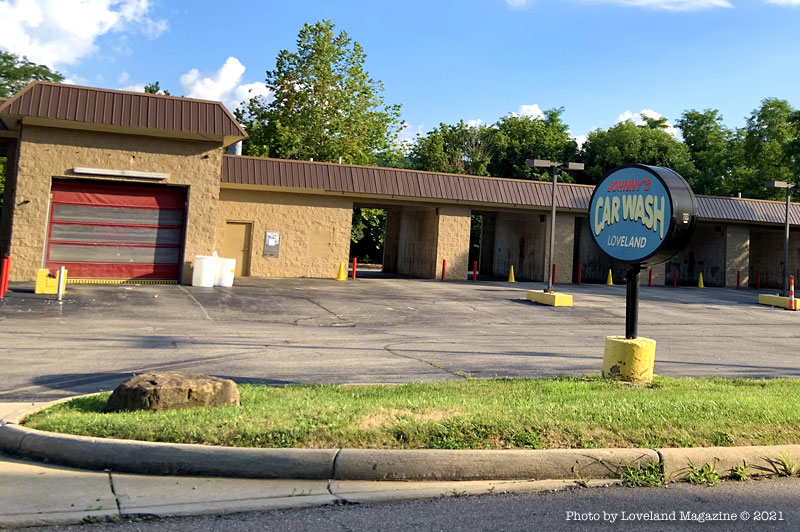
    The Hearing before the Planning and Zoning Commission on a conditional use permit for converting Johnny’s Car Wash on Loveland Madeira Road into a micro-brewery and tap room has been rescheduled for Monday, August 8, at 7 PM.

    Loveland Magazine has made a public records request for the “Staff Report” that will tell readers more about the project and will publish it as soon as it is received from City Hall.

    Loveland, Ohio – A micro-brewery and tap room are being proposed for property along the Loveland Madeira Road leading out of Loveland. A “conditional use” application was submitted to the Loveland Planning and Zoning Commission on June 21 from DVDREAL,LCC. The existing zoning for the property according to the applicant is for “commercial” use. The applicant is Dana Depenbrock. The proposal is for the location of Johnny’s Car Wash at 1555 Loveland Madeira Road.

    The application says, “By granting this conditional use we are ensuring the current old, outdated car wash will be converted into a community establishment where community members can congregate, laugh, and begin their journey into other parts of Loveland.”

    The Planning and Zoning Commission will hold a public hearing for the proposal on Tuesday, August 2 at 7 PM at City Hall in the council chambers at 120 West Loveland Avenue.

    Here is the link to Home (dvdbrew.com).

  • [Alex Eicher Photo Album] The Orange and Blue tied for the fourth straight game

    [Alex Eicher Photo Album] The Orange and Blue tied for the fourth straight game

    Cincinnati, Ohio – FC Cincinnati and Vancouver Whitecaps FC finished 2-2 Wednesday night in front of 21,078 fans at TQL Stadium. The Orange and Blue tied for the fourth straight game and are unbeaten in their last six.

    FCC move to 7-7-6 (27 points). The Whitecaps are now 7-9-4 (25 points).

    FC Cincinnati struck first in the 3rd minute with Álvaro Barreal’s third goal of the season. After receiving a pass from Brenner approaching the top of the box, the Argentine took a touch and then weaved past a defender challenging the approach to fire from his favorite left foot into the back of the net.

    Barreal’s goal was the fifth-fastest goal in club history, the first ever for FCC to come in the third minute of play in an MLS contest.

    The Whitecaps equalized in the 5th minute to mark the second game in FCC club history with two goals in the opening five minutes (July 3, 2021 at Houston Dynamo FC).

    The Orange and Blue went back on top in the 23rd minute with the 10th goal of the season from Brandon Vazquez.

    With Brenner carrying the ball through defenders in traffic, he found a streaking Vazquez who moved in-between the Vancouver backline to receive the pass alone at the top of the box. He took a touch and fired a right-footed shot past Vancouver’s diving Cody Cropper for the go-ahead goal.

    Vazquez, the first player in FCC’s MLS history to reach 10 goals in a season, is two goals behind NYCFC’s Taty Castellanos for most in the league this season.

    The Whitecaps equalized on an 82nd minute goal from Cristian Dajome.

    RECAP | On Sunday FC Cincinnati 2 fall to Columbus Crew 2 4-0 in inaugural derby match

    Cincinnati’s next match is at TQL Stadium July 23 at 7 PM. (Tickets)

  • Monkeypox is spreading but the Ohio Department of Health hasn’t spread the message

    Monkeypox is spreading but the Ohio Department of Health hasn’t spread the message

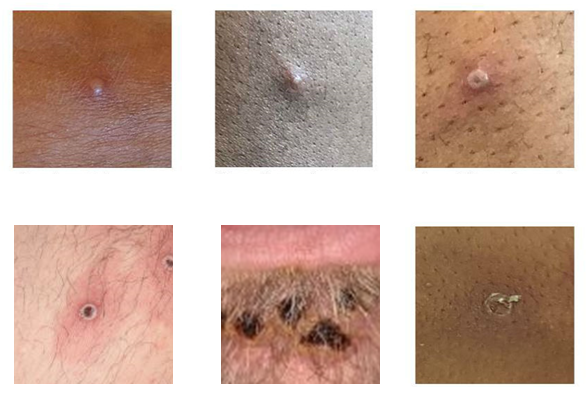
    The monkeypox virus causes lesions that can resemble sores from acne, an ingrown hair or other viruses. They are infectious until the scab is fully healed. (UK Health Security Agency/CDC).

    A Guest Column by Kenyon Farrow

    It may come as a surprise to most people in Ohio that in addition to dealing with the ongoing problem of COVID-19 ebbs and flows of infections and variants, we actually have an entirely different infectious disease to be concerned about: monkeypox. And the Ohio Department of Health (ODH) has done very little else to engage the public in any detail about the virus, how it’s spread, any plans to scale up testing and when the state might be able to access the vaccines that are approved to prevent contracting the virus.

    So far, all we’ve gotten is one press release announcing the first suspected case of monkeypox in the state. On June 13, the Ohio Department of Health issued a press release announcing this case, with messaging from ODH Director Dr. Bruce Vanderhoff, that seemed to downplay the threat monkeypox could play to the health of Ohioans. 

    “What I want to emphasize strongly is that monkeypox does not spread easily between people, and so the risk to Ohioans generally is very low,” he said. 

    Dr. Vanderhoff is correct in one sense. Monkeypox, compared to airborne virus like COVID-19, is less efficient in spreading from person to person. But it does spread through physical contact with someone who has contracted the virus — and that contact can be sexual contact, but also kissing, cuddling, bodily fluids and any contact where you could come into contact with the lesions that most often accompany an infection, and without testing can sometimes be mistaken for other diseases like herpes or congenital syphilis. And while monkeypox is rarely fatal, it is an extremely excruciating illness for those who contract it. Furthermore, it is more dangerous for infants and children, and pregnant people. 

    Since June 13, when the ODH first announced a suspected case, we now have 3 documented cases, according to the Centers for Disease Control & Prevention. While this number may seem low and like nothing most Ohioans should worry about, the truth is we actually do not have an accurate count to know whether monkeypox is spreading here, and how rapidly. 

    The ODH has not launched any public education materials in the form of televised or radio public service announcements, social media posts, press conferences or outreach efforts so most Ohioans would know about the virus, how its spread, and how to protect themselves. ODH has not announced any places around the state where one can get tested for monkeypox if you suspect you may have it. 

    And even if monkeypox cases here are currently few in number, they may not stay that way. Unlike COVID-19 where summertime has typically meant lower transmission rates because people are outdoors more and have windows open to allow clean air to circulate, there are more events where people come into close contact with one another. Airports and flights are packed. Summer is full of music festivals, county fairs, amusement parks and all sorts of events where people are often in close contact. Prisons and jails, due to medical neglect, overcrowding and unsanitary conditions created by lack of care, can also become a venue through which monkeypox could spread in and out of carceral settings. 

    Furthermore, monkeypox seems to be spreading rapidly in most American cities among LGBTQ people, particularly gay/bisexual men. June was Pride Month and every corner of the state has had pride festivals last month (and folks from Ohio, including myself, who’ve traveled to pride festivals in other cities and back) how do we actually know whether we have more cases without doing the proper public education and outreach campaigns connected to an infrastructure to offer testing to people who think they’ve been exposed?  

    JYNNEOS (also known as Imvamune or Imvanex) is a 2-dose vaccine for monkeypox currently in limited supply in the U.S., and according to the U.S. Health and Human Service’s (HHS) Office of the Assistant Secretary of Preparedness & Response, only 4 doses (enough for 2 people to be fully vaccinated against monkeypox) have been distributed to Ohio until more doses can be secured and imported later this year. 

    But will ODH or Gov. Mike DeWine advocate for Ohioans to get access to this vaccine once more doses become available? And will the set up a monkeypox testing and distribution plan?

    I certainly hope so. But in the current political climate, it would not shock me if yet again good public health policy is taking a back seat to politics, endangering the lives of Ohioans in the process. The Ohio GOP’s in the last few years has passed anti-LGBTQ legislation, further criminalized abortion after the Supreme Court decision overturning Roe v. Wade, and their 2021 bill to dismantle the authority of the ODH to be able to issue and enforce measures to protect Ohioans during public health emergencies, all add up to ways in which ODH may have been the victim of state capture by personal and political interests that have zero to do with the stated mission of the organization. 

    One only need to look at what happened a month prior to the June notice on the first possible monkeypox case in Ohio—two ODH staffers (who were in the sexually transmitted infections prevention department) were fired or resigned because they included information about an upcoming training for medical providers on how to prescribe a medication used for women experiencing miscarriages or for abortions up to 10 weeks (which was 6 weeks before the U.S. Supreme Court decision to overturn Roe v. Wade) in an e-newsletter (first reported by Ohio Capital Journal on June 22). 

    The OCJ piece also noted that ODH’s HR department also took issue with the newsletters promotion of “National Masturbation Month; Honor Our LGBT Elders Day; International Day Against Homophobia, Pansexual and Panromantic Visibility Day; SLAM (Sexuality, Liberators, and Movers); Black and Blue – Suicide in our own Leather, Kink and Queer Communities; and National Condom Month.” 

    How is the STI prevention program at ODH supposed to do prevention work without taking advantage of these anniversaries to get the public’s attention? Is this the reason why they’ve been so lackadaisical about monkeypox virus education, outreach and testing? 

    To be sure, no one was looking for a monkeypox outbreak in 2022. As someone who’s worked in public health on infectious diseases as a policy advocate and journalist for more than two decades, this wasn’t on my radar either. But that’s the thing with infectious disease — they take advantage of human frailty and ignorance. And just when you least expect it, they’ve find a way to grow and to thrive. And ignorance on a virus and how to prevent it, and government negligence in creating educational, outreach, testing and vaccination opportunities become ways that diseases spread. 

    So knowing this, one would expect our state health department leadership to take more of an active role publicly to get ahead of what could be a real public health catastrophe. I hope they choose public health over politics. 

  • Colemine Records and Rhinegeist Record Fair

    Colemine Records and Rhinegeist Record Fair

    Promoted Post

    Join us next Saturday, July 23rd, for the Record Fair with Colemine Records hosted by Rhinegeist!

    Rhinegeist and Colemine Records are teaming up to host an afternoon of top notch vinyl sales, swapping, and spinning in the Taproom! Guests can shop thousands of vinyl records and other sundries while getting to know other vinyl enthusiasts and experiencing the sounds of Colemine Records. We will feature vendors from all over the region set up festival-style throughout the space.

    Over a dozen vendors slinging new and used vinyl, food from Mazunte, and our very own Terry Cole aka Leroi Conroy spinning records all afternoon long.

    Be sure to set a calendar reminder right now, and come hang with us on the 23rd!

    Plaid Room Records is in the Historic District of Loveland, Ohio

    Family owned and completely independent, we are proud to offer personal, high quality service along with a vast selection of over 45,000 new and used LPs!

    Hit Terry or Bob up anytime and they’ll be glad to help.  If you have any questions about an order, record availability or anything else, just call us.  There are humans that will answer the phone and talk to you!

    For order inquiries via email, PLEASE email the following address for the fastest response:

    support@plaidroomrecords.com

    Plaid Room Records
    122 West Loveland Avenue

    Loveland, OH 45140

    HOURS of Operation

    Closed April 20th – 22nd to prepare for Record Store Day on the 23rd!! 

    Wednesday – Saturday

    12 p.m. – 7 p.m.

    Sunday 12 p.m. – 5 p.m.
    (513) 583-1843

    Facebook

    Instagram

    Twitter

    Map to Rhinegeist and the Record Festival

  • U.S. House passes bill expanding health care, benefits for veterans exposed to burn pits

    U.S. House passes bill expanding health care, benefits for veterans exposed to burn pits

    BY: JENNIFER SHUTT – Ohio Capital Journal

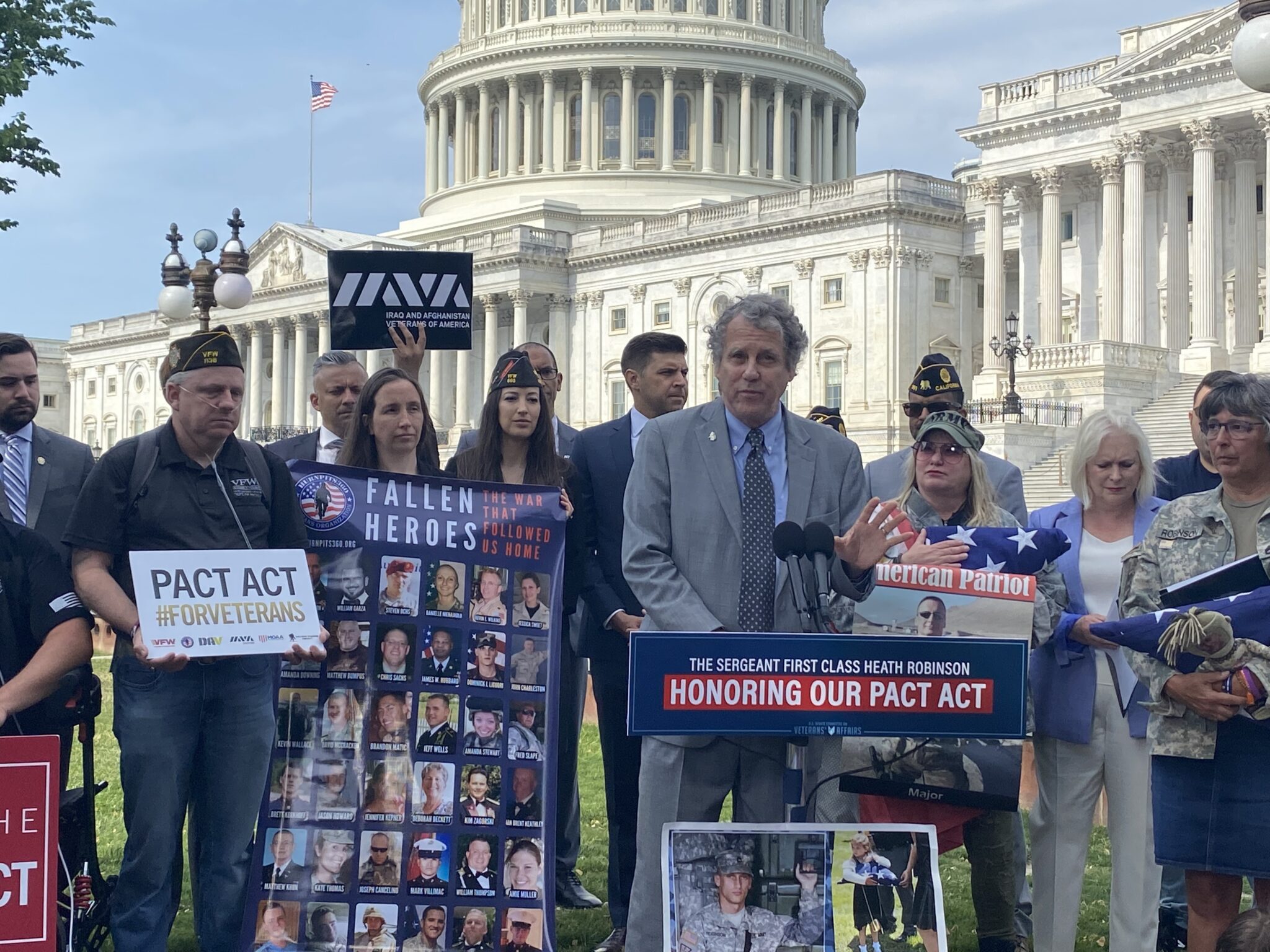
    Ohio Democratic Sen. Sherrod Brown speaks at a press conference on legislation to provide health care for veterans exposed to burn pits on June 7, 2022. Susan Weber Zeier of Sandusky is on the far right of the photo. Photo by Jennifer Shutt, States Newsroom.

    WASHINGTON — The U.S. House overwhelmingly approved a bipartisan bill Wednesday to expand health care and benefits for veterans exposed to burn pits overseas, sending the package back to the U.S. Senate after making a minor change.

    Senators, who broadly support the landmark package led by Montana Sen. Jon Tester and Kansas Sen. Jerry Moran, are expected to quickly clear the measure for President Joe Biden’s signature. The House vote was 342-88.

    Biden, who has linked his son Beau’s death from a brain tumor in 2015 to exposure to burn pits, has repeatedly called on Congress to address the illnesses and deaths linked to toxic exposure.

    “What I found with my son, what I found with my friends, what I found with the generation of Vietnam: There’s this notion that you shouldn’t ask for anything,” Biden said in March while at a resource center in Fort Worth, Texas.

    “You should be asking. You should be letting us know. You should let us know what is bothering you, what is the problem, because we owe it to you,” Biden continued.

    Delayed by dispute

    The Senate approved the legislation last month following an 84-14 vote, but House approval was delayed while members of the Veterans’ Affairs Committees worked out a dispute over a provision designed to boost staff in rural areas.

    The language would have allowed the U.S. Veterans Affairs Department to buy certain health care providers out of their contracts if they took offers to work for at least four years at “rural or highly rural facilities.” The provision also said that the money for the buyouts “shall not be considered a taxable benefit or event for the covered health care professional.”

    Lawmakers on the U.S. House Ways and Means Committee cited a so-called blue slip issue, since a tax provision cannot originate in the Senate.

    After substantial back-and-forth about how to fix the problem, the House Rules Committee opted to remove the provision this week, before sending a new, slightly altered bill to the floor.

    Bipartisan acclaim

    House debate on the legislation Wednesday was broadly bipartisan, with the vast majority of lawmakers speaking in support of the package.

    Rep. Mariannette Miller-Meeks, an Iowa Republican, said she has “seen firsthand the effects that toxic exposure has had” on her fellow service members following her 24-year military career.

    “Exposure to these substances can lead to severe, life-altering disease,” Miller-Meeks said.

    “However, under the current system at the VA it can be extraordinarily costly, time-consuming and in some cases impossible for a sick or disabled veteran to prove that their condition is related to the toxins to which they were exposed during their military service.”

    The bill the House passed Wednesday, she said, would help to end that by requiring the VA to deliver health care and benefits to veterans exposed to toxins “in a responsible, fair way.”

    Arizona Democratic Rep. Ruben Gallego, a Marine Corps infantryman who deployed to Iraq in 2005, said the legislation was overdue and desperately needed.

    “Too many veterans live in fear that their next doctor’s appointment will reveal an illness that in addition to harming their health could drive them into bankruptcy because the VA refuses to care for them,” Gallego said. “I am one of those people that does have that fear.”

    The legislation, named for deceased Sergeant First Class Heath Robinson of the Ohio National Guard, would expand eligibility for VA health care to more than 3.5 million veterans exposed to burn pits since 9/11.

    It would add 23 illnesses to the list of toxic-exposure-related ailments presumed to be connected to military service, ending the need for veterans with those conditions to try to prove to the VA their illnesses were linked to their deployments.

    The package would direct more resources to VA health care centers, employees and claims processing as well as federal research on toxic exposure.

    The measure would also expand presumptions for veterans exposed to Agent Orange, a chemical the U.S. military used during the Vietnam War. American Samoa, Cambodia, Guam, Johnston Atoll, Laos and Thailand would all be added to the list of locations where veterans are presumed to have been exposed to the chemical.