Loveland, Ohio – Two students from Loveland High School are doing a raffle drawing for several lucky Loveland (45140) community members to win a painted and installed rain barrel through a partnership with Caring For Our Watersheds.
If you’re interested in entering the raffle fill out this FORM.
If you win you are responsible for selecting a location for installation.
Installation will take place the first 2 weeks of April.
If you are selected they will reach out to you to coordinate the installation.
Columbus, Ohio – Peer leadership and meaningful connections can save lives. According to a new study funded by the Centers for Disease Control and Prevention and published in the American Journal of Preventive Medicine, Sources of Strength’s (Sources) prevention model helps reduce suicide attempts among high school students by an astonishing 29%.
For nearly 30 years, Sources has worked with both youth and adults to build resilience, promote mental well-being, and prevent suicide. By training diverse student leaders and leveraging peer influence, Sources transforms school environments and fosters cultures of hope and support, according to a new report released by the Ohio Suicide Prevention Foundation.
Sources of Strength Ohio (SourcesOH) is an initiative of the Ohio Suicide Prevention Foundation (OSPF) and PreventionFIRST! with funding and support from the Ohio Department of Mental Health and Addiction Services.
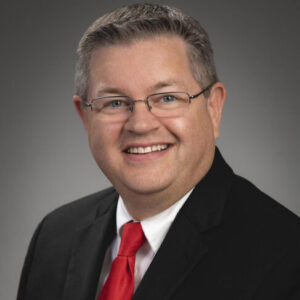
Tony Coder
“We hear from so many people how Sources positively impacts the well-being of students, teachers, and communities across Ohio,” said OSPF Executive Director Tony Coder. “This new study provides further evidence of the life-saving potential of this program. We are so thankful to be a part of providing Sources at no- or low-cost to as many Ohio schools and communities as possible.”
Considered one of the first suicide prevention programs to demonstrate effectiveness using Peer Leaders, SourcesOH has been implemented in 62 Ohio counties and 399 Ohio schools since December 2020 and has reached 174,000 Ohio students, including 218 middle and high schools.
Nicole Schiesler
“PreventionFIRST! supports Ohio schools in implementing and adopting Sources of Strength Ohio. When we meet with administrators and teachers, sharing positive outcomes, supported by national and state-level data, adds incredible value to this successful program,” said PreventionFIRST! President and CEO Nicole Schiesler. “Schools want to make informed decisions, and this evidence-based research elevates Sources of Strength as a beneficial and exceptional choice for the mental wellness of their students and teachers.”
The new study involved 20 high schools in Colorado and over 6,500 students, with 226 peer leaders and 79 adult advisors trained by certified Sources staff.
Key findings from the study include:
29% Fewer Suicide Attempts: The program helped reduce suicide attempts among high school students by nearly a third.
Students Create Big Change: By empowering students to foster healthy and protective cultures, the program builds stronger, more connected schools where students feel seen, valued and supported.
Innovative Public Health Approach: According to the CDC, suicide is the second leading cause of death among young people aged 10–24, making it a pressing public health issue. This approach is promising for being able to reduce suicide at a population level.
Support for Students Facing Trauma: The study was funded to examine Source’s potential impact on sexual violence and harassment prevention. A cautious interpretation of the evidence suggests that Sources may not prevent suicide attempts among students who have recently experienced sexual violence, highlighting the need for additional intervention support for this high-risk group.
An independent evaluation of Sources Secondary Program conducted in Ohio schools during the 2023-2024 school year showed that nearly half of the students felt equipped to recognize the warning signs of suicide and step in to help a friend in need; fewer students experienced prolonged periods of sadness, many used the coping strategies learned through Sources; and the number of students involved in physical fights on school property decreased from 8.7 to 4.8%.
The Ohio Department of Education and Workforce has approved the Sources Secondary Program as a suicide and violence prevention program for HB123/the SAVE Students Act. For more information, please visit SourcesofStrengthOhio.org or email SourcesOH@Prevention-First.org.
Local public school leaders from all around the state filled the Ohio House Education Committee’s hearing room on Tuesday to explain to lawmakers how full state funding is critical to their districts.
Christopher Edison, superintendent of Pymatuning Valley Local School District, described the pride in the district’s diversity and resilience. At the Northeast Ohio district, 76% of the students are considered economically disadvantaged and there’s been an increase in the need for specialized services. Edison also highlighted the successes in academic achievement, career and workforce readiness, and mental health supports at the district.
“However, the sustainability of these programs is increasingly at risk due to rising operational costs,” Edison told the committee in Tuesday testimony. “Inflation has significantly increased expenses for essential resources such as transportation, instructional materials, and staffing.”
Without an increase in base funding, Pymatuning’s ability to “maintain and expand these successful initiatives is severely threatened,” Edison said.
GET THE MORNING HEADLINES.
Hits have already come to districts because of inflation and increasing costs not reflected in the funding model that looks to see its final funding phase-in this year, if the legislature includes it in the operating budget set to be passed by July 1.
Montgomery County’s Northmont City Schools — a district with rural, suburban, and urban areas — has seen state funding cuts and defeats of school levies that resulted in the need to cut more than 40 district positions in May 2023, and the closure of one of their elementary schools, according to Superintendent Tony Thomas.
“I understand that members of the General Assembly passed a budget two years ago that increased funding across the state, and we are thankful,” Thomas told the education committee. “But unfortunately for Northmont, those dollars are not reaching our school buildings and we are doing more with less.”
It’s stories like these that the Fair School Funding Plan workgroup, which was created along with the state’s public school funding model, is hoping will flood both the education and finance committees, along with the offices of state legislators, to inform them about the importance of proper public school funding in Ohio.
“It’s our responsibility to ensure that every member of the Ohio legislature and the General Assembly be made fully aware of these facts, their implications, and the legislative decisions that led to these circumstances as they contemplate this important budget,” said Mike Hanlon, Jr., superintendent of Chardon Local Schools, and Fair School Funding Plan workgroup member.
The workgroup met recently, along with more than 600 other education community members, to discuss upcoming legislative meetings about the budget, what the governor’s proposal would mean for districts, and how to engage with lawmakers.
“In my visits to Columbus … one message was very clear with the legislators that we met with: ‘We need to hear from constituents on the issue of school funding,’” Hanlon said.
Members of the workgroup said they’ve heard another message from the lawmakers: resources are limited in the budget.
In the governor’s executive proposal, the Fair School Funding Plan’s final phase-in was included, but inputs that would account for inflation costs at districts were not, something the governor’s office has “remained silent” on in all budgets that included the public school funding plan, workgroup members said.
“First and foremost, this is not our ideal proposal from the governor,” said Jared Bunting, CFO and treasurer of the Athens City School District. “However, this is in line with what the governor has done in the past and we’re thankful that the governor has included the Fair School Funding Plan in his budget, even though it falls woefully short of our expectations.”
In the governor’s budget for the next two years, the budget would decrease funding for traditional public schools by 0.9%, according to a workgroup analysis. Community and STEM schools will receive an 11.3% increase in the governor’s proposal, while joint vocational school districts receive a 14.1% increase. Voucher programs including the EdChoice private school program would see a 15.8% increase.
“So 90% of the students in the state are seeing a reduction in funding,” Bunting said, referring to the enrollment numbers in the state, which show the vast majority of students attend traditional public schools.
Alternately, last year, the state funded private school voucher scholarships with nearly $1 billion in one year, according to the Ohio Department of Education and Workforce.
Source: Ohio Fair School Funding Plan Workgroup
School administrators on the workgroup noted that the funding simulations used in the governor’s budget proposal show an intention to “continue to update capacity each year without any input updates.”
Without inputs to account for rising costs and inflation, the state not only won’t meet the workgroup’s ideal of a 50% state share of education costs, but will drop below the share of funding before 1995, when the Ohio Supreme Court first ruled in DeRolph v. State of Ohio that the state’s education funding violated the state constitution, falling short of the “thorough and efficient” system of schools directed in the founding document.
With talk of addressing property taxes in Ohio, something that school funding has relied on for decades, workgroup members said updating cost inputs could help with that issue as well.
“When we talk about property tax relief, we would like to argue that … updating all inputs consistently is a form of property tax relief to our community members,” said Jenni Logan, treasurer for the Sycamore Community Schools.
Now, as the budget process continues, educators, and administrators not only plan to push for proper education supports in committees considering the budget document, but also want to get district stories to all legislators, including newly elected GA members, who haven’t had a front-row seat to the public school funding model fight.
Those who are new to school funding are also faced with “competing interests in other areas that are not related to school funding,” according to Hanlon. He said legislators who talked to him said they “haven’t heard from anyone” on school funding.
“As a result, it’s very likely that they need to hear from us, and from someone that they trust and are confident in, that will provide them with the necessary facts to shape their understanding of school funding,” Hanlon said.
YOU MAKE OUR WORK POSSIBLE.
________________
Susan Tebben
Susan Tebben is an award-winning journalist with a decade of experience covering Ohio news, including courts and crime, Appalachian social issues, government, education, diversity and culture. She has worked for The Newark Advocate, The Glasgow (KY) Daily Times, The Athens Messenger, and WOUB Public Media. She has also had work featured on National Public Radio.
Ohio Capital Journal is part of States Newsroom, the nation’s largest state-focused nonprofit news organization.
This article was written by Captain Trey Foust of the Loveland-Symmes Fire Department
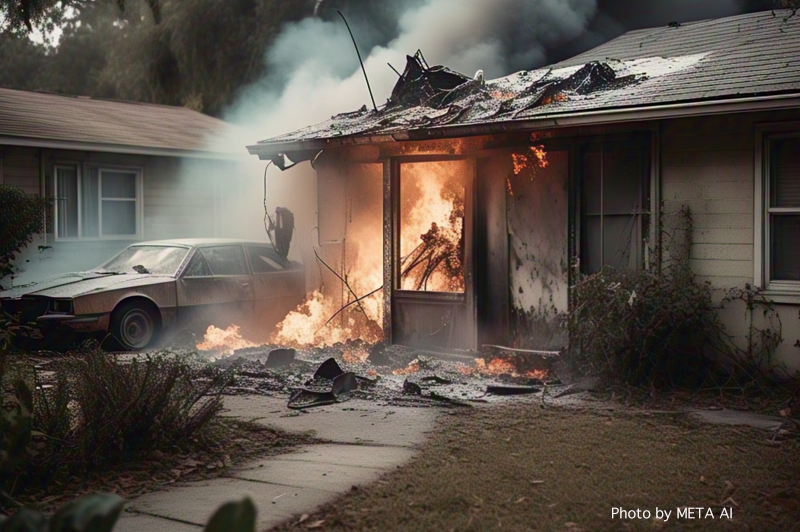
Loveland and Symmes Township, Ohio – During the 1960’s and 1970’s, aluminum wiring became a popular choice for electrical installations in homes. It was seen as an affordable alternative to copper wiring, which had become expensive due to high demands for copper. However, over the years, it has become evident that aluminum wiring poses significant safety risks, in relation to fire hazards. Residents may be at a greater risk of a fire if their home has aluminum wiring.
The Risks of Aluminum Wiring
The primary safety concern with aluminum wiring lies in its material properties and the way it interacts with electrical systems over time.
Key risks associated with aluminum wiring:
Thermal Expansion & Contraction: Aluminum expands and contracts more than copper when exposed to the heat generated by electrical currents. Over time, this expansion and contraction can loosen connections, leading to arcing and overheating, both of which significantly increase the risk of fire.
Oxidation: Aluminum reacts with oxygen in the air to form aluminum oxide, a substance that is less conductive than the base metal. This oxidation increases resistance at connections, causing them to heat up and potentially ignite nearby flammable materials.
Galvanic Corrosion: When aluminum wiring is connected to copper wiring or terminals, a chemical reaction called galvanic corrosion can occur. This process deteriorates the connection, leading to increased resistance and heat generation.
Brittleness: Aluminum is softer and more prone to damage than copper. Over time, aluminum wires can become brittle, increasing the likelihood of breaks or fractures, which can lead to arcing and sparks.
Signs of Potential Issues
Homeowners with aluminum wiring should be aware of warning signs that could indicate electrical problems, such as:
flickering lights;
unusual warmth or discoloration around outlets or switches;
a smell of burning plastic;
sparking when plugging in or unplugging appliances.
Fire Statistics
Studies have shown that homes with aluminum wiring are more likely to experience electrical fire compared to homes with copper wiring. According to the U.S. Consumer Product Safety Commission (CPSC), homes built with aluminum wiring are 55% more likely to have a fire hazard at connections than homes with copper wiring.
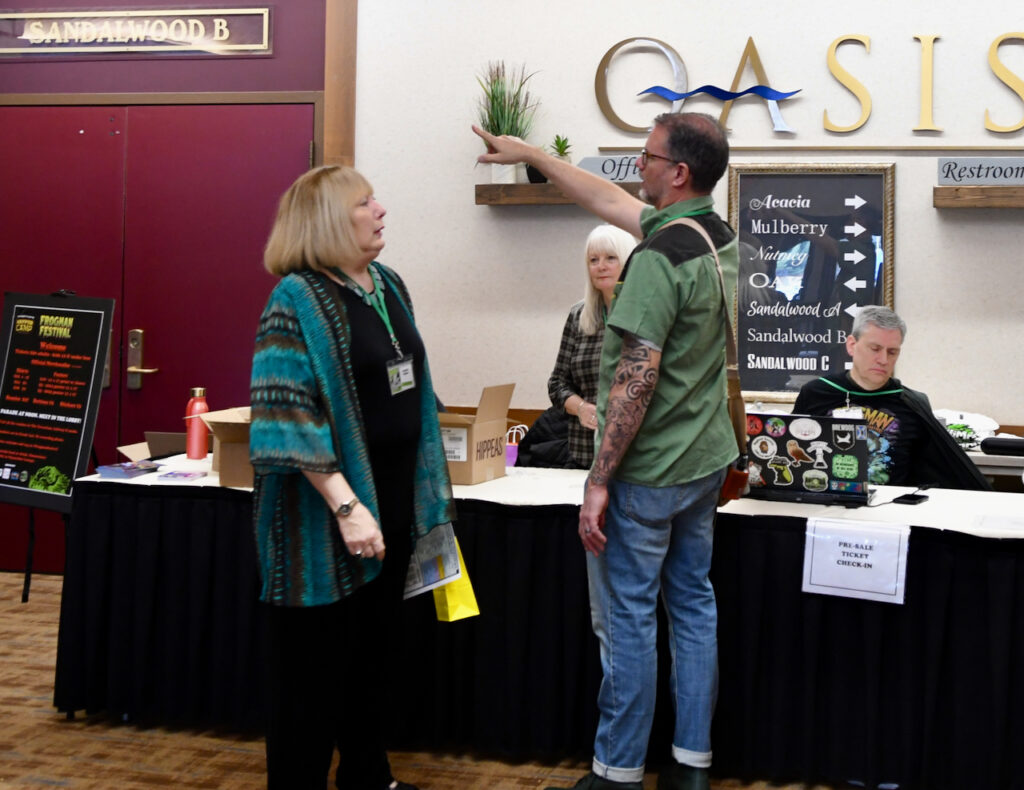
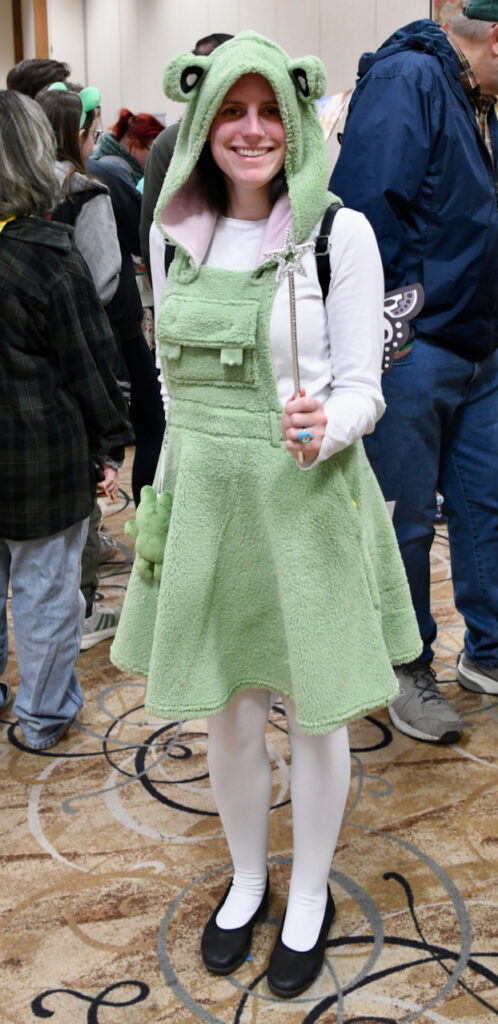
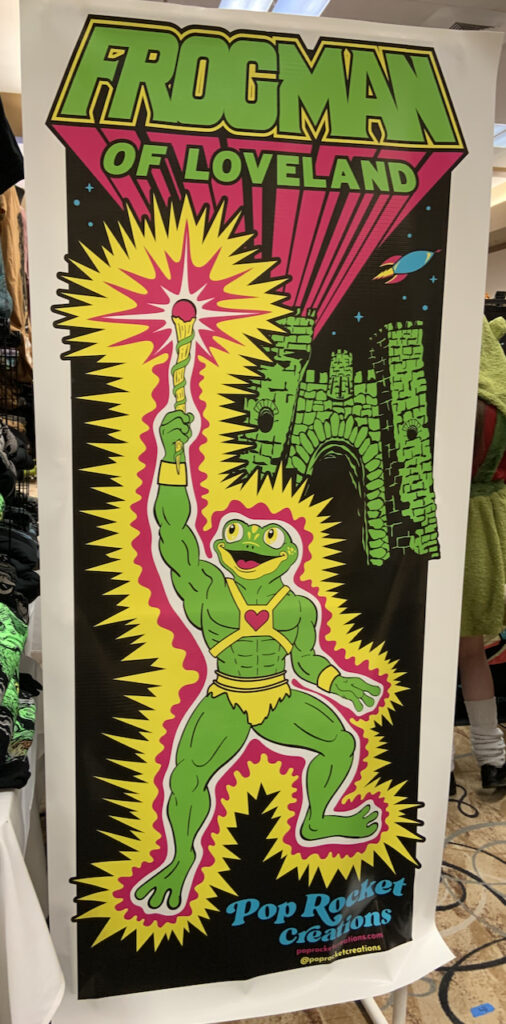
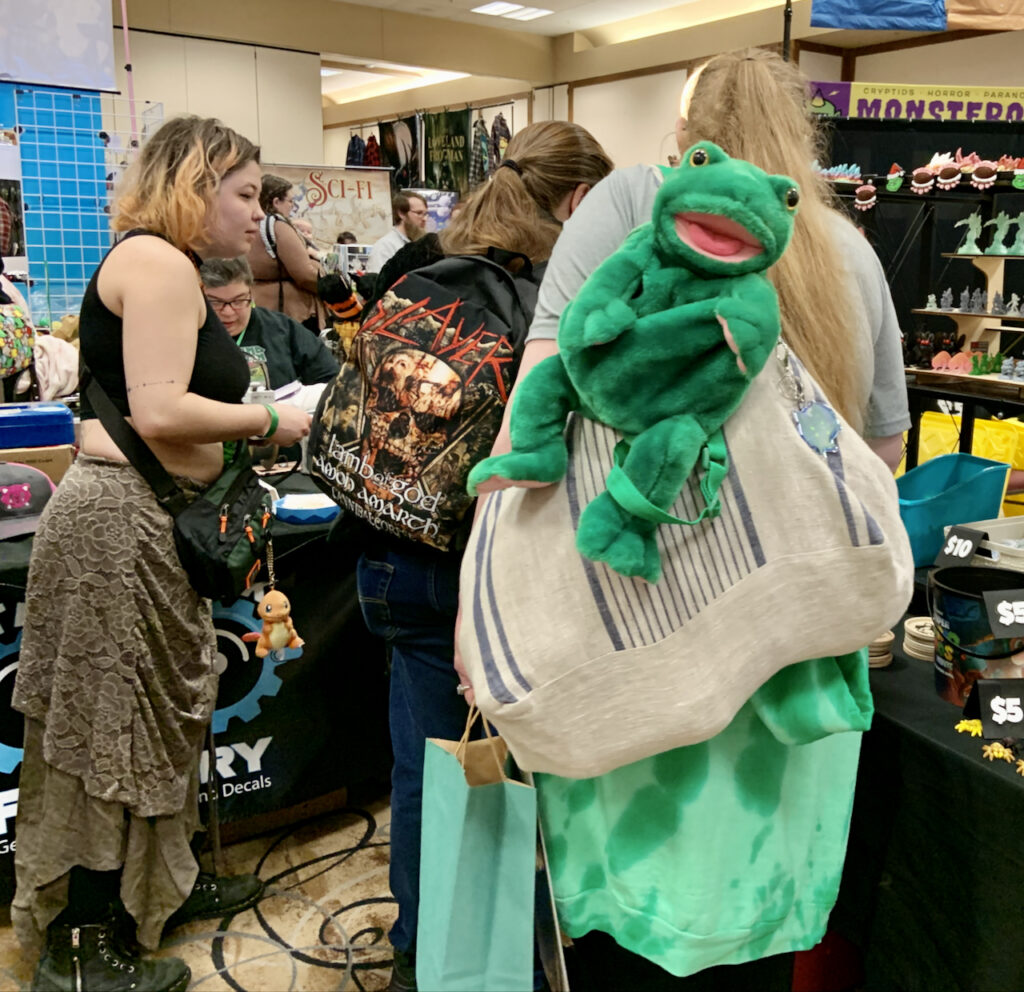
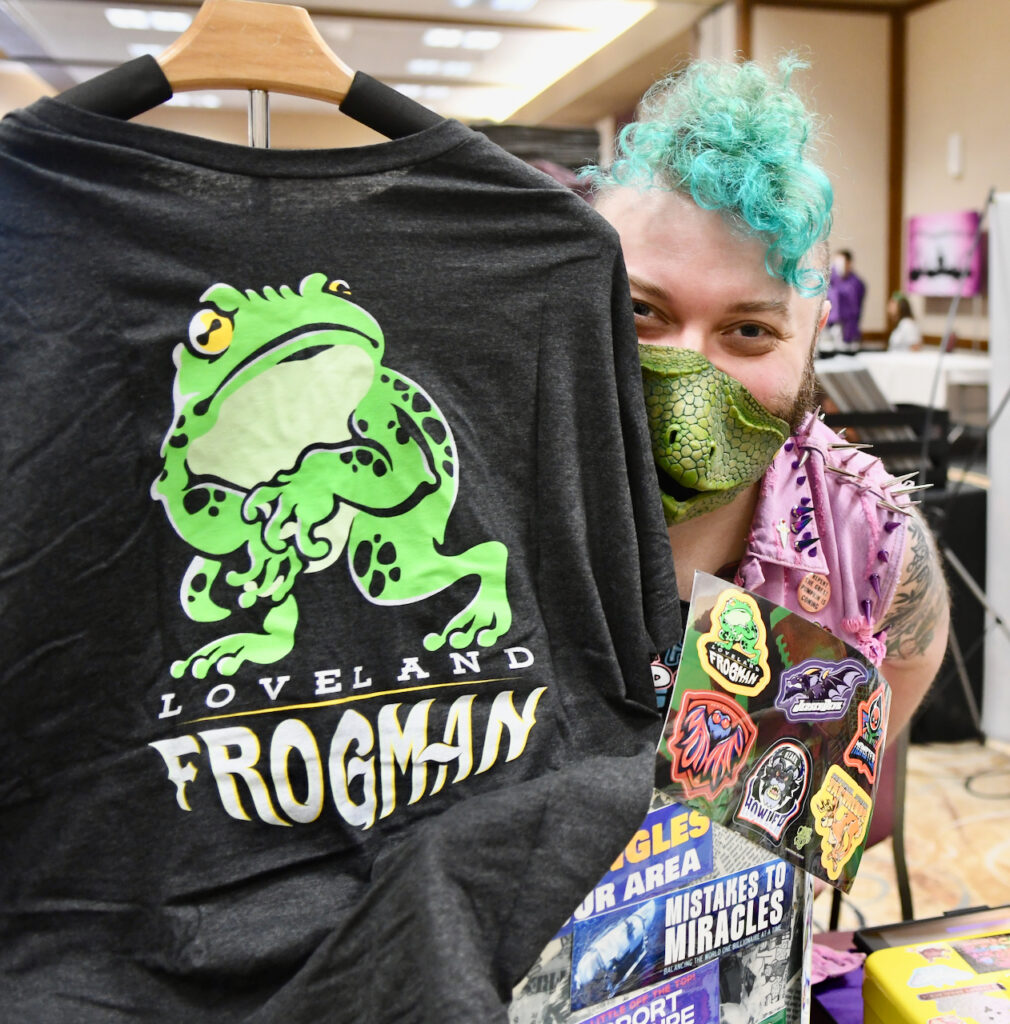
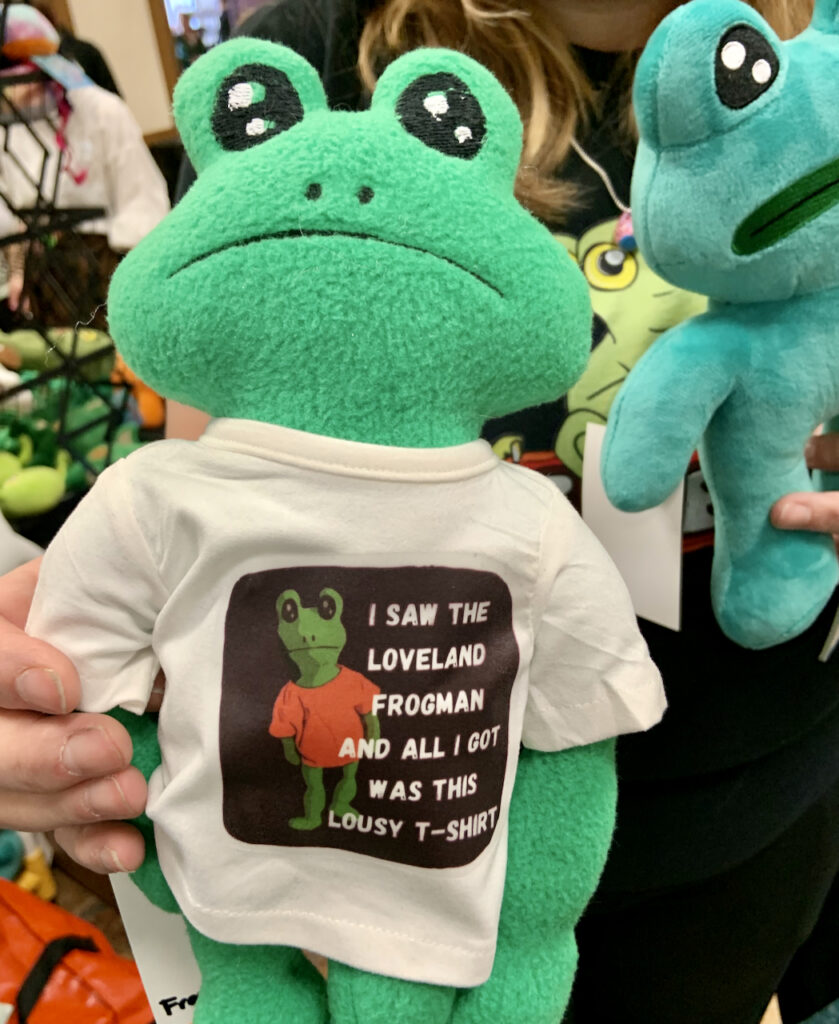
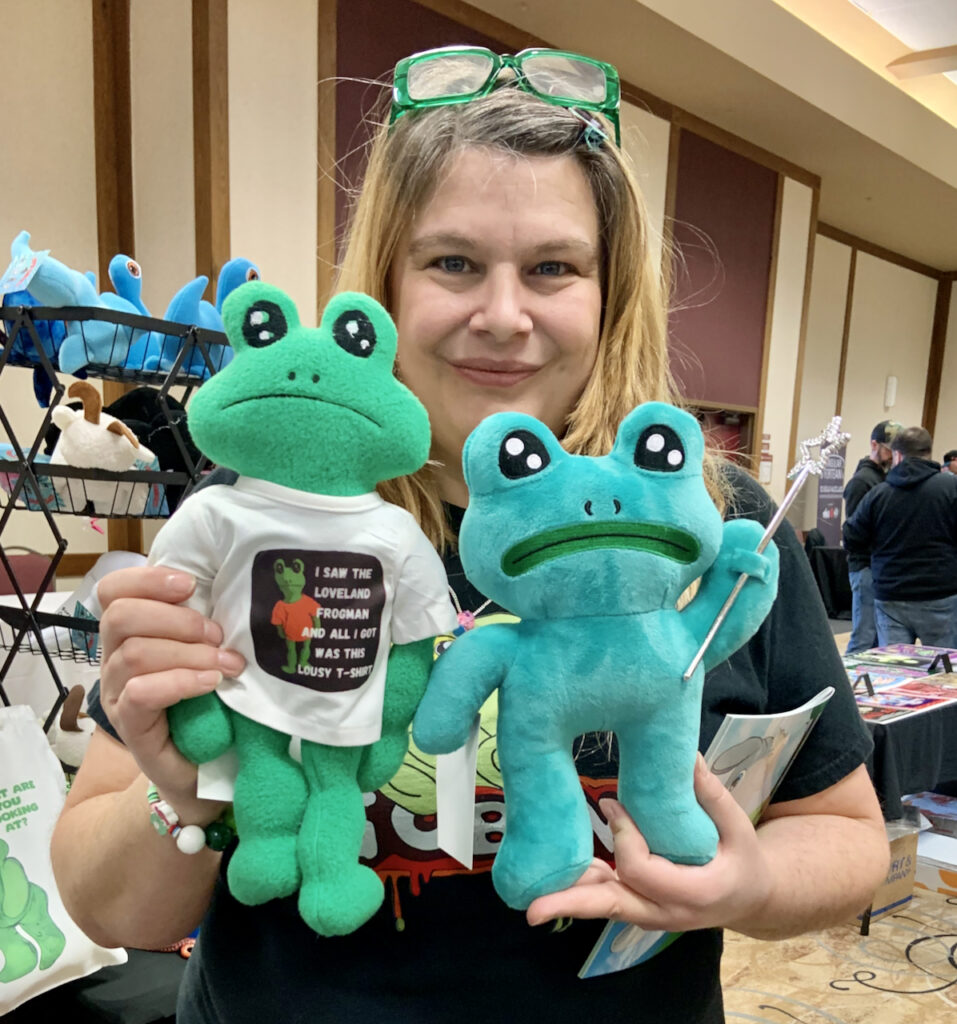
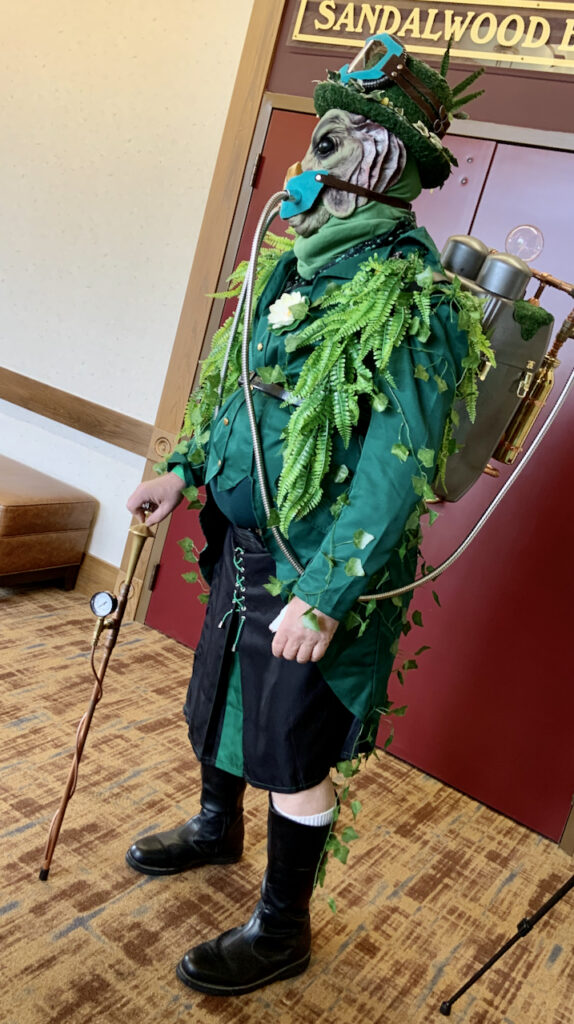
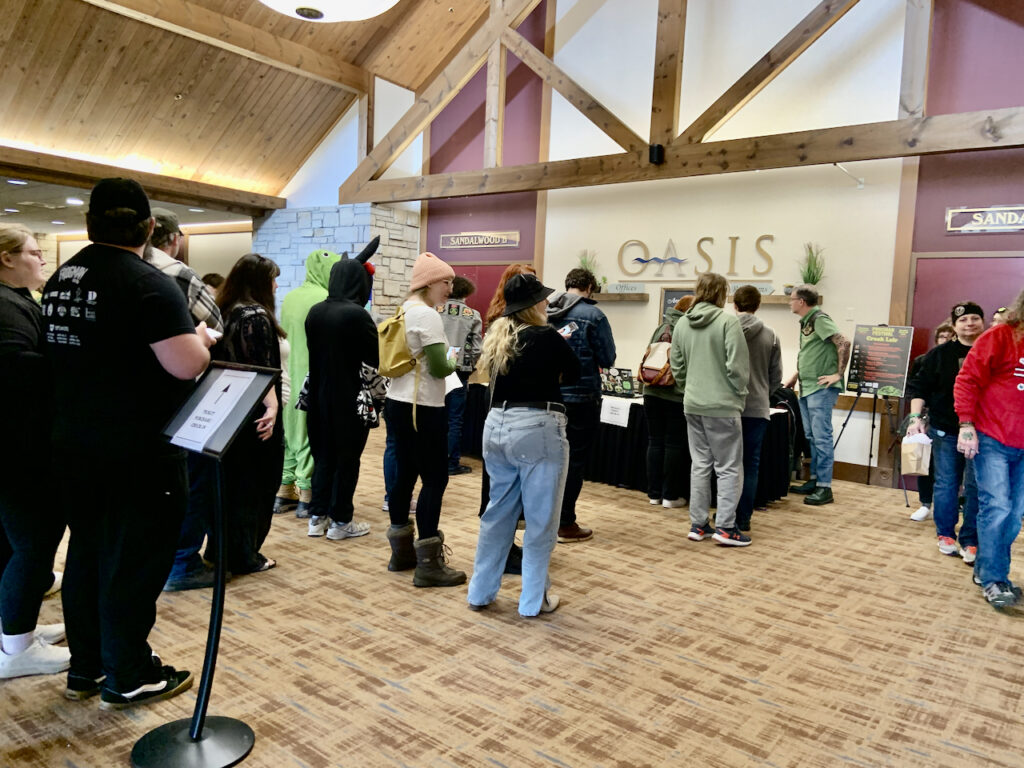
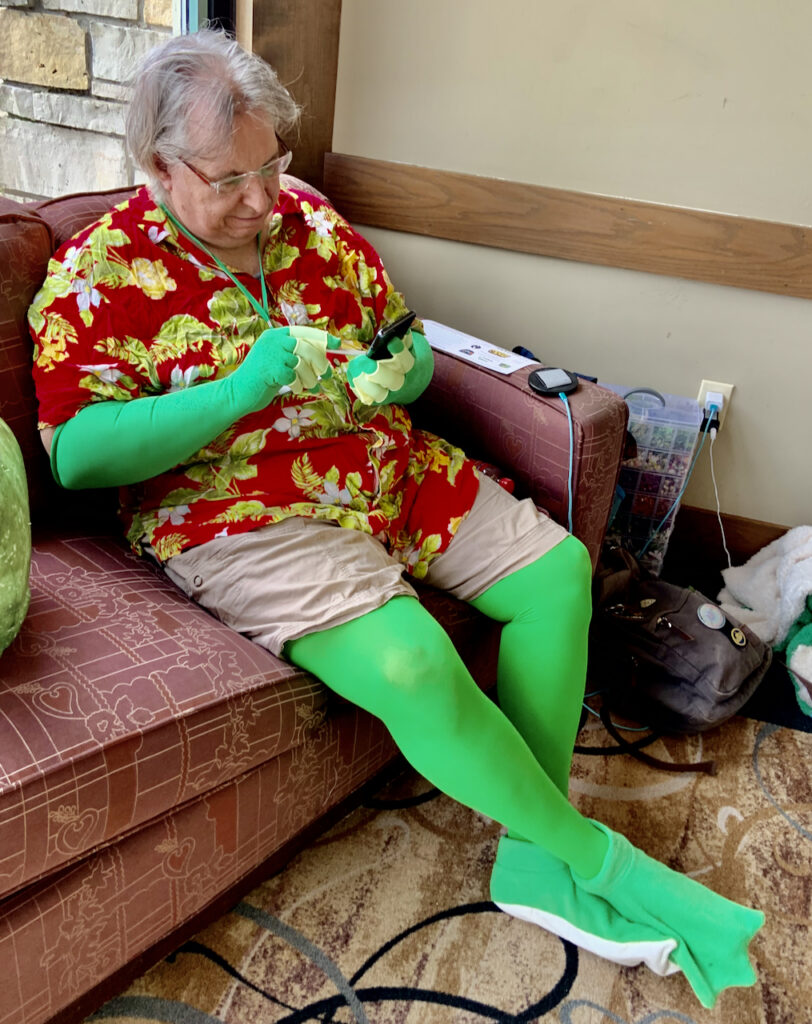
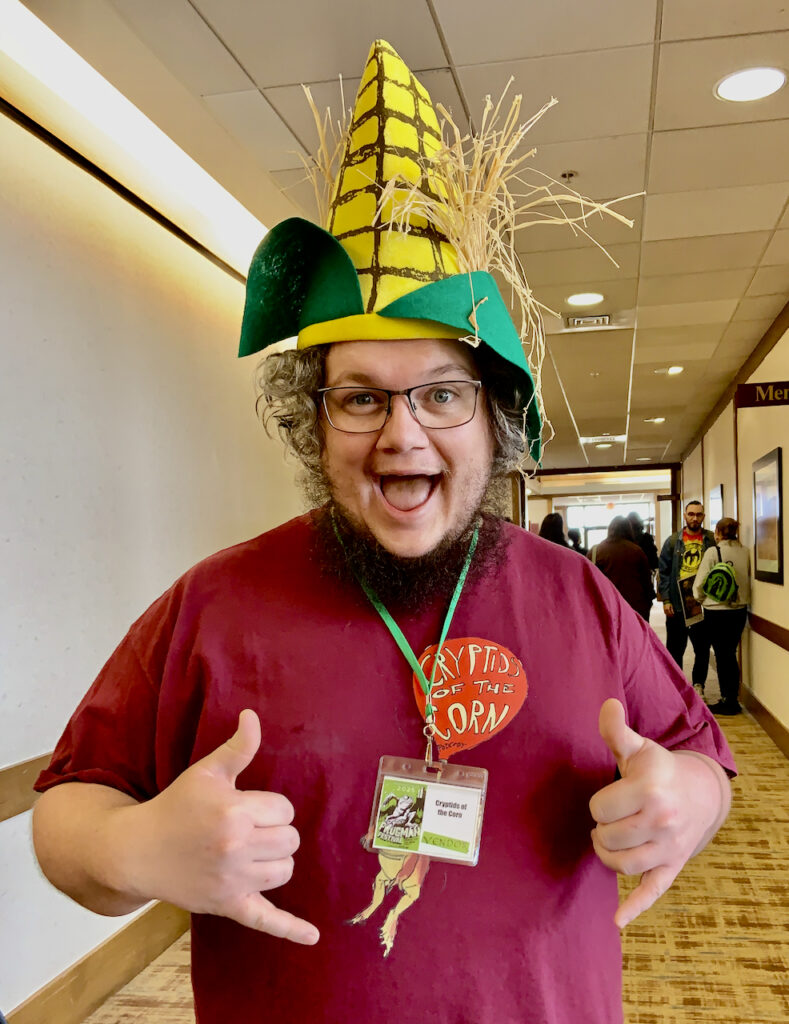
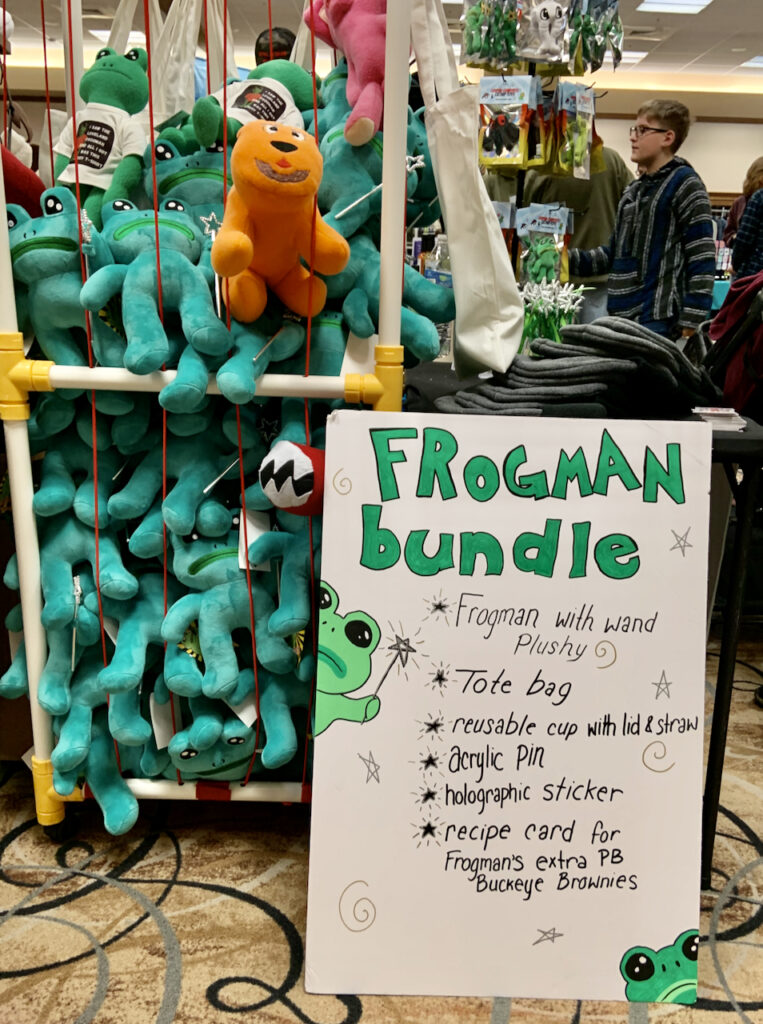
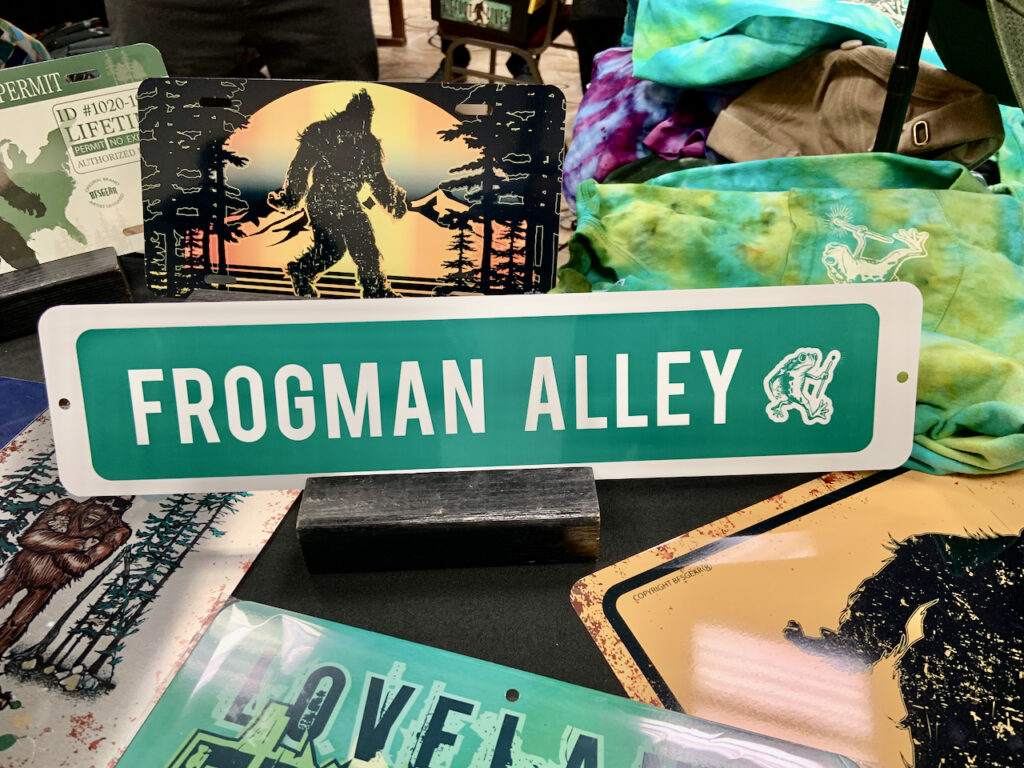
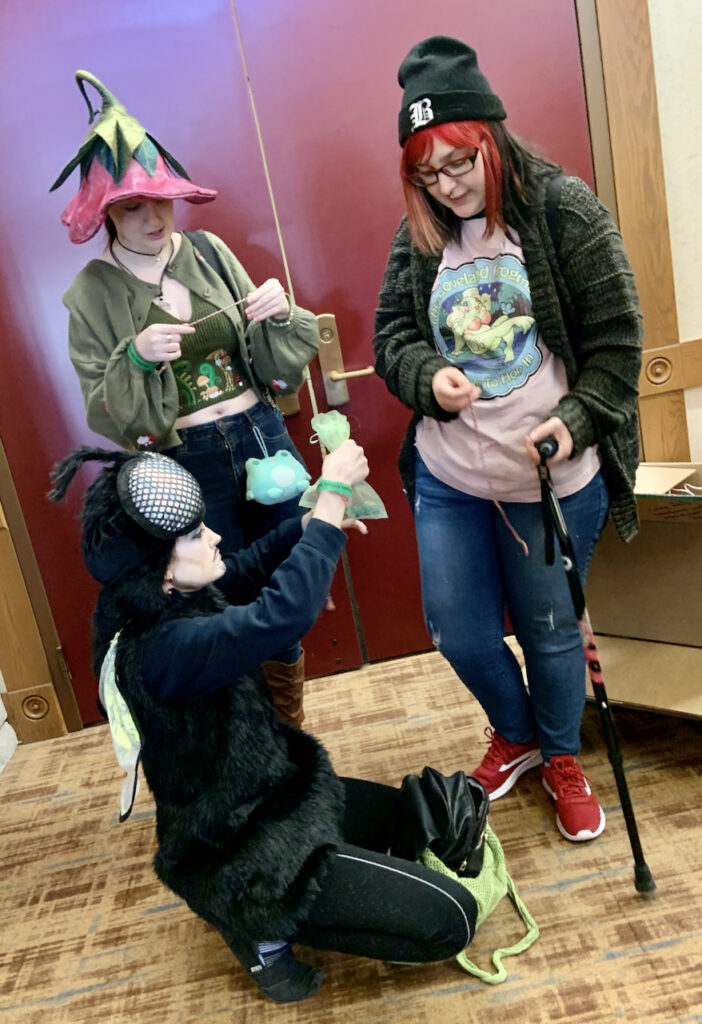
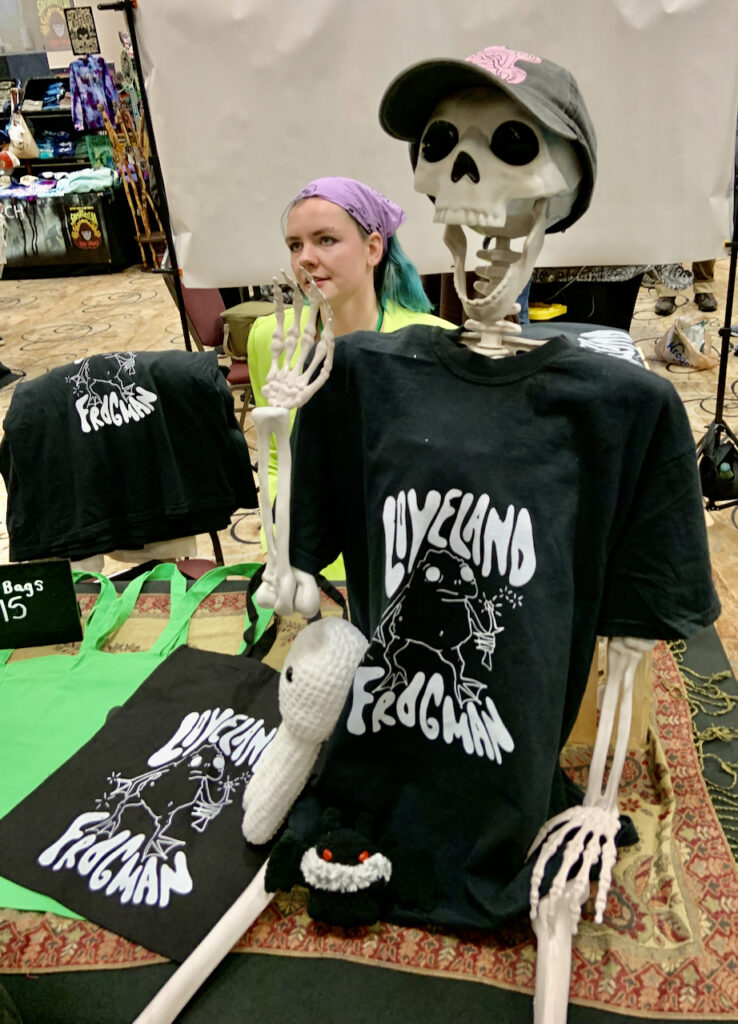
Loveland, Ohio – The attendance this year for Saturday at the 3rd annual Frogman Festival was about 1200 attendees with participants in and out throughout the day. A second day was added this year, and Sunday had over 750 attending and participating.
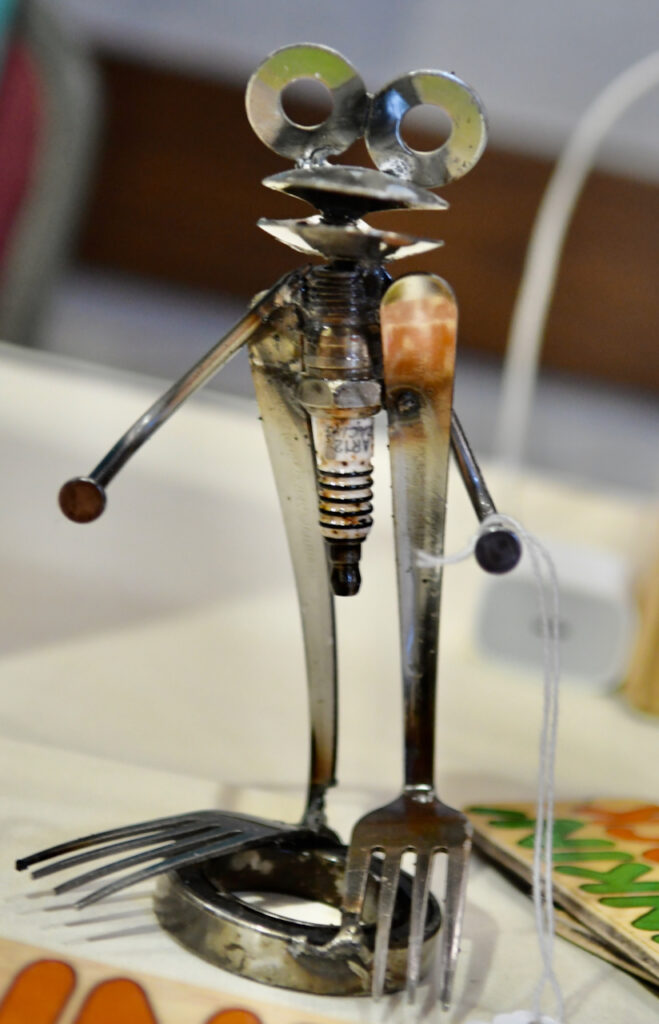
Many were families, with kids under 12 getting in for free. There were 70 vendors plus a tattoo studio and a roasted nut stand. There was also an intuitive reader and a face-painter. Erin Shaw from the Ohio Department of Natural Resources and the Warren County Park District was there again with a nature exhibit including turtles and Caesar the snake.
Over the course of the weekend, there were 12 presentations by 13 speakers on topics ranging from the origins of the Frogman story, to Mothman, to the expansion of consciousness.
The Strange Road, one of the sponsors with a YouTube channel that explores topics in the supernatural based out of Columbus, ran the audio visual system for the third year in a row. Performances were added this year to entertain young and old alike, with Wump Mucket Puppets packing the Lily Pad Room for a show both days. The Dakarai World Dancers gave a great performance both days.
Creep It Real, a husband and wife duo from Lebanon, sang tunes about cryptids, and Aaron Crary provided ethereal sounds produced electronically with a laptop and mixer.
The event was sponsored primarily by Cryptid Camp, a new trading card game in the realm of Pokemon and Magic The Gathering. Attendees got free promo cards only available at the event with an interpretation of the Frogman in the style of the card game.
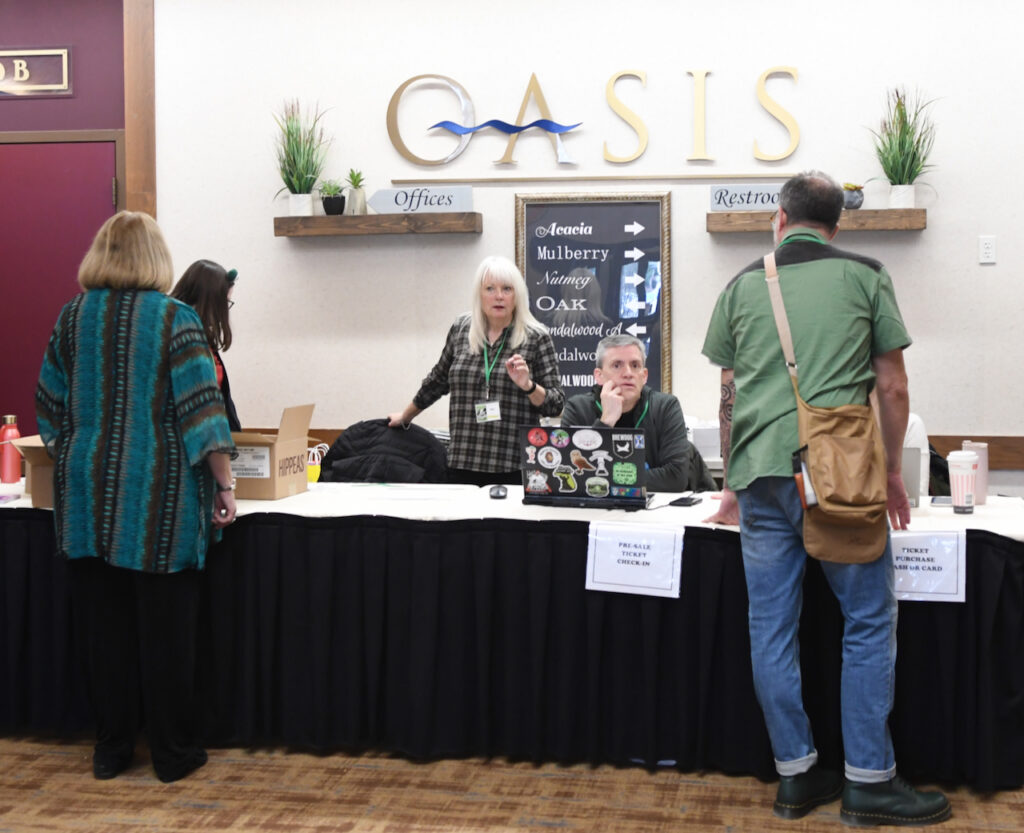
Jeff Craig, along with family and friends, produced the Frogman Festival. The Oasis Conference Center provided a great venue with staff running the concessions for the crowd that included lunch items, snacks, and beverages, including beer.
The found footage horror movie, Frogman (2023), was screened on Saturday night with producer and writer Anthony Cousins and other crew present to share the scoop on the movie, with big news revealing a sequel will soon be in the works.
Several local media outlets covered the event, including the sponsor Loveland Magazine. A duo calling themselves the Ohio Broadcasting Company, based in the Loveland area, were wandering around to compile shots and shorts from the crowd for a documentary about the festival. CET, the local public TV affiliate, got B-roll to feature in an upcoming segment on art.
The mission of the Frogman Festival as stated by Jeff Craig:
Frogman Festival provides an inclusive and accessible space to celebrate the legend of Frogman and other stories or events in the supernatural realm across the region. This is achieved through education, entertainment, and art.
It brings people from all over the country, with some of the furthest attendees hailing from Florida, New York, and California. Plans are in the works for a 4th annual Frogman Festival, which will be held again at the Oasis on the first full weekend of March. Details on one or two days haven’t been decided yet.
Loveland, Ohio – The 2025 spring brush pickup program will begin on Monday, March 17. Brush must be placed in the grass near the roadside no later than Sunday night, March 16. Public Works will collect brush for approximately two weeks.
City Hall Guidelines
The following are guidelines established for the brush pick-up program:
Brush must be placed in the grass behind the curb or edge of roadway. Do not place brush in the roadway, gutter, ditches, or on sidewalks.
Do not block fire hydrants.
Please remove basketball hoops from sidewalks, cul-de-sacs, the end of your driveway, etc. In many neighborhoods, basketball hoops make it difficult for crews to navigate the route and make turns.
Limbs cannot exceed 10 inches in diameter at the cut section.
Limbs should be placed with the cut section facing the street and all limbs should be facing the same direction. This makes it easier and faster to handle.
No leaves, pine needles, grass clippings, bamboo, ornamental grass, or other yard waste will be collected. These items clog or bind up the chipper.
Small twigs and sticks should be tied with twine in bundles 12 inches in diameter. Twigs or sticks can also be placed in a container, but no other yard waste should be in the containers. No loose piles of sticks and debris, please.
Any material not meeting these requirements cannot be collected and will be left.
Outside the regular pick-up schedule, residents are encouraged to visit City Hall to get a free voucher to drop off any yard waste to Evans Landscaping.
Wood chips may be available. Anyone in the city who would like a load of wood chips should call (513) 774-3067.
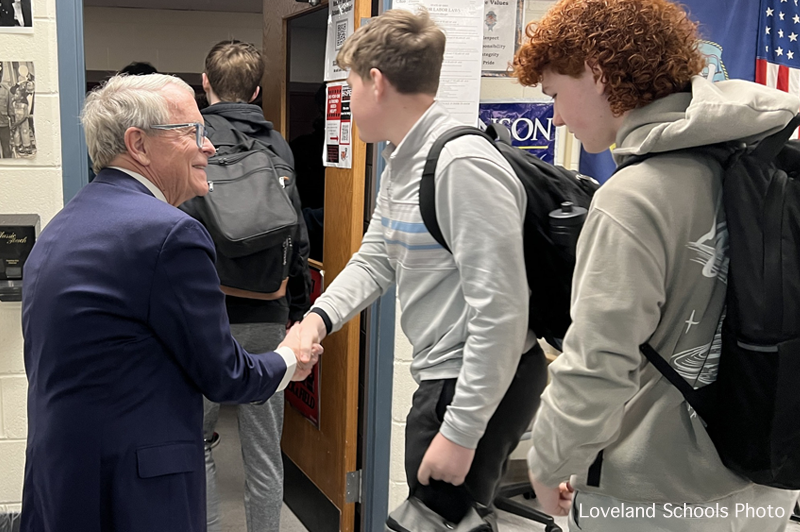
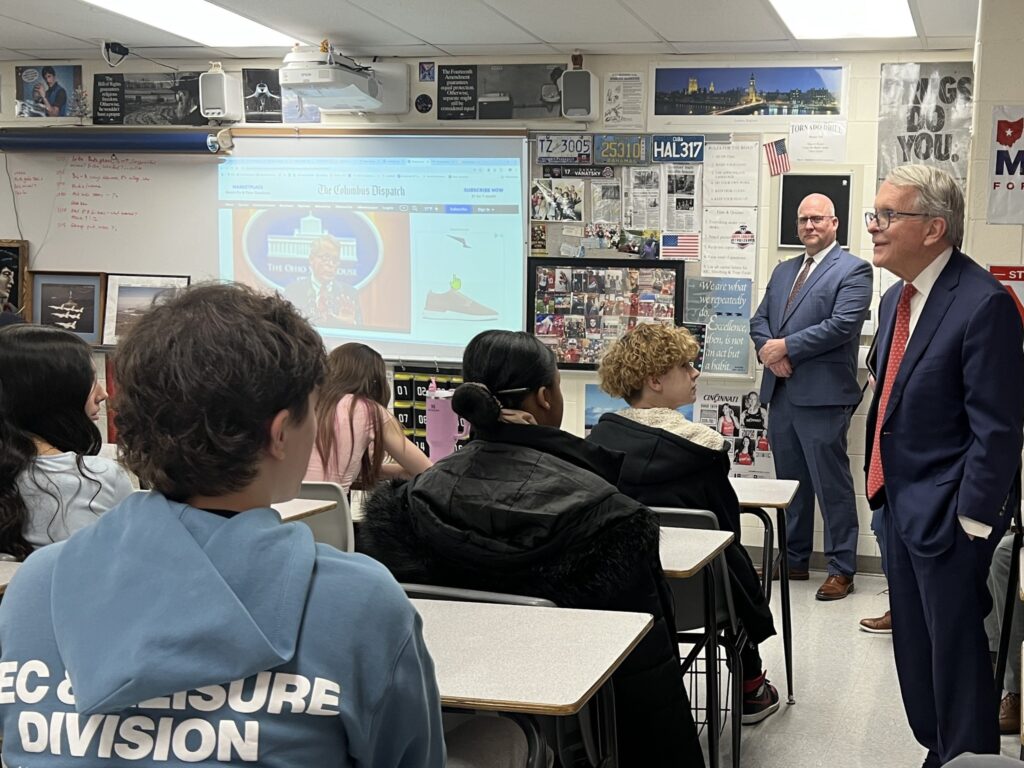
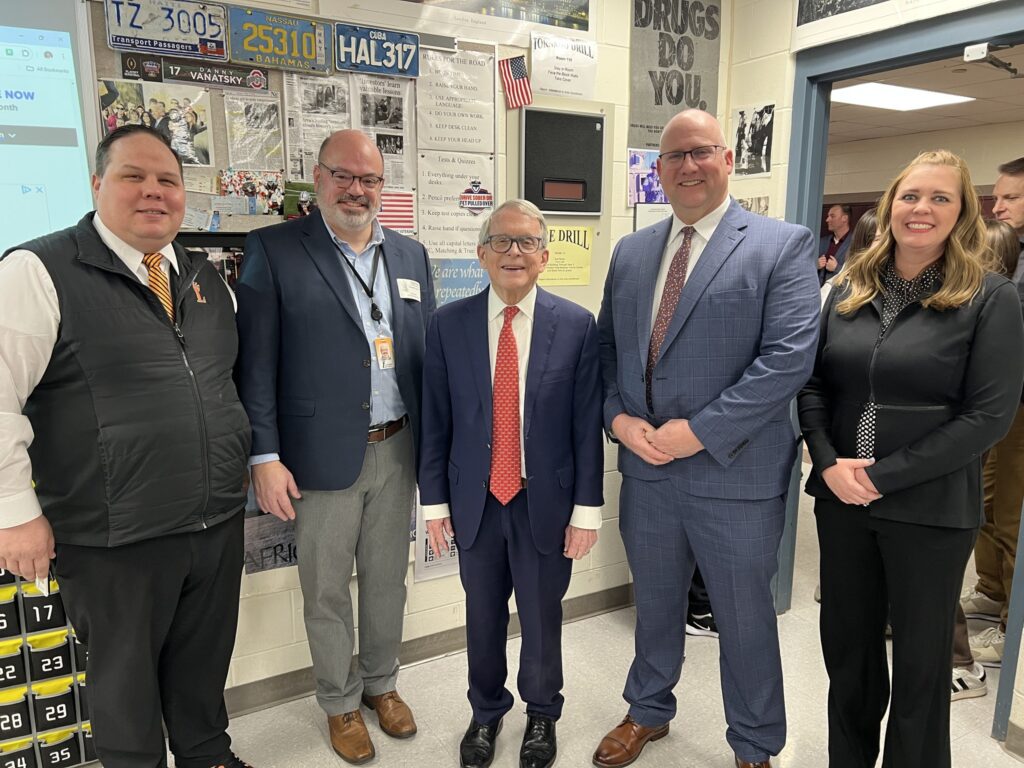
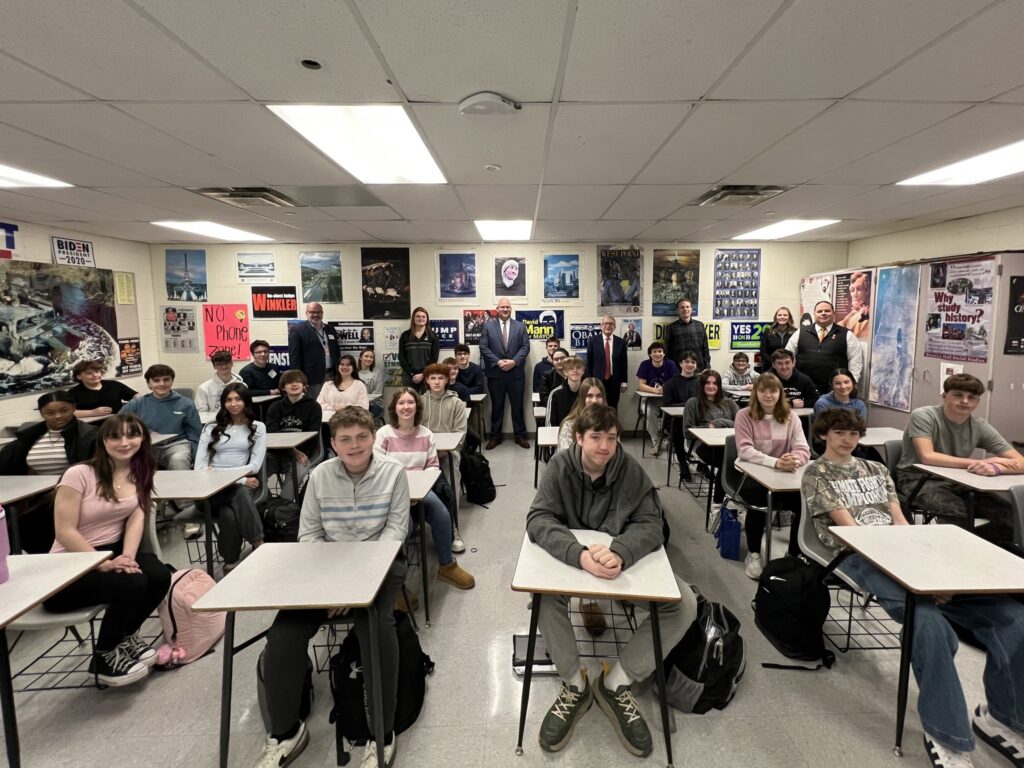
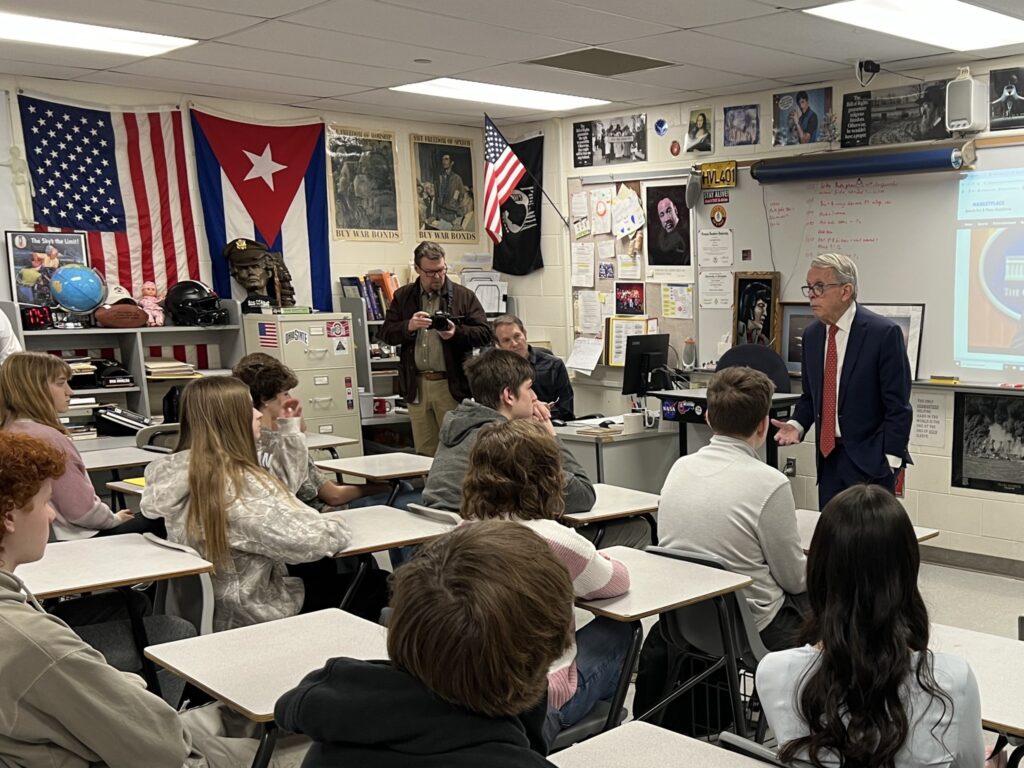
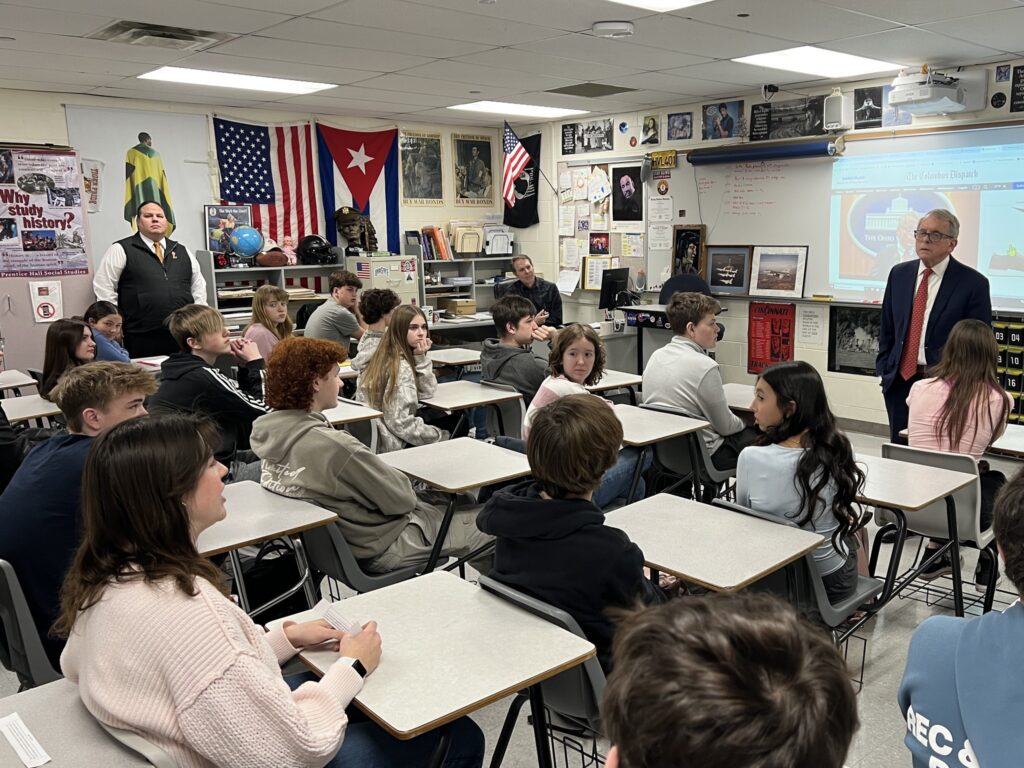
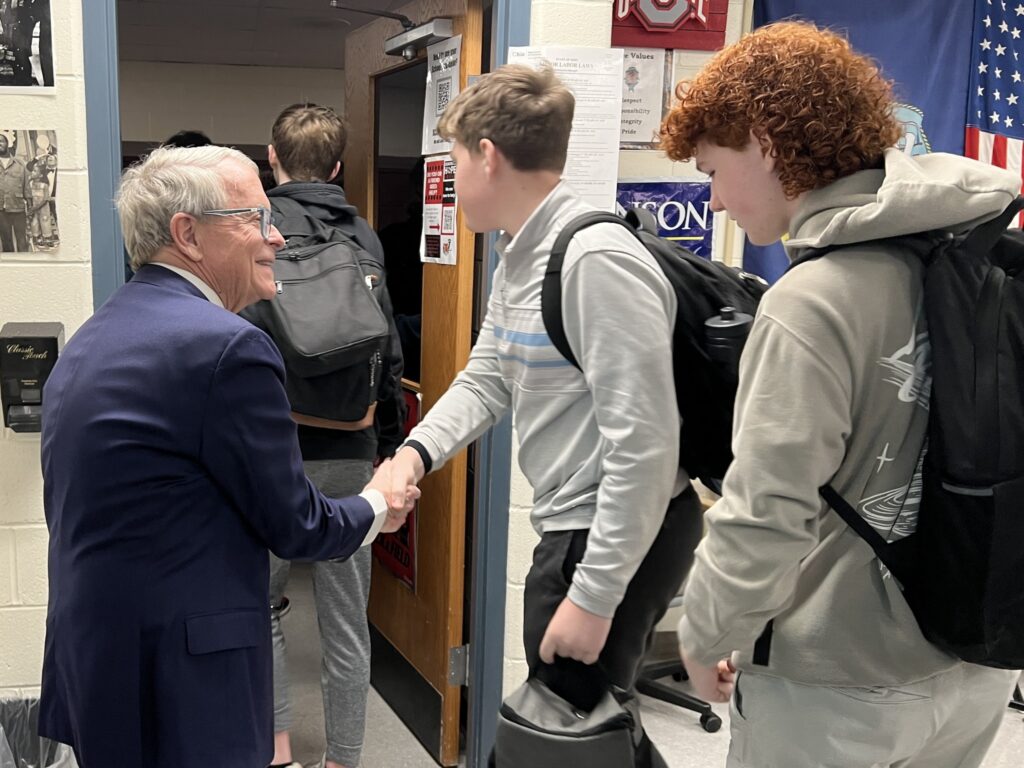
Loveland, Ohio – On Monday, Loveland High School welcomed Ohio Governor Mike DeWine for a visit with students. DeWine spoke to students in Jim Vanatsky’s freshman World History class and Caitlin Smith’s Advanced Placement Macroeconomics class.
During the visit, the Governor talked about his family, his childhood, and his nearly 50-year career in public service. DeWine is currently in his second term, serving as the 70th governor of Ohio. He has served in numerous county and state offices, as a U.S Senator, and a member of United States House of Representatives. He is a member of the Republican Party and graduated from Miami University with a bachelor’s degree in 1969 and earned a Juris Doctor from Ohio Northern University College of Law in 1972.
DeWine fielded questions from students about various topics, including taxes, manufacturing careers, school cell phone policies, and literacy programs. Students also asked questions about public school funding and the sources of revenue for school districts.
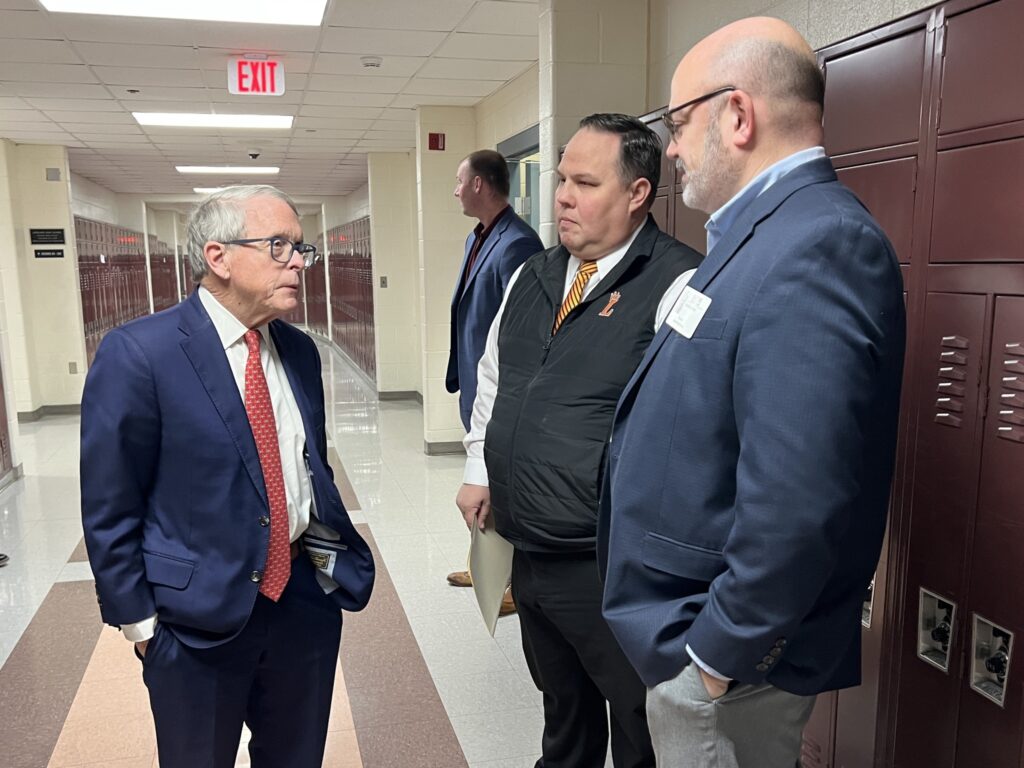
Loveland School Board President Jonathan Eilert and Treasurer John Espy also talked with Governor DeWine about his current state budget proposal and the negative impact it would have on state funding for the Loveland City School District.
Loveland, Ohio – CancerFree KIDS received a surprise donation of $100,000 from Jersey Mike’s Subs CEO Peter Cancro last week, marking the official start of Jersey Mike’s Month of Giving, which began Saturday, March 1.
Throughout March, Cincinnati area Jersey Mike’s customers can support CancerFree KIDS by rounding up their purchase to the nearest dollar, or donating $1, $3, or $5 when placing their order. Find a Jersey Mike’s location near you.
The campaign culminates in the nationwide Day of Giving on Wednesday, March 26th when all 31 Jersey Mike’s locations in Greater Cincinnati and Northern Kentucky will donate every dollar spent in their store to CancerFree KIDS.
CancerFree KIDS and Jersey Mike’s Subs have partnered on the effort since 2015, resulting in almost $1.4 million in donations to CancerFree KIDS. CancerFree KIDS celebrates surprise donation from Jersey Mike’s.
Pictured: Jersey Mike’s Area Director Holden Kangas, Jersey Mike’s CEO Peter Cancro, CancerFree KIDS Executive Director Jill Brinck, Jersey Mike’s Area Director Sam Ballard (Provided Photo)
In a public release about the news Jill Brinck, Executive Director of CancerFree KIDS said, “What a wonderful surprise to start Jersey Mike’s Month of Giving. We are incredibly grateful for the support of Jersey Mike’s and its customers, and their dedication to our mission has made a tangible difference in the lives of children battling cancer.”
As a direct result of the money raised from the Month of Giving, eight CancerFree KIDS research grants have been named in honor of Jersey Mike’s. These grants have gone on to achieve remarkable results, securing $12.9 million in subsequent funding, resulting in five publications and providing crucial support to the development of a new FDA-approved drug for neurofibromatosis.
About CancerFree KIDS
CancerFree KIDS aims to find more effective and gentler treatments for childhood cancer by funding innovative research projects in the early stages of development. New ideas need money to grow, yet potential breakthrough treatment methods often go unfunded because pediatric cancer research is drastically limited. CancerFree KIDS provides grants to high-risk/high-reward childhood cancer research projects in these crucial early stages, which allows researchers to prove their concept, secure additional funding, and eventually create new treatments for kids. Learn more at cancerfreekids.org.
Loveland, Ohio – Daylight saving time means setting clocks forward by one hour in spring. Daylight saving time begins annually on the second Sunday in March and ends on the first Sunday in November.
When we set our clocks forward one hour at 2 AM on March 9, we lose one hour of sleep and effectively pushing the sunrise later in the morning.
Loveland, Ohio – Water safety is critical for children and adults with developmental disabilities (DD). Many individuals with DD are drawn to water and some are unable to understand the dangers associated with it. Tragically, the leading cause of death among individuals with autism who wander is drowning.
Make sure your prepared to keep your loved ones with DD safe by joining us in learning practical tips on community safety, including water safety, and wandering prevention! This session will take place on Tuesday, March 18 from 6 PM until 8 PM at the Janet Clemmons Center located at 282 N. Fair Ave. in Hamilton, Ohio. Register on our website today at https://www.butlerdd.org/…/cookies-and-connections…/.



 Loveland, Ohio – Two students from Loveland High School are doing a raffle drawing for several lucky Loveland (45140) community members to win a painted and installed rain barrel through a partnership with Caring For Our Watersheds.































 Pictured: Jersey Mike’s Area Director Holden Kangas, Jersey Mike’s CEO Peter Cancro, CancerFree KIDS Executive Director Jill Brinck, Jersey Mike’s Area Director Sam Ballard (Provided Photo)