Tag: Manufacturing

  • Job fair features openings in manufacturing, healthcare, and more

    Job fair features openings in manufacturing, healthcare, and more

    Clermont County, Ohio – On Tuesday, March 9 OhioMeansJobs of Clermont County will present its first Virtual Job Fair. This event is hosted by the BCW|Workforce, operated by the Workforce Investment Board of Butler, Clermont, and Warren Counties, along with OhioMeansJobs (OMJ) and REDI Cincinnati, (a JobsOhio Network Partner).

    This virtual career fair will be offered at no cost to employers and job seekers and will focus on the manufacturing, healthcare, and logistics & distribution sectors. Participating employers and job seekers will be offered an immersive virtual career fair experience — all from the comfort of a computer or mobile device.

    Right Click to save the Coupon

    There will be hundreds of jobs available in Clermont County from companies like Huhtamaki, HealthSource of Ohio, Cintas, Amazon, Home Instead Senior Care, Milacron, and more.

    For more information, including an updated list of employers, contact Eric Plummer at OhioMeansJobs at eric.plummer@jfs.ohio.gov.

    The next Virtual Job Fair currently is scheduled for May 4, 2021.

  • Details of Ohio’s “Responsible RestartOhio” plan

    Details of Ohio’s “Responsible RestartOhio” plan

    Columbus, Ohio – Ohio Governor Mike DeWine, Lt. Governor Jon Husted, and Director of the Ohio Department of Health Dr. Amy Acton, made several announcements yesterday regarding Ohio’s plan to restart Ohio’s economy during the ongoing COVID-19 pandemic.

    HEALTHCARE

    Beginning May 1, 2020, all medically necessary procedures that do not require an overnight stay in a healthcare facility or do not require inpatient hospital admission and minimize the use of personal protective equipment may move forward. This includes regular doctor visits, well-care checks, well-baby visits, out-patient surgeries, imaging procedures, and diagnostic tests. Dental services and veterinary services may also proceed if a safe environment can be established.

    Healthcare providers and facilities that plan to resume providing these services must adhere to infection control practices, have sufficient PPE, and talk with patients about the risk of contracting COVID-19.

    Surgeries and procedures that, if not performed, would cause a threat to a patient’s life, a threat of the spread of cancer or the permanent dysfunction of a limb or organ, the presence of severe symptoms causing an inability to perform activities of daily living, and/or the risk of rapidly worsening symptoms have always been permitted even if an overnight stay is necessary.

    “RESPONSIBLE RESTART OHIO”

    The “guiding principles” of the Responsible RestartOhio plan are protecting the health of employees, customers, and their families, supporting community efforts to control the spread of COVID-19, and responsibly getting Ohio back to work.

    “We put this plan together based on all the information we have about how dangerous COVID-19 still is right now, balanced with the fact that it’s also dangerous to have people not working,” said Governor DeWine. “COVID-19 is still out there. It’s still killing people. We’re asking Ohioans to be reasonable and rational. Please don’t take huge chances, and please use common sense when you go out and where you go out.”

    Are you finding this information is important to your daily life?

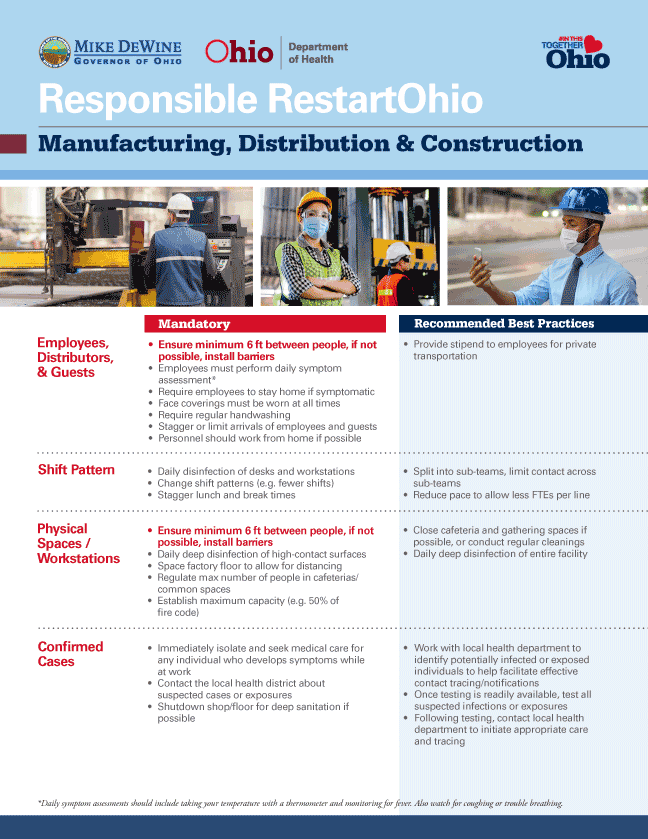
    Manufacturing, Distribution, and Construction Businesses

    Beginning on May 4, 2020, manufacturing, distribution, and construction businesses may reopen if these businesses can meet mandatory safety requirements (see graphic below) for customers and employees. The full Responsible RestartOhio plan for manufacturing, distribution, and construction can be found at coronavirus.ohio.gov/ResponsibleRestartOhio.

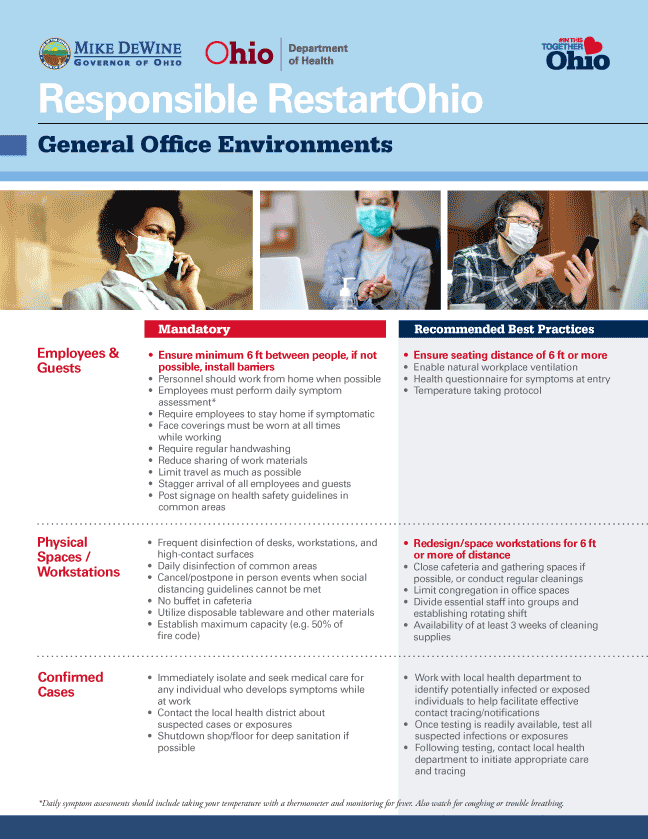
    General Office Environments

    Beginning on May 4, 2020, general office environments may reopen if these businesses can meet mandatory safety requirements (see graphic below) for customers and employees. The full Responsible RestartOhio plan for general office environments can be found at coronavirus.ohio.gov/ResponsibleRestartOhio.

    CONSUMER, RETAIL, and SERVICES

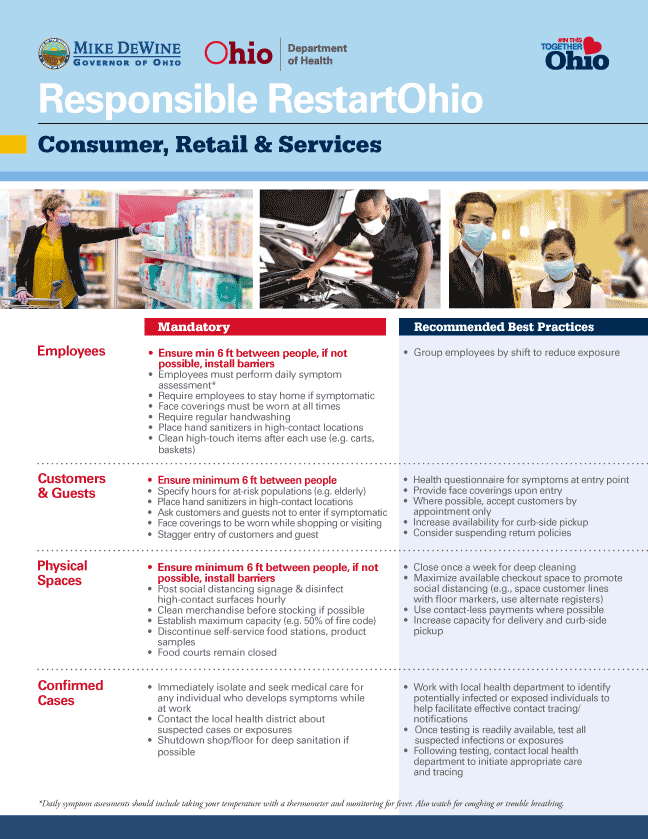
    Beginning on May 12, 2020, consumer, retail and services, may reopen if these businesses can meet mandatory safety requirements for customers and employees. (see graphic below) The full Responsible RestartOhio plan for consumer, retail, and services can be found at coronavirus.ohio.gov/ResponsibleRestartOhio.

    ALL BUSINESSES

    The general safe business practices that all businesses must follow as they reopen are:

      • Requiring face coverings for all employees, and recommending them for clients and customers at all times
      • Conducting daily health assessments or self-evaluations of employees to determine if they should work
      • Maintaining good hygiene at all times such as hand washing and social distancing
      • Cleaning and sanitizing workplaces throughout the day and at the close of business or between shifts
      • Limiting capacity to meet social distancing guidelines

    “I have an obligation as the Governor of Ohio to get people back to work and keep them safe. Opening everything up at once would not be consistent with the obligation to keep people safe,” said Governor DeWine. “Our Responsible RestartOhio plan is the best guarantee that Ohioans will feel safe going to stores and employees will feel safe going to work. I’m optimistic about our future, but we can’t be reckless.”

    CONTINUED CLOSURES

    Continued Business Closures Graphic

    The following types of establishments are ordered to remain closed due to their increased risk of potential COVID-19 exposure:

        • Schools and daycares
        • Dine-in restaurants and bars (carry-out is still permitted)
        • Personal appearance and beauty businesses
        • Older adult daycare serveries and senior centers
        • Adult day support or vocational rehabilitation services in group settings
        • Entertainment, recreation, and gyms

    For greater detail on the types of businesses that must stay closed, visit coronavirus.ohio.gov/ResponsibleRestartOhio.

    STAY AT HOME ORDER / LARGE GATHERINGS

    Because the danger of COVID-19 still exists, Ohio’s Stay at Home order will remain in effect to encourage Ohioans to continue making reasonable, rational decisions about leaving home.

    Although anyone is susceptible to getting sick with COVID-19, those who are 65 or older are encouraged to be especially careful, as are those with high-risk conditions such as chronic lung disease, moderate to severe asthma, heart conditions, diabetes, chronic kidney disease, or liver disease, as well as those who are immunocompromised or obese.

    Large gatherings of more than 10 people are still prohibited.

    MORE INFORMATION

    More detailed information on the Responsible RestartOhio plan can be found at www.coronavirus.ohio.gov/ResponsibleRestartOhio.

    Current Ohio and Local Data

    There are 16,325 confirmed and probable cases of COVID-19 in Ohio and 753 confirmed and probable COVID-19 deaths. A total of 3,232 people have been hospitalized, including 978 admissions to intensive care units. In-depth data can be accessed by visiting coronavirus.ohio.gov.

    CLERMONT COUNTY

    72 confirmed cases. 4 probable cases. 76 total cases. 47 recovered. 21 hospitalizations. 2 deaths.

    HAMILTON COUNTY

    1048 Hamilton County confirmed cases. 241 hospitalizations. 56 deaths. (Includes Cincinnati, Norwood, and Springdale.)
    WARREN COUNTY
    124 confirmed cases. 22 hospitalizations. 11 deaths.

    Video of yesterday’s full update of the Statehouse briefing, including versions with foreign language closed captioning, can be viewed on the Ohio Channel’s YouTube page.

    Are you finding this information is important to your daily life?

  • Working for less: Most common Cincinnati jobs pay too little

    Working for less: Most common Cincinnati jobs pay too little


    Last year, six of Ohio’s 10 most common jobs paid so little that a typical worker would need food assistance to feed a family of three — generally less than $26,000 a year.

    From the booming Columbus metro area to struggling Youngstown, too many jobs across Ohio don’t pay enough for families to get by.

    The research by Hannah Halbert, with research assistance from Isaac Miller of Policy Matters Ohio shows that too many jobs in Cincinnati pay too little and many pay less as a share of poverty than they did nearly two decades ago. New data released by the U.S. Department of Labor show that six of the Cincinnati area’s 10 most common jobs pay the typical worker too little to feed a family of three without food assistance (earnings under 130 percent of poverty typically qualify).

    At a time when state and federal policymakers are determined to erect new barriers to food assistance and health care, these new data show that the challenge is not requiring people to work, as most already do. Rather, the true challenge is getting employers—many of which are major international corporations with vast profits—to pay their workers a fair wage with benefits and set a schedule that provides some measure of job security.

    Low wages were not always so ubiquitous in the Cincinnati area. In 2000, five of the 10 most common occupations paid so little that a family of three was left dependent on food assistance to get by- now it’s six. Some occupations paid less as a share of poverty in 2017 than they did a decade and a half ago. The new rules of Ohio’s labor market are so tilted in favorof corporate employers that many Cincinnatians will not be able to work their way to self-sufficiency.

    The fact sheet for the Cincinnati area shows the median annual salary and hourly wage of the metro area’s 10 most common jobs in 2000 and 2017, and how far they went towards lifting a family of three out of poverty. The fact sheets also contain data showing which sectors have grown and which have declined since 2017.

    “State and federal leaders are trying to create new barriers to health care, food aid and housing assistance. If they succeed, many of Ohio’s working people will slip deeper into poverty.”

    “Throughout Ohio, not only are many of the most common jobs paying extremely low wages, many do less to lift working people out of poverty than they did in 2000,” Policy Matters Ohio Researcher Hannah Halbert said. “State and federal leaders are trying to create new barriers to health care, food aid and housing assistance. If they succeed, many of Ohio’s working people will slip deeper into poverty.”

    Working for Less

    Most common occupations in the Cincinnati metropolitan area, by employment, 2017

    page1image249770912

    Top 10 occupations 2017

    page1image217104592

    page1image217105424 page1image249765312

    Total Employment

    page1image249740352 page1image249740960

    page1image130905248

    Median Hourly Wage

    page1image130904352

    page1image217588912

    Median Annual Salary

    page1image244367120

    page1image250051424

    Median annual earnings as a share of poverty

    page1image217478848

    Food Prep & Serving Workers, including Fast Food (-)

    31,720

    $9.18

    $19,090

    93%

    page1image244798304

    Retail Salespersons (+)

    page1image217744544

    page1image217739968 page1image217745712

    29,450

    page1image217738752 page1image217739360

    page1image311361328

    $10.95

    page1image131679936

    page1image251376128

    $22,780

    page1image311086592

    page1image311268128

    112%

    page1image310533488

    Registered Nurses (+)

    page1image310416304

    23,580

    page1image310671296 page1image311124144

    $30.80

    page1image310815104

    $64,050

    page1image215549680

    314%

    page1image310858720

    Laborers & Freight, Stock & Material Movers (+)

    23,190

    $13.59

    $28,260

    138%

    page1image215184304

    Cashiers (+)

    page1image215543760 page1image310612048

    21,320

    page1image215652512

    $9.50

    page1image215335488

    $19,760

    page1image311066384

    97%

    page1image310671568

    Waiters & Waitresses (-)

    page1image243739824

    page1image243737584 page1image215305264

    20,170

    page1image251501744 page1image251382944

    page1image311312368

    $9.16

    page1image310910736

    page1image311314928

    $19,050

    page1image311314128

    page1image310900752

    93%

    page1image310598160

    Customer Service Reps (-)

    20,080

    $15.31

    $31,840

    156%

    page1image310620112

    Stock Clerks & Order Fillers (+)

    page1image310664160 page1image310622480

    17,640

    page1image250848320

    $11.87

    page1image311348784

    $24,690

    page1image310629872

    121%

    page1image310682096

    Office Clerks (+)

    page1image310603856

    page1image310686304 page1image310684112

    17,440

    page1image311048528 page1image311049072

    page1image311392992

    $15.29

    page1image311392112

    page1image310718256

    $31,800

    page1image310716784

    page1image310704560

    156%

    page1image310703184

    Janitors & Cleaners, except Maids & Housekeeping (-)

    page1image310785024

    15,670

    page1image310998416 page1image310785920

    $11.42

    page1image310890320

    $23,750

    page1image310931392

    116%

    page1image310861072

    Source: Bureau of Labor Statistics (BLS), Occupational Employment Statistics (OES) Survey, May 2017 estimates, available at https://www.bls.gov/oes/tables.htm, accessed April 13, 2018. Largest detail occupations in Cincinnati MSA by employment. Median annual earnings shown as a share of the poverty threshold for a family of three in 2017 ($20,420). The gross monthly income threshold for food assistance is generally 130 percent of poverty. Red text highlights the occupations paying a typical wage below this threshold. (-) indicates a median wage lower than the state median for that occupation. (+) indicates a median wage higher than the state’s for that occupation. Note that Cincinnati MSA includes areas in Ohio, Kentucky and Indiana.


    “Examining statewide numbers, Ohio may look better off than it really is,” Halbert said. Although the state has recovered all the jobs lost during the recession, since 2007, 215,000 fewer Ohioans are participating in the workforce — pushing down last year’s statewide unemployment rate of 5 percent. Statewide data also masks deep regional disparities and wage stagnation.

    Wrong Direction

    Cincinnati MSA occupations, employment and median annual wage: 2000 and 2017

    page2image246072976

    Top 10 occupations 2000

    page2image133617088

    page2image133617920 page2image133764992

    Earnings as share of poverty

    page2image249264672 page2image249265280

    Top 10 occupations 2017

    page2image246396256 page2image245699808

    Earnings as share of poverty

    page2image249219232 page2image249234000

    Retail Salespersons

    119%

    Food Prep & Serving Workers, including Fast Food-

    93%

    page2image249010192

    Cashiers

    page2image246153216

    page2image248752912 page2image246255328

    102%

    page2image248753648 page2image248754256

    Retail Salesperson-

    page2image246204448 page2image246202368

    112%

    page2image246205168 page2image246205776

    Laborers & Freight, Stock & Material Movers

    page2image246345216

    141%

    page2image245632016 page2image245632624

    Registered Nurses+

    314%

    page2image245879536 page2image245876896

    Food Prep & Serving Workers, including Fast Food

    page2image249340816

    97%

    page2image246090064 page2image246090672

    Laborers & Freight, Stock & Material Movers-

    138%

    page2image245748448 page2image245749056

    General & Operations Managers

    402%

    Cashiers-

    97%

    page2image248731808

    Office Clerks

    page2image249460192 page2image249429248

    152%

    Waiters & Waitresses

    page2image246210304 page2image245862544

    93%

    page2image245526848

    Customer Service Reps

    page2image249213120 page2image249212576

    177%

    Customer Service Reps-

    page2image248631456 page2image249215696

    156%

    page2image249286976

    Registered Nurses

    page2image248793024

    page2image248793728 page2image248794208

    295%

    page2image245810992 page2image245811600

    Stock Clerks & Order Fillers-

    page2image246001696 page2image246002240

    121%

    page2image249017168 page2image249017776

    Waiters & Waitresses

    page2image245745968

    93%

    page2image245841888 page2image245922752

    Office Clerks+

    156%

    page2image245734976 page2image245735584

    Packers and Packagers

    page2image249530432

    120%

    page2image249314176 page2image245769328

    Janitors & Cleaners, except Maids & Housekeeping-

    116%

    page2image246013456 page2image246014832

    Source: BLS, OES Survey, 2000 Cincinnati MSA estimates and May 2017 estimates, accessed 4/13/18 at https://www.bls.gov/oes/tables.htm. Largest detail occupations in Cincinnati MSA by employment. Median annual earnings shown as share of poverty threshold for a family of three in 2000 ($14,150) and 2017 ($20,420). The gross monthly income threshold for food assistance is generally 130 percent of poverty. Red font notes occupations that have median annual earnings under 130% of poverty for a family of three. (+) indicates earnings increased since 2000, (-) indicates the earnings decreased since 2000, as a share of poverty. Note that Cincinnati MSA includes areas in Ohio, Kentucky and Indiana.


    “Ohio needs leaders who will make a renewed public commitment to working people,” Halbert said. “Both the nation and state have productive economies with abundant wealth. We can use policy to shape the economy to benefit working people. Only the lack of political will keeps leaders from passing policies to improve job quality, make education and training affordable and fund basic services like transit and childcare that help people work.”

    The Cincinnati region on average had 1,093,600 jobs last year. That’s 49,800 more jobs than in 2007, when the last recession began. The Cincinnati region has been a driver of the Ohio recovery. One of the top jobs, registered nurse, provides better earnings. This job relies in part on maintaining expanded health coverage. Yet, many of the jobs that have grown over recent years do not offer the same income or stability as those lost. Manufacturing took the biggest hit. Growing sectors, like leisure and hospitality, often pay poorly and lack benefits.

    Job quality has been eroded. Ohio tax policy has sent big cuts to the wealthiest, shrinking funding for education, infrastructure, and healthcare—investments that help working people and their kids get ahead.

    Job quality has been eroded. Ohio tax policy has sent big cuts to the wealthiest, shrinking funding for education, infrastructure, and healthcare—investments that help working people and their kids get ahead.

    Policy Matters Ohio has set out 10 policy priorities that help working people by raising wages, extending overtime protections, providing paid leave, preserving public jobs and more. These new data show that such policies are essential in the Cincinnati region where jobs still make it hard to get by.

  • Southwest Ohio Job Fair at Great Wolf Lodge November 17

    Southwest Ohio Job Fair at Great Wolf Lodge November 17


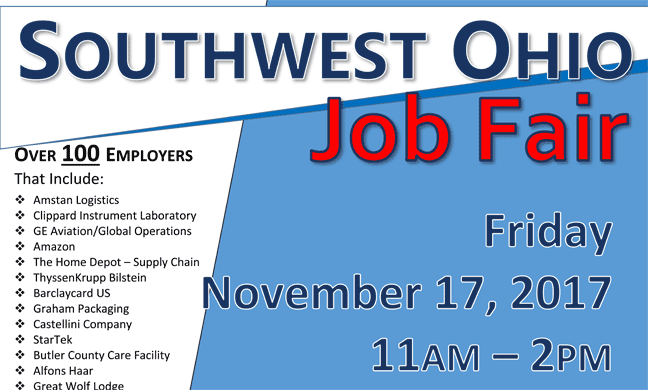
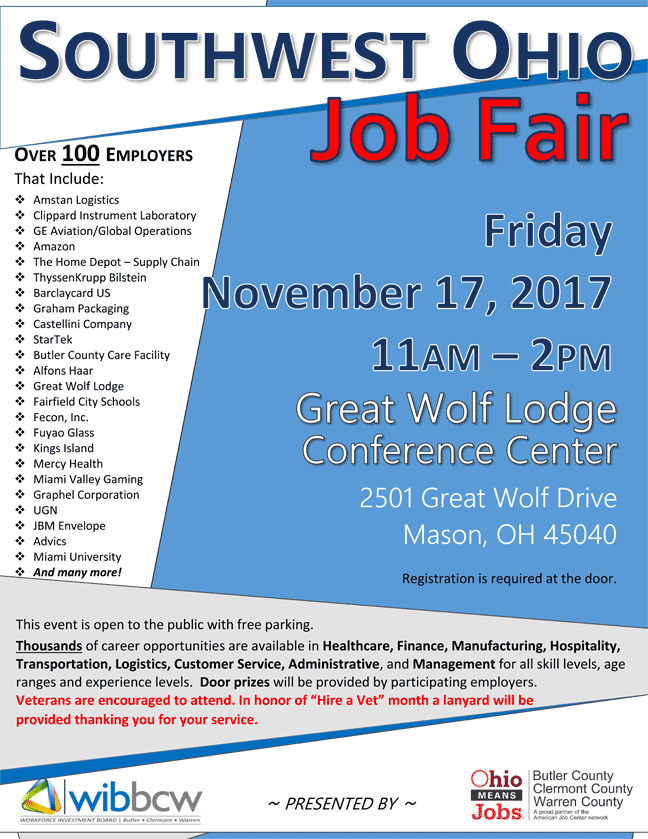
    Workforce Investment Board of Butler, Clermont and Warren Counties, along with the OhioMeansJobs centers of Butler, Warren and Clermont counties have joined together to host the Southwest Ohio Job Fair on November 17, 2017 from 11 AM to 2 PM at the Great Wolf Lodge Conference Center located at 2501 Great Wolf Drive Mason, Ohio 45040.

    Over 100 employers will be in attendance,  many of which will be offering on-the-spot interviews. 

    Mason, Ohio – The Southwest Ohio Job Fair will take place this Friday, November 17 from 11 AM to 2 PM at the Great Wolf Lodge in Mason. One hundred employers will be attending representing businesses such as: Graphel, GE Aviation, Amazon, Amstan Logstics, Mercy Health, ThyssenKrupp Bilstein, Miami Valley Gaming, Alfons Haar, Miami Valley Gaming and many more. Thousands of career opportunities are available in Healthcare, Finance, Manufacturing, Hospitality, Transportation, Logistics, Customer Service, Administrative, and Management for all skill levels, age ranges and experience levels. 

    The Southwest Ohio Job Fair will be distinguishing those who have served in our military forces by providing exclusive identification cards at the door.The cards will recognize local heroes that have sacrificed for our freedoms. Butler, Clermont and Warren County employers value the unique skills and considerable talent that veterans bring to their businesses. 

    This is a great opportunity to begin a new career. Many employers will be conducting on-the-spot interviews for skill levels ranging from entry level to management.The event is open to the public with free parking. Registration is required at the door.

    For more information visit www.wibbcw.com


    Take Home Tano Consumer Meal Market

    Take Home Tano is about fresh, wholesome food for the frenzied family   Our goal is to meet the needs of busy families.