Tag: maps

  • Ohio Redistricting: The Sequel

    Ohio Redistricting: The Sequel

    Ohio legislators will head back to the drawing board on congressional and Statehouse maps

    BY: SUSAN TEBBENOhio Capital Journal

    The new year could include many different developments in the redistricting arena, but one thing is for sure: new maps have to be on the agenda.

    But this time around, majority leaders may not have as much trouble getting maps through the current approving authority: The Ohio Supreme Court.

    With the departure of Chief Justice Maureen O’Connor due to age limits, Justice Sharon Kennedy was elected to take the top spot, and Kennedy made clear how she felt about redistricting in the past, accusing the court majority of judicial overreach in rejecting maps as unconstitutional.

    The maps have gone through the ringer: Statehouse district maps have been rejected by the state’s highest court five times, and congressional maps have been turned down twice.

    After the last round of rejection, GOP members of the Ohio Redistricting Commission turned to a federal U.S. District Court for an answer, which came in the form of the temporary approval of a map passed in February, but still deemed unconstitutional by the state supreme court.

    The three-judge panel in federal court said they did not intend for the map to last ten years, or even the four years laid out in the constitutional amendment that reformed the process. The ORC could pass a map without bipartisan support, but the map would only last four years.

    The GOP took another step around the Ohio Supreme Court, by appealing to the U.S. Supreme Court on congressional redistricting, and the power of the state legislature over the state supreme court.

    The nation’s highest court has not yet decided whether it will take up the case, and is still deciding a different redistricting-related case, Moore v. Harper, which also addresses the role of the state legislature in elections.

    U.S Sen. Sherrod Brown pointed to ousted Ohio House Speaker Larry Householder’s corruption scandal as part of the problem the state is having in attempting to resolve the redistricting issue.

    “This state government is the most corrupt in the country,” Brown said on a press call. “I think there’s no question about that.”

    Householder wasn’t a part of redistricting, but his predecessor as Speaker, Bob Cupp was, along with Senate President Matt Huffman.

    “Of course, (GOP members of the legislature) know they’re losing elections all over the country based on the fact that they are out of step with the majority of voters, so they believe the only way to win is change the rules,” Brown said.

    Legislative leaders have not made any indication for sure as to when the process will start again, though the need to pass a new state budget may slow the process down.

    Voting advocates have said they are pulling together a new ballot measure, that could change redistricting yet again. Outgoing Chief Justice Maureen O’Connor has said she plans to help anti-gerrymandering efforts.

  • Ohio Supreme Court rejects legislative maps, sets fifth redistricting deadline

    Ohio Supreme Court rejects legislative maps, sets fifth redistricting deadline

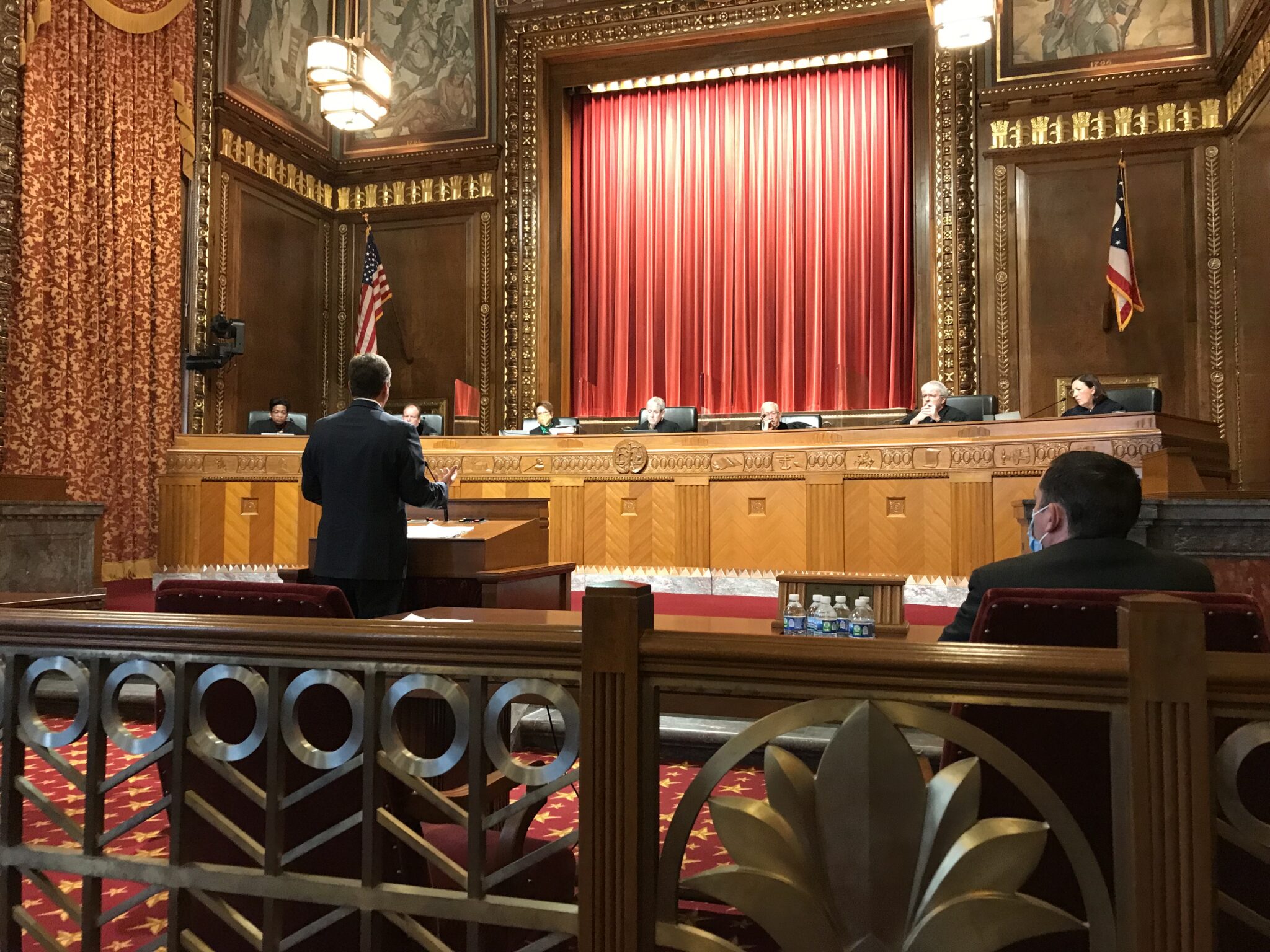
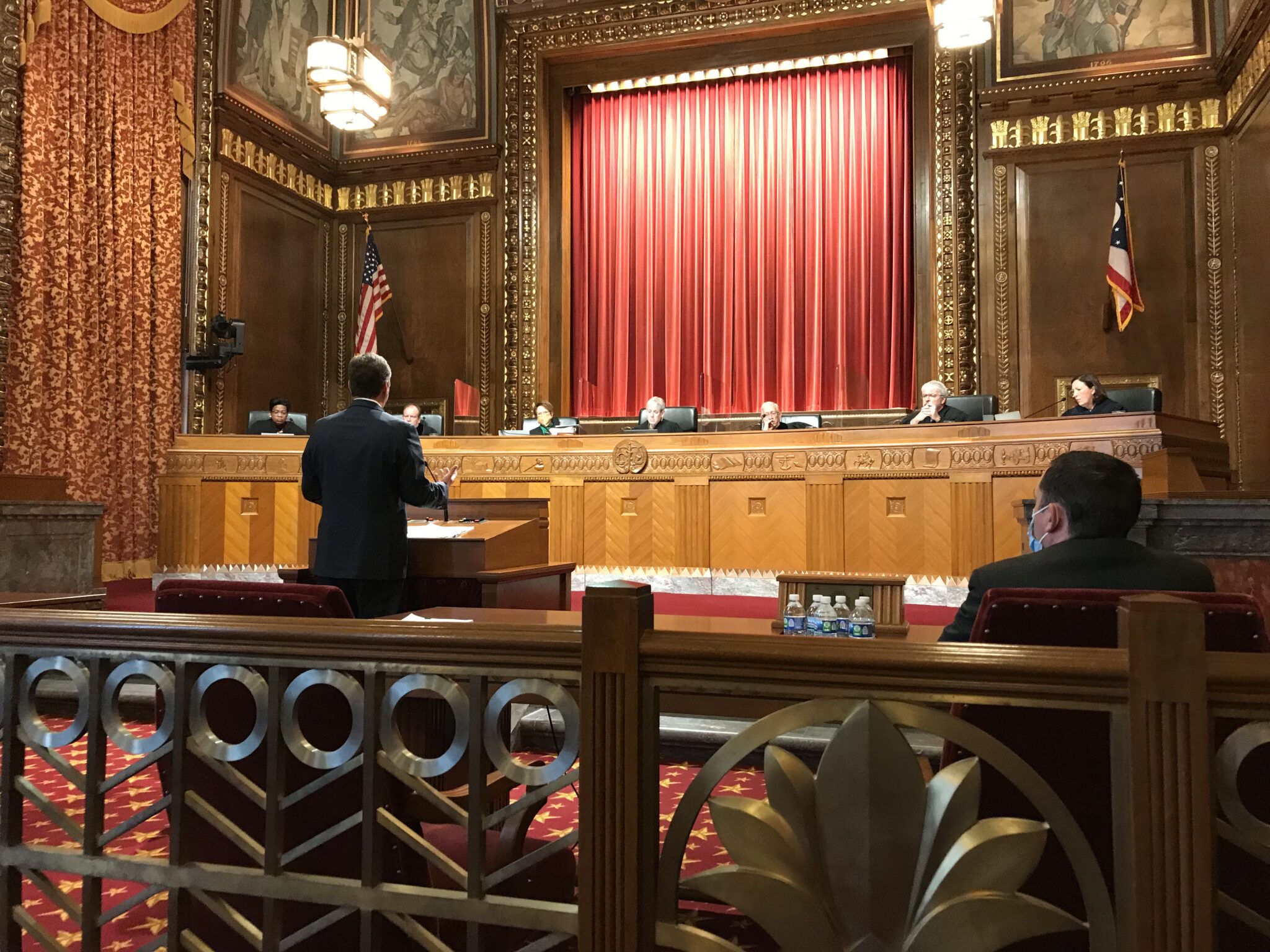
    Attorney Phillip Strach speaks before the Ohio Supreme Court in December, arguing for the constitutionality of legislative district maps. The court heard arguments on three cases asking it to reject the maps approved in September. (Photo: Susan Tebben, OCJ)

    Commission members won’t be held in contempt

    BY: SUSAN TEBBEN – Ohio Capital Journal

    The Ohio Supreme Court turned away a fourth set of redistricting plans from the Ohio Redistricting Commission in a 4-3 decision on Thursday, but left the responsibility with the commission to redraw the maps yet again.

    In a separate announcement, the court also denied requests to hold commissioners in contempt of court for violating court orders. Justice Patrick DeWine, son of governor and commission member Mike DeWine, recused himself from the contempt proceedings, but not from the redistricting rulings.

    The fourth set of maps was similar to the third maps, as admitted by Senate President Matt Huffman, the member of the commission who proposed they be adopted by the ORC at the end of March.

    The supreme court spelled out in its Thursday ruling the way in which objections to the maps showed “beyond a reasonable doubt” that the plan once again violated the constitutional regulations surrounding redistricting, but they didn’t order any other remedies offered by the map challengers, which included taking the map-drawing power away from the ORC.

    The commission started off on the right foot this time, the justices in the majority said, when they “began to heed our suggestions” given in the previous map rejection, which advised the commission to hire independent mapdrawers, hold near-daily meetings, and give mapdrawers “a neutral set of instructions” that they would use to publicly draw maps.

    In the week leading up to the March 28 deadline for the most recent maps, the commission hired Dr. Douglas Johnson, as proposed by the GOP, and Dr. Michael McDonald, as proposed by the Democrats. The two were paid at a rate of $450 per hour, with a cap set at $49,000 each.

    The commission also partnered with the Ohio Channel to set up a room with cameras showing Johnson and McDonald working, and the computers on which they were collecting data and drawing district lines. The commission met several times during that week to answer questions from the mapmakers and give them instructions, up until the day of the deadline.

    On that day, Huffman made a move to bypass the Johnson/McDonald maps because he said time was running short, too short for the commission members to offer amendments and make changes by the deadline.

    The best option, he then said, was to make a few changes to the previously rejected map, and submit it to the court, with the argument that it was better to get a map in on time than to wait for the mapmakers to be done with their map and possibly go past the March 28 date set by the court.

    To do so, he tasked Blake Springhetti, a House GOP staffer who had worked on the previous maps, to make the changes that night.

    “The evidence suggests that Springhetti … modified the second revised plan in one afternoon to produce the (fourth map),” the majority justices wrote in their rejection of the most recent maps.

    Broken ‘parachute’

    Despite the fact that the court told the commission to come up with an “entirely new” map this time, the court said the commission acted as though a tweaked version of an invalidated plan was a “parachute” to get it over the finish line. They also said there was evidence of efforts to block McDonald and Johnson from finishing their maps.

    “The timeline of events demonstrates convincingly that the commission — or at least some members of the commission — when faced with one or more plans that closely matched constitutional requirements in the form of Dr. McDonald’s and Dr. Johnson’s plans, reverted to partisan considerations when time was running short, even though the potential for successful completion was high,” the majority justices wrote.

    “Particularly problematic,” those justices said, was Huffman’s “last-minute insistence” that the mapmakers consider the addresses of incumbent House and Senate members in their district drawing, which the court said “pulled the rug out from under the independent map drawers.”

    In throwing forth the revised version of the third plan, commission members sent the court “a nearly identical one-sided distribution of toss-up districts,” the court rules. The number of toss-up districts — those districts whose partisan “advantage” is less than 2 percentage points — went from 26 to 23 from the third maps to the fourth. The fact remained, though, that all the toss-up districts were considered “Democratic-leaning” in the GOP analysis of the maps, and none were similarly toss-ups for Republican districts.

    “Senate President Huffman and House Speaker Cupp point out that the (fourth plan) improves upon the (third plan),” court justices noted. “While this may be true, the improvement falls short of landing in constitutional territory.”

    The court is now giving the commission until 9 a.m. on May 6 to come up with an “entirely new” plan. They again pushed for transparency and public viewing of the process. They also retained jurisdiction on the map, meaning they hold on to the authority to reject or approve the map as they have in previous instances.  This wasn’t the case in the congressional maps, forcing challengers of that map to file brand new lawsuits to fight against what they see as gerrymandered federal districts.

    Adopting another new plan…again

    The majority justices, while acknowledging that they do not have the power to adopt a map of their own, suggested a more “efficient way” of moving forward with a new plan.

    “No matter what the primary date is to be, time is of the essence,” the justices wrote. “With time in mind, it appears that the most efficient way for the commission to proceed may well be to continue working with Dr. McDonald and Dr. Johnson to complete the plan on which they have made considerable progress — if they are willing and available and if the commission has the authority to timely retain them for additional work.”

    The court argued that “by certain measure” the Johnson/McDonald plan “is on track to being constitutionally compliant.”

    Seemingly responding to sticking points that came up along the way, the court’s majority gave new guidance on adopting a new legislative plan.

    During the late hours of March 28, Cupp and Huffman both argued the commission couldn’t push past the deadline because the court had said it would not allow any other extensions of time. The court was more specific this time in saying no request for extension of time could be filed for objections to the adopted maps.

    The commission, however, could file a motion for an extension to their time with the secretary of state if they can prove it is needed.

    Justices also took time in their decision to argue against a federal intervention in state redistricting, something being discussed by a three-judge panel in U.S. District Court. Those judges are considering a lawsuit by Ohio voters asking that the federal court decide on a map for the state to use, under the argument that voters are losing their constitutional right to do so without a map to establish candidate districts.

    “While the process has proved challenging for the commission, as evidenced by four legislative plans falling short of (the constitution’s) requirements, the difficulty of the task is not a reason for federal-court intervention,” the majority of supreme court justices wrote.

    Dissents

    The three votes against rejecting the maps came from expected sources: Justices Sharon Kennedy, Patrick DeWine and Patrick Fischer, all of whom voted against rejection in the last three court decisions.

    Kennedy, who is running for chief justice in this year’s election, used her Thursday dissent to again discredit the majority opinion for overuse of judicial power. She criticized the justices who rejected the last three maps for moving constitutional goalposts and abusing their power in previous dissents over redistricting.

    “The majority’s continued denial of the limitation of this court’s power may end up costing the taxpayers millions of dollars,” Kennedy wrote in her dissent to the newest ruling. “Money that is being consumed by the never-ending cycle of map drawing, litigation, and now, two primaries, one on May 3 and the other perhaps on Aug. 2, all ordained by the majority’s overreach.”

    Justice Patrick DeWine claimed the majority had “long ago forsaken any concern about the actual words of the Constitution – it simply demands a General Assembly-district plan that achieves its policy goals.”

    “With each iteration of these cases, it becomes more evident that a rogue majority is simply exercising raw political power,” Justice DeWine wrote in his own dissent. “No one should be deceived.”

    The justice goes on to say the authors of the constitutional amendment overhauling redistricting “were overly optimistic,” and the threat of a four-year map instead of 10-year map “was not the stick it was thought to be” to incentivize bipartisan work.

    Whatever the reason for the “mess” redistricting has become, Patrick DeWine said court overreach is not the solution.

    “(The court’s job) is not to impose extraconstitutional standards on the commission in an attempt to achieve political outcomes that the court finds desirable,” DeWine wrote.


  • Ohio Supreme Court to redistricting commission: Why shouldn’t we hold you in contempt?

    Ohio Supreme Court to redistricting commission: Why shouldn’t we hold you in contempt?

    Attorney Phillip Strach speaks before the Ohio Supreme Court, arguing for the constitutionality of legislative district maps. The court heard arguments on three cases asking it to reject the maps approved in September. (Photo: Susan Tebben, OCJ)

    BY: SUSAN TEBBEN – Ohio Capital Journal

    The Ohio Supreme Court weighed in on the redistricting battle on Friday evening, asking the members of the Ohio Redistricting Commission why it shouldn’t hold them in contempt of court for defying its order.

    Chief Justice Maureen O’Connor signed an entry in all three of the lawsuits against the ORC on legislative redistricting, asking Gov. Mike DeWine, Secretary of State Frank LaRose, Auditor Keith Faber, Senate President Matt Huffman, House Speaker (and commission co-chair) Bob Cupp, state Sen. (and commission co-chair) Vernon Sykes and House Minority Leader Allison Russo, to explain the “failure to comply with this court’s February 7, 2022 order,” and why they shouldn’t face anything from fines to jail time, the consequences for contempt of court.

    The court had been asked by the League of Women Voters, the Ohio Organizing Collaborative and a group of Ohio residents – the parties in the three lawsuits originally filed to challenge maps approved by the ORC – to order the commission to give specific reasons for their choice to adjourn without maps on Feb. 17.

    The ORC members now have until noon on Feb. 23 to tell the court why they shouldn’t be held in contempt.

    The groups also asked for justification for the commission’s lack of action on any sort of map, despite being presented with a map by the Democratic House and Senate caucuses, which they shot down along party lines on the day of the deadline.

    Huffman accused drawers of the Dem map of racial gerrymandering to the benefit of Democrats in certain districts, including the district that holds Lake County, typically a strongly GOP area. Russo wholly denied the accusations.

    The GOP commission members said during the meeting that they could not find a way to draw maps that complied with all the redistricting provisions of the constitution, while also complying with the rules the supreme court had given in their majority opinion invalidating the previous maps. Mainly, the GOP said they couldn’t hit the target of 54-46 partisan breakdown asked for by the court justices, a number based on statewide voter preferences over the last 10 years.

    But some of the commission members, of both parties, disagreed with the decision to leave before approving a map.

    “I think it is a mistake for this commission to stop and basically say that we’re at an impasse,” Gov. Mike DeWine said on Thursday. “I don’t think that is an option that the law gives us.”

    Co-chair Sykes agreed that contempt was a possibility for the commission members, and said he was willing to do whatever could be done to move forward.

    Asked after the commission adjourned if that included contempt of court: “Including whatever we can do.”

    The choice to adjourn didn’t require a majority vote, but was met with no formal objections.

    The supreme court ordered the ORC to come up with “entirely new” maps after invalidating not one but two different sets of legislative district maps. Their deadline to file with the Secretary of State’s Office was Feb. 17, with those maps then being sent to the court for review by the next day.

    The order came the same day a federal lawsuit was filed by Ohio residents, some of whom are also anti-abortion advocates in the statewide lobby group Ohio Right to Life. That lawsuit asks the district court to take over the process, and accuses the redistricting commission of preventing them from advocating for candidates, running for office, and even voting.

  • Dems: We’ll talk about primaries when fair maps are passed

    Dems: We’ll talk about primaries when fair maps are passed

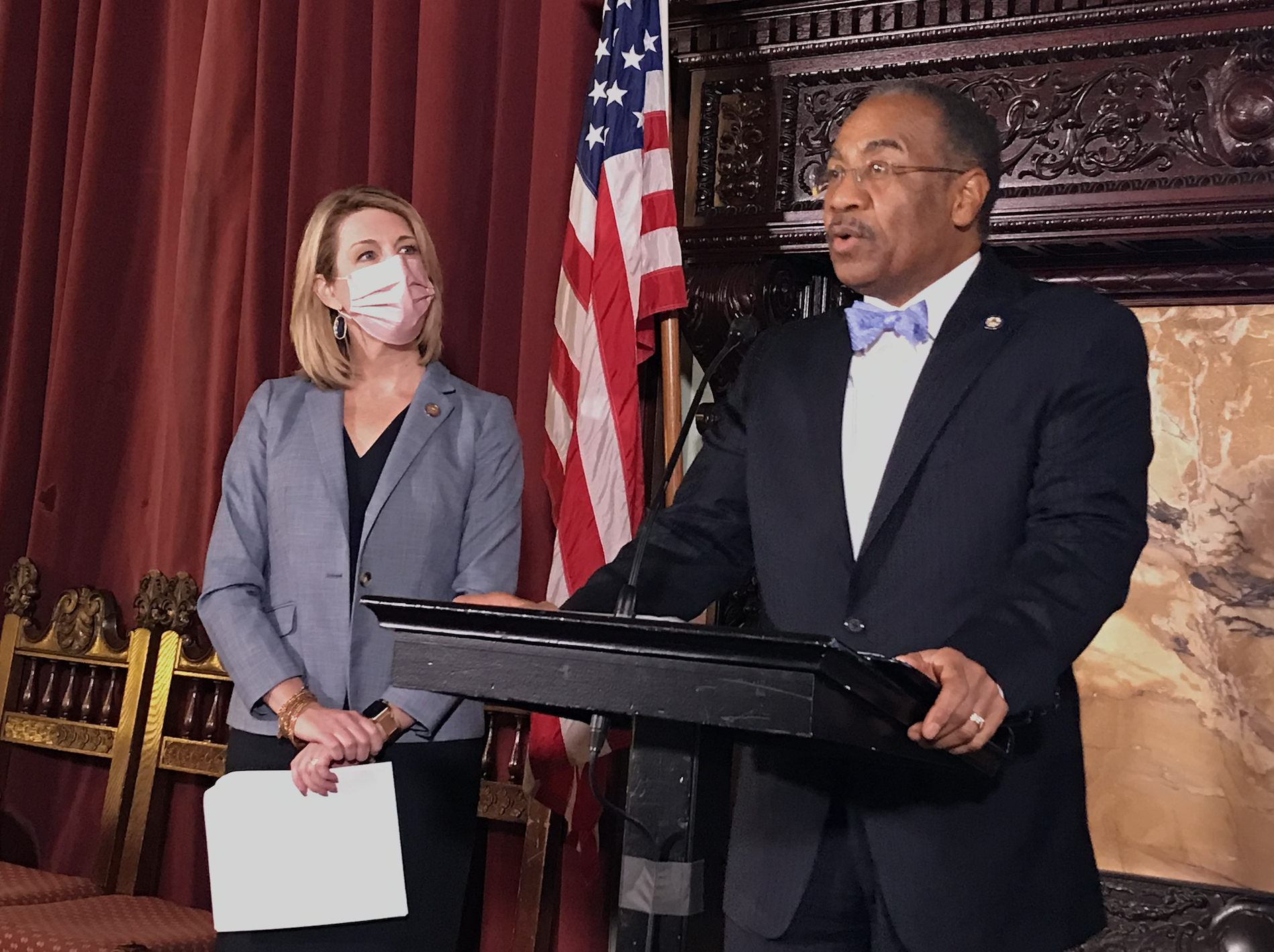
    State Sen. Vernon Sykes, D-Akron, speaks with press alongside House Minority Leader Allison Russo on Friday. The Dem caucuses pushed their maps and pushed for cooperation in the ongoing redistricting process. (Photo: Susan Tebben, OCJ)

    BY: SUSAN TEBBEN –  Ohio Capital Journal

    After making technical fixes brought up by GOP members of the Ohio Redistricting Commission, Ohio’s Democratic caucuses in the legislature are again pushing for their maps to be a model for redistricting in the state.

    Legislative leaders of the party also still believe a May primary is possible, but until maps are produced with bipartisan agreement, they say they can’t come to the table to talk about other election options.

    House Minority Leader Allison Russo, state Sen. Vernon Sykes, and Democratic redistricting mapmaker Chris Glassburn met at a press conference on Friday to bring up their versions of legislative maps, but also to give Republicans an ultimatum on the process.

    “It is not a lack of ability that is delaying the process, rather Republicans lack the will to do what is constitutionally required to deliver the fair maps that Ohioans overwhelmingly demanded not once, but twice,” Russo said.

    As of Monday evening, spokespeople for Senate President Matt Huffman, Secretary of State Frank LaRose, Auditor Keith Faber and Governor Mike DeWine said they had no information about when the commission would be meeting.

    “Check with the co-chairs,” said Huffman’s spokesperson when asked if Huffman had heard about the commission or provided his own schedule to the commission.

    “Secretary LaRose is ready and willing to meet at the call of the co-chairs,” LaRose’s spokesman told the OCJ. “He is focused on explaining to the General Assembly the risks associated with trying to run a secure, accurate and accessible election on the current timeline without the finality of new districts.”

    A spokesperson for House Speaker and commission co-chair Bob Cupp did not respond to requests for comment on Monday.

    The maps presented on Friday were the same that were released on Tuesday, which Glassburn said didn’t hold major substantive changes. Mostly the maps contained corrections to precinct lines or single census blocks, some of which were requested by Senate President Matt Huffman asked for in the most recent meetings of the Ohio Redistricting Commission.

    Sykes, D-Akron, is the co-chair of the Ohio Redistricting Commission with House Speaker Bob Cupp, R-Lima. The two previous times the ORC met on legislative redistricting, Sykes and the Democrats expressed their frustration with a lack of transparency and a lack of concessions they say the Republicans were willing to provide as the map-making process went on.

    The two legislative redistricting plans that came from the ORC were passed on purely Republican majorities, and each time, Sykes left the process feeling as though Democrats weren’t heard and the GOP was unmovable.

    Still, Sykes said he is “hopeful” about the newest process, now with a court-ordered deadline of February 17. He said staff members have been “exchanging some information.”

    But despite only days until the deadline, Sykes acknowledged getting the commission together is still an uncertainty.

    “Right now, the reason we’re not meeting is because (the Republican commission members) can’t get organized on a date and time and place to do that, so we have not received any indications of what they plan on doing,” Sykes said.

    Gov. Mike DeWine, who convenes the Ohio Redistricting Commission and serves as a member, went to Los Angeles this past weekend to watch the Cincinnati Bengals compete in the Super Bowl.

    He held a media availability in LA on Thursday, “to talk about Super Bowl LVI, all things Cincinnati Bengals, and all things Ohio ahead of the big game on Sunday,” according to his office.

    A spokesperson for fellow ORC member and Senate President Matt Huffman, R-Lima, wasted no time in releasing a statement on behalf of the majority party regarding the Dem maps and criticism of the process.

    “I’m sure at this point, Democrats believe they could draw House and Senate maps in crayon and watercolor and the same four members of the court would approve their unconstitutional maps,” Senate majority director of communications John Fortney wrote in a statement.

    The only specific criticism Fortney gave of the Dem plan was the 1st Senate district, saying the new plan “shoved it into districts that will not have another Senate election until 2024.”

    One thing Dems said they’d be willing to wait on is deciding whether or not a May primary is possible. Russo still believe a primary can be held on May 3 as scheduled “if we take the necessary steps to promptly pass fair, constitutional maps.”

    Republicans, including Huffman, brought up the idea of holding two primaries to take the pressure off the Ohio Secretary of State’s Office and local boards of election should the redistricting process take them past filing deadlines and administrative timelines for the election.

    In court filings with the Ohio Supreme Court asking them to uphold the previous maps, GOP members of the ORC asked the court to allow them to use the unconstitutional maps for the primary or wait to file a decision until after the 2022 general election.

    The Ohio Supreme Court did not move the primary, but reiterated in their rejection of the revised legislative maps that the General Assembly “has the authority to ease the pressure that the commission’s failure to adopt a constitutional redistricting plan has placed on the secretary of state and on county boards of elections by moving the primary election, should that action become necessary.”

    The secretary of state’s office, which both Republicans and Democrats say they’ve met with, has expressed hesitancy to postpone the May 3 election, or to have two separate primaries.

    The nearest deadline for the election is March 19, when the Uniformed and Overseas Citizen Absentee Voting Act says absentee ballots for eligible Ohioans should be sent out. April 5 starts the early voting period for the state under the current election timeline.

    Rob Nichols, spokesperson for Secretary of State Frank LaRose, said discussions on the election are “important, complex and ongoing.”

    “We continue to engage in negotiations over redistricting with those involved,” Nichols told the OCJ.

    The press conference ended a week that started with multiple committee meetings in the House and Senate to discuss congressional redistricting, all of which were canceled as House Speaker Bob Cupp said the GA didn’t have the support needed to pass new maps, as ordered by the Ohio Supreme Court. With the deadline for legislative approval set for Feb. 13, Cupp said the process will now move to the ORC. They will have another 30 days to come up with new maps.

  • What’s next for congressional redistricting

    What’s next for congressional redistricting

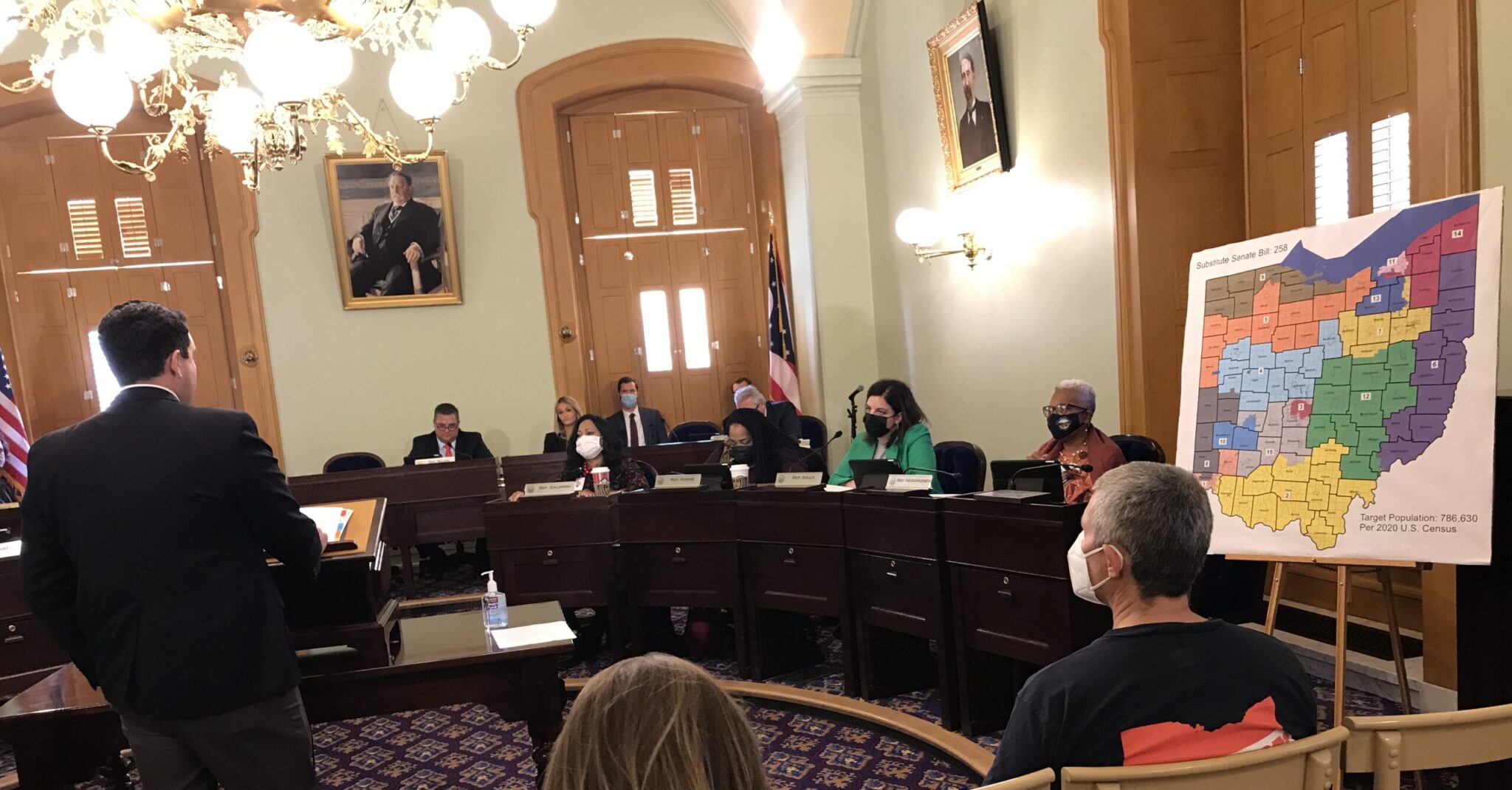
    State Sen. Rob McColley, R-Napoleon, presents congressional redistricting maps to the House Government Oversight Committee on November 17. (Photo: Susan Tebben, OCJ)

    BY: SUSAN TEBBEN –  Ohio Capital Journal

    This week the process begins again of trying to draw congressional districting lines in Ohio.

    The Ohio Supreme Court started its year sending the state legislature back to the drawing board on congressional redistricting, after rejecting the map passed in November by the GOP supermajority.

    With a one-week timeline for the legislature to come up with a plan, committees are convening with that specific purpose.

    Starting Tuesday morning in the Ohio House’s Government Oversight Committee, representatives will hear about House Bill 479, a bill led by state Rep. Scott Oelslager, R-North Canton, which is up for a possible substitution, meaning it could include the new House proposal for congressional districts.

    That bill was the vehicle for the House’s proposal last time around, but it was overtaken by the GOP’s Senate Bill 258, which was quickly adopted by the legislature as the official redistricting plan.

    The same day the House considers its own redistricting effort, the Senate General Government Budget Committee will be looking at Senate Bill 286, state Sen. Rob McColley’s bill for congressional redistricting.

    McColley, R-Napoleon, was the lead on SB 258, the map that would eventually be rejected as unconstitutional by the state’s high court.

    The senate committee accepted testimony on the bill for its first hearing on Tuesday, and a possible vote is indicated for Wednesday’s meeting of the General Government Committee. No testimony or vote is indicated for the House Bill, and the committee is not set to meet again this week.

    If either of the bills pass through committee, it would move on for a full House and/or Senate vote. Both chambers are scheduled to have sessions on Wednesday, with the House set to meet at 1 p.m. and the Senate to meet at 1:30 p.m.

    The House has an “if-needed” session on the calendar for 1 p.m. on Thursday, which could mean the Senate will pass a redistricting plan on Wednesday and send it to the House for agreement on Thursday.

    The legislature has until Feb. 13 to pass a plan. In order for the plan to take effect for 10 years, bipartisan support is needed, which would have to include 33% of Democrats in both the House and Senate. If the legislature can’t get bipartisan support, the map would be in place for four years, pending supreme court approval.

    A new plan from the legislature would have to have an emergency clause attached to it in order to take effect before the May 30 primary. Typically, without an emergency clause, a bill passed by the General Assembly goes into effect 90 days after the governor signs it.

    If the legislature doesn’t bring a plan to a vote by the deadline, the process heads back to the Ohio Redistricting Commission, who would have another 30 days to come up with a plan.

    The ORC just finished revising legislative maps, which were once again invalidated in a Monday ruling by the supreme court.

    The 4-3 decision by the court found the revised maps had similar violations as the original maps, with the court still finding issues with the revised maps in terms of partisan favoritism.

    The ORC now has until February 17 to revise the legislative maps for a third time.

  • Ohio Supreme Court allows Dems’ redistricting objection

    Ohio Supreme Court allows Dems’ redistricting objection

    Attorney Phillip Strach speaks before the Ohio Supreme Court, arguing for the constitutionality of legislative district maps. The court heard arguments on three cases asking it to reject the maps approved in September. (Photo: Susan Tebben, OCJ)

    BY: SUSAN TEBBEN – Ohio Capital Journal

    The Ohio Supreme Court has rejected a request by the state’s Attorney General to reduce Democratic redistricting leaders’ court filing to a “friends of the court” brief.

    In a short ruling released Friday evening, the court denied a motion to convert the brief, filed by Ohio Redistricting Commission co-chair state Sen. Vernon Sykes, D-Akron, and House Minority Leader and commission member Allison Russo, D-Upper Arlington.

    Russo and Sykes filed the objection to the newest legislative redistricting maps without an attorney, which they said was the fault of Attorney General Dave Yost. The Democrats say he refused to allow them to consult attorneys for the Ice Miller law firm.

    Yost asked that the brief be considered amicus of “friend of the court” brief rather than an official response by state officials. “Friend of the court” briefs are typically filed by non-parties in lawsuits, who want to provide the court input but aren’t necessarily connected to the case.

    The ruling by the supreme court did grant Yost’s motion for “limited intervention” in the case, meaning he maintains his position as a legal representative for all state officials in the lawsuits. Yost told the court the limited intervention was needed “to protect his powers as Chief Law Officer of the State of Ohio.”

    He said Russo and Sykes are being sued in their official capacities, therefore filing court documents saying they don’t have an attorney undermines his authority.

    Russo and Sykes are both mentioned in the lawsuit as members of the Ohio Redistricting Commission, along with Governor Mike DeWine, Senate President Matt Huffman, House Speaker (and commission co-chair) Bob Cupp, Secretary of State Frank LaRose and Auditor Keith Faber.

    Chief Justice Maureen O’Connor was the only justice to differ from the majority in the ruling. O’Connor, it was noted, would have denied the motion for Yost to intervene in addition to denying the conversion of the Democratic brief.

    Russo released a statement saying she was “relieved to see that a fair process is continuing in the courts.”

    “Now, we wait the Court’s decision on the submitted maps and let the process play out with greater transparency,” Russo said in the statement.

    The Ohio Redistricting Commission revised the legislative maps with a 5-2 vote along party lines in January after the court sent them back to the drawing board, calling their original plan unconstitutional.

    Republicans commission members responded to objections made by the League of Women Voters, the Ohio Organizing Collaborative and a group of Ohio residents. They said they made appropriate attempts to get to the court’s desired 54% GOP to 46% Dem split, based on statewide voter preferences for the last 10 years.

    The maps sent back to the court have a 57-42 split.