Tag: march ballot

  • Upcoming Loveland City Schools Levy and Ohio School Funding

    Upcoming Loveland City Schools Levy and Ohio School Funding

    by Dr. Gregg Tracy

    The current system and laws in regard to funding schools in Ohio are flawed. The funding system overemphasizes real estate taxes and creates inequality in educational funding across the state. The system has been declared unconstitutional multiple times by the Ohio Supreme Court, most recently in 2002. However, due to inaction by the administrative and legislative branches, the funding system remains law. So school systems, like Loveland, that do not have large commercial and industrial bases, must rely heavily on local, individual real estate taxes in order to operate. Voters are faced with the choice of voting for higher taxes or not providing our public schools with the funds necessary to operate effectively. Our schools simply cannot be effective in preparing current and future students without the essential funds to operate.

    Dr. Gregg Tracy is a Loveland resident and property owner, a Loveland High School Graduate, a retired professor of leadership, and former school administrator.

    Even as assessed property values increase, no new monies are generated for schools. Thus operating funds are fixed while operating costs increase. New levies are regularly and periodically necessary. It is a reality in Ohio. Excellent schools depend on good administration, teaching, and community participation, but schools just cannot perform effectively without periodic tax levies.

    Loveland’s consistent excellence will continue to benefit students and the community.

    It is easy to say, “I do not want to pay more taxes.” It is equally as easy to come up with justifications for voting “no.” Historically, voting against operating levies has not been a strategy that has facilitated any positive change. It is a weak substitute for dialogue and cooperative participation in a meaningful process aimed at changing and improving schools. Without necessary funds, schools cannot operate effectively, let alone have opportunities to change and improve. With needed funds, Loveland’s consistent excellence will continue to benefit students and the community.  Loveland’s board and administration, have established a number of ways to learn, cooperate and participate in the school improvement process.  Administration is accessible, public meetings have been held and will continue, printed materials have been sent regularly, and  online communications are available. The leadership team has been very clear about the district’s needs and financial status.

    They are simply asking for operating funds to continue the quality education that Loveland has been providing over time.

    As our school board asks for additional operating funds in March, they are not asking for money for building or adding programs. They are simply asking for operating funds to continue the quality education that Loveland has been providing over time. The board has committed to keeping expense growth to less than 3% through fiscal year 2024. As a concerned citizen, I encourage you to make an informed decision in March based on an understanding of the need based on Ohio’s funding system and the recognition of the importance of your vote for our community. Public schools are one of our community’s vital organizations. As you make your decision in March, I hope you have gone directly to the source and not relied on hearsay and negative campaigns. I hope that you have directly accessed information sources made available by the district’s leadership team. I also hope that you consider our students and the short term and long term effects of your vote. Summarily, I hope you cast a concerned and informed vote on March 17.


  • Loveland School Budget Cuts – Responsible Management?

    Loveland School Budget Cuts – Responsible Management?

    Kim and Rick Donaldson live on Paxton Road in Miami Township

    by Kim and Rick Donaldson

    At its February 18th business meeting, the Loveland City School District Board of Education reviewed the administration’s updated five-year financial forecast, which includes annual operating expenditure cuts averaging $2.5 million and fee increases averaging $0.2 million.* The updated forecast still requires passage of a 6.95 mill operating levy, which will raise annual revenue by $6.3 million, to maintain an adequate cash balance through fiscal year 2024. Indeed, the included budget cuts were made for the express purpose of limiting the levy to only 6.95 mills. So, after cutting $2.5 million from expenditures, why do we need an additional $6.5 million (taxes plus fees) in revenue? Let’s look at the numbers.

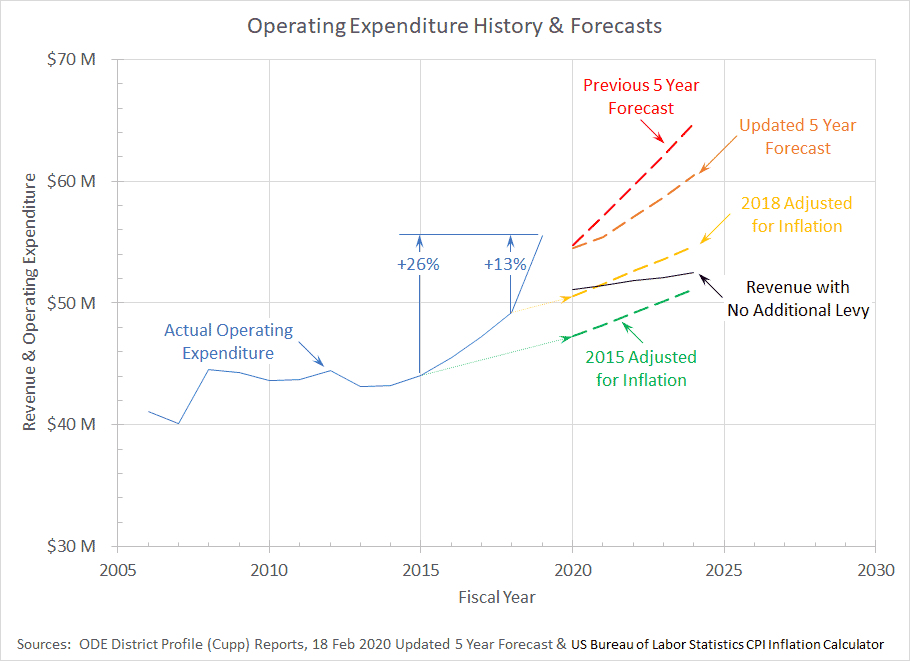
    This graphic is the Donaldson’s original presentation of the data sourced from the Ohio Department of Education and the US Bureau of Labor Statistics as noted on the chart and in the list of references.

    As shown in the included chart, both five-year forecasts start from a very high baseline expenditure level established in 2019 when operating expenditures increased 13% from the previous year.** That increase was the culmination of an accelerated spending trend that started in 2015, bringing the total four-year increase to 26%. By comparison, the cumulative inflation rate was only 7.7% during the same period.*** This rapid expenditure increase quickly overtook the 23% annual revenue increase in the years following the 2014 levy.

    Since median income tends to be tied, albeit loosely, to inflation, expenditure increases that exceed the inflation rate make our schools increasingly less affordable to taxpayers.

    Furthermore, it is important to recognize that the spending cuts and fee increases included in the updated forecast are all relative to the previous forecast, which anticipated increasing expenditures by 4% annually. Since the Federal Reserve Board targets a 2% annual inflation rate, the plan was to increase spending by twice the rate of inflation. The updated forecast anticipates annual increases of 3%, which is still 50% above the target inflation rate. Since median income tends to be tied, albeit loosely, to inflation, expenditure increases that exceed the inflation rate make our schools increasingly less affordable to taxpayers.

    As a more affordable alternative, we advocate limiting operating expenditures to 2015 levels on a per student basis, adjusted for inflation.  As shown on the chart, this approach would result in spending much lower than the updated five-year forecast and, more importantly, lower than current projected revenue. It would thus obviate the need for any additional operating levy. It is worth noting that this would be consistent with, and a continuation of, expenditure trends from 2006 through 2015.

    If a 2015 baseline seems too aggressive, the same approach using a 2018 baseline could be considered. Although it would require an additional levy, the levy vote could be postponed to November 2021 and would only need to be around 1 mill to maintain the same cash balance as in the updated forecast.

    These particular cuts, chosen by the administration, raise some serious questions.

    So, what would we cut? After all, in the same February 18th presentation we were told that we will have to eliminate teaching and staff positions even if we approve the levy in March. We have also been warned that failure to pass the levy in March will result in additional cuts, including staff, teachers and high school transportation. These particular cuts, chosen by the administration, raise some serious questions. If we could afford current staffing levels in 2018, why can we not afford them in 2021 with nearly 13% higher expenditures in the updated forecast?****  Even if we choose to defeat the levy and limit expenditures to inflation-adjusted 2018 levels, why could we not continue to support essentially the same staff and transportation that we did in 2018? Where is the additional money going, and why has the administration chosen to cut staff and transportation?

    Before we head to the polls in March, we need to have satisfactory answers to these questions that are quantitative, complete and transparent. We need to know whether the proposed budget and associated cuts are indicative of fiscally responsible management for the benefit of our children, or emotional manipulation designed to get the levy passed.  Ultimately, it comes down to a question of trust.

    References:

    *5 Year Forecast Update from 18 February 2020 Board Meeting:  https://go.boarddocs.com/oh/love/Board.nsf/files/BLY4FG0B571B/$file/5%20Year%20Forecast%20Presentation.pdf

    **Ohio Department of Education District Profile (Cupp) Reports:  http://education.ohio.gov/Topics/Finance-and-Funding/School-Payment-Reports/District-Profile-Reports

    ***US Bureau of Labor Statistics CPI Inflation Calculator:
    https://www.bls.gov/data/inflation_calculator.htm 

    ****Ohio Department of Education District Teacher Information:  https://reportcard.education.ohio.gov/download

  • Our youngest Loveland Tigers know these three words well

    Our youngest Loveland Tigers know these three words well

    by Kathryn Lorenz

    Our youngest Loveland Tigers know these three words well. Here in Loveland schools, we care for each other. We respect each other. And we take responsibility for our words and actions. 

    The Loveland Board of Education strives to do our best to live up to the expectations our teachers and staff have for our students. We care about each and every member of our school community and demonstrate that with leadership and fiscal responsibility. That care means we regularly need to place tax levies on the ballot in order to ensure the operation of programs that our students need and deserve. 

    The way taxes work in Ohio means that a school board respects the right of our district citizens to vote on these levies. We need to show the necessity for new operating funds and do so with the publishing of budgets, expenditures, and five-year forecasts. We publish the evidence of the success of our students as well.

    The last operating levy passed in 2014 was designed to move the district from a “stay put” mode of operation to a time of forward progress and was strongly supported by our community. Our teachers and students delivered significant achievements as a result of that change in direction and now we need to protect that investment and optimize that effort.

    Acting responsibly means telling the truth and sometimes means that you cannot respond in kind when false, harmful accusations are made.

    Acting responsibly means telling the truth and sometimes means that you cannot respond in kind when false, harmful accusations are made. But responsible public servants also stand up for what is true. There are many false statements being made about the March 2020 levy, about the Board of Education, and about the people who work with us and for us. The Loveland school district and this Board of Education are committed to optimizing resources, to extending the adequacy of 2020 levy funds as long as possible, and to continuing progress for Loveland students. 

    Please take the time to review the information on our website, lovelandschools.org under the levy tab. Take the time to talk to our board and our administrators. Attend a board meeting or an information session.  Get the right information right now. 

    We know our community cares about our schools. We respect the right of our citizens to vote on March 17. Each of us has a great responsibility for the future of Loveland schools. 

    Kathryn Lorenz is the President of the Loveland Board of Education and lives in Miami Township