Tag: Mask mandates

  • Ohio cities revive mask mandates as new state law stops health departments

    Ohio cities revive mask mandates as new state law stops health departments

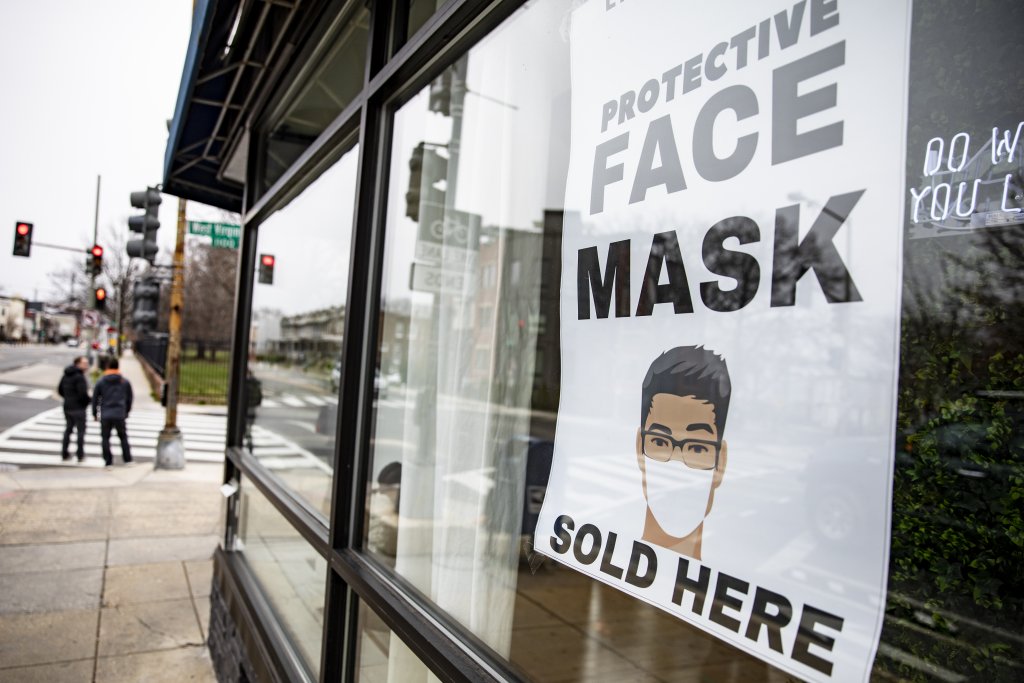
    A sign advertising protective face masks is taped in the window of a coronavirus pop-up store. Photo by Samuel Corum | Getty Images.

    BY: JAKE ZUCKERMAN and Ohio Capital Journal – AUGUST 19, 2021 1:00 AM


    First the Mount Vernon City School District opted against requiring masks for students.

    Then Gambier, a small village of 2,400, mandated masks indoors in town — where one of the district’s elementary schools happens to exist.

    Finally, the sheriff said neither he nor his deputies would enforce the law.

    It’s August 2021 and the mask wars are back — if they ever left.

    Hospital rolls are once again swelling, a trend attributed to the hyper-transmissible delta variant of COVID-19 running amok through unvaccinated communities. Less than 51% of Ohioans are vaccinated, and doses are not yet authorized for use on those 11 and younger — most of whom are returning for a new school year in the coming weeks.
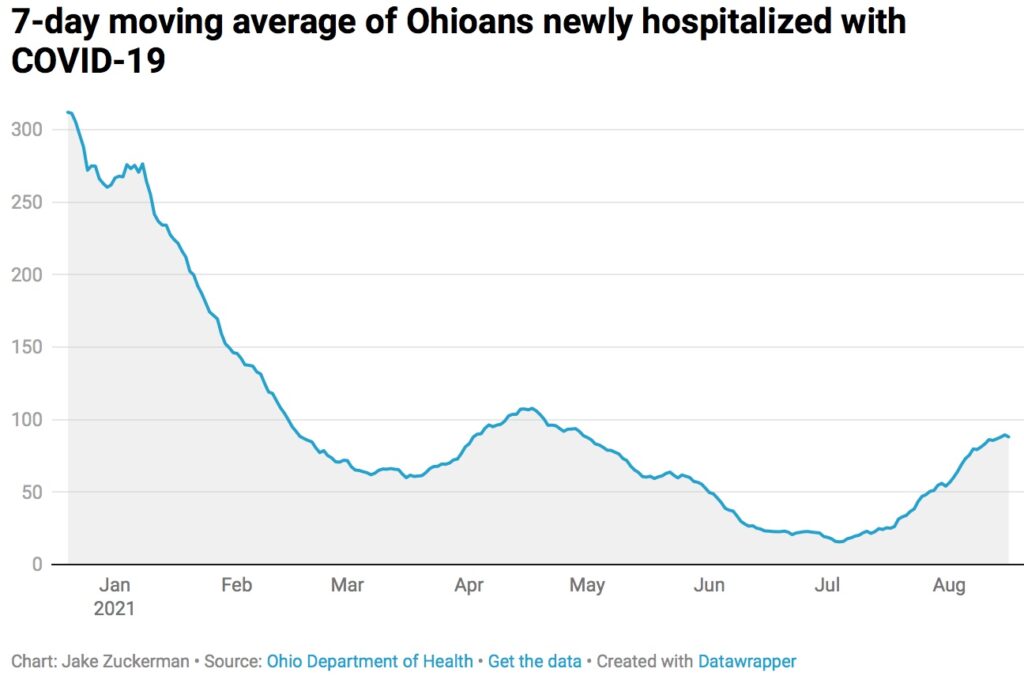
    As such, a handful of Ohio city councils — not health departments — are reinstituting mask mandates. State lawmakers passed legislation this past spring that guts the powers of state and local public health departments to issue orders like mask mandates, but city officials believe they still maintain the power to do so.

    The legislation, Senate Bill 22, says that any health order from a county board of health that applies to a “class of persons” is “invalid and has no legal effect.” It offers more restrictions on county board of health orders, but makes no mention of local governments.

    “From our perspective, we would not have gone forward with this if we thought it was not defensible in court,” said Gambier Mayor Leeman Kessler.

    Gambier is in Knox County, where the vaccination rate (less than 38%) sags far behind the state level. It’s a dot of liberal politics in a deep red county. If Kessler is correct on the legality of the ordinance, the politics are another question entirely.

    The Knox County Sheriff’s Office, which Kessler said is solely responsible for police work in Gambier, wrote on Facebook it would not enforce the ordinance and will “not put deputies in this situation.” Sheriff David Shaffer did not return a phone call.

    “If this mandate keeps our village safe, keeps our schools safer than they would have been without, then yes,” Kessler said when asked if the ordinance would be worth the blowback. “If we’ve gone through all of this for nothing, it’s hard to say. But based on the science and recommendations from all the professional health organizations … this is the course of action that is most recommended.”

    Mount Vernon City School District Superintendent William Seder Jr. sent a letter to parents Wednesday night stating Wiggin Street Elementary would follow the ordinance and calling for patience from those opposed to it.

    “While there is a time and a place to continue these conversations, we simply request that this not take place at the schoolhouse steps,” he said. “We respectfully ask that we not put our students in the middle of adult conversations and differences.”

    In Athens, another blue city in a generally red area of the state, the city council passed an indoor mask mandate of its own, as The Athens NEWS first reported. City law director Lisa Eliason, in an interview with the Ohio Capital Journal, said the city built its policy around the recommendation of its local health department.

    She said she carefully read Senate Bill 22 — which basically allows lawmakers to veto orders from the state health department, and blocks blanket orders from local health departments — and doesn’t believe it precludes Athens from its ordinance.

    The ordinance is legal, she said, and makes sense from a public health perspective given the number of unvaccinated students (only 44% of 20-29 year-olds are vaccinated) soon to flood Athens and its crowded bar district.

    “You still have Home Rule authority from the Ohio Constitution in matters of health and safety,” she said. “That’s what Athens is relying on.”

    Other cities have joined in. Yellow Springs, a small village near Dayton, imposed a mask mandate at an Aug. 9 council meeting. The city fire chief and police chief both backed the proposal at a council meeting.

    Oxford considered a mask mandate at its city council meeting Tuesday evening, but could not pass it at the time due to absent members. One absent member, Chantel Raghu, was out tending to his parents, both of whom were hospitalized with COVID-19, according to a letter read on his behalf at the meeting.

    “If my parents were not both struggling with COVID, I would be at home, in the meeting, making the commonsense vote yes to keep our community safe by indoor masking,” he wrote.

    The towns are correct in that Senate Bill 22 still allows them to pass mask mandates through their city legislative bodies — the law only applies to their departments of health, according to Micah Berman, a professor of public health law at Ohio State University.

    “Extending that limitation to city councils, depending on how it was written, might well violate the Home Rule amendment of the Ohio Constitution,” he said.

    “But health departments are creations of state law, so their authority can be more easily limited by the legislature.”

    Last summer, Ohio cities started to impose a patchwork of mandates around the state, eventually mounting enough political pressure on (or political cover over) Gov. Mike DeWine to impose a statewide mask mandate.

    It’s too early to tell if the cities are trendsetting once again, or if the mandates remain confined to the modest list seen thus far, according to Keary McCarthy, executive director of the Ohio Mayor’s Alliance. He offered a more lukewarm take on whether cities can impose mandates.

    “I think that is certainly something that is open to interpretation,” he said. “What was prescribed in [SB] 22 wasn’t exactly crystal clear.”

    Cities harbor dense populations of people — ideal conditions for a communicable disease. Similarly, they stand to lose huge dollars in tax revenue if COVID-19 spread forces businesses to keep their workers remote and out of reach from taxation of the former site of work, he said.

    “Obviously, the delta variant is concerning, and the transmissible nature of it is concerning, and local leaders are going to do what they think is right to protect the health and well-being of their communities,” he said.


  • Loveland School Board: A homework Assignment

    Loveland School Board: A homework Assignment

    COMMENTARY

    David Miller is the Publisher and Editor of Loveland Magazine

    By David Miller

    Dear Loveland School Board.

    Given that COVID infections caused by the now predominant delta variant are likely to go undetected and children attending school with what appears to be a mild cold, what measures, if any, do you propose to use to prevent the spread of COVID-19 throughout the Tiger school community?

    The predominant delta variant is much more contagious than the version of COVID-19 Loveland school children faced last year.

    Here is a list of things to consider and do before your meeting on Tuesday, August 10 – eight days before classes begin for the school year. I have provided the resource materials below that you will need to complete your assignment.

    You know this but does it bear repeating? Loveland students eleven years old and younger cannot currently receive any benefit a vaccination will provide.

    Only approximately 18% of our students who are eligible for a vaccine are fully vaccinated.

    The tracking system of the Centers for Disease Control and Prevention (CDC) has now moved Clermont and Warren Counties to the highest level of warning for the transmission of COVID 19. Hamilton County remains in the “Substantial” range.

    There will be no remote learning opportunities (Remote Academy) for Loveland teachers or students as all school buildings will return to full capacity in-person classes in August. Find out how many more students will be attending each building and riding buses as classes begin.

    Find out how many students, staff, and teachers became infected and how many were quarantined last school year when there were far fewer persons in the buildings and on buses than there will be this year.

    Review the comprehensive study ($66K “Pandemic Preparedness and Planning” services) that you purchased before school began last year. Review which of the recommended COVID protocols were implemented and whether or not you are going to abandon them as school starts on August 18.

    Your current policy states that you will follow any “mandates” of a list of what you call your “Directing Entities”. Since none of these “Directing Entities” have mandated protocols and nothing in current Ohio law prevents you from adopting any recommendation you choose – review their recommendations and choose one.

    Below is a list of what your “Directing Entities” are currently recommending for K-12 schools.

    Also, below for your review, are the recommendations contained in the $66,000 report you purchased.

    With all due respect, none of you or your staff are smarter or have any greater insight as to what is the best way to start this school year than the medical and scientific community of your Directing Entities.

    And, with all due respect to the parents of the District, “parental choice” of your child wearing a mask or not – is not your decision to make. You can be the loudest voice in the classroom of social media, but just as the elected Board of this District relies on known experts to decide which textbooks teachers use or what is served in the cafeteria – providing a healthy classroom is in their job description.

    Board, please follow the latest advice from the health experts, your “Directing Entities” and from your own “consultant experts” that you hired in 2020.

    Let’s get back to school. Let’s do so in a way that fully protects our children, teachers, and our friends that work as District staff. Don’t allow any of them to be put in the potentially lethal classroom petri dish experiment of this new delta variant.


    Ohio Department of Health Releases Updated K-12 School Guidance

    Loveland Magazine –  Jul 28, 2021

    COVID-19 Guidance for Safe Schools from American Academy of Pediatrics

    Loveland Magazine –  Jul 28, 2021

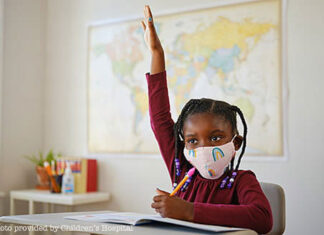
    Cincinnati Children’s recommends all children wear masks at school

    Loveland Magazine –  Jul 28, 2021

    Centers for Disease Control issues new guidance for return to school

    Loveland Magazine –  Jul 28, 2021

    Ohio Department of Health Releases Updated K-12 School Guidance

    Loveland Magazine –  Jul 28, 2021

    Hamilton County Public Health responds to request for back to school…

    Loveland Magazine –  Jul 29, 2021


    School Board gives go-ahead for $66K “Pandemic Preparedness and Planning” services

    “Pandemic Preparedness and Planning” report for Loveland Early Childhood Center

    Nov 9, 2020

    “Pandemic Preparedness and Planning” report for Loveland High School

    Nov 9, 2020

    “Pandemic Preparedness and Planning” report for Loveland Middle School

    Nov 2, 2020

    “Pandemic Preparedness and Planning” reports for Loveland Intermediate School

  • OHSAA Announces Suspension of all Contact-Sport Scrimmages

    OHSAA Announces Suspension of all Contact-Sport Scrimmages

    by Cassie Mattia

    Loveland, Ohio – With Ohio High School 2020-2021 sports seasons set to start on August 1st, coaches, parents, fans, and student-athletes are wondering when school vs. school competition will be allowed to resume. That particular question was answered on Tuesday when the OHSAA sent out a newsletter confirming that for the time being all contact-sport school vs. school scrimmages will be suspended.

    The OHSAA’s Interim Executive Director, Bob Goldring, stated in the newsletter that the goal is to work with the Governor’s Office to make sure everything that they are implementing for the 2020-2021 sports seasons will be “in concert.”

    OHSAA’s Interim Executive Director, Bob Goldring

    “We are on track for the low/non-contact sports of golf, girls tennis and volleyball to begin practices on August 1, with school vs. school scrimmages and contests to follow per their normal OHSAA permissible dates and regulations,” Goldring said, “We are on track for the contact sports of football, soccer, field hockey and cross country to begin practices on August 1. We are waiting for more guidance from the Governor’s Office and Department of Health on when school vs. school competition can begin and are hopeful of that permission being granted for our normal contest dates later in August. To that end, school vs. school scrimmages are SUSPENDED. We do not anticipate that suspension changing soon and there remains the possibility that no scrimmages will be permitted in the contact sports of football, soccer, and field hockey. We will certainly keep you updated if that changes.”

    Goldring said that the OHSAA plans on continuing to have conversations about both field hockey and cross country being put into the low/non-contact category.

    After speaking with the Governor’s Office, Goldring explained that one thing was very clear, the end goal is to make sure Ohio’s student-athletes get the opportunity to “learn the lifelong lessons and receive the social, emotional, and physical benefits that the privilege of participating in education-based interscholastic athletics programs provide.”

    “We all have to be accountable for following all mandates and requirements. By not following the mandates and requirements, we are putting our student-athletes at risk of not only contracting and/or spreading COVID-19 but also at risk of losing the season for themselves, their families, their teammates, their schools and their communities. Mandates and requirements put into place must be followed in order for the Governor’s Office to continue to allow us to participate,” Goldring said.

    According to Goldring, the OHSAA has been working hard to finalize contest day mandates and requirements that he says will be strictly enforced.

    “Our administrators, coaches, and student-athletes will be held accountable for non-compliance. So as to not cause alarm, these mandates and requirements will be to elevate many of the recommendations that were provided in the OHSAA Return to Play Recommendations document to the level of mandates and requirements and should not require wholesale modifications to your game-day protocol,” Goldring added.

    If you missed the OHSAA Return to Play Recommendations click on the following article link we released last week: https://lovelandmagazine.com/ohsaa-releases-updated-covid-19-return-to-play-recommendations/.

    As rules and regulations change within the sports world due to COVID-19, here at Loveland Magazine we will continue to bring you the latest updates so that you and your family know what to expect if your child or someone you know is participating in Ohio High School athletics this year! Stay tuned to the Sports 411 With Me, Cassie Mattia!

  • Clermont County elevated to RED COVID 19 Alert

    Clermont County elevated to RED COVID 19 Alert

    The Public Health Advisory Alert System is a color-coded system designed to supplement existing statewide orders through a data-driven framework to assess the degree of the virus’ spread and to engage and empower individuals, businesses, communities, local governments, and others in their response and actions.

    The system consists of four levels that provide Ohioans with guidance as to the severity of the problem in the counties in which they live.  The levels are determined by seven data indicators that identify the risk level for each county and a corresponding color code to represent that risk level.

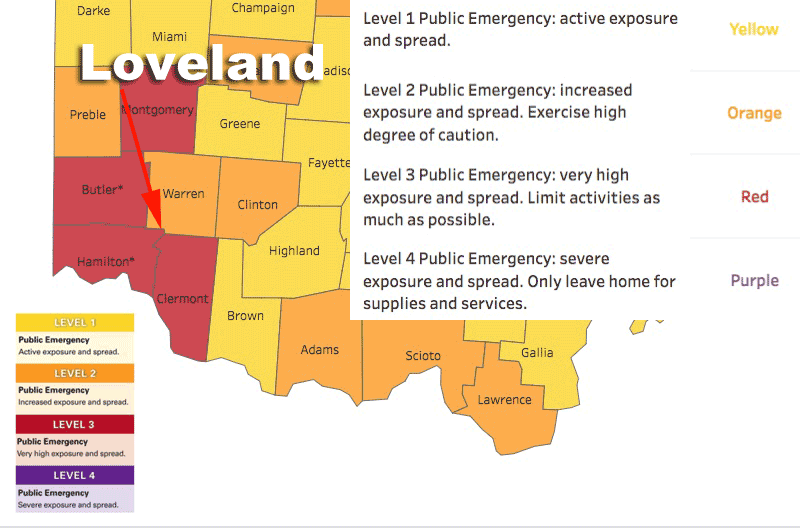
    Loveland, Ohio – Governor DeWine announced today that new public health data has led the Ohio Department of Health to designate that Clermont County is now among 12 counties as being in a Red Alert Level 3 Public Emergency as defined by the Ohio Public Health Advisory System.

    Clermont County had been in Level 2 until the announcement today.

    Hamilton County remains RED Alert Level 3 however it is on Ohio’s “Watch List” as they are approaching Purple Alert Level 4.

    Mandates for people to begin wearing masks in public in Clermont County will begin at 6 PM on Friday, July 10.

    Governor DeWine announced the creation of the Ohio Public Health Advisory System last week to provide local health departments, community leaders, and the public with data and information on the severity of the COVID-19 spread in the counties in which they live. The system consists of four levels with specific risk-level guidelines. Each level is calculated with data gathered on seven public health indicators.

    Read the Health Order

    Director’s Order for Facial Coverings in Butler, Cuyahoga, Franklin, Hamilton, Huron, Montgomery, and Trumbull Counties in Level 3 Public Health Advisory

    Those in counties designated as Red Alert Level 3 or Purple Alert Level 4 are required to wear a face covering:

      • In any indoor location that is not a residence;
      • When outdoors and unable to consistently maintain a distance of six feet or more from individuals who are not members of their household; or
      • While waiting for, riding, driving, or operating public transportation, a taxi, a private car service, or a ride-sharing vehicle.

    The order does not apply to children under the age of 10 or any other minor who cannot safely wear a face covering. The order also reflects the mask guidance in place for employees and businesses which does not require a person to wear a mask if their physician advises against it, if wearing a mask is prohibited by federal regulation, if communicating with the hearing impaired, when alone in an office or personal workspace, and other similar measures.

    Schools that offer Kindergarten through Grade 12 instruction should follow the guidelines set forth last week by the Ohio Department of Education and the Ohio Department of Health.

    The Ohio Department of Health will update county rankings every Thursday. Any county that increases to Red Alert Level 3 will automatically be included in the face-covering mandate. Any county that decreases from Red Alert Level 3 to Orange Alert Level 2 will automatically be released from the face-covering requirement.